Category Archives: Drama

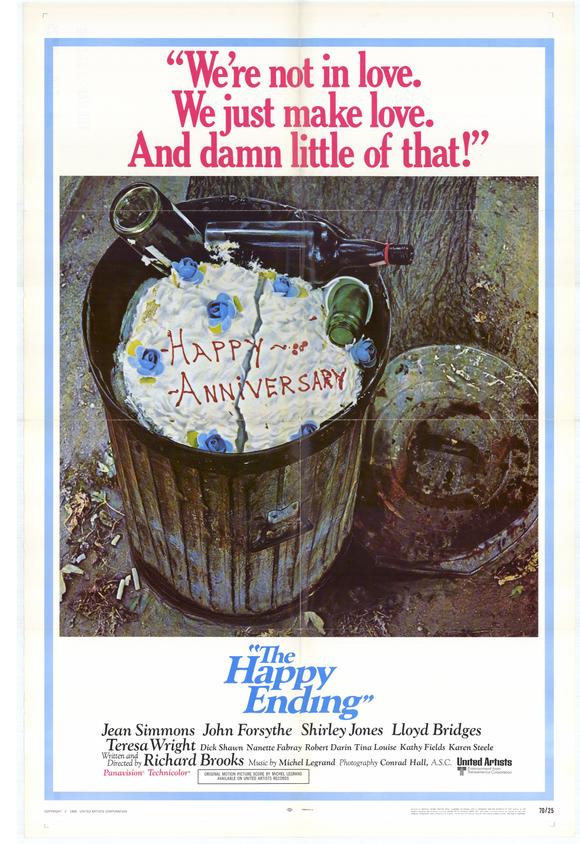
The Happy Ending (1969)

happy ending

By Richard Winters

My Rating: 4 out of 10

4-Word Review: The problems of marriage.

If there was ever a film with a misleading title it is this one. There is no happy ending here and in fact there is nothing in its entire 117 minutes that is happy as the film examines every negative and depressing thing it can think of about the institution of marriage and then rhythmically beats it into the viewer like a victim in a bar fight being pummeled by a brawler. The format works like a boring college professor lecturing endlessly about some tepid subject while tirelessly pinpointing every monotonous detail and not knowing when to stop.

The story is about Mary (Jean Simmons) who at one time was madly in-love with Fred (John Forsythe) and had extremely high ideals in regards to love and marriage when she married him. Now after fifteen years of living in a relationship that no longer has any passion she has turned into a depressed and disillusioned alcoholic looking for any way to escape the confines.

The film itself is intelligently done and well executed and makes some good hard-hitting points. The dialogue and conversations between the characters are realistic and well written and it is nice having adults acting and talking like real people. The only real issue is the question of why the filmmakers would think anyone would actually want to sit through something that is so endlessly downbeat. Sometimes these types of things work better in a satire format where they can still make the same points, but allow the viewer a few laughs as well. As it is the film is in desperate need of some levity and none is ever offered.

I also felt that film was too one-sided. I realize that there are a lot of unhappily married people out there, but there has got to be some couples that are happy with it. By never balancing it out and showing no other viewpoint makes the film come off like one long and unending rant.

Writer-director Richard Brooks infuses certain directorial touches that are novel to some extent, but heavy-handed as well. Showing clips of famous old romantic movies like It Happened One Night and Father of the Bride during Mary’s wedding is creative, but too obvious as is the segment when Mary is on a beach and a young couple asks her to take a picture of them and inside the camera’s viewfinder Brooks inserts an image of Mary and Fred when they were a young and in-love. There is also too much footage of Casablanca shown, which does nothing but make the viewer want to watch that over this dreary thing.

Simmons gives a strong performance and looks as beautiful as ever. She is also straddled with a few difficult scenes but does them well including a harrowing segment where she is rushed to an emergency room after swallowing some pills and has a hose stuffed down her throat in an attempt to vomit them out. Tina Louise is great in support as is Dick Shawn in a rare dramatic turn. Shirley Jones is also good as Mary’s jaded friend Flo and she is given some of the film’s best lines.

Forsythe is okay as the husband, but not too exciting though he never usually is. He should have had the big mole in the center of his forehead surgically removed as my eyes always seemed to fixate on it every time he was shown in a close-up. I got to admit I was amazed his character did not kill his wife on the spot when he found out that she had run up his credit card in one day on $11,421 worth of charges on clothes. This was 1969 dollars and I have no idea what astronomical figure that would be for today, but it would be beyond outrageous nonetheless. Of course he was caught fooling around, so I suppose this was her way of getting back at him and boy did she ever.

The film does have a few powerful scenes that I did like. The part where Fred defends Mary after she has run out on them and their daughter Marge (Kathy Fields) feels that her mother no longer loves her is really good as is the final conversation between Fred and Mary as well as Mary’s conversation with her mother (Teresa Wright) about the happiness of her mother’s own marriage. The moment when the very cynical Flo becomes all teary-eyed and excited when the married man that she has been fooling around with decides to divorce his wife and propose to her despite the fact that she has spent the rest of the movie considering the idea of marriage to be over-rated is savvy.

Like with the sappy and over-played Michael Legrand song ‘What Are You Doing the Rest of Your Life?’ the film goes on too long and there are just not enough good things about it to justify sitting through.

My Rating: 4 out of 10

Released: December 21, 1969

Runtime: 1Hour 57Minutes

Rated PG

Director: Richard Brooks

Studio: United Artists

Available: VHS, Amazon Instant Video, Netflix streaming

Deathwatch (1980)

deathwatch 2

By Richard Winters

My Rating: 8 out of 10

4-Word Review: Everyone watches her die.

Based on the David Compton novel this story deals with Katherine (Romy Schneider) who is living in a futuristic society where almost all diseases can be cured and death is very rare. When she is diagnosed with having a rare and incurable illness Vincent (Harry Dean Stanton) tries to get her to appear on his hit reality show ‘Deathwatch’ in which they film in documentary style a person’s slow and agonizing death, which is a huge TV hit. When Katherine tries to escape the publicity and hide from their cameras Vincent has a small camera surgically implanted into the brain of Roddy (Harvey Keitel) one of his cameramen, which then allows  Roddy to follow Katherine around and record her actions without her knowing it. The two then slowly form a relationship that culminates with tragic results.

Director Bertrand Tavernier is in top form. The movie is nicely paced and Tavernier shows a perfect grasp of the material. His use of music wonderfully accentuates the mood and tone. Filmed on-location in Scotland he captures the old buildings of the region with a stylish flair that gives the film an added personality and memorable image. Showing characters walking all alone in the seemingly abandoned streets hits home their loneliness and having the scenes done in decaying buildings and neighborhoods illustrates the decaying values and morals of the world these characters live in. The gray stormy skies brings out the pictures moodiness and the isolated shack in the middle of a vast empty field that the two hide out in captures visually the characters lost and hopeless desperation. The film becomes like an orchestral ensemble moved along by a talented conductor at the peak of his skill.

This is also a great example of using a hand-held camera sparingly and only to create a certain mood, or emotion. Too many films these days seem to have what I call ‘the shaking camera syndrome’ and it is annoying and loses the original intended effect. Here Tavernier employs it during a scene where Katherine is trying to elude the production crew and the viewer feels her frantic tension with each move that the camera makes as well as getting a great cultural feel by capturing the various street vendors along the way.

The story itself is fascinating and years ahead of its time. The issues it brings out about television, ratings, and the cutthroat ugly world of business of entertainment have never been more on-target. This film may even transcend the classic Network with its dire message and that is not easy to do. What I really liked though was the fact that the twists keep coming in layers and all of them are unexpected, but equally fascinating. The story is riveting and compelling from beginning to end.

Schneider is brilliant and beautiful as always giving another one of her impeccable performances. Her character is easily identifiable and the viewer immediately gains her sympathy. She shows an array of different emotions and traits making her a fascinating three-dimensional person. Her presence is the main ingredient that propels the film and without her none of it would have worked and her gorgeous natural smile is wonderful and manages to come on display briefly despite the ugly difficulties of her character.

Keitel is in fine form as well playing a character who finds that when one works for those who are more than willing to exploit others they themselves will eventually be exploited by them as well. Von Sydow appears near the very end and lends stature to the proceedings.

I hate to bring this up because I love the film’s visual design, but I did find it a bit odd that the story is about the hi-tech future and yet all we are shown are old buildings and other gadgets that look very much like they are from the 1980’s. The computer that Katherine works on is laughably archaic and I felt from that end they could have tried harder to create a little more of a futuristic impression. Also, the name of the network ‘NTV’ sounds a little too much like the cable network that used to show music videos.

The recent Blu-ray release from the Shout Factory is excellent and restores the film to its original runtime of 130 minutes. I highly recommend this to those who enjoy Sci-fi fare that is thought provoking and original.

My Rating: 8 out of 10

Released: January 23, 1980

Runtime: 2Hours 10Minutes

Rated PG

Director: Bertrand Tavernier

Studio: Gaumont International

Available: VHS (1Hour 57Minute Version), DVD, Blu-ray

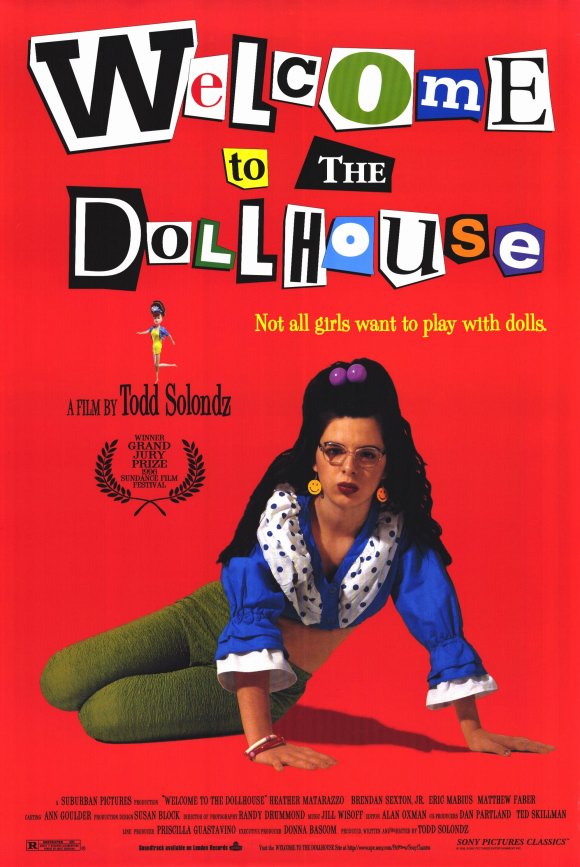
Welcome to the Dollhouse (1995)

welcome to the dollhouse

By Richard Winters

My Rating: 7 out of 10

4-Word Review: She doesn’t fit in.

Another flick about the trials and tribulations of high school life. There is the shy, sensitive, and alienated girl, the bitchy cheerleaders, the bullies, the name calling, the not being able to find a seat at lunchtime, the stupid teachers, the too busy to listen parents, the bratty siblings, and yes even the spitballs. This is a very accurate and concise portrait of Junior High. It will make you soooooooo glad that you are past that age and will never have to go back to it.

It’s the pinpoint accuracy that makes this film stand out the most. Every scene and segment ring true. Even the little stuff from the way the little sister answers the phone to the way our protagonist Dawn Wiener (Heather Matarazzo) always seems to get blamed even when it really isn’t her fault.

Although the film displays many of the ugly elements of that age it doesn’t wallow or sensationalize them. In fact this film has a nicely balanced perspective. It shows scenes from both Dawn’s high school life and family life. It weaves a nice tapestry and observes how interconnected everything really is. The family life scenes are probably more interesting and in many ways just as difficult.

The film has a good ability at bringing out all the confusion that permeates that age. It is interesting how it shows that everyone is a bit alienated and lost. A big fish can simply get eaten up by an even bigger one. For example there is Steve a good looking kid with a nice singing voice. He is ‘cool’ and when in school everything goes his way. Yet when he drops out so as to ‘make it big’ in New York he suddenly realizes how stacked the odds are against him. There is also Brandon the class bully. He is a composite of all those other bullies. At first you really dislike him, but then you witness his very sad home life. You learn to understand not only why he acts the way he does, but also begin to feel sorry for him.

The film also scores by not letting the adults off the hook either. They are in many ways very much of the problem. They suffer from their own type of confusion and have their own type of code. They lack the ability to really communicate as much as the kids do. Junior high may be a mean, ugly, and crazy place, but that is only because it is a byproduct of very mean, ugly, and crazy world.

If the film has a weak point it is with the ending that fails to give any type of closure. Of course it doesn’t have to, but it would have given it more of an impact and made it come more full circle. Yet even if it doesn’t show it we still know that Dawn will make it. There are many scenes that show her to be very resourceful and strong willed when she needs to be. She is, like a lot of us, a survivor.

My Rating: 7 out of 10

Released: September 10, 1995

Runtime: 1Hour 28Minutes

Rated R

Director: Todd Solondz

Studio: Suburban Pictures

Available: VHS, DVD, Amazon Instant Video

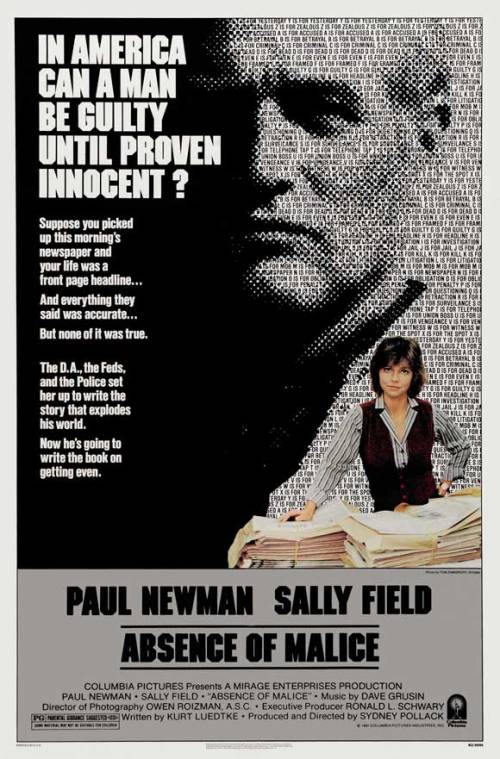
Absence of Malice (1981)

abscence of malice 2

By Richard Winters

My Rating: 6 out of 10

4-Word Review: Not fit to print.

Megan Carter (Sally Field) is a go-getter newspaper reporter who implicates innocent liquor wholesaler Mike Gallagher (Paul Newman) simply to get a big story. However, Mike proves to be quite clever and resourceful and spins a subtle, but effective line of revenge and eventually is able to expose the irresponsibility of the media.

The drama here is strong. The issues are relevant and the story is well structured. The points are hit home in a no-nonsense way while revealing how newspaper operations work and how easily they can abuse their power to the extent that it is almost horrifying.

Yet the film seems to defeat its own purpose by wrapping everything up in a much too tidy way. It is almost like saying yes we have a very serious and potentially dangerous issue here, but it can be easily contained and resolved so don’t worry about it.  Also, Mike is just a little too resourceful and slick and it becomes almost like wish-fulfillment at seeing the way he sticks it to the corrupt corporate fat-cats. An ordinary person would be destroyed by an untrue story printed about them and unable to find the money or resources to fight back and the film would have been much more hard-hitting had it taken this route instead.

I also wasn’t too crazy about the musical score. Not that the music sounded bad, but it was too upbeat while a downbeat score would have fit the mood better.

Newman has always been one of my favorite actors, but I felt he wasn’t a perfect fit here. His performance is too low-key and he doesn’t display enough anger or rage that one would expect.

Field is also miscast. Her features are too child-like and a taller woman with a few lines on her worn face would have worked better as it would have helped create the jaded persona of a character who had been is the business long enough to know what she was doing was wrong, but didn’t care.

Having Mike form a sexual relationship with Megan seemed particularly ridiculous on several levels. For one thing the graying Newman looked so much older than Field that it almost appeared like child molestation. Also, the chances of someone forming a relationship with a reporter who has just libeled him seem slim to none.

It’s the supporting cast that comes off better. John Harkins is completely on-target as the jaded corporate lawyer who toys the ethical line like it is some sort of game. Bob Balaban is memorable as a hot-shot young executive with a very interesting way of playing with rubber bands and chewing gum. Melinda Dillon is also outstanding in one of her best roles as a very emotionally fragile woman.

My Rating: 6 out of 10

Released: December 18, 1981

Runtime: 1Hour 56Minutes

Rated PG

Director: Sydney Pollack

Studio: Columbia Pictures

Available: VHS, DVD, Blu-ray, Amazon Instant Video

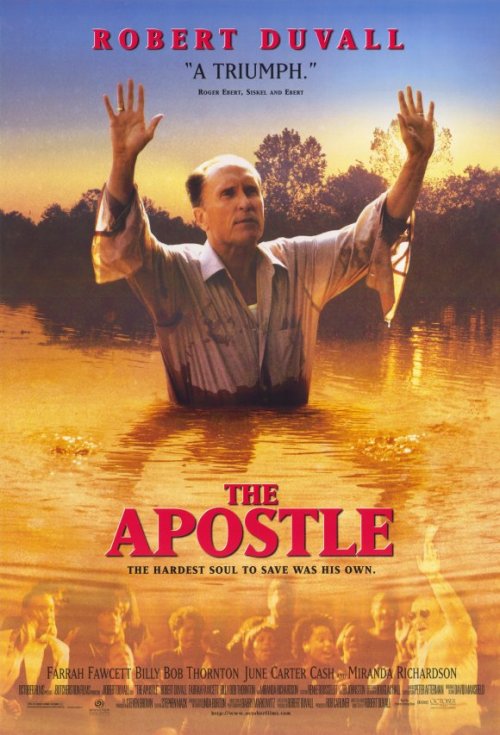
The Apostle (1997)

apostle

By Richard Winters

My Rating: 8 out of 10

4-Word Review: Preacher on the run.

As a would-be screenwriter I find it heartening knowing how many great screenplays there are out there that struggle to find a home no matter who has written or pitched it.  Actor Robert Duvall wrote the solid screenplay for this film in the 80’s only to have it rejected by every major studio and only got made when he decided to put up 4 million dollars of his own money.

The story involves a fiery evangelical minister by the name of Sonny (Duvall) whose volatile ways gets the better of him and he ends up killing his wife’s lover. He then goes on the run to Louisiana where he starts up a new church. There he begins to turn his life around and become loved and admired by the community only to have the police close in on him.

In many ways this is similar to a 1962 episode of the old ‘Alfred Hitchcock Hour’ series that was entitled ‘Bonfire’ and starred Peter Falk as the minister.  Both characters were loud and dramatic preachers.  Both men went on the run after committing homicide while continuing to start up new congregations along the way and both ended up being surrounded by the police as they gave one last fiery sermon. However, the difference comes with the fact that the Falk character was clearly a self-serving fraud while with Sonny that is not so clear, which is what makes this film and character so fascinating.

Sonny has a temper as well as other underlying issues, but he makes a genuine effort to rectify things with his new congregation.  He even brings boxes of groceries to the doorsteps of poor families. It is never clear whether he is simply trying to make personal amends for past transgressions, or just a flawed man with a good heart. The viewer is never allowed to feel sure either way, but ends up empathizing with him nonetheless. Every scene and line of utterance becomes more revealing.

Duvall gives a strong performance. I felt this may be his signature role and that comes after a long line of already brilliant performances.  I enjoyed his running ‘conversations with the Lord’ that he has when he is alone or just walking down the street.  The conversation that he has with the police is amusing as is the final scene that is shown over the closing credits.

The casting is unique.  June Carter Cash plays his mother, which is interesting by the fact that in real-life she was only two years older than Duvall.  Farrah Fawcett plays his wife, and although she was much younger than him, I felt she did a good job and made a perfect fit.  Billy Bob Thornton gets a memorable cameo as a man who initially wants to destroy the church with a bulldozer, but then with Sonny’s help becomes spiritually awakened.  I also very much liked James Beasley in the supporting role as the minister who helps Sonny start up his new church.  His calm and collected manner helped balance Duvall’s intensity.

The supporting players were all amateur actors, some of which had never performed in front of the camera before.  Director Duvall was known during filming to keep the atmosphere loose.  He allowed his cast to ad-lib, which gives the film a more authentic feel.  Just like with other actors who turned to directing, like Paul Newman and Marlon Brando, Duvall has scenes that stretch out much longer than most films.  This is done to give the actors more control over their characters and allow their performances alone to carry the scene.  I also liked the fact that the supporting cast was almost all African-American and the story centered on a white minister preaching to a black congregation.

Duvall has long been known to be an admirer of the south, so it is no surprise that the story takes place there or that the shooting was on-location.  He captures the ambience of the region and people quite well, including the sound of the heat bugs buzzing at night.

The only issue I had with the film involves the scene where Sonny kills his wife’s lover. He does this by hitting him over the head with a baseball bat during a little league game while in front of many onlookers.  In most real-life accounts when something similar to this happens people will usually gang up on the culprit and physically subdue him, or chase after him until the police arrive while here the onlookers allow Sonny to peacefully walk away.  Other than that I thought this was a great character study and I would highly recommend it.

My Rating: 8 out of 10 

Released: October 9, 1997 

Runtime: 2Hours 14Minutes 

Rated PG-13 

Director: Robert Duvall 

Studio: Butcher Run Films 

Available: VHS, DVD, Amazon Instant Video

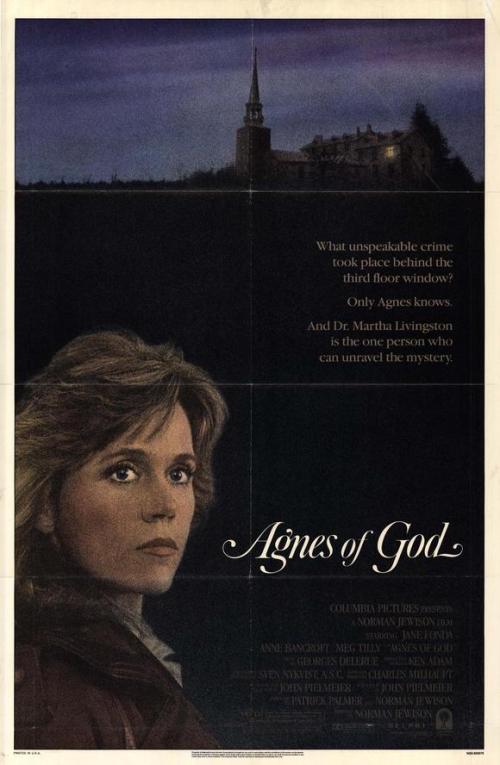
Agnes of God (1985)

Agnes of God 2

By Richard Winters

My Rating: 7 out of 10

4-Word Review: Meg Tilly is marvelos.

Sister Agnes (Meg Tilly) is a young nun found in a convent to have given birth to a baby who then dies. Martha Livingston (Jane Fonda) is the court appointed psychiatrist brought in to investigate the case, but as the investigation ensues it only seems to unearth more and more perplexing twists.

The theology is slight and the film, which is based on the Broadway play by John Pielmeier, approaches the subject matter in a very matter of fact way. It has the mindset that the majority of the viewers are non- religious or disgruntled ex-Catholics and portrays the church as a stubborn, age old institution that is slowly losing touch with our more modern sensibilities.

Yet, refreshingly, it also doesn’t try to tear down the church with every chance it gets. There is a certain level of respect and objectivity. The mother superior (Anne Bancroft) is shown to be very human and multi-faceted. She and Fonda make interesting adversaries. Their love-hate relationship is both interesting and enlightening. There is even a rare scene showing an excited young woman being inducted into the sisterhood as her proud family looks on.

Fonda, with her liberated modern woman persona, seems a very obvious choice to play the no-nonsense psychiatrist. She approaches the role with conviction, but her constant chain smoking seems affected and her emotionalism overwrought. I still say she is better suited for comedy like in Cat Ballou and Nine to Five.

Bancroft is solid as usual. Yet it’s Tilly that is really impressive. She portrays the innocence of her character with an incredible clarity and it’s almost astounding.

The mystery unravels well and keeps you intrigued. Yet the ambiguous conclusion is a bit disappointing. The drama side fares better. It poses a few good insights and ends with an interesting perspective. The film is well done on all levels even though outside of Tilly’s compelling performance there is really nothing that memorable or distinctive about it.

My Rating: 7 out of 10

Released: September 13, 1985

Runtime: 1Hour 38Minutes

Rated PG-13

Director: Norman Jewison

Studio: Columbia

Available: VHS, DVD, Amazon Instant Video

The Anniversary (1968)

anniversary 2

By Richard Winters

My Rating: 6 out of 10

4-Word Review: Bette eats them up.

Since tomorrow will mark the 1st anniversary of when this blog started I wanted to choose a movie that had a similar theme in its title. The anniversary here deals with Mrs. Taggart (Bette Davis) celebrating the date of when her and her now deceased husband where married. Taggart is a bully who enjoys manipulating her grown sons and having her way. On this occasion all three of her sons carries a secret, which will all slowly come out as the evening progresses. Terry (Jack Hedley) is the oldest and is married to Karen (Sheila Hancock) their secret is that they plan on moving to Canada much to his mother’s dismay as she likes having her children close by. Henry (James Cossins) harbors a secret fetish to dress in women’s underwear. Tom (Christian Roberts) brings his fiancée Shirley (Elaine Taylor) to visit with their secret being that she is already pregnant.

If you’re a Bette Davis fan then this is required viewing as she is at her bitchy best. Although Mona Washbourne played the role when it was on stage it was revised by Jimmy Sangster for the screen with Davis’s personality very much in mind. It has all of her famous caricatures and she revels in it. Her insults are like arrows that slice through the other characters until they are mush. She gives her part just the right amount of camp and her infatuation with a statue of a little boy that is hooked up with a hose that when squeezed spurts water out of its front end like he is peeing is priceless.

Hancock makes for a good adversary and in fact out of all the other performers she is the only that seems to be able to stay toe-to-toe with Davis. Apparently Davis did not like Hancock and tried to get her replaced with Jill Bennett. Hancock was aware of this and I think that animosity comes out perfectly on the screen.

Taylor is young and gorgeous and she has one good moment when she tells off Davis, but that is about it. The three male actors are just not as effective as the females. Part of it could be the characters that they play, but on the most part they are rather blah.

Director Roy Ward Baker, who replaced Alvin Rakoff one week into the shooting at Miss Davis’s request, does his best to avoid the filmed stage play look. He opens the movie at an outdoor construction site, which is unusual. He also has a dazzling fireworks display in the middle, but my favorite is when Henry steals women’s bras and panties from an outside clothesline and replaces them with dollar bills in an attempt to ‘pay’ for what he is stealing. Yet despite all this the movie eventually gets stagy and becomes a bit draggy for it.

My biggest complaint is the fact that this type of thing has been done before. There is no new angle or perspective to any of it. Davis rants on and on with the other characters too cowardly to fight back. The little that they do is not enough. This is the type of film that screams for a big payoff, but it never happens. Taggart, as mean as she is, comes through it pretty much unscathed and for most viewers that will probably not be satisfying.

My Rating: 6 out of 10

Released: February 7, 1968

Runtime: 1Hour 35Minutes

Rated NR (Not Rated)

Director: Roy Ward Baker

Studio: 20th Century Fox

Available: DVD

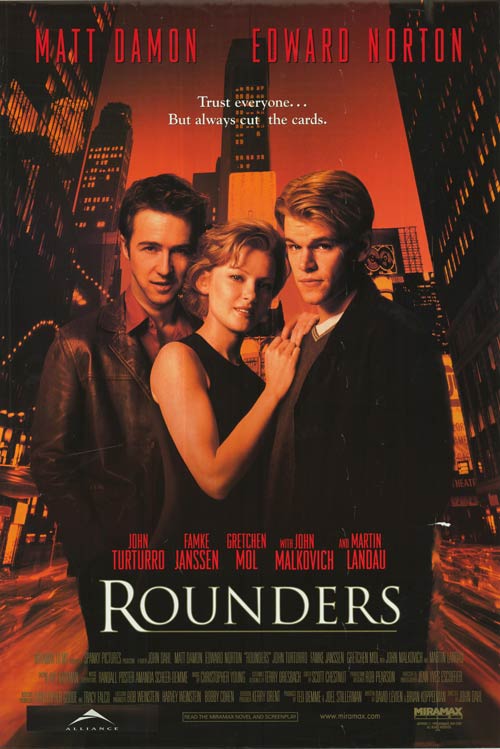
Rounders (1998)

By Richard Winters

My Rating: 3 out of 10

4-Word Review: Gambling can hurt you.

‘One does not find one’s destiny one’s destiny will find them’. This seems to be the moral of this multi-faceted character study that has all the right ingredients, but is incredibly flat.

The story involves Mike McDermott (Matt Damon) a man trying to forge a normal life with a good job as an attorney and a relationship with a pretty woman. Yet he can’t beat his urge to gamble. When his friend Lester ‘Worm’ Murphy (Edward Norton) gets released from jail he finds himself led back into his old habits and his life soon falls apart.

The film wants to take an honest look at the lifestyle of a gambler without taking any shortcuts. In most ways it does an honorable job. It takes a more technical approach to poker playing and therefore makes it more enlightening. The situations seem a bit overly-dramatized, but overall are quite believable. It definitely has insights and is well crafted.

The problem is that it never comes together. Nothing is compelling and the momentum is lacking to the point that it starts to drag. Certain ‘strong’ scenes that are meant for impact end up having no effect at all. In the end it comes off as being too obvious and having too much of a textbook type approach.

Damon has proven himself to be a solid actor, but his character here is bland and colorless. Norton, as his troubled friend, is a little more interesting, but he is trapped in a stale setting. Both men look way too boyish to be playing the parts of seasoned, hardened, ‘been there, done that’ type characters.

John Malkovich is on hand to give an offbeat performance as a Russian born card player complete with a thick Russian accent. At first this is fun, but he ends up overdoing it and eventually makes it too campy. John Turturro gives an amazingly restrained performance, which could be of interest too his followers.

The one scene that really caps this off as being a bad movie for me is when Norton and Damon are caught cheating while playing amongst a large group of off-duty policemen. The police all gang up on them and pummel them in a way that should produce severe life threatening injuries. Instead they are thrown out of the building with not even a strand of their hair being out of place. They have a few streaks of red on their faces that is supposed to be blood, but it looks like paint put on by a paintbrush. Damon goes through the rest of the film with a slightly darkened eye and two scratches around his nose. Everyone comments that he looks like he “got it bad” when I’ve seen third graders with worse looking injuries after a playground fight.

My Rating: 3 out of 10

Released: September 11, 1998

Runtime: 2Hours 1Minute

Rated R

Director: John Dahl

Studio: Miramax

Available: DVD, Blu-ray

Red Dawn (1984)

By Richard Winters

My Rating: 5 out of 10

4-Word Review: Fight for your country.

Due to the recent release of the remake of this film I decided it would be a good time to review the original.  One thing that has always surprised me about this movie is the fact that out of all the 80’s movies out there why this one would remain such a perennial hit to the point of remaking it even though the cold war has technically long been over has always been a bit of a mystery. I know the ladies at my office are young and don’t know many old movies, but for whatever reason they are familiar with this one, which kind of compelled to check it out.

I remember when the film came out many liberals complained that this could never happen and tried to boycott it much like they did with the ‘Amerika’ mini-series that came out a few years later and dealt with the same plot. My position on the matter remains the same, which is freedom of speech comes first and if someone wants to make a movie about a Soviet invasion more power to them and if they want to make a movie about Sweden invading us then they can do that too.

Now with that said I still felt it seemed farfetched. The explanation for how the Soviets were able to invade us so very easily and quickly is spotty, but I guess if you are going to enjoy the film then you’re going to have to overlook it.

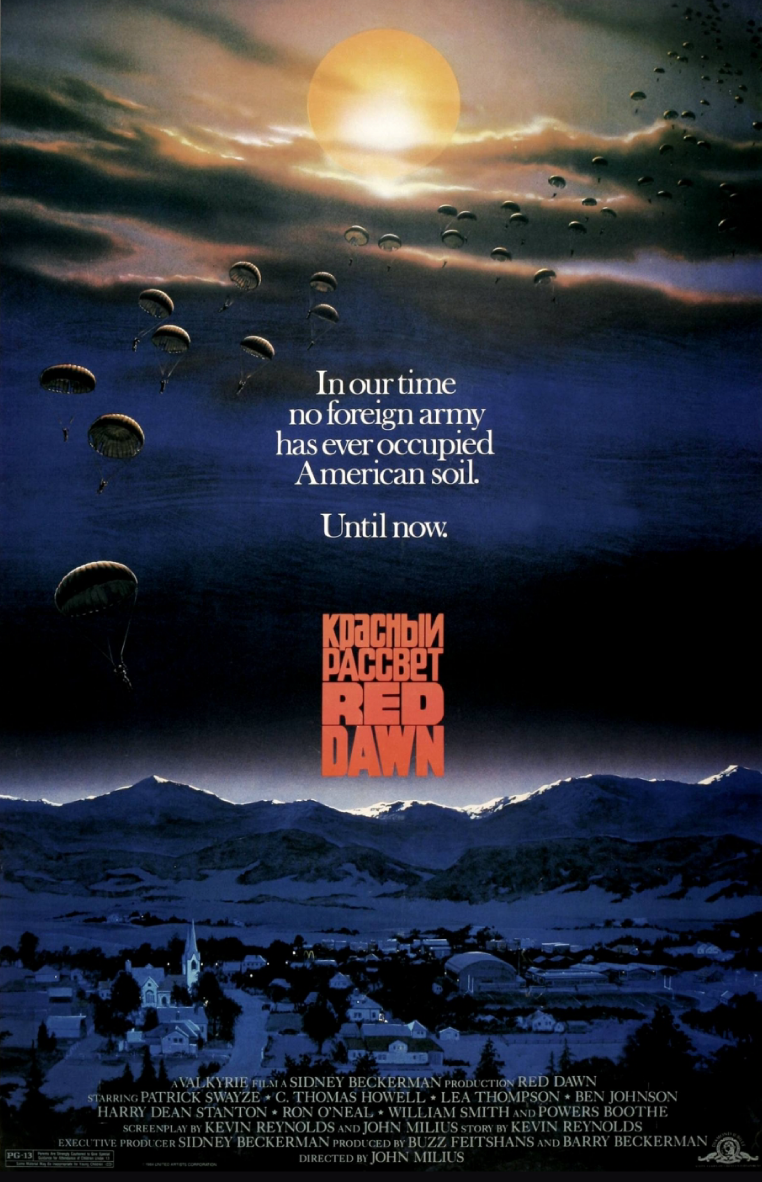
The plot consists of soviet troops parachuting out of the sky and shooting up a classroom before taking over the rest of the small Colorado town. A group of teens manage to escape and hide out in the nearby mountains. Eventually they start to wage guerrilla warfare against the invading troops and name themselves the ‘Wolverines’.

I liked the way the teens are portrayed. They are not just a bunch of spoiled, superficial suburban kids concerned with being hip and trendy and talking in some irritating slang. Instead they seem very much like young men growing into being real men. The fact that there are a few casualties and that they change and become hardened by what they go through makes it all the more authentic. I also liked that the two young women they pick up along the way end up fighting and shooting up the bad guys just as well as the males.

Patrick Swayze does a terrific job as the group’s leader. He makes a strong presence and I wished the movie had focused more on him. It is fun seeing Charlie Sheen looking very boyish and older actor Harry Dean Stanton has a good bit as the father of one of the boys who is now imprisoned in a labor camp and instructing them on how to toughen up.

My favorite performance though was Lea Thompson. She is real young and cute. I loved her volatile temper, her willingness to use a rifle without hesitation, and her infatuation with Andy Tanner (Powers Boothe) a much older man who joins them.

I liked that the point-of-view is exclusively with the kids. There is no attempt to show things from the Communist side, or even try to humanize them at least not until the very, very end. They are portrayed as monstrous and evil lining up civilians and savagely shooting them. If there is anything that can resonate with the masses it is emotionalism and this film keys in on it well and I think that is why it has remained a hit. It becomes like a David and Goliath story with the teens showing up the evil empire and disrupting their plans. I found myself rooting for them even though I kept wondering how they were able to find all that ammunition that they use as well as the warheads.

Action wise it is pretty good. It starts from the very beginning and doesn’t let up. In fact this film was in The Guinness Book of World Records at the time for having the most violent acts of any movie. The film averages 134 violent acts per hour and 2.23 per minute. I enjoyed that the special effects are all real and none of this computerized crap like you see today, which to me still looks phony and makes movies seem too much like a video game.

After about the first hour the movie started to drag and I kept looking at my watch wondering when it would be over. The ending had some satisfying elements as they attack the building housing all the leaders of the invasion, but it is not enough. If you take away the novelty of the Communist invasion then this thing is really just a standard action flick that is no better or worse than the thousands of others out there. The only reason to watch this is to compare it to the remake, or vice-versa.

My Rating: 5 out of 10

Released: August 10, 1984

Runtime: 1Hour 53Minutes

Rated PG-13 (The First movie ever to have this rating)

Director: John Milius

Studio: MGM/UA

Available: VHS, DVD, Blu-ray, Amazon Instant Video

The Roman Spring of Mrs. Stone (1961)

By Richard Winters

My Rating: 6 out of 10

4-Word Review: Throw keys to transient.

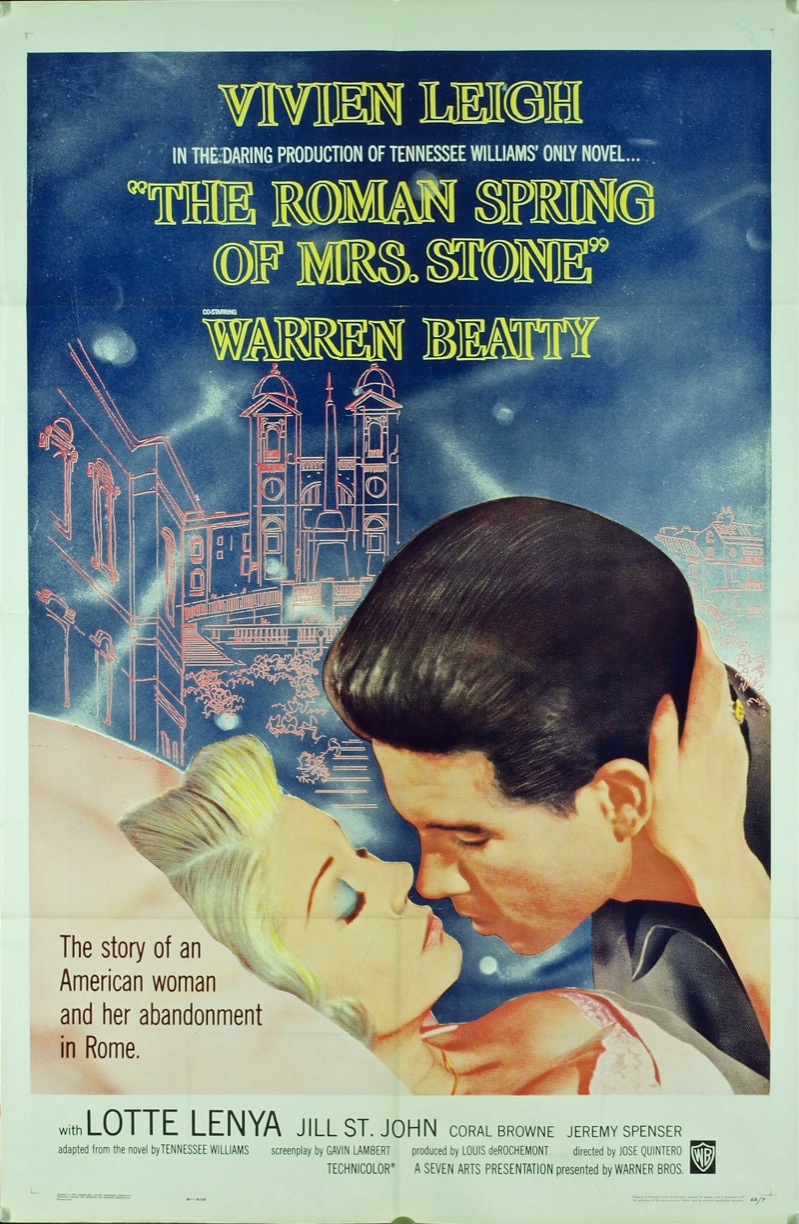
Karen Stone (Vivien Leigh) is an aging actress who is no longer getting the top roles like she used to. She and her husband decide to travel off to Rome for a retreat, but instead he dies of a fatal heart attack while on the plane. Karen then decides to remain in Rome where she leases a luxurious apartment, but becomes lonely and starts feeling insecure about her desirability.  She meets Contessa Madga (Lotte Lenya) who is known in the area with setting up young men with lonely rich older women.   She sets Karen up with Paolo (Warren Beatty) a dashing young gigolo who is only attracted to Karen because of her money and the belief that she will pay him to be her lover while Contessa will get a cut of the profit. Karen does give Paolo a ‘salary’, but remains under the delusion that eventually he will fall in love with her for real.

Although the story moves along at a slow and plodding pace and there is little if any action I still found myself captivated. The script is based on a novel by Tennessee Williams and somehow his stuff always remains strong drama no matter how talky it may appear. The characters and their situations are real. Their fragility and desperation are things many people can sometimes find themselves facing and therefore it makes an impact.

The sets are excellent. Karen’s apartment has a nice mixture of elegance and airiness. I also liked the recreation of the streets of Rome that was done inside a sound stage. Normally I prefer on-location shooting, but when the sets are built in such a meticulous way it becomes almost mesmerizing.

Leigh, in her second to last film role, is solid as usual. Some may complain that she is playing a part that is too similar to her Oscar winning role of Blanche Dubois in A Streetcar Named Desire and to some extent they have a point. It almost seemed like Leigh in her later career was becoming a bit of a caricature, but she does it so well that it is a treat nonetheless. Just watching the way she moves her eyes as she gazes at Paolo secretly flirting with another woman is memorable.

Beatty is equally good. He speaks with an authentic sounding Italian accent and has a tanned complexion. This was the role that established him as a leading man and worth seeking out for his fans.

Lenya is engaging as the wicked Contessa. Most viewers today will know her best as the villainess Rosa Klebb in the classic James Bond film From Russia to Love. I always felt that she was one of the best Bond villains, but the amazing thing is that here she ends up being almost as menacing though in a more subtle way. She exudes evilness with clarity that is both impressive and creepy.

Jill St. John is terrific as Barbra Bingham a younger, more attractive actress who makes no secret about her desire to take-over from Karen’s now fading spotlight. Her bratty, haughty behavior is effectively on-target. Apparently Leigh like her character felt intimidated by St. John’s youthful beauty and refused to say even one word to her during the production.

Spoiler Alert

My only real complaint is with the ending. Paolo abandons Karen and so in a fit of desperation she throws her apartment keys down to a transient who has been stalking her during most of the movie. The next shot has the homeless man entering the apartment and walking towards the camera, but then it fades and we are left to wonder what happened. Supposedly at the time just having a woman throw her keys down to some strange man on the street was considered shocking enough, but I wanted more of a conclusion. Did he kill her, or did they have sex and then start some sort of weird relationship? These are interesting questions that I felt should have been answered and the story’s ambiguity is frustrating.

My Rating: 6 out of 10

Released: December 28, 1961

Runtime: 1Hour 43Minutes

Rated NR (Not Rated)

Director: Jose Quintero

Studio: Warner Brothers

Available: VHS, DVD