Category Archives: Drama

Agatha (1979)

By Richard Winters

My Rating: 4 out of 10

4-Word Review: Agatha Christie runs away.

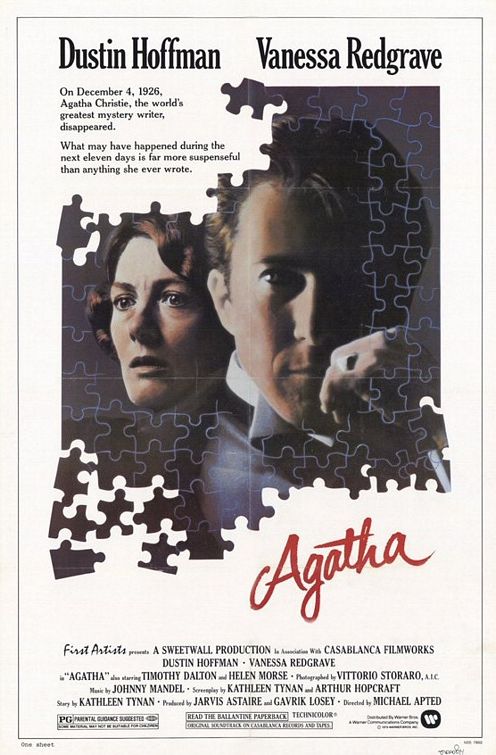
Despondent over her husband’s affair famous British novelist Agatha Christie (Vanessa Redgrave) decides to go away for a while to collect her thoughts. She then gets into a car accident while on the road and having her car disabled she first takes a train and then a cab to the Old Swain Hotel where she registers there under an assumed name. The police find her disabled car and fear that Agatha may have drowned in a nearby lake, been kidnapped, murdered by her husband Archie (Timothy Dalton) or committed suicide. A nationwide search begins that encompasses thousands of volunteers that scour the nearby countryside for clues. Meanwhile American reporter Wally Stanton (Dustin Hoffman), working off of  a tip from Agatha’s secretary, decides to check into the same hotel and begins following Agatha around where he keeps notes on everything she does while also falling in love with her in the process.

The film is loosely based on Agatha Christie’s real-life 11-day disappearance that occurred in 1926. No explanation was ever given for the reason nor was it even mentioned in her autobiography. Had there been some actual research about what might’ve transpired during those 11-days then this would be worth a look, but, as the film plainly states at the beginning, it is simply an ‘imaginary solution to an authentic mystery’, so then what’s the point?

Most likely it was nothing more than a woman looking to escape to some quiet location for a short respite that unfortunately due to the press getting wind of it, spiraled quickly out-of-control. The film’s low point comes in the side-story dealing with Agatha’s attempts to kill herself through a jolt of electricity from sitting in a Bergonic chair, but is saved at the last second by Wally who grabs her from the chair just as she’s shocked. Yet as he lays her limp body on the floor he doesn’t perform CPR, but instead shouts at her to ‘breath’ several times and despite no scientific study proving that this ‘technique’ can actually work she still miraculously begins breathing again anyways.

I have never read a biography on Christie, so I have no idea what her real personality was like, but the film portrays her as being a complete wallflower lacking any type of confidence and so painfully shy it’s pathetic. The character is so transparent it’s almost like she’s not even there. Hoffman’s character was completely made-up and the way he chain smokes reminded me too much of the character that he had played in Midnight Cowboy. His growing ‘love’ for her and the way he later expresses it is extremely forced and corny. Also, why is Hoffman given top billing when the main subject is Agatha?

Johnny Mandel’s soothing score is the best thing. I also liked the shot of the thousands of volunteers searching for her along the vast countryside, but everything else about the movie gets either under cooked or overbaked. The scene where Agatha tries to do a triple bank shot while playing pool gets badly botched. We initially see it captured from above where the entire pool table is in view. The pool ball banks off the side and rolls towards the corner pocket, but then it slows up and it becomes clear that it won’t make it to the pocket, so director Michael Apted cheats by cutting to a close-up of the ball and having it magically regain speed, which easily makes it into the corner pocket. The attempt was to ‘trick’ the viewer into believing that this was a continuation of the same shot but any halfway savvy person will realize this close-up was shot later and edited in.

The film’s poster tells us that ‘What may have happened during the next 11 days is far more suspenseful than anything she ever wrote’, but it really isn’t and in fact it’s not even close. The original intent by screenwriter Kathleen Tynan was to make this into a documentary after researching the true facts of the case, which would’ve been far better than the flimsy fanciful thing we get here.

My Rating: 4 out of 10

Released: February 9, 1979

Runtime: 1Hour 38Minutes

Rated PG

Director: Michael Apted

Studio: Warner Brothers

Available: DVD-R (Warner Archive), Amazon Video, YouTube
The Competition (1980)

By Richard Winters

My Rating: 7 out of 10

4-Word Review: Pianists fall-in-love.

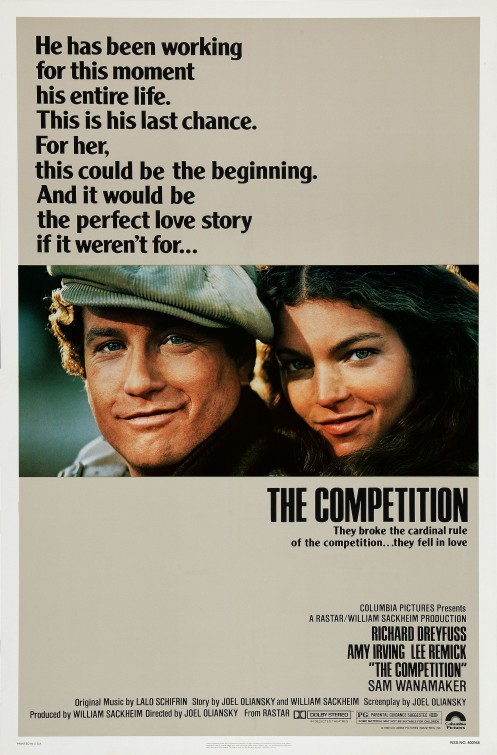
Paul (Richard Dreyfuss) is a gifted, but frustrated pianist. He has entered many classical piano competitions, but has always come just short of winning first prize. He wants to take one last stab at it, but his parents (Philip Sterling, Gloria Stroock) push him to settle down with a regular job and consistent pay. Paul though decides to forge on with his hopes at receiving a medal by entering a contest that will allow for a financial grant and 2 years of concert engagements for the winner. It is there that he meets Heidi (Amy Irving) who is also competing for the same prize. She immediately becomes smitten with him having met him a couple of years earlier at a music festival. She tries to get into a relationship with him despite warnings from her piano teacher (Lee Remick) who feels it might soften ‘her edge’ and allow him to attain the award instead of her.

The film does a masterful job at recreating a realistic atmosphere of a piano competition including showing the judges meticulously following each note on the sheet music they have at hand as the contestant performs while also taking studious notes of each performer afterwards before finally settling on a winner. The viewer is given a broad understanding of all six contestants involved helping to give the movie a fuller context on the human drama that goes on behind-the-scenes in these types of competitions while also showing how parents and instructors can at times be great motivators, but also crippling nags.

Watching the actors mimic the playing of a pianist is another major asset. Usually films dealing with pianists will never show the actor’s hands on the keys, but instead shoot them from behind the piano while editing in close-ups of a professional pianist’s hands later. Here though the actors, with the help and training of music consultant Jean Evensen Shaw, convincingly move their fingers along the keys in tandem with the music. How they were able to later effectively edit in the sound to stay on track with the finger movements and vice-versa is an amazing thing in itself, but watching the actors literally ‘play the piano’  helps to heighten the film’s realism and make watching the concert footage, which gets amazingly drawn out, quite fascinating.

The film has a terrific supporting cast as well including Lee Remick as Heidi’s no-nonsense instructor who looks at Heidi’s budding relationship with Paul with immediate cynicism and isn’t afraid to bluntly speak out about it either. Sam Wanamaker has the perfect look and demeanor of an orchestra conductor and the scene where Paul decides to ‘show him how it’s done’ by taking a stab at conducting is the film’s highlight.

The weakest element though is the romance and the movie would’ve worked better had this been only a side-story instead of the main focus. The idea that Heidi has to do all the sacrificing and at one point even considers dropping out of the competition because it’s ‘more important to him that he wins it’ is sexist. Woman can be just as competitive as men and sometimes even more so. The story would’ve been better served had they both been portrayed as fierce competitors who deep down have mutual feelings for the other, but remain guarded and slowly shows a softer side as the contest progresses and then only when it is finally over does the romance really blossom.

Having Heidi constantly chase after Paul, who is extraordinarily arrogant, is ridiculous. After his initial rebuff she should’ve quickly moved-on as she was pretty and there were plenty of other men for her choose from instead of having her literally throw herself at him like she were some dimwitted groupie. It was bizarre as well that when Paul finds out that is father is dying that Heidi is the first person he decides to turn to for comfort and solace. This is well before a relationship was established and the two had only spoken to each other in passing, so why does Paul consider her a trusted emotional confidant and shouldn’t he most likely have other friends that he would’ve known longer that he could go to instead?

The film has a side-story dealing with a Kazakh performer (Vicki Kriegler) whose instructor (Bea Silvern) decides to defect to the U.S. during the competition, which takes the film in too much of a different direction that distracts from the main theme and should’ve been cut out completely. I also thought it was odd that the music played over the closing credits is a disco sounding song. We’ve just spent 2 hours listening to classical piano music, so shouldn’t the music at the end have been kept with the same theme/sound?  Otherwise this is still a terrific study showing the emotional and mental sacrifices that go in to achieving success and how staying too focused on a central goal can sometimes affect a person’s relationships with their friends, family and lovers.

My Rating: 7 out of 10

Released: December 3, 1980

Runtime: 2Hours 6Minutes

Rated PG

Director: Joel Oliansky

Studio: Columbia Pictures

Available: DVD, Amazon Video, YouTube

Wild Seed (1965)

By Richard Winters

My Rating: 6 out of 10

4-Word Review: Runaway falls for drifter.

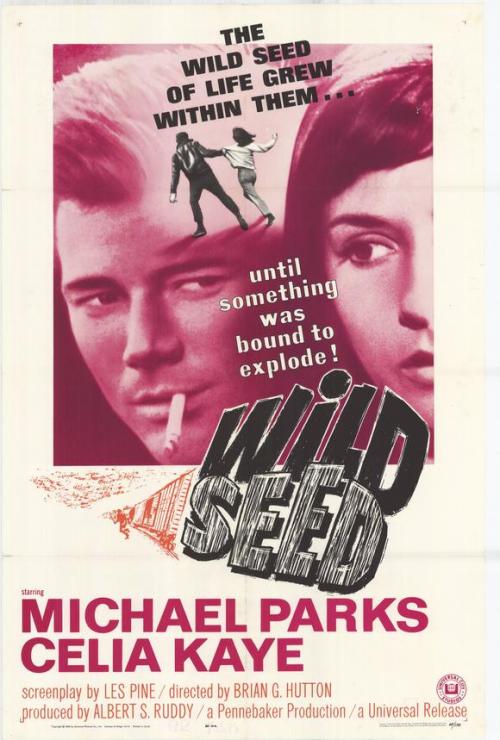
Daphne (Celia Kaye) is a 17-year-old who runs away from her foster parents (Woody Chambliss, Eva Novak) in order to meet her biological father (Ross Elliot) who resides in Los Angeles. On her journey from the east coast to the west she meets up with Fargo (Michael Parks) a drifter who teaches her the ropes of surviving on the streets. As their trip progresses so does Daphne’s feelings for Fargo who resists her advances despite having feelings for her as well.

This black-and-white mid ‘60s drama has too much of the same trappings of the teen runaway films that came both before and after it. There’s just nothing that particularly distinguishes it from the others, which hurts the ability of the viewer from getting into it because you think right from the start that you’ve essentially ‘seen it all before’. The film also has very little action and Daphne who at times acts with extraordinary naiveté could’ve had far worse things happen to her than what does giving the film a sanitized feel in regards to the runaway experience.

Kaye, who later went on to marry famous writer/director John Milius, lacks visual appeal and fails to seem all that ‘wild’ despite what the film’s title suggests. Much of the time she comes off as someone who is quite sheltered and timid about things and not anyone who would even consider going out recklessly into the world without much ‘street smarts’ to go with it. Her character shifts from being overly paternal about certain things, particularly the ‘lectures’ that she gives to Fargo, to acting incredibly naïve making her character lack any type of real center. She also fails to display a vulnerable side just a crusty defensive one. Instead of being someone the viewer cares for she replicates a pesky nag nobody would want hanging around.

Parks, in his film debut, channels James Dean a bit too much while his character remains an enigma that we learn very little about. The fact that he resists Daphne sexual advances, at least initially, was confusing as usually it’s the man that makes the first move. I kept figuring there had to be some reason for it that would come out later, like for instance he was secretly gay or insecure about his ability to perform, and yet no explanation is ever given.

The second-half improves as this is the type of film that grows on you if you’re patient. I enjoyed some of the long shots showing to the two from an extreme distance making them look like tiny little ants on the landscape, which nicely accentuates their place in the world as a whole. Bringing in the parents, both the biological and foster ones helps add to the drama and fills in the holes of the story, but having a relationship develop between the two leads didn’t seem authentic. Spending so much time trying to survive on the outer fringes of society doesn’t allow for much else most of all a romance. The film would’ve been more interesting had it expanded its timeline and shown how things ended up for the two 5 or even 10 years later and whether the relationship had remained, or whether they were even still alive at all.

My Rating: 6 out of 10

Released: May 5, 1965

Runtime: 1Hour 39Minutes

Not Rated

Director: Brian G. Hutton

Studio: Universal

Available: None at this time.

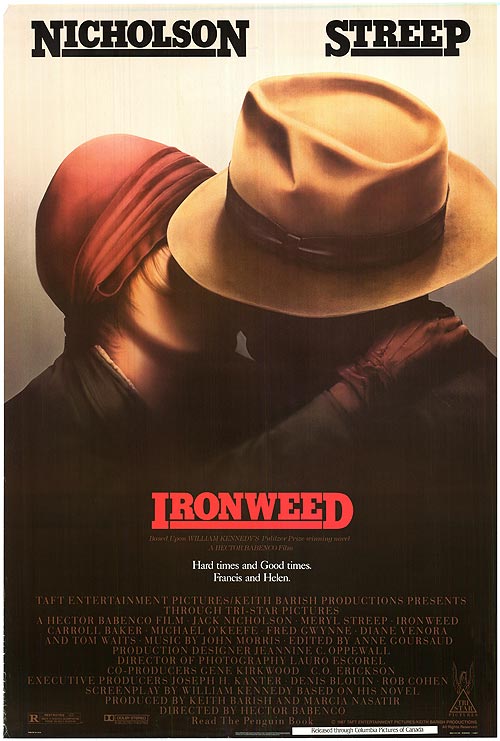
Ironweed (1987)

By Richard Winters

My Rating: 8 out of 10

4-Word Review: Life on the streets.

It’s the 1930’s and Francis Phelan (Jack Nicholson) has been living on the streets for over two decades. At one time he was a promising baseball player with a bright future, but then he accidently dropped his infant son and killed him. Dealing with the guilt and shame of it turned him into an alcoholic who roams the cold streets of Albany, New York looking for odds jobs and handouts when he can. He seeks out his lover Helen (Meryl Streep) for companionship and the two share a bottle of booze and their bitterness at the world that is ambivalent to their desperate situation.

The film is based on the novel of the same name by William Kennedy, who also wrote the screenplay and is directed by Hector Babenco who received wide claim for directing Pixote a film that dealt with homelessness in Brazil. This film is without question one of the best to tackle the lives of street people. Most films tend to treat the subject rather timidly and only analyze the topic from a distance (i.e. having a side character who is homeless, or maybe a main character who is temporarily on the streets), but this film engrosses the viewer completely into the homeless lifestyle while supplying absolutely no letup to their bleak existence. The result is a fascinating and revealing journey that shows how complex and multi-dimensional these people actually are while exposing every facet of the homeless experience including the indignities and dehumanization that they must face on a daily basis.

The casting is interesting particularly for the fact that both Nicholson and Streep had just starred together in Heartburn a year earlier playing a couple on the completely opposite side of the socio-economic scale. I commend Nicholson for tackling a challenging role that goes completely against his persona as normally he plays flamboyant types with over-the-top personalities, so it’s great seeing him take on a humble one who feels and acts like a complete miniscule to the world around him. However, the scenes where he interacts with the ghostly visions of people he has murdered in the past does not come off as successfully as it could’ve. The imagery is interesting, but the fact that he had played a character already that dealt with similar types of ghostly visions in The Shining causes the viewer to think back too much to that film and takes them out of this one.

Streep is outstanding and her constant ability to completely submerse herself into her characters and take on different accents with an amazing authenticity never ceases to amaze me. She really looks the part too by not only wearing no make-up, but having her teeth stained and darkened to effectively give off that decayed look. I’m genuinely floored at how many times most films neglect to do this. Actors portraying characters in destitute environments, or from the old west, may convey the down-and-out or rugged look physically, but their teeth still always look great when in reality they should’ve been in as bad of shape or worse as the rest of their bodies.

The supporting cast is good but they have little to do, which includes Fred Gwynne who appears briefly as a bartender. Carroll Baker though is excellent as Nicholson’s ex-wife. She was a blonde beauty that burst onto the scene in the ‘50s and was billed as the next Marilyn Monroe, but her acting ability quickly became suspect and by the ‘60s she was relegated to low budget B-movies and European productions, but in the ‘80s she made a Hollywood comeback in supporting roles and her appearance here was clearly her best performance and proves that she really could act. Margaret Whitton is also a standout as she takes part in one of the film’s few lighthearted moments as an eccentric woman who is prone to histrionic fainting spells and walking outside without any clothes.

The film though does suffer from a few too many dramatic peaks, which includes having two of Nicholson’s homeless friends die almost simultaneously, which only helps to lessen the effect by squeezing out more drama than it needs to, but overall this is a top notch effort where every scene and utterance rings true.

My Rating: 8 out of 10

Released: December 18, 1987

Runtime: 2Hours 23Minutes

Rated R

Director: Hector Babenco

Studio: TriStar Pictures

Available: DVD, Blu-ray, Amazon Video, YouTube

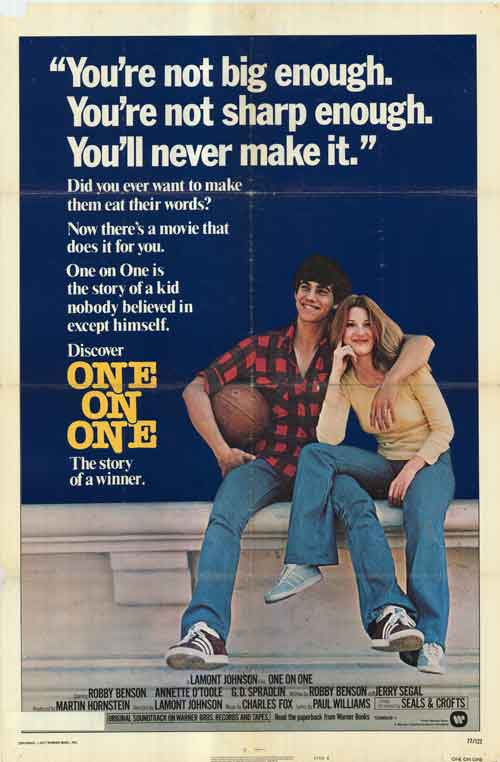
One on One (1977)

By Richard Winters

My Rating: 6 out of 10

4-Word Review: A college basketball star.

Henry Steele (Robby Benson) becomes the star of his small town high school basketball team, which is enough to get him a scholarship to a university in California on their team. Once there he becomes overwhelmed by the demands of his coach (G.D. Spradlin) as well as the under-the-table ‘business side’ of college athletics. The disappointed coach eventually asks him to rescind his scholarship, but Henry refuses leading to many brutal practices where the coach tries to make life a living hell for him, which he hopes will get Henry to finally quit, but to everyone’s surprise Henry perseveres and shows more grit in him than anyone ever imagined.

The script, which was co-written by Benson and his father Jerry Segal shows a revealing look of the underside of college sports making it quite compelling to watch particularly the first half-hour where Henry gets introduced to many things he hadn’t come into contact before including getting involved with ‘payouts’ to college benefactors, drugs, wild parties, amorous secretaries (Gail Strickland) and even romance with his tutor Janet (Annette O’Toole). The film has a nice year-in-the-life approach where the viewer feels like they are following Henry around by his side and experiencing the same first-hand situations as he does. It also examines the discrimination that athletes go through, which is rarely tackled in other films, dealing with Janet’s boyfriend Malcolm (James G. Richardson) who mocks Henry and other athletes like him for being ‘unintellectual’ and trained to passively obey all rules handed to them by their coaches while unable to think for themselves.

Benson’s performance of a wide-eyed, naïve small town lad works and the viewer can’t help but chuckle at his initial inability to handle the many new challenges he’s faced with while also remaining sympathetic to his ongoing quandary. Many actors may not be able to pull off such a feat, but Benson, who’s a far better performer than people may realize, does so flawlessly particularly the times when his character fights back and grows from a hayseed kid to a full grown man.

Spradlin has the perfect look and voice for a college coach and he coincidentally played a coach in North Dallas Forty, which came out that same year. However, his facial expressions reveal too much of his inner feelings particularly that of concern and worry where an actual coach would try to mask these vulnerable feelings from their players in order to prevent them from ‘reading’ what they are thinking and maintain more control.

Henry’s relationship with Janet comes off as forced. The two clearly were on opposite ends of the intellectual plain and I didn’t see what if anything that they actually had in common. Having Henry read ‘Moby Dick’ one of her favorite novels didn’t seem to be enough of a catalyst to have her suddenly fall-in-love with him. She brought in other athletes into her apartment to tutor and since she was paid $265 an hour I’d doubt she’d give that up, which most likely could cause tensions with their relationship, but this never gets addressed.

The songs by Seals and Croft don’t help and the film would’ve been better had they not been involved. They had some great chart toppers during the ‘70s, but slowing up the film by having a montage with their songs played over it takes the viewer out of the drama and unwisely reminds them that they’re just watching a movie instead. The Seals and Croft sound doesn’t coincide with a spots theme at all and it’s too bad that the Hall and Oates hit of ‘One on One’ hadn’t been released earlier  because that song would’ve been a better fit.

Spoiler Alert!

The ending has a dreamy/sports clichéd feel particularly the way Henry comes off the bench and scores all the points as the team scratches and claws their way from behind, which could be enough to make some viewer’s eyes roll, but the fact that all the fans run onto the court afterwards is what had me. This was only an early season game and usually fans only do this during a crucial late season contest or championship. Henry’s team was expected to go undefeated and they were losing to a team that they were favored to beat, so if anything the fans would’ve been annoyed that the game was so close and not inclined to rush the court, but more thankful that they had avoided a potential loss and then critical that the squad was not living up to expectations.

Having Henry stand-up to the coach at the end and leave the team may have been emotionally satisfying for a few seconds, but in the long run he’d be better off had he stayed. If he joined a new team he’d have to start all over again proving himself to the new coach and teammates while here he had finally gotten that out of the way. He’d also have to move to a new school, which would’ve hurt his relationship with Janet.

End of Spoiler Alert!

Overall though as sports movies go this isn’t bad and pretty realistic most of the way. Fans of college basketball should enjoy it as it gives one a sort-of behind-the-scenes view of the inner workings of college athletics.

My Rating: 6 out of 10

Released: June 28, 1977

Runtime: 1Hour 38Minutes

Rated PG

Director: Lamont Johnson

Studio: Warner Brothers

Available: DVD-R (Warner Archive), YouTube

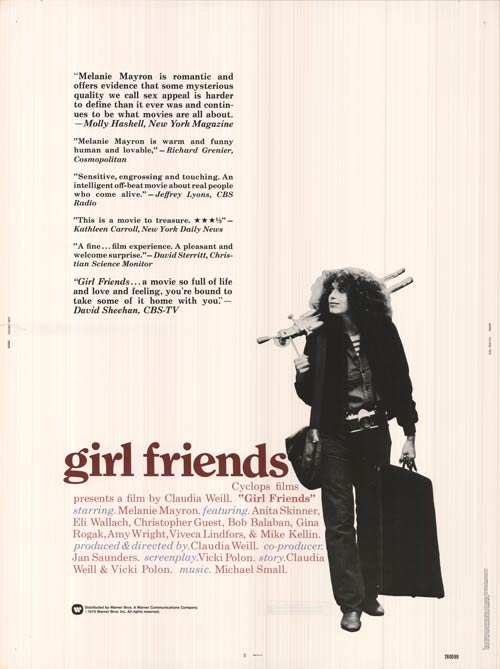
Girlfriends (1978)

By Richard Winters

My Rating: 6 out of 10

4-Word Review: She misses her friend.

Susan (Melanie Mayron) and Anne (Anita Skinner) are best friends and roommates, but when Anne decides to get married to Martin (Bob Balaban) and move out Susan can’t handle the solitude. She picks-up a hitch-hiker named Ceil (Amy Wright) who moves in for a bit, but it doesn’t work out. She then gets into a relationship with Eric (Christopher Guest) and even a 60-year-old married rabbi (Eli Wallach), but both of these end in heartache. The more Susan tries to ‘move-on’ the more she longs for the old days with Anne and Anne starts to feel the same way.

This was Claudia Weill’s feature film debut that met with high accolades including director Stanley Kubrick who considered it his favorite film of 1978. There’s a nice understated quality here that not only brings out a vivid late ‘70s feel, but also the very real day-to-day struggles of a young adult trying to swim through the quagmire of relationship and career obstacles. Melanie Mayron is certainly not a beauty by the conventional standard, but her plain appearance helps accentuate the challenges of the regular person trying to break-out and get noticed.

Susan’s struggles at trying to become a full-time photographer had me hooked the most as it portrays the universal challenges anyone can have in trying to get ‘their foot-in-the-door’ no matter what the profession, but I was a bit stunned when she forgets about the exhibition of her work at an art show. If someone is truly excited about getting their first big break then there is simply no way that would happen. It’s also hard for the viewer to completely empathize with someone’s career struggles if they themselves aren’t doing all they can to achieve it.

Another misguided wrinkle to the story was Susan’s relationship with a married rabbi who was almost 40 years older than her. These types of relationships suffer from extraordinarily long odds  and just about anyone would realize that from the get-go, which makes Susan’s ‘shocked’ reaction when the rabbi is unable to get together for a date due to family obligations seem almost  irrational. How a relationship like this could even begin to blossom is a whole other issue that never even gets addressed.

The film suffers from a few awkward scenes too. One has Wallach sitting down to play a game of chess with Melanie only for him to get up a minute later and leave for no reason. Why does he bother to show up for a chess game if he isn’t even going to make a single move on the board? Later Viveca Lindfors appears wearing a neck brace and yet no explanation is ever given for why she has it on. Later she’s shown without it, so why did she have it in one scene and not the other? Maybe it was for a minor accident, which can happen, but film is a visual medium and when something slightly askew gets shown it needs to get addressed even if it’s just in passing otherwise the viewer will key in on that and not the story.

Even more amazingly, and I can’t believe I’m saying this as I’ve never seen it in any other movie that I’ve ever watched before, but there’s an actual scratch on the camera lens that can be spotted in just about every scene. It appears on the top right hand side as a small white mark. If the sun is shining through a window it will reflect the light and be more pronounced. If a character walks in front of the window it fades a bit, but you can still see it and this continues throughout the entire run of the film. I can only presume that cinematographer Fred Murphy was aware of this, but due to the budget constraints they didn’t have enough money to replace the lens and decided to simply chug along with the scratch in place and hope no else would notice.

Ultimately though I found the story, in its simple way, to be touching and poignant this is particularly evident at the end where the viewer can see firsthand how friendships help add insight and support to a person’s life and are an important dimension to the human experience.

My Rating: 6 out of 10

Released: August 4, 1978

Runtime: 1 Hour 26 Minutes

Rated PG

Director: Claudia Weill

Studio: Warner Brothers

Available: DVD-R (Warner Archive), YouTube

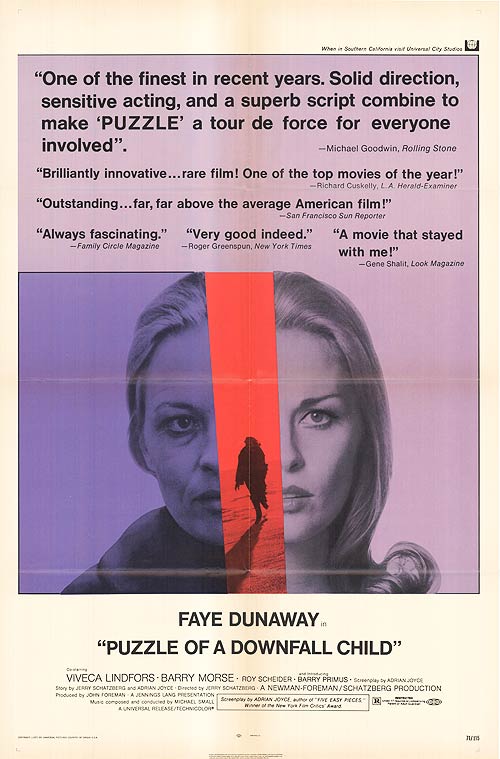
Puzzle of a Downfall Child (1970)

By Richard Winters

My Rating: 3 out of 10

4-Word Review: Fashion model is troubled.

Lou Andreas Sand (Faye Dunaway) was a once famous fashion model who now sits in an isolated seaside cabin telling her life story to Aaron (Barry Primus) who records her conversations which he plans to use as a basis for an upcoming film. Through her stories she describes of being molested at the age of 15 by a much older man, her bouts with drugs and alcohol, her time spent inside a mental hospital and how she jilted her fiancé (Roy Scheider) by running out on him on their wedding day.

This film marks the directorial debut of Jerry Schatzberg who up until that time was best known as a still photographer and having captured the cover of Bob Dylan’s seventh album Blonde on Blonde. The inspiration for the movie was the life of model Anne Saint Marie who Schatzberg interviewed much the same way that the Aaron character does in the movie.

Unfortunately the director clearly doesn’t understand what makes his main character tick as she comes off as this one-dimensional, self-destructive cliché whose perpetually sad tales of woo become increasingly more contrived as the film goes on. We get no insight as to why she behaves the way she does turning her into a maddening caricature that frustrates the viewer and allows for no empathy.

A great deal of effort was put into the film’s visual style and on that level it’s a fascinating achievement. Adam Holender’s cinematography is quite vivid and makes you feel like you’re right there in the same room with the characters, but the fragmented narrative that comes with it is unappealing. Certain interesting dramatic moments get dropped and never gone back to, or readdressed at a much later time long after the viewer has lost interest. I suppose this is the reason that the word ‘puzzle’ gets used in the title as we are supposed to ‘piece together’ this woman’s life and personality through the erratic bits that she gives us, but she only succeeds at becoming an enigma.

Dunaway is a great actress, but tends to do better in parts calling for strong or emotionally ambivalent women. Playing the roles of vulnerable people is definitely not her forte. She’s managed to do it a few times, but it’s not easy for her and here she fails at it completely as she doesn’t understand her character’s motivations any better than the viewer.

The one actress that does do well here is Viveca Lindfors who was a beauty in her day, but by this time was already aging into her later years and yet she commands the screen with the brief time that she is on it and had she been seen more she might’ve saved it. However, the story lacks substance fails to be compelling and leaves the viewer with a lot of fleeting, fragmented images and nothing more.

My Rating: 3 out of 10

Released: December 16, 1970

Runtime: 1 Hour 45 Minutes

Rated R

Director: Jerry Schatzberg

Studio: Universal

Available: DVD (Region 2), Blu-ray (Region B/2)

Carny (1980)

By Richard Winters

My Rating: 6 out of 10

4-Word Review: Runaway joins the carnival.

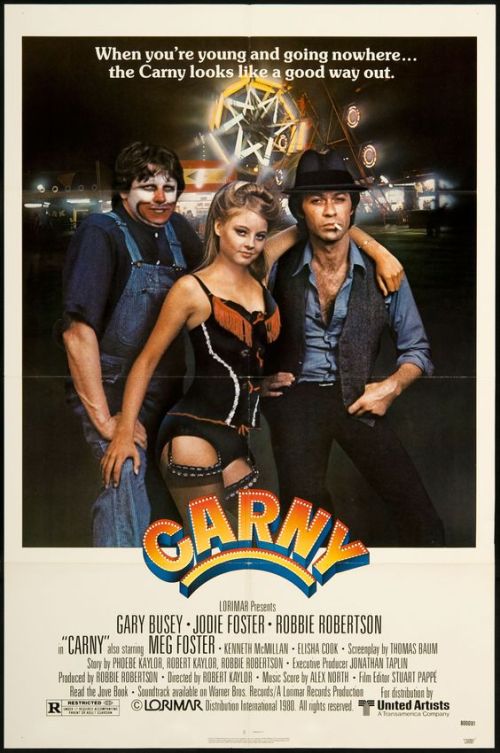
Bored with small town life and an overly-protective boyfriend (Craig Wasson) Donna decides at the age of 18 to break-free of her restraints and travel the countryside by working in a carnival. She befriends Frankie (Gary Busey) who works as a clown and she gets a job as one of the strippers before eventually working the string joint booth while slowly adapting to the shady ways of the gypsy-like lifestyle.

The carnival atmosphere is well-recreated and was directed by Robert Kaylor who years earlier helmed the documentary Derby, which was a behind-the-scenes look at life on the roller derby circuit and this film works much the same by fully immersing the viewer into the dark aspects of a tough environment while also exposing the personalities of the people who work in it. The revealing story manages to be both hard-hitting and intriguing.

The tone though stays too much on the negative side until the viewer feels almost bombarded with one unpleasant situation after another. There’s never anything redeeming and you’re made to feel tense waiting for the next uncomfortable twist to come about, which gets overdone. Certainly there had to be some good times and bonding that occurs and the film lightly touches on this at the very, very end, but I felt more of that should’ve been sprinkled in throughout.

There’s also too many con-games and underhanded shenanigans making me wonder if all carnivals were really this bad , or is it simply playing-it-up for dramatic purposes. The ending in which everyone works together to pull off an elaborate con on a meddling crime boss (Bill McKinney) comes off too much like a poor rendition of The Sting. Some potentially intriguing storylines get dropped; like what happened to Donna’s psycho boyfriend when he finds out that she has left him? I was fully expecting him to come back into the picture at some later point once he tracked her down, but instead he gets forgotten.

Robertson is a famous songwriter and musician whose been around since the ‘60s, but he grew up working in the carnival circuit and helped put his real-life experiences and insights into the script. His performance is okay, but the soundtrack he composed for the film is too upbeat and does not jive with the dark, moodiness of the plot.

The performances are the best thing. Foster usually plays characters that are confident, but here she is someone who is unsure of herself only to acquire an edge as the story progresses. Kenneth McMillan is engaging as the nervous, stressed-out owner and Meg Foster is good as a woman who’s become hardened from being on the road too long. Gary Busey is a standout too even though he sometimes gets mocked today for his weird behavior off-screen, but this guy was at one time considered a serious up-and-coming star and his presence here shows why.

My Rating: 6 out of 10

Released: June 13, 1980

Runtime: 1 Hour 47 Minutes

Rated R

Director: Robert Kaylor

Studio: United Artists

Available: DVD (Warner Archive), Amazon Video, YouTube
Extremities (1986)

By Richard Winters

My Rating: 5 out of 10

4-Word Review: She traps her attacker.

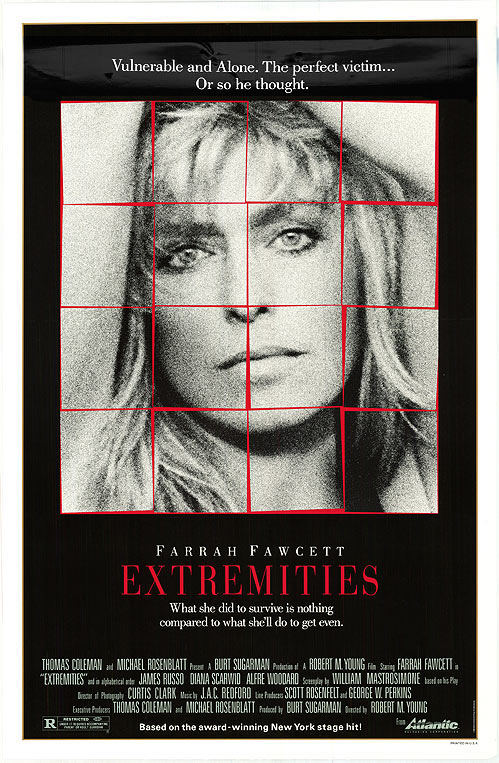
Marjorie (Farrah Fawcett) decides to grab a snack late one night at a convenience store. Since she plans on being in the store for only a minute she neglects to lock her car, which is enough time for her would-be rapist Joe (James Russo) to sneak into the vehicle and hide in the backseat. When she returns he attacks her, but she is able to break free and runs out. Unfortunately she leaves her purse behind and he’s able to find her address from her driver’s license. A few weeks later he attempts to attack her again at her home, but she fights back and is able to turn-the-tables on him by tying him up and trapping him in her fireplace. She then plans on killing him by burying him in her backyard as she’s afraid she won’t get a fair trial, but when her roommates (Alfre Woodard, Diana Scarwid) return home from work they try to convince her otherwise.

The film is based on the 1982 off-Broadway play written by William Mastrosimone and starring Susan Sarandon, who eventually got replaced by Fawcett and then later by Lauren Hutton when the play opened in Los Angeles. The play was notorious for its intense violence where the stars would routinely get injured while going through the motions of their parts and audience members would become so upset by it that they would sometimes storm the stage in an attempt to protect the actress. The stage version is also different from the film one in that it doesn’t show the backstory, but instead starts right away with the Marjorie being attacked in the home and then the aftermath.

The film was directed by Robert M. Young, whose best known effort previously was his film version of the stage play Short Eyes about a child molester’s experiences inside a harsh prison. While that film was excellent this one isn’t as he approaches it too much like it’s a thriller with loud, pounding music inserted when Joe attacks Marjorie inside the house, which actually takes the viewer out of the scene. The approach should’ve been more on the gritty side with no music and a handheld camera used to capture the action, which would’ve given the viewer a voyeuristic feeling like they are watching this from some hidden camera.

The scene where Marjorie ties up her killer and then hops into her car to go to the police only to have the vehicle mysteriously not start is ridiculous. This cliché has been used in movies too many times and should be outlawed forever. Had she been in a cold climate we could’ve attributed it to the weather, but she wasn’t. Or if it had been mentioned earlier that her car has had problems starting then it might’ve worked better, but having it conk-out for no reason when it drove just fine before is a total cop-out and a sign of weak writing.

I was also disappointed that no backstory is given to James Russo’s character. Earlier in the film we are shown that he is actually a family man with a daughter, so I was intrigued to see what drove him to have this Jekyll and Hyde personality and how being a father and husband he could justify what he does and yet no explanation is ever even touched on, which I found highly disappointing.

Fawcett is good particularly with her big blue, expressive eyes. I also enjoyed Scarwid’s nervous persona and how she becomes torn at how to approach the dilemma at hand. The conversations between the three women are strong and should’ve been extended, but the film as a whole misses-the-mark and isn’t as riveting or groundbreaking as it could’ve been.

My Rating: 5 out of 10

Released: August 22, 1986

Runtime: 1 Hour 29 Minutes

Rated R

Director: Robert M. Young

Studio: Atlantic Releasing Corporation

Available: DVD, Blu-ray, Amazon Video

Making Love (1982)

By Richard Winters

My Rating: 1 out of 10

4-Word Review: Her husband is gay.

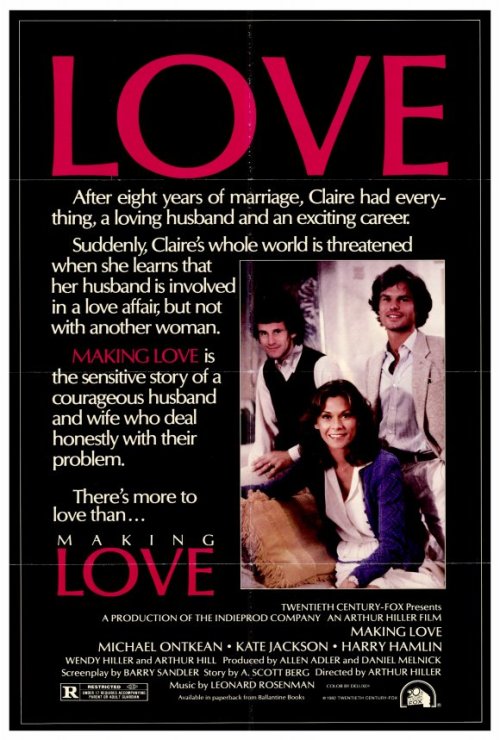
Claire (Kate Jackson) thinks she has the perfect marriage yet her husband Zach (Michael Ontkean) harbors dormant feelings for other men and one day he decides to act upon them when he meets Bart (Harry Hamlin). Bart is more into one night flings, which heightens Zach’s inner turmoil as he’s not sure if he should stay with Claire, or live life the way he wants.

This film was considered groundbreaking for its time and even controversial, but it has not stood the test of time well and comes off as quite benign by today’s standards. Part of the problem is with Zach who has supposedly harbored these dormant feelings for a long time, but it is not clear why he suddenly decides to act upon them. The shift between happy married couple to an unhappy one seems to occur overnight and is jarring.

He asks Bart out for lunch when he has only known him for a few minutes, but if he’s quarreling with desires that he has never acted upon then I would think he’d be more hesitant and only move forward with Bart after having known him longer. He also denies to Bart that he’s gay and then a half-minute later is kissing him on the lips. Then quickly after that he’s hopping into bed with him, but I would presume someone who has never had sex with another man before would react more awkwardly and self-consciously their first time.

Hamlin’s character is far more interesting simply because he’s edgier than Zach who is too annoyingly goody-goody. I also enjoyed that he watches movies on a laser disc machine, which you rarely see anymore, but he like all the other gay men in the film has too much of a pretty-boy face and the film should’ve balanced itself by showing that balding, overweight, middle-aged men can be gay too.

The segments where the characters talk directly to the screen is unnecessary and amounts to incessant babbling as they describe things that the viewer could easily pick-up on visually. Wendy Hiller’s old lady character adds nothing and the scene where Zach goes home to visit his folks (Arthur Hill, Nancy Olson) is equally pointless and should’ve also been excised as the film’s runtime is too long to begin with.

Gay viewers may take to this better and the film’s intent may have been noble, but that doesn’t forgive its poor execution as the whole thing comes off like a shallow soap opera with cardboard characters manufactured to fit into an already preconceived concept. In fact the movie’s only good moment comes during a throwaway bit involving Erica Hiller, who was the daughter of the film’s director Arthur Hiller, playing an overly deluded, but woefully under talented singer who is convinced that she will be a smash with the audience during an amateur contest only to be booed off stage the moment she starts singing, which acts as an interesting precursor to a bad audition from ‘American Idol’.

My Rating: 1 out of 10

Released: February 12, 1982

Runtime: 1 Hour 51 Minutes

Rated R

Director: Arthur Hiller

Studio: 20th Century Fox

Available: DVD