Category Archives: Cult

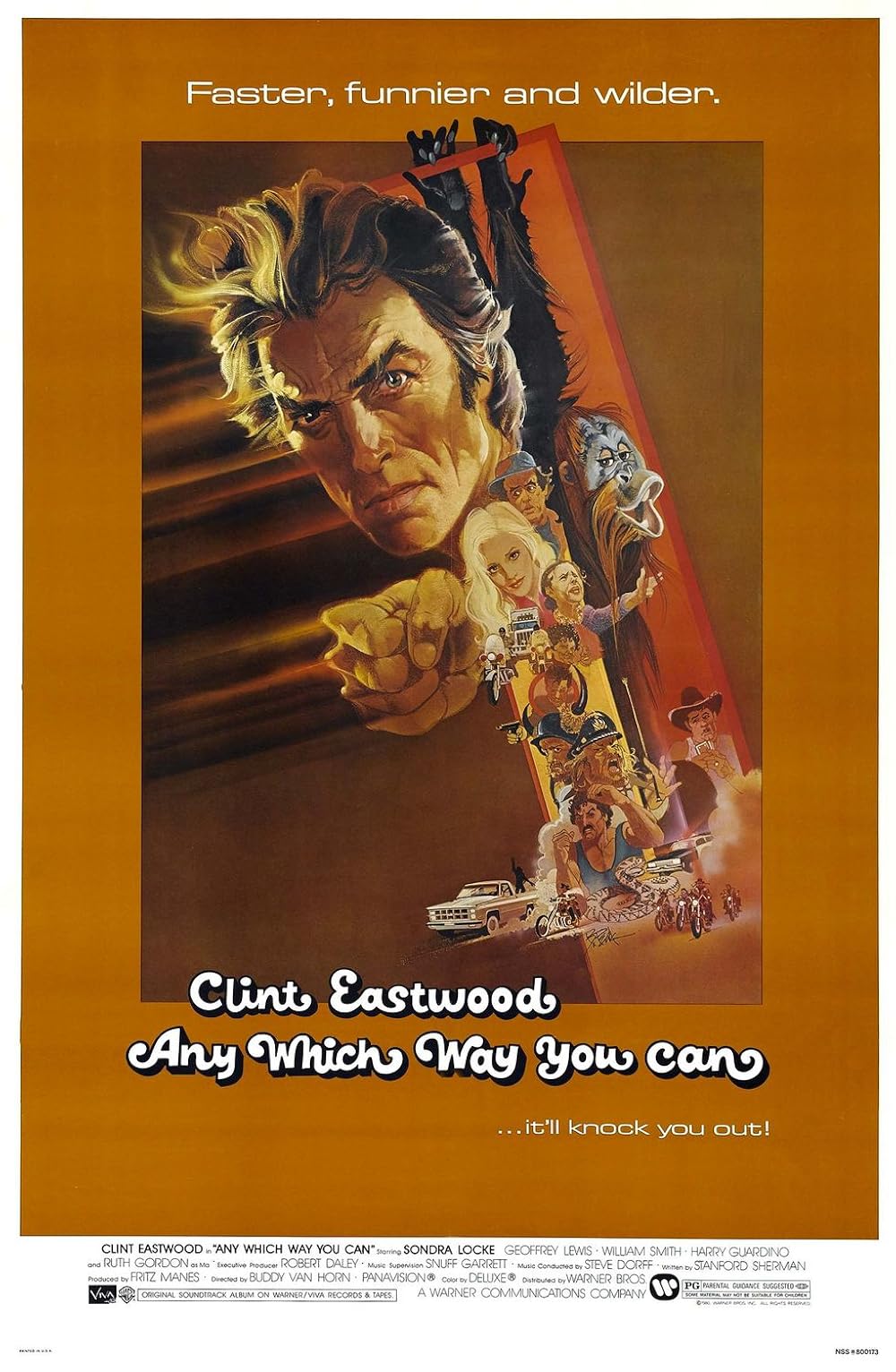
Any Which Way You Can (1980)

By Richard Winters

My Rating: 7 out of 10

4-Word Review: Betting on a fight.

Philo (Clint Eastwood) is still working as a trucker, still travels around with his pet orangutan Clyde, and still lives at home with his mother (Ruth Gordon) while getting involved in some bare-knuckle fights on the side to earn some extra money. He also continues to be harassed by the Black Widow biker gang who constantly hound him to even a past score. Things begin to change a bit when he meets back up with Lynn (Sondra Locke) who apologizes for her behavior from before and wants to rekindle their romance. Philo resists at first, but eventually the two get back together and she even moves-in with him in a spare room, but pressure mounts when fight handicapper Jack Beckman (Harry Guardino) comes-up with the idea of pairing Philo with Jack Wilson (William Smith), whose fighting skills mixes both martial arts and boxing. Jack figures it would be a match that would generate much betting interest and uses his men and money to convince Philo to take part in it. While Philo does initially agree he eventually backs out due to pressure from Lynn as she feels it’s too dangerous, but Jack, who has Mafia money riding on the fight, won’t take no for an answer and kidnaps Lynn in an effort to get Philo to reconsider. 

This is one of those sequels that’s a vast improvement over the first and much of the credit goes to Stanford Sherman, who wrote over 18 episodes for the 60’s ‘Batman’ TV-show and shows a good knack for balancing campy humor with interesting action. He’s also able to tie-in everything that goes on, so it doesn’t come off like a disconnected mess like with the first installment that had characters and situations coming-out of nowhere that wasn’t cohesive. Here each character has a purpose and everything that happens has a reason and connects with the main theme making for a much slicker production even when some of it gets silly.

Much more attention goes to the ape here though it’s not the same one as in the first film. That one was named Manis who was deemed to have grown too big for the part, so he got replaced by Buddha who has some amusing segments with his best moments coming when he tears up some cars, including one being driven by a bad guy, played by Michael Cavanaugh, as he’s trying to get away and another scene where he wears a dress and then ‘flashes’ an amorous hotel owner. However, in a book by Jane Goodall entitled ‘Visions of Caliban’ it was asserted that Buddha was badly beaten by his owner during the production after he stole some doughnuts on the set and was eventually clubbed to death forcing them to bring in a third ape named C.J. to do the publicity tour for the movie after filming had wrapped. 

Like in the first one the movie also features a lot of bare-knuckle brawls though these aren’t quite as interesting since Clint wins every one of them, so there’s never any tension. To keep it realistic, and give it better balance, they should’ve had him lose one, possible in humiliating style, and the rest of the movie could’ve been having him trying to defend his title and the audience would’ve been more emotionally invested in seeing him do it.  Would’ve been nice too had they not implemented that annoying punch sound effect that to me puts the fight at a cartoon level and I wished more movies from the period did it like The Whole Shootin’ Matchwhich didn’t feel the need to have that effect put in and thus actually made the fighting grittier and more intense in the process. 

While the film is way too long, there’s no reason for a runtime of 2-hours with such a slight and goofy plot, which should’ve have not been more than 85-minutes. However, it saves itself with some genuinely inspired moments including when real-life couple Logan and Anne Ramsey, who play a traveling husband and wife who stay in the hotel room next to the two apes whose noisy love making turn them on as does Clint and Sondra in adjacent room while Ruth and the elderly hotel clerk, played by Peter Hobbs, also make it in the motel office, I found to be quite amusing and almost worth the price of admission. The climactic bout between Clint and Smith and the way it galvanizes people from all over to witness it and bet money on it, including the Black Widow biker gang, who survive a ‘taring’ earlier, is good fun making it worth checking out on a slow night. 

My Rating: 7 out of 10

Released: December 17, 1980

Runtime: 1 Hour 56 Minutes

Rated PG

Director: Buddy Van Horn

Studio: Warner Brothers

Available: DVD, Blu-ray, Amazon Video, YouTube
The Chocolate War (1988)

chocolate

By Richard Winters

My Rating: 7 out of 10

4-Word Review: Teen challenges the hierarchy.

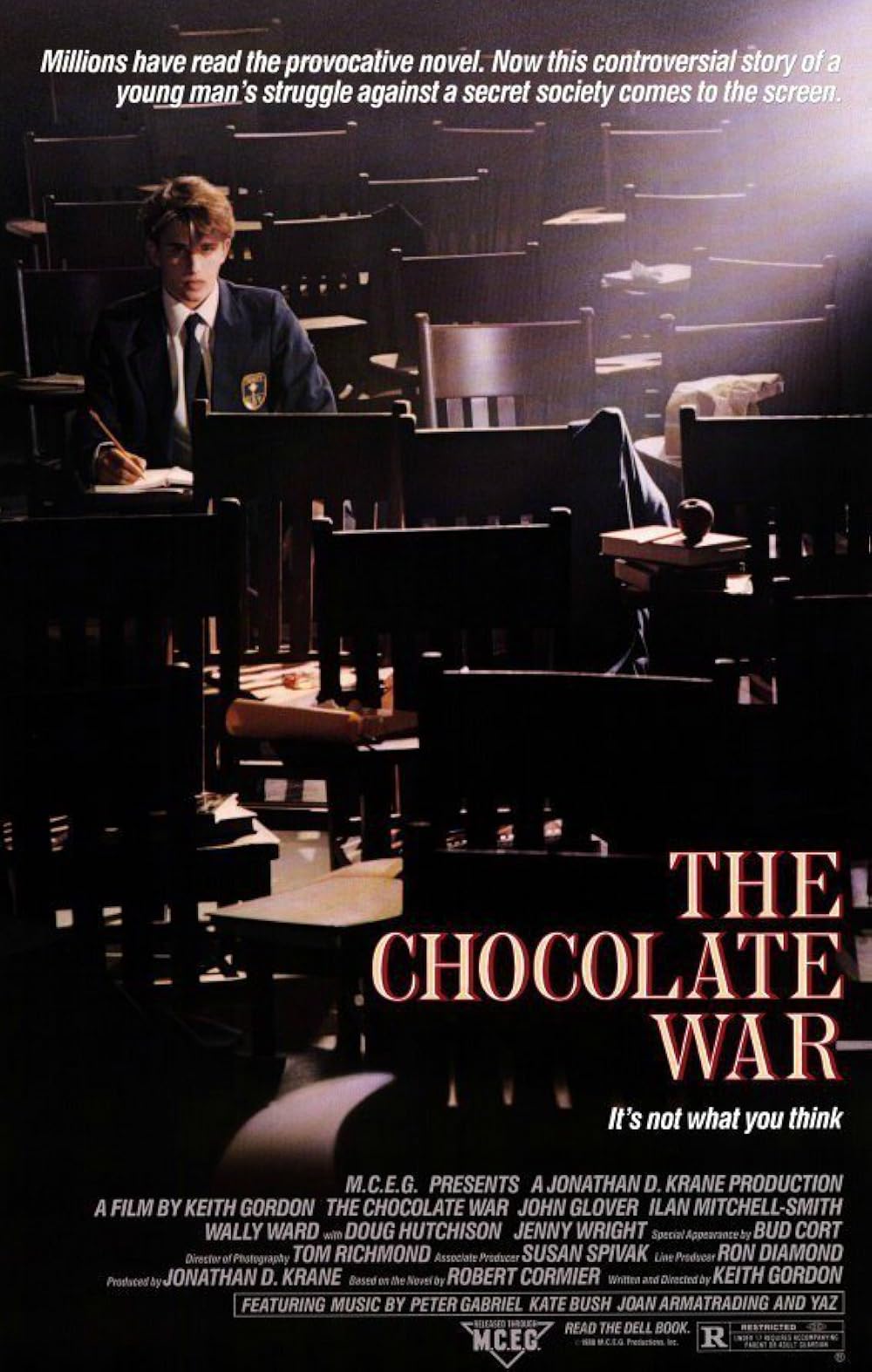
Jerry (Ilan Mitchell-Smith) is the new student at an all-boys Catholic School that finds himself insnared into a controversy that wasn’t of his making. Brother Leon (John Glover), the school’s headmaster, promotes a program in which all the students must sell a certain allotment of chocolates in order to bring in much needed revenue for the school. While it’s technically voluntary the students are strongly pressured to take part in it and all of them do except for Jerry who for ten days refuses to get involved. This it turns out was the result of a hazing ritual brought on by a secret fraternity of students known as The Vigils. The idea was for Jerry to prove himself as being mentally strong enough to join the group by standing up to the intimidating Leon. Leon though becomes aware of what’s going on and since he’s in close contact with Archie (Wally Langham), the Vigil’s leader, he forgives the action convinced that once the 10-days are up Jerry will conform like all the others and take part in the sales drive. However, to everyone’s shock this doesn’t happen. Instead, Jerry continues to rebel, and his nonconformity has an infectious quality causing other students to take part, which challenges the strength of the school’s hierarchy to keep everyone in line. 

The film is based on the 1974 novel of the same name by Robert Cormier, which many critics have deemed one of the best young adult novels every written, but also one that routinely shows up as being on the top 10 list of banned or challenged books in high school libraries. It marks the directorial debut of Keith Gordon, who up until this time was better known for his acting particularly his starring role in the horror classic Christine. As a director I think he does a splendid job. I loved the eclectic camera angles, the zooms and hand-held shots. The soundtrack is distinctive featuring songs by artists who allowed their music to be used at a significantly lower price due to the movie’s low budget. The on-location shooting done at an abandoned seminary in Kenmore, Washington is perfect with the gray and dreary Northwest late autumn landscape perfectly reflecting the grim characters and situation. 

The acting is impeccable especially Glover who creates a three-dimensional villain who’s bullying at times, but at other points nervous and insecure. Mitchell-Smith, whose teen heart throb appearance belies is high-pitched voice, which I’ve never cared for and the reason I believe his acting career didn’t last, is quite good mainly because he isn’t forced to say much and instead relies on his reactions to what goes on around him, which in that element he excels. Langham is the perfect composite of the preppie bully particularly with that hairstyle that has ‘attitude’ written all over it, but his best moment is when he picks at a pimple on his arm after he gets off the phone with someone. I had noticed it during his conversation and was almost stunned when he picked at it. So many other teen movies show adolescents with unblemished skin, with maybe only a few geeky kids that have acne, but here one of the ‘cool’ kids was shown with it, which coupled with him actually trying to squeeze, which teens in reality will do, was genuinely groundbreaking and not something I’ve ever seen in any movie before or since. 

While there’s many memorable moments there’s a few loopholes as well. The fact that the students didn’t have any locks on their lockers, and thus allowing the Vigils to put trash into Jerry’s locker, didn’t seem valid as virtually every high school I’ve been in, past or present, does. The running segment dealing with Jerry and his father receiving harassing anonymous calls is quite dated due to now having caller ID, but even then, they could’ve still called the authorities to have their phone line tapped and thus the calls would’ve been traced, which is something you’d think they’d ultimately would do as it continued to occur. It’s also unclear how the students are able to sell the boxes of chocolates and achieve such a high quota. The film intimates they’re using unscrupulous methods, but not explicit enough as to the exact method. 

Spoiler Alert!

The film’s most controversial moment, and one that may have led to it doing poorly at the box office, is the way it changes the original ending. In the book Jerry gets defeated by Archie in the climactic boxing match, but in the movie, Jerry wins, and Archie is subsequently replaced as The Vigil’s leader. Personally, both endings have interesting nuances, so I can’t say I favor one over the other though the movie version does bring out some intriguing elements. However, fans of the novel tend to hate it feeling it was an attempt by Hollywood to give the story a more ‘uplifting’ conclusion. 

My Rating: 7 out of 10

Released: November 18, 1988

Runtime: 1 Hour 40 Minutes

Rated R

Director: Keith Gordon

Studio: MCEG

Available: DVD, Blu-ray, PlutoTV, Tubi

Silent Night, Deadly Night (1984)

silent

By Richard Winters

My Rating: 6 out of 10

4-Word Review: A killer Santa Claus.

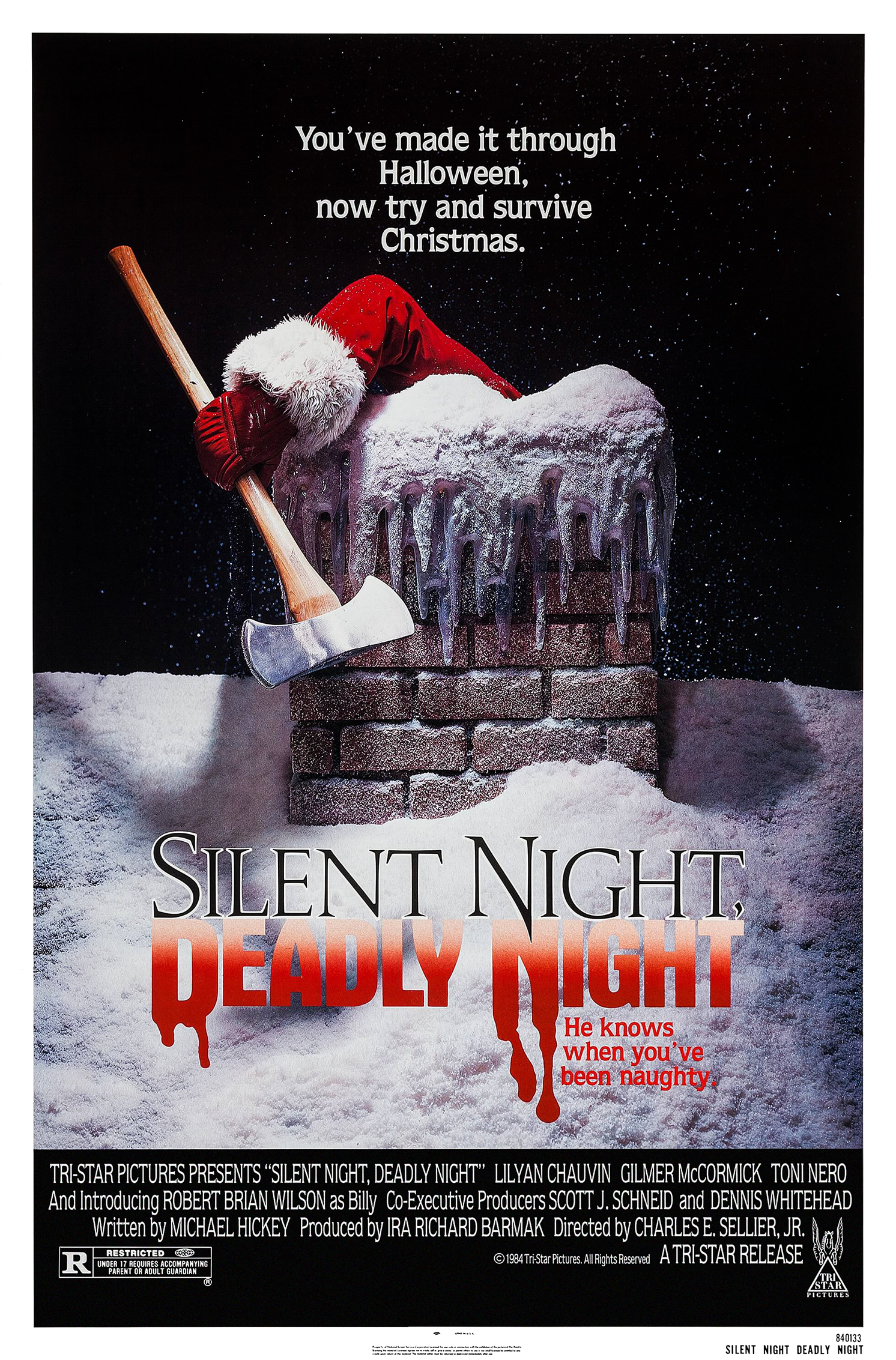
When he’s only 5-years-old Billy Chapman (Jonathan Best) has a very traumatic experience. It starts when he and his family are visiting their grandfather (Will Hare) inside a senior living facility. While his parents and younger brother are temporarily out of the room his grandfather, who usually never says a word, suddenly speaks by warning him about Santa Claus and how he punishes those who’ve been naughty. On the car ride home, his family is attacked by a gunmen dressed as Santa (Charles Dierkop) who has just robbed a liquor store. Both his parents are killed by the man, but Billy manages to escape by running out of the vehicle and hiding behind some bushes. Things now flash forward to the year 1984 where Billy (now played by Robert Brian Wilson) is 18 and still suffering from the dark memories of the event as well as the abusive upbringing inside the orphanage he was sent to that was ruled by a tyrannical Mother Superior (Lilyan Chauvin). Working as a stock boy at a nearby toy store, he gets asked to fill-in as Santa when the man who usually plays him calls-in sick. Playing the part though brings back up all the repressed emotions of what happened years earlier causing him to have a mental breakdown and turning him into a killer. 

This film ended up becoming quite controversial and it all started when producer Scott J. Schiend accepted story submissions from the public to help him decide what movie project he’d like to finance next. One of those submissions was short story written by a recent college grad named Paul Caimi entitled ‘He Sees You When You’re Sleeping’, which involved a killer Santa. Schnied became intrigued by the concept and hired Michael Hickey to write a full-length screenplay around the premise. Once completed the script was shopped around until Tri-Star Pictures decided to pick-it-up and finance it as well as act as its distributor. 

Since there were already two other films that had been released that dealt with a killer Claus including the 1972 horror anthology Tales from the Crypt, and the 1980 slasher You Better Watch Out! no one behind-the-scenes was expecting this one to create much controversy since neither of those had. However, mainly because of an aggressive marketing campaign, it soon caused the ire of many parents who felt based off of the TV-ads that this film would tarnish the image of Santa Claus and make children fear him and thus a movement to have the movie removed from theaters was created. Even Siskel and Ebert got in on it by focusing an entire episode of their show to it and reading out the names of the cast and crew in order to ‘shame’ them for having worked on the production. The movie was soon pulled after having been in theaters for only a week, but the controversy ended up having a Streisand effect as it garnered it more attention than it would’ve otherwise, and it made a hefty profit at the box office and ultimately became a cult hit that spawned 4 sequels as well as a reboot.  

It seems to me that most people that protested the movie didn’t actually watch it because if they had they’d realize that it’s made very clear that the guy doing the killings isn’t really Santa nor does he even look much like him. The kid who plays him doesn’t even bother putting the beard on and his own face is constantly exposed while he does the butchering, so at no point does the viewer ever see him as being anyone other than a troubled teen with severe mental issues. I actually wished the part had been played by Dierkop who portrays the initial Santa during the hold-up and puts far better energy into the role and genuinely looks more like the classic Claus both in his age and physical build. 

The movie puts a lot of effort into showing how Billy became the way he does, but for me that was a problem as it gets too plodding and seems to take forever for the carnage to get going, which for a slasher fan is what you really want to see. Would’ve been better had it started out right away with this guy Santa killing people, maybe even one of the kids who sits on his lap at the store, and with no reason why he was doing it, and then through intermittent flashbacks allow his back story to be revealed versus having the background painfully elaborated from the start, which takes away any mystery, or surprise. There’s also the issue of young Billy having prominent brown eyes, but when he reaches adolescence his eye color suddenly turns to blue. 

Spoiler Alert!

My biggest complaint though is with the Mother Superior. Chauvin plays the part quite well making the nun scarier than the killer and somebody you really love to hate, but she’s never killed off, which is a huge disappointment. Many people who grew up going to a strict Catholic School might’ve enjoyed seeing a disciplinarian nun get hacked and it might’ve been cathartic and thus having it not occur doesn’t give the film a sufficient payoff. 

My Rating: 6 out of 10

Released: November 9, 1984

Runtime: 1 Hour 25 Minutes

Rated R

Director: Charles E. Sellier Jr.

Studio: Tri-Star Pictures

Available: DVD, Blu-ray, Amazon Video

The Warriors (1979)

Version 1.0.0

Version 1.0.0

By Richard Winters

My Rating: 7 out of 10

4-Word Review: Back to Coney Island.

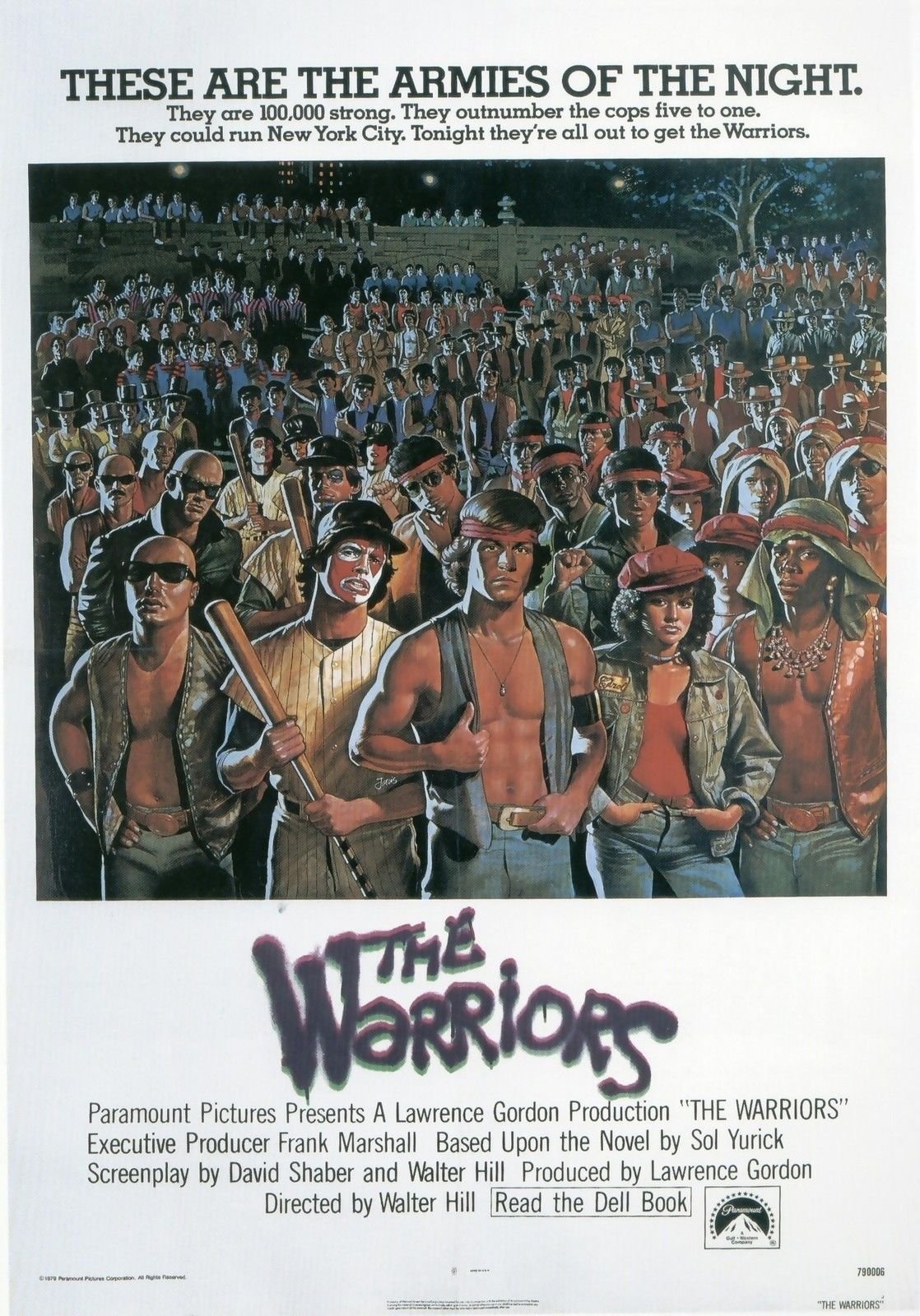
The Warriors lead by Cleon (Dorsey Wright) make their way to from Coney Island to Van Cortland Park in order to attend an outdoor rally lead by Cyrus (Roger Hill) who heads the gang called The Riffs. It’s Cyrus’ idea to bring all the gangs in New York City together as one because if they do so they’ll be able to outnumber the police. However, Luther (David Patrick Kelly), who’s a member of the Rogues gang is not privy to this idea and thus shoots and kills Cyrus, which gets witnessed by Fox (Thomas G. Waites) a member of the Warriors. Once Luther realizes he’s been spotted he quickly accuses the entire Warriors gang of carrying-out the murder, which sends the mob into violent chaos and in-turn causing the death of Cleon. Swan (Michael Beck) becomes the group’s new de-facto leader though it receives a frosty reception from Ajax (James Remar), but since they’re in such an urgent situation he has no time to fight him for it as the gang now must make their way back to the safety of their territory while having to trek through the turfs of other gangs who are all out to kill them.

For a film about gang life this one is quite different. Most of the movies before then that dealt with this topic would typically place the protagonist as being someone outside of the gang culture, but here that outside world doesn’t even exist. Everything is fully from inside the gang world, which is what makes it so fascinating as the viewer gets immersed into a universe that most likely they really wouldn’t experience or understand otherwise. However, as big as their turfs wars are one of the most memorable moments in the film doesn’t deal with the action at all, but instead it’s the scene inside the subway car where some suburbanites come-on after a night at the club and sit across from The Warriors, who are quietly judged, through their glances, at the disheveled nature of the gang members, which they’re distinctly aware of, revealing how even though in the gang’s mind their the ‘top dog’ of their universe, they’re still perceived from the mainstream world as being people to look down upon.

I also really dug the gang attire. Some may argue this gets ‘campy’ and hurts the realism with proposed remakes offering to play down some of it, but for me it’s what makes it more fun. Personally, I found the Baseball Furies and roller-skating gang known as The Punks to be generally frightening. Even if the gang carrying baseball bats wears facial make-up resembling the rock band KISS I still in no way would want to meet them in a dark alley and in a lot of ways The Warriors constantly coming into these weird gang types as they cross through their territories creates a surreal nightmare atmosphere.

I did though find some of the action to be problematic. It starts with The Warriors trying to outrun another car driven by a rival gang, which I found unrealistic. Possibly if it was a short distance then maybe, but to go several blocks wouldn’t be fathomable. I would think at least a couple of the gang members would tire-out and slow down and ultimately be hit by the vehicle. Having The Warriors totally annihilate the Baseball Furies even though it was the Furies with the baseball bats while the Warriors had only their fists didn’t make sense either. Maybe you could argue that The Warriors had such good fighting skills they were able to use that to overpower the other side, but logically I think one or two of them should’ve at least gotten hit by a bat, which the Furies were swinging wildly, and the fact that they’re all able to get out of the fight unscathed is a bit of an eye roll. Having a few of them later trapped in a room with a female gang that shoots directly at them with a gun and none of them get hit by even a stray bullet is equally unrealistic. Also, since they all get involved in punching their opponents, you’d think there would be numerous scratches, abrasions, and dried blood on the broken skin of their knuckles, at the very least, but on the subway ride after the fights there’s a quick close-up of Micheal Beck’s hands, who was involved in the majority of battles, and they’re completely unblemished.

The 1965 novel version, the author, Sol Yurick, was not happy with the film, has many differences including the gang rape of the female, played in the movie by Deborah Van Valkenburg, by the protagonist gang members, that doesn’t occur here. The book also delves more deeply into the gang leaders sad home life, which the movie doesn’t tackle at all, but it would’ve helped create a better understanding of the main character’s motivations. If a remake does get made, and it’s been talked about, I think it would be more interesting if it followed the book’s plotline, which ultimately is grittier.

My Rating: 7 out of 10

Released: February 9, 1979

Runtime: 1 Hour 33 Minutes

Rated R

Director: Walter Hill

Studio: Paramount

Available: DVD, Blu-ray, Amazon Video, YouTube
Intruder (1989)

intruder2

By Richard Winters

My Rating: 6 out of 10

4-Word Review: Killer in grocery store.

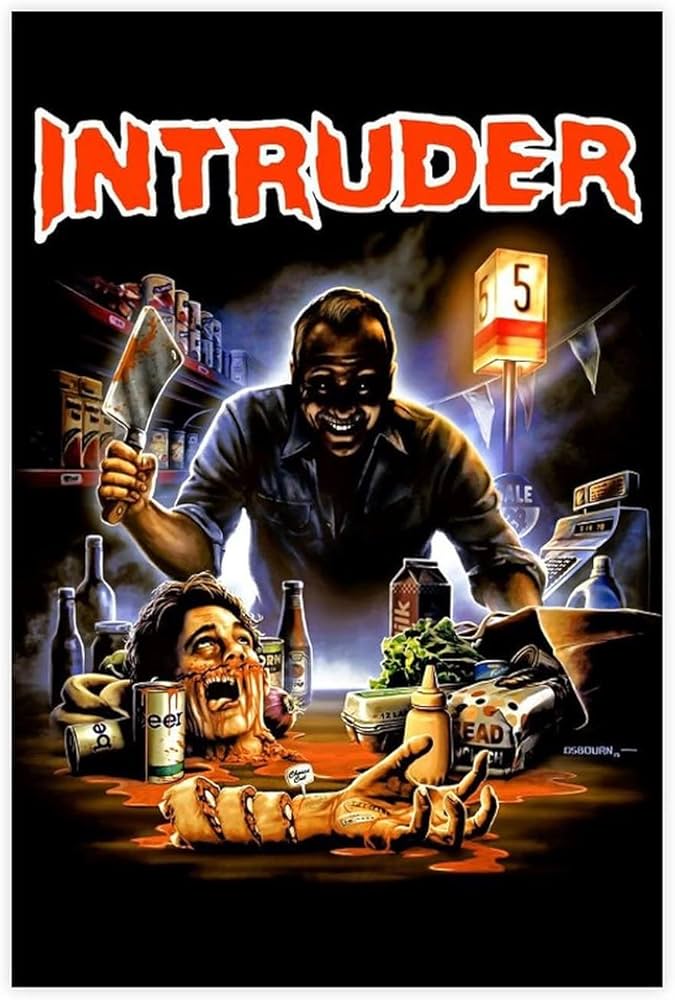
Jennifer (Elizabeth Cox) and Linda (Renee Estevez) are two cashiers working the night shift at a grocery store. Just before closing Jennifer gets confronted by Craig (David Byrnes) a man she dated briefly who pressures her to get back together. When she refuses he becomes irate prompting Linda to alert the store owners (Dan Hicks, Eugene Robert Glazer). The police are eventually called in, but by then Craig has disappeared yet as the night progresses the night crew begins being stalked by some mysterious person that they can’t see. Eventually they start to turn-up dead having been killed in gruesome and novel ways. Is Craig the one behind it, or is it possibly someone else?

The concept is an interesting one as all the action takes place entirely on the grocery store premises with the majority done inside though there’s a few scenes that happen just outside of it. Scott Speigel, who co-wrote Evil Dead II with Sam Raimi, who appears as one of the store employees, got the idea for the film after working as part of the night crew at a Michigan grocery store and in fact ‘Night Crew’ was the movie’s original title, as well as the short film that was shot before they found funding to make a feature length version, but the distributors felt a more generic horror title would help it sell better. It was shot inside a former grocery store that was now empty in Bell, California where they hired a company to deliver two tons of damaged goods in order to use that to line the shelves.

The film is well directed with a lot of unique camera angles including a shot seen through a wine bottle another one where the point-of-view from inside a telephone looking-up and another showing someone from the outside turning a lock on a door and then having the camera shot rotate in tandem to it. The killings, once they finally get going, are adequately grisly and should suffice for gore fans.

While I enjoyed the store setting and felt they did an admirable job in making it appear like a real grocery market I was put-off with the lighting. All grocery stores that I’ve ever been to always are brightly lit in order to give-off this inviting feel and make people want to come inside. This store however was very dark and shadowy looking like no grocery place I’d ever been to and as a result it hurt the believability. Some may argue that this was the night shift and hence no need for all the lights to be on since only the overnight crew was in it, but it was very shadowy from the beginning even before it had closed and customers were still in it. I also didn’t care for the cameo appearances by Aly Moore and Tom Lester, two men who had been cast members in the old ‘Green Acres’ TV-show. Not sure what the relevance was for having them appear here, but they don’t really add much to the story and their bumbling ways don’t help add any tension and if anything detract from it.

The story moves a bit too slowly to the extent I started to worry if the killings were ever going to get going, or if it all was just one of those gimmicky horror flicks that ultimately isn’t very scary, or gory at all. The tension ebbs quite a bit and it would’ve worked better had the killer had some sort of identity, even if it was just wearing a goofy mask, versus having it be someone we never see. The idea that this killer would be able to single-handedly lift someone into the air simply by grabbing the victim’s hair and then proceed to shove them completely through store shelves, or hang them effortlessly on meat hooks, is absurd and makes the culprit seem more like a supernatural entity instead of the human that he is.

Spoiler Alert!

The ultimate reveal where the killer is exposed as being Bill the store’s co-owner was a bit of a surprise, but his motivations didn’t make sense. I could understand that he was upset about the store going out-of-business and would want to kill his partner for allowing it, but why kill all of the employees? If the idea is to ‘save’ the store this isn’t exactly a good way of going about doing it. His explanation that he simply got ‘carried away’ doesn’t suffice. If he really is just ‘crazy’ then elements of his insane personality should’ve come to the surface long before just that night.

Having Jennifer and her former boyfriend Craig, the only two survivors, get arrested for the crimes does have an ironic twist to it, but then leaving everything as a sort-of cliffhanger isn’t satisfying. The original ending was to have the camera go inside Jennifer’s screaming mouth, as she’s protesting her arrest, and down her throat until it got to her heart, which would then be shown as stop beating, but because it would be too complicated to shoot the idea got scrapped, but it would’ve been a cool final shot for sure.

My Rating: 6 out of 10

Released: January 27, 1988

Runtime: 1 Hour 28 Minutes (Unrated Version)

Director: Scott Spiegel

Studio: Empire Pictures

Available: DVD, Blu-ray, Amazon Video, Tubi, Full Moon

Creepshow 2 (1987)

creepshow2

By Richard Winters

My Rating: 6 out of 10

4-Word Review: Three stories of terror.

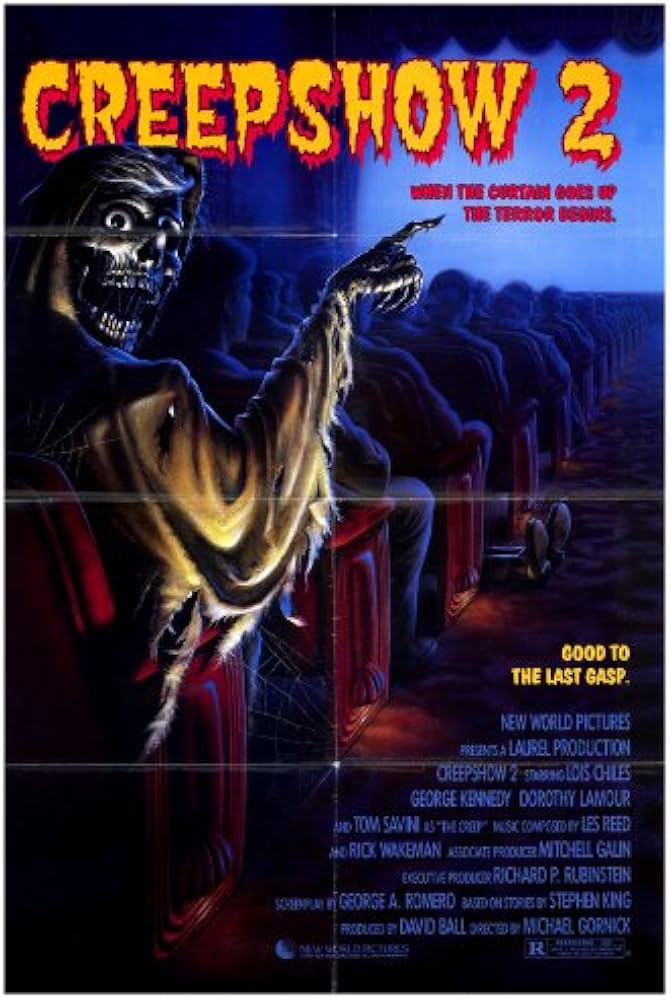
Due to the success of the 1982 installment Stephen King and George Romero got together to write a second script based on three of King’s short stories and directing duties were turned over to Michael Gornick who had been the cinematographer on the first one. The budget was much lower than the first, which hampered the special effects and critical reception though it still made $14 million at the box office and has garnered a cult following amongst contemporary audiences.

The first, which is the weakest, stars George Kennedy and Dorothy Lamour, in her last film appearance, as owners of a small-town general store that’s no longer making any profit. An Indian tribe elder (Frank Selsado) gives the couple a bag filled with jewelry as repayment for a debt and then later that night three hooligans lead by the long-haired Sam (Holt McCallany) rob the store and kill the couple. The three think they’ve gotten off scot-free, but then the cigar store Indian that stood in front of the store comes to life and avenges the couple’s deaths by murdering the three boys one-by-one.

This segment takes a while to get going and really doesn’t get interesting until the robbery happens, which should’ve occurred sooner. While the effects of showing the wooden Indian moving around is impressive as it really looks like he’s made of wood and not just somebody in a costume it would’ve been more intriguing had it not given away who the killer was. Simply shown the three being hacked by some mysterious, shadowy figure and then only at the very, very end alluded to it being the Indian.

The second story is better and deals with four college friends (Paul Satterfield, Jeremy Green, Daniel Beer, Page Hannah) going for a swim on a remote lake. They leave their car running and then all dive into the water and swim out onto a wooden raft, but then notice a black, gooey substance that surrounds them. The four feel trapped and when one of the young ladies puts her hand into the water the blob sucks her in and drowns her. The blob then seeps its way through the cracks of the raft and kills another one leaving only two left.

This one is genuinely creepy and I liked how it’s shot under a bright sunny sky making the area appear inviting and no need for anyone to be guarded until it’s too late. The constant shots of the running car sitting on the beach not far from where the swimmers are on the raft, but still unable to get to it, heightens the tension as well as the fact that there’s never any answer to just what this substance is, which in this case accentuates the intrigue. The only thing that I didn’t like is that after being stuck on the raft for an entire day the guy holding the sleeping girl lays her down onto the raft floor, but then uses the opportunity to undress her and admire her breasts, but I’d think with the situation they were in he’d be too exhausted and frightened to think about sex. The ‘twist’ at the end, which shows a No Swimming sign posted in a grove of trees, which the young adults hadn’t spotted, doesn’t totally work because if there’s no swimming in that lake then why would there be a wooden raft in the middle of it and who put it there?

The third story is the best and features a middle-aged woman, played by Lois Chiles, who goes on a drive late one night and accidentally kills a hitchhiker (Tom Wright) when her car goes spinning out-of-control. Instead of offering aid to the man she just drives-off, but then becomes plagued by visions of him constantly reappearing during the rest of her trip making her panic as she attempts to ‘re-kill’ the man, so she can be rid of him once and for all.

Initially this one seemed like a redo of the classic ‘Twilight Zone’ episode that featured actress Inger Stevens who went on a car trip and kept seeing the same hitch-hiker at various intervals on her drive, but this one takes it a step further by having Chiles use her car to literally smash the guy again and again, which gives it a gruesome over-the-top quality that deftly mixes in gore and black humor perfectly.

The film was set to have two other stories, ‘Cat from Hell’ and ‘Pinfall’, but due to budgetary limitations it was decided not to proceed with those and they were never filmed. In the ‘Cat from Hell’ one a hitman gets paid $100,000 to kill a cat that’s supposedly killed three other people. The ‘Pinfall’ one deals with competing bowling teams where the one team kills the other one, by tinkering with the van they ride in, and then the dead team coming back to life as zombies and killing the other team in unique ways by using things only available in a bowling alley, which sounded really cool and it’s a shame this segment wasn’t made as it would’ve been the best of the bunch.

My Rating: 6 out of 10

Released: May 1, 1987

Runtime: 1 Hour 30 Minutes

Rated R

Director: Michael Gornick

Studio: New World Pictures

Available: DVD, Blu-ray, Amazon Video, Plex, Pluto TV, Tubi, Roku, YouTube

Fright Night (1985)

fright1

By Richard Winters

My Rating: 6 out of 10

4-Word Review: Vampire moves next door.

Charley (William Ragsdale) is a teen making-out with his girlfriend Amy (Amanda Bearse) in his bedroom one night when he looks out his window and sees movers carrying a coffin into the home next door. Throughout the proceeding days he becomes convinced, after eyeing what’s going on over there, that his new neighbor, Jerry Dandridge (Chris Sarandon), is a vampire. With the police refusing to believe him he feels his only option is to elicit the help of an actor named Peter Vincent (Roddy McDowall) who has starred in a lot of old movies about vampires and hosts a horror TV-show called ‘Fright Night’. Peter does not believe Charley at first, but when they go over to Jerry’s house for a visit he becomes convinced that Charley is telling the truth when he can’t see Jerry’s reflection in a mirror. Knowing that he’s now been found-out Jerry immediately goes on the offense by turning Charley’s friend Ed (Stephen Geoffreys) into a vampire and then setting his sights to do the same to Amy who closely resembles a woman he was once deeply in-love with.

The film became a surprise runaway hit despite the studio feeling it had no chance and pumped more money into the John Travolta, Jamie Lee Curtis film Perfect that was being shot at the same time. Because the execs were putting more focus on that one they left writer/director Tom Holland alone allowing him full directorial control and not forcing him to have to deal with the usual studio meddling. Holland, who had started out as an actor during the 50’s and 60’s before eventually moving into screenwriting during the late 70’s when his acting offers began to dry up, came up with the idea for this film while working on his Cloak & Dagger script and since he had won accolades for some of his earlier horror scripts that had gone onto success including Psycho IIhe was offered the chance to make his directorial debut with this one.

The film has a wonderful tongue and cheek approach, which keeps it consistently entertaining and lively throughout. While it’s funny at times it also has some really impressive special effects done well before the advent of CGI, but in many ways better. The best one and possibly best moment of the whole movie is when Ed morphs into a wolf and attacks Peter and Peter is able to pierce the dogs heart with a broken chair leg forcing the injured and dying Ed to slowly return to human form, which is both gory and realistically handled and creepy visually. If there’s definitely one part to watch again and again and never get tired of it would be that one.

The acting is stellar particularly Sarandon who displays a casual and very frightening menacing quality that makes all of his scenes unnerving. Supposedly he attempted to try and humanize his character by adding in certain traits that were not in the script like him eating apples to show how he was using it to help ‘cleanse his pallet from all the blood he had sucked’, but to me he just came off as this constant evil presence and one of the scarier film villains in horror movie history. Bearse, who has become better known for her work in the TV-show ‘Married with Children’, is entertainingly feisty as the teen girlfriend despite being already 28 at the time of filming though you really couldn’t see it.  Though not as well known Dorothy Fielding is very amusing as Charley’s daffy mom and I wished she had been in it more and of McDowall is absolutely perfect in a role that was originally intended for Vincent Price.

While the film has a lot going for it I did find its logic to be problematic. I found the fact that Amy so closely resembles Jerry’s past love from long ago to be too much of a coincidence and felt there should’ve been more of a backstory. The idea that these kids would choose some two-bit actor in their quest to defeat this vampire made no sense as an actor is just reading words off of a script and would have no more insight into vampires than your local junkman. Having Peter be some self-promoting vampire hunter and advertise his ‘vampire eradicator services’ in TV-ads, even if he was just a huckster, would’ve at least been a better choice than expecting someone starring in low budget movies from years ago to be the solution that will ‘save them’. Also, him bringing along a gun that he used in a past movie, in order to deploy it to shoot Jerry’s bodyguard, played by Jonathan Stark, is another head-scratcher because movie guns are props that shoot blanks instead of real bullets.

The use of the cross to ward off vampires gets confusing. When Peter attempts to use it on Jerry it isn’t effective and yet when Charley tries it it works. Jerry says this is because ‘you have to have faith’, but what type of faith? Faith that it will work, or faith in a deity? To help clarify this Charley should’ve been shown earlier, even briefly, as having some spiritual leanings, or just a quick shot showing the Holy Bible in his room would’ve been enough. Also, when Peter uses the cross against the vampire Ed it’ works, so why is this, or does Peter’s ‘faith’ go flip-flopping back-and-forth?

Spoiler Alert!

Having Amy transform into a vampire and to be advised by Peter that if Jerry gets destroyed before dawn  the process will reverse seems like its making up rules as most vampire movies I’ve seen seem to say the opposite like once they’re bitten there’s no going back. Having the two then go back just a few nights later after the big ordeal is over and be snuggling together in his room didn’t seem believable to me. Personally if I were Charley I don’t care how deep my feelings were for her I’d still be frightened to be alone with her especially after seeing her face turn into such a scary bloodthirsty monster. In the back of my mind I’d be paranoid it could happen again and who’s to say it wouldn’t. I realize American audiences are conditioned to expect everything to ‘work-out’ in the end and if it doesn’t they get cranky, but having things here go back to normal was too quick and seamless. Psychologically there would’ve been post traumatic stress by all and this overly smooth resolution is phony.

My Rating: 6 out of 10

Released: August 2, 1985

Runtime: 1 Hour 46 Minutes

Rated R

Director: Tom Holland

Studio: Columbia Pictures

Available: DVD, Blu-ray, Amazon Video, YouTube
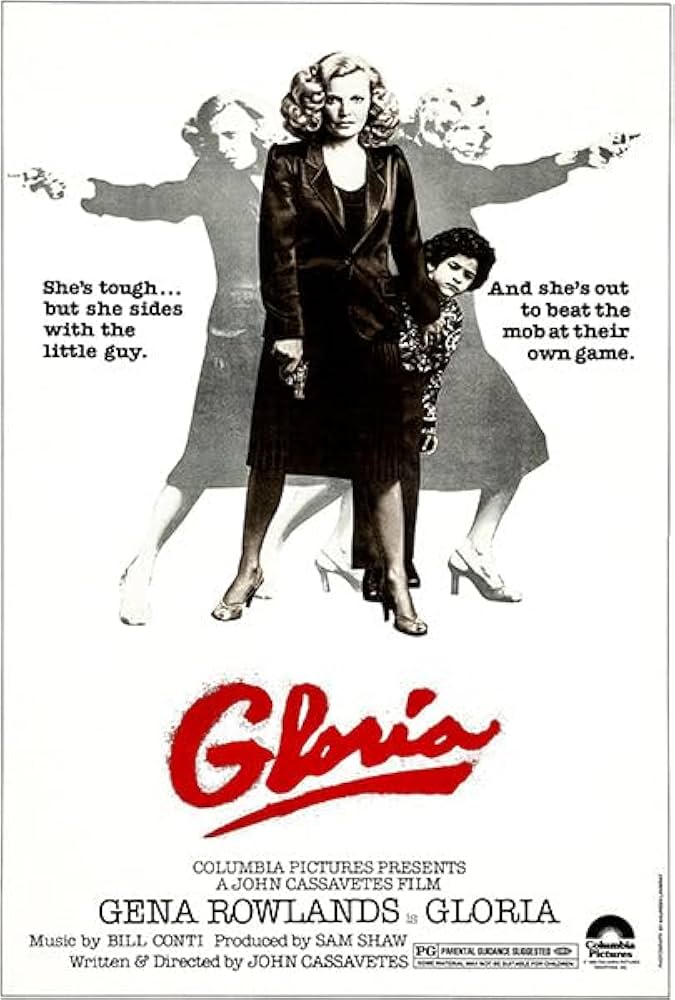
Gloria (1980)

gloria

By Richard Winters

My Rating: 8 out of 10

4-Word Review: Protecting a young boy.

Phil (John Adams) is a young boy whose father (Buck Henry) works as an accountant for the mob and has become an informant for the F.B.I. causing him and his family to become marked for retaliation by the criminal underground. In desperation Phil’s mother (Julie Carmen) pawns the child off on Gloria (Gena Rowlands) who’s their neighbor from across the hall. Gloria initially refuses to take the child as she’s adverse to kids, but eventually agrees as she takes the boy away and into her apartment just as the mob moves in on the hit. Phil was also handed by his father the ledger listing in detail the mob’s incriminating financial corruption and when they’re unable to find it after annihilating his family they then go after the pair. Gloria, who has mob connections from her past including having been in relationship with a mob kingpin, feels she can’t go to the police and must defend the child on her own using only her street savvy and gun, but where ever they go in the city the hit men remain right behind them.

John Cassavetes, who has described this as “a thoughtless piece about gangsters and I don’t even know gangsters” was never intending to direct it and though it’s become his most popular work among mainstream audiences it was one of his least favorites and something he felt embarrassed about doing. He wrote the script simply to sell it and make enough money from it to help him finance his other projects. He completed it in early 1979 and was meant as a vehicle for Ricky Schroeder who was just coming-off doing The Champ and MGM studio was looking for other projects for him to do. Cassavetes intentionally gave it a very commercial feel, much more than any of his other scripts, because he felt it would give it a better chance to sell, but when Schroeder and Barbara Streisand, who was the original choice for Gloria, both turned it down Cassavetes then shopped it around to Columbia Pictures who agreed to take it on, but only if Rowlands played the lead and since she was his wife he then reluctantly took on the directing duties.

The film doesn’t seem like the usual Cassavetes material as I was quite impressed with the location shooting, which takes the viewer to all sorts of New York City locales and makes you feel like you’re right there with Gloria and the boy as they try to maneuver their way around the unpredictable and very dangerous urban jungle. The opening bird’s-eye shot that tracks from the city’s skyline to Yankees Stadium is downright breathtaking and the grimy, rundown interiors of the family’s inner city apartment building effectively illustrates on a purely visual level the fear, stress, and tension of living in the inner city is truly like. Leonard Maltin, in his review, labeled this as being possibly done ‘for laughs’, but I didn’t find anything funny about it except for one amusing comment Gloria makes when she gets stuck in a slow elevator, but otherwise it’s a nail-bitter all the way through.

Rowlands gives her usual stellar performance, but I was hoping for more of an arch with her character. She states right up front to Phil’s mother that she hates kids and yet is pretty much warm and friendly to the child the second she takes him back to her apartment and it would’ve been more interesting to see her cold and indifferent to him initially only to slowly warm-up to him as their shared adventure went on. Buck Henry is also surprisingly good in an unusual casting choice as he’s typically known for his deadpan humor and had very little dramatic acting in his background. It was strange though why such a small, squirmy guy who was hitting 50 would be married to such a hot young Latino woman who looked to be only 24 and I felt this needed to be explained, but isn’t. I also felt the shooting of the family should’ve been shown, it gets implied, but that wasn’t enough. Seeing them shot in graphic style would’ve really hit home how dangerous and serious these people were and would’ve made the tension even stronger.

Critics at the time of the film’s release didn’t like the kid nor his acting and in fact Adams got nominated for the first razzie award for worst actor, which traumatized him so much he decided never to pursue anymore roles and to date this has been his only film appearance. I for one happened to like the kid and yes his character isn’t exactly ‘cute and cuddly’, but real children rarely ever are. They can be as rude, indifferent, and crabby as any adult and since he was brought-up in a troubled neighborhood having him be a bit ‘rough-around-the-edges’ made sense and was realistic. The only acting that I really didn’t care for was from Basilio Franchina who plays a crime boss that Gloria used to date and while he may have looked the part his performance is stiff like he’s just regurgitating lines he’s memorized and there’s no sign of a chemistry between them and their conversation is stilted and unconvincing.

Spoiler Alert!

The mob’s ability to be constantly on the pair’s tale no matter where they went seemed a bit implausible especially being in such a big, congested city, but I was willing to forgive it since the rest of it is so good. The ending was a little problematic too as it has Gloria reappearing disguised as an old lady after it was presumed she was dead. She then reunites with the kid in the middle of a cemetery, but it leaves more questions than answers like how did the two evolve? Did they become like mother and adopted son and where did they ultimately move to since New York for them was no longer safe? This might’ve gotten answered in the sequel that Cassavetes had written, but unfortunately never got green-lit. Remade in 1999 with Sharon Stone in the lead.

My Rating: 8 out of 10

Released: October 1, 1980

Runtime: 2 Hours 2 Minutes

Rated PG

Director: John Cassavetes

Studio: Columbia Pictures

Available: DVD, Blu-ray, Amazon Video, Tubi, YouTube

The Hit (1986)

hit

By Richard Winters

My Rating: 5 out of 10

4-Word Review: Not afraid to die.

Willie (Terence Stamp) turns states evidence against the criminal underground that he’d been apart of, which then sends his former partners away to prison, but before they go they sing ‘We’ll Meet Again’ just as he leaves the court room. Ten years later Willie is living the quiet life in Spain as a part of the witness protection program only to have his home invaded by a group of teens who kidnap him and take him to hitman Braddock (John Hurt) who was hired by the kingpin that Willie helped put away. Braddock along with his young partner Myron (Tim Roth) are instructed to take Willie, via a car, to Paris where the kingpin hopes to inflict harm on Willie before eventually killing him. However, things don’t go quite as planned as Willie shows no fear of death insisting that he’s accepted it as a part of the cycle of life and this throws the two hit men off convinced that he must have something up-his-sleeve, but does he?

This is another example where a movie I enjoyed when I first watched it years ago, but doesn’t quite live up to expectations upon the second viewing. For the most part this doesn’t happen that often and there has been some cases where a movie I didn’t like when I first saw it I’ve come to appreciate when seen a second time. This one though is definitely a case of the former and I came away a bit miffed on what its point was. When I first saw it I was impressed by the scene at the waterfall where Willie, who had a chance to escape, but doesn’t and instead decides to spend his time appreciating nature’s beauty until Braddock catches up to him, I found at the time to be quite memorable and unique moment as it revealed that the bad guy in this instance was the one more afraid and insecure of death than the intended victim.

However, there’s a lot of stuff that doesn’t mesh, or could’ve been more convincing. I had a hard time understanding why this sophisticated criminal group would hire a bunch of teen boys to break into Willie’s home (hideout). How could they trust these novices to get the job done and the fact that they’re able to do it so easily makes it seem that Willie’s ‘protection’ as it were wasn’t too impressive. It also negates the effect of the criminal unit. They’re supposedly this cunning, evil, underground group relentlessly pursuing their man against this supposedly intricate government program, but if literal kids can just break down the door with just a bit of effort then the whole operation from both sides comes-off as rather amateurish.

The casting of Hurt as the bad guy isn’t effective mainly because of his meek stature. Stamp was originally intended for that role and with his big build and piercing blue eyes would’ve been perfect, but it was ultimately decided for both actors to play against type and thus the parts got reversed, but it really doesn’t work. Hit men should have an intimidating presence, but with Hurt’s slim figure and quiet, exhausted looking demeanor that doesn’t happen. Roth as his quick-triggered, youthfully naive henchmen makes matters worse as he’s a walking cliche of a teen in over-his-head just biding time before his knee-jerk reactions to do them in. Thus the psychological games that Willie plays with them are not that interesting, or impressive since these two come-off as badly dis-coordinated right from the start and like any average person could easily outfox them.

Stamp’s character is baffling as well. During the courtroom moments he states his testimony is an almost hammy way like he’s making fun of the whole situation, which maybe he is, but it’s not clear as to why and his ulterior motivations are never answered. It’s hard to tell whether he really is a good guy, or maybe secretly a bad one as there are scenes where he puts other potential victims in definite danger and then feigns ignorance about it afterwards. He spends the whole time telling everyone how death doesn’t scare him and yet when a gun does finally get pointed at him he panics and tries to run while also pleading for his life, so which is it? The same goes for Roth’s character who during the course of the movie he seems to be falling for the lady hostage, played by Laura del Sol, and even protective of her and yet when the time comes for Hurt to shoot her he puts up no fight, or resistance, which defeated the momentum and missed-out on what could’ve been an interesting confrontation.

I like movies with multi-dimensional characters and the film does have that and certainly humans can be a bag full of contradictions. However, at some point it kind of needs to explain itself and it fails on that end. Intriguing elements about these people get thrown-in, but the story fails to follow through with it ultimately making it too vague, ambiguous to be full satisfying and in many ways it will most likely leave most viewers frustrated and scratching their heads as they ask themselves what the point of the whole thing was supposed to be.

I did though really enjoy the scenes with Australian actor Bill Hunter who is marvelous in support playing a man who takes over one of Hurt’s friend’s apartments while on vacation only to get the shock of his life when the hit man and his entourage show up unexpectedly. His rather pathetic attempts to mask his fear and trying to somehow carry-on a casual conversation knowing full well he could be blown away at any second is dark comedy gold and by far the film’s best moments.

My Rating: 5 out of 10

Released: May 18, 1984

Runtime: 1 Hour 38 Minutes

Rated R

Director: Stephen Fears

Studio: Zenith Entertainment

Available: DVD, Blu-Ray (Criterion Collection), Tubi, Plex

Meatballs (1979)

meatballs2

By Richard Winters

My Rating: 3 out of 10

4-Word Review: Shenanigans at summer camp.

Tripper (Bill Murray) has been assigned to lead a new group of counselors-in-training while simultaneously pulling pranks on camp director Morty (Harvey Atkin). He also takes shy camper Rudy (Chris Makepeace) under his wings and giving the kid some confidence, so that he can play in sports and feel that he has a chance to win. Tripper also gets involved in the annual Olympiad between his camp, Camp North Star, and their rival Camp Mohawk, which sits across the lake from theirs. Camp Mohawk has won the title the past 12 years, but this year Tripper thinks things will be different mainly because he’s trained Rudy on how to be a cross-country runner due to their early morning jogs together and assigns him, much to the disagreement of the other campers, to run against Mohawk’s top runner in the crucial final race.

This was the fourth film directed by Ivan Reitman and while he went on to direct a lot of big hits I felt here he was still learning the craft and it would’ve been a better movie had someone with more experience been at the helm. Originally it was intended for John Landis to direct, but he was too busy working on The Blues Brothersso Reitman reluctantly took the reins, but the pacing and tone is all off. To some degree it seems to want to be an Animal House wanna-be filled with off-color humor and slapstick, but at other points it tries for sentimental drama. Nowhere is this more evident than it’s eclectic choice of music featuring bouncy tune by Rick Dees and then turning around and having a sappy song by Maureen McGovern that seems out of place for a film that most of the time dwells in low brow humor.

Story-wise it’s incredibly vapid and seems to almost be plotless most of the way. The main crux of the script is apparently centered around Rudy and Tripper’s attempts to help him find some confidence in himself, but even these moments come-off as trite and thrown-in at haphazard intervals. In-between we get treated to a lot of silly hijinks and benign characterizations that mostly fall flat. There’s a lot of potential story threads that the could’ve been funny, but the movie fails to follow through on.

There’s a segment where the parent’s come to visit for a day, but this lasts for a minute and then it’s over. I also wanted to see the reluctant Rudy give out the morning messages of the day via an intercom set-up that had been traditionally done by Tripper. Since Tripper was going to be out he handed over the duties to Rudy who seemed nervous about the responsibility, so it would’ve been interesting to watching how he ended up approaching it and how the other campers responded, but instead we aren’t shown any of it. The same goes for a little boy who brings a frog with him that doesn’t ever move because he’s ‘tired’ yet we never get any follow-up to this, so why even have the scene, which isn’t funny or interesting anyways, if it has no real point to the plot?

The running gag involving the camp director named Morty who’s constantly referred to as ‘Mickey’ gets overblown and rather dumb. It has him being such a sound sleeper that the other campers, under Tripper’s guidance, move him and his bed, along with his bedside table, out of cabin and into various other parts of the campsite including at one point on a raft on a lake. When he wakes up he then finds himself in a very precarious situation, but it’s hard to believe that someone could sleep that deeply that they would’ve wake-up while they were being moved. Even if that were the case you’d think they’d come-up with some way to prevent it occurring in the future like bolting their door shut, or constructing some sort of booby trap that would catch the pranksters in the act. This could actually make it even funnier as it would be upping the ante each time versus just replaying the same old prank. At the very least you’d expect an ultimate angry confrontation between Morty and Tripper who he knew was behind it, which at one point he threatens to do, as he states ‘we’ll talk about it later’, but we never see the ‘talk’ actually happen, which again makes it seem like the movie really isn’t going anywhere.

Bill Murray, who reportedly wasn’t sure if he wanted to do it due to his SNL obligations at the time, but finally did show up to the shoot on the third day of production, is genuinely quite funny and the only things that saves it from being a dud though it comes close to being one anyways. However, his character does prove to be a bit problematic in the scene where he aggressively tackles an attractive counselor he wants to have sex with, played by Kate Lynch, which would be deemed sexual harassment in this day and age and not the ‘good natured, boys will be boys’ fun that it was considered at the time.

The film though does manage to elicit nostalgic homage to the camping experience, so those that look back to their summer camp days with fond memories may bond to this better. Otherwise I found it highly overrated and genuinely surprised that it did so well at the box office.

My Rating: 3 out of 10

Released: 1 Hour 34 Minutes

Rated PG

Director: Ivan Reitman

Studio: Paramount Pictures

Available: DVD, Blu-ray, Amazon Video, Freevee, Pluto, Roku, Tubi, YouTube