Category Archives: Cult

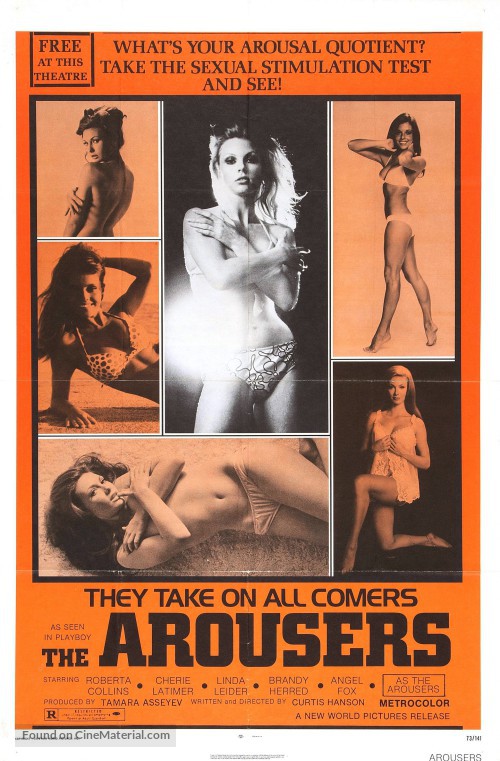
The Arousers (1972)

sweet-kill-1

By Richard Winters

My Rating: 5 out of 10       

4-Word Review: He suffers from impotence.

Eddie (Tab Hunter) is a good-looking high school athletic coach who is a magnet to the young southern California women that inhabit the area. Unfortunately Eddie cannot perform in bed and the stress and shame that he feels because of this causes him to murder the women that he attracts.

The original title for this film was Sweet Kill, which I liked better, but because it did not make any money at the box office it got reissued as The Arousers, with nude scenes of voluptuous women added in, which doesn’t really improve it. The film is indeed pretty slow, but I still found it strangely captivating. The story has a real-time approach with more emphasis on seeing the characters as real people than on the chills or shocks. Charles Bernstein’s acoustic musical score is excellent and helps build the tension by being soft at the beginning to the point of barely being detected and then becoming increasingly more present as the film progresses.

Hunter’s excellent performance is not only the best of his career, but one of the better psycho’s in horror film history. The way his eyes glare with evil is impressive and the film makes attempts to show the character’s frustration at suffering from inner shame and not just a one-dimensional killer.

It’s great that the film brings out an important social issue, which at the time was still quite taboo and not at all talked about. Unfortunately the story makes no attempt to explain the cause. Impotence can be caused by many different factors, so the character didn’t necessarily need to be pinpointed with one, but more of a background would’ve helped the viewer understand his inner demons better.

The killings themselves aren’t interesting and the story is too one-sided as we see everything from the killer’s perspective where the tension would’ve been heightened had there been a side-story dealing with a police investigator on his trail. The ending offers no payoff outside of seeing Hunter give off a menacing scowl that rivals Jack Nicholson’s from The Shining. The movie also offers a glimpse of Angus Scrimm, who later became famous for playing The Tall Man in Phantasm, in his film debut.

sweet-kill-2

My Rating: 5 out of 10

Alternate Title: Sweet Kill

Released: May 15, 1972

Runtime: 1Hour 23Minutes

Rated R

Director: Curtis Hanson

Studio: New World Pictures

Available: DVD

Bloody Birthday (1981)

bloody-birthday

By Richard Winters

My Rating: 5 out of 10

4-Word Review: Sociopathic children become murderers.

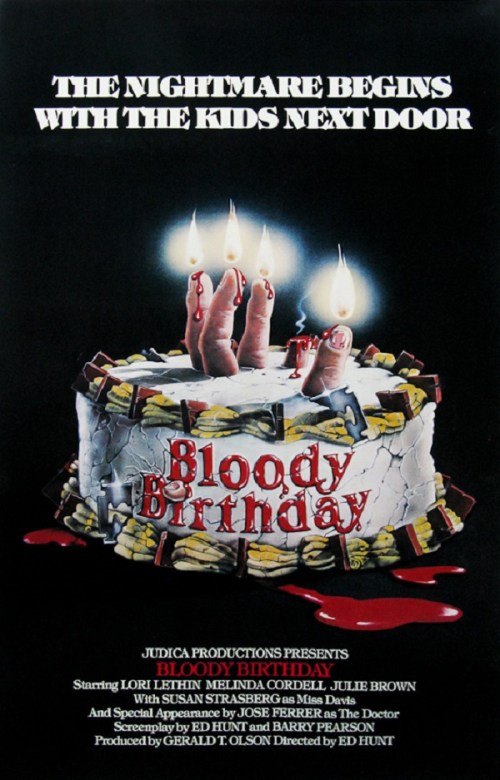
Three children (Billy Jacoby, Elizabeth Hoy, Andrew Freeman) who were born during a solar eclipse become cold-blooded killers ten years later. The reason is because during their births the sun and moon blocked Saturn, which is the planet for emotions, so they’re devoid of any feelings and kill for the pure enjoyment of it and even proudly keep a scrapbook filled with newspaper articles of their dirty deeds. Because they’re just children nobody believes that they’re the actual culprits to the rash of murders that are happening. Only Timmy (K.C. Martel) and his older sister Joyce (Lori Lethin) are on to them, but can they get the rest of the town to believe them before it’s too late?

Minor, but still watchable horror outing requires the viewer to buy into the astrology nonsense in order to enjoy it, but manages to be paced well enough to remain mildly entertaining. The murders aren’t too gruesome and if it weren’t for an abundance of nudity, which includes actress Julie Brown fully in the buff, this could’ve been a TV-Movie where it might’ve fared better.

The kids are fun as the killers. Both Hoy and Jacoby have a good menacing quality to their facial expressions, which helps. Jacoby, who now goes by the last name of Jayne, has an older brother Scott who already played a similar psycho kid in Rivals.

The murders are okay, but cannot hold up to even minor scrutiny.  The kids kill the sheriff (Bert Kramer) by bashing him over the head with a baseball bat and then try to make it look like it was an accidental fall, which would’ve only caused one blow, but an autopsy would’ve confirmed several blows and the freak accident theory would’ve immediately crumbled. The idea that such a small girl would be able to effectively use a bow-and-arrow is not believable and the opening sequence features a young couple who decide to go into a hole in the ground to make-out, but how many real-life couples would consider jumping into a dirt hole to be sexy or romantic?

I found the Joyce character to be annoyingly goody-goody, but was still impressed with her resourcefulness. The entire scenario though goes on too long and becomes derivative with a twist ending that’s only marginally acceptable. The film also offers familiar faces in small, pointless bits including Jose Ferrer, Susan Strasberg, and Joe Penny.

My Rating: 5 out of 10

Released: April 28, 1981

Runtime: 1Hour 24Minutes

Rated R

Director: Ed Hunt

Studio: Judica Productions

Available: DVD, Blu-ray, Amazon Instant Video

Don’t Go in the House (1980)

dont-go-in-the-house

By Richard Winters

My Rating: 5 out of 10

4-Word Review: He burns his victims.

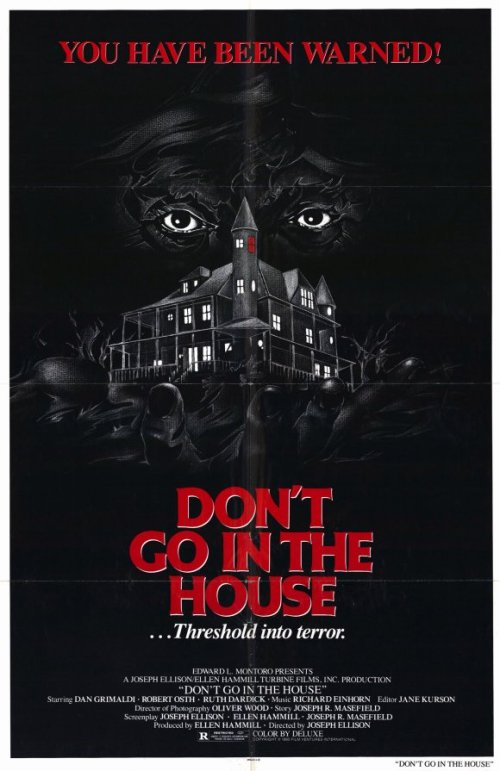
Donny (Dan Grimaldi) is a grown son living at home with his mother (Ruth Dardick) and suffering from the nightmares of his childhood where she would routinely burn his arms on an open flame every time he misbehaved. When she dies he decides to use his new found freedom to pick-up women at random, bring them back to his place and then burn them to death with his blow torch. Afterwards he dresses the corpses up, puts them into a bedroom where he routinely visits them and has ‘conversations’.

The film uses its low budget to great effect by becoming a grainy, starkly realized journey into a madman’s mind. The large, rundown 21-bedroom home that Donny lives in and has now become the Strauss Mansion Museum in Atlantic Highlands, New Jersey offers a terrific backdrop. The decayed, rundown interior becomes a motif to Donny’s deteriorating mind. The faded color matches the grim subject matter and even the sound, which has a constant popping noise like it was taken from a corrupted tape, gives off an eerie feeling like listening to muffled dialogue from a secret, underground source. The cold, gray, wintery landscape adds even more to the bleak ambience.

Director Joseph Ellison seems intent on forcing the viewer to get inside the killer’s head and understanding things from his point-of-view. Instead of having a robotic, evil killing machine we get an overgrown man-child, so tormented from his upbringing that he is unable to know right-from-wrong and burns his victims under a misguided notion that it is somehow ‘cleansing’ them from their sins. The surreal dream done along a lonely beach in which Donny sees his victims come back to life and who drag him down a hole is well captured with just the right amount of atmosphere that easily makes it the best moment in the movie.

Some viewers have found the scene where Donny burns a woman alive inside a metal room while she dangles from a rope to be ‘repugnant’ and ‘going too far’ and has helped the movie achieve a notorious reputation. The scene though is really not all that graphic. We never see the victim actually burned just the lighted blow torch coming towards the screen and then it cuts away. The masks worn by the burn victims isn’t any different from those worn by dead decomposed bodies in other films, so it’s really more what’s implied that upsets some people than what is actually shown.

The film’s only real drawback is that it is much too similar to William Lustig’s Maniac that starred Joe Spinell and came out at around the same time. Both film’s deal with killer’s that have a severe mother complex, hear voices inside their heads, dress the bodies of their victims up, store them in their homes, have ‘conversations’ with them and even harbors visions of them coming back to life to seek revenge. The similarities between the two movies are so striking that they come off like a carbon copy to the other, which seriously hurts the tension because you feel like you’ve seen it all before.

My Rating: 5 out of 10

Released: March 28, 1980

Runtime: 1Hour 30Minutes

Rated R

Director: Joseph Ellison

Studio: Film Ventures International

Available: DVD, Amazon Instant Video

The House on Sorority Row (1983)

house-on-sorority-row

By Richard Winters

My Rating: 4 out of 10

4-Word Review: House mother harbors secret.

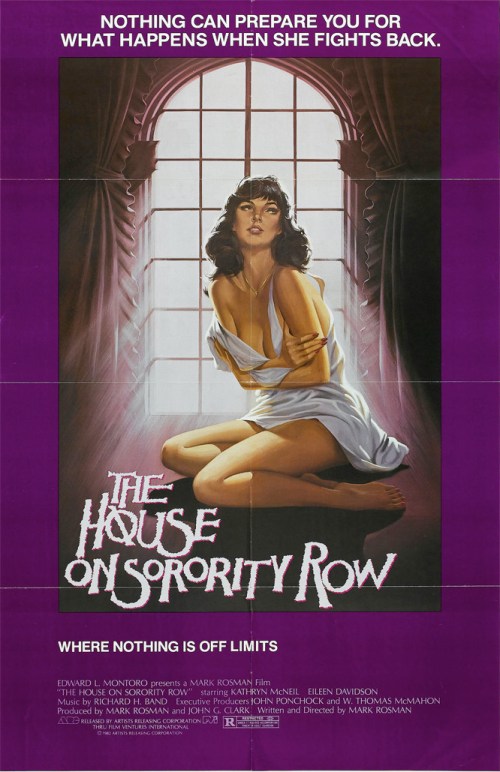
Mrs. Slater (Lois Kelso Hunt) is a crabby house mother of a college sorority who tends to be quite terse and controlling to the girls that she oversees. When she catches Vicki (Eileen Davidson) having sex with her boyfriend she punctures the water bed that they are on, which causes Vicki to seek an elaborate revenge in the form of a practical joke. The joke though goes awry leading to the accidental death of Mrs. Slater. The sorority members hide her body, but then it disappears while the girls start to get picked-off one-by-one by a mysterious assailant.

This is far more stylishly directed than the usual horror film and this becomes quite apparent right from the start. I loved the opening flashback sequence, which is tinted in blue-and-white and a crane shot done over the opening credits. There is also a tracking shot that goes down the hallway of the sorority house that nicely captures the energy and ambience of the first day of moving in. The soundtrack, which uses the music of the London Symphony Orchestra, is another plus.

The acting is better than in most low budget horror films. Some will point to the line delivered by actress Jodi Draigie “How do we know she is alive” as being the single worst line reading in the history of cinema, which it could be, but overall the performances are decent particularly by Davidson. The only exception is Hunt as the house mother. She certainly has the face of a crabby old lady, but her delivery is very monotone and comes off like it was dubbed. Later I read in an interview with director Mark Rosman where this was indeed the case as they felt her actual voice was too high pitched, but why replace it with one that is even worse.

The use of Mrs. Slater’s walking cane as a murder weapon seemed ridiculous. The idea that this thing could be so sharp that it could cut through walls and people’s skulls with one swing made it seem more like an ax. The pressure of it continually cutting through hard surfaces, and then subsequently being removed so it could be used again, would most likely have broken the thing in half. The fact that she had used it for many years would’ve worn it down to more of a dull and smooth surface and not that of a steely, razor sharpness. There is also a scene where the cane is taken away from Mrs. Slater and she is able to walk briskly and without any noticeable limp, which means she didn’t even need it in the first place.

The killings aren’t scary, jolting or imaginative and seemed almost like they were an afterthought. Many times if you blink you’ll miss when they happen. The first killing where Mrs. Slater’s cane goes through a man’s skull looks glaringly amateurish as it is quite obvious that the victim is a mannequin.

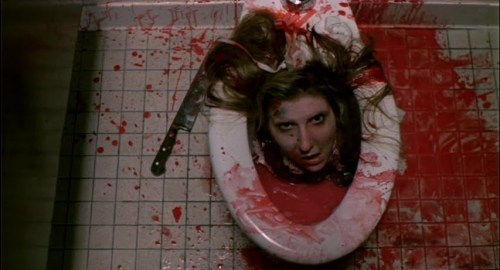
I did like the shot of a victim’s head in a toilet, but even this has issues because we don’t know what happened to the rest of her body. If the killer is walking around with a bloody headless corpse that would cause a lot of attention and the dripping blood would create a trail that would lead right to him.

house-on-sorority-row-3

Spoiler Alert!

This film has managed to garner a strong cult following, but I’m really not sure why. The more it went on the more bored I became with it. I was also irritated with the ending as we are never shown the identity of the killer. It is strongly implied who it is, but we never see his face unmasked. The original ending had police removing dead bodies from a pool and when they overturn the one wearing a clown suit it is revealed to be Katherine, the killer’s final victim, but this was rejected as being too downbeat even though I would’ve liked it better.

End of Spoiler Alert!

My Rating: 4 out of 10

Released: January 21, 1983

Runtime: 1Hour 31Minutes

Rated R

Director: Mark Rosman

Studio: Film Ventures International

Available: DVD, Amazon Instant Video, YouTube

Blood Beach (1981)

blood-beach-1

By Richard Winters

My Rating: 3 out of 10

4-Word Review: Beachgoers get sucked away.

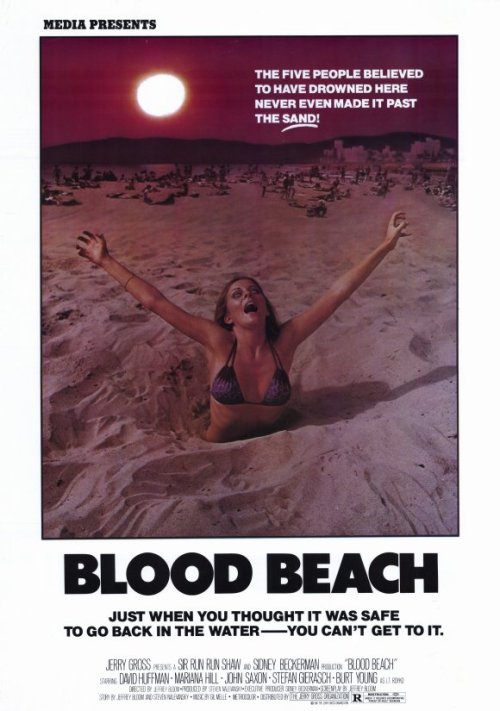
Something is lurking beneath a Southern California beach and it’s not human. People and even animals are being sucked underneath the sand and disappearing, never to be found again. Lifeguard Harry (David Huffman) tries to do some investigating while starting up a relationship with the daughter (Marianna Hill) of one of the victims, but his efforts prove futile, so the police are called in, but do no better.

One of the nice things about this movie is that unlike most other horror films from that era it actually has a pretty decent budget and distinctive music score. The beach location, which was filmed at Santa Monica, makes for a pleasant diversion from the usual horror settings and the one thing I came away liking most about the movie.

Huffman, who ended up becoming a homicide victim himself in real-life only a few years after this was filmed, is bland to the point of being completely forgettable. However, the much more talented supporting cast gives the film some life. John Saxon is great as a brash and gruff police captain. Burt Young and Otis Young are amusing as police detectives with completely contrasting styles with Otis playing an amusing extension to the character that he did in The Last Detail where he tries earnestly to reel in his more undisciplined partner.

The film’s weak point is the second act that stalls without enough new twists being brought in. Seeing people constantly being swallowed up by the sand becomes monotonous and it takes way too long before we finally get an understanding to what is causing it. The film also has some quick cutaways showing what happens to the people once they are underneath the sand, which looks like it was spliced in from a cheaper film stock with tacky special effects that may simply be a product of the ‘Complete and Uncut’ version that I saw, but should’ve been avoided.

The attempt at doing a Jaws formula storyline on land instead of the water doesn’t work and only helps make the original seem all that much better. Had this been done as a parody might’ve helped it.

Spoiler Alert!

The biggest letdown is the ending that never fully explains what this creature is and only gives the viewer a brief glimpse of it during the film’s last few minutes, which is disappointing. The story then goes full circle by showing the sand ready to swallow up more unsuspecting beachgoers while making the viewer feel like they’ve wasted 90 minutes of their time watching a film that doesn’t progress anywhere.

End of Spoiler Alert!

My Rating: 3 out of 10

Released: January 28, 1981

Runtime: 1Hour 25Minutes (‘Complete’ cut)

Rated R

Director: Jeffrey Bloom

Studio: Compass International Pictures

Available: DVD

Hobgoblins (1988)

hobgoblins-2

By Richard Winters

My Rating: 1 out of 10

4-Word Review: Avoid the furry creatures.

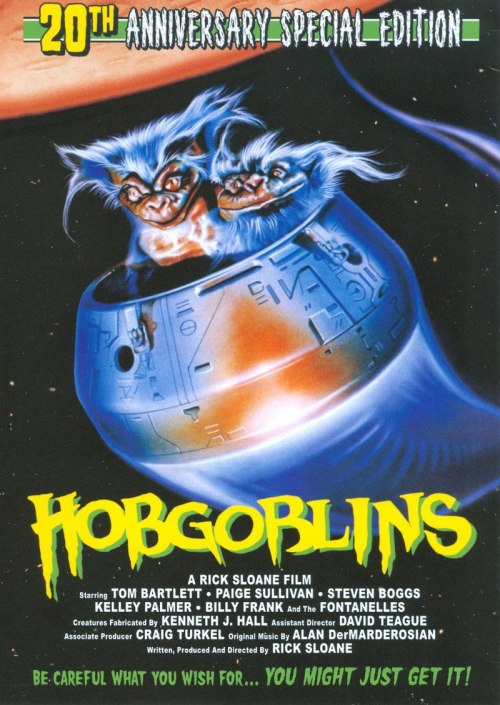
Kevin (Tom Bartlett) gets a job as a night security guard at a local factory. During his training he is told by his supervisor McCreedy (Jeffrey Culver) not to unlock the vault, but he does so anyways, which releases all these small furry creatures that apparently landed on earth 30 years ago. These aliens, which are called hobgolbins, are a nefarious bunch as they are able to delve into the thoughts and fantasies of the people around them. When a person starts thinking about their secret fantasy they are actually being controlled by the aliens, which will lead them to an ultimate death. It is now up to Kevin to try and stop these creatures before they attack his friends.

This film has attained a notorious reputation of being one of the worst ones ever made and its director Rick Sloane has become this generation’s Ed Wood. With all this considered I was actually surprised that it wasn’t quite as bad as I was expecting. In fact there have been films that I’ve seen which have been worse, which isn’t to say that it’s a good one either. The movie does take some stabs at humor and while most of it is lame the segment regarding the bouncing van, which is supposed to simulate the lovemaking actions of the couple inside, is mildly amusing.

The film’s biggest fault is its limited locations. The factory setting isn’t visually interesting and the fact that Sloane constantly goes back to shooting scenes in the same drab hallway of the place doesn’t help. The bar known as Club Scum, which is the setting for the second half of the story, has an equally bland interior. There is also the issue of the factory owner’s office being quite obviously the exact same room that is later used in another scene by a 1-900 sex operator (Tamara Clatterbuck).

The cast is made up of Rick Sloane regulars who’ve appeared in his other productions and pretty much nowhere else. Bartlett is quite weak in the lead and Culver’s old man routine especially having to watch his pathetic attempts at running are annoying and the shots showing Bartlett and Culver running in tandem side-by-side make no sense as Bartlett is much younger and could easily out run the old timer as could just about anybody else.

The plot is full of holes and the fantasies that the characters go through are generic to the extreme. The scenes inside the bar become overly extended and bog the already slow pace down until it comes to a complete standstill. The creatures are clearly just stuffed animals whose facial expressions never change and the attempts to make them look like they can move their bodies are pathetic.

The humor shifts from double-entendres to silly stuff aimed at the kids making me wonder what the intended audience was, or if they had even thought of that. About the only thing that it does accomplish is making me want to watch Gremlins again, which this tries to rip-off, since it is far better.

My Rating: 1 out of 10

Released: July 14, 1988

Runtime: 1Hour 28Minutes

Rated R

Director: Rick Sloane

Studio: American Cinema Marketing

Available: DVD (MST 3000 Vol. 8), Amazon Instant Video

Pieces (1982)

pieces-1

By Richard Winters

My Rating: 0 out of 10

4-Word Review: Cutting up the coeds.

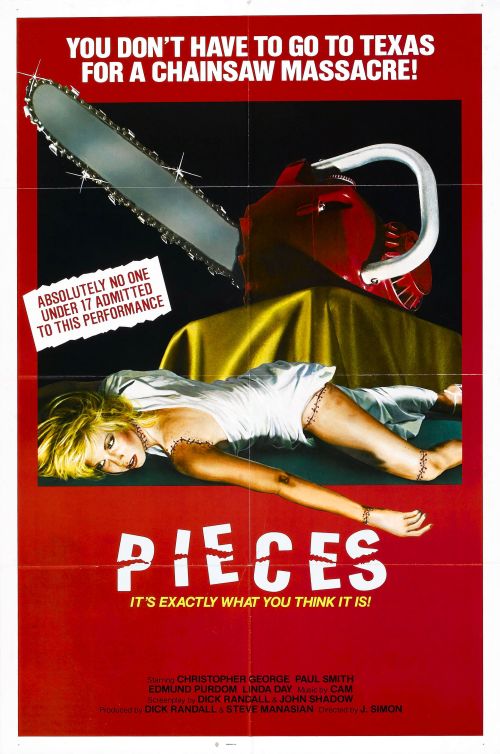
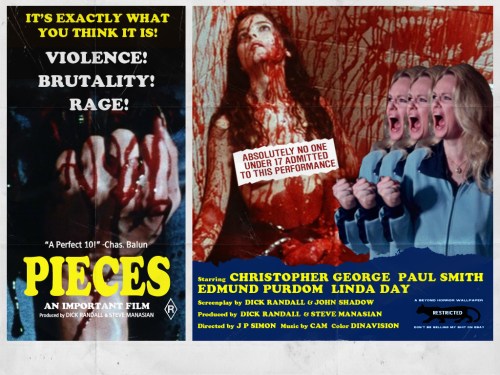
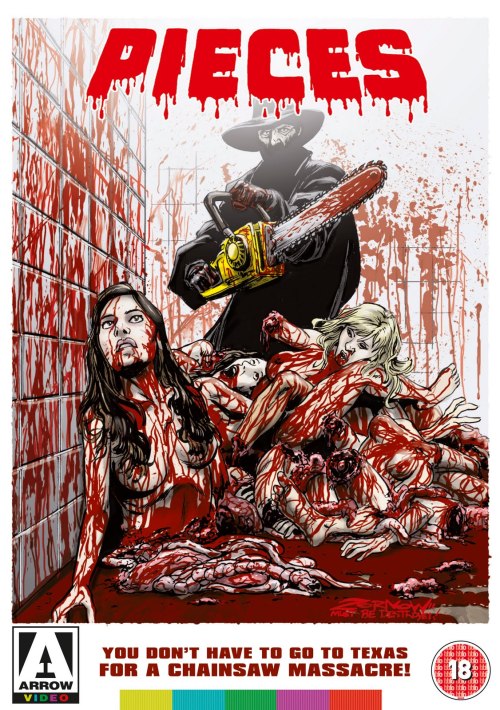
This review will be the first of many in which we celebrate October by reviewing all horror movies for the entire month. The film we look at today has managed to gain a strong cult following and deals with a Boston area college that is under attack by an elusive killer who slashes coeds to bits and then uses their body parts to create his personal human-sized jigsaw puzzle.

Horror director Eli Roth describes this film as being one of the top “horror films of all-time” and “the ultimate slasher film” with “the greatest ending in horror history”. Unfortunately I thoroughly disagree with him and was genuinely beginning to wonder if we had even seen the same movie, or if he was just joking. To me it was just another cheaply made horror flick made by a producers looking to cash in on the ‘80s slasher craze by churning out something that is completely formulaic and offers nothing new or imaginative to the genre. The plot is dull and predictable and the scares nonexistent. Even the killer is boring by appearing as this shadowy figure that has no features or distinction. Also, the film’s setting is Boston, but no one speaks with a New England accent and instead just about everyone has a European one.

The opening bit, which supposedly takes place in 1942, is full of anachronistic errors and the other killings, with the exception of the one that takes place on a water bed, fall equally flat. The one that I found particularly ridiculous features a coed, which is played by actress Cristina Cottrelli, who gets killed while swimming in an indoor pool. The killer stands on the edge of the pool and uses a long handled net to ‘catch’ her as she swims and then drags her back towards him. However, the net would be too flimsy for this and if she had given it any resistance at all it would’ve been enough to make the killer to lose his balance and fall into the pool. She also could’ve easily escaped from it by diving beneath the water. The fact that this same net also manages to knock her out is even more absurd although she does manage to regain consciousness only to see the killer coming at her with a chainsaw, but instead of just rolling back into the water for an easy escape, which is literally just inches from her, she instead passively lies there and screams while he hacks her up.
pieces-4

I might’ve given it a few points had the gore been better, but I really wasn’t impressed. There’s lots of quick cutaways before anything much is shown and the body parts were clearly just stuff taken from mannequins and then doused in red paint.

The film got some notoriety at the time for its violence and then was disown by its two stars Christopher George and his wife Lynda Day George who insisted they were unaware that this was going to be a horror film when they agreed to sign on. The truth is they were already doing a lot of horror films before this as their careers were in severe decline and it was the only thing they were being offered. Chances of them thinking this was going to be anything different was slim and they probably were simply reacting to the critical backlash and trying to save what was left of their reputations by ‘disowning’ it even though it made very little difference as George ended up dying from a sudden heart attack just 2 months after its US release.

Edmund Purdom, who was at one time a top European star during the ‘50s should’ve been equally embarrassed and apparently was equally desperate to have signed on. The only other recognizable face is Paul L. Smith who gets stuck with an insignificant role as the maintenance man and uses some over-the-top facial expressions that I found more annoying than funny.

That ‘greatest ending in horror history’ that Roth describes is also really stupid and in fact may be the dumbest part in the film. If you don’t want to read a ‘spoiler’ then look away now although it really doesn’t have anything to do with the rest of the plot anyways, which is the reason why I’m choosing not to give this paragraph my usual ‘spoiler Warning’ alert. Anyways the scene deals with a hand of a dead body suddenly reaching up and grabbing the crotch of the protagonist (Ian Sera), but the corpse was facing away from the character meaning that if it had somehow extended its arm then only the back of the hand would’ve touched the character and no grabbing would’ve occurred. Also, there were no supernatural elements ever introduced into the film, so how then does this body suddenly manage to move anyways?  ‘Surprise endings’ can be fun, but if they make no sense and have nothing to do with what’s occurred before then they become pointless and shouldn’t be added.

Some fans seem to enjoy this for its cheesiness, but for me it was a real chore to sit through and not amusing even on a bad movie level. Even if one makes a party of it by showing it with a group of friends and some beer I don’t see it getting much better.
pieces-5

My Rating: 0 out of 10

Released: August 23, 1982

Runtime: 1Hour 29Minutes

Not Rated

Director: Juan Piquer Simon

Studio: Artists Releasing Corporation

Available: DVD, Amazon Instant Video

The Cars That Ate Paris (1974)

cars-ate-paris-1

By Richard Winters

My Rating: 7 out of 10

4-Word Review: Lots of car accidents.

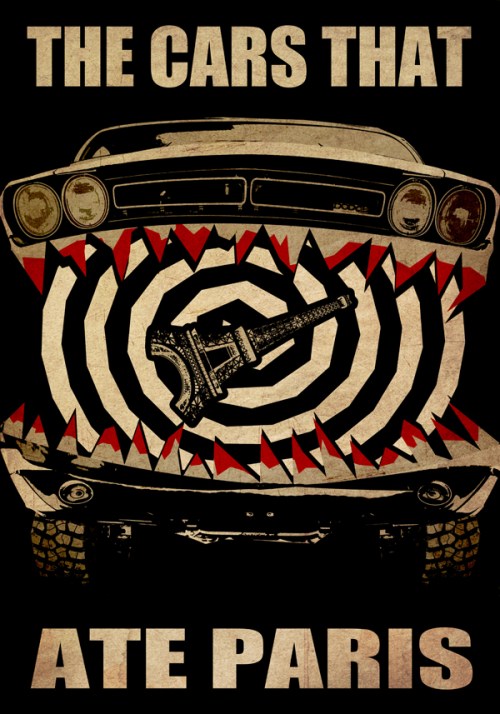
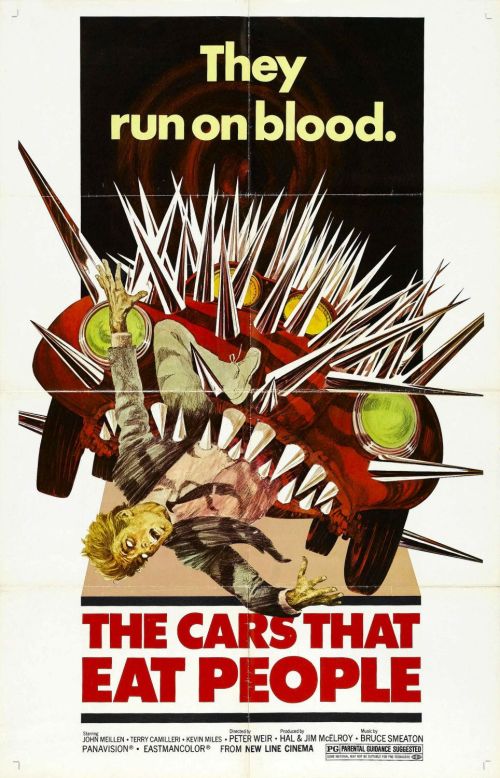
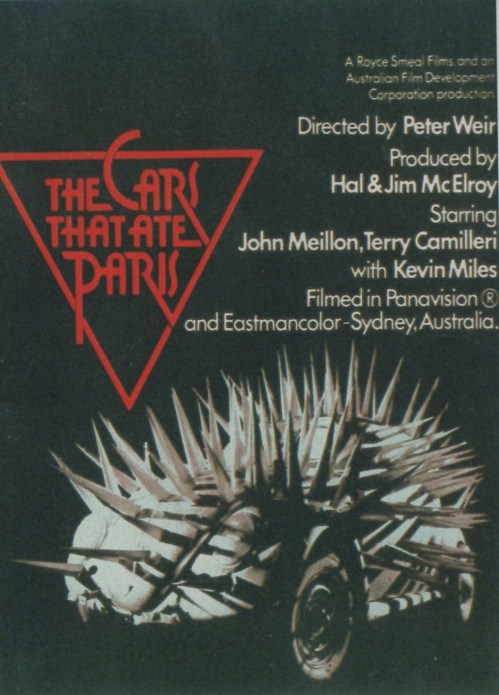
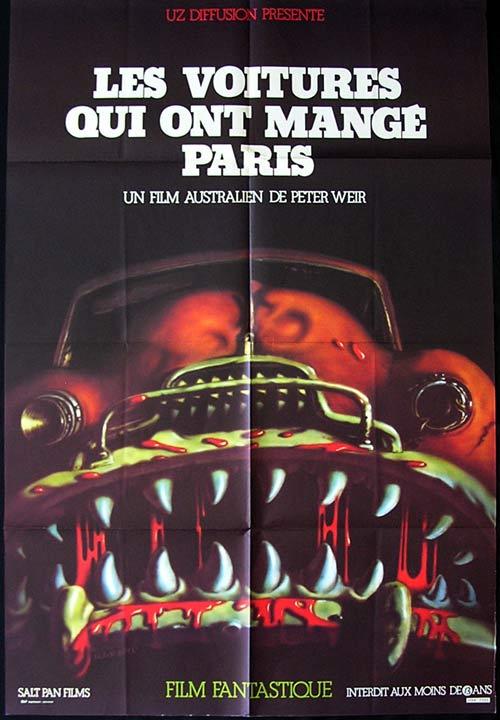
The residents of a poor Australian town known as Paris come up with a scheme to cause car accidents to those traveling through it which will allow them to salvage what’s left of the vehicle and resell it for goods or cash.  Things go smoothly for a while until Arthur (Terry Camilleri) and his brother George (Rick Scully) become victims to one these ‘accidents’. George dies, but Arthur survives and is too traumatized to get back into a car again or leave town. He takes up residence with the town’s mayor (John Meillon) who gets him a job as a parking enforcer, which causes problems when Arthur gives a citation to some rowdy young people who do not take kindly to this and seek a violent revenge.

This decidedly odd story marks director Peter Weir’s feature film debut and it’s hard to know what genre to place it into. Originally it was intended as a wacky comedy, but then dark elements were added in. Eventually it was distributed as a horror film, but it didn’t do well at the box office, so it was reissued as an art film and only fared slightly better. The film has managed to obtain a cult following and the story is original with funny moments, but the unexpectedly gory ending could leave some viewers cold as it did when it was first screened at the Cannes Film Festival back in ‘74.

cars-ate-paris-2

One of the best things about the movie is the casting of Camilleri in the lead. He’s very soft-spoken and has an almost transparent demeanor, which helps heighten the interest because you become intrigued at seeing how this schmuck is going to potentially take down this small town criminal organization, which would’ve been fun, but unfortunately the plot doesn’t get played-out in quite that way.

Meillon is solid as the mayor and I enjoyed seeing how his character puts up this calm façade while simultaneously trying to bottle up all the tension that he has inside. Bruce Spence is effective as the town crazy as well as Chris Haywood playing an average-joe who seems quite benign and good-natured at the beginning only to become increasingly more menacing as the film progresses.

The entire movie was shot on-location in Sofala, New South Wales which has a population of only 208 people and quite possibly the narrowest main street of any town in the world. Weir captures its rundown look well and helps convey how poor and isolated the residents were, which allows the viewer to understand why the people resorted to such desperate measures. However, I didn’t like how these same people immediately flee the town the minute the young adults get out-of-control. People who’ve lived somewhere all their lives become emotionally bonded to it and will not move the moment something goes wrong. They would try to control the threat if they could and only up-and-leave months or years later if they had to. Besides where would these people go as they had no money and limited job skills.

If you’re into offbeat comedy then this one may do for a slow evening although those looking for something in the horror vein will be disappointed.

cars-ate-paris-3

cars-ate-paris-4

My Rating: 7 out of 10

Released: October 10, 1974

Runtime: 1Hour 31Minutes

Rated PG

Director: Peter Weir

Studio: The Australian Film Corporation

Available: DVD

Cannonball! (1976)

cannonball-1

By Richard Winters

My Rating: 5 out of 10

4-Word Review: An illegal car race.

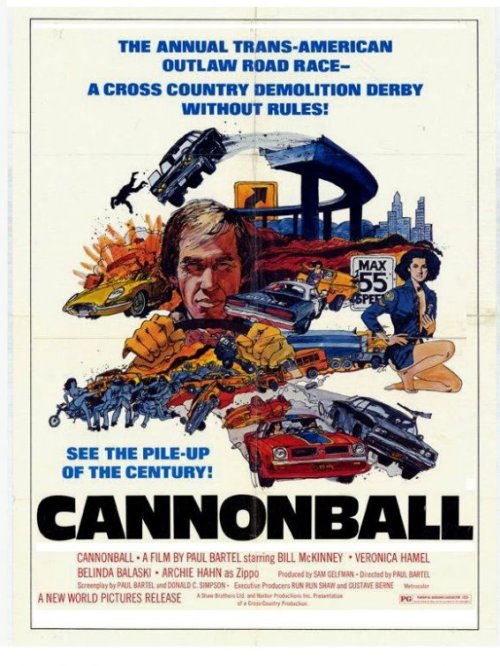
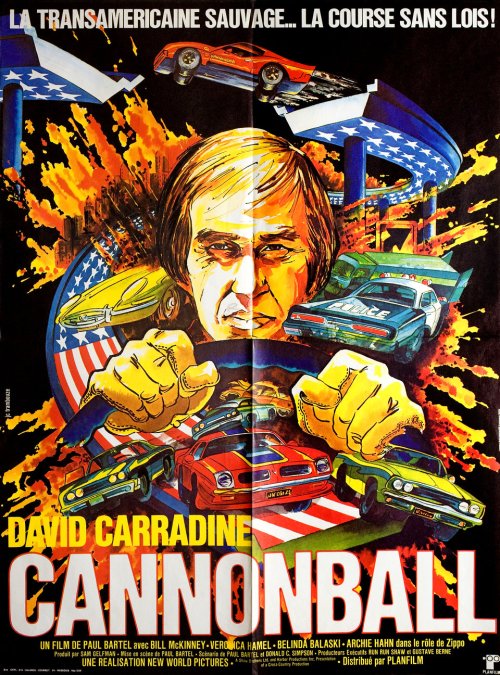
Wacky participants convene in Santa Monica to take part in an unsanctioned cross country car race. All drivers are accountable for any speeding tickets or injuries that they may accrue and the only rule is that the first person to arrive at a designated spot in New York City wins. Yet the race’s top driver Coy ‘Cannonball’ Buckman (David Carradine), who is on parole, risks being sent back to prison if he crosses the state line, but he decides to proceed any ways despite the objections of his lawyer girlfriend (Veronica Hamel) who eventually rides along with him.

This film is based on the same real-life race that inspired The Gumball Rally, but critic Leonard Maltin incorrectly states in older versions of his book that this film plagiarizes that one, which isn’t true as this movie came out first and adds in many different story angles.

Despite the fact that the production is plagued with the typically cheap Roger Corman look and seems more like an extension to Death Race 2000 I still preferred this to Gumball. Both films have characters that are decidedly cartoonish and neither film makes any attempt to recreate what really happened, but this movie has a darker edge and most thankfully a better soundtrack that doesn’t have a kiddie-like melody.

This film also reverses the race’s starting and end points. In both the real-life event and in Gumball the starting point was New York, but here it’s California, which is actually a plus. In Gumball the drivers seemed to go from the Big Apple to the desert southwest in a matter of only a few minutes, which made no sense. Here the film crew is allowed ample time to take advantage of the closed desert roads to do their car stunts, which aren’t bad, and it also sets up an ending in which driver Mary Woronov arrives in New York, but then gets lost in the congested traffic and can’t find the finish line, which is the film’s funniest bit.

The cast is much more eclectic. I really enjoyed Judy Canova in her final film appearance as her facial expressions are a hoot especially as she has her car gets rear-ended by Carradine’s. Dick Miller is entertaining as a man that tries to rig the race and Bill McKinney is very effective as the bad guy. Director Paul Bartel and producer Roger Corman have bit parts as does Carl Gottlieb the man who penned the screenplay for Jaws. Other directors make cameo appearances including Jonathan Kaplan, Allan Arkush, Joe Dante and even Martin Scorsese.

Yet what I really liked is the massive car pile-up that occurs near the end that features car after car crashing into an already existing accident and then exploding one after another into a ball of flames. This was considered quite controversial amongst the crew and star Carradine tried to convince Bartel not to put it in, but he insisted and I’m glad he did. Yes it’s morbid, but it helps put a touch of reality into the whole thing. The ‘70s were filled with a lot of silly car chase movies all with the running theme that people needed their ‘freedom’ and having a speed limit takes away all the ‘fun’, but there is a reason why those rules were put into place as what starts out as a good time can easily turn into something horrific in a matter of seconds. To me this was Bartel’s way of spitting-in-the-face at all those other inane road race movies that always took an innocuous angle while conveniently ignoring the ugly realities that existed just beneath the surface.

cannonball-2

My Rating: 5 out of 10

Released: July 6, 1976

Runtime: 1Hour 34Minutes

Rated R

Director: Paul Bartel

Studio: New World Pictures

Available: DVD, Amazon Instant Video
THX 1138 (1971)

thx-1138

By Richard Winters

My Rating: 9 out of 10

4-Word Review: Sex is not allowed.

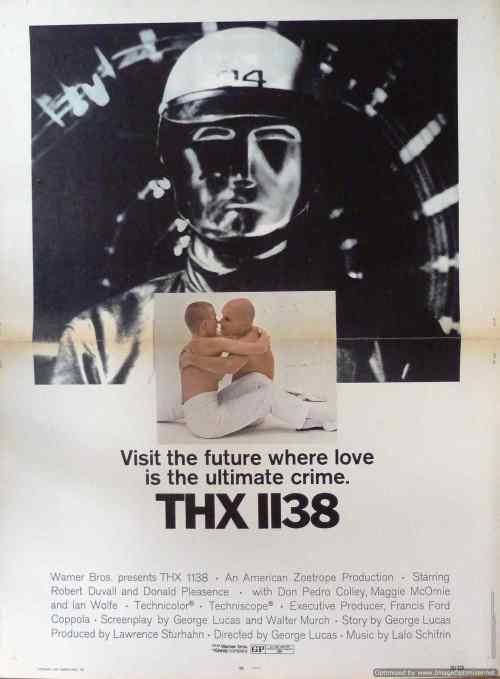
THX 1138 (Robert Duvall) is member of a futuristic, work camp-like society where everyone has shaved heads, forced to take drugs to control their emotions and avoid having sex, which is forbidden. His days are spent on the production line where he helps build police androids and at night he goes home to an apartment where he rooms with LUH 3417 (Maggie McOmie). She is unhappy with her situation and stops taking the required drugs while replacing THX’s with placebos. The two begin a sexual affair and are promptly arrested. THX is thrown into a modernistic prison that has no walls or bars and he eventually decides to attempt a daring escape with the help of SEN 5241 (Donald Pleasence) and a hologram known as SRT 9 (Don Pedro Colley).

This story is an extension to the student film that director George Lucas made while attending the University of California film school. That film was a 15 minute short entitled Electronic Labyrinth: THX 1138 4EB, which dealt with a man trying to escape from a futuristic world while being chased and monitored by government run computers. It won first place in the 1968 National Student Film Festival and was good enough to gain the attention of Francis Ford Coppola who offered to produce a feature film dealing with the same basic premise, but having more of a background to the character and his reason for escaping.

Reportedly Lucas considers this to be his favorite project and despite the fact that it did not do well at the box office I consider it to be his best stuff as well. The visuals are imaginative and striking and make you feel like you are entering a whole new world unlike any that had ever been created before. I especially liked the prison scenes where the characters are surrounded by nothing but an unending white as well as THX’s medical examination done exclusively by robotic arms. Having the characters framed towards the side of the screen instead of the center while action occurs just out of view helps accentuate the off-kilter vibe and was year’s ahead-of-its-time.

Even though there is very little dialogue or music the sound becomes an integral part of the film by relying on comments made by the androids who tell the people in a HAL-like tone to ‘stay calm’ as well as the state sanctioned god known as OHM who routinely advises his followers ‘to be happy’. The best part though comes when two techs have a casual a conversation while viewing through monitors the torture of THX.

The film is visually groundbreaking and one of the greatest directorial debuts of any director living or dead, but it still comes with a few caveats. One is the fact that the plot relies too heavily on the stereotypical Orwellian view of the future where everything is worse than it is today and people no longer have any individual rights. Yet technology has proven to make life increasingly easier for people and with more freedoms and options, so why would everything suddenly revert the other way? Maybe they were survivors of a nuclear holocaust and this society was humankind’s way of ‘starting over’, but that’s never made clear and it would’ve been nice to at least get a glimpse of the person, or people who were behind-the-scenes with the ultimate authority as well as some sort of backstory.

There is also the fact that everyone in this society needs to be working, but jobs today are increasingly being lost to automation every year and that trend will continue. Certain nations like Finland are already experimenting with paying their citizens a basic salary because there are more people than jobs available.  Citizens of future societies are predicted to have more free time than ever before, so why doesn’t the world in this film follow suit? If this society can build android cops why can’t they also build robots to do the all the other jobs too, which would then allow the humans to have more of an idyllic existence than a workaholic one?

I also wasn’t too crazy about the 2004 digital restoration, which added new special effects and footage. I last saw this film in 2001 and could tell right away that this version had been tampered with. I realize that Lucas has been known to do this with his Star Wars films, but to me it’s as bad as colorization. Why mess with something that is already good? The added computer effects does not ‘enhance’ anything, but instead desecrates the original vision and treats it like it were a video game than a movie.

My Rating: 9 out of 10

Released: March 11, 1971

Runtime: 1Hour 28Minutes

Rated R

Director: George Lucas

Studio:  Warner Brothers

Available: DVD, Blu-ray, Amazon Instant Video, YouTube