Category Archives: Court Drama

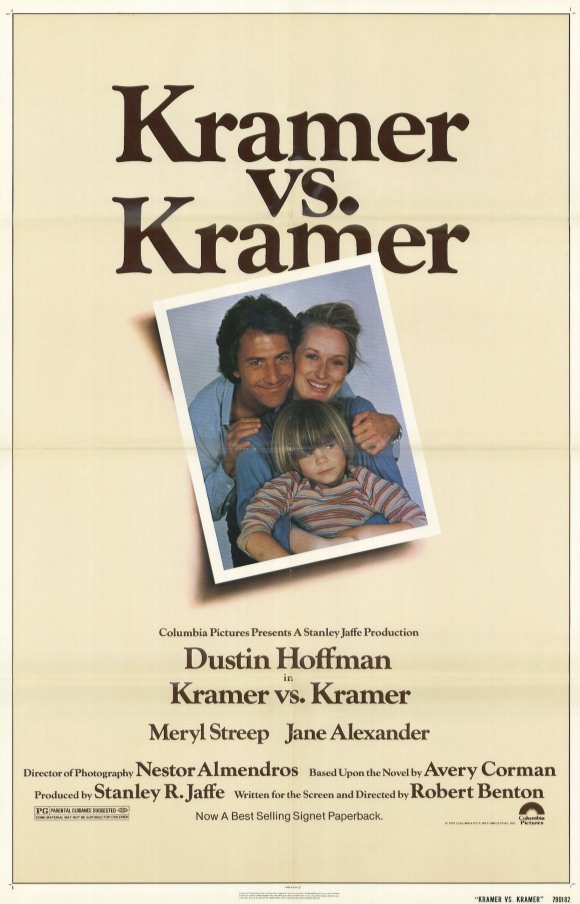
Kramer vs. Kramer (1979)

kramer vs kramer

By Richard Winters

My Rating: 10 out of 10

4-Word Review: Life after wife leaves.

This is a solid drama detailing the divorce and subsequent custody battle between two young, educated and upper middle class parents (Dustin Hoffman, Meryl Streep).

To say that this is simply an examination of divorce and its effects on both the child and parents do not do the film justice as this is a very richly textured story that brings out the many variables that come with being a modern day parent. One of the best is the examination of Hoffman’s character’s job and how ‘moving up the corporate ladder’ can have an adverse effect on a man’s home life and his family members. In fact this is a major factor to his break-up and emotional detachment with his wife.

The film also offers a nice glimpse between father and son and the scenes showing this relationship are quite touching especially as they learn to coexist with one another after the mother leaves. Justin Henry doesn’t get enough credit for his performance as the son. Yes, he is adorable in the typical child-like way, but he also manages to create a child character that is diverse and memorable.

Hoffman gives a superior performance and in many ways it is all about him and his adjustment at playing the dual roles of being both a father and mother. He has his aggressive New Yorker persona, but you understand it and really feel for what he is going through. Even watching him frantically running around from place-to-place is interesting.

Streep is also outstanding in what is kind of an unusual role for her. Typically she plays strong-willed women with a strong on-screen presence, but here her character is rather weak and suffers from problems that are elusive, but still intriguing.

Howard Duff is solid as Hoffman’s attorney and Jane Alexander offers good support as the next-door-neighbor although her character is a bit too ordinary and could have been supplied with a few interesting quirks.

The subject itself is still quite topical and everything is kept in a real perspective with nothing getting overblown or clichéd.  Robert Benton’s direction is flawless as it pays attention to the smallest of details and makes them special.  A good example of this is the poor way the father and son try to make French toast when they first find themselves alone together and then the very efficient way they learn to make them at the end. It is also not all serious as there is a really hilarious scene involving Jobeth Williams who plays Hoffman’s new girlfriend and the unusual circumstances onto which she first meets Henry.

There are a few issues to quibble about, but they are minor. One is that you hear Hoffman and Henry peeing in the toilet a lot, but they never seem able to flush it! There is also a scene where Hoffman who is in desperate need for a job applies for one during a holiday party and when he gets it he runs out, grabs a woman he does not know and kisses her right on the lips. If he tried something like that today he would not only be fired on the spot, but have a sexual harassment lawsuit as well.

My Rating: 10 out of 10

Released: December 19, 1979

Runtime: 1Hour 45Minutes

Rated PG

Director: Robert Benton

Studio: Columbia Pictures

Available: VHS, DVD, Blu-ray, Amazon Instant Video
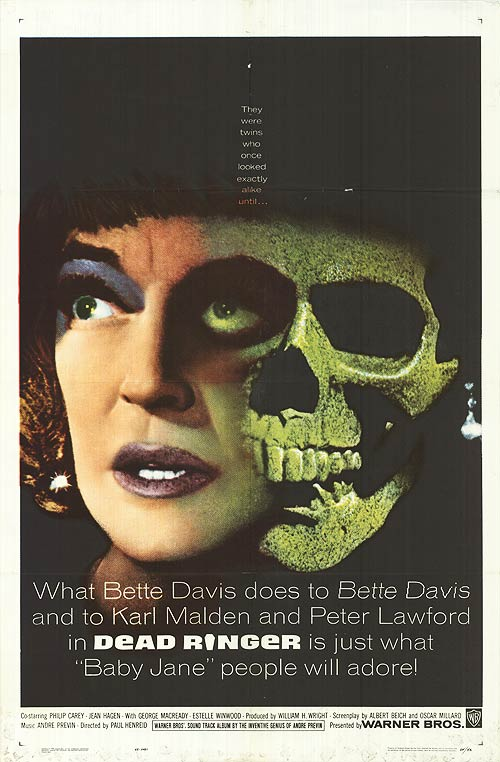
Dead Ringer (1964)

dead ringer

By Richard Winters

My Rating: 5 out of 10

4-Word Review: She kills her twin.

Edith (Bette Davis) attends the funeral of her twin sister’s husband a man she secretly loved and who became very rich. Edith struggles as a bar owner and is jealous of her sister Margaret’s affluent lifestyle. When she finds out that Margaret tricked her way into marrying this man it sends Edith over-the-edge in rage. She kills Margaret and then assumes her identity only to come into some unexpected complications and realize things would have been better had she just remained herself.

Davis shines in the dual role. She had already played this type of role before in 1946 in A Stolen Life. I was surprised that although she was only 56 at the time this was filmed her face looked very old and haggard almost like she was 70. Watching her eyes get all wide and roll around every time she becomes suspicious or nervous is a treat in itself.

Paul Henreid an actor turned director who is probably best known for playing the role of Victor Laszlo in Casablanca doesn’t quite give the story the zing that it needs. He employs a lot of long takes especially during the first hour that slows things down too much and doesn’t build any tension. There is a lot of extended dialogue and scenes that could have been cut out completely that would have made the movie faster paced and more exciting.

The story itself has a few too many plot holes. One is the fact that Edith meets Margaret for the first time in several decades at the funeral and then suddenly the next day decides to kill her and assume her identity, which seemed too quick. I would have expected a lot more complications than there are and the fact that she can seem to remember all the servants’ names without a hitch didn’t quite jive. There is also a scene where the detective character played by Karl Malden enters someone’s apartment and riffles through his personal belongings without any type of search warrant or probable cause, which is not realistic. They do find some incriminating evidence, but I think it would have been thrown out based on that technicality, which in turn would have completely altered the film’s ending.

The supporting cast adds some spark. Malden is good as the dogged detective a type of part he refined even more in the 1970’s TV-series ‘The Streets of San Francisco’. Peter Lawford who is always terrific is fun as Margaret’s conniving lover Tony. You can also spot in bit parts the familiar faces of Jean Hagen, Henry Beckman, Bryan O’Byrne, Bert Remsen, and Estelle Winwood. Henreid even casts his own daughter Monika in the part of Margaret’s maid Janet.

There are some fun twists that come near the end, but it takes too long to get there. The film would have been more successful had it had a more compact running time and direction that was flashy and creative.

My Rating: 5 out of 10

Released: February 19, 1964

Runtime: 1Hour 55Minutes

Not Rated

Director: Paul Henreid

Studio: Warner Brothers

Available: DVD, Blu-ray, Amazon Instant Video

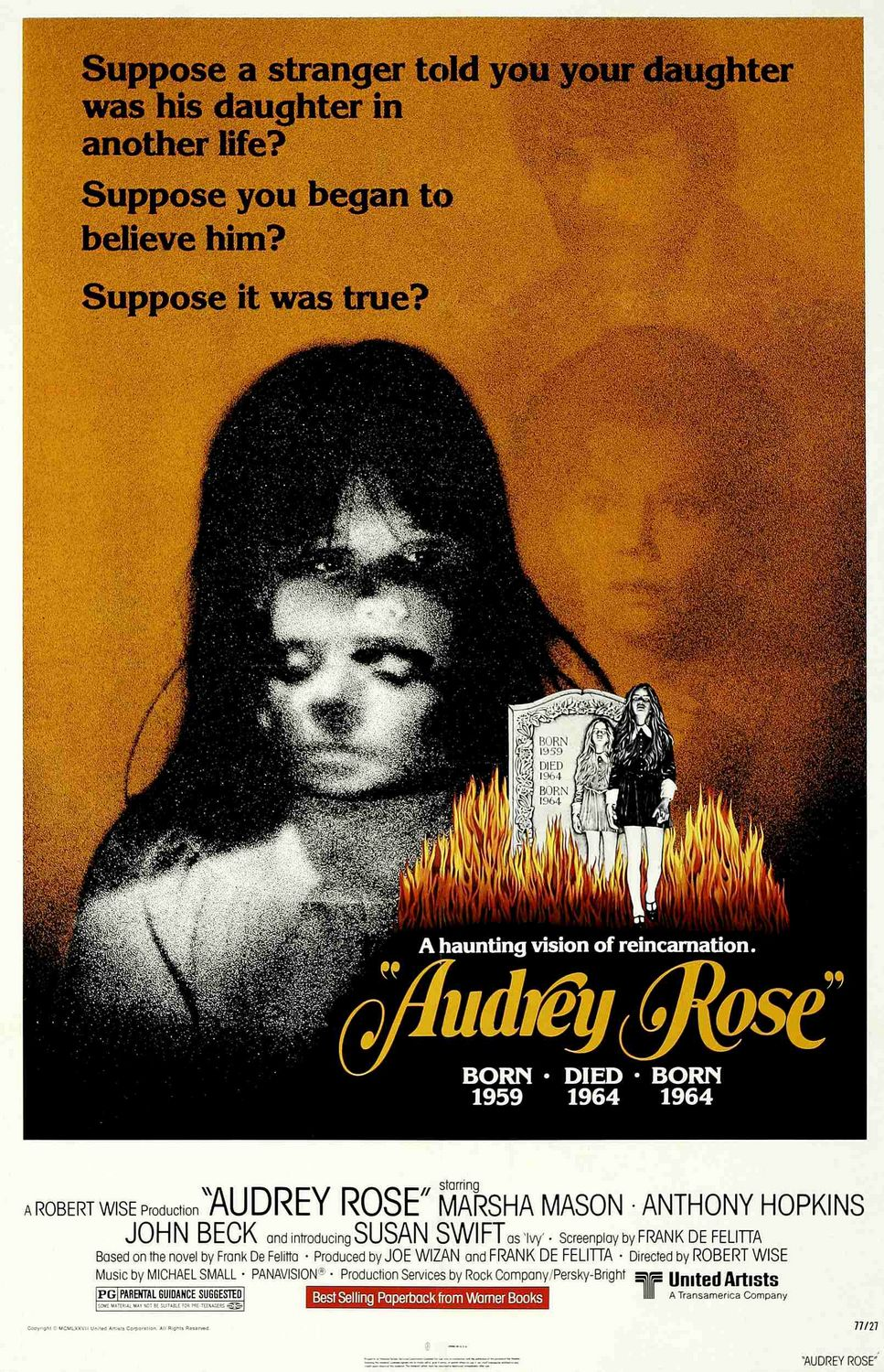
Audrey Rose (1977)

audrey rose 2

By Richard Winters

My Rating: 6 out of 10

4-Word Review: Dead daughter gets reincarnated.

On October 3rd, 1965 at precisely 8:20AM a young Audrey Rose dies in a fiery car crash. At 8:22AM on that same day Ivy (Susan Swift) is born to Janice and Bill Templeton (Marsha Mason, John Beck). Several years later after talking to a couple of psychics Audrey’s father Elliot (Anthony Hopkins) becomes convinced that his dead daughter has been reincarnated in the body of Audrey. When he approaches Ivy’s parents about it they scoff and then when he tries to take her they have him arrested. He then goes on trial where he tries to get 12 jurors to believe that reincarnation is a reality.

Based on the Frank De Felitta novel, and who also wrote the screenplay, this odd hybrid of a horror film never really takes-off.  Director Robert Wise does a terrific job of capturing the Manhattan skyline and a late 70’s New York City ambience as well as the gorgeous classic paintings that line the ceiling of Janice’s and Bill’s apartment, but he has a story that is light on action. The restrained and genteel narrative creates a film that seems more like a conventional drama than a horror film despite a storyline that is brimming with supernatural elements.

Every effort is made to keep the proceedings as realistic as possible only to have the entire second hour delving into a court room drama with a defense strategy that is so outlandish it becomes almost ludicrous. Having Elliot become convinced of the reincarnation through talking to psychics is another weak point. The few so-called psychics that I have been to have proven to be inaccurate and unreliable and most people that I know have had the same experience. In the past few years several famous psychics have been outed in the media as being frauds and charlatans. Having the film treat these people like they are a reliable source puts the entire premise on poor footing from the very beginning.

Mason can play a distraught and beleaguered character about as well as anyone and her teary-eyed presence helps give the film a few extra points. Beck is also good as her husband and their contrasting personalities and approaches to the situation add an interesting subtext.

Not to necessarily sound cruel but Swift as the young girl has a big pair of buggy eyes that to me became more of a distraction as it went along. Also, with her long brown hair she starts to resemble the Linda Blair character from The Exorcist, which was a far more intense, scary, and exciting film than this one. The producers would have done well to have cast a blonde or redhead in the role simply to avoid the comparison.

The scares are almost non-existent and the only slightly spooky moment is the scene where Swift looks into a mirror and chants the Audrey Rose name repeatedly, which is the only time where her buggy eyes come into good use. The several scenes showing her running around the place and banging onto the widows while screaming become old pretty fast. The direction is slick and the production values good. It is compelling enough to be entertaining, but the ending is very unsatisfying and as a thriller it is transparent and unmemorable.

My Rating: 6 out of 10

Released: April 6, 1977

Runtime: 1Hour 53Minutes

Rated PG

Director: Robert Wise

Studio: United Artists

Available: VHS, DVD, Amazon Instant Video

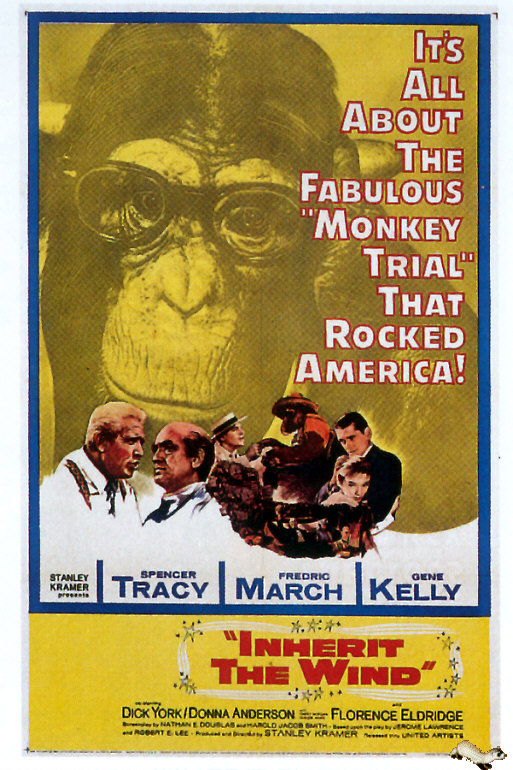
Inherit the Wind (1960)

By Richard Winters

My Rating: 6 out of 10

4-Word Review: Don’t teach Darwin theory.

Bertam Cates (Dick York) is a  young school teacher who is put on trial for the teaching the Darwin theory of evolution in the film version of the hit stage play, which in turn was a variation of the famous trial of 1925.

Although labeled a ‘classic’ this film seems awfully stilted and heavy-handed. Everything gets overplayed with too much emphasis on high drama, which in certain instances becomes unintentionally funny. Director Stanley Kramer shows his bias from the beginning and doesn’t allow the viewer to come to their own realization on the issue. The townspeople are the embodiment of every small town cliché you can think of. The buildings that make up the town appear quite obviously to have been built on some studio back-lot. The same goes for the stagy indoor sets as well. Location shooting really helps even if it does go over budget. Just look at this film and then watch Joshua Logan’s Picnic and then decide which one gives you the stronger more lasting impression of small towns.

Fredric March is an accomplished actor, but goes over the top with his performance as the fundamentalist prosecutor Matthew Brady. He plays the character like he is a comical buffoon and uses too many exaggerated gestures and facial tics. Having the character go through a meltdown at the end is almost anticlimactic since he seemed destined for it from the very beginning. George C Scott, who played the same role in the Showtime remake, is much better.

Spencer Tracy as the defense attorney Henry Drummond is great and becomes the film’s main virtue. He is such a master of his craft that he is a joy to watch. He makes it seem all so effortless and natural and yet fascinating at the same time and the character he creates is quite memorable.

The courtroom showdown does allow for some fireworks and the final segment between Gene Kelly and Tracy proves interesting and introspective. The film does have some strong moments, but as a whole it seems kind of clunky.

My Rating: 6 out of 10

Released: July 21, 1960

Runtime: 2Hours 8Minutes

Rated NR (Not Rated)

Director: Stanley Kramer

Studio: United Artists

Available: VHS, DVD, Amazon Instant Video 

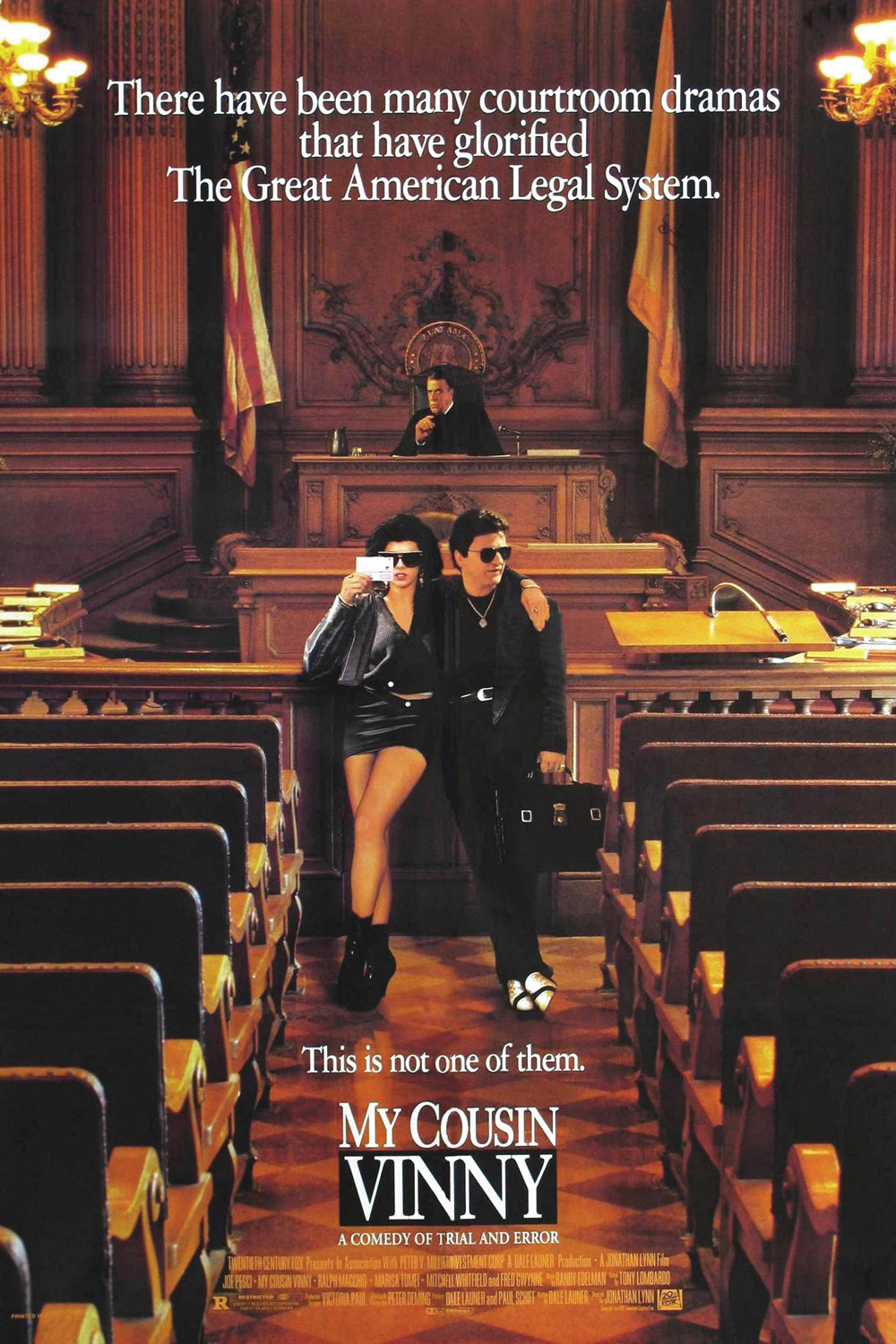
My Cousin Vinny (1992)

By Richard Winters

My Rating: 5 out of 10

4-Word Review: Don’t hire this lawyer.

A huge and much talked about hit upon its release in 1992, My Cousin Vinny is the story about two traveling college friends (Ralph Macchio, Mitchell Whitfield) who, upon going through Alabama, get implicated to the murder of a convenience store attendant that they did not commit. They’re only hope is calling up Macchio’s uncle Vinny from Brooklyn (Joe Pesci) who has only been practicing law for six weeks and has never tried a case.  Even worse is the fact that his brash Brooklyn sensibilities do not mesh well with the trial’s very strict, no-nonsense Judge (wonderfully played by Fred Gwynne in his last film role).

One thing that stood out right away with me was the way this film did not fall into age old stereotypes despite being in a setting that seemed ripe for it.  There is not a single mention of racism anywhere.  Instead the film seems to want to focus on a more contemporary Alabama where the African American characters are, by and large, on equal footing with the whites as well as having a white Sheriff who is not redneck, corrupt, or ignorant.  The two college kids also thankfully break rank from the typical Hollywood films of that era.  These kids are not the rowdy, partying, beer swilling, sex crazed teens that you usually see, but instead believable and most of all likable.  I found them to be so likable that I wished they were in the film more, unfortunately after the first twenty-five minutes they pretty much disappear until the very end, which I found disappointing.  Still it was nice seeing Macchio growing out of his Karate Kid role and looking a little more filled out and mature.

I also want to give mention to the excellent on-location shooting.  Although it was not actually filmed in Alabama, but instead the neighboring state of Georgia, it still nicely captures the look and feel of the south and it does it right from the start.  I have often said good on-location shooting (as opposed to the annoying Hollywood studio back-lot) can enhance just about any story and help create what’s almost like another character.  I have been to Alabama recently and enjoyed the many references to the red, muddy soil that is everywhere down there and the scene where the Pesci character gets his car stuck in it is great.

The comedy runs pretty well, but is much stronger at the start.  The conversations the boys have with the police are quite amusing as is Whitfield’s initial dialogue with the Pesci character who he doesn’t know is a lawyer and instead thinks he is a cellmate there to ‘break them in’.  I also enjoyed the running gag dealing with Vinny using his debating skills to try and ‘negotiate a settlement’ with a tough guy at a bar who refuses to pay up after losing a bet.

Unfortunately there is also a lot of comedy that does not work.  The running gag dealing with Vinny and his girlfriend constantly being awakened in the early morning hours by some unexpected noise at each of the places they stay at starts to get real redundant and silly.

There is also another segment featuring actor Austin Pendleton who plays one of the court appointed attorneys and, without warning or any logical explanation, starts to stutter terribly when he tries to give his opening argument.  I was genuinely shocked to see Pendleton take this part since he was a stutterer in real like and didn’t overcome the problem until he was well into his forties.  He even starred in a 1983 film entitled Talk to Me about a man coping with the affliction. Apparently Pendleton did protest the scene and even labeled it a ‘sick joke’, but eventually did it anyways because he needed the work, which was unfortunate because it comes off as being forced and uncomfortable.  Most lightweight comedies, which in the end this is, run about ninety minutes yet this film runs a hundred and twenty minutes, which is too long.  Had some of these so called ‘funny’ scenes been cut it would have shortened the film nicely and even strengthened it.

I should also mention Marisa Tomei who won the Oscar for best supporting actress as Pesci’s girlfriend.  Now her performance isn’t bad, but I didn’t see anything really outstanding about it either.  She spends most of the time wearing garish and gaudy outfits, speaking in a Brooklyn accent that borders on annoying, and playing the caricature of a ditzy girlfriend. Only at the end does she become a little more dimensional when she inexplicably displays some amazingly detailed knowledge about automobiles that for me just didn’t ring true.  I would have given the Oscar to Fred Gwynne, TV’s Herman Munster, as the judge. Some of his courtroom exchanges with the Pesci character are the best parts in the film.  I also really like Lane Smith in the role as the prosecutor. His performances are never flashy, but he is always reliable and gives his characters a nice, quiet dignity.  He is also a genuine southerner, so he fits into his role more easily.

The film is overall passable.  I had no idea how it was going to turn out and it kept me intrigued.  However, once the resolution was made and the mystery solved, I wasn’t completely satisfied.  I was hoping it would be like The Vanishing, the excellent 1988 film from the Netherlands, that went back and reenacted how it all took place.  It would have at least been nice had the film put in a little red herring at the beginning, so the viewer could have tried to figure it out themselves instead of just throwing in a wrap-up that seemed too convenient.

If you are fans of Joe Pesci then you’ll enjoy this movie a little bit more.  His performance as the volatile character in Goodfellas is so etched in my mind that I have a hard time adjusting to him in likable roles, or comedy.  However he manages to be quite engaging throughout.

My Rating: 5 out of 10 

Released: March 13, 1992 

Runtime: 2Hours 

Rated R 

Director: Jonathan Lynn 

Studio: 20th Century Fox 

Available: VHS, DVD, Blu-ray, Amazon Instant Video
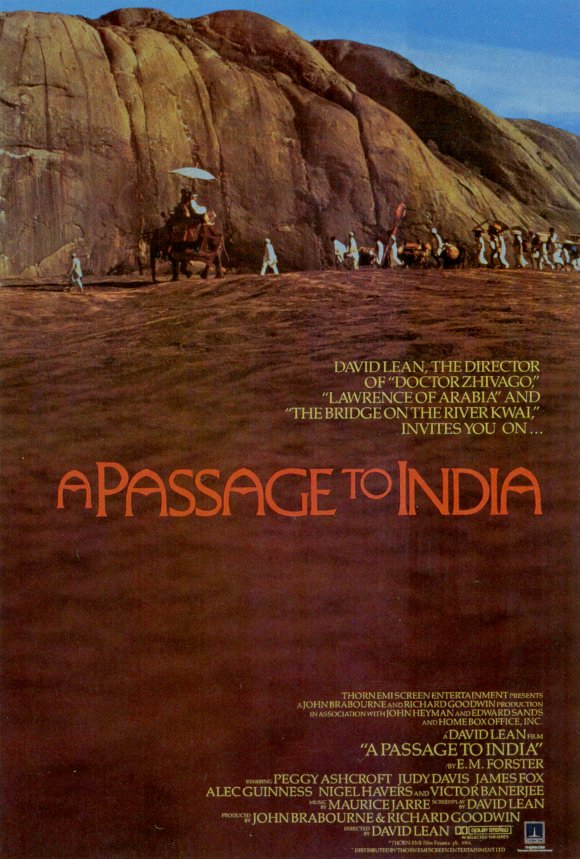
A Passage to India (1984)

By Richard Winters

My Rating: 7 out of 10

4-Word Review: Unjustly accused of rape.

An older woman (Peggy Ashcroft) and her son’s fiancée Adele (Judy Davis) travel to India to visit him as he works as a British Magistrate there. During the course of their visit they come upon the harshness of British rule, the unusual climate, and a rather unexpected criminal trial.

Like with most of Lean’s films the gargantuan approach cannot equal the story. You sit through two hours and forty five minutes only to feel slighted when it is all over. The story plays a lot like To Kill a Mockingbird only it is stretched out more and has a different location. That is not to say it isn’t entertaining, because it is, but only in the most general of ways.

The first hour is downright breezy. It does hit on certain inhumanities and inequalities, but it is all handled with kid gloves. It also seems very similar to Gandhi, which came out only a year earlier. The second half, which involves the court trial, seems almost jarring when compared to the first. It does get more intense and multifaceted, but just when it seems to be getting intriguing it fizzles with a wrap up that is too neat and tidy.

Lean’s films have always had a sort of running theme involving the characters coming to terms with the full scope of their personalities. Yet here their changes seem too abrupt and severe. Adele starts out as a very interesting person. She is independent and idealistic and then having her turn into a confused and bullied woman without any real explanation doesn’t mesh. The same can be said for Aziz (Victor Banjeree) the man she accuses of rape. His character is so benign and affable at the beginning that having him turn so angry and vindictive in the second half seems overdone understandable to some degree, but still overdone. Of course everyone can have these traits at times, but here it gets heavy- handed.

The two best characters consist of Mrs. Moore (Ashcroft) and Fielding (James Fox). Ashcroft is compassionate and strong and it is nice to have an older character where their age isn’t completely embedded into their persona. Fielding is strong and stalwart as well and his very proper sensibilities help keep the whole thing stabilized.

Legendary actor Sir Alec Guinness is badly miscast. Although some of his dispensed wisdom is fun he never completely comes off as a native and the part should have been played by an actual native of the country.

Out of all of Lean’s films this may actually be his weakest. The cinematography is okay, but it is not as sumptuous as some of his others. I wanted to be shown more of India and given a broader perspective of the region. There also could have been a little more action and the characters placed in a little more physical danger. The part where Adele is chased by some wild monkeys is unconvincing especially when you never see her or the monkeys in the same shot.

My Rating: 7 out of 10

Released: December 14, 1984

Runtime: 2Hours 45Minutes

Rated PG

Director: David Lean

Studio: Columbia Pictures

Available: VHS, DVD, Blu-ray, Amazon Instant Video
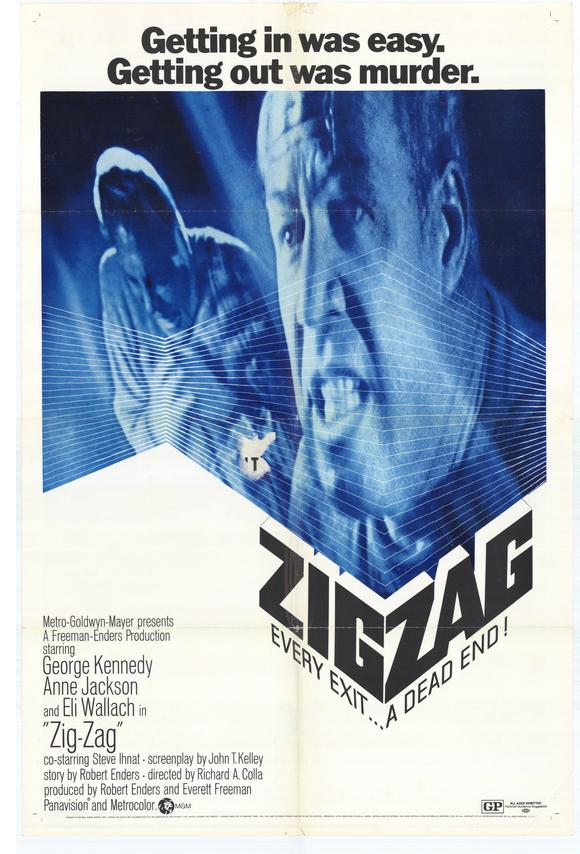
Zig Zag (1970)

By Richard Winters

My Rating: 5 out of 10

4-Word Review: Framing yourself isn’t good.

            Paul Cameron (George Kennedy) is an insurance agent and family man who learns that he is dying from a brain tumor and has only a few months to live. In order to provide money for his wife and children he sets himself up as the kidnapper of a wealthy businessman in an unsolved case that offered a $225,000 reward for anyone leading to the conviction of the culprit. After he is found guilty at his trial he faints and the doctors there decide to do experimental laser surgery to remove the tumor. The operation proves to be a success forcing Paul to go on a battle to prove his innocence, or risk spending the rest of his life in jail for a crime he did not commit.

Although he has done well in supporting roles Kennedy proves to be quite weak as a leading man as he shows almost no emotion in any of his scenes. When he is told of his tumor he takes it in a very matter-of-fact way without getting upset at all, which seemed unrealistic. His performance is dull and the few times that he does get upset it comes off as forced. His presence hurts the film and a more engaging, eccentric actor could’ve made it more interesting.

Eli Wallach as Paul’s attorney is terrific and the one thing that injects some energy. He is dynamic throughout and is fun to watch even during the slow parts. It was nice to see him doing a scene with his real-life wife Anne Jackson. As of this writing the two have now been married for 64 years, which has to be one of the longest marriages in Hollywood history.

The supporting cast features a long list of familiar character actors making it like spot-the-star. They include: Dana Elcar, Douglas Henderson, Steve Ihnat, William Marshall, Joan Tompkins, Robert Sampson, Leonard Stone, and Walter Brooke in an interesting duplicitous part.

Richard A. Colla’s direction is impressive. The film opens with a diverting cinema verite-style scene showing Paul going through the examination process before entering the prison, which seems unusually elaborate touch for what is otherwise just a gimmicky script. Another innovative part is when Paul is shown planting evidence at the scene of the crime and only the sounds and ambiance of the locale is heard without any music, which is more effective.  Unfortunately the direction and story become much more conventional towards the middle and it is not as interesting. The film tries to be too many things and does not come together as a seamless whole. The courtroom scenes were too extended for my tastes as we know Paul is innocent, but wants to be convicted anyways, so his many prolonged conversations with his exasperated lawyer who does not know of his scheme seem rather pointless. However, when Paul is cured and then goes on a mission to find the real killer it becomes exciting as the mystery itself proves to be complex and intriguing.

The twist ending did not go over well with audiences at the time of the film’s initial release. It’s a downer for sure, but after seeing so many tacky happy Hollywood endings in my lifetime I can’t say I totally hated it. As a budding screenwriter I enjoy irony and the ending here certainly has that. It’s slickly handled and although I saw it coming others may be genuinely surprised by it. My only complaint is that it’s a bit abrupt and could’ve and should’ve been extended in some way, or given a more effective closure.

If you like a movie with a lot of twists then this film may be worth seeking out. The legendary Roy Orbison sings the title tune during a party scene and it sounds like some of his best stuff. I am surprised it didn’t chart and I wished they had allowed the viewer to hear the complete son before cutting away.

My Rating: 5 out of 10

Released: September 11, 1970

Runtime: 1Hour 45Minutes

Rated PG

Director: Richard A. Colla

Studio: MGM

Available: VHS (as False Witness), DVD (Warner Archive) 

The Verdict (1982)

verdict

By Richard Winters

My Rating: 8 out of 10

4-Word Review: Lawyer makes a comeback.

Frank Galvin (Paul Newman) is a lawyer that has hit rock bottom. He has lost his last four cases and become an alcoholic in the process. His associate Mickey (Jack Warden) hands him what appears to be an open and shut case dealing with a woman who was put into a permanent comatose state after being given the wrong type of anesthesia during the delivery of her child. Both parties are willing to settle out of court and Frank is initially happy to accept the settlement as he is hard up for funds, but after seeing the sad condition of the patient in the hospital he changes his mind.  He becomes convinced that the hospital is trying to hide something, but the other doctors and nurses that where present during the procedure are refusing to talk. He then tracks down the admitting nurse, who was the one person who refused to sign a sworn statement relieving the doctors of any wrong doing. Once he finds her it blows the case wide open.

This marked a turning point in Newman’s career. He was no longer the young, shirtless, virile hero, but now a grey haired, gravely voiced man showing the signs of aging and his roles from then on where all of older characters past their prime. Newman definitely looks tired and washed up and it is so effective that it makes the viewer feel the same way. Yet, he is still able to show the boyish side of his character by way he becomes engrossed with the pinball machine at the bar and getting excited when he achieves a high score.  Newman continues to be one of my favorite actors and his ability to act in a way that seems so effortless never ceases to amaze me. It may seem minor, but I liked when Galvin is forced to take a red-eye flight out of town in order to meet the former admitting nurse (Lindsey Crouse) who has moved to another city, he is shown to be unshaven. Too many times male characters placed in hectic scenarios in most films are clean shaven at all times even when it doesn’t make sense. Yet here Newman’s character isn’t. Being the consummate method actor who was always looking for realism I’m sure he decided to add this extra touch himself. Sometimes what separates the great ones from the average are the little things.

Director Sidney Lumet shows why he is a legend as well. The movie was shot in the late autumn, early winter in Boston. The cold climate and gray skies help accentuate Galvin’s state of mind and stage in life. I remember hearing Lumet state in an interview how he made sure that the color schemes in the entire film where of a dark, brownish color which he felt would reflect the story’s serious tone. In fact the color brown is the one quality I remember most of this film from when I first saw it years ago. I also liked the visual touch Lumet uses of having Frank taking Polaroid pictures of the victim lying motionless in her hospital bed. As the viewer watches the images of the woman on the Polaroids slowly develop it perfectly reflects Galvin’s developing empathy for her. My only quibble is that I wish that Lumet had shown a close-up of the woman so we the viewers could completely take in her sad condition as well. We are only shown the victim from a distance and even then it is never straight on, which doesn’t help us become as upset by her quandary as we should have.

Another thing I appreciated about the script, which was written by David Mamet and based on the novel by Barry Reed who was at one time a practicing attorney, is the fact that is focuses on all the behind-the-scenes tasks that a lawyer must do before the case comes to trial. Most courtroom dramas deal almost exclusively with the trial portion, but here we see how the attorneys prep their clients for questioning and cross-examination. We also take in the process of them interviewing potential jurors, researching legal issues, chasing down witnesses, and even discussing potential strategies with their clients. I found the approach here, as opposed to other legal dramas, to be more thorough, revealing, and satisfying.

The grievances that I had with the film all contain spoilers, so if you are interested in watching this movie then you may want to skip the next two paragraphs.

The first problem I had was with the Lindsay Crouse character who plays the admitting nurse whose bombshell testimony turns the tide of the case in the favor of Galvin’s client. Her scenes are certainly riveting and marked with all the classic ingredients of high drama. Her character states that the admittance sheet that she had filled out that day had been altered by the doctor and that she had the original. Yet neither the viewer nor the jury is shown the original making what she says, as compelling as it may be, seem like hearsay. The judge also orders everything that she said to be stricken from the record and not considered when the jurors come to their final decision. Yet the jurors openly ignore this order and side in Galvin’s favor anyways, which I couldn’t completely buy. I didn’t think all twelve of them would disregard the judge’s order especially when no documentation was ever shown to help verify what the witness stated.

I also did not like the Charlotte Rampling character who plays a woman that Frank meets at a bar and begins to date. She is also paid by the opposing attorney Ed Concannon (James Mason) to spy on Frank and give away all his strategies. I didn’t feel it was necessary to show this, or even bring in the character at all. We are already shown earlier that Concannon is underhanded by the way it is implied that another doctor, who was going to be the star witness for Galvin, was paid off not to testify and then just disappears. Having him go further by using Galvin’s girlfriend as a snitch seemed like over-kill. The movie strives for realism and therefore should keep extreme side-story scenarios like this out of it as I am sure it is not something that occurs every day.

The subject matter is serious and somber. On a dramatic level it is excellent and although some may find it slow and depressing others will appreciate the intelligent script and deliberate pace. It is also an unusually quiet film with long stretches with no dialogue, or music, which is a nice change of pace from most films, which feel it necessary to be loud and noisy, or risk losing the audience’s perceived short attention span.

My Rating: 8 out of 10

Released: December 8, 1982

Runtime: 2Hours 9Minutes

Rated R

Director: Sidney Lumet

Studio: 20th Century Fox

Available: VHS, DVD (2-Disc Collectors Edition), Amazon Instant Video

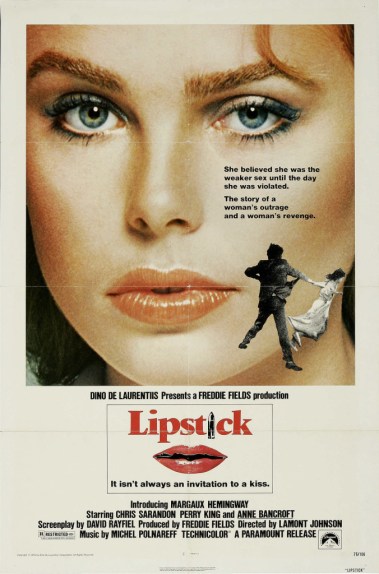
Lipstick (1976)

By Richard Winters

My Rating: 3 out of 10

4-Word Review: Don’t get her angry.

During the mid-70’s, Margaux Hemingway, granddaughter of the legendary author Ernest Hemingway, was one of the most photographed and highest paid models in the business, in fact she was the very first model ever to be awarded a million dollar contract.  After appearing on the June, 1975 cover of Time magazine she caught the eye of famous Hollywood producer Dino De Laurentiis who thought he could turn her into a star. The idea was to prove that she wasn’t just another pretty face by casting her in the difficult and challenging role of a rape victim, which they hoped would affirm her as a ‘serious’ actress. The gamble failed and she appeared in only a few more B-pictures even though her kid sister Mariel, who was cast in the film by Marguax’s suggestion, ended up having her career take off. Alcoholism and depression followed before she eventually committed suicide in 1996 at the age of only 42.

The story is basically just another tired exercise in the now cluttered rape and revenge genre. Chris McCormick (Marguax) is a beautiful lipstick model who is brutally victimized by a weirdo named Gordon Stuart (Chris Sarandon). She is dragged through the long and arduous court proceedings only to have him found not guilty and then start to stalk her younger sister (Mariel), which forces her to take matters into her own hands.

Right from the beginning this film comes off as very clumsy dramatically. Gordon is the high school music teacher of her younger sister Kathy. Chris is introduced to him at one of her photo shoots, but is too busy to listen to his music tapes, so she gives him her home address and tells him to ‘stop by anytime’.  Now, back in the 70’s people may have been a little less cautious than they are these days, but giving one’s home address to a man that she barely knows and isn’t interested in just to listen to one of his weird music tapes seems utterly ridiculous.

The rape happens almost right away before there is any character development. It almost seemed like this was the intended leering ‘highlight’ of the film with the rest just thrown in as second-rate filler. Wikipedia describes this scene as being one of the most ‘infamous in film history’.  That may have been the case at the time, but since then there have been many films that have exceeded what you see here, most notably in the controversial French hit Irreversible. Personally, I didn’t find it to be all that extreme. The one good thing I could say about it is that Sarandon is effectively menacing. I also liked the way his character is initially shown to be very meek and geeky and his inner-rage only comes out after he feels he has been slighted, which I felt made him a little less one-dimensional.

The courtroom scenes fall flat. Normally I find a good court drama to be riveting, but here it is stagy, phony, and uneven. The best thing about this segment is the presence of Anne Bancroft as Chris’s attorney Carla Bondi. She helps give the picture some stature and I wished she could have been in more of it.

If the film comes together at any point it is after the assailant is found innocent and Chris is forced to try to move on with her life and career despite the emotional toil and stigma. This segment has a certain socially relevant drama quality and to an extent it works even though it is brief. It also conveys some rather alarming statistics including the fact that only 10, 000 out of an estimated 50,000 rape cases every year actually ever get reported and only 2 out of 100 rapists ever get convicted. Since the credits list experts in the field that were consulted I can only assume that these numbers were accurate. Things may have hopefully improved since then, but the figures still seemed startling. However, all of this gets undermined by a tacked-on, manufactured, over-the-top, Rambo-like finale that relies too much on extreme coincidence and severely stretches the credibility.

I also found the film’s visual style to be unappealing. The colors are garish and gaudy while captured through a soft focus lens that resembles a model shoot in a glamour magazine and gives one a glossy trash perception.

I can see why Mariel made a strong impression with viewers. Her testimony on the stand is both touching and heart-wrenching and her emotionalism seems genuine and gripping. Marguax does not fare as well. Although her performance improves as the film progresses I still felt she was in way over her head and her nasal sounding voice is a bit irritating.

Although this film was pretty much panned by critics and audiences alike upon its initial release there is a new generation of people who feel it is underrated as evidenced by the many positive comments about it at IMDB. I approached this with an open-mind, but couldn’t help but come away from it feeling it was exploitation from beginning to end and even at that level it seemed derivative and uninspired. The whole thing left me cold and feeling like I wasted 90 minutes.

My Rating 3 out of 10

Released: April 2, 1976

Runtime: 1Hour 29Minutes

Rated R (Rape, Violence, Mature Theme, Language)

Director: Lamont Johnson

Studio: Paramount

Available: DVD, Amazon Instant Video