
By Richard Winters
My Rating: 4 out of 10
4-Word Review: One room, different characters.
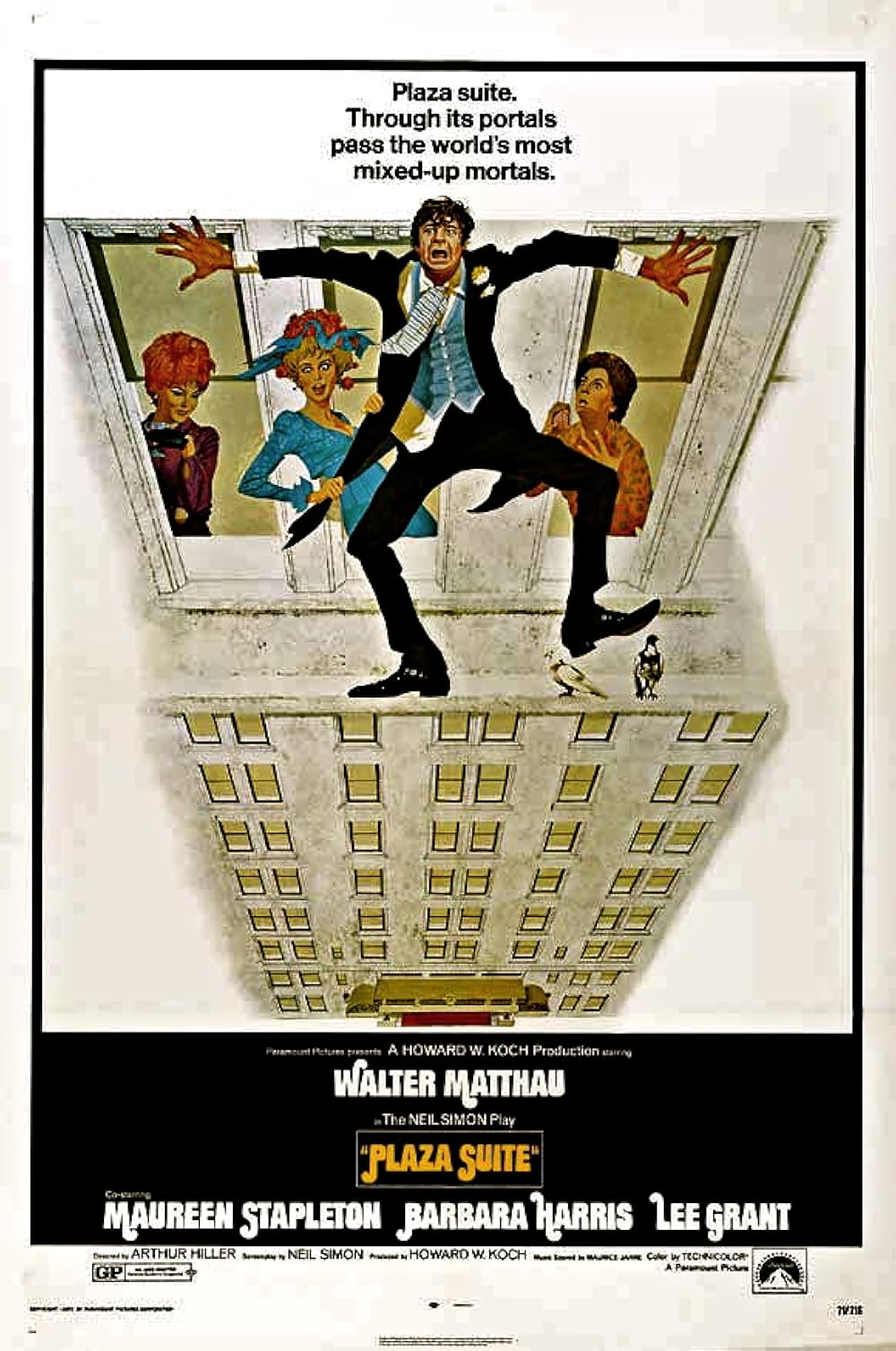
The entire movie takes place in one setting, New York’s historic Plaza Hotel, where three different couples rent out the same room at different times and the story examines what happens while they’re in it. The first segment involves Sam and Karen (Walter Matthau, Maureen Stapleton). Karen has checked into the room because that was where they spent their honeymoon 23 years earlier, but since then their marriage has soured and she hopes to rekindle the old flame but finds her husband’s resistance to it to be both challenging and troubling. The second story involves a famous Hollywood producer (also played by Matthau) checking into the room so he can have a quick fling with Muriel (Barbara Harris) a girl he dated before he was famous and who is now married with kids. The third and final act revolves around Roy and Norma (Walter Matthau, Lee Grant) and their efforts to get their daughter Mimsy (Jenny Sullivan) to come out of the bathroom, of which she has locked herself inside, and attend her wedding.
The film is based on the play of the same name that was written by Neil Simon who also wrote the screenplay. The play, which opened in 1968 at the Schubert theater before moving onto Broadway, had the same storylines, but was cast differently. In that one George C. Scott and Maureen Stapleton played the characters in all three segments, but director Arthur Hiller didn’t like that approach. Initially he wanted different actors for each story including having Peter Sellers and Barbra Streisand cast in the second, which would’ve been terrific, but when that fell through, he decided to have Matthau play in all three and then simply change around the female leads, but this approach doesn’t work as well. The film suffers badly from having everything done in the same room, which quickly becomes visually static, and the talky script is only occasionally amusing.
The first story features a strong performance by Stapleton, but having the husband eventually admit to having an affair with his secretary, has been done hundreds of times before. The segment lacks anything fresh and the viewer can almost immediately guess where it’s going right from the start making it both predictable and boring. Had it unfolded differently where the husband at least pretended there was a spark left in their marriage and only revealed his true nature through subtle layers then it might’ve had potential but having him be aloof and cranky at the start offers no surprises and makes things much too obvious.
The second segment shows its cards too soon as well. It’s clear that the producer will come onto any attractive woman he sees, so watching him attempt to exploit an old girlfriend and then become shocked when he finds her more intrigued with the celebrities that he knows instead of himself doesn’t offer much of a payoff. Instead, he should’ve been portrayed as being burnt out with Tinsel Town and all of the plastic people he’s bedded and genuinely wanting to rekindle things with his past love whom he remembered as being down-to-earth and then having him shocked to learn that she had become just as superficial as the rest would’ve been funny.
The third act is by far the funniest particularly Matthau hamming up over his frustration at how much the wedding, and subsequent reception, is costing him. This is also the only segment to have some of the action take place outside of the room when in an attempt to get into the locked bathroom he goes out on the 7th story ledge, which is a bit nerve-wracking. However, there’s still some issues including the fact that Mimsy, the daughter, never says anything while locked inside the bathroom, which is unrealistic and off-putting. I didn’t like the point-of-view shots showing her sitting on the toilet through the door’s keyhole as this was unintentionally creepy as it insinuates that anybody could secretly peep at anyone else going to the bathroom and therefore putting a keyhole on a bathroom door would’ve been patently absurd. The parents are also not very likable, or caring as they seem to feel that their daughter is somehow ‘obligated’ to get married and it’s ‘too late to backout’ when it really isn’t. Forcing someone to get hitched and acting like it’s some sort of ‘life duty’ is very old fashioned making the segment quite dated even for its time period.
Some of the exterior shots were cool including the opening bit where Stapleton is shown walking down a busy New York street towards the hotel where the pedestrians are not extras, but instead regular people unaware that they were a part of a movie. The bird’s eye shot showing cars going along the Brooklyn Bridge and its ability to focus in on the one being driven by Harris is impressive and quite possibly, at least on a visual scale, one of the best moments in the film. Even these segments though have some logic loopholes as it shows the character from the segment that has just ended walking outside the hotel while the new character walks in making it seem like the new guest goes into the room the second the former one leaves it, which wouldn’t make sense as a maid would’ve had to go in there in-between to clean it.
My Rating: 4 out of 10
Released: May 12, 1971
Runtime: 1 Hour 54 Minutes
Rated PG
Director: Arthur Hiller
Studio: Paramount Pictures
Available: DVD, Amazon Video, PlutoTV, YouTube


 Scopophilia