Category Archives: Comedy

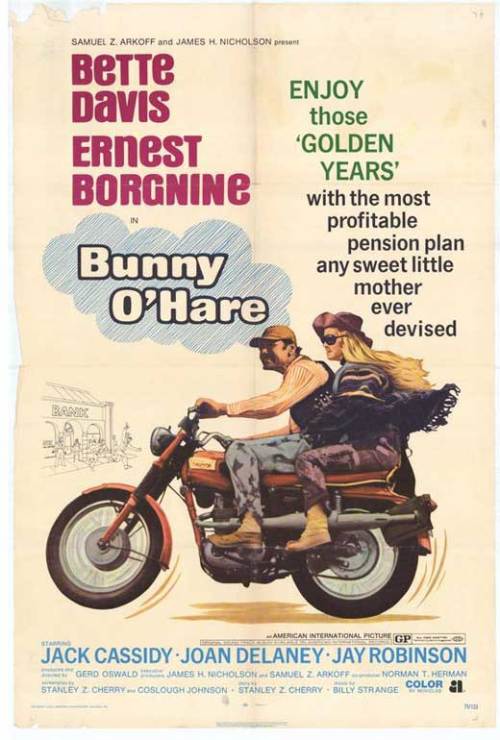
Bunny O’Hare (1971)

bunny

By Richard Winters

My Rating 2 out of 10

4-Word Review: Bette becomes a hippie.

Extremely odd Bette Davis vehicle made in her later years when her career had crested and she was forced to be less choosy about her projects. The story has to do with a lonely widow named Bunny O’Hare (Davis) who losses her home to foreclosure and is rendered homeless. She meets an older man named Bill Gruenwald (Ernest Borgnine) who is an escaped bank robber. Together they dress up as hippies and rob banks throughout the state of New Mexico in order to survive.

Davis is exceptional. Usually she plays cold, manipulative characters, but here she gives a perfect, touching performance as a nice old lady. She is terrific in every scene that she is in and the only bright spot in what is otherwise a misfire. Borgnine though seems wasted and thrown in only as a stock character.

The story really has nowhere to go. The intention was to make the film a mixture of social satire and slapstick, but it fails on either end. The novelty wears off quickly and it soon becomes derivative. Initially their ploy to rob the banks seemed clever as Bill releases a bird into the bank, which causes such a distraction that they are able to rob it without detection, but it becomes tiring when it gets played-out again and again. The police are portrayed as being universally bumbling and making it seem like a six-year old could rob a bank and easily get away with it. I also did not like the banjo music being played as they are trying to get away from the cops as it seems too similar to the much better film Bonnie and Clyde and in fact the original title for this movie was going to be ‘Bunny and Claude’.

The casting of Jack Cassidy as Lieutenant Greely, the policeman who becomes obsessed with capturing them, should’ve worked.  He was very adept at playing cold, cunning, slightly offbeat characters as evidenced by his Emmy Award winning performances on the old Columbo TV-show as well as the cult TV-series He and She. He was the husband of actress Shirley Jones and the father of Shaun and David Cassidy whose career was unfortunately cut short when he ended up dying in a fire in 1976 after falling asleep with a lit cigarette. His unique talent here is stifled because the character is portrayed as being unrealistically dimwitted and saps any possible energy from the scenes that he is in.

Actress Joan Delaney makes a terrific addition as his female counterpart R.J. Hart. She is young, attractive, and hip. She plays off of Greely’s old, regimented ways quite well and it is a shame that, with the exception of a very brief appearance in the 1991 comedy Scenes From a Mall, this ended up being her last film.

The New Mexico landscape is nice, but I got the feeling that the location shooting had not been scouted out sufficiently. The police station didn’t look authentic at all. It seemed like scenes where shot in any building that they were able to attain a film permit. The lighting consists of one bright spotlight put on the subject while the sides of the frame and the background are dark and shadowy. Sometimes, in a good movie, this is done for artistic effect, but here I felt it was more because that was all they could afford. This one is for Bette Davis completest only.

Well known character actors John Astin and Reva Rose appear as Bunny’s two grown children, but are essentially wasted. The then acting governor of New Mexico, David Cargo, plays one of the state troopers.  Larry Linville, who would later become famous for playing Major Frank Burns on the classic TV-series M*A*S*H, can be seen very briefly at the end, but has no lines of dialogue.

My Rating: 2 out of 10

Released: October 18, 1971

Runtime: 1Hour 28Minutes

Rated PG

Director: Gerd Oswald

Studio: American International Pictures

Available: Netflix Streaming

The Notorious Landlady (1962)

By Richard Winters

My Rating: 4 out of 10

4-Word Review: Landlady could be killer.

            William Gridley (Jack Lemmon) is an American who has arrived in London and looking for a place to stay. He rents a room from a home owned by Carly Hardwicke (Kim Novak) a gorgeous woman who Bill immediately becomes smitten with. The problem is that many people think Carly has killed in her husband even though his body has not been found. When Bill gets word of this he becomes determined to investigate the case and prove her innocence.

You would think a script written by Larry Gelbart and Blake Edwards would be funnier and full of zany scenarios and slapstick, but instead it gets grounded in a lot of dialogue for much of the first hour and forty-five minutes and only starts to get interesting during the final fifteen. The conversations lack any wit, or sharp one-liners, and the premise plods along at a much too leisurely pace. There is a segment where Bill accidentally sets fire to the patio, but I think this was simply thrown in for some action as there is very little else of it. The plot is formulaic and fails to add any new twist or perspective and once it is over it is easily forgettable. Lemmon’s character is bland and transparent and more than a little naïve since he falls in love with her immediately and is then convinced that she is innocent even though he has only known her for a day.

The best part comes at the very end where the two find themselves at a recital for a group of senior citizens that are all sitting in covered wheelchairs. This scene gets drawn out amusingly and includes a bit where an old lady named Mrs. Dunhill (Estelle Winwood) is pushed down the side of a hill, which is nicely captured in a silhouette style with Bill chasing after her. Winwood, who was already seventy-nine at the time, hams it up perfectly as the daffy old woman.  Of course all this comes much too late to really help the picture, or story, but at least it saves the film from being a complete bore, which it otherwise would have been.

Novak gives a surprisingly strong performance and a convincing British accent that I wish she had spoken in for the entire duration.  She was always a stunner, but here she may look her all-time best. One scene taken with her in the bathtub was highly risqué at the time and doesn’t leave much to the imagination. British character actor Lionel Jeffries is engaging as the inspector, but Fred Astaire is essentially wasted as Bill’s boss. The production values are decent, but the results are middling.

My Rating: 4 out of 10

Released: July 26, 1962

Runtime: 2Hours 3Minutes

Rated: NR (Not Rated)

Director: Richard Quine

Studio: Columbia

Available: VHS, DVD (Region 1 & 2)

The Longest Yard (1974)

longest1

By Richard Winters

My Rating: 8 out of 10

4-Word Review: Prisoners play football game.

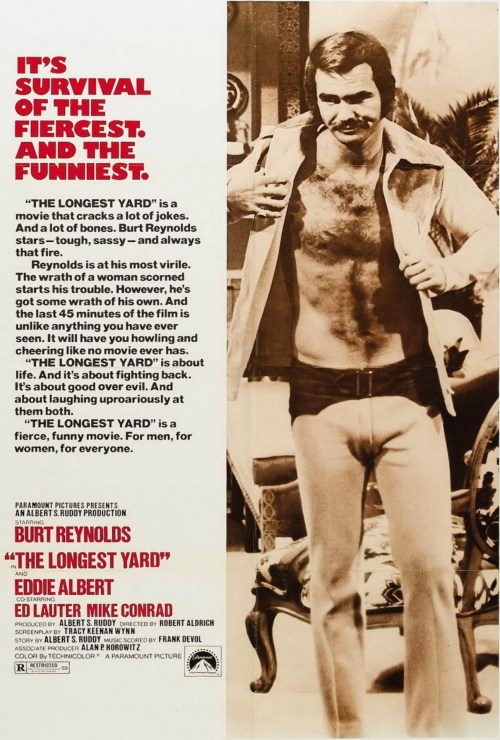
            Burt Reynolds is Paul Crewe a down-on-his-luck former professional football player who was kicked out of the league due to a point shaving scandal. After going on a long car chase with police he is thrown into the Georgia State Penitentiary where the crooked warden (Eddie Albert) tries to get him to coach the prison football team. Initially he refuses, but after some ‘convincing’ he eventually agrees to play in one game that will feature the guards versus the inmates. The prisoners use this contest as a way to get back at the guards and their brutal treatment of them while the guards approach it as a way to instill their authority.

Some consider this one of the best sports movies of all-time and I would have to agree it is up there. One of the things I liked about the movie is the way it taps into the emotional aspect of not only playing the sport, but watching it. There can be deep seated psychological reasons for why a spectator, or fan, roots for one team over the other.  The prisoners that cheer on their team use the game, as fleeting as it may be, as a sort of equalization and revenge factor to the guard’s authority and corruption. Watching the scenes showing the prisoners cheering their team as they score a touchdown is almost as emotionally charging as the action itself.  Director Robert Aldrich does a great job of using the prison setting and the game as a microcosm of 70’s society and the conflict between the counter-culture and the establishment as well as the haves and have-nots.

The game is nicely choreographed.  The hits look real and the plays are shot in a bird’s eye view just like watching an actual game on TV. The action is easy to follow and it is evident that the filmmakers have a good understanding and appreciation for the sport.  Outside of the final play that is done in slow motion there is none of the fluky, theatrical stuff thrown in that you usually see in most other films of this type. I found myself getting emotionally tied into the action even though I had seen the film many times before.

The only misgiving I had was the segment where the Richard Kiel character slams an opposing player to the ground and announces “I think I broke his fucking neck.” Of course this has become one of the film’s most popular lines and is made funnier when other players and even the game announcer repeats it several more times, but when the injured player is unable to come-to even after being given smelling salts and is carted off motionless from the field it starts to seem cruel to be laughing.

Another scene that I found surprising and had almost as much impact as the climatic contest is at the very beginning when Paul is shown arguing with his girlfriend Melissa (played by Anitra Ford one of the original models on ‘The Price is Right’ game show). She calls him a whore, which has to be the first and only time in film history that a woman has called a man that, but what is even more amazing is when he violently slaps her and knocks her to the floor.  I don’t think I can remember another time where a protagonist male character has done that to a female and yet the audience is still expected to sympathize with the male, which is interesting. The ensuing car chase is one of the better ones you’ll see and the part where he drives the car into a lake while the song ‘Saturday Night Special’ by Lynyrd Skynyrd is playing on the car’s radio and gets muffled as it goes under the water is cool.

Burt is perfect for the role. I love the glib way he delivers his lines and his laid back persona. The fact that he is an anti-hero with obvious personal flaws makes him even more fun. He seems right at home in the southern setting and filming it at an actual state prison gives the film a nice gritty subtext.

The supporting cast is unique. John Steadman as Pop, one of the prison’s oldest members, is memorable and he is the only other actor with a nose big enough to rival that of Karl Malden’s. It is nice to see Richard Kiel, one of the tallest actors you will ever see, with a speaking role.  The part where he starts to cry when he gets hit in the nose is funny.  Charles Tyner is perfectly creepy as Unger and Michael Conrad is compelling in his role as Nate Scarboro. This is also a great chance to see Bernadette Peters in an early career role as the warden’s ditzy and amorous secretary Miss Toot. She wears one of the worst looking beehive hairdos you’ll ever see although there probably isn’t a beehive hairdo that looks good anyways. Former football player Joe Kapp is good as one of the evil guards.

My Rating: 8 out of 10

Released: August 30, 1974

Runtime: 1Hour 1Minute

Rated R: (Adult Theme, Language, Violence)

Director: Robert Aldrich

Studio: Paramount

Available: VHS, DVD, Amazon Instant Video, Netflix Streaming

Semi-Tough (1977)

semi

By Richard Winters

My Rating: 7 out of 10

4-Word Review: Got to go pee.

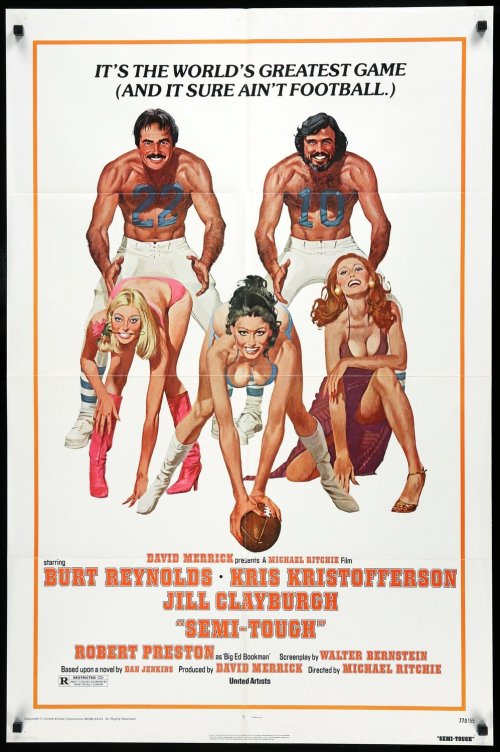
            Billy Clyde Puckett (Burt Reynolds) and Marvin Tiller (Kris Kristopherson) are two players for the Miami football team who just happened to live with the daughter of the team’s owner Barbra Jane Bookman (Jill Clayburgh). Strangely enough they do not have sexual relations and despite seeming like an odd arrangement to others the three manage to get along just fine until Marvin proposes to Barbra, which starts to make Billy jealous. Billy then spends the rest of the time trying to win her over and break-up the impending marriage.

This movie, based on the novel by Dan Jenkins, has an interesting premise, but I was disappointed that it didn’t start from the beginning when the three met and started rooming together. It certainly seemed to be an unusual set-up and I wanted more background to these characters and a history and the film doesn’t give any making it incomplete. The plot itself is a bit under-developed and at times seems to have nowhere to go. To make up for it the film delves into some odd comic scenarios that have nothing to do with the characters, or story. Some of these are interesting on their own terms while the others fall flat.

One of these segments features silent film actress Lotte Lenya in her last film appearance. Today’s audiences will know her for her outstanding performance as the villainess Rosa Klebb in the James Bond classic From Russia with Love. Her she plays a massage therapist named Clara Pelf who has some really weird and painful ideas about physical therapy. The scene seems just thrown in there for its own sake and doesn’t do much for the film as a whole, but seeing Lotte banter with Burt is a lot of fun regardless.

Another and even more bizarre segment features Bert Convy as a motivational speaker who hosts a marathon 48 hour self-help seminar, but will not allow any member of the audience to get up and go to the bathroom for the first 12 hours, which seemed too implausible even for satire. However, this scene does feature the film’s best line and quite possibly one of the best lines in film history, which occurs when one of the female members of the audience gets up and states in front of everyone “I just peed in my pants and it feels great!”

The football scenes don’t gel and in fact I wouldn’t even categorize this as a sports movie, or even a football one. For one thing director Michael Ritchie and writer Walter Bernstein didn’t seem to put much thought, or research into the sport, or how teams function. This becomes obvious in the segment where the players are shown staying up late and drinking at a bar the night before a big game and even bringing women back with them to their hotel rooms without having any type of curfew. There is another scene featuring Brian Dennehy as a big, intimidating player T.J. Lambert who dangles a woman off a roof and threatens to drop her when she does not give-in to his kinky sexual demands. He does this in front of the rest of the team who laugh it off like it is no big deal and state that he does it frequently when in reality the man would probably have a lot of lawsuits on his hands, jail time, and league suspension. It also paints big players too much as a stereotype and being nothing more than dumb out-of-control morons bordering on sociopathic.

The team logos and uniforms worn by the players during the games are unimaginative. The ones worn by the players representing the Denver team in the movie look almost exactly like the Texas Longhorns and I am almost surprised that they didn’t sue.

Burt of course is highly engaging throughout. The guy has terrific comic timing and I love the way he delivers his humorous lines. It is his presence alone that really makes this movie work. My only problem with his casting was that he was forty at the time and looking just a wee bit too old for the part. His hair also resembles a toupee and I don’t know of any player in football history who smokes a long pipe, or listens to Gene Autry records. What is worse is that he plays a lot of Gene’s records and forces the viewer to have to listen to the tunes although he makes up for it a bit with his Gene Autry quotes, which are funny.

Kristopherson as an actor has never connected with me even though I love him as a singer/songwriter. In the movies I have seen him in he always seems either half-a-sleep, or stoned. His presence and delivery is too laid back for my tastes however, the part where he is shown half-naked in bed and doing a commercial for a deodorant and then uses the product to create a mock erection is great.

Clayburgh is passable as the female lead, but I didn’t like her southern accent.  Robert Preston, who plays her father and the team owner, is okay, but his role is rather meaningless. The scene showing him crawling around on his office floor is stupid and pointless.

For some reason, despite certain flaws and an overall superficial treatment I still enjoyed this movie and found it entertaining. This is a great example of a 70’s romance with all the expected elements and clichés nicely put in place. It is also a chance to see Ron Silver in an early role as the team’s kicker who has no lines of dialogue, but ends up being a scene stealer anyways.

My Rating: 7 out of 10

Released: November 18, 1977

Runtime: 1Hour 48Minutes

Rated R

Director: Michael Ritchie

Studio: United Artists

Available: VHS, DVD (Widescreen Edition)

Paper Lion (1968)

By Richard Winters

My Rating: 6 out of 10

4-Word Review: Scrawny guy plays quarterback.

            Lighthearted adaptation of George Plimpton’s best-selling novel detailing his account of playing for the Detroit Lions football team as a back-up quarterback despite having no real experience.  Alan Alda plays Plimpton and the movie’s main focus is during the team’s training camp and his shock at just how hard and rigorous being a pro-quarterback really is.

The film’s most amusing moments come during the many weeks of practice when Plimpton finds that even throwing a pass is difficult because the defenders are so quick that they are in his face and have him on the ground before he is even able to react. Even taking a hand-off from his center proves to be a difficult process as it jams his thumb. Director Alex March does a fine job of giving the viewer a feeling of Plimpton’s experience by having the defenders come barreling towards the camera until you feel like you’ve been tackled yourself.

What makes the story interesting is the fact that despite being an intellectual man from Harvard Plimpton still ends up having the same competitive spirit as the rest of the players. He becomes determined to prove himself by memorizing the playbook and practicing until he is able to function decently in the position. He even finds himself getting into a potential fist-fight with another man at a bar when the man makes a disparaging remark about the team.  Although the players quickly realize that he is not a legitimate athlete and try to scare him away they become impressed enough with his perseverance and fiery spirit to eventually be willing to play for him, which is a nice touch.

The cast is loaded with actual players and coaches incluing: John Gordy, Mike Lucci, Alex Karras, Sugar Ray Robinson, Roger Brown, Frank Gifford and the then head coach Joe Schmidt. All of them are given a lot of screen time and a surprising amount of lines. Despite what one may think they do an exceptionally good job. They are likable and believable especially coach Schmidt. In fact it is their presence that really helps make the movie succeed and gives the viewer the impression that they are experiencing the NFL as it is, or at least as it was at that time. There is even a segment featuring legendary coach Vince Lombardi, which is special.

Probably the only character that I felt wasn’t necessary was Lauren Hutton as Plimpton’s super-hot model girlfriend.  Now, I have never read the book, so I am not sure if Plimpton had an attractive girlfriend in real-life, or not, but the character here seemed to be put in for eye candy and added little if anything to the story.

The footage shown of an actual exhibition game that the Lions play against the St Louis Cardinals at the old Busch Stadium is vivid. So many times film of this nature will borrow footage from another source and then incorporate it in, but the grainy film stock always makes this evident and distracting and here that wasn’t the case. The camera gets right down on the field with the players and you see the plays and hits up close. You even hear the trash talk and a bit of cursing although they do edit some of that out.

The film’s drawback is that it is too serene for its own good. There is never any dramatic tension, or conflict. The pace and music is so easy going that at times it seems ready to put you to sleep. The film had the backing of the league, which I felt ended up compromising it. Some of the harsher ugly elements of football boot camp were clearly glossed over. I would have wanted something a little bit meatier, even if it had been for a only a few brief scenes. The film hasn’t particularly aged well. The ‘big’ players of yesteryear look rather puny by today’s standards. The game and conditioning has evolved a lot and I felt this story should be revisited in the modern day setting.

My Rating: 6 out of 10

Released: October 23, 1968

Runtime: 1Hour 47Minutes

Rated NR (Not Rated)

Director: Alex March

Studio: United Artists

Available: VHS, Netflix streaming

The Best of Times (1986)

best of times

By Richard Winters

My Rating: 2 out of 10 

4-Word Review: Play the game over.

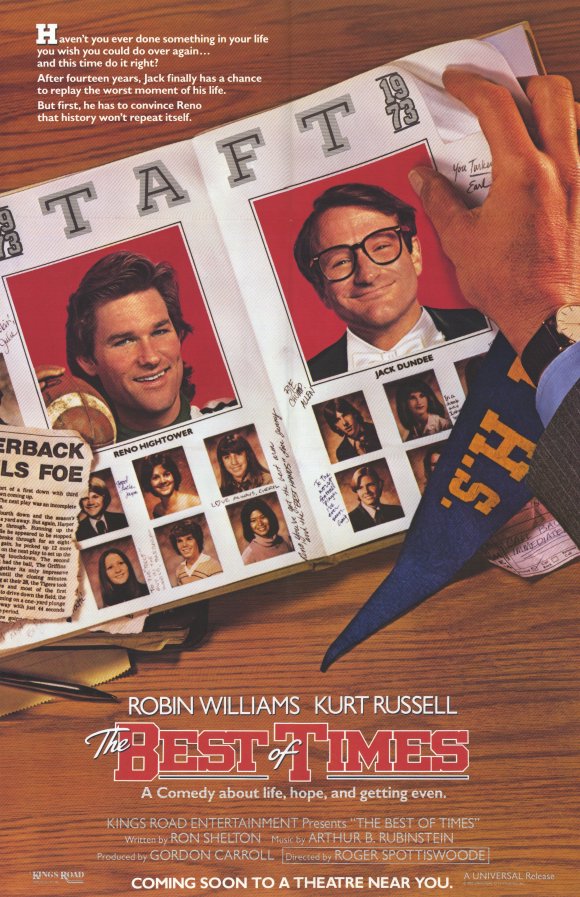
            Robin Williams plays Jack Dundee, a man who on November 15, 1972 dropped a sure touchdown pass in a football game with their chief rival Bakersfield. Now, 13 years later, he still dwells on it all the time and even watches old film footage of it in his basement. He becomes obsessed with playing the game again with all of the same players. The problem is that most everyone has moved on including their star quarterback Reno Hightower (Kurt Russell) who is now working as a local car mechanic due to a knee injury that he suffered during that game. Jack persists and eventually gets a game scheduled, but that proves to be only part of the battle.

The script, by Ron Shelton, has an interesting point that could touch anybody. Who out there doesn’t want to go back and relive some past mistake, or regret, and make it better? The fact that he also lives in a small town and is constantly being reminded of it hits home as well. I was born and raised in a small, Midwestern town, so I know it can be hard to live down certain things. So, in context, it is a great theme. As people age and fall into a dull routine of a dead-end job and marriage it is sometimes an event that happened to them when they were younger that matters and in that capacity it is a great idea.

The problem is that the execution of it is contrived and dull. The first 45 minutes are spent with endless conversations of the ‘dropped pass’ that goes nowhere. Some of the psychological tactics that Jack uses to motivate not only his teammates and those from the other team into playing the game is somewhat interesting, but not terribly funny. In fact there is very, very little in this movie that is funny, or even halfway creative for that matter. It seems to be nothing more than the regurgitated ‘feel good sports formula’ that has been done a million times before without adding anything new. The final game sequence has all the expected clichés and what should be exciting and thrilling becomes boring and tiresome. I was almost hoping that Jack would drop the damn thing again when he had his second chance, which gets shown in annoyingly slow motion, as it would have been funnier and if anything given us some sort of surprise as everything else is painfully predictable.

The only time this movie that gets even slightly amusing, and I do emphasize amusing as there is nothing in here that is at any time hilarious, is when they bring back all the old players who are now middle-aged and out-of-shape and try to hold a practice. Having now grown to middle-age myself I can say succinctly that you can’t go back again even if you want to and the movie brings this up in some of the vignettes, but then doesn’t go far enough with it.  Instead, just as the film should be gaining some sort of momentum, it gets bogged down with a meandering segment involving the men trying to reconcile with their wives after some inconsequential tiff.

There is also the fact that if someone who has not moved on in their life and dwells on something as much as Jack does than in most cases would be unable to have long-term relationships with other people, or even hold down jobs. Yet here our hero is in a pretty good marriage and a cushy job. It would have been more interesting and probably funnier had the Jack character been a crook, or living on the absolute fringes of society and not been able to adjust to life until he had a second chance at the catch. Of course this would have been considered too ‘edgy’ by most Hollywood producers and I’m sure test audiences of which Hollywood is very dependent on would not have approved, which probably explains why the character is so boringly normal.

For what it’s worth Williams gives an energetic and engaging performance. The character is not all that well developed, but Robin gives it some life and helps make the movie passable. Russell seems a bit a dull here despite being an always durable actor. I realize the character is a bit passive, but having him transform into an aggressive, angry leader at the end seemed forced and phony. I was also disappointed that legendary character actors appear here including Carl Ballantine, Dub Taylor, Kathleen Freeman, and R.G. Armstrong and are given nothing more than a line of dialogue a piece and in the case of Ballantine only one word, which seems outrageous.

I have nothing to recommend here. I am giving it two points simply because the production values are high enough that it doesn’t look amateurish, but the flat, slightly implausible storyline needs to be injected with some sort of originality. Even for fans of Williams I would say stay away from it as seeing him in such blah proceedings doesn’t make it worth it.

My Rating: 2 out of 10

Released: January 31, 1986

Runtime: 1Hour 44Minutes

Rated PG

Director: Roger Spottiswoode

Studio: Universal

Available: VHS, DVD, Amazon Instant Video
The April Fools (1969)

By Richard Winters

My Rating: 2 out of 10

4-Word Review: Affair between married people.

Director Stuart Rosenberg was on a high note in 1967.  He had just won rave reviews for his cult hit Cool Hand Luke and many felt he was well on his way to being Hollywood’s next top director only to follow it up with this incredibly vapid and stupid romance movie.

It involves a married man by the name of Howard Brubaker (Jack Lemon) who meets an attractive woman named Catherine Gunther (Catherine Deneuve) at a party. They spend the evening walking around outside and having nothing more than a casual conversation, which is enough to make him decide to leave his wife (Sally Kellerman) and child, quit his high paying executive job, and run off with her to Paris.

The story is pretty threadbare and filled with a lot of characters and situations that are not fleshed out at all.  This almost seems like a partial treatment to a main script that never got completed.  This movie provides no real tension, conflict, or subplots.  Most movies dealing with potential romances usually has one or both of the participants second guessing themselves as to whether they should move ahead with the relationship especially when both of the people are married like they are here.  These two fall in love so amazingly quickly that they make the art and act of dating seem completely unnecessary.

A much better idea would have been to have this quick romance act as only the starting point.  The film then should have cut to 5 or 10 years later where we could have seen how this relationship fared, or evolved. This would have given much better perspective to both the movie and characters.

I also have never felt that two people having an affair is a real good catalyst for a love story because it seems to go against the whole ‘true and everlasting love’ theme that propels most romance stories.  After all if someone can’t stay fully committed to one person what is to say that they will be able to do so with someone else.  To give the argument that they are just ‘crazy’ about this new person doesn’t work because at some point they must have been ‘crazy’ about the person they are currently with or they wouldn’t have married them. So what is to say that in a few years time when the newness of the relationship wears off that the whole vicious cycle won’t just get repeated.  I don’t have the exact statistics in front of me, but research has shown that people who cheat on one person are prone to doing it with their next partner simply because it is in their nature.

In some ways I could see why Catherine would consider leaving her husband, which is well played by Peter Lawford, simply because the guy is a womanizing lout in the worst way.  It is understandable that she may have been initially mesmerized by his wealth and charisma and only had her eyes opened to his shallowness years later.  However, Howard’s marriage didn’t really seem that bad and what is worse is the fact that he had a 5 year old son whom he seemed to have no problem abandoning without even a second thought.

The whole thing comes off like some uninspired idea by some studio head who wanted to make a ‘sure-fire’ hit by throwing together every contrived romantic element he could think of, piecing it together with a flimsy script, and then using the star-power of Lemon and Deneuve to cover up all the holes.  Everything here seems forced and that includes the humor.  Lemon’s duel with Charles Boyer is overdone and irrelevant.  There is also a scene where Howard’s friend (Jack Weston) drives him to the airport while being completely drunk and weaving in and out of on-coming traffic.  Today’s audiences would find this to be highly irresponsible and also terribly unfunny, which it is.

There are some potentially funny ideas that scriptwriter Hal Dresner never seems to think of.  For instance Catherine ends up being the wife of Howard’s new boss.  This could have been a goldmine of a lot of funny scenarios as the two tried sneaking around behind his back. The Lawford character does eventually corner Howard at the airport just as he is ready to board the plane and go off to Paris with Catherine, but even this potential confrontation gets botched badly.

I did really like Deneuve and her presence is the only real good thing about this movie. She looks radiant and I enjoyed the cool, chic way she responds to all the situations she is put in. This also marked her American movie debut.

Lemon though does not fare as well.  He overplays the high-strung businessman persona until it becomes tiresome.  He is nervous and befuddles every second that he is on the screen until you wonder how he was ever able to impress anyone enough to be able to obtain the prestigious position that he has at his company.

The supporting cast is stellar, but not used enough.  Jack Weston has a funny bit as he explains the goofy way that he handled an affair of his own.  Harvey Korman is amusing as a man who tries stealing the alluring Deneuve away from Lemon at the last minute.  It is also fun to see Melinda Dillon in her film debut.  She is best known for her supporting dramatic roles, but here she plays a giggling, ditzy blonde.  She is paired up with comic character actor Kenneth Mars and the two have the makings of being a great hammy couple. Unfortunately they are not given enough screen time, nor enough good lines, to really make it gel. Myrna Loy and Charles Boyer, as a long-time married couple, are essentially wasted.

Besides Deneuve there were a few other things that I did like about the movie.  The Burt Bacharach score is certainly pleasing on the ears.  There is a funky, mod 60’s party that takes place at the beginning of the film that features a lot of weird art exhibits that are nicely realized by award-winning set designer Richard Sylbert. I found the exhibit that featured a faucet dangling in mid-air while running a constant stream of water to be fascinating. I also enjoyed the scene where Deneuve and Lemon go to a wild nightclub where they are handed pop guns as they sit down which they can use to shoot at the rear-ends of the waitresses when they want to get their attention. I thought this was a genuinely neat idea that should be used at every restaurant.

My Rating: 2 out of 10

Released: May 28, 1969

Runtime: 1Hour 35Minutes

Rated PG

Director: Stuart Rosenberg

Studio: National General Pictures

Available: VHS, DVD (Import)

Who’s Been Sleeping in My Bed? (1963)

who1

By Richard Winters

My Rating: 3 out of 10

4-Word Review: Carol Burnett does striptease.

Every time I get annoyed by many of today’s Hollywood comedies that seem to be nothing more than a stretched out idea for an episode of a sitcom, one only has to go back into time to find that the comedies of yesteryear weren’t always much better. Of course there were some classics, but a lot of vapid ones in the mix as well. In fact this one is so trite that it becomes almost agonizing to sit through. It was considered in its time to be a ‘sex farce’, but fails to deliver on either.

The old adage ‘it’s not what you know, but who you know’ has never been truer in this instance. I have attended many screenwriting classes and seminars and can verify there is a lot of good stuff out there that hasn’t been read unfortunately because the authors don’t have the right connections. In this case the screenplay was written by Jack Rose who had previous writing success with such films as My Favorite Brunette, Houseboat, and The Road to Rio. Judging from its lack of creativity Rose probably wrote this real quickly to make some fast cash and the studio heads gave it the green light simply based on his past success without ever looking at it critically.

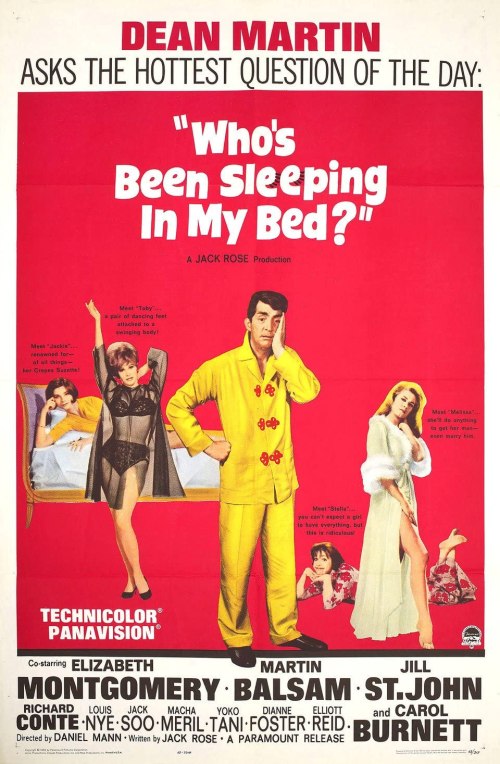
The plot, if you can call it that, has to do with TV-star Jason Steel (Dean Martin) who plays the part of a popular Dr. on a TV-series.  His TV character matches all the ideal qualities that women want in a man and thus he always has women chasing after him in real-life. He even has the wives of his friends coming on to him. With so many married women telling him how unhappy they are in their marriages he begins to fear that marriage may not be a good idea and thus calls off his impending engagement to beautiful Melisa Morris (Elizabeth Montgomery).  Melisa is devastated by this, so her goofy roommate Stella Irving (Carol Burnett, in her film debut) hatches up a kooky scheme in order to get him to reconsider.

This film gets tiring right from the beginning.  Jason goes out with his buddies every Thursday night to play poker, but then during the game he always gets a call from one of his buddy’s wives telling him they have to see him.  He leaves the game and meets them at his place and then fights off their advances. This silly scenario gets repeated four different times with all four of his friend’s wives and it’s like being told the same dumb joke over and over. This triviality ends up taking up the whole first hour before it moves into the scheme portion, which really doesn’t even measure up to a weak episode of ‘I Love Lucy’.

Out of the whole ninety minutes there are only two scenes that are mildly amusing.  One is when Jason pushes everyone into a pool and they fall in like dominoes and the other is when Stella goes to a strip club and is forced to go onstage and do a striptease when she can’t pay for her drinks, which makes great use of Burnett’s ad-libbing abilities.

Burnett and Montgomery make an interesting pair. Montgomery is a good straight-man to Burnett’s zaniness and with a better script this could’ve been ideal casting. Montgomery did this film just before she started her long running series ‘Bewitched’. She looks gorgeous and gives the film’s best performance.

There is a long list of excellent male character actors here including: Martin Balsam, Jack Soo, Richard Conte, Louis Nye, and Johnny Silver. All of them are wasted with very little to do. Except for the money I don’t know why any of them took their parts.

The satirical jabs at TV-dramas are too gentle and not even good for a chuckle.  If one is considering getting married then I would definitely not suggest it as the script takes so many potshots at the institution that it is liable to give anyone second thoughts.

Although this was made as a vehicle for Martin I feel even fans of Dino will be disappointed. It really doesn’t take advantage of his persona and he seems as bored with the material as the viewer and just going through the paces. Despite the interesting cast this is an all-around disappointment.

My Rating: 3 out of 10.

Released: December 25, 1963

Runtime: 1Hour 43Minutes

Rated NR (Not Rated)

Director: Delber Mann

Studio: Paramount

Available: Netflix Streaming

Avanti! (1972)

avanti1

By Richard Winters

My Rating: 7 out of 10

4-Word Review: Juliet shows her boobies.

Jack Lemmon plays Wendell Armbruster Jr. a conservative, set-in-his-ways businessman who travels to Italy to arrange the return of his father who died in a car accident. To his shock he finds that his father did not die alone, but instead was with his secret lady lover of twenty years. Apparently they would meet every summer and the two had been carrying on the secret affair without any of their family members knowing. Juliet Mills plays Pamela Piggott the daughter of the other woman. She comes to claim the body of her mother and after the two meet a certain romantic spark slowly begins to ignite.

This film is similar to The April Fools, which was another romantic Lemmon vehicle that was done just a few years earlier.  This film though works much better. For one thing there is a nice bit of mystery as to whether this thing will continue on or not and the ending leaves you guessing. Sometimes the best romances in life are the brief flings one has with someone that they know for only a short period of time and then move on and this film nicely captures that. The relationship grows at a realistic pace without ever being forced, clichéd, or sappy. In fact the two at first don’t even like each other.

Lemmon’s character here is much improved from the one in The April Fools. Instead of just being a bland schmuck he is more crusty, argumentative, and confrontational almost like talk show host Bill O’Reilly. His snappy comebacks and one-liners are fun and help hold the movie together. Mills (sister of Hayley, daughter of Sir John and wife of Maxwell Caulfield) is a delight as always playing a serene good-natured character similar to the one she did in her famous TV-show ‘Nanny and the Professor’. The fact that the two leads have such diametrically different dispositions helps give it a spark and make it intriguing.

Director Billy Wilder nicely captures the ambience and scenic beauty of the region and screenwriter I.A.L Diamond’s script is paced with amusing side-stories and characters. However, a 145 minute runtime is too long for such slight material and it spends a little too much time on side-stories that go nowhere. The scenes themselves are stretched out longer than they should with hardly any action and there is too much emphasis on the Neil Simon-like comical banter that ultimately makes this production seem more like a filmed stage play than a movie.

The film though does have some nice moments of humor. The part where the two go the morgue to identify the bodies and the very particular way the administrator sets out the legal documents to be signed and the way he packs them back up is amusing. There is also a scene where the two go skinny dipping and swim out to a small island. Yes, you do get to see both stars in the buff and although Mills isn’t bad, Lemon with his pale, out-of-shape, middle-aged-body, might be a bit too much for some. However, it is funny seeing him swim in the nude, but still leaving on his brown socks, which is a perfect testament to his uptight character. The best part and by far and away the funniest moment in the film comes when a boat load of sailors come by and start whooping and hollering at the nude Pamela. Wendell then tries to ‘protect Pamela’s modesty’ by taking off his wet, dripping socks and holding them over her ample bosoms while she merrily waves to the passing men. It’s a visual thing, but it had me laughing-out-loud.

I did have two issues with the film that I feel should be discussed. The first is the opening bit where Wendell gets on the plane without any luggage and wearing casual attire because he was given too short a notice to change clothes before he had to board the plane. He sees a man with a nice suit on and asks him if they could change clothes. Yes, it is a bit amusing when everyone on the plane, including the stewardesses and the pilots, crowd around the bathroom door in confusion after seeing two grown men go in, but the joke falls flat because it is not in any way believable. Who in their right mind would go into a small bathroom of a plane with a perfect stranger to change clothes with him, especially when there was no money exchanged? Most would probably think he was a kook and tell him to get lost. The first rule they teach you in comic screenwriting 101 is that for the joke to work there needs to be some grain of truth to it, or otherwise it will come off as stupid, which it does here.

The other problem has to do with Pamela and her apparent ‘weight problem’ that gets mentioned not only by her, but by the other characters as well. The truth of the matter is that she looks great and has a figure most women would die for. I noticed this same thing with the Anne Hathaway character in The Devil Wears Pavda where she was labeled as ‘fat’ when compared to the other models even though she looked terrific. Apparently Hollywood, in their never ending quest for ideal beauty, cannot bring themselves to actually cast a plain, over-weight woman in the pivotal role of a love interest even if the script calls for it so instead they get someone who is just slightly under the gorgeous level, but still way above the average woman, and then hope to pass her off as a ‘plain Jane’. The result becomes not only ridiculous, but highly annoying and even insulting especially when it continues to be brought up and discussed.

Overall romance fans should find it appealing as the story has all the necessary ingredients and fits the formula well.

My Rating: 7 out of 10

Released: December 17, 1972

Runtime: 2Hours 20Minutes

Rated PG

Director: Billy Wilder

Studio: United Artists

Available: VHS, DVD, Amazon Instant Video

Funny Farm (1988)

funny1

By Richard Winters

My Rating: 3 out of 10

4-Word Review: Novelist moves to country.

Uninspired comedy about a man named Andy Farmer (Chevy Chase) who receives an advance from a publishing company, which he uses to quit his job and buy a cabin out in the country with his wife Elizabeth (Madolyn Smith) in order to write his novel. Unfortunately the local citizens are eccentric in very clichéd ways and their time there is spent dealing with one crazy misadventure after another.

Right from the start this film proves to have no footing in reality. Publishing companies only pay advances to authors who are already published and proven. They do not shell out $10,000 to some average unpublished Joe with only a vague idea for a story. Many publishers won’t even look at a finished manuscript from someone unless they are already represented by an agent and have some sort of track record, which renders this entire premise as ridiculous.

The movie starts off too quickly with them moving to the country without any set-up. The characters themselves are extremely bland and the script does not take advantage at all of Chase’s cynical, sardonic humor, or impeccable comic timing. Smith is certainly pleasant on the eyes, but things could have been more interesting had they been played-up as spoiled city slickers like the Lisa Douglas character from the TV-series Green Acres and then forced to adjust.

The humor is sloppy and uninspired and shows no level of sophistication. It is thrown in haphazardly without any consideration for story progression, or character development.  Much of it is not funny and the whole thing seems like a stretched out episode from the old Newhart TV-series and in fact the film was shot in Vermont were that series took place. The only mildly amusing moment comes when Andy goes fishing with some of the men from town and ends up accidently throwing them all overboard and even that is worth only a small chuckle. The final segment were Andy and Elizabeth convince everyone in the town to act like people from a Norman Rockwell painting and have them study covers from old issues of the Saturday Evening Post, as  they think this will make things seem more appealing to prospective buyers, is utterly preposterous.

The only time this film has any possibilities is when Elizabeth ends up not liking the story that Andy has written. Being a writer myself and having dealt with other writers I can attest that this can happen more than you think. In fact famous horror novelist Richard Laymon stated that his number one rule of things not to do was giving your manuscripts to friends and family members to read because it can create needless acrimony. Things get dicey when Elizabeth writes a story that sells, but the sterile script by Jeffrey Boam fails to take full advantage of this scenario and the results become as disappointing as everything else.

I did like that it was shot on location. The cottage is nestled away in a scenic area and the viewer gets the feeling that they are ‘getting away from it all’ along with the characters.  Capturing it during all four seasons is another plus. I also thought that the realistic looking stuffed squirrel was cool and I wish I could find one of those for myself.

Sadly, this was director George Roy Hill’s last film. He had much more success with Butch Cassidy and the Sundance Kid, Slapshot, and The Sting to name just a few. None of his genius shows up here as it is quite mechanical and formulaic.

My Rating: 3 out of 10

Released: June 3, 1988

Runtime: 1Hour 41Minutes

Rated PG

Director: George Roy Hill

Studio: Warner Brothers

Available: VHS, DVD, Blu-ray, Amazon Instant Video