Category Archives: Comedy

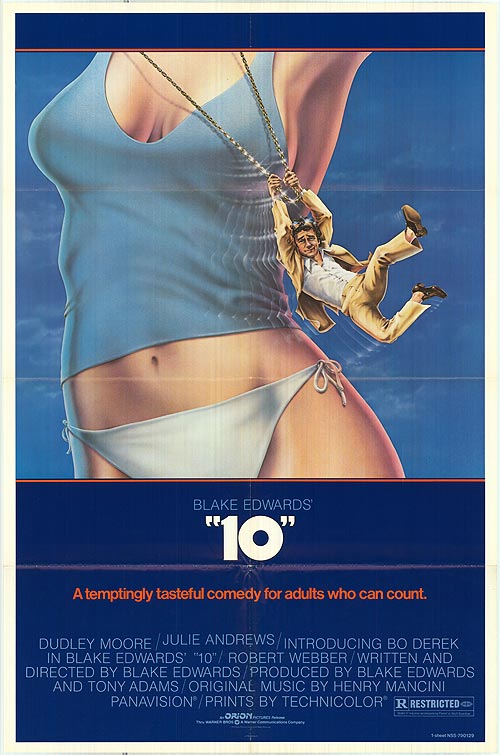
10 (1979)

By Richard Winters

My Rating: 3 out of 10

4-Word Review: Bo Derek is hot.

George Webber (Dudley Moore) is a successful songwriter who has just turned 42 and finds himself longing for a beautiful younger woman (Bo Derek) that he sees while driving. Problem is he meets her on her wedding day and yet he still pursues her all the way to Mexico where she goes for her honeymoon.

It’s really, really hard to believe that this was such a big hit. It meanders badly and has a lot of slow stretches. It is also not that sexy. Bo is only shown sporadically and you never really get to see her naked, or at least not from the front. Writer/director Blake Edwards incorporates his patented slapstick humor, but it’s uninspired and doesn’t mesh well with a film that is supposedly working on a more mature and sophisticated level.

The issue of middle-age, or better yet ‘male menopause’, has been handled before and better. In fact this thing can’t hold a candle to Tom Ewell and The Seven Year Itch. The issues it brings up are quite general and handled superficially. It offers no new perspective and is shockingly unimaginative.

Dudley Moore fits nicely into his role and it seems not too far removed from the man himself as it deals with a uniquely talented man that harbors a degree of cynicism and detachment. His relationship with girlfriend Samantha (Julie Andrews) has some interesting elements and it could have been a foundation for a movie in itself.

Derek is stunning, but rather poor in the acting department. Having a beautiful lady portray such a shallow person is a real turn off. Sure it’s done to give the film its point, but it seems extreme.

Overall I found the film to be weak and empty and unable to even come close to meeting its reputation.

My Rating: 3 out of 10

Released: October 5, 1979

Runtime: 2Hours 2Minutes

Rated R

Director: Blake Edwards

Studio: Warner Brothers

Available: VHS, DVD, Blu-ray, Amazon Instant Video

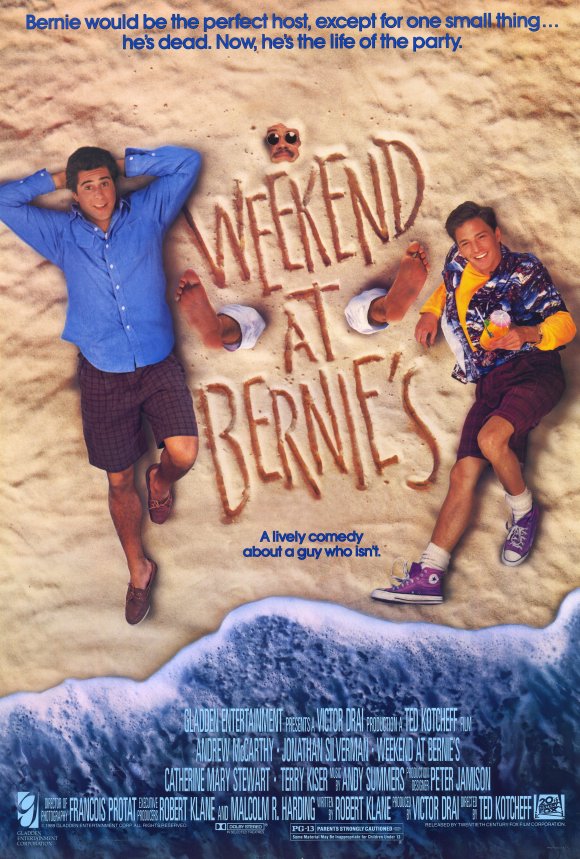
Weekend at Bernie’s (1989)

By Richard Winters

My Rating: 4 out of 10

4-Word Review: Dead body causes problems.

Larry and Richard (Andrew McCarthy, Jonathan Silverman) are two young executives that find an accounting error that could save the company two million dollars. They show their arrogant boss Bernie (Terry Kiser) the findings. He decides to reward them with a weekend at his beach house on the Hampton Island. However, unbeknownst to them Bernie also has mob connections and the mob decides to off him just as they get there. Antics ensue as the two young men must pretend that their dead boss is still alive.

It sounds rather mindless and I braced myself for the worst yet, at least at the beginning, it is surprisingly tolerable. The two leads are likable and have distinctive personalities. They mesh well and even have a few good exchanges. The pacing is decent and without the usual 80’s sloppiness or crudeness. It even culminates with a party that nicely satirizes the trendy, affluent set.

However, it collapses after this. The second half becomes stretched and one-dimensional and the action gets silly and cartoonish. There is a potential at making it slapstick, but like in the boat scene, it is not extended out enough. It seems almost amazing that such a simple and routine comedy could have been written by Robert Klane the same man who wrote Where’s Poppa?, which was so original and groundbreaking.

Silverman was a good choice for the lead. He has the perfect composure and attitude for frantic comedy. McCarthy gives his part a lot of energy, but his face looks like it never reached puberty. Recycled supporting player Terry Kiser is fun as the arrogant boss, but having him become such a patsy to the mob seems disjointed. His best work actually comes when he is playing dead. Trying to remain motionless and unresponsive to everything happening around you is much harder than you think. It’s also fun to see a cameo by talented director Ted Kotcheff half- naked in his underwear playing Silverman’s dad.

If you are looking for fluffy, undemanding comedy then this should do the trick. However, others will find it vapid and lacking in any type of depth, or distinction.

My Rating: 4 out of 10

Released: July 5, 1989

Runtime: 1Hour 37Minutes

Rated PG

Director: Ted Kotcheff

Studio: 20th Century Fox

Available: VHS, DVD, Blu-ray, Amazon Instant Video

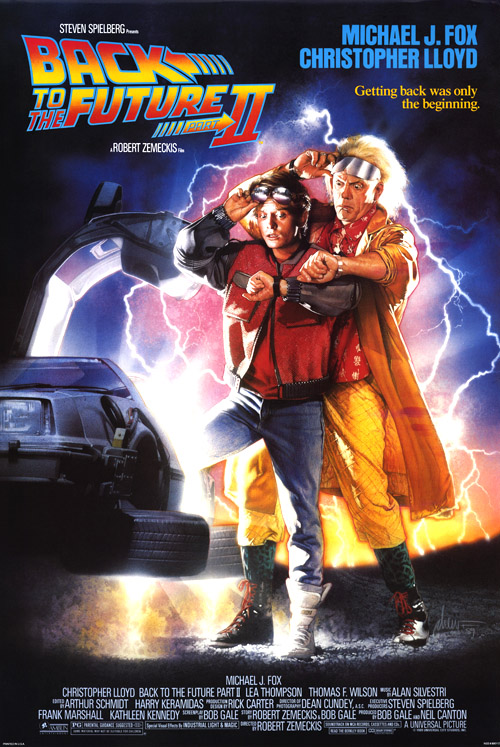
Back to the Future Part II (1989)

By Richard Winters

My Rating: 6 out of 10

4-Word Review: They go back again.

            Marty McFly (Michael J. Fox), Dr. Emmett Brown (Christopher Lloyd) and his girlfriend Jennifer Parker (Elisabeth Shue) use the DeLorean to travel 30 years into the future to help save their future son who is in trouble with the law. There Marty meets an older version of Biff (Thomas J. Wilson) who overhears about the time machine. He decides to take a discarded sports almanac listing all the scores for the past five decades and steals the machine and uses it to go back to the year 1955. The older Biff then meets up with his younger version and hands him the almanac telling him that he can bet on every winning team in every sport and make a fortune, which he does. This then changes the course of history drastically and it is up to Marty and the Dr. to go back to the 50’s and try and stop the transaction between the two Biffs from happening.

Like with the first film, I found the plot to be inventive and creative. Writer/director Robert Zemeckis has thought everything through and keeps the twists and turns coming at a fast pace making it virtually impossible to predict where it is going. Yet the story is complex and some may say convoluted. The idea of going back to the 50’s makes it seem almost like a retread of the first film. The characters even meet their counterparts going through the same scenes from the first, which ends up only tarnishing the original. Outside of the scenes from the future this film lacks the lightheartedness and fun of the first. The tone is much darker and the Biff character as well as his grandson Griff, which Marty meets in the future, are boring one-dimensional bad guys that are given too much screen time.

My favorite part is at the beginning. The flying cars and the space highway with similar road signs that you would see on a regularly highway is well done. I got a kick out of the Nike sneakers that can tie themselves and the coat that talks, can change shape to fit any size, and even dry itself off when wet. Marty’s trip to an 80’s café is fun and if you look closely you will see a young Elijah Wood in a brief part. The futuristic Texaco gas station and the movie marquee advertising ‘Jaws 19’ because this time ‘it’s really, REALLY personal’ is funny as is the holographic shark that jumps from the ad and scares Marty. Of course, as of this writing, we are now only three years away from the actual 2015 and it is safe to say that they got it all wrong, but it’s still interesting to see how they envisioned it. My only objection would be the clothing styles worn by the people that look like clown outfits, which may have been subtle satire, but I’m not sure.

I did feel the reason for them traveling to the future proved to be a loophole. In every other scene Emmett is always preaching about never trying to alter the regular course of events because this could cause unforeseen cataclysmic problems, so why then change his philosophy here? The reasoning given is sloppy and slapdash.

I did like that Marty turns out to be just a regular middle-aged suburbanite and not the famous rich rocker he dreamed of as the odds probably could have predicted. Fox is amusing as the older Marty and the make-up job is impressive for the way they get his perpetually boyish face to age.

Crispin Glover is certainly missed. He was unable to come to an agreement on the salary and thus turned down reprising the role of George McFly. A likeness of his image was used and he sued them for it and I say good for him.

Elisabeth Shue appears as Jennifer filling in for Claudia Wells who played the part in the first one, but then dropped out of acting to care for her sick mother. Shue has certainly grown into being a fine and respected actress, but here she is wasted. She does little except show facial expressions that are constantly perplexed and nervous, which eventually becomes laughable. The scene where Emmett and Marty decide to allow Elisabeth to lie sleeping amidst a pile of trash while they go off and do something else seemed questionable.

Had the film stayed in the future it would have been more enjoyable. I still found it to be entertaining, but it is easy to see why this entry is generally considered the weakest of the series. I was rather put off to see previews of Part III shown at the end, which made it seem like this whole thing was just an excuse to sell the audience on seeing the next one, which artistically isn’t a good precedent to set.

My Rating: 6 out of 10

Released: November 22, 1989

Runtime: 1Hour 48Minutes

Rated PG

Director: Robert Zemeckis

Studio: Universal

Available: VHS, DVD, Blu-ray (25th Anniversary Trilogy)

Back to the Future (1985)

By Richard Winters

My Rating: 7 out of 10

4-Word Review: Traveling back in time.

Marty McFly (Michael J. Fox) is a 17 year old videotaping his older friend Dr. Emmett Brown (Christopher Lloyd) who is planning on entering a time machine he has invented and going thirty years into the future. Just when he is about to enter the vehicle some angry Libyan nationalists with rifles appear who are upset that Emmett took plutonium from them under deceptive means. To escape the bullets Marty jumps into the machine, which is a DeLorean car, and goes back to the year 1955. Here he bumps into his father George (Crispin Glover) who is now a teenager himself and Marty inadvertently stops him from meeting his mother Lorraine (Lea Thompson) thus putting his entire existence into jeopardy. Marty must find a way to get them together while also working with Emmett on getting him back to the 80’s.

The concept is original and creative. Director Robert Zemeckis has every plot point and tangent covered. Just when you think you have a handle on it he throws in another twist that makes it even more interesting. It moves at a fast pace and a perfect blend of action and comedy. The dialogue is endlessly amusing as it takes full-advantage of the ironic scenarios and the special effects are good. The music, especially the song ‘The Power of Love’ by Huey Lewis and the News is rousing and Huey even appears in a brief cameo as a nerdy talent judge. There are a lot of great scenes that are both funny and exciting.

Fox is terrific in the lead although Eric Stoltz was cast in the part originally, but fired after four weeks of shooting. Fox is far better as he displays an intelligence and restraint that most other teen stars don’t have. His mannerisms are a plus and the way his voice reaches a high pitch whenever he is nervous is funny.

Crispin Glover is always interesting. He has such an eccentric personality and acting style that he makes every film that he is in better. However, in the early scenes he doesn’t look middle-aged and more like a skinny teenager with horn rimmed glasses.

I had the same issue with Christopher Lloyd only in reverse. Of course he is perfect for the role. His bulging eyes almost make it seem like he was born to play the part of a mad scientist. I was however surprised that no noticeable attempts were made to make him look younger when Marty meets him in the 50’s. I expected the character to be young and just starting out, but instead he already seemed established and living in a nice house making me wonder who was paying him to tinker around his home all day on his experiments?

Lea Thompson is not completely convincing as a mature woman during the first part and she looks very uncomfortable under all the heavy make-up. However, she is certainly cute in the scenes where she is younger.

In the complaint department I do have a few. First all the characters that Marty meets during his time in the 50’s seem excessively dopey. The film is too entrenched with an 80’s mindset. The 50’s is portrayed as a quaint bygone era with no relevance. There is too much of a ‘we’ve come a long way baby’ mentality and the 80’s played-up as being way ‘cooler’ than the 50’s even though some people may disagree. It would have been nice had there been a broader, transcendent approach to the story that would have been able to compare and poke fun of each era equally instead of just dumping on the 50’s like it was a joke.

The climatic sequence in which Emmett tries to connect a wire from a clock tower, which is set to be struck by lightning, to the DeLorean, so Marty can use the electricity to propel the vehicle back to the present gets overplayed. I don’t mind some unexpected mishaps to happen, but Zemeckis becomes obsessed with throwing in every type of calamity possible every few seconds until it becomes tiring and annoying. It got to the point where I just wanted the damn scene to end not so much because I cared anymore about Marty’s fate, but more because my ‘tension meter’ had become exhausted.

SPOILER ALERT

            My third and final grievance has to do with the very end when Marty returns to the present and finds that his father has turned into a much more confident and successful man then he had originally been at the beginning. This is because due to Marty’s meddling during his time in the 50’s, George ended up confronting Biff (Thomas F. Wilson) his lifelong nemesis and knocking him out with one punch, which gave George a new found sense of confidence. This also turned Biff from a bully into a patsy and thirty years later we see him as George’s mindless assistant. Now this twist may initially sound funny, but after a second when you really think about it, the humor is lost because it has absolutely no bearing in reality. No bully is going to take on a meek role for the rest of his life simply because some scrawny guy was able to knock him out with a lucky punch. If anything Biff would have become obsessed with getting back at him and even challenging George to another fight and not giving up until they did so. Or after graduation, he would have simply left that hick town and gone on with his life and leaving that embarrassing and isolated incident far behind him. Sometimes irony can be great and I usually do love it, but too much of anything is never good and at certain points this film seems to get to that level. Also, for such an otherwise clever film you would have thought that they could have come up with a more creative name than Biff for the bully.

My Rating: 7 out of 10

Released: July 3, 1985

Runtime: 1Hour 56Minutes

Rated PG

Director: Robert Zemeckis

Studio: Universal

Available: VHS, DVD, Blu-ray (25th Anniversary Trilogy)

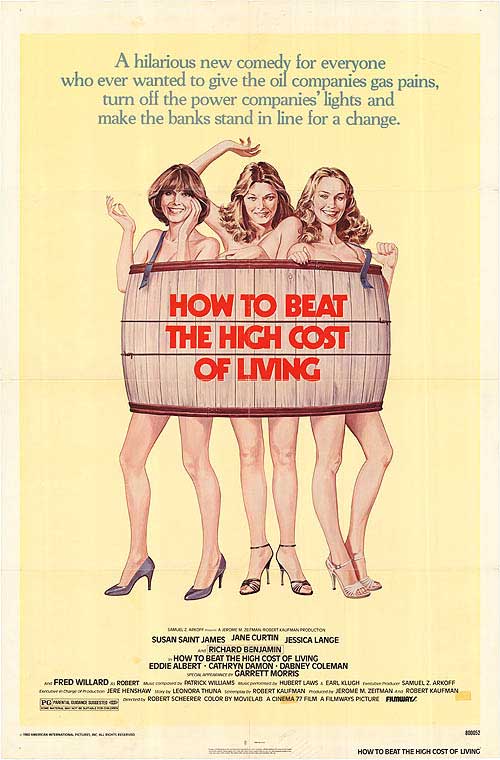
How to Beat the High Co$t of Living (1980)

By Richard Winters

My Rating: 2 out of 10

4-Word Review: Ball full of money.

            Jane, Elaine, and Louise (Susan Saint James, Jane Curtain, Jessica Lange) are three women who find themselves in financial straits. They become aware of a contest going on at their local mall that features a giant plastic ball filled with money. The idea is to guess how much money is inside the ball, but the women decide to tunnel underneath the building and suck the money out with a vacuum.

The movie falls flat from the beginning. There is no action, hijinks, jokes, or pratfalls. Everything relies on the dialogue that is boring and conventional. The small attempts at humor including some Abraham Lincoln jokes are stale and unimaginative. It takes a plodding 35 minutes just to detail all of their financial difficulties and then another 40 minutes of going through their planning phase before we ever get to the actual heist, which proves not to be worth the wait.

Having a giant ball in the middle of the mall makes for an interesting visual and the concept of trying to get money out of it managed to hold my interest somewhat in what is otherwise a highly uninspired movie. However, I found it hard to believe that these women, as financially desperate as they were, would decide to pull off such a dangerous and complex heist when they had no experience in robbing anything before. Having them rob a bank, although more standard, would have made more sense and with a little imagination could have been even funnier and more interesting. The actual execution of the crime is dull and I thought it was really reckless and stupid that they chose to do it while security guards where standing around it and tons of people present watching a nearby play instead of waiting until the place closed. Also, it was ridiculous during the planning stage when they decided to force Jane to rob a grocery store in order to get her ‘psychologically ready’ and prove that she had the ‘guts’ to pull off the big heist, but this seemed stupid because if she got caught, which could easily happen, then all their plans would have been ruined.

The only thing that half-way saves it are the female leads and I liked all three of them. Saint James is a very attractive woman and normally I don’t particularly like ladies with husky voices, but with her it is sexy. I also enjoyed the naïve quality of her character. Lange is young and beautiful here and looking light years removed from the southern accented old crone that she has been playing in ‘An American Horror Story’. Her vivaciousness helps propel every scene that she is in. Curtain is a blast as well. She has impeccable comic timing and I always felt her presence on ‘Saturday Night Live’ was one of the main reasons that show was so successful and ground-breaking during its first five seasons. The only problem I had with the character is that she performs a striptease near the end, which isn’t funny or sexy and comes off as stupid and degrading instead. It is also quite clearly a body double and not Curtain herself that you end up seeing topless, so for any voyeurs out there who might think of buying this just for that reason, don’t bother.

The male leads are essentially wasted. Eddie Albert has a meaningless role as Jane’s father and I could see no other reason for why he took the part except that he wanted to stay busy in his old age. Richard Benjamin can be great at times, but here his character is vapid. I also thought it was a bit strange that he was cast as Lange’s husband since in real-life he was eleven years older and given her very youthful appearance here almost made it look like a middle-aged guy bedding a minor. Dabney Coleman is cast against type playing a nice guy for a change instead of a conniving jerk that he usually does. Since he plays conniving jerks so well I have always enjoyed him and the change of pace is interesting for a few seconds before it becomes boring like everything else.

The on-location shooting in Eugene, Oregon does not help. The music score comes about as close to ‘elevator music’ as you can get. The opening animation sequence is lame. Outside of a slightly amusing cameo by Garret Morris this thing never gels and it is one film you can afford to miss.

My Rating: 2 out of 10

Released: July 11, 1980

Runtime: 1Hour 44Minutes

Rated PG (Brief Nudity)

Director: Robert Sheerer

Studio: American International

Available: VHS, DVD, Netflix streaming

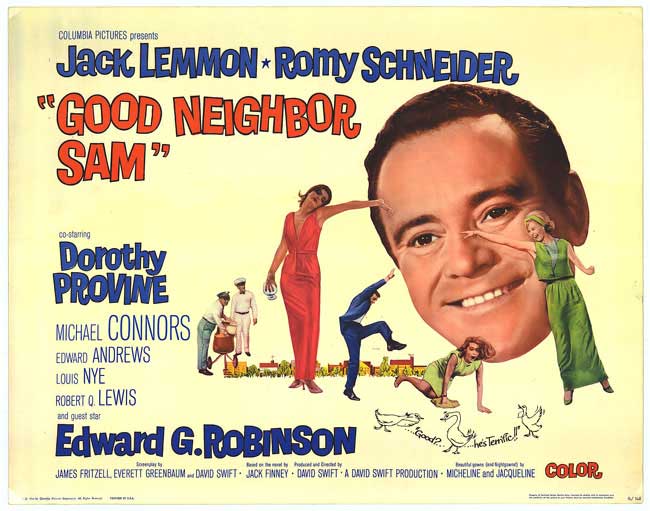
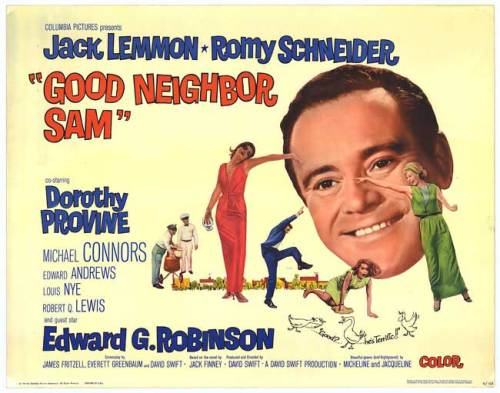
Good Neighbor Sam (1964)

By Richard Winters

My Rating: 7 out of 10

4-Word Review: Pretending to be married.

            Sam Bissell (Jack Lemmon) is an advertising executive working for a demanding client (Edward G. Robinson) who is very conservative and insists everyone around him have a clean-cut image and lifestyle. Sam’s wife Minerva (Dorothy Provine) brings home her college friend Janet (Romy Schneider) for a visit and she rents out the neighbor’s place while she is there.  Janet then finds out that she is going to be left a large inheritance, but the will stipulates that she must be married even though Janet is instead going through a divorce. For the sake of allowing her to collect the large fortune, which is 15 million dollars, Sam agrees, with the blessing of Minerva, to pretend to be Janet’s husband by staying at her place until the money is paid out.  A private detective (Louis Nye) is hired to keep a close eye on them and matters become even more complicated when Janet’s ex-husband Howard (Mike Connors) returns.

The concept is original and to my recollection has never been done before, or since, which is amazing when you think about the fact that just about everything else has. It does rely heavily on coincidence and too much of the first hour is spent setting up the plot with some extraneous scenes that could’ve and should’ve been cut. For such fluffy material, even entertaining fluff such as this, a 130 minute runtime is too long.  Three different writers were credited with doing the screenplay and the overall vision seems disjointed as at times it works as a satire, slapstick, and sex comedy, but never coming together completely as a whole. However, there is enough eventual pay off to still make it worth it.

This is one of Lemmon’s better comedy vehicles, if not his all-around best. Sometimes he comes off as too strait-laced and benign in these things, but here it works to the film’s advantage. His best part is when he dreams seeing himself getting out of bed and going over to the bedroom where Janet is and trying to seduce her. She screams so loudly that the entire town wakes up and comes over, which is funny and should have been played-out more.

Schneider though is the best thing about the movie. I loved her bright, beaming smile and effervescent personality. She sparkles in every scene and I was impressed that although she could be pleasant she could also easily get into a shouting match with Howard and the fact that she could switch emotional gears so easily and quickly proves that she had talent. Costume designer Jacqueline Moreau puts her into some snazzy outfits that look great on her including an all red jumpsuit, a strapless evening gown, and a two piece white pajama outfit with pink polka dots that was my favorite. It is a shame that due to her severe depression over the accidental death of her son as well as alcoholism and a three-pack-a-day smoking habit her career and life was cut short as she most assuredly still had a lot of outstanding parts and performances left to do.

Blonde Provine looks almost as good and equally delightful in her role where she tries holding it all together. Connors, best known for starring in the long-running TV-show ‘Mannix’, is surprisingly engaging as the ex. His arguments with Sam are fun and in order to keep the scheme going he pretends to be Sam and stays in the home with Minerva, which culminates with the film’s funniest moment, which is the early morning ‘kissing contest’ the two men have with each other’s wives.

Nye is also amusing as the detective and I got a kick out of his van that was supposedly disguised to be that of a cleaning service with a giant model of a vacuum on top of it that was used as a telescope.

The only one who gets wasted here is legendary actor Robinson who really doesn’t have anything funny to say, or do. However, his dinner party is still memorable simply because everyone gets served on all gold dinnerware, which includes the plates, cups, and utensils.

The music score is bouncy and the climatic sequence that features the main characters defacing area billboards is artsy and creative. On a lightweight, inoffensive level this satisfies and delivers a few laughs along the way.

My Rating: 7 out of 10

Released: July 22, 1964

Runtime: 2Hours 10Minutes

Rated NR (Not Rated)

Director: David Swift

Studio: Columbia Pictures

Available: VHS, DVD (The Jack Lemmon Collection)

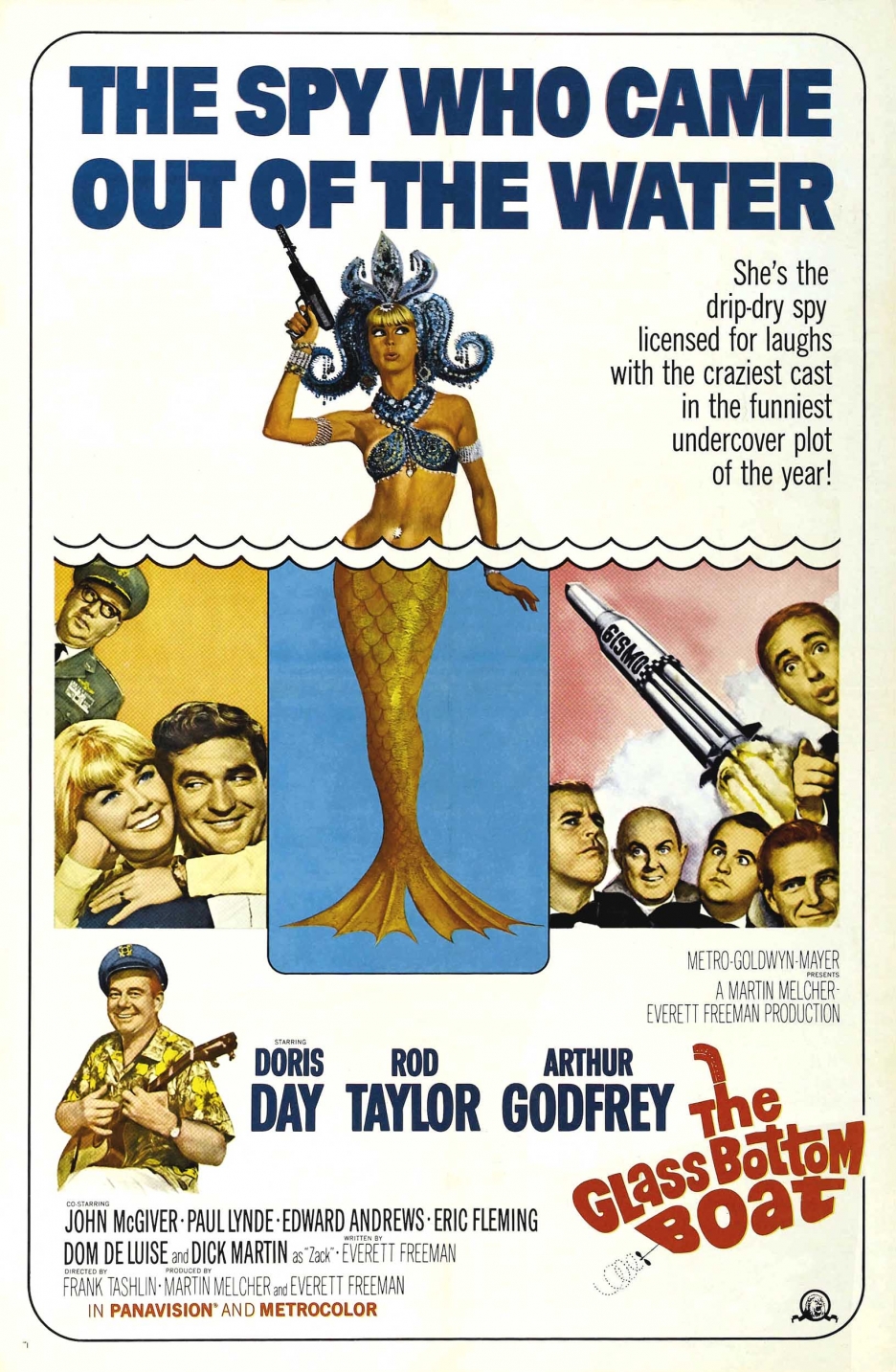
The Glass Bottom Boat (1966)

By Richard Winters

My Rating: 7 out of 10

4-Word Review: Doris is a spy.

            This is an energetic and zany Doris Day vehicle featuring her as Jennifer Nelson a tour guide at the NASA Space Center. She meets Bruce Templeton (Rod Taylor) who at first she can’t stand, but when she finds out that he is one of the top scientists at the lab and makes a lot of money she immediately becomes infatuated. This certainly does nothing to help fight the gold-digger stigma that some women have, but it was made over forty years ago, so I guess it was more acceptable. Through quirky circumstances she comes under suspicion as being a Russian spy and spends the rest of the time trying to prove otherwise while continuing her romance with Bruce.

Day looks gorgeous and is hammy at just the right level without going overboard and becoming cartoonish. Her best segment is when Taylor imagines here as a Mata Hari spy complete with skimpy outfit, which she looks great in, as well as dreaming that she is blindfolded and speaking in a foreign accent while ready to be shot by a firing squad. She sings the film’s title tune, which is bouncy, and even does, later on, a goofy rendition of her signature song ‘Que Sera Sera’.

Taylor is perfect as the love interest and I think he is the best out of all of Day’s male co-stars. His funniest moment, although brief, is when Day crosses her eyes to be goofy and then keeps them that way, which makes him momentarily panic. I got a kick out of his model of the solar system that he had in his office that displayed the planets in a symbolic fashion after the Greek gods they were named after.

The supporting cast is full of familiar comic pros. Alice Pearce and George Tobias appear as Jennifer’s neighbors and a variation of the Kravitz couple that they played on the ‘Bewitched’ TV-series. Pearce is hilarious and it was a shame that she wasn’t in more scenes and died before the movie’s release. Dom Deluise is amusing as the actual spy, who goes undercover as an electrical repairman. Normally his goofy fat-guy persona becomes tiring, but here it worked especially during the climatic sequence. Paul Lynde, who was always hard to cast and in the process usually got meaningless parts, has one of his best roles as the lab’s security guard and even dresses up in drag at the end. Dick Martin, Edward Andrews, and John McGiver help round out the cast. Arthur Godfrey, as Jennifer’s father, is the only one who is boring, but his part was dull, so it might be hard to completely blame him.

Director Frank Tashlin creates sets with bright, vivid colors and each scene is a Technicolor dream. Being a former cartoonist he creates some nicely played-out comic scenarios including Bruce’s hands-free futuristic kitchen that has a little robot that comes out of the wall and cleans-up any messes that are left behind and ends up attacking Jennifer. The out-of-control boat ride is also amusing, but the best part is the wild, fast-paced ending when Jennifer decides to turn the tables on her accusers.

Sure it is silly, but you know that going in and on a non-think level it is perfect entertainment for all-ages.

My Rating: 7 out of 10

Released: June 9, 1966

Runtime: 1Hour 50Minutes

Rated G

Director: Frank Tashlin

Studio: MGM

Available: VHS, DVD, Amazon Instant Video

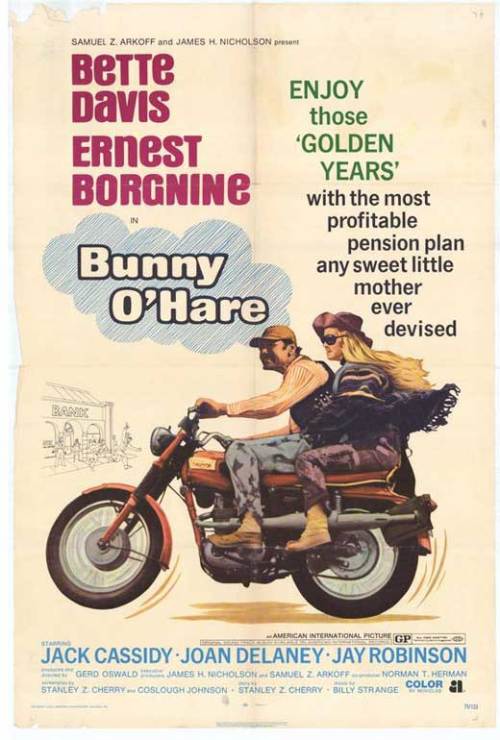
Bunny O’Hare (1971)

bunny

By Richard Winters

My Rating 2 out of 10

4-Word Review: Bette becomes a hippie.

Extremely odd Bette Davis vehicle made in her later years when her career had crested and she was forced to be less choosy about her projects. The story has to do with a lonely widow named Bunny O’Hare (Davis) who losses her home to foreclosure and is rendered homeless. She meets an older man named Bill Gruenwald (Ernest Borgnine) who is an escaped bank robber. Together they dress up as hippies and rob banks throughout the state of New Mexico in order to survive.

Davis is exceptional. Usually she plays cold, manipulative characters, but here she gives a perfect, touching performance as a nice old lady. She is terrific in every scene that she is in and the only bright spot in what is otherwise a misfire. Borgnine though seems wasted and thrown in only as a stock character.

The story really has nowhere to go. The intention was to make the film a mixture of social satire and slapstick, but it fails on either end. The novelty wears off quickly and it soon becomes derivative. Initially their ploy to rob the banks seemed clever as Bill releases a bird into the bank, which causes such a distraction that they are able to rob it without detection, but it becomes tiring when it gets played-out again and again. The police are portrayed as being universally bumbling and making it seem like a six-year old could rob a bank and easily get away with it. I also did not like the banjo music being played as they are trying to get away from the cops as it seems too similar to the much better film Bonnie and Clyde and in fact the original title for this movie was going to be ‘Bunny and Claude’.

The casting of Jack Cassidy as Lieutenant Greely, the policeman who becomes obsessed with capturing them, should’ve worked.  He was very adept at playing cold, cunning, slightly offbeat characters as evidenced by his Emmy Award winning performances on the old Columbo TV-show as well as the cult TV-series He and She. He was the husband of actress Shirley Jones and the father of Shaun and David Cassidy whose career was unfortunately cut short when he ended up dying in a fire in 1976 after falling asleep with a lit cigarette. His unique talent here is stifled because the character is portrayed as being unrealistically dimwitted and saps any possible energy from the scenes that he is in.

Actress Joan Delaney makes a terrific addition as his female counterpart R.J. Hart. She is young, attractive, and hip. She plays off of Greely’s old, regimented ways quite well and it is a shame that, with the exception of a very brief appearance in the 1991 comedy Scenes From a Mall, this ended up being her last film.

The New Mexico landscape is nice, but I got the feeling that the location shooting had not been scouted out sufficiently. The police station didn’t look authentic at all. It seemed like scenes where shot in any building that they were able to attain a film permit. The lighting consists of one bright spotlight put on the subject while the sides of the frame and the background are dark and shadowy. Sometimes, in a good movie, this is done for artistic effect, but here I felt it was more because that was all they could afford. This one is for Bette Davis completest only.

Well known character actors John Astin and Reva Rose appear as Bunny’s two grown children, but are essentially wasted. The then acting governor of New Mexico, David Cargo, plays one of the state troopers.  Larry Linville, who would later become famous for playing Major Frank Burns on the classic TV-series M*A*S*H, can be seen very briefly at the end, but has no lines of dialogue.

My Rating: 2 out of 10

Released: October 18, 1971

Runtime: 1Hour 28Minutes

Rated PG

Director: Gerd Oswald

Studio: American International Pictures

Available: Netflix Streaming

The Notorious Landlady (1962)

By Richard Winters

My Rating: 4 out of 10

4-Word Review: Landlady could be killer.

            William Gridley (Jack Lemmon) is an American who has arrived in London and looking for a place to stay. He rents a room from a home owned by Carly Hardwicke (Kim Novak) a gorgeous woman who Bill immediately becomes smitten with. The problem is that many people think Carly has killed in her husband even though his body has not been found. When Bill gets word of this he becomes determined to investigate the case and prove her innocence.

You would think a script written by Larry Gelbart and Blake Edwards would be funnier and full of zany scenarios and slapstick, but instead it gets grounded in a lot of dialogue for much of the first hour and forty-five minutes and only starts to get interesting during the final fifteen. The conversations lack any wit, or sharp one-liners, and the premise plods along at a much too leisurely pace. There is a segment where Bill accidentally sets fire to the patio, but I think this was simply thrown in for some action as there is very little else of it. The plot is formulaic and fails to add any new twist or perspective and once it is over it is easily forgettable. Lemmon’s character is bland and transparent and more than a little naïve since he falls in love with her immediately and is then convinced that she is innocent even though he has only known her for a day.

The best part comes at the very end where the two find themselves at a recital for a group of senior citizens that are all sitting in covered wheelchairs. This scene gets drawn out amusingly and includes a bit where an old lady named Mrs. Dunhill (Estelle Winwood) is pushed down the side of a hill, which is nicely captured in a silhouette style with Bill chasing after her. Winwood, who was already seventy-nine at the time, hams it up perfectly as the daffy old woman.  Of course all this comes much too late to really help the picture, or story, but at least it saves the film from being a complete bore, which it otherwise would have been.

Novak gives a surprisingly strong performance and a convincing British accent that I wish she had spoken in for the entire duration.  She was always a stunner, but here she may look her all-time best. One scene taken with her in the bathtub was highly risqué at the time and doesn’t leave much to the imagination. British character actor Lionel Jeffries is engaging as the inspector, but Fred Astaire is essentially wasted as Bill’s boss. The production values are decent, but the results are middling.

My Rating: 4 out of 10

Released: July 26, 1962

Runtime: 2Hours 3Minutes

Rated: NR (Not Rated)

Director: Richard Quine

Studio: Columbia

Available: VHS, DVD (Region 1 & 2)

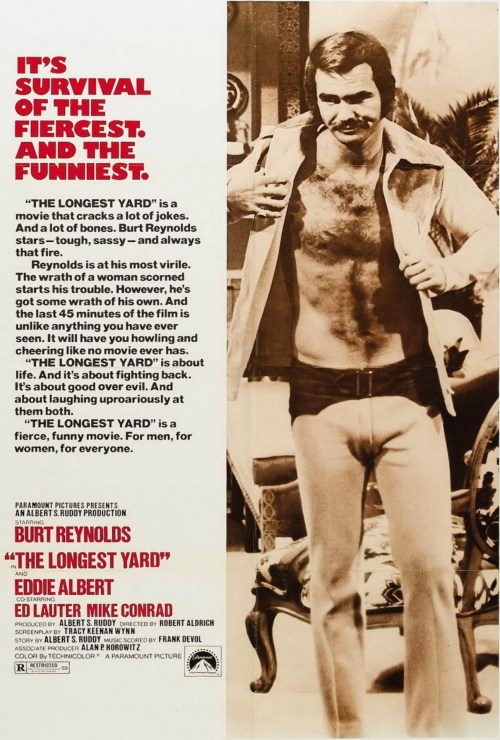
The Longest Yard (1974)

longest1

By Richard Winters

My Rating: 8 out of 10

4-Word Review: Prisoners play football game.

            Burt Reynolds is Paul Crewe a down-on-his-luck former professional football player who was kicked out of the league due to a point shaving scandal. After going on a long car chase with police he is thrown into the Georgia State Penitentiary where the crooked warden (Eddie Albert) tries to get him to coach the prison football team. Initially he refuses, but after some ‘convincing’ he eventually agrees to play in one game that will feature the guards versus the inmates. The prisoners use this contest as a way to get back at the guards and their brutal treatment of them while the guards approach it as a way to instill their authority.

Some consider this one of the best sports movies of all-time and I would have to agree it is up there. One of the things I liked about the movie is the way it taps into the emotional aspect of not only playing the sport, but watching it. There can be deep seated psychological reasons for why a spectator, or fan, roots for one team over the other.  The prisoners that cheer on their team use the game, as fleeting as it may be, as a sort of equalization and revenge factor to the guard’s authority and corruption. Watching the scenes showing the prisoners cheering their team as they score a touchdown is almost as emotionally charging as the action itself.  Director Robert Aldrich does a great job of using the prison setting and the game as a microcosm of 70’s society and the conflict between the counter-culture and the establishment as well as the haves and have-nots.

The game is nicely choreographed.  The hits look real and the plays are shot in a bird’s eye view just like watching an actual game on TV. The action is easy to follow and it is evident that the filmmakers have a good understanding and appreciation for the sport.  Outside of the final play that is done in slow motion there is none of the fluky, theatrical stuff thrown in that you usually see in most other films of this type. I found myself getting emotionally tied into the action even though I had seen the film many times before.

The only misgiving I had was the segment where the Richard Kiel character slams an opposing player to the ground and announces “I think I broke his fucking neck.” Of course this has become one of the film’s most popular lines and is made funnier when other players and even the game announcer repeats it several more times, but when the injured player is unable to come-to even after being given smelling salts and is carted off motionless from the field it starts to seem cruel to be laughing.

Another scene that I found surprising and had almost as much impact as the climatic contest is at the very beginning when Paul is shown arguing with his girlfriend Melissa (played by Anitra Ford one of the original models on ‘The Price is Right’ game show). She calls him a whore, which has to be the first and only time in film history that a woman has called a man that, but what is even more amazing is when he violently slaps her and knocks her to the floor.  I don’t think I can remember another time where a protagonist male character has done that to a female and yet the audience is still expected to sympathize with the male, which is interesting. The ensuing car chase is one of the better ones you’ll see and the part where he drives the car into a lake while the song ‘Saturday Night Special’ by Lynyrd Skynyrd is playing on the car’s radio and gets muffled as it goes under the water is cool.

Burt is perfect for the role. I love the glib way he delivers his lines and his laid back persona. The fact that he is an anti-hero with obvious personal flaws makes him even more fun. He seems right at home in the southern setting and filming it at an actual state prison gives the film a nice gritty subtext.

The supporting cast is unique. John Steadman as Pop, one of the prison’s oldest members, is memorable and he is the only other actor with a nose big enough to rival that of Karl Malden’s. It is nice to see Richard Kiel, one of the tallest actors you will ever see, with a speaking role.  The part where he starts to cry when he gets hit in the nose is funny.  Charles Tyner is perfectly creepy as Unger and Michael Conrad is compelling in his role as Nate Scarboro. This is also a great chance to see Bernadette Peters in an early career role as the warden’s ditzy and amorous secretary Miss Toot. She wears one of the worst looking beehive hairdos you’ll ever see although there probably isn’t a beehive hairdo that looks good anyways. Former football player Joe Kapp is good as one of the evil guards.

My Rating: 8 out of 10

Released: August 30, 1974

Runtime: 1Hour 1Minute

Rated R: (Adult Theme, Language, Violence)

Director: Robert Aldrich

Studio: Paramount

Available: VHS, DVD, Amazon Instant Video, Netflix Streaming