Category Archives: Comedy

The Scalphunters (1968)

By Richard Winters

My Rating: 7 out of 10

4-Word Review: Don’t steal his furs.

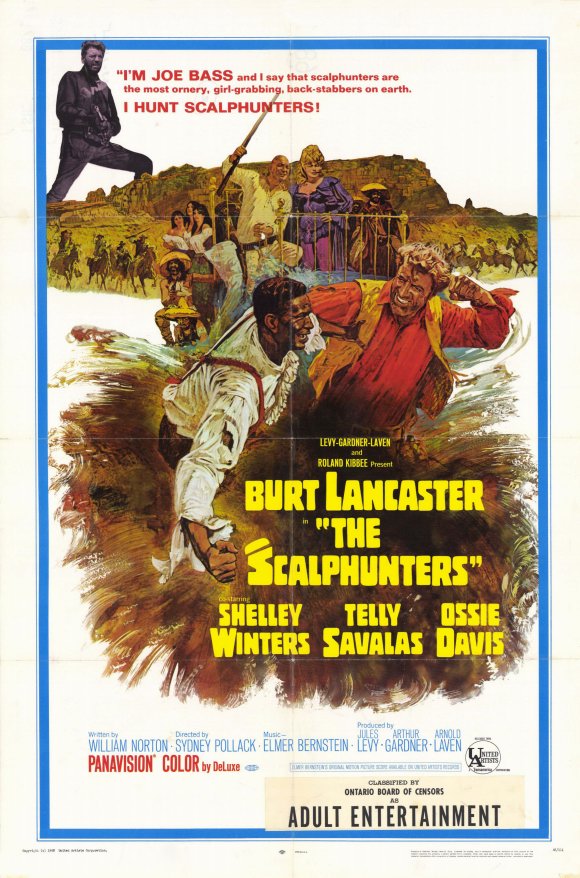
Joe Bass (Burt Lancaster) is a trapper who has all of his furs stolen from him by a group of Indians. In return they give him Joseph Lee (Ossie Davis) a very educated black slave. The two do not hit it off right away and Joe becomes determined at getting his property back by following the Indians and waiting for them to get drunk off the liquor that he had hidden with the hides that they took. Just as he is ready to make a move the Indians are attacked and killed by a group of scalphunters led by Howie (Telly Savalas) who take Joe’s pelts for themselves. Joe chases after them determined to get back what he feels is rightfully his and plays a crafty game of cat-and-mouse with Howie and his group. Joseph Lee on the other hand decides to travel with the group and become the personal servant to Howie’s grouchy wife Kate (Shelly Winters) as they plan on going to Mexico where slavery is outlawed.

This is a highly engaging and amiable comedy/western. It is hard to dislike this movie, or not to be entertained by it. The performers play their parts to the hilt. Lancaster is perfect as the not-so-bright, but highly resourceful trapper who has the perseverance you gotta love. Savalas has always done well in villainous roles and the fact that he adds some comic touches to it as he consistently finds himself outsmarted by Joe and nagged by his wife is funny. Winters always shines in caricatures of desperate and pathetic people and this one proves no exception. However, it is Davis that really makes the film work. This is probably the best role of his career. The amusing way he deals with everyone who are all quite convinced that they are smarter than he is, but aren’t is what really makes the movie fun. His bantering and arguing with Joe is good as well.

The comedy is nicely balanced as it stays consistently humorous, but manages to avoid becoming farcical. There are still enough gritty elements to call it a true western, which is good. Some of the best moments though are Joe’s ongoing ‘negotiations’ with Howie as well as an avalanche of rocks that Joe creates on Howie’s caravan when he refuses to give him his furs. I also enjoyed the long and stretched out fist fight between Joe and Joseph at the end that continues even as a bloody Indian attack occurs all around them. The two end-up tumbling through a muddy lake and seeing their bodies and faces covered in thick, caked-on mud is a hilarious sight.

Director Sydney Pollock is in fine form. I loved the way he captures the surrounding landscape, which is lushly photographed with a wide lens. It was filmed on-location in Mexico and a wide variety of picturesque locales were chosen.  The DVD version is an especially clear transfer with bright, vivid colors that make you feel you are right there alongside the characters.

Although I found this enjoyable I still felt that the script by William Norton seemed to be missing something. The scenario is a little too simple and one-dimensional and I was hoping for something more maybe even a side-story, or added twist. The movie is sufficient for entertainment, but lacks the added element to make it a classic. There was potential, but it’s kept it at a mild level making it fun, but not memorable.

My Rating: 7 out of 10

Released: April 2, 1968

Runtime: 1Hour, 42Minutes

Rated NR (Not Rated)

Director: Sydney Pollock

Studio: United Artists

Available: VHS, DVD, Amazon Instant Video, Netflix streaming

Yesterday, Today and Tomorrow (1963)

By Richard Winters

My Rating: 8 out of 10

4-Word Review: Gotta love Sophia Loren.

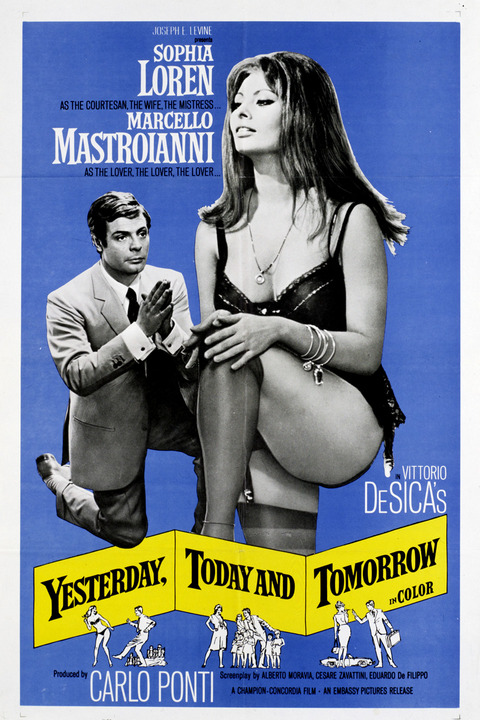
This is a delightful comedy that won the Academy Award in 1964 for best foreign film. It consists of 3 vignettes all starring Sophia Loren and Marcello Mastroianni and directed by the legendary Vittorio De Sica.

The first segment is entitled ‘Adelina’ and is a story about Adelina (Loren) who lives in poverty and sells cigarettes for a living. She is arrested for selling contraband products, but is released when it is found that she is expecting with the condition that six months after she delivers the baby she will be forced to serve her sentence. However, Adelina and her husband Carmine (Mastroianni) decide that the best way to avoid the sentence altogether is by keeping her continuously pregnant. Once she delivers one child she immediately gets pregnant with another, which creates overcrowding as well as an exhausted Carmine.

This segment is original and amusing throughout. Watching them trying to handle and maintain a household with such a large brood has its share of funny moments including one scene where Adelina tries to give one of her petulant children his medication. This setting vividly shows the poor side of Italian society, but unlike De Sica’s neo-realist films of the 40’s this one has a very engaging and even upbeat quality to it. The impoverished townsfolk become like a third character and their resiliency and support of one another proves to be a major plus to the story. Loren is fantastic in every scene she is in and makes this one special. Mastroianni is interesting playing against type as he is usually debonair and sophisticated, but here is simple and dominated.

The second story entitled ‘Anna’ deals with characters on the completely opposite end of the economic spectrum. Anna (Loren) is a spoiled rich woman who in an effort to alleviate her boredom with her husband who spends too much time working she has an affair with Renzo (Mastroianni). Renzo though fears that he is being used and that Anna has no intention of ever leaving her luxurious lifestyle to be with him.

All of the action takes place in a Rolls-Royce Silver Cloud III convertible as the two characters discuss their relationship while driving through the streets of Rome. This story is not as lively as the first and the characters aren’t as likable. However, the part where Renzo has an accident with the car and Anna’s reaction to it is quite funny.

The third and final act is entitled ‘Mara’ and deals with a prostitute named Mara (Loren) who becomes interested in Umberto (Gianni Ridolfi) a young man living next door with his Grandmother (Tina Pica) and studying to become a priest. The grandmother does not approve of Mara’s ‘profession’ and openly shuns her causing a major discord between the two, but when Umberto decide to drop out of the seminary the two work together to try and bring him back to his senses.

This story, like the first, has many amusing moments. Loren shows impeccable comic ability. I loved how the character goes from sexy seductress to a woman pleading with Umberto to go back to seminary and escape this ‘wicked world’. The shift between having Mara and the grandmother hating each other to becoming friends is equally funny. Mastroianni doesn’t have as much to do here, but still makes the most of it playing one of Mara’s customers who is just looking for a little sex, but is reluctantly thrown into the middle of the controversy.

This segment became famous at the time for a striptease that Loren does for Mastroianni. However, by today’s standards it is not much and hardly even seemed worth mentioning. I actually thought the part where Loren walks outside wearing nothing more than a towel and provocatively singing a flirtatious song to the young Umberto, who has a face that looks like it had not reached puberty, was much steamier.

My Rating: 8 out of 10

Released: December 19, 1963

Runtime: 1Hour 58Minutes

Rated NR (Not Rated)

Director: Vittorio De Sica

Studio: Embassy Pictures

Available: DVD, Blu-ray, Netflix streaming, Amazon Instant Video

Dirty Rotten Scoundrels (1988)

By Richard Winters

My Rating: 7 out of 10

4-Word Review: Don’t trust these guys.

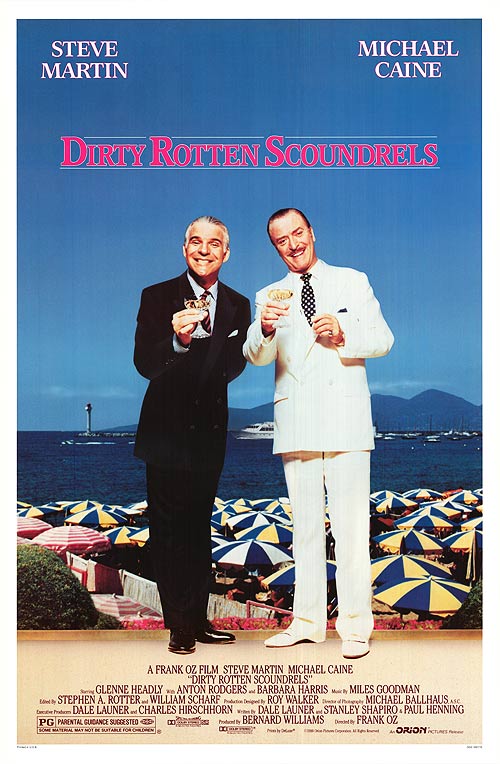
Freddy (Steve Martin) is a small-time con able to trick women into paying for his meals and sometimes even into their beds, but he is nothing compared to Lawrence (Michael Caine). This is a man that lives in luxury all from money that he has duped from rich women. Freddy decides to team up with Lawrence to learn his craft. The two work together for a while with Freddy playing Lawrence’s crazy younger brother, but the two have a falling out and end up becoming rivals instead. They meet Janey Colgate (Glenne Headley) the supposed daughter of a rich soap manufacturer and compete to see who can con her out of $50,000.

This version is far superior to Bedtime Story, which was reviewed yesterday. The pace is snappier and gets into the scenario more quickly. The scenes are consistently amusing and everything is handled at a slick level. The women aren’t all portrayed as naïve idiots like in the first and in certain cases they are just as corrupt and greedy as the two men. The music is bouncy and playful and helps propel the movie along.

Although both films were shot along the French Rivera this one does a better job of capturing the sunny and exotic locale. When Freddy visits Lawrence at his mansion and looks out at his exquisite seaside view and says ‘I want this’ I felt like saying ‘I want it too’.

I wasn’t sure Martin could top Marlon Brando’s performance from the first film, which was the only thing good about it, but he does. It took a little adjusting at first, but Martin takes the reins and in his usual style makes the part his own. His best segment is when he is in jail and can’t remember Lawrence’s name, which makes terrific use of his improvisational skills. The part where he asks to go to the bathroom is a little bit gross, but funny as well.

Caine is excellent is his part and gives the role more panache than David Niven did in the first one. He even puts on an effective German accent during the segment where he pretends to be a famous German psychiatrist. Believe it or not the parts of Freddy and Lawrence were originally intended for Mick Jagger and David Bowie.

Headley is good in her role as well. She has an attractive quality about her that is distinct and natural and avoids the plastic Hollywood starlet image. Her voice borders on being a little nasally, which could have become annoying, but with this type of part it works.

The best thing about this version though is the twist ending, which helps to maintain the slick level throughout the entire duration of the story. In the first version the ending was highly contrived and unimaginative as well as going against the personalities of the characters. Here it hits-the-mark and works as a nice payoff to the rest of the film.

The only critical comment I have about the movie is that it goes on a bit too long. 110 minutes is too extended a runtime for light comedy.

My Rating: 7 out of 10

Released: December 14, 1988

Runtime: 1Hour 50Minutes

Rated PG

Director: Frank Oz

Studio: Orion Pictures

Available: VHS, DVD

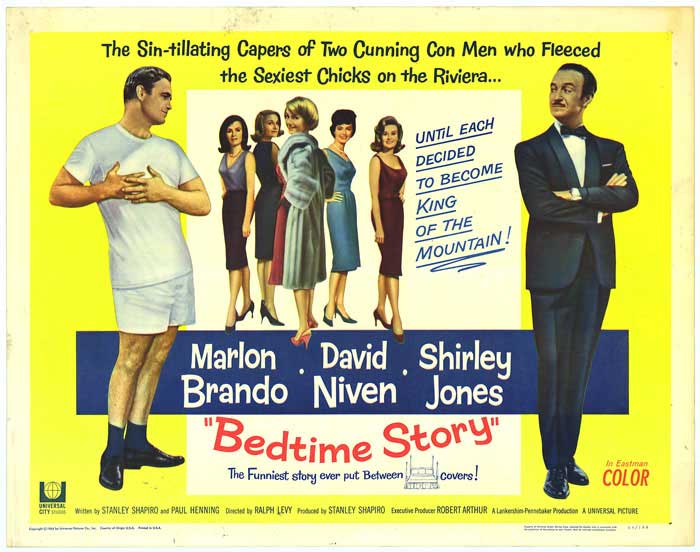
Bedtime Story (1964)

By Richard Winters

My Rating: 5 out of 10

4-Word Review: Con men fleece ladies.

Freddy Benson (Marlon Brando) enjoys conning his way into women’s beds. He uses all sorts of different ruses and has become so good at it he’s made it into a full-time profession. Then he meets Lawrence Jameson (David Niven) and is impressed because not only is Lawrence able to woo them for sex, but he is also able to get into their finances as well. The two work together for a while, but then there is a falling out and they become rivals instead. Along comes Janet Walker (Shirley Jones) a single woman with a supposedly rich father. The two then compete to see which one can con her best.

The movie itself is so-so, but Brando’s performance is excellent. He is far better known for his brooding dramatic performances, but the guy is amazingly engaging here. I loved every scene that he was in and found him to be consistently amusing. I was impressed with how at ease he was in doing comedy and this is a must for all Brando fans as you will see him doing something completely different from anything else he has done. I came away feeling he was perfect for comedy and wishing he had done more of it in his career.

The story though is contrived and formulaic in the worst way. The first hour is particularly tough going as the schemes the two men play are rather lame and something a fifth grader could see through. The women are portrayed as being utter morons and apparently so good-hearted that they will fall for any trick in the book. It would have given it a better balance had a few of them become wise to the men’s antics, but the fact that none of them do makes the whole thing seem horribly stereotyped and insulting to females everywhere. The humor is trite and unsophisticated and it should come as no surprise that the script was written by Paul Henning known for such ‘classics’ as ‘The Beverly Hillbillies’.

If you survive the boring and silly first hour things improve slightly during the second. The antics that Lawrence and Freddy pull on Janet are a little more clever and it is fun to see how each tries to one-up the other. Freddy pretends to be a man stricken to a wheel chair after he becomes traumatized from the rejection of a woman he loved. The only person who can cure him is a famous, but expensive psychiatrist that gets played by Lawrence. Larwrence’s initial examination of Freddy is funny as is the part where Freddy and his wheelchair go wildly out-of-control and crash into a countryside barn.

I was disappointed that there was no twist ending here as I was starting to think there would be and defiantly should have been. Instead it is just another ‘happy’ hollow Hollywood ending that was typical for that era and solidifying this as an empty lightweight exercise that barely deserves any attention at all if not for Brando’s performance.

In 1988 this film was remade as Dirty Rotten Scoundrels that starred Steve Martin and Michael Caine. That film will be reviewed tomorrow.

My Rating: 5 out of 10

Released: June 10, 1964

Runtime: 1Hour 39Minutes

Rated NR (Not Rated)

Director: Ralph Levy

Studio: Universal

Available: VHS 

Sweet Liberty (1986)

By Richard Winters

My Rating: 4 out of 10

4-Word Review: Retelling history Hollywood style.

Michael Burgess (Alan Alda) is an historian who writes a book that is purchased into a movie. To his dismay the screenplay is ‘Hollywoodnized’ and looks nothing like the original story. Michael then attempts to get the script corrected while the movie is being produced.

This is a mechanical comedy with situations, characters, and jokes are that quite predictable. There is not one moment that stands out as hilarious and the direction lacks visual flair. Yet when compared to Alda’s other efforts this one fares better. The dialogue is livelier and the story has more energy and conflict, but as satire it is too light.

There are more subplots than are necessary and take away from the main plot. One involves his relationship with a fellow history professor Gretchen (Lisa Hilboldt) and their constant arguing about whether or not to get married becomes tiring. There is also a storyline involving his interactions with his aging mother, which is played by the legendary Lillian Gish. Of course it is always fun to see Gish in a later day role and this is indeed one of her most amusing, but the segment itself is contrived.

Alda always likes to cast fellow performers around his same age, which would explain the miscasting of Michael Caine. Caine is reliable, but having him play a Colin Farrell like leading man seems best suited for a younger actor. A more virile performer would have made the animosity between the character and Alda’s more distinct and intriguing.

Michelle Pfeiffer is cast as a beautiful actress hired to play the leading lady. Her character is interesting because it shows how on her off time how she is completely different person from the one she is playing in the production. This allows for some light insight into the acting process. The film also touches on the politics and behind the scenes maneuverings that go on during a production although it could have gone a lot further with this.

Having Burgess end up sleeping with Pfeiffer seems to be a stretch. Things become even more incredulous when Gretchen, in a fit of revenge, forms a relationship with Caine. The Caine character is a self- absorbed star with lots of beautiful women chasing after him and the chances of him getting excited or even noticing an average looking woman like her seems unlikely.

The Bob Hoskins character is by far the most engaging. He plays the scriptwriter and tries to educate Michael on the ins and outs of the film business. Saul Rubinek as the film’s director runs a close second. He perfectly creates the frantic traits of someone who must act more like a politician than a director.

Overall this is a film that could have done more with the material. It rates slightly better than some of Alda’s other efforts, but it is still just a pleasant time filler that is easily forgettable. I did however like the original music.

My Rating: 4 out of 10

Released: May 14, 1986

Runtime: 1Hour 46Minutes

Rated PG

Director: Alan Alda

Studio: Universal

Available: VHS, DVD

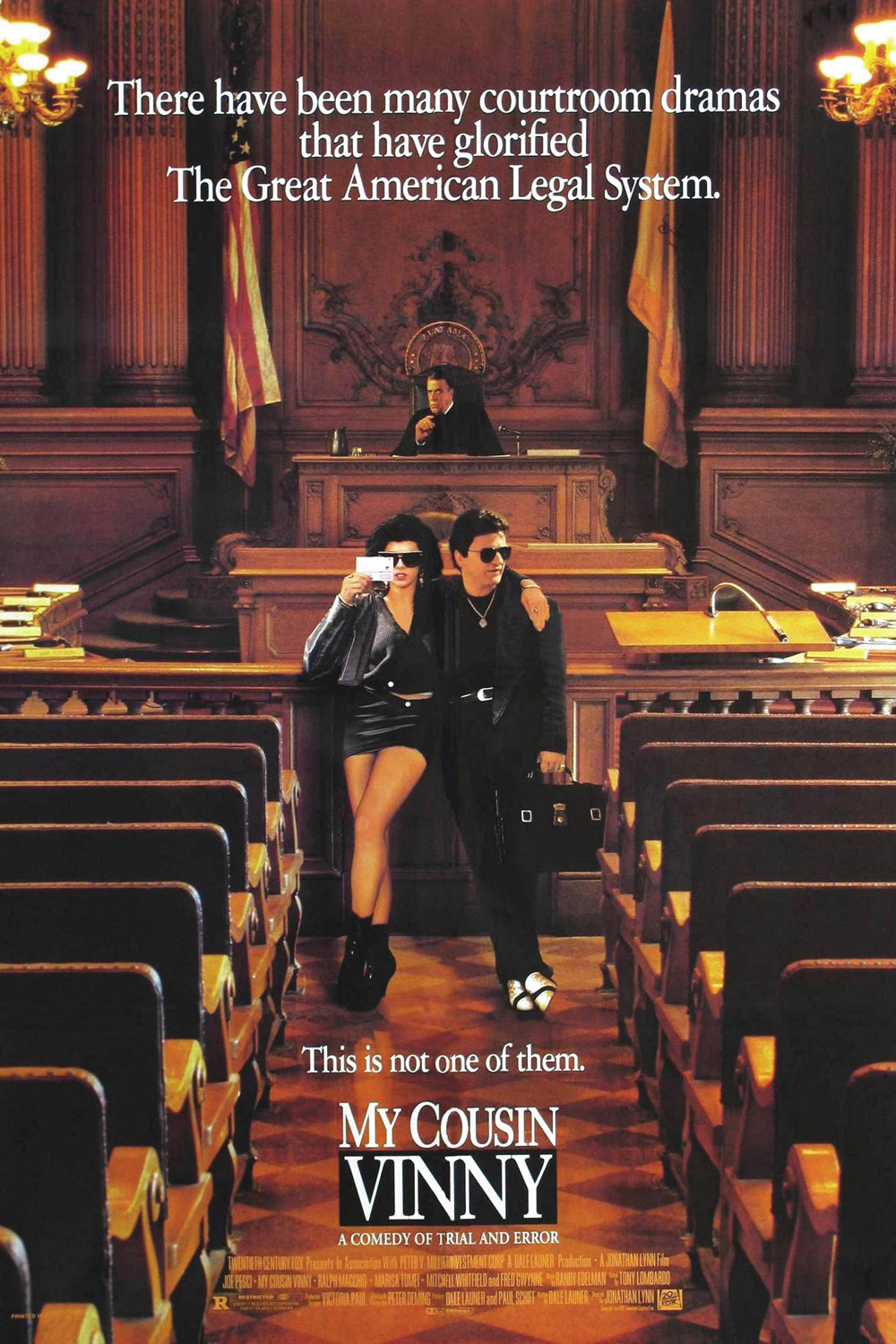
My Cousin Vinny (1992)

By Richard Winters

My Rating: 5 out of 10

4-Word Review: Don’t hire this lawyer.

A huge and much talked about hit upon its release in 1992, My Cousin Vinny is the story about two traveling college friends (Ralph Macchio, Mitchell Whitfield) who, upon going through Alabama, get implicated to the murder of a convenience store attendant that they did not commit. They’re only hope is calling up Macchio’s uncle Vinny from Brooklyn (Joe Pesci) who has only been practicing law for six weeks and has never tried a case.  Even worse is the fact that his brash Brooklyn sensibilities do not mesh well with the trial’s very strict, no-nonsense Judge (wonderfully played by Fred Gwynne in his last film role).

One thing that stood out right away with me was the way this film did not fall into age old stereotypes despite being in a setting that seemed ripe for it.  There is not a single mention of racism anywhere.  Instead the film seems to want to focus on a more contemporary Alabama where the African American characters are, by and large, on equal footing with the whites as well as having a white Sheriff who is not redneck, corrupt, or ignorant.  The two college kids also thankfully break rank from the typical Hollywood films of that era.  These kids are not the rowdy, partying, beer swilling, sex crazed teens that you usually see, but instead believable and most of all likable.  I found them to be so likable that I wished they were in the film more, unfortunately after the first twenty-five minutes they pretty much disappear until the very end, which I found disappointing.  Still it was nice seeing Macchio growing out of his Karate Kid role and looking a little more filled out and mature.

I also want to give mention to the excellent on-location shooting.  Although it was not actually filmed in Alabama, but instead the neighboring state of Georgia, it still nicely captures the look and feel of the south and it does it right from the start.  I have often said good on-location shooting (as opposed to the annoying Hollywood studio back-lot) can enhance just about any story and help create what’s almost like another character.  I have been to Alabama recently and enjoyed the many references to the red, muddy soil that is everywhere down there and the scene where the Pesci character gets his car stuck in it is great.

The comedy runs pretty well, but is much stronger at the start.  The conversations the boys have with the police are quite amusing as is Whitfield’s initial dialogue with the Pesci character who he doesn’t know is a lawyer and instead thinks he is a cellmate there to ‘break them in’.  I also enjoyed the running gag dealing with Vinny using his debating skills to try and ‘negotiate a settlement’ with a tough guy at a bar who refuses to pay up after losing a bet.

Unfortunately there is also a lot of comedy that does not work.  The running gag dealing with Vinny and his girlfriend constantly being awakened in the early morning hours by some unexpected noise at each of the places they stay at starts to get real redundant and silly.

There is also another segment featuring actor Austin Pendleton who plays one of the court appointed attorneys and, without warning or any logical explanation, starts to stutter terribly when he tries to give his opening argument.  I was genuinely shocked to see Pendleton take this part since he was a stutterer in real like and didn’t overcome the problem until he was well into his forties.  He even starred in a 1983 film entitled Talk to Me about a man coping with the affliction. Apparently Pendleton did protest the scene and even labeled it a ‘sick joke’, but eventually did it anyways because he needed the work, which was unfortunate because it comes off as being forced and uncomfortable.  Most lightweight comedies, which in the end this is, run about ninety minutes yet this film runs a hundred and twenty minutes, which is too long.  Had some of these so called ‘funny’ scenes been cut it would have shortened the film nicely and even strengthened it.

I should also mention Marisa Tomei who won the Oscar for best supporting actress as Pesci’s girlfriend.  Now her performance isn’t bad, but I didn’t see anything really outstanding about it either.  She spends most of the time wearing garish and gaudy outfits, speaking in a Brooklyn accent that borders on annoying, and playing the caricature of a ditzy girlfriend. Only at the end does she become a little more dimensional when she inexplicably displays some amazingly detailed knowledge about automobiles that for me just didn’t ring true.  I would have given the Oscar to Fred Gwynne, TV’s Herman Munster, as the judge. Some of his courtroom exchanges with the Pesci character are the best parts in the film.  I also really like Lane Smith in the role as the prosecutor. His performances are never flashy, but he is always reliable and gives his characters a nice, quiet dignity.  He is also a genuine southerner, so he fits into his role more easily.

The film is overall passable.  I had no idea how it was going to turn out and it kept me intrigued.  However, once the resolution was made and the mystery solved, I wasn’t completely satisfied.  I was hoping it would be like The Vanishing, the excellent 1988 film from the Netherlands, that went back and reenacted how it all took place.  It would have at least been nice had the film put in a little red herring at the beginning, so the viewer could have tried to figure it out themselves instead of just throwing in a wrap-up that seemed too convenient.

If you are fans of Joe Pesci then you’ll enjoy this movie a little bit more.  His performance as the volatile character in Goodfellas is so etched in my mind that I have a hard time adjusting to him in likable roles, or comedy.  However he manages to be quite engaging throughout.

My Rating: 5 out of 10 

Released: March 13, 1992 

Runtime: 2Hours 

Rated R 

Director: Jonathan Lynn 

Studio: 20th Century Fox 

Available: VHS, DVD, Blu-ray, Amazon Instant Video

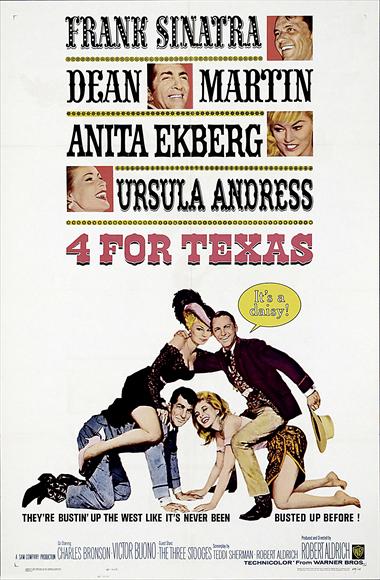
4 for Texas (1963)

By Richard Winters

My Rating: 4 out of 10

4-Word Review: Frank and Dino vehicle.

            Sharp-shooter Zack Thomas (Frank Sinatra) and Joe Jarrett (Dean Martin) fight over a cache of money they come upon after fighting off Matson (Charles Bronson) and his gang from a stage coach attack. Eventually Jarrett takes the money and makes his way to Galveston were the two meet up again and continue their bickering. When Joe fixes up an old riverboat and proceeds to turn it into a casino Zack tries to take it over, but not until Matson tracks him down to seek revenge.

The movie opens nicely with a snappy segment between the quarreling Zack and Joe trapped all alone in the middle of the desert. Their banter is great and it makes the most of each star’s appeal. However, after this the movie proceeds to die and very long, slow death. Absolutely nothing gels and the fragmented story lacks any type of singular voice, or vision. The film is also devoid of much action. There is a fistfight that Zack and Joe have at the end, but from the longshots it is clear that stunt doubles are being used for both men, which kind of takes the fun out of it. There is some potential when the two decide to combine their forces to take on Matson and his gang, but this finale moves along too hastily and the action is as uninspired as the rest of the film.

Martin is engaging and he is one of the film’s few bright spots. Sinatra though is stiff and out-of-place and shows no flair for lighthearted comedy. Apparently director Robert Aldrich and Sinatra did not get along at all and it shows.

The female co-stars don’t fare much better. Anita Eckberg who plays Zack’s love interest Elya amounts to not much more than a tired walk-on. The character has little to say or do and minimal connection to the main plot. Ursala Andress as Joe’s girlfriend Maxine fares better simply because she looks great. I’d say she is more striking here than she was in her most famous role in Dr. No.  Her low-cut dress is tantalizing and her tan, curved features have never looked better. The problem though is that there are a few drawn-out romantic scenes between both couples that makes a slow movie drag even more.

Talented character actor Victor Buono is excellent as bank president Harvey Burden. I was impressed with how he managed to hold his own with the rest of the cast despite the fact that he was much younger than all of them. Bronson is effective in the bad guy role and he makes a more interesting villain than he ever did as a good guy.

The Three Stooges appear in a cameo and do their predictable shtick that is strained and forced. Jack Elam who is a veteran support player in many westerns and has a very distinctive cross-eyed gaze is shockingly killed off right at the beginning, which was stupid.

This movie is a perfect example of a big Hollywood production relying too heavily on the star power of its two leads without first having an interesting script for them to work with. The production values are high and it is watchable, but plays itself out in a meandering and pointless fashion.

My Rating: 4 out of 10

Released: December 25, 1963

Runtime: 2Hours 4Minutes

Rated NR (Not Rated)

Director: Robert Aldrich

Studio: Warner Brothers

Available: VHS, DVD, Amazon Instant Video
 

Goodbye Pork Pie (1981)

By Richard Winters

My Rating: 8 out of 10

4-Word Review: Minis are very durable.

A middle aged man named John (Tony Barry) whose wife has just left him and an unemployed nineteen year old named Gerry (Kelly Johnson) come together through circumstance and trek across New Zealand in a yellow mini while desperately trying to elude the police.

The film has a wonderfully carefree approach and anyone who has ever wanted to ‘drop out’ or stick it to authority will most assuredly enjoy this. There are some clever chase sequences involving the mini with the best coming at a Wellington shopping center. There are also a couple of good running bits including a stressed out vacationing couple dealing with their noisy kids and police officer doing a sexual role playing game with his wife while on duty. The vast age difference between the two main characters is refreshingly different from most ‘buddy’ movies and Johnson, as the younger one of the pair, is excellent. He shows a lot of star making appeal and it is amazing that his film career never flourished. Claire Olberman is gorgeous as a hitch-hiker that they pick up along the way and she closely resembles 80’s adult film star Stacey Donovan and it is a real shame that she doesn’t stay with them throughout the entire film. I also must mention the music score, which has a nice distinct quality to it.

On the negative side I felt Barry in the role of the middle aged man was a little too laid back in his performance. He needed to show more stress and tension, especially when he is put into such crazy and hectic scenarios. I felt his mellowness hurt the film’s believability and even to some extent the excitement. The ending is not very satisfying and seems like the screenwriter wrote himself into a hole that he didn’t know how to get out of. The police are made to look too hopeless and helpless and the film goes overboard in its attempts to mock them.

Despite some flaws this is a road movie the way all road movies should be. It is fun and engaging and will bring out the free spirit in anyone. Although small the minis are a durable and fast car and this film makes prime use of their abilities almost as well as the original The Italian Job did. It also features some great stunt work that most viewers should find impressive.

My Rating: 8 out of 10

Released: February 6, 1981

Runtime: 1Hour 45Minutes

Rated R

Director: Geoff Murphy

Studio: Greg Lynch Film Distributors

Available: VHS, DVD

Man’s Favorite Sport (1964)

By Richard Winters

My Rating: 2 out of 10

4-Word Review: Winning a fishing contest.

            Roger Willoughby (Rock Hudson) works at a sporting goods department store and uses the information he overhears from his customers to become an ‘expert’ at fishing and best-selling author on the subject despite never having done it himself. Things unravel when his boss (John McGiver) enters him into a fishing contest and he must use the help of beautiful brunette Abigail Page (Paula Prentiss) to show him the techniques and save his reputation.

Billed as another screwball comedy much in the same vein as Howard Hawk’s classic Bringing Up Baby. However, this film doesn’t even come close to that one. It is extremely slow and the comedy bits are thrown in with a haphazard style. The pacing is none existent and the plot is far-fetched and contrived. I was willing to forgive it a little figuring that by the second half things would kick-in, but it never does. The jokes are simplistic and unimaginative.  I found none of it to be funny and mainly strained and labored. With the slight exception of the scene involving Roger’s inflatable wading pants I didn’t find any of it to be even engaging. Roger’s attempts at fishing are particularly disappointing as this scenario could have been played up a lot more.

Hudson is weak as the lead. His voice always has a hollow tone and his delivery is wooden. Cary Grant would have been a much better choice and the film could have been a lot funnier with his presence. When Grant became irritated it was always amusing, but with Hudson it comes off as forced and boring.

Paula Prentiss is the best thing about the movie. Many fans agree that this is her best performance of her career. She has a nice free-form style to her delivery and avoids having that stiff drama school touch. I liked the gaze of her brown eyes and at times it reminded me a lot of Karen Black’s. Her younger, more relaxed presence helps compensate against Hudson’s stiff older one. I’m surprised her career fizzled in the 70’s as she has an interesting and unique style that I would have liked to have seen more of. Her sparing with Hudson is the only thing that gives this film any energy. However, having them end up falling in love was formulaic and forced. The two really didn’t have the right chemistry and showing them not getting along, or getting on each other’s nerves was more entertaining.

My Rating: 2 out of 10

Released: January 29, 1964

Runtime: 2Hours 1Minute

Rated NR (Not Rated)

Director: Howard Hawks

Studio:  Universal

Available: VHS, DVD

The Monitors (1969)

By Richard Winters

My Rating: 3 out of 10

4-Word Review: They are watching us.

            Aliens, who dress in suits, long overcoats, and bowler hats, invade earth and an attempt to police everybody’s thoughts and actions while trying to quell a rebel uprising led by Colonel Stutz (Larry Storch). Working for the uprising is Harry (Guy Stockwell) who falls in love with Barbara (Susan Oliver) who secretly sides with the aliens.

The movie starts out with a lot of potential and piqued my interest with unusual montages and camera work. Unfortunately this subsides quickly and soon we are stuck with drab sets, extraneous scenes, and a film unable to hide its low budget roots. I began to wonder if the reason the rebels had their hideout in an abandoned farmhouse was more because the filmmakers could film there without having to pay for a permit than anything else.

The film should have gone completely for parody and farce and if they had done that this might have worked. Instead it seems to drift into a conventional sci-fi narrative complete with a pseudo philosophical climactic debate between the humans and aliens that we have all heard before and does nothing but slow the film down to a tedious level. Adding in the love interest angle between the two leads is contrived and formulaic.

The aliens aren’t too interesting either. There is never any explanation as to how they were able to take over the planet, but the fact that they are unable to even get through a locked door of an old crumbling warehouse made me wonder how they were able to succeed at anything. Equipping them with a little more sci-fi gadgetry would have helped. I realize they don’t have to be carrying around the proverbial ray-gun, but having them break up an angry mob by using ordinary canisters of pepper spray seemed unimaginative.

Spliced into the story are comical TV ads with famous celebrities of the day such as Stubby Kaye and Xavier Cugat promoting the monitors and convincing the public to support them. These commercials are not funny with the only exception being Alan Arkin playing a foreign man who speaks broken English. In the case of former Senator Everett Dirksen it is almost sad. He was very elderly at the time of the filming and he is clearly reading his lines from cue cards and mouthing the words and looking like he is barely functional, or coherent.

The music is another problem. Initially I really liked it as the opening credits feature a computer with a very robotic voice singing the theme. Singer Odetta sings most of the other songs and some of them have a distinctive sound, but they get overplayed and saturated by the end.

The production was shot on-location in Chicago and I loved the aerial shots showing the skyline. I almost wished there had been a little more of them although I did notice that the exact same skyline shots at the beginning get reused in the second half. I didn’t like the idea that it was filmed in the late fall/early winter as the cast is shown shivering in several shots while forced to wear light clothing and their breath is clearly visible.

Susan Oliver gives another solid performance and shown flying an airplane in one sequence as in real-life she was an avid pilot. Sherry Jackson’s presence is minimal, but she is always appealing to the eyes. Avery Schreiber, a comedian known to overact horribly in just every part he is in, comes off as rather amusing here playing the younger brother of Harry who reluctantly joins up with the resistance. Larry Storch, another notorious ham, is engaging as well especially when he appears in drag and later on dressed as General MacArthur.

This is a failed experiment that should have been a lot better. It seems to want to take on the quirky sentiments of the era, but is either too timid, or too unimaginative to go all the way with it.

My Rating: 3 out of 10

Released: October 8, 1969

Runtime: 1Hour 32Minutes

Rated M

Director: Jack Shea

Studio: Commonwealth United Entertainment

Available: Netflix Streaming