Category Archives: College Life

The Initiation (1984)

initiation

By Richard Winters

My Rating: 2 out of 10

4-Word Review: She has reoccurring nightmares.

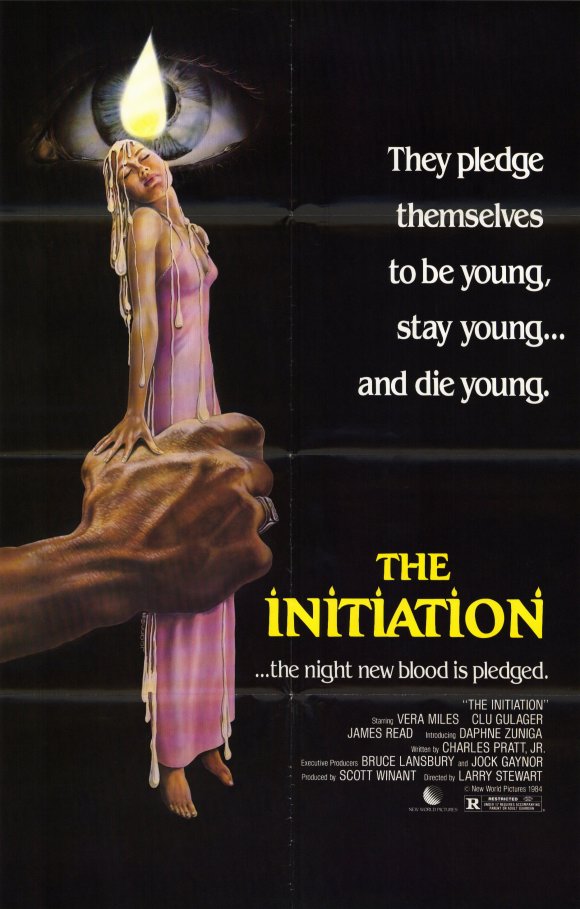
Kelly Fairchild (Daphne Zuniga) is a college student plagued with reoccurring nightmares as well as suffering from amnesia in which she cannot remember anything that occurred before she was nine. She meets Peter (James Read) who runs a department dealing with sleep research. She hopes he can help her interpret these dreams, but her parents (Clu Gulager, Vera Miles) are greatly opposed to the idea. As these dreams continue to get worse she also gets involved in a sorority in which as part of an initiation ritual she along with her sorority sisters are required to break into her father’s department store and steal some items, but as they do they become stalked and eventually killed by a mysterious killer.

Zuniga makes for an appealing lead and is pretty much the only good thing about the movie as the story itself isn’t too interesting. It becomes clear from the start that the man she sees burning in her dreams is really her father and that the Gulager character was her mom’s lover who is now posing as her father while her real one got carted off to the mental hospital and having to watch someone spend almost two hours trying to figure out something that the viewer already knows isn’t compelling.

The plot is also full of a hundred and one loopholes including the fact that her father had to be institutionalized after received burns over forty percent of his body even though this rarely if ever occurs with real-world burn victims. How Kelly gets her amnesia is confusing as well since we later learn she never really did fall out of a treehouse like she had initially thought. The scene where the Gulager character gets murdered in his own drive way, but the mother does not find out about it until several days later is equally ridiculous because the killer immediately drives away with the dead body with no time to clean up, so the mother would’ve seen all the blood when she went into her own car, but apparently doesn’t.

There is also a scene involving one of the sorority sisters named Marsha (Marilyn Kagan) who tells the others about getting sexually violated by an older man when she was younger, which is not necessary since she is not a main character and what she describes has no connection to the main story. What is even worse is that after telling the others about it she then ‘miraculously’ loses her lifelong frigidity and is ‘cured’ from her horrible memories while also immediately hopping into bed with one of the frat boys, which becomes an insult to rape victims everywhere.

Spoiler Alert!

The film’s ending though is the most annoying. Halfway in I thought I had figured it out by guessing that it was actually Zuniga who was doing the killing. Well it turns out that I was half-right as it is really her twin sister, but there is no indication of this with anything that occurs earlier and still does not explain how it connects to Kelly’s amnesia, nightmares, or lost father. If anyone who has watched this movie can explain how this makes any sense I would appreciate it because it comes off as really dumb otherwise.

End of Spoiler Alert!

My Rating: 2 out of 10

Released: December 17, 1984

Runtime: 1Hour 37Minutes

Rated R

Director: Larry Stewart

Studio: New World Pictures

Available: DVD, Amazon Instant Video
The Dorm that Dripped Blood (1982)

the dorm that dripped blood

By Richard Winters

My Rating: 2 out of 10

4-Word Review: Yet another slasher flick.

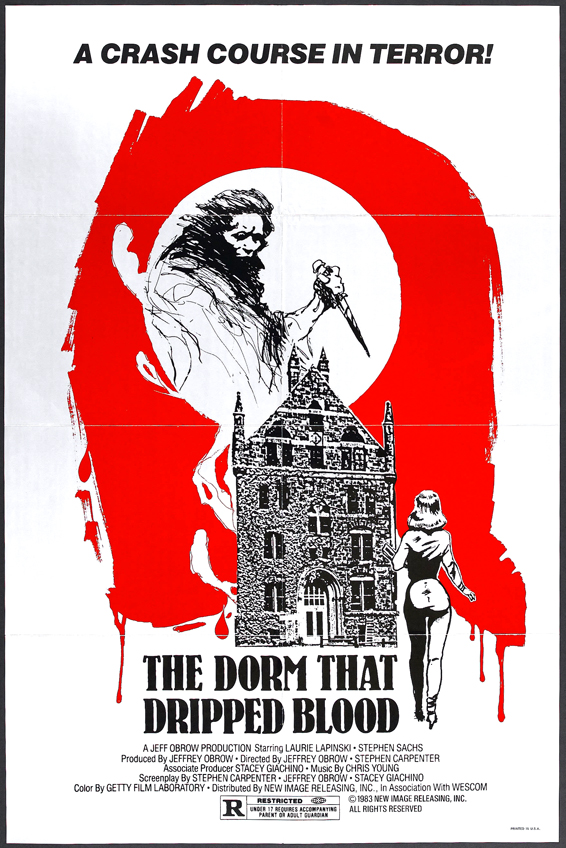
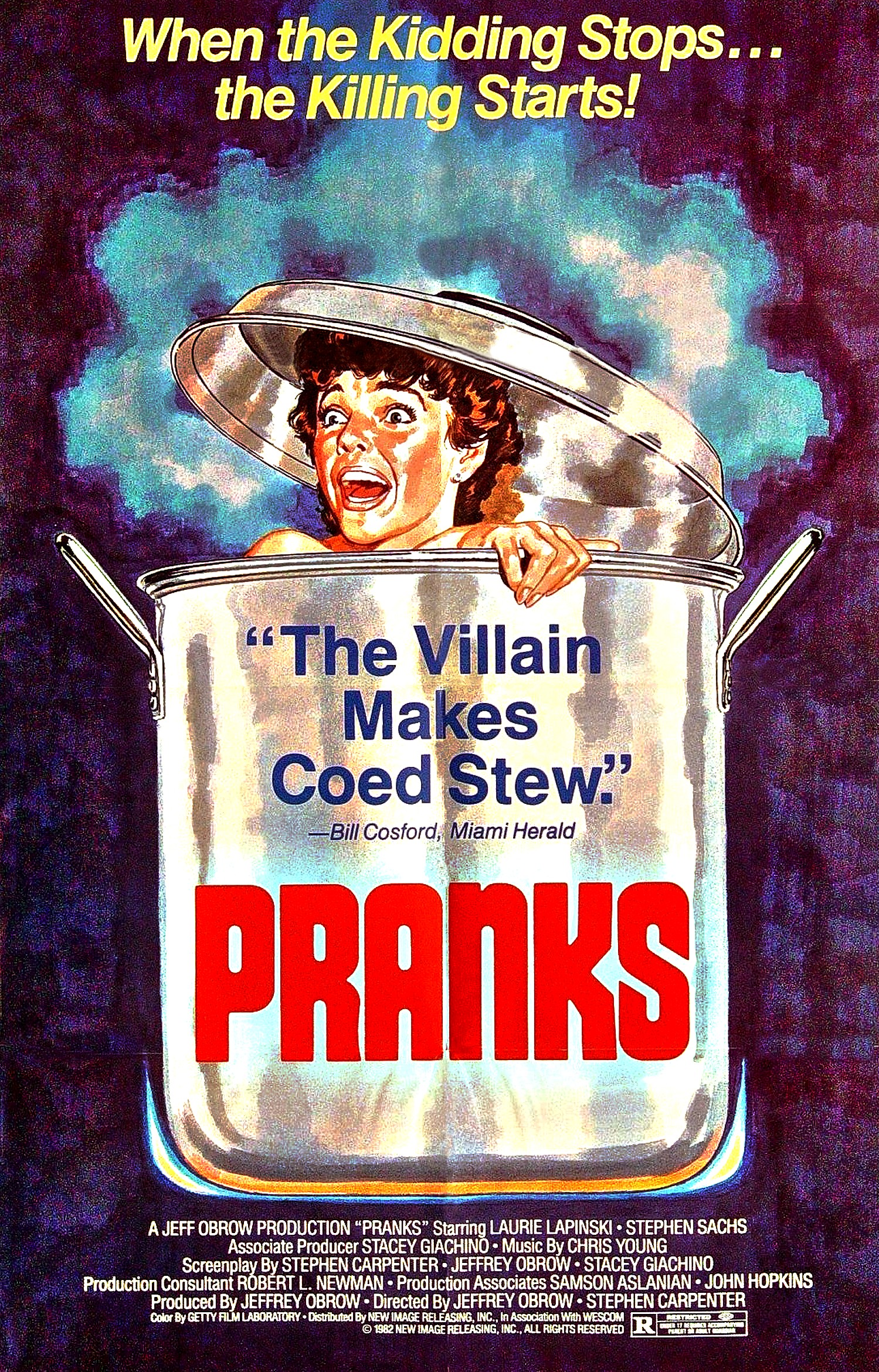
If, based on its misleading title, you’re figuring this thing will be filled with hot sorority babes having their late night beer parties ruined by an unscrupulous masked killer who does unethical things with an ax then you’ll be sorely disappointed as that is not what you’ll get here. Instead you’ll be treated to a story about five volunteers who clean out an abandoned dorm that looks more like a business building, so that it can be renovated into apartments. During the process they become menaced by a mysterious killer who begins hacking them off one-by-one.

This movie’s one and only claim to fame is that it marks the film debut of Daphne Zuniga who gets promptly killed off within the first 15 minutes by having her head run over by a car! The rest of the cast is not up to the acting standards of a high school play including leading lady Laurie Lapinski whose monotone delivery does nothing to enliven the proceedings.

The gore is okay and probably the only reason I’m giving it 2 points. The scene where the killer beats a man’s head in with a bat looks pretty realistic and the part where he drills into another man’s skull isn’t bad either. The tension though, or what little there is of it, is hurt by having long stretches that feature nothing but extraneous dialogue and wooden characters.

Some fans of the film will point to its so-called surprise ending as a redeeming element. Yes, the identity of the killer is not who you’re expecting, but you know that from the start since the character of the mentally unstable John Hemmit (Woody Roll) is too obviously pushed as being the suspect from the beginning, so you know it has to be someone else. Finding out who the real killer is not interesting as it has no real connection to anything that came earlier and was pretty much done in a random way where the writer/director choose a character you’d least expect, so it would seem like a ‘great revelation’, but with no other logic behind it.

Dull and uninspired this is yet another in a long line of rip-off slasher flicks that adds nothing unique or interesting to the genre and unless you want to see Zuniga in an early performance it’s not worth seeking out.

the dorm that dripped blood 3

Alternate Titles: Death Dorm, Pranks

My Rating: 2 out of 10

Released: April 12, 1982

Runtime: 1Hour 28Minutes

Rated R

Directors: Stephen Carpenter, Jeffrey Obrow

Studio: New Image

Available: DVD, Blu-ray, Amazon Instant Video

The Pursuit of Happiness (1971)


pursuit of happiness 2

By Richard Winters

My Rating: 5 out of 10

4-Word Review: Justice isn’t always fair.

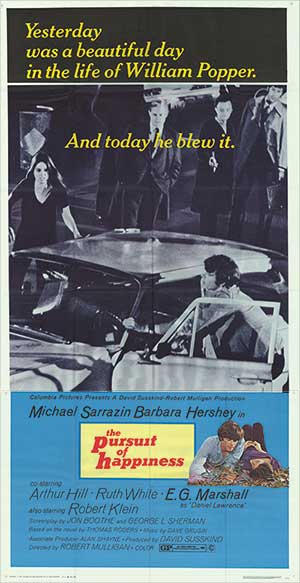
Everything seems to be going William Popper’s (Michael Sarrazin) way. He is a young college student with a great looking girlfriend (Barbara Hershey) and from a rich family. One night he takes a trip to the grocery store. It is raining and he accidently hits and kills a woman who walks out onto the street between two parked cars. Since William has several unpaid traffic tickets, is part of the anti-establishment movement and seems to have a generally belligerent manner he gets arrested for her death. His rich father (Arthur Hill) hires a successful lawyer (E.G. Marshall), but William is a major idealist who doesn’t want to compromise on anything and the more he fights for his ideals the deeper it gets him into trouble.

The film, which is based on a novel by Thomas Rogers, certainly makes some great points about our modern day American justice system where everything seems more based on the image that the defendant tries to present than the actual facts. Unfortunately most viewers today are already quite jaded by this and the message comes off as old and redundant.

The biggest problem is with Sarrazin. He has always had a bit of a transparent quality and I’ve defended him in some of his other roles, but here he helps to bring the whole thing down. He conveys no anger or emotion of any kind even though it’s supposedly his passion for the truth that causes him to behave the way he does. His comes off as limp and lifeless making me wonder how such a bland guy could attract a girlfriend at all let alone a really beautiful one. His character is also a bit too stubborn and strangely naïve to the point that the viewer isn’t completely empathetic with his cause as it becomes painfully obvious that he is only hurting himself by refusing to back down at all while most rational people would’ve likely buckled under just enough to get themselves out of the jam.

The script unfortunately is more intent on making a statement than telling a story as we are given no conclusion to the character’s plight. He escapes from jail and takes a flight to Mexico, but then it just ends leaving open a wide array of unanswered questions and making the viewer feel like they’ve seen only half a movie.

Ruth White, in her last film appearance, gives a strong performance as Walter’s Archie Bunker-like grandmother. It’s also great to see Marshall playing a more hard-lined version of the defense attorney role that he was famous for from ‘The Defenders’ TV-show. Robert Klein is engaging as Walter ‘60s radical college friend and David Doyle is good as Walter’s cellmate. Charles Durning, Ralph Waite and Rue McClanahan can be seen in small roles and this also marks William Devane’s film debut.

pursuit of happiness 3

My Rating: 5 out of 10

Released: February 23, 1971

Runtime: 1Hour 33Minutes

Rated GP

Director: Robert Mulligan

Studio: Columbia Pictures

Available: DVD, Amazon Instant Video
Creator (1985)

creator

By Richard Winters

My Rating: 2 out of 10

4-Word Review: Cloning his dead wife.

Harry Wolper (Peter O’Toole) is an eccentric college professor obsessed with the idea of cloning his dead wife. With the help of an undergraduate assistant named Boris (Vincent Spano) he sets up a makeshift shed in his backyard and uses the university equipment for his experiments. He employs the services of Meli (Mariel Hemingway) a 19-year-old in desperate need of funds whose egg he uses as part of the cloning process. After a while she starts to fall in love with him and as the fetus of his dead wife takes shape she becomes jealous and feeling that he should be more concerned with the living than the dead.

O’Toole is engaging as ever in the type of role that most suits his talents. Had the film stayed centered on him it would have been a joy to watch, but unfortunately it enters in the generic Spano who looks like he was pulled straight off of the cover of a men’s modeling magazine. I presume this was because the studio felt a movie centered on a man over 50 wouldn’t attract the all-important 16-30 year-old demographic, but despite being an obvious chick-magnet he adds little and there was period in the middle where he isn’t seen for a long time to the point where I forgot about him and didn’t miss him at all.

Hemingway adds quirky energy as the free-spirit and her kooky romance with O’Toole adds genuine spark, but the film regresses by spending too more time focusing on Spano’s relationship with fellow coed Barbara (Virginia Madsen). This romance is very formulaic and makes the film seem like two movies in one while sucking all of its offbeat potential right out. If anything Spano should’ve fallen for his robot that is by far funniest thing in the movie.

Spoiler Alert!

David Ogden Stiers makes for a good antagonist and John Dehner, in his last theatrical film appearance, is solid as O’Toole’s loyal colleague, but the film’s biggest problem is when it shift gears and destroys the whole cloning angle completely. It then centers on a mysterious illness that befalls the Barbara character that like in Love Story never gets explained and comes out of nowhere. She goes into an immediate coma and is put on life support where her parents (Rance Howard, Ellen Geer) agrees much too quickly and without bothering to even get a second opinion to take her off of it and allow her to die. This then forces Spano to talk to her endlessly until just as the she is about to be disconnected she ‘miraculously’ comes back to life, which is too implausible, too contrived and too cute for even the most hopeless of romantics and helps ruin the engaging performances of its two lead stars, which is the only good thing about it.

End of Spoiler Alert!

My Rating: 2 out of 10

Released: September 20, 1985

Runtime: 1Hour 47Minutes

Rated R

Director: Ivan Passer

Studio: Universal

Available: VHS, DVD, Amazon Instant Video
The Strawberry Statement (1970)

strawberry statement 4

By Richard Winters

My Rating: 5 out of 10

4-Word Review: Students go on strike.

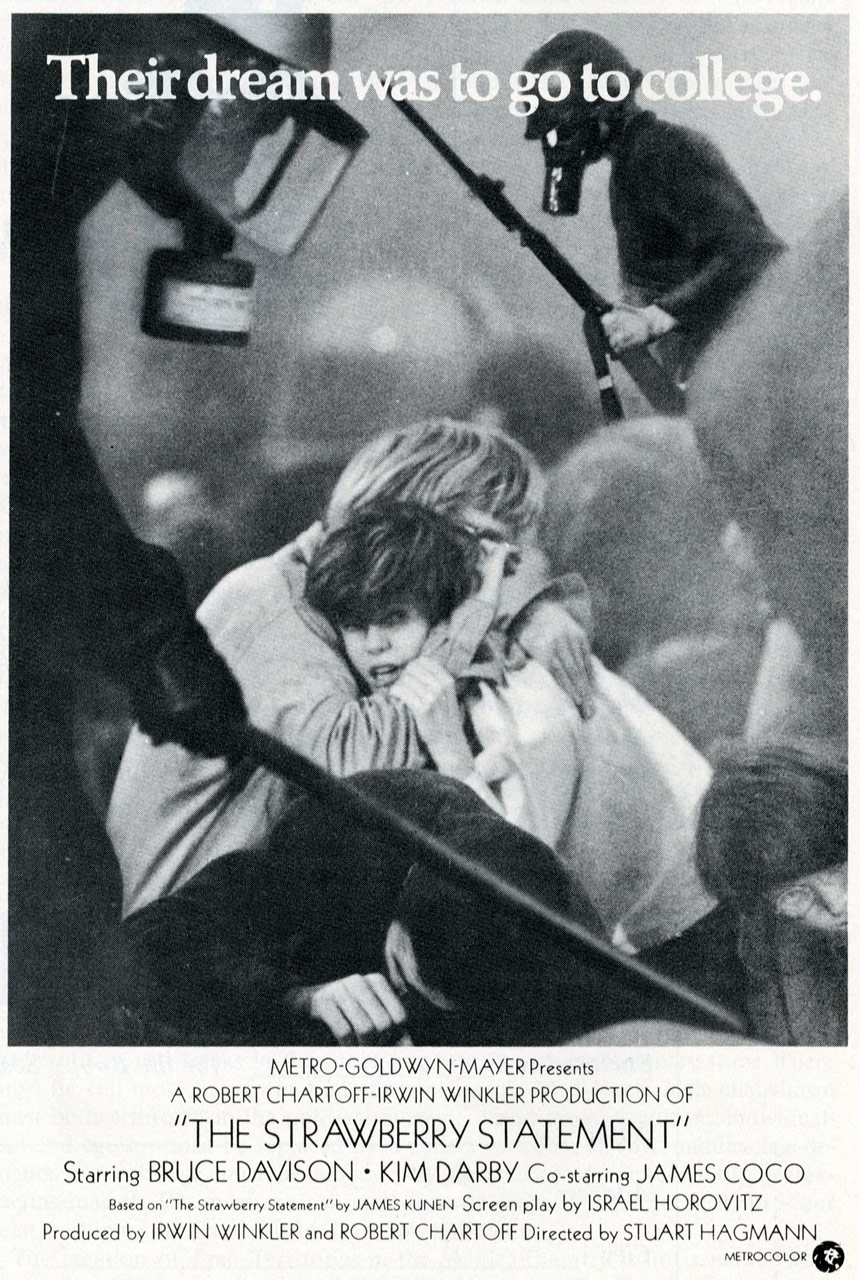
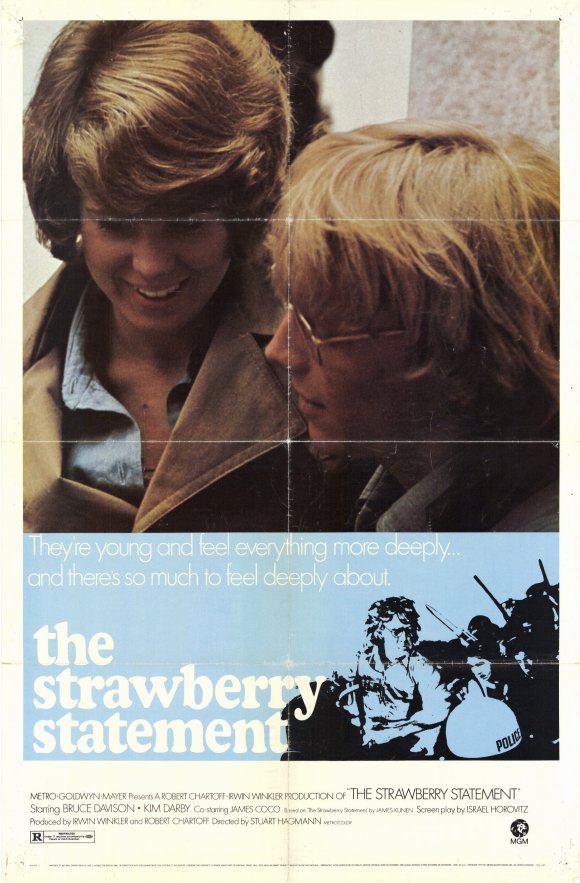
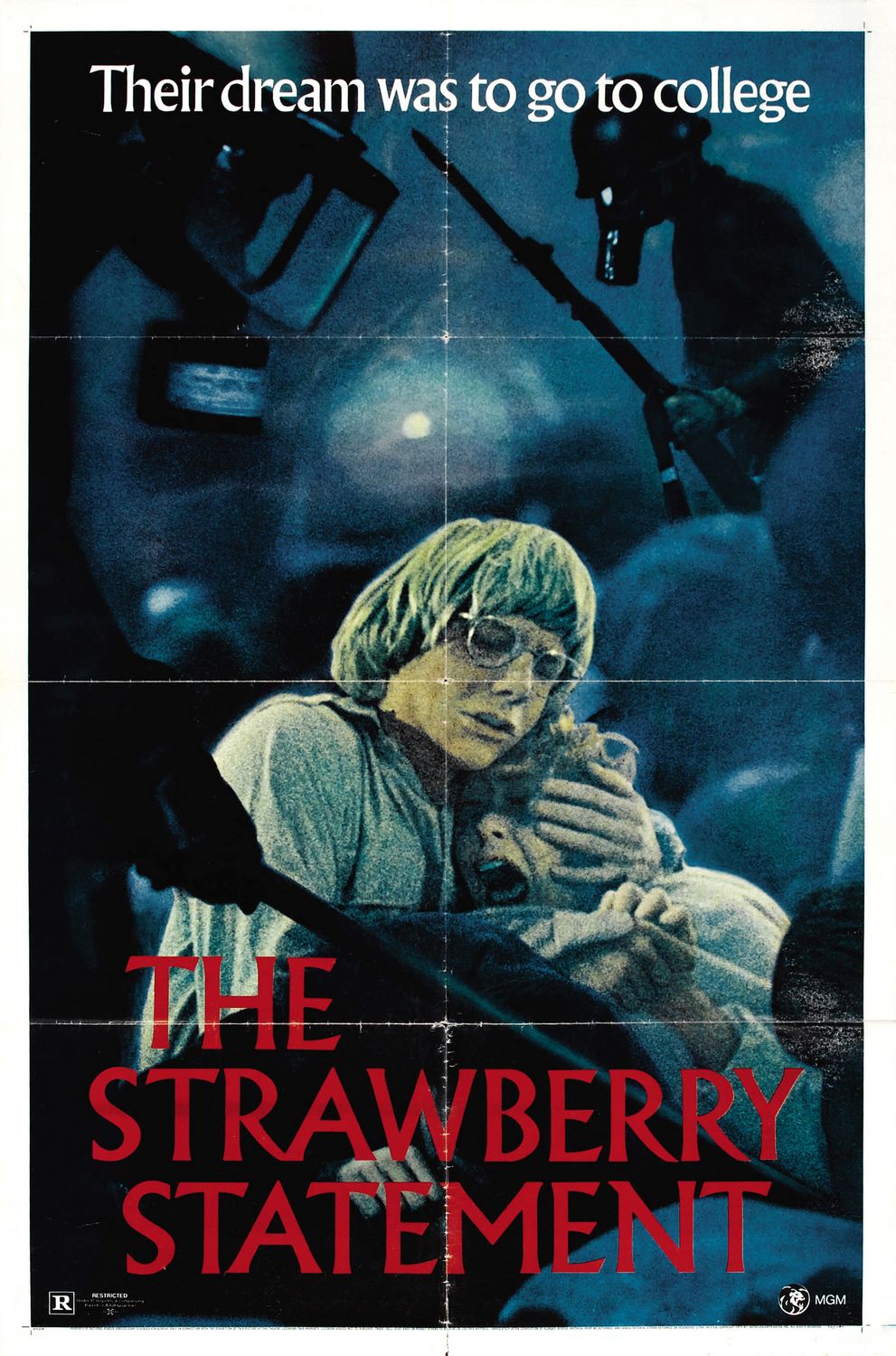
Simon (Bruce Davison) is a young college student attending a university simply as a means to get an education and find himself a good job. He has no real interest in the student revolt going on, but as a lark and a way to meet girls, he decides to passively get involved with students who have taken over the administrator’s building in protest of the school’s plan of building a gymnasium in an African American neighborhood. Slowly Simon finds himself taking up more of their cause and embracing their stance especially after meeting Linda (Kim Darby) who is much more of a student radical, but the two are ill-prepared for the brutal outcome when exasperated school officials have the police violently storm the building and haul the students out.

The film is based on the book ‘The Strawberry Statement: Notes of a College Revolutionary’ by James Kunen, which in turn is based on his experiences of being involved in a student sit-in that took place at Columbia University in April of 1968. The book’s narrative had more of an engagingly detached manner as it looked at the contradictions and hypocrisies of both sides while the screenplay by Israel Horovitz is nothing more than a commercialized effort to cash in on the counter-culture emotions of the time while glossing over or ignoring some of the book’s more perceptive points. The plot is too loosely structured and relies heavily on artsy camerawork and moody music to propel it until you get an hour into it and realize that nothing much has really happened. The whole thing would’ve been better focused had it been done with a voice-over narration by the main character.

strawberry statement 3

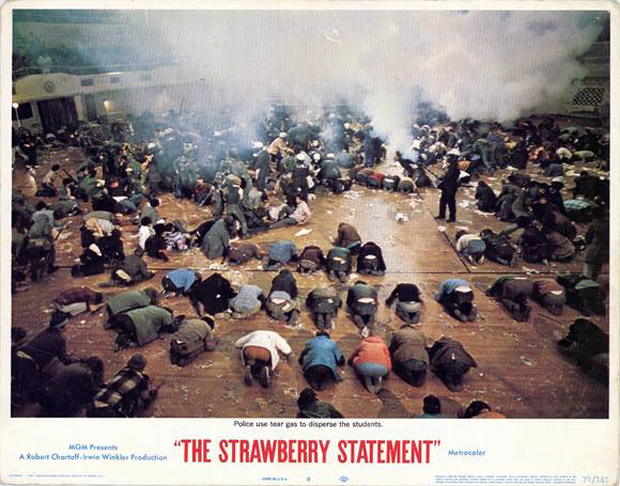
Although at times it borders on being pretentious I still found director Stuart Hagmann’s camerawork to be intoxicating especially the bird’s eye view of the students forming into several large circles as a way to block the police from entering and taking them out. Some of the scenes involving the demonstrations look staged and phony especially when compared to similar scenes of actual protests that were captured in Medium Cool that came out around the same time. However, the scene where the students grab a police officer, strip off his pants and force him down the slide and onto the swings at a children’s playground is downright amusing. The climatic sequence where the students are violently herded out of the building while sprayed with tear gas is well captured and by far the most startling and memorable thing about the movie.

Davison gives a solid performance and creates a middle-of-the-road character that is engaging enough to hold the thing together. It’s also great seeing Bud Cort playing an atypical role of an amorous girl-crazy coed who’s constantly looking to get laid. This film also marks the film debuts of David Dukes, Jeannie Berlin, Paul Willson, Andrew Parks, Kristina Holland and soap actress Jess Walton. You can also spot Horovitz and Kunen in brief cameo parts as well as character actor James Coco as a deli owner who’s all too willing to have his placed robbed simply so he can collect the insurance money.

Although they wanted to shoot the movie at Columbia where the incident actually occurred they were unable to get permission and were forced instead to do it at Berkeley, which in some ways helped it as the liberal, free-spirited look and mood of the region helped match the tone of the story. Ultimately though the film fails to ever really gel and comes off as being too placid and generic while failing to distinguish itself from the myriad of other student protest movies from that era.

strawberry statement 2

strawberry statement 1

My Rating: 5 out of 10

Released: June 15, 1970

Runtime: 1Hour 49Minutes

Rated R

Director: Stuart Hagmann

Studio: MGM

Available: DVD (Warner Archive), Amazon Instant Video

Witches’ Brew (1980)

witches brew 1

By Richard Winters

My Rating: 4 out of 10

4-Word Review: Witch has ulterior motives.

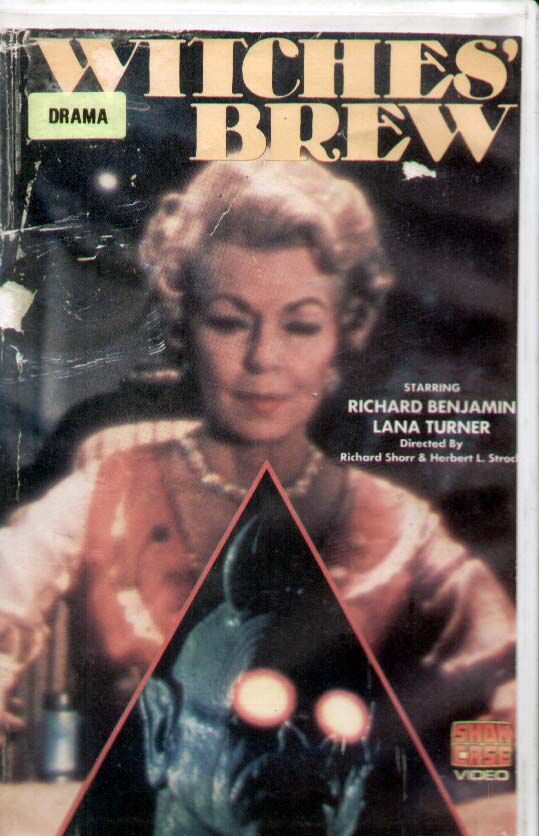
Margaret (Teri Garr) will do anything to help her husband Joshua (Richard Benjamin) get a promotion at a local college, so she decides to resort to witchcraft with the help of Vivian (Lana Turner) who is an expert on the matter. The problem is that two of Margaret’s closets friends Susan (Kathryn Leigh Scott) and Linda (Kelly Jean Peters) also have husbands that are vying for the same position, so they begin to practice witchcraft of their own, which conflicts with Margaret’s and causes Joshua to have a streak of terrible luck and even near tragedy. Vivian comes to their aid, but only because she harbors a dark secret that could cause Margaret her life.

This is a remake of 1944’s Weird Woman that starred Lon Chaney Jr. and Evelyn Ankers, which also got remade before in 1962 with Burn, Witch, Burn! Out of the three versions this one is considered the weakest. The set-up is alright, but the second half in which the cynical Joshua slowly comes to terms with the reality of witchcraft goes on way too long. The comedy and effects are much too restrained and do not take enough advantage of its wild concept. The final third does manage to have some interesting twists, but the climatic sequence is full of loopholes and unfinished story threads that left this viewer feeling unsatisfied and confused when it was over.

I’ve enjoyed Richard Benjamin and his sarcastic wit in other films, but here he comes off as a borderline jerk and has such a radically different temperament from his wife you wonder how they ever got married in the first place. Garr is far more appealing and should’ve been given the most screen time. Turner whose last film this was, doesn’t have all that much to do and locked into a role that is limited and rather thankless.

Director Richard Shorr was fired midway through the production and replaced by Herbert L. Strock, which may explain the film’s disjointed feel that never really comes off as the intended spoof that it wants to be and in some ways far edgier than you’d expect including one scene that has a disgruntled former student climbing to the top deck of a parking ramp and shooting at Joshua below in a Charles Whitman-like attack. There is also another segment that has a giant devil-like bat hatch from an oversized egg that might’ve worked had the special effects been better. In either case this film, which starts out with good potential never comes together and becomes rather flat and forgettable.

My Rating: 4 out of 10

Released: March 10, 1980

Runtime: 1Hour 38Minutes

Rated PG

Director: Richard Shorr, Herbert L. Strock

Studio: United Artists

Available: VHS

St. Elmo’s Fire (1985)

st elmos fire

By Richard Winters

My Rating: 3 out of 10

4-Word Review: Introducing the brat pack.

Seven friends from college start out on the rocky road of adulthood while learning to hold down full-time jobs and having long term relationships. Kirby (Emilio Estevez) is obsessed with an older woman (Andie MacDowell) who doesn’t reciprocate his same interest. Alec (Judd Nelson) wants to get married to Leslie (Ally Sheedy) despite the fact that he has already cheated on her with several other women. Wendy (Mare Winningham) is secretly in love with Billy (Rob Lowe) who is married to someone else and Kevin (Andrew McCarthy) has a secret crush on Leslie while Jules (Demi Moore) still seems to be in perpetual party mode.

I would’ve liked some explanation as to why there was a nude fat guy walking around in the opening scene at the hospital, but otherwise I felt the beginning was okay. The dialogue has a believable conversational quality and friends sticking together lends out a nice vibe although the scene where Alec dunks Billy’s head into a toilet after he loses his job would’ve ended that friendship for me quite quickly. The setting was supposed to be Georgetown University, but ended up being shot at the University of Maryland instead. I liked the tree lined streets and snazzy apartment neighborhoods, but was surprised how kids just out of college could afford such ritzy places.

The main fallback is the male characters that even for guys seem too full of extreme contradictions. Alec expects loyalty from his girlfriend Leslie even though he’s fooled around on her, but because somehow they were ‘meaningless’ to him then they should be overlooked. Billy is already married and has a kid, but shows no ability or interest in holding down a job and expects his wife to still ‘believe in him’ even though he hits on every woman in sight. Kevin expresses major cynicism towards marriage and relationships and then suddenly expounds on his ‘love’ for Leslie when he is alone with her like he is speaking straight out of a Harlequin romance novel.

The worst though is Kirby who shows definite signs of being a creepy stalker/psycho by chasing after a woman that clearly isn’t that in to him. He sniffs her pillows when alone in her apartment and disrupts one of her parties by barging into it dripping wet with rain and angered that he wasn’t invited. Then when she doesn’t show up to one of his parties he becomes enraged and travels all the way up to her remote mountaintop ski lodge and pounds on her door like he is ready to beat her senseless. What’s even more ridiculous is that she finds his behavior to be ‘flattering’ instead of scary making me wonder if she’s crazier than he is.

The women fare better. Winningham is a great nerdette and Sheedy allows for some genuine sympathy. I even liked Moore who does a fun caricature of an 80’s party girl and her scene inside a homeless shelter was interesting, but having her flip-out so severely and quickly after losing her job was, like with everything else, overdone.

The film’s musical score is the best thing while the drama is over-the-top and impossible to take seriously.

My Rating: 3 out of 10

Released: June 28, 1985

Runtime: 1Hour 50Minutes

Rated R

Director: Joel Schumacher

Studio: Columbia Pictures

Available: VHS, DVD, Blu-ray, Amazon Instant Video, YouTube

Tag: The Assassination Game (1982)

tag 1

By Richard Winters

My Rating: 6 out of 10

4-Word Review: Playing with dart guns.

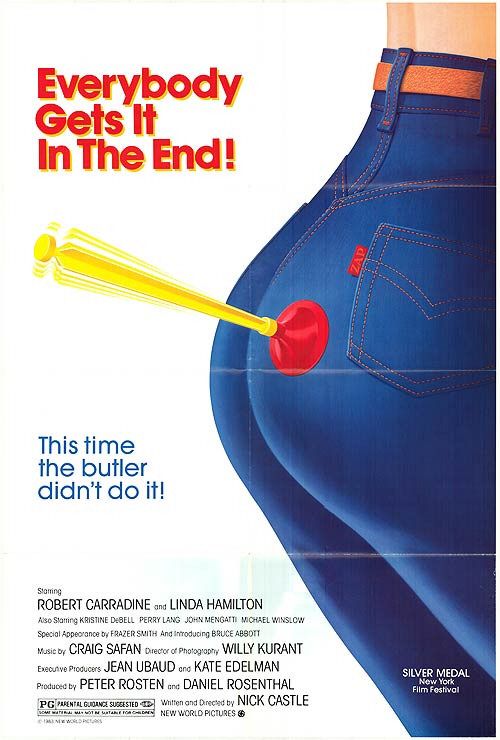
A new fad has caught on at a nondescript college campus where students play an assassination game by killing off other students with dart guns. The one who assassinates the most while still surviving wins. Alex (Robert Carradine) who writes for the school newspaper decides to do an expose on the game in an attempt to better get to know its star player Susan (Linda Hamilton). Unfortunately for them the game’s 5-time champion Gersch (Bruce Abbott) has gone over to the dark side and now using real bullets in his gun. As the game whittles down to just Susan and Gersch the tension mounts for her to catch on to his murderous plans before it is too late.

For a low budget film with only the most modest of settings this thing isn’t too bad. The dialogue is snappy and the story proceeds at a good pace. The opening credits, which is a parody of the ones done on James Bond films is cute and it’s great to see Linda in her official film debut playing the same type of strong-willed female that brought to greater prominence in The Terminator franchise. Carradine is good too as her awkward suitor and the fact that this film plays against sexual stereotypes by having the male in more of a passive role is refreshing.

The film’s playful parody and the way the players take this silly game so very seriously is funny and having the second half shift to more of the conventional ‘psycho-on-the-loose’ plot made it less original and more formulaic. I understood why Gersch kills the first player using a real bullet, but was confused why he would keep on killing them and not go back to just using darts. He could’ve still retained his champion title and passed off the first killing as being possibly just an accident, but by continuing to kill people and harboring their corpses in the closet of his room was clearly going to lead to an eventual long jail sentence that even the craziest of persons could see coming. It also might have been more interesting had the identity of who was using real bullets was kept a mystery until the end.

Even with these drawbacks I still found myself entertained and the film has strong cult potential for fans of low budget 80’s flicks. It’s also interesting to note that Hamilton and Abbott, who first met while filming this, later ended up getting married and having one child.

My Rating: 6 out of 10

Released: April 20, 1982

Runtime: 1Hour 30Minutes

Rated PG

Director: Nick Castle

Studio: New World Pictures

Available: VHS

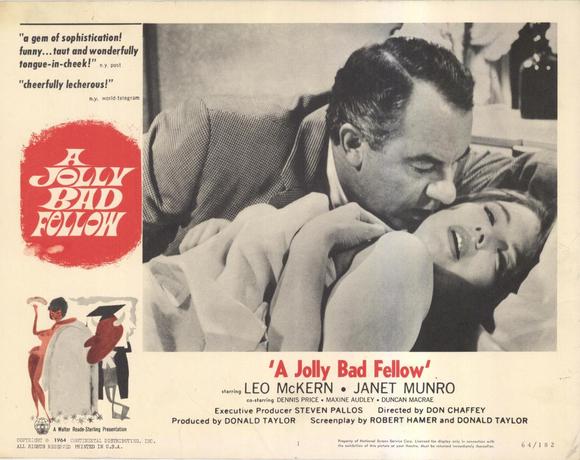
A Jolly Bad Fellow (1964)

jolly bad fellow 2

By Richard Winters

My Rating: 5 out of 10

4-Word Review: He poisons his enemies.

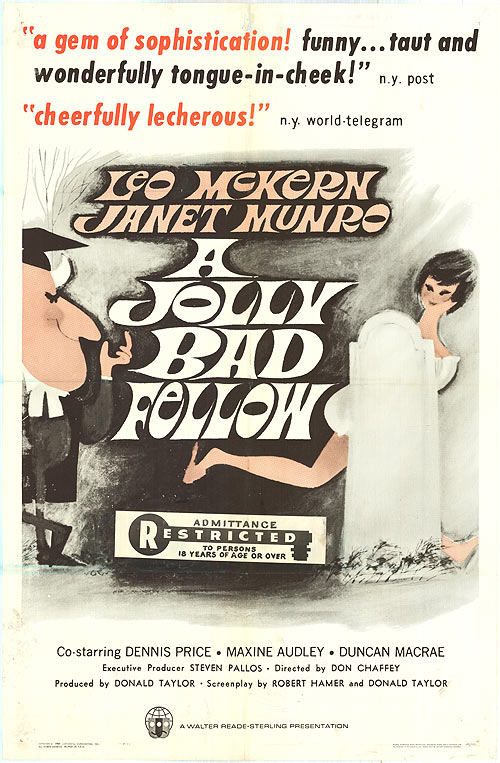
Professor Kerris Bowles-Ottery (Leo McKern) is a college professor working in the university’s science lab where he conducts experiments on mice. One day he accidently comes upon a poison that kills the mice, but only after sending them into a brief euphoric state, which he then decides to use on his enemies. Only a little bit of it is needed to work, so he is able to use all sorts of methods to get them to ingest it including putting it into their drinks, as well as the cigarettes they smoke, and even dabbing a bit of it on a tip of a pencil, which one of the character’s routinely likes to lick before he begins writing with it. Things go quite smoothly until his wife Clarinda (Maxine Audley) leaves him, which upsets him enough that he become careless and eventually culminates with ironic results.

The film’s chief asset is McKern’s presence whose acerbic delivery and facial expressions perfectly captures a stuffy, pompous curmudgeon in highly humorous fashion. He nails every scene that he is in, but his best moment comes at the very end when he hops into his car and begins driving at high speeds throughout the English countryside while giving off a loud, long maniacal laugh.

The plot is thick with satire, but doesn’t go far enough with it. Just when it seems to be catching its stride it bogs down with an affair that McKern has with a much young woman (Janet Munro) that didn’t make a lot of sense. I could see why he’d be into her, but no so much why she would have the hots for him although the fact that he does seem to truly love his wife even when he fools around on her and becomes upset when she decides to leave him was excellent irony.

The funniest element is when he poisons his enemies and rivals many of whom are as pompous and stuck-up as he is. Watching these refined, stuffy people suddenly act silly and child-like is quite amusing, but again the film stops short of packing the punch as these scenes should’ve been more extended, which is the one thing that makes this potentially hilarious film not half as funny as it could’ve been.

jolly bad fellow 1

My Rating: 5 out of 10

Alternate Title: They All Died Laughing

Released: March 15, 1964

Runtime: 1Hour 34Minutes

Not Rated

Director: Don Chaffey

Studio: British Lion Film Corporation

Available: DVD

The Revolutionary (1970)

the revolutionary 2

By Richard Winters

My Rating: 6 out of 10

4-Word Review: He fights against capitalism.

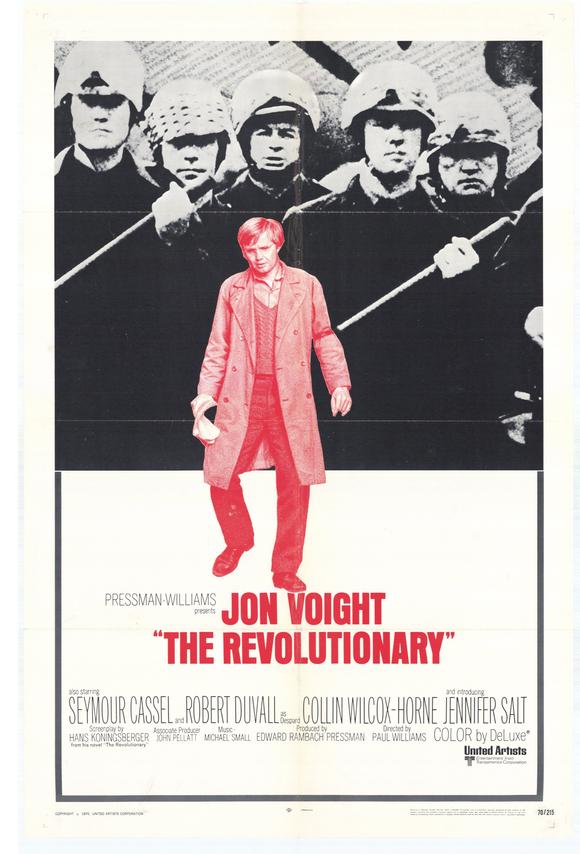
Jon Voight plays a college student involved in a student protest group called The Radical Committee. They push for social change particularly with a more communist/socialist style of government, which he becomes fonder of after working with Despard (Robert Duvall) a nearby factory worker who’s trying to start a union up at his plant. After being suspended from the school for his radical views he becomes frustrated at seeing how his work and actions seem to have very little influence or effect. He then meets up with Leonard (Seymour Cassel) who is a more seasoned radical and not shy about using violent or unethical methods to make his point and pressures Voight to start doing the same.

On the whole despite its slow pace this is a slickly produced intriguing character study. I enjoyed the grainy pictures of the 1917 Bolshevik Revolution shown over the opening credits, but I didn’t like the film’s choice of on-location shooting. Supposedly it takes place in a small American city, but it doesn’t resemble one since it was filmed in London, which gives everything from the old buildings to roadways and sidewalks a European look that you never see in any American town or city. There is also no explanation initially about what the students are protesting against or why they are at odds with the school, which makes the storyline seem generic and hard to get into at first.

I loved Voight’s character as it is similar to his Joe Buck one in Midnight Cowboy with all of the social awkwardness, but fortunately he is not as painfully dumb. It is interesting to see how such a highly intellectual man with strong opinions and ideals can still at times be quite timid. I was looking forward to seeing the character go through a transition and was disappointed that it took so long to get there.  To me the ending should’ve been the beginning and the fact that it isn’t hurts the film’s overall impact. I was also confused as to why the Jennifer Salt character, who plays a young lady from an affluent family, would find Voight so appealing, or why she wanted to continue to go out with him, which to me demanded more of an explanation.

The scene in which a mob gets attacked by some riot police is photographed in a way that makes it intense and startling and could’ve been extended even more. The ending is nerve wracking and great example of how complete silence without any music can sometimes create far more tension. Unfortunately the ambiguous resolution is a disappointment and after such a long and deliberately slow build-up comes off almost like a cop-out.

My Rating: 6 out of 10

Released: July 15, 1970

Runtime: 1Hour 40Minutes

Rated R

Director: Paul Williams

Studio: United Artists

Available: DVD (MGM Limited Edition Collection), Amazon Instant Video