Category Archives: Cold Climate/Wintertime Movies

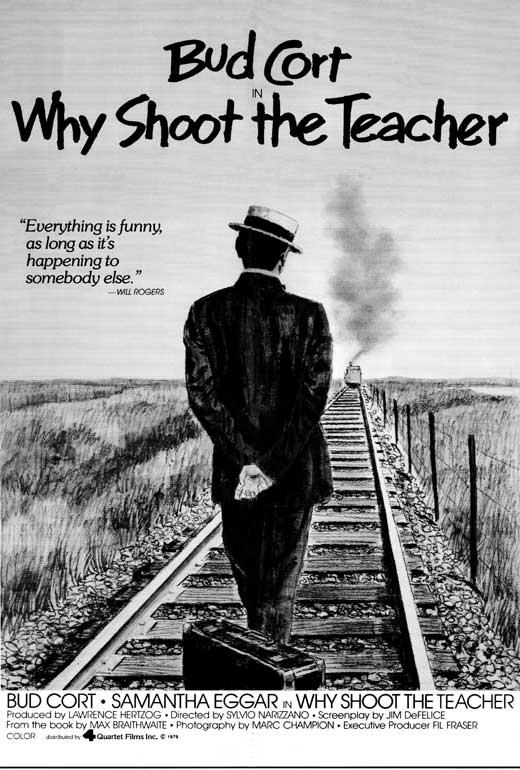
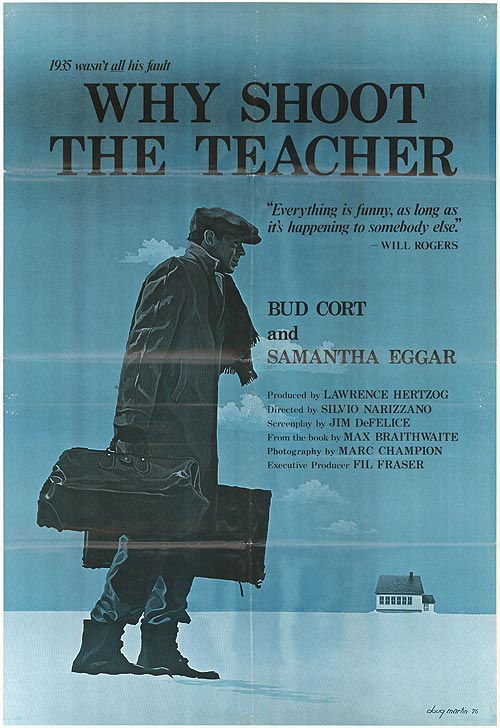
Why Shoot the Teacher? (1977)

why shoot the teacher 2

By Richard Winters

My Rating: 8 out of 10

4-Word Review: Not a good job.

If you hate your job then watching the escapades of Max Brown (Bud Cort) dealing with his should make you feel a lot better about yours, or even lucky. The setting is 1935 and Max has traveled to an isolated farming community in Saskatchewan Canada in order to live out his dream of being a school teacher. The problem is that he must live in the dingy basement of the school that has no running water and an outhouse that gets regularly overturned by the rowdy school children, sometimes with Max in it, and he is only paid $20 dollars a month for his efforts, which even back then was a paltry amount. What is worse is that the district can’t even afford to pay him so instead gives him promissory notes and forces him to be dependent on the generosity of the townspeople for his food. Since he had to borrow money for his train ride up there he is unable to go back and forced to spend the harsh Canadian winter all alone while dealing with difficult students and indifferent parents and adults.

Cort really shines. The fact that through all his diversity he still remains civil and upbeat makes the character quite appealing even though he does evolve and at times compromises from his initial ideals. The best example of this is when he eventually, despite his initial reluctance, uses the strap on one of the older bigger students while the rest of the school children watch through the school windows. Although Cort is best known for his starring role in Harold and Maude I’d actually say this is his best all-around performance.

Samantha Eggar another under-appreciated and underused performer is terrific in support as Alice Field a woman transplanted from England who like with Max finds herself alienated and unconditioned to the harsh climate. She also has a really amusing line when she states “Canada is a nice country…sometimes…in the spring.”

Filmed on-location in the tiny town of Hanna, Alberta the sprawling wheat fields create a tremendous sense of isolation as well as a distinctive sense of natural beauty. The story is filmed during all three seasons, which makes the viewer feel like they are battling the rigorous Nordic climate right alongside Max. One of the funniest moments is when the word ‘Spring’ is flashed on the screen while a raging blizzard goes on behind it making Canada one of the few places that can make Minnesota, where I am originally from, seem like a mild climate.

The film is wonderfully vivid and creates a rich multi-textured tapestry of life on the prairie. By keeping everything on a realistic level it helps recreate what life must have been like for a lot of rural school teachers during the period, which is what makes it so fascinating. The film’s faded washed-out color and archaic low budget technical approach only helps to accentuate the look and feel of the period. There are shades of Wake in Fright here that also dealt with a man teaching school in an isolated school house while battling the elements and I found it interesting to note that Ted Kotcheff who was the director of that film was listed as a production consultant on this one.

My only complaint about the film was the misleading title. There is no shooting of any kind of the teacher, or even any talk of it. Why they came up with that title, which is based on the book with the same title is a mystery. Unfortunately it may give some people the idea that this is a violent film when nothing could be further from the truth and may turn-off potential viewers from enjoying this endearing slice-of-life comedy/drama.

why shoot the teacher 1

My Rating: 8 out of 10

Released: June 23, 1977

Runtime: 1Hour 39Minutes

Rated PG

Director: Silvio Narizzano

Studio: Lancer Productions Limited

Available: VHS, DVD, Amazon Instant Video, YouTube

The Luck of Ginger Coffey (1964)

the luck of ginger coffey

By Richard Winters

My Rating: 7 out of 10

4-Word Review: He needs a job.

Ginger Coffey (Robert Shaw) is a middle-aged man living in Montreal whose dreams and ambitions far outweigh his grim predicament. He moves from one low paying job to another convinced that his lot in life will improve. His wife Vera (Mary Ure) decides to leave him and Ginger tries to win her back while juggling two jobs and hoping to get a promotion in one that never seems to come.

As a vivid look at the daily lives of the everyday working class this film hits a solid bullseye. The conversations between the co-workers and the monotonous and sometimes demeaning job interview process and Ginger’s on-going arguments with his wife and daughter are all true to form. There is no pretension and director Irvin Kershner keeps everything at a bare-bones minimum giving it almost a documentary style and making the viewer feel immersed in the bleak environment. The outdoor shots of the city are unexciting and cinematically unappealing, but help reflect the grim level. Watching Ginger get kicked out of his apartment and have to carry what is left of his belongings and then place them on the outside sidewalk while he goes in to visit his daughter in her school is quietly powerful.

Robert Shaw is excellent. This is a man who had by all accounts had a very dominating and proud personality in real-life and usually played characters with the same traits, so seeing him play against type and succeed is interesting. What is really effective is that he makes the character very human and likable despite his constant goof-ups, which keeps the viewer compelled to his situation.

Ure, who at the time was married to Shaw in real-life, gives an equally outstanding performance. Her perplexed facial expressions are perfect and the fact that we see her character grow and become more confident is good.

I also must mention Liam Redmond as Ginger’s cantankerous boss, who is nicknamed by his employees as ‘Hitler’. Ginger’s rushed job interview that he has with him is one of the film’s highpoints as is the moment when Ginger dashes away from him when he is caught making a personal phone call.

The only real complaint I have with the film is the ending, which is for the most part non-existent. I have seen vague wide-open endings in my movie viewing lifetime, but this thing is a cop-out and really boring one at that. I think when a viewer has spent nearly two hours empathizing with his difficult  and precarious situation that they deserve some sort of finality, or at least a hint of what became of him and whether he ever did find that ‘luck’ that he was so convinced was out there.

My Rating: 7 out of 10

Released: September 21, 1964

Runtime: 1Hour 40Minutes

Not Rated

Director: Irvin Kershner

Studio: Continental Distributing

Available: YouTube

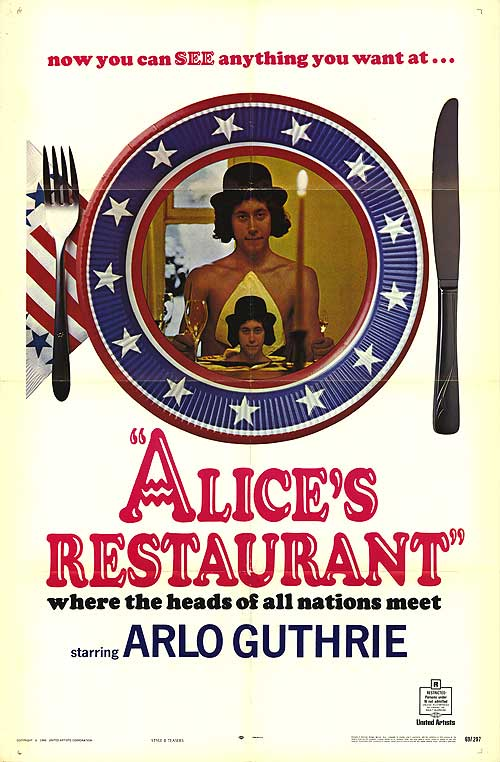
Alice’s Restaurant (1969)

alices resturaunt 2

By Richard Winters

My Rating: 7 out of 10

4-Word Review: Nobody likes the draft.

Attempt at making a movie out of Arlo Guthrie’s famous 18-minute song, which in itself was based on actual events succeeds for the most part although it seems to be biting off little more than it can chew. Pat Quinn plays Alice a middle-aged woman who along with her husband Ray (James Broderick) buys a church and turns it into a hippie retreat as well as a restaurant. Arlo plays himself and a friend of the couple who helps them in their endeavor. Things go well for a while, but then infighting, the draft, the death of some of the members, and basic overall disorganization do it all in.

Although Guthrie’s song has a bouncy, upbeat, and humorous quality to it the movie works in an opposite fashion. There are a lot of long dramatic takes with a tone that is overall downbeat and depressing. To some extent it succeeds at giving the viewer a vivid look at the late 60’s experience, but compared to the song it seems to be a bit of a letdown. However, there are still some great moments that will connect with you on a purely emotional level. One of them is seeing legendary folk singer Pete Seeger and Arlo playing a song for Arlo’s bedridden father Woody (Joseph Boley) and another includes the sights and sounds of an outdoor wintry funeral for one of their troubled friends.

There are some good comedic moments, but they all come pretty much in the second half making the film seem a bit disjointed and almost like two films rolled into one. The best moments in this area include Arlo’s attempts at dumping out garbage, which features a lot of good quick edits as well as the actual Officer William Obanhein mentioned in the song. Arlo’s army physical is also quite funny especially his experiences in the ‘Group W’ room, which also has an early appearance by character actor M. Emmet Walsh who talks so fast that he becomes incoherent.

The idea of casting Arlo in the lead works to some extent. Obviously the presence in his own story makes it more authentic, but he also seems too detached and shows little if any emotional range. He also looks incredibly young almost like he is only 14.

It is Broderick who comes off best and this is easily his best performance of his otherwise sporadic career. He seems light years away from the more conservative, fatherly figure that he played in the 70’s TV-show ‘Family’ and the fact that the character here is a middle-aged man trying to submerge himself with the youth movement while displaying obvious frailties in the process makes him fascinating to watch and help give the film an added layer.

When I first saw this film years ago I came away feeling that it was too downbeat and disjointed, but upon second viewing I have a greater appreciation for it. It seems now more prophetic and forewarning to the beginning of the end of the hippie movement and how their carefree youthful ideals simply weren’t going to survive amidst the harsh, practical realities of the world that it was in. The long, continuous shot of Alice’s sad, forlorn expression seen at the very end seems to be conveying this and thus makes this movie less of a relic and more perceptive than most people may realize.

My Rating: 7 out of 10

Released: August 20, 1969

Runtime: 1Hour 51Minutes

Rated R

Director: Arthur Penn

Studio: United Artists

Available: VHS, DVD, Amazon Instant Video

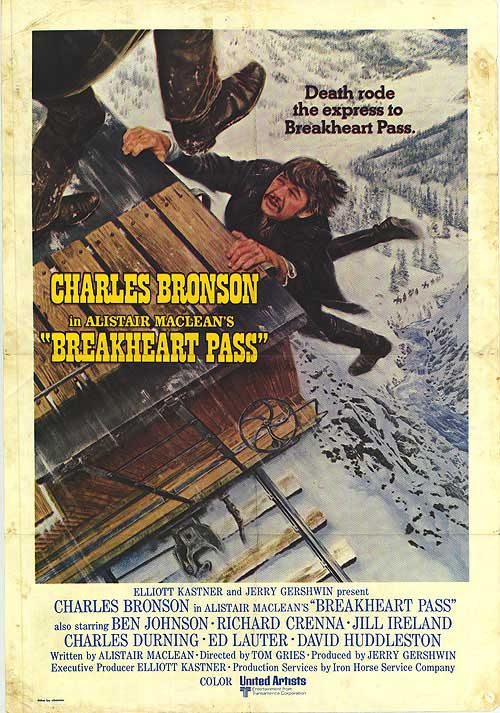
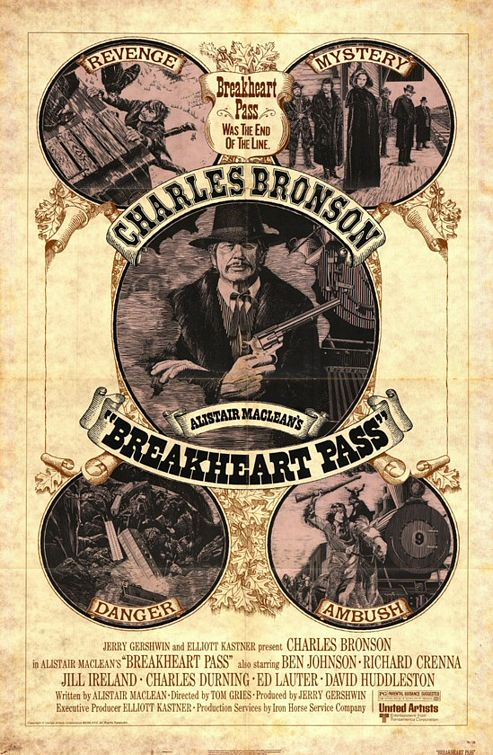
Breakheart Pass (1976)

breakheart pass 2

By Richard Winters

My Rating: 7 out of 10

4-Word Review: Chuck’s on a train.

John Deacon (Charles Bronson) is a prisoner on a train headed Fort Humboldt. The train is carrying medical supplies to help the people there who are suffering from a plague outbreak. Amongst the passengers on the train is a Governor (Richard Crenna) a U.S. Marshal (Ben Johnson), a priest (Bill McKinney) and a load of Calvary soldiers, but as the ride progresses strange things begin to happen. People disappear and then turn up dead. Everyone seems to have a secret to hide and what is inside the boxes labeled medical supplies isn’t medicine.

This is the first Bronson/Ireland production to be given a big budget and the wintry Rocky Mountain landscape is sumptuous. The plot itself is intriguing and full of interesting twists that grabs you right from the start and keeps you enthralled until the end. Based on the Alister Maclean novel who also wrote the script it is no surprise that it seems more like a spy/espionage thriller than a conventional western yet there is enough gritty elements to keep it passable at both ends. The mixture of the two genres is unique and exciting and for a bubblegum actioner this one hits the mark.

The stuntwork is impressive and one of the film’s highpoints. Some of the best moments are when a man is thrown from a train and you see him fall from a bridge all the way to the river below. What makes this stand out is that the conventional, lightweight mannequin was thankfuly not used. Instead it looks like a real human body that even thumps along the wooden posts of the bridge as it goes down making it vivid. Watching the trainload of soldiers spiral off the tracks and go crashing along the mountainside has the same realistic quality. The fight on top of one of the snowy train cars between Bronson and former boxer Archie Moore is well choreographed and the scene of a telegraph operator getting a bullet shot through his head is surprisingly graphic.

The supporting cast is good and for a while they outshine Bronson who seems in a way outclassed by their colorful personalities and different acting styles. However, as it evolves Bronson comes into his own and it becomes a lot of fun watching the way he singlehandedly outsmarts and outmuscles all of them.

Ireland is beautiful as always and manages to hold her own to the otherwise all male cast. The music becomes an excellent added element. The booming orchestral sound of the opening theme is reminiscent of ones used in classic westerns. The unique score played whenever the Indians appear on screen has an interesting beat and sound. This is an entertainment winner for not only Bronson fans, but for action lovers as well.

breakheart pass 1

My Rating: 7 out of 10

Released: December 25, 1975

Runtime: 1Hour 35Minutes

Rated PG

Director: Tom Gries

Studio: United Artists

Available: VHS, DVD, Amazon Instant Video

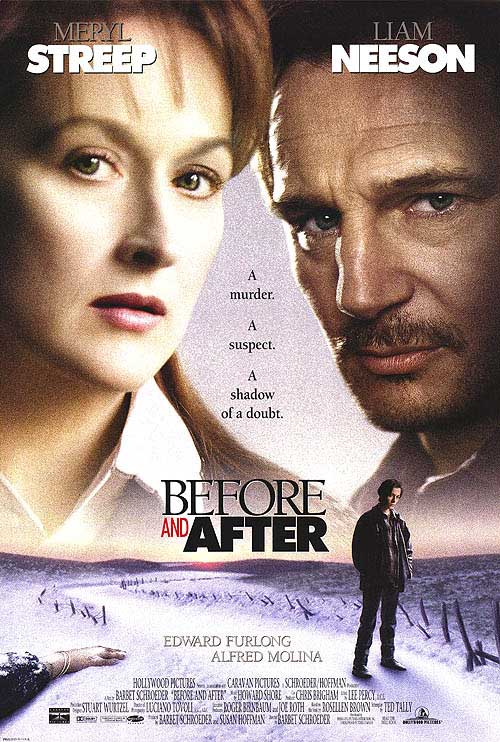
Before and After (1996)

before and after

By Richard Winters

My Rating: 8 out of 10

4-Word Review: Son is a murderer.

This is a solid drama based on the novel by Rosellen Brown detailing how a family copes after their teenage son Jacob (Edward Furlong) is accused of killing his girlfriend.

Thoroughly engrossing and believable from beginning to end and full of intriguing plot twists. It is fascinating how it examines things from a completely unique perspective namely the family members of the perpetrator, which is rarely ever done. The story is also interesting in that it gets the viewer too become quite attached to Furlong who plays the accused. The film forces the viewer to face and question their own moral judgments, which is good since many films these days seem timid at digging too deeply into anything of a serious nature or forcing the viewer to confront any of their own preconceived notions.

On the negative end the film lacks cinematic style and at times almost looks like it is a TV-movie. Meryl Streep is okay as Jacob’s mother, but this is definitely not one of her better performances. There is a love making scene between her and Liam Neeson that looks mechanical and is completely unnecessary. Viewers who have had family members or friends that have been victims of crimes may find themselves upset with some of the moral conclusions.

Overall this is a strong drama that presents a lot of issues that are timely and haven’t been done anywhere else. Despite a lack of flair or visual style it is still an excellent piece of storytelling with an outstanding performance by Furlong.

My Rating: 8 out of 10

Released: February 23, 1996

Runtime: 1Hour 48Minutes

Rated PG-13

Director: Barbet Schroeder

Studio: Caravan Pictures

Available: DVD, Blu-ray, Amazon Instant Video 

Dealing: or the Berkeley-to-Boston Forty-Brick Lost-Bag Blues (1972)

dealing

By Richard Winters

My Rating: 5 out of 10

4-Word Review: Drugs are a trip.

This review was originally slated to post in February, but due to the death on Christmas Eve of Charles Durning I decided to post it now. Durning was one of the all-time great character actors who always brought an amazing amount of energy to every role he played and could do a wide variety of character types well. Although he has very few lines of dialogue in this movie he still manages to become the most interesting part of the proceedings and helps enliven an otherwise slow moving film.

The plot, based on a novel by Michael Crichton, pertains to Peter (Robert F. Lyons) who is a recent Harvard graduate hired by John (John Lithgow) to transport a suitcase full of marijuana from Boston to Berkeley, California. Peter is new at this and things do not go as planned, but he meets beautiful Susan (Barbara Hershey) along the way and the two fall in love. John next hires Susan to transport another suitcase of narcotics, but when she loses the luggage at the airport and then tries to go back and get it she is arrested by corrupt cop Murphy (Durning) who resells some of the recovered stash back out onto the street. In order to get Susan out of jail Peter plays an elaborate game of cat-and-mouse with the cop, which culminates in a violent showdown.

The story is done in a laid-back style similar to the approach taken by many European films. The emphasis is on mood and subtle nuance yet when the Europeans do it this style seems refreshing, but here it is more off-putting. I really had a hard time getting into it as the first hour is slow with too many scenes going on longer than it should. The set-up is too quick and there is not enough background, or history shown to the main character.

The second hour improves. Durning gives the proceedings some pizazz and Peter’s scheming is fun. The shootout done in the snow has flair and style.

The music by Michael Small is impressive. It is one of the most original scores I have heard and really fits the mood of the script. The best is over the opening credits.

Hershey is as always gorgeous and fans may like that she is shown topless. The part of a free-spirited hippy chick seems to be her forte and she excels. However, having her fall for a guy that is rather dull and ordinary didn’t make sense. Sure they make love right away, but I thought that was more just because it was a part of her lifestyle and she does after all go around in a dress without wearing any underwear. She just seemed to be diving into the free love atmosphere of the era. Obviously having Peter fall for her made sense because she is hot, but why would she go head-over-heels for this schmuck when there are so many other guys that would be more than willing to do it with her. The romantic angle was forced and hurt the credibility of the story.

Lithgow is okay in his film debut, but I had problems with the character. One minute he is cool, conniving, brash, and arrogant and then in the next instant he becomes scared, confused, and meek, which was too much of a quick transition.

The under-rated Lyons is excellent and makes for a terrific lead especially with this type of part. Despite being in his 30’s he looks and acts very much like a college kid from that period. His performance is nicely understated and believable throughout.

The on-location shooting in Boston is vivid and people from the area may like to view this just to see how much it has changed. The DVD transfer from Warner Archive is excellent with a nice clarity and vivid colors. The movie itself is slick, but it also has a detachment to it that doesn’t allow the viewer to get as connected with the characters, or the situations like they should and thus making it an interesting period artifact, but nothing more.

Also, Demond Wilson can be seen briefly as one of the drug dealers. He did this just before his signature role of Lamont in the hit TV-series ‘Sandford and Son’. Ellen Barber is real cute as Peter’s girlfriend and so is Joy Bang who later became a registered nurse. Normally I don’t like women with buck teeth, but with her it actually looks sexy.

My Rating: 5 out of 10

Released: February 25, 1972

Runtime: 1Hour 28Minutes

Rated R

Director: Paul Williams

Studio: Warner Brothers

Available: DVD (Warner Archive)

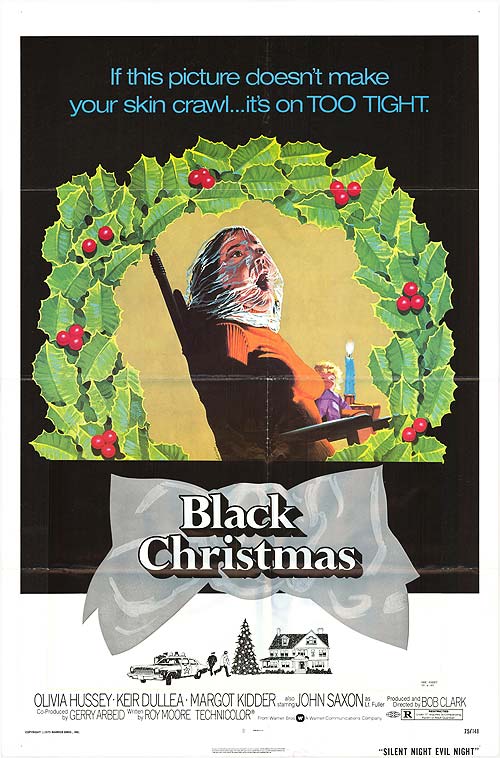
Black Christmas (1974)

black christmas 1

By Richard Winters

My Rating: 8 out of 10

4-Word Review: He’s in the attic.

It’s Christmas time at the sorority house, but as the girls celebrate the season they continue to get harassing phone calls from a strange man who speaks in different and frightening voices. Unbeknownst to them the man has snuck into the attic of their house and the calls are coming in from another room. As the night progresses the girls begin to disappear forcing the lone survivor to fight off the killer by herself.

I have not seen the remake of this film and due to negative response that I have heard I don’t think I want to either. This review pertains to the original only. If you have seen the remake and disliked it you should still give this film a try.  Despite its low budget it is quite effective and it slowly builds up the tension in a nice compact style with a great twist ending.

Of course one of the things that make this movie so good is the humor. I loved Marian Waldman as the alcoholic house mother Mrs. McHenry who stashes bottles of whiskey in all sorts of goofy places. The vulgar Santa who swears even as the kids are sitting on his lap is a hoot and a nice precursor to Bad Santa, but my favorite is the poster of a sweet old lady giving the finger.

One of the best moments on the terror end is the part where the killer’s eyeball can be seen looking through a small crack in the doorway, which is memorable. The scene where the camera pans from each girl’s nervous and frightened face as they listen to the weird voices emanating from the phone receiver is very well done although it would have been even stronger had the Christmas music not have been playing in the background.

The performances are top rate and I liked the fact that the girls all have distinct personalities from one another. Margot Kidder as the vulgar and obnoxious sorority sister Barb is a scene stealer and I’d say this is the best performance of her career. I loved when she calls one of the more conservative members of the group a ‘professional virgin’, or has the audacity to call her own mother a ‘gold-plated whore’. The part where she gets a young kid drunk and even swears in front of him is also funny as is her conversation about a species of turtle that can have sex for three straight days without stopping. Yet through all of her outrageousness director Bob Clark still manages to create a three-dimensional character by showing her as also being lonely, moody, and suffering from asthma, which is good.

Olivia Hussey as Jess is terrific. She is poised, confident, intelligent, and sweet and the type of character the viewer can immediately connect with and care about. Her face has a wonderful fragility about it as well a natural beauty. The look of terror coming from her eyes seems genuine and the horror is made more effective because she responds to it in a believable and relatable way.

Keir Dullea is good as Jess’s high strung boyfriend Peter. I had to chuckle a bit seeing him here as it brought back memories of what playwright Noel Coward once said about him “Keir Dullea gone tomorrow”, which seemed to have some credence since he was starring in the masterpiece 2001: A Space Odyssey just a few years earlier and now delegated to a supporting role in a low budget horror film. I always felt that his reserved and emotionless delivery can work when given the right role and for the most part it clicks here despite the fact that he was pushing 40 at the time and not quite looking college age.

I read one review where the critic complained that he did not feel it was believable for a killer to be hiding in an attic and no one else in the house aware of it, but the house was a big old building and for me it seemed possible especially since it was only for a short period of time. Overall I felt this was a very plausible premise that is handled in a realistic fashion without all the glaring loopholes, which is one reason I continue to enjoy it no matter how many times I’ve seen it.

However, there are a few quibbles. One is the policeman who gets his throat slashed while sitting in an unmarked police car just outside of the sorority home. I would think a seasoned office would be able to spot someone sinking up on him while he is inside a car especially since it was otherwise not a busy street and since it was wintertime I think it would be highly doubtful that he would be sitting there with the driver’s side window rolled down. I also had to roll my eyes at the scene where Jess is trying to get out of the house as she is being chased by the killer and yet for some inexplicable reason the front door conveniently jams even though no had a problem with it before.

Bob Clark shows what a talented director he is and it is too bad his career and life was cut short in a car accident in 2007. It is one thing to have a big budget and access to all the state-of-the-art special effects, but it is another to make a memorable movie on a shoestring. Despite its low budget it doesn’t seem hampered by many of the limitations that other similar films suffer.

Some may prefer lots of gore, which this one has very little of, and a bigger-than-life monster or bad guy, but the reason this is a classic is because they go with the philosophy that less is more. Any self-respecting horror fan should see this film and most likely appreciate it.

My Rating: 8 out of 10

Released: October 11, 1974

Runtime: 1Hour 38Minutes

Rated R

Director: Bob Clark

Studio: Warner Brothers

Available: VHS, DVD (Special Edition), Blu-ray

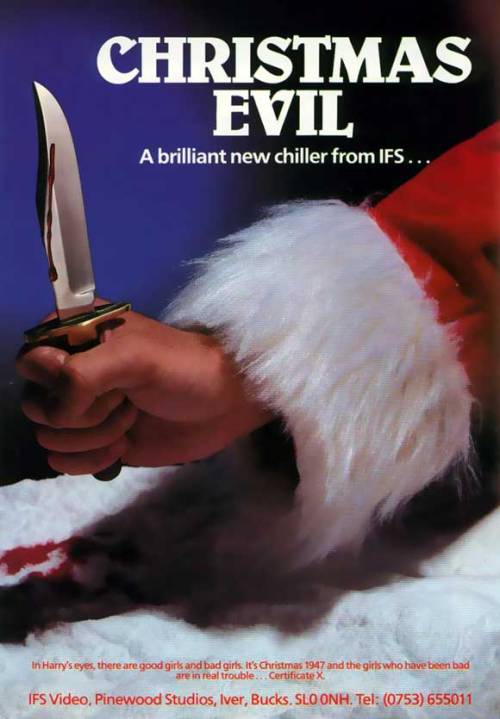
You Better Watch Out (1980)

you better watch out

By Richard Winters

My Rating: 1 out of 10

4-Word Review: This Santa isn’t jolly.

As a young boy Harry Stadling (Brandon Maggart) witnessed his mother being groped by Santa Claus, which was apparently his father in the disguise, but it nonetheless created a disturbing image in his mind that shattered the ideal he had for the mythical man. Years later as an adult working a thankless job at a toy factory Harry starts to believe he is Santa Claus and even spies on the neighborhood children to see which ones have been naughty or nice and keeps meticulous records on each. Then on Christmas Eve he dresses up as Santa and delivers presents to some needy kids at a hospital, but also comes into contact with a group of condescending people outside of a church who he then kills. This sends out a police alert where everyone in the city including the regular townspeople is on the hunt for him and Harry tries to avoid them while continuing to deliver his gifts.

For some reason this film never created the controversy of portraying Santa Claus as a killer like Silent Night Deadly Night did even though this film came out 4 years earlier.  Critic Leonard Maltin came down hard on that one in his book, but seemed to like this one, which is the whole reason I gave this one a chance 25 years ago, but I remember disliking it. Since this film has managed to inspire a small cult following I decided to give it another chance, but I didn’t like it any better.

Part of the problem is that it is very slow and plodding with the majority of the film focusing on Harry as he goes through the daily routines of his pointless and lonely life. Nothing that he does is compelling and sometimes it is even confusing. It is hard to call this a horror film even though that is what it is considered because there are really no scares at all and the gore is at an extreme minimum. Maggart gives a solid performance in the lead, but as my acting teacher in school once said a good actor cannot save a weak script, or as he put it ‘you can’t shine shit.’

There are only two killings and neither of them is effective. The killing done outside a church is captured in a choppy editing style with bloody special effects that look fake and it is carried out by Harry while using a toy ax, which seemed ludicrous. I also didn’t think it made a lot of sense for the victims to have such a snarky and sarcastic behavior especially when they were just coming out of a church service. What is worse is that when the victims are killed no one comes to their aid to see if they can save them they just stand on the church steps and stare at their lifeless bodies. An APB is also put out which is broadcast on the TV news stating that the killer escaped in a white van with Christmas sled painted on its side, which is distinct enough that somebody somewhere would have spotted it and yet Harry continues to drive around unheeded.

SPOILER ALERT!

The ending is the weakest part. For one thing some townspeople recognize Harry as being the killer Santa and chase him down through the neighborhood streets while carrying torches, but just where in this modern day and age are people going to find torches? Some fans of the film insist that this is homage to the film Frankenstein, but to be clever it still has to make sense and this doesn’t.  There is also the issue of when Harry drives his van off a bridge instead of going into the river below it instead flies off into the sky like Santa on his sled. Now, since the majority of the film was done from Harry’s perspective this might simply be his last delusional moment before he dies, but the film needed to confirm this and doesn’t, which makes it more annoying than anything.

Writer/director Lewis Jackson has stated in later interviews that he got the idea for this movie while smoking a joint and I think he was still smoking them when he made this thing. The majority of people come away from this thing feeling the same way about it that I did, but I know there are a few that insist it is ‘brilliant’ and if you are one them feel free to leave your comments below and let me know what it is you think I am missing because after two viewings I just don’t see it.

My Rating: 1 out of 10

Released: November 10, 1980

Runtime: 1Hour 40Minutes

Alternate Title: Christmas Evil

Rated R

Director: Lewis Jackson

Studio: Edward R. Pressman Productions

Available: VHS, DVD (Special Edition and in 3D), Amazon Instant Video

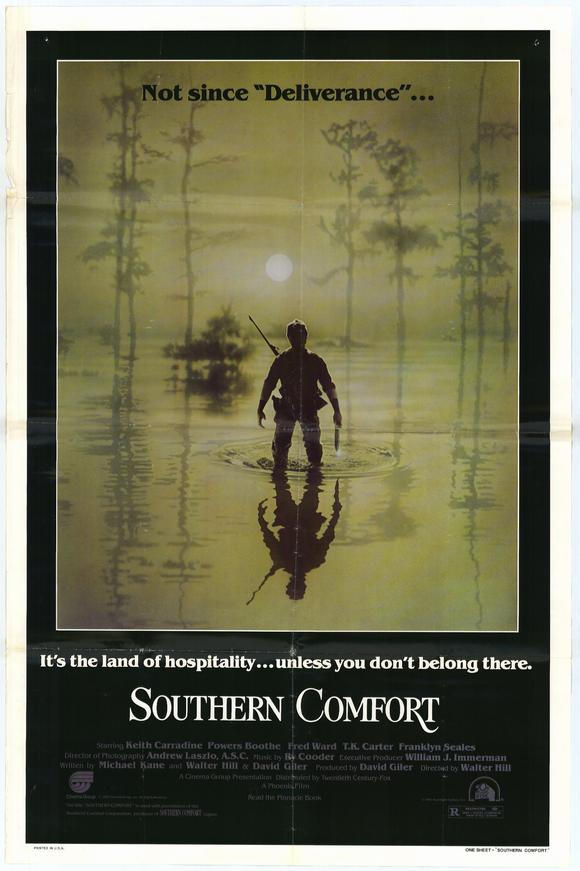
Southern Comfort (1981)

By Richard Winters

My Rating: 4 out of 10

4-Word Review: Watch out for Cajuns.

A National Guard unit goes on a training exercise in the Louisiana swamps and finds themselves fighting for their lives from a group of vindictive Cajuns that lurk in the woods.

Just about all the characters are obnoxious, unlikable, and incredibly ignorant. These guys have to be the most undisciplined and poorly managed guard unit out there. It becomes like a comedy of errors and one almost begins to side with the Cajuns. The suspense ebbs and flows poorly and most of the time there is no tension at all. The final sequence takes too long to play out until you end up not caring what happens. It would have been better had the Cajuns not been so hidden and given a face and some distinction. It also would have been a better atmosphere had the story taken place in the summer instead of the winter. The film though is really hurt by the fact that it is too reminiscent of Deliverance which is a better film simply for the fact that it created a more lasting eeriness. Also, the sequence involving the killing and gutting of what looks to be a wild hog is just about as gruesome and graphic as the infamous turtle killing scene in Cannibal Holocaust.

On the positive side there is one good scene involving a very intense attack by a group of vicious dogs as well as a nicely photographed knife fight between actors Powers Booth and Fred Ward. The Cajuns are portrayed as being more cunning and clever than in Deliverance, which makes this a little more of a slick thriller. Ward is very good in his role as one of the surly soldiers and Keith Carradine is surprisingly engaging in his part.

Ultimately this is a grade C Deliverance that despite some good attempts just never comes together. It would be best to just watch the original and avoid this one completely.

My Rating: 4 out of 10

Released: September 25, 1981

Runtime: 1Hour 46Minutes

Rated R

Director: Walter Hill

Studio: EMI

Available: VHS, DVD

Shoot (1976)

By Richard Winters

My Rating: 2 out of 10

4-Word Review: Hunters out for revenge.

Rex (Cliff Robertson) is a man who really enjoys hunting and especially likes his guns, just watch the way he cleans and caresses it at the beginning, it’s almost obscene. He takes his buddies out on a hunting party in the woods. They come upon a group of other hunters and for some inexplicable reason they begin shooting at each other until one of the men in the other party dies. Rex and his group go back home sure that the police will be contacted and an investigation to pursue, but that doesn’t happen, so Rex thinks they are out for revenge instead. He becomes convinced that the other party plans to attack his group at the exact same spot the very next week. He gets his men ready for battle and dressed in army gear as they prepare for what they believe will be all out warfare.

Part of the problem with this film, which is based on the novel by Douglas Fairbairn, is that it doesn’t make any sense. Rex and his buddies meet the other party from across the river and then the two groups proceed to just stand there in silence like zombies before all the shooting breaks out. There is no reason for why any of it happens and I found it hard to believe this could ever occur in real-life. I am not a hunter myself, but I presume different hunting parties come into contact with each other all the time and it doesn’t end up with them trying to kill each other. I would also think that they may politely greet each other and share some sort of brief conversation in passing. Having all the men not say anything seemed odd and unfounded. The story would have made more sense had the groups spoken to one another and then somebody said something that was insulting and then it escalated. Doing it the way it is done here seems stupid and it is hard for any viewer to get into the plight of characters when there is no reasonable motivation.

The logic for the second half of the story works just as strangely. There is absolutely no reason to believe that the other hunters are planning any type of revenge at the same spot for the next week. The men don’t even know who any of them are. It would have worked better had the other group sent Rex’s group some sort of threatening message, or harassed them in some way to make the threat more real. Watching them prepare and discuss at length for a battle that may never occur is a waste not only of their time, but the viewers as well.

In between there is a long, boring middle part, which includes a scene where Rex visits the widow (Kate Reid) of the man that his group shot while under the pretense that he was an old friend of the deceased. Reid gives an interesting performance, but having her come on to Rex so shamelessly and even tells him that she wasn’t wearing any underwear seemed absurd and unnecessary. A similar scene happens in Rex’s office when the wife (Helen Shaver) of one of his friends aggressively flirts with him as well. Neither of the scenes helps propel the story, or characters and just another clue of a sloppy and unfocused script. There are a few too many shots exposing the boom microphone making me wonder if director Harvey Hart was only going through the motions on this one.

Robertson and Ernest Borgnine as Rex’s friend Lou are adequate, but the characters are painted in one-dimensional ways. The hunters are portrayed as violent prone loons with a penchant for shooting at anything and unable to display any type of sophistication, or rationale. The ultimate anti-gun, anti-violence message is heavy-handed and predictable. This was a trendy theme during the 70’s, but there had been so many better films on the subject that the producers shouldn’t have even bothered to make this one.

The on-location shooting in Ontario, Canada is poorly done. The buildings used for the interior scenes are dull and unimpressive with no visual style or sense. The outdoor scenes are flatly shot and done in the dead of winter, which gives the film a very brown, gray, and drab look. It would have been better had this been done in the summer as the green foliage would have been more scenic. There is also the issue of snow cover. On the first Saturday during their initial hunting trip there is no snow, then on the following Tuesday when Rex visits the grieving widow of the man that they shot there is a good six inches of the white stuff. Then on the following Saturday when they meet in town to get ready for their trip the snow is all gone only to again appear when they get to their hunting site.

I did like the solo trumpet soundtrack although it gets overplayed. The unexpected violent ending is indeed a surprise, but only helps in creating more loopholes. This was another attempt at cashing in on the success of Deliverance by coming up with a similar theme, but lacking the superior execution of the original. Another Deliverance-rip-off that came out in the 80’s Southern Comfort will be reviewed on Monday.

My Rating: 2 out of 10

Released: May 28, 1976

Runtime: 1Hour 39Minutes

Rated R

Director: Harvey Hart

Studio: AVCO Embassy Pictures

Available: YouTube