Category Archives: British Movies

Laughter in the Dark (1969)

laughter in the dark

By Richard Winters

My Rating: 6 out of 10

4-Word Review: Man obsesses over teen.

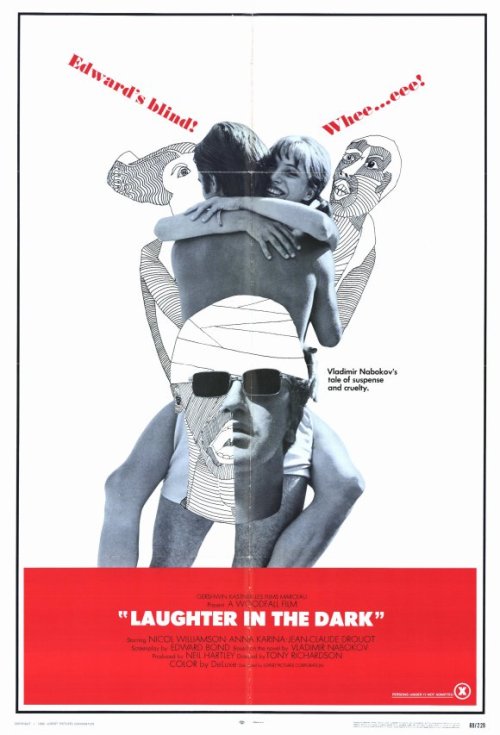
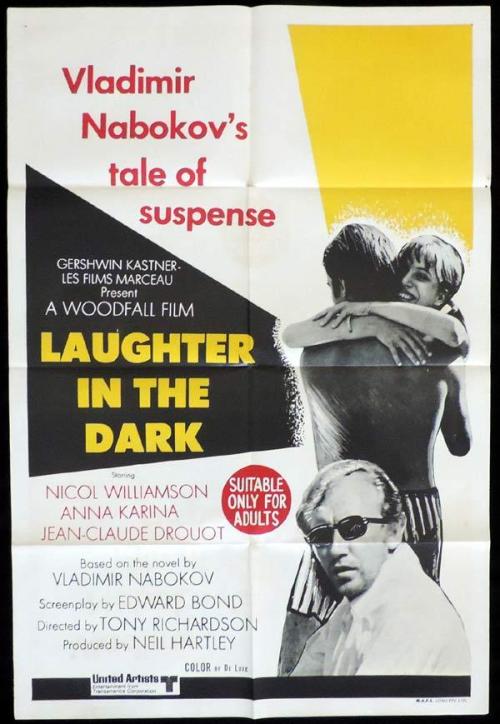
This film is based on an early novel by Vladimir Nabokov, who is more famous for writing Lolita and the story here has a similar theme to that one. The plot revolves around Edward (Nicol Williamson) who is a successful middle-aged art curator, but bored with his marriage and looking for an escape. While watching a film inside a theater one day he spots the beautiful Margot (Anna Karina). While she is only 18 he becomes madly obsessed with her and tries to start-up a relationship. She initially resists, but then realizes that he has a lot of money and decides to play-him. On the side she has a passionate relationship with Herve (Jean-Claude Drouot) who begins to work for Edward as his assistant. Initially Edward has no clue that Herve and Margot are cavorting around behind his back, but eventually he catches on and plots a dark revenge only to find himself as the victim.

While the story has its share of intriguing moments it suffers from featuring a main character that is not relatable.  Fantasizing about having sex with a beautiful, younger woman is fine, but he shouldn’t expect her to automatically reciprocate those same feelings and even if she does he should be concerned that it is only because of his money, which are thoughts that he never once seems to consider. He also spouts out right from the beginning of how much he ‘loves’ her like a lovesick 14-year-old, but a man his age would normally be wise enough to realize that there is a big difference between that and sexual attraction, which is all that this really is.

It also takes way too long for Edward to catch on to the affair occurring between Herve and Margot even though anyone else would’ve seen the red flags a mile-away. It is for these reasons and the way he gets taken advantage of time and again that makes the character come off as suffering from some serious mental defect that is not in any way a normal for even a halfway intelligent person.

It all would’ve worked much better had Richard Burton remained on as the film’s star. He was the original choice for the part and even filmed a few scenes before being kicked off the project due to repeatedly showing up drunk. Williamson is a fine actor and has an impressive resume, but he’s rather benign here while Burton would’ve been able to bring in an extra dimension and because he was older would’ve made the contrasting age difference between him and Margot even stronger.

Karina on the other hand is stunning and an absolute beauty to behold. She was much older than what the part called for, but her wicked, conniving performance more than makes up for it as she eats up every scene that she is in and everyone else in it.

It was filmed on the island of Majorca, which allows from some exotic Mediterranean scenery and Raymond Leppard’s harpsicord soundtrack is pleasing. I also, for the most part, enjoyed the story, which manages to remain intriguing all the way up until its unsatisfying conclusion. The drama though, particularly at the beginning, is clumsy and the whole thing ultimately comes off as a good director’s weakest work.
laughter in the dark 2

My Rating: 6 out of 10

Released: May 11, 1969

Runtime: 1Hour 44Minutes

Rated X

Director: Tony Richardson

Studio: Lopert Pictures Corporation

Available: None at this time.
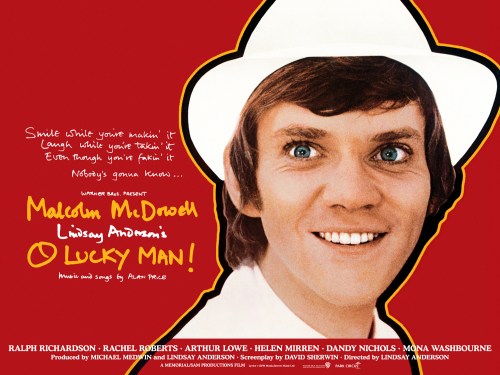
O Lucky Man! (1973)

o lucky man

By Richard Winters

My Rating: 9 out of 10

4-Word Review: A young man’s journey.

Mick (Malcolm McDowell) is a wide-eyed young man entering into the adult world and full of Horatio Alger-like illusions of working real hard and becoming insanely rich while doing it. His first job is as a coffee salesman where he is told that ‘the-sky’s-the-limit’ in regards to his earning potential, so with the carrot-on-the-string firmly in place he dives into it, but ultimately finds little to show for it. He then meets up with a rich tycoon ( Ralph Richardson) and essentially becomes the man’s lapdog assistant only to learn that this doesn’t work either. After spending time in jail he comes back out into the world as a ‘reformed’ man extoling on the idealistic virtues of humbleness only to again meet with aversion and failure.

The film, which is based on an original idea by McDowell, is essentially a broad look at society’s many socio-economic class levels and how easy it is to fall down it, but hard to move up. Some consider Glengarry Glen Ross to be the bleakest indictment on the sales profession, but having worked in the business when I was like the character here first getting out into the working world I can say that this one is even more searing and accurate.

On a wider scope the film successfully works as a critical statement on capitalism, which due to the purveying political climate of the day most American audiences are just now ready to catch up to. Mick’s journey is more his eventual disillusionment as he slowly realizes that being a ‘go-getter’ and having a ‘good attitude’ isn’t going to be enough as the system is rigged so that the individual is more likely to lose than win and can’t really function otherwise. His efforts then become exploited while helping to make someone else richer as he tolls in the bottom rung doing lateral moves into areas that have potential promise, but only produce the same results.

Although the character’s perpetual delusions of grandeur become a bit annoying McDowell plays the part well. The intent was for him to play against type from the one that he did just previously in A Clockwork Orange by portraying someone who is clean-cut, respectful and obedient, but with all the transitions that the character goes through and at one point even having him strapped to a chair in much the same way that he was in the Kubrick film it eventually comes off more like a continuation of that part than a completely different one.

The fun of watching the film is seeing the supporting cast playing dual roles. Arthur Lowe is great especially in the part where he gets put into heavy black make-up to play the leader of a fictitious foreign nation. Rachel Roberts is good too with the erotic scene where she transfers coffee from her mouth into McDowell’s and then later as a poor woman who commits suicide, which has a foreboding quality to it since Roberts ended up doing the same thing five years later in real-life.

Fans of Helen Mirren will enjoy seeing her when she was much younger and playing the part of a rebellious daughter. I also liked the way Alan Price and his band fits into the film. They do the movie’s soundtrack, which is quite good, but instead of having their music played over the action the movie cuts away and captures them doing their renditions inside a sound studio, which in any other case would be considered distracting, but here helps accentuate the film’s  already cerebral tone. It’s also amusing how the band ends up becoming a part of the story as the McDowell character almost gets hit by their van, which allows the opportunity for Price to say the film’s best line “Are we suing you, or are you suing us?”

The film is full of many surreal and original moments and is so consistently inventive that you hardly notice its three hour runtime. However, to me the best part about it is the way it attacks and criticizes the status quo, which is something that no Hollywood movie ever does.

My Rating: 9 out of 10

Released: March 26, 1973

Runtime: 2Hours 58Minutes

Rated R

Director: Lindsay Anderson

Studio: Warner Brothers

Available: DVD, Amazon Instant Video, YouTube

Steaming (1985)

steaming

By Richard Winters

My Rating: 2 out of 10

4-Word Review: Saving a steam room.

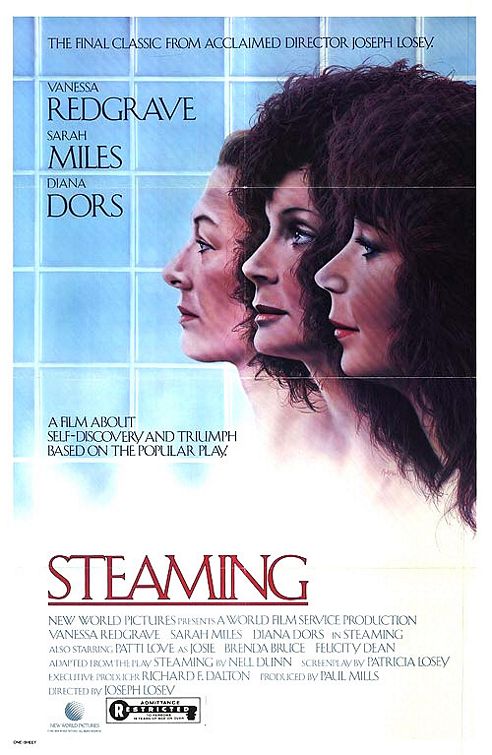
Three women (Vanessa Redgrave, Sarah Miles, Patti Love) congregate at a London steam room designed like a Turkish bathhouse. Despite their lifestyle differences they become good friends as they divulge their problems to one another and learn to lean on each other to help them cope with life’s difficulties. Then one day Violet (Diana Dors), who is the bath house owner, informs them that the place is set for demolition, which causes everyone to go on a mission to try and save it.

The film is based on the Nell Dunn play, which was highly regarded at the time, but makes for a very poor transfer to film. It starts out flat and never recovers. The dialogue has too much of a conversational quality that is not interesting and the problems that they discuss are not compelling, or original. The humor from the play is missing and the dry, somber tone only makes things even more boring. The only time it gains any traction is when it’s announced that the place is closing, but everything gets resolved in such a sitcom-styled way that it hardly seems worth the effort to watch.

The entire cast is made up of women and there is an abundance of nudity particularly from Miles, which doesn’t seem like a big deal these days. The biggest issue though is the fact that everything takes place from inside the bath house, which is gray, grimy, and rundown. The film should’ve had some segments shot from different locales if to only allow for some visual variety and to help the viewer understand the characters better by seeing how they react in different social settings.

Miles and Redgrave are wasted in drab roles and this goes likewise for Dors whose last film role this was. Love is the only one that shows any liveliness and although her character is a bit annoying she at least has an emotional breakdown near the middle, which adds some mild dramatic tension.

Joseph Losey was a competent director who made many interesting films, so it’s a shame that his career had to end with such a dud. He was already sick with cancer while he filmed this and like with Dors died a year before it was released. The disease may have sapped his creative energy and explain why this production is so ponderously sterile. It’s certainly a far cry from his other works as well as the Bruce Jay Friedman play Steambath, which had a similar setting, but a much more imaginative plotline.

My Rating: 2 out of 10

Released: September 28, 1985

Runtime: 1Hour 31Minutes

Rated R

Director: Joseph Losey

Studio: New World Pictures

Available: DVD (Region 2)

One Way Pendulum (1965)

one way pendulum 1

By Richard Winters

My Rating: 4 out of 10

4-Word Review: An absurd little movie.

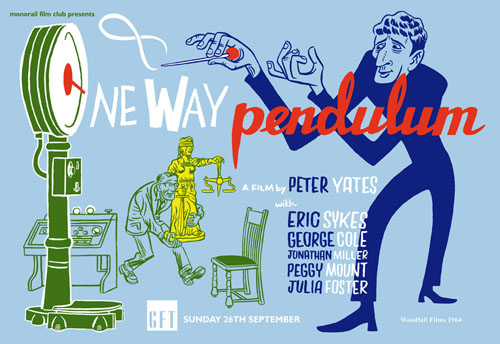
The Groomkirby family is one really absurd bunch. The father (Eric Sykes) wants to build a replica of the Old Baily courtroom in his living room and then have a trial, involving his son Kirby (Jonathan Miller) as the accused, reenacted. His daughter Sylvia (Julia Foster) wishes that she were an ape so that her arms would be longer and discusses this at length with her mother (Alison Leggatt). Kirby steals weight machines, which voices the person’s body weight, off the city streets and brings them back to the family’s attic were he then converts them into machines that sing. There’s also Aunt Mildred (Mona Washbourne) who thinks she’s waiting for a train that never comes as well as Mrs. Gantry (Peggy Mount) who’s paid to come over and eat the family’s unwanted leftovers.

The film is based on the stage play of the same name written by N.F. Simpson and was labeled as being ‘A farce in a new dimension’. John Cleese is purportedly a big fan of the movie and credits it as inspiring many of the absurd ideas that they used in their later Monty Python sketches. It was also directed by Peter Yates who went on to direct such quintessential hits as Bullitt, Breaking Away, and Year of the Comet.

The film certainly does have its share of funny and highly original moments. One of my favorite scenes is where the father carts the props that he needs to build his courtroom down a busy street of London using nothing but a wheel barrow and holding up traffic while he does it. Kirby’s ability to make the weight machines sing and sound like a genuine chorus is fun also as well as the climactic courtroom segment in which a myriad of comically absurd arguments, testimony, motions and reasoning is used until it becomes almost mind bending.

Unfortunately it all gets just a little too weird. Normally I’m a fan of the offbeat, but there still needs to be something to anchor it down and this film lacks it. The dialogue, characters and storyline are so progressively strange that it becomes downright nonsensical. The court case loses its edge as well because the father is somehow able to recreate it and the people in it in some magical way using a machine where kidnapping a magistrate and lawyers and forcing them perform in their makeshift court of law would’ve been funnier.

The movie will certainly satisfy those with inkling for the offbeat and the film seems intent to push the absurdity as far as it possibly can with a cast primed to pull it off, but it ends up being too weird for its own good and parts of it are confusing and hard to get into.

My Rating: 4 out of 10

Released: March 2, 1965

Runtime: 1Hour 20Minutes

Not Rated

Director: Peter Yates

Studio: United Artists

Available: None at this time

The Wicker Man (1973)

the wicker man 1

By Richard Winters

My Rating: 8 out of 10

4-Word Review: Pagans on an island.

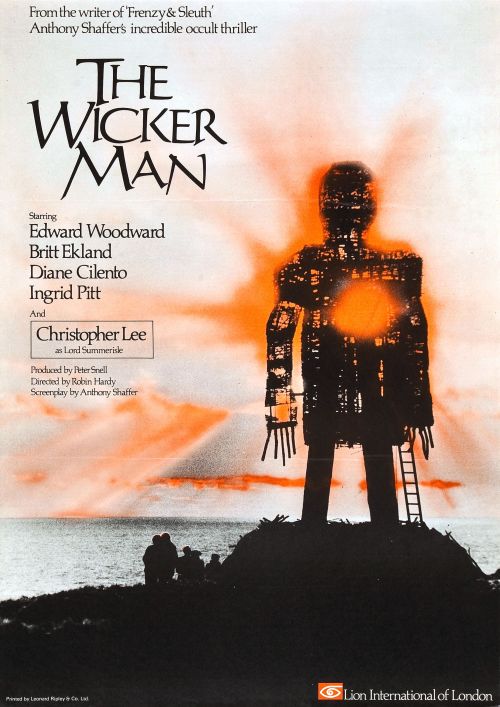
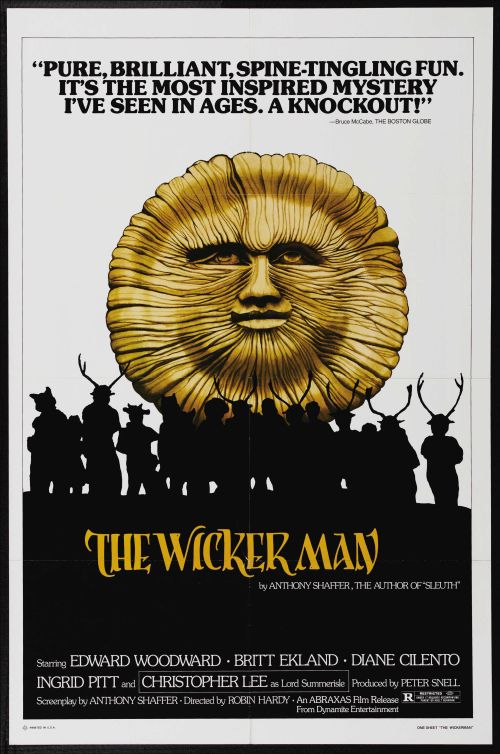
Police sergeant Howie (Edward Woodward) receives a letter stating that their daughter named Rowan Morrison (Gerry Cowper) has disappeared and it compels him to travel by plane to an obscure island village off the coast of Scotland to find her. Once he arrives he finds nothing but resistance from the people and everyone denying that she even exists. He also learns that the people practice a pagan type of religion and begins to suspect that the girl’s disappearance may have something to do with the upcoming harvest celebration and decides to infiltrate the proceedings in order to weed-out the culprits and find the girl.

The film, which was inspired by the 1967 novel ‘Ritual’ by David Pinner, manages to be quite intriguing despite being material better suited for a short story. The whole concept is woven around the big twist that occurs at the end and everything that occurs beforehand is simply a lead up to that, which could’ve been a stretch for feature length but director Robin Hardy’s tight editing and deft use of atmosphere keeps things permanently lodged in the creepy and compelling even though I did figure out at around the 60 minute mark where it ultimately was headed. The film’s original length is supposedly longer than the 1Hour 28Minute release that is currently available, but to be honest I felt this was a perfect runtime for this type of story and stretching it out further would’ve simply been diluting it.

Edward Woodward, who later became familiar to American audiences with his starring role in the TV-show ‘The Equalizer’, is terrific in the lead and I liked that fact that the character wasn’t a completely ‘nice guy’ either, but instead rigidly entrenched in his Christian religious beliefs and arrogantly convinced that his spirituality was superior to anyone else’s. Christopher Lee again makes a good nemesis even though his mod hair style looks a bit goofy. Britt Ekland is on hand as well singing a weird song and even doing a provocative dance although the nude scenes of her from the waist down were done by a body double.

the wicker man 2

The only issue that I had with Anthony Shaffer’s script is the fact that the sergeant must go back to the mainland to get more men from the force to help him search for the girl, which to me was a bit of a loophole because I would think he could’ve just gotten on a phone and called in for more backup without arduously having to travel back. The facts that no one else knows where he is seemed a little implausible as well as most people working on the force have a supervisor that they must report to and who is at least somewhat aware of what case they are working on and where they are traveling to do it.

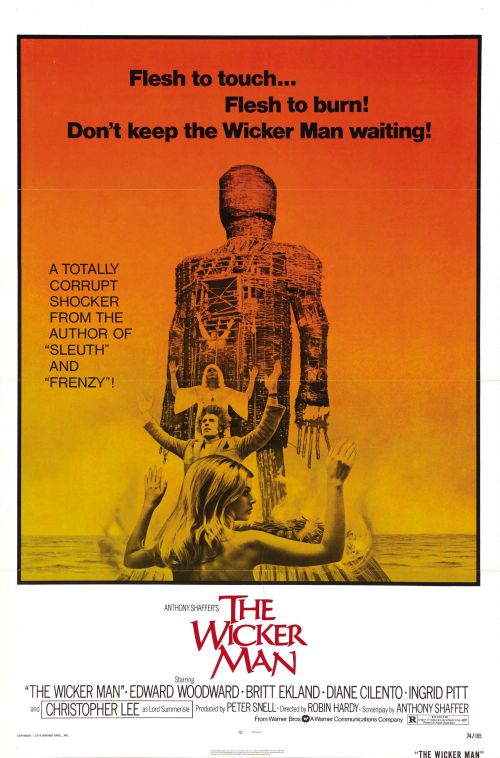
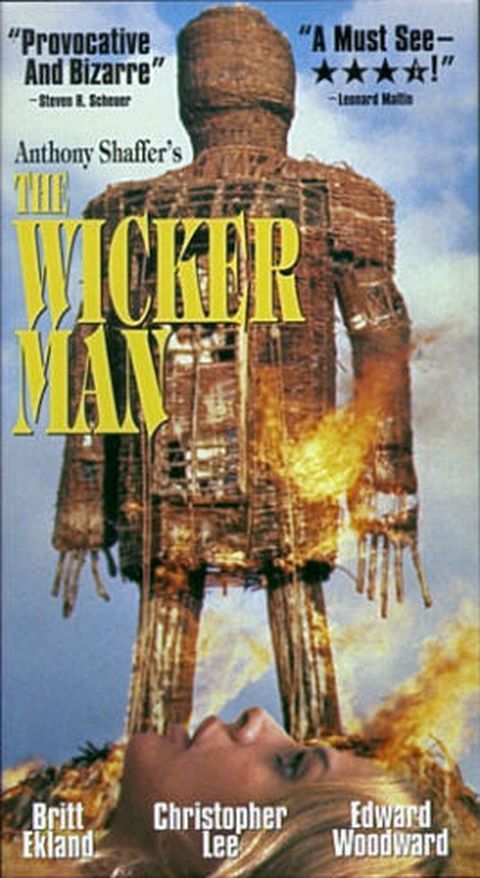
The ending though, which features an actual giant wicker man made of wood is an amazing site. When it gets set on fire with the victim and even some animals trapped inside of it is quite exciting and I liked how the point-of-view shifts between the people who view it from the ground as well as the victim seeing the people on the ground from inside the burning structure.

I remember seeing the 2006 remake starring Nicholas Cage in the theaters. While the details of it are vague I do recollect coming away from it finding grossly inferior in literally every way to this one and something that should be avoided at all costs.

the wicker man 3

the wicker man 4

My Rating: 8 out of 10

Released: December 10, 1973

Runtime: 1Hour 28Minutes

Rated R

Director: Robin Hardy

Studio: British Lion Film Corporation

Available: DVD, Blu-ray, Amazon Instant Video, YouTube

Nicholas and Alexandra (1971)

nicholasandalexandra1

By Richard Winters

My Rating: 9 out of 10

4-Word Review: The last Russian Tsar.

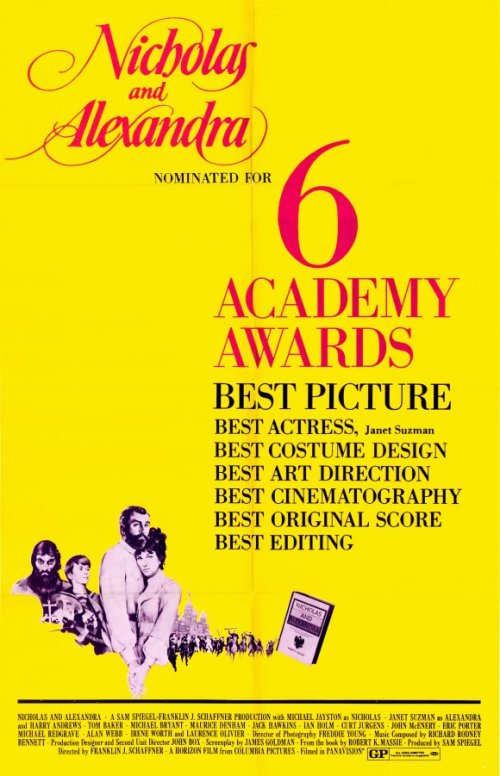
This film chronicles the life of Tsar Nicholas II (Michael Jayston) of Russia and his marriage to Alexandria (Janet Suzman). Based on the novel by Robert K. Massie it examines the height of his power and his apathy to the poverty of his people and his reluctance to listen to their needs, or consider a more democratic form of government. It also looks at his personal life including the birth of his son Alexei (Roderic Noble) who is diagnosed with hemophilia and his wife’s over-reliance on Grigori Rasputin (Tom Baker) a man pretending to have divine connections who ultimately uses his influence on Alexandra to take control over her political affairs when her husband is away. The film also portrays Russia’s involvement during WWI as well as the Tsar’s downfall and eventual exile in Siberia with his family.

The film is basically split up into three parts with the first hour looking at Nicholas’ family life while intercutting with scenes showing the discontent of the Russia people and the efforts of Vladimir Lenin (Michael Bryant) to create a revolutionary form of government. The second hour examines Russia’s war involvement and the many warnings that Nicholas is given not to get involved in it, but foolishly decides to anyways, which ultimately creates massive upheaval. The third hour looks at his abdication of power and the family’s exile and virtual imprisonment at the Ipatiev House in Yekaterinburg where they nervously await their fate.

Initially I thought the third hour would be the weakest as we all know they get shot and killed execution style, but to my surprise it is actually the strongest part of the film. To an extent tearing the characters away from their plush surroundings and forcing them to exist in bleak, squalor-like conditions actually humanizes them and allows the viewer to empathize with them particularly the four daughters who had nothing to do with their father’s harsh policies and just wanted a chance to grow up and live a normal life. The scene where the family is herded into the basement of the home in the early morning hours and forced to sit silently while awaiting their executioners is quite possibly one of the most intense moments ever captured on film.

The performances are uniformly strong particularly Suzman’s as well as Baker as the evil Rasputin who’s drawn out death scene may be one of the longest in movie history. Laurence Olivier in a small, but pivotal bit as the Prime Minister gets two commanding moments including his speech after the Bloody Sunday massacre and later his strong misgivings about the country’s war involvement.

The film is full of brilliant cinematography, direction, costumes and set pieces and is certainly something that must be watched on the big screen to be fully appreciated. I enjoyed the lavish interiors of the Winter Palace especially their walks down the elegant hallways that are lined with Royal guards, but found it equally interesting when Nicholas returns there after the war and forced to walk down these same hallways, which are now darkened and rundown. The many long distance shots of the flat and majestic landscape is also impressive particularly a view of a rolling sunflower field.

Although this film has never attained the well-known classic status of Doctor Zhivago, and in fact this was producer Sam Spiegal’s answer to that film when he was blocked from working on it, I still found it to be every bit as compelling and well directed.

My Rating: 9 out of 10

Released: December 13, 1971

Runtime: 3Hours 8Minutes

Rated GP

Director: Franklin J. Schaffner

Studio: Columbia Pictures

Available: DVD, Blu-ray, Amazon Instant Video


A Zed & Two Noughts (1985)

zed 3

By Richard Winters

My Rating: 6 out of 10

4-Word Review: They’re really into decay.

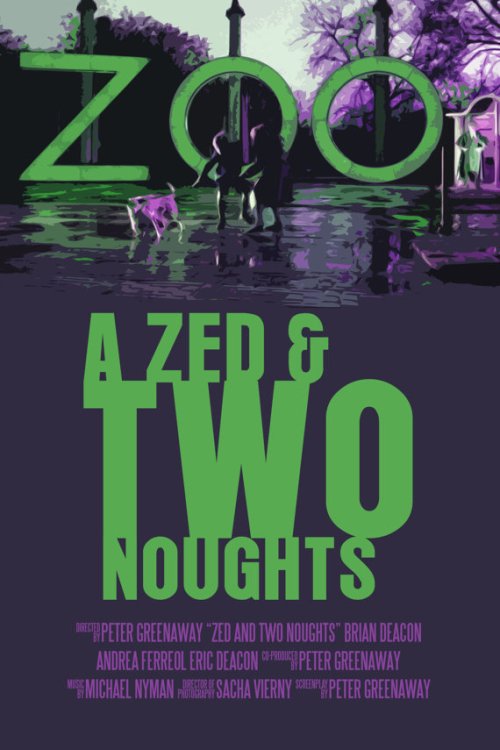
Oswald and Oliver (Brian and Eric Deacon) are twin brothers working at a zoo who become devastated to learn that both of their wives have died in the same freak accident in a car driven by Alba (Andrea Ferreol) who survives, but without her leg. Initially the brothers’ are angered with her, but this slowly grows into a strange attraction, which eventually forms into a ménage a trois. To help with their grief they begin doing time-lapse photography of the decaying process. They start with dead animals before deciding on a human subject with Alba as their chosen ‘star’.

From a completely visual level this film can be considered a great success. This was the first of ten projects that Director Peter Greenaway and cinematographer Sacha Vierny collaborated on and the result is stunning. The vivid contrasting colors, lighting and symmetrically designed sets make each and every shot look like its own painting. This is also one of the few films that completely transcend its era. Usually one can tell what decade a movie is from by watching it for only a few minutes, but this film is unlike any other ‘80s movie made, which is an achievement unto itself.

The best part of the movie is its depiction of the real-life decaying process captured in time-lapse form. I realize this may sound extremely morbid and ‘sick’, but it’s a natural process of the world we live in and if taken from a purely scientific perspective quite an interesting and fascinating phenomenon to watch. It gives the film a unique one-of-a-kind edge and something I wished had been shown even more.

The film’s drawbacks are the characters that come off as too weird and twisted, which is an issue in a lot of Greenaway’s movies that are always technically brilliant, but lacking in emotion or empathy. A good movie, no matter how ‘artistic’ it may be still needs relatable characters to help propel it and instead this movie has what amounts to mouth pieces in disguise as people who are simply used to relay a concept, but in no way connected to anyone you’d ever meet in real life. This results in leaving the viewer cold and making the film more of an ‘Avant-garde experiment’ than an actual story.

My Rating: 6 out of 10

Released: October 4, 1985

Runtime: 1Hour 55Minutes

Not Rated

Director: Peter Greenaway

Studio: British Film Institute

Available: VHS, DVD, Blu-ray

The Leather Boys (1964)

leather boys 1

By Richard Winters

My Rating: 6 out of 10

4-Word Review: Befriending a gay biker.

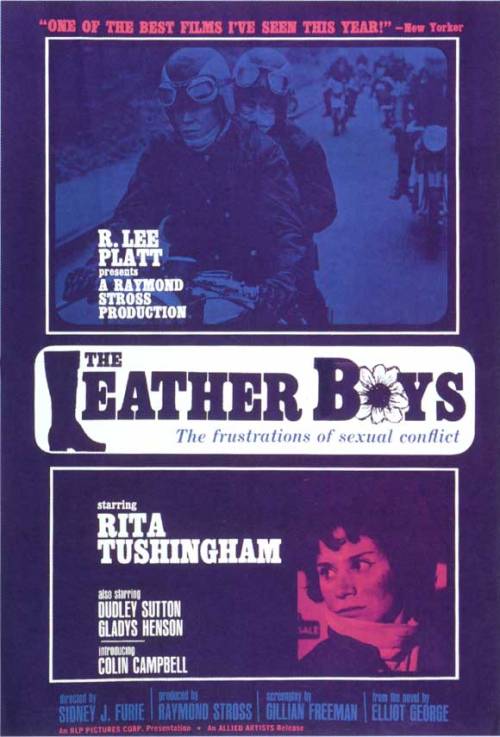
Reggie and Dot (Colin Campbell, Rita Tushingham) are young and in love, at least they think they are. They want to rush off and get married, but Reggie’s father (Lockwood West) feels that they ‘don’t know the meaning of the word’ and he gets proven right as immediately after they tie the knot they are at odds with each other. Reggie begins looking for companionship elsewhere and meets up with a fellow biker named Pete (Dudley Sutton). Pete and Reggie quickly become best friends and begin hanging out together, but Pete is secretly gay and has more of an interest in Reggie than just a friendship.

Director Sidney J. Furie, whose career has now spanned 6 decades, has done a lot of duds in his time, but this isn’t one of them. The stark black-and-white photography helps bring out the bleak working class existence of the characters and the variety of locales used including a nicely captured cross country motorbike race make the story captivating and believable.

The performances are outstanding. Tushingham is especially good at displaying a genuinely nasty side to her character at the most unexpected times. Gladys Henson, who plays the widowed grandmother, is also excellent and the scene where the others argue while right in front of her about how they consider her to be ‘an elderly inconvenience’ who needs to be sent away to a retirement home is downright heart wrenching. Sutton though is the most dynamic in a risky role that helped jettison him to stardom. His distinctive facial features galvanize the viewer’s attention and the ambivalent expressions that he makes particularly when in the presence of Dot are priceless.

Spoiler Alert!

The film though takes too long to get to its obvious conclusion as we have a pretty good idea from the beginning that Pete is gay, so having to wait until the very end for this to finally get revealed seems to be stretching the story out longer than necessary. Most likely Pete would’ve made some sort of pass at Reggie at some point earlier anyways especially since the men shared the same bed. The film also ends with Reggie walking away from Pete and essentially ‘abandoning’ him once he realizes that he is gay. The music that is played over the scene conveys the idea that this is the ‘right’ thing to do and parlays the conventional attitude of the time that there is something ‘wrong’ with Pete, which doesn’t make this as much of a landmark movie as it’s widely considered since its ultimate message is still entrenched with the biases and bigotry of that era.

End of Spoiler Alert!

My Rating: 6 out of 10

Released: March 8, 1964

Runtime: 1Hour 48Minutes

Not Rated

Director: Sidney J. Furie

Studio: Allied Artists

Available: DVD, Amazon Instant Video


To the Devil a Daughter (1976)

to the devil a daughter 1

By Richard Winters

My Rating: 6 out of 10

4-Word Review: He sacrifices his daughter.

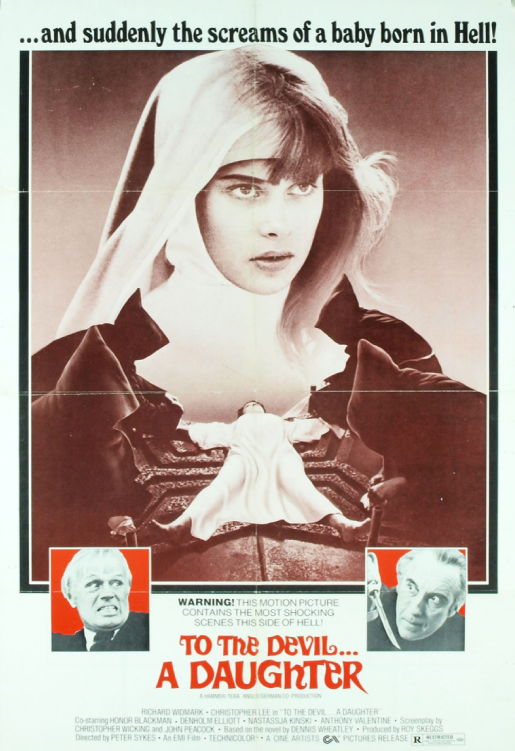
Father Michael (Christopher Lee) is an ex-communicated priest who runs an offshoot religion called Children of the Lord that seems connected to the Catholic Church on the outside, but underneath the façade it is actually a cover for a group of Satanists. Henry (Denholm Elliot) is the father who signs over his daughter Cathrine’s (Nastassja Kinski) soul at her birth which stipulates that on her 18th birthday she will become the devil’s representative here on earth. Yet as that date approaches Henry begins to have second thoughts and hires occult novelist John Verney (Richard Widmark) to steal Catherine away from her captors and take her away to his place to hide, but Father Michael uses the power of black magic to hypnotize Catherine and force her to return to him while John tries everything in his power to stop it.

One commenter on the IMDB message boards claims this is ‘one of the worst movie to come out in the 70’s’, which only proves that he must not have seen a lot of ‘70’s movies as there is far worse stuff from that decade than this. Although it is certainly no classic it’s still not bad on the technical end and even rather slick. I enjoyed the on-location shooting done in Europe particularly the scene showing a drawbridge that could be lowered and raised manually by one person. The gore and scares are skimpy, but the scene where Kinski dreams of having the devil fetus crawl up her body and she then proceeds to stuff it into her vagina is certainly worth a few points.

Kinski’s presence is the best thing about the movie and the film became notorious in its day for showing her in full frontal nudity even though she was only 14 at the time. However, what surprised me even more was how confident she looked when she did it without any of the expected nervousness or shyness. I felt that because she was the daughter of actor Klaus Kinski and had to learn to group up fast she had a higher level of maturity than most other teens her age and therefore the scene wasn’t as awkward for her as it might otherwise have been.

Lee’s great as always as the bad guy and I particularly enjoyed his facial expressions. However, Widmark  was miscast as he was too old and I didn’t understand why being only a friend of the family he would take such an invested interest in their daughter and such personal risks to get her out of the cult, which I felt would’ve been better suited to the role of the father and cutting out the Gurney character altogether.

This was the last horror film to be produced by Hammer and for the most part it plays like a cheesy rip-off of The Exorcist, but still has enough of a budget and a capable enough cast to keep it mildly enjoyable.

My Rating: 6 out of 10

Released: March 4, 1976

Runtime: 1Hour 28Minutes

Rated R

Director: Peter Sykes

Studio: Hammer Films

Available: DVD, Amazon Instant Video

Village of the Damned (1960)

village of the damned 2

By Richard Winters

My Rating: 6 out of 10

4-Word Review: The eyes have it.

Remade in 1995 and based on the John Wyndham novel ‘The Midwich Cuckoos’ the story centers on a small English village where one day everyone mysteriously falls asleep for several hours while under the spell of some invisible, odorless gas. When they awaken everything seems normal, but later on all the women become pregnant, even those that were not married or were still virgins. When the babies are born they are found to be different from their human counterparts as they have a higher intelligence, odd shaped heads and bright blonde hair. Later on these same children gain the ability to read other people’s minds and dispose of those that they don’t like penetrating them with the spell of their glowing eyes. As the rest of the village panics one man (George Sanders) feels that he may have the ability to stop them, but only if he can somehow control his own thoughts, so they won’t be able to tell what he is actually up to.

As a sci-fi thriller it’s not bad. The film’s short running time has a nice compact style to it with a story that evolves at a fast pace and continues to add new twists. The special effects for its day are realistic enough to be passable and the violence is surprisingly high. Sanders is effective in the lead and Martin Stephens as the leader of the children is quite creepy.

I found it a bit baffling though that the townspeople wouldn’t have quarantined the strange children from the start as it becomes quite obvious from the beginning that they aren’t normal. Instead they are allowed to roam freely even as they become increasingly more sinister. I would’ve also have thought that some of the mothers who gave birth to these strange beings would’ve disowned them and even refused to take care of them once their unnatural and frightening oddities became apparent.

The ending is frustrating as the film does not supply any answer as to who these kids where and what type of alien presence impregnated the women and why. The movie tells us that other places have been effected with these strange children as well, which leads one to believe that this is only a part of some other more sinister plot with far reaching consequences that never gets tackled. Instead we get left with a short film that acts like a small chapter to a fascinating idea with broad potential variables that unfortunately never gets followed through on.

My Rating: 6 out of 10

Released: July 5, 1960

Runtime: 1Hour 17Minutes

Not Rated

Director: Wolf Rilla

Studio: MGM

Available: DVD, Amazon Instant Video