Category Archives: British Movies

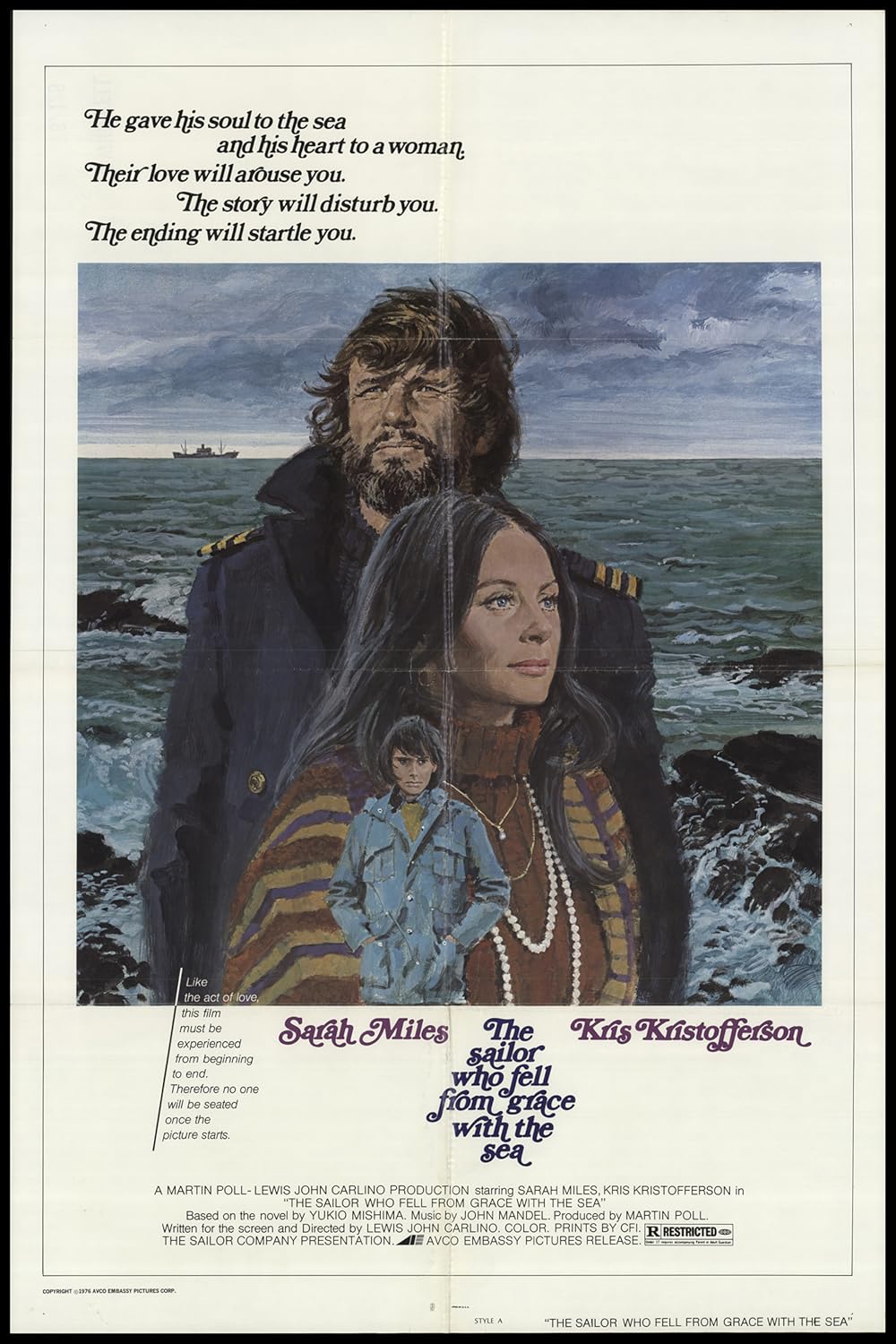
The Sailor Who Fell from Grace with the Sea (1976)

By Richard Winters

My Rating: 4 out of 10

4-Word Review: They dissect a cat.

Jonathan (Jonathan Kahn) is a 14-year-old who lives with his mother (Sarah Miles) and nanny Mrs. Palmer (Margo Cunningham) in a beachfront house along the sea after the death of his father three years earlier. Jonathan enjoys his friendship with a group of boys lead by Chief (Earl Rhodes), but his mother does not approve due to Chief’s anti-social sentiment forcing Jonathan to have to sneak out on the sly to see them. One day Jonathan finds a peep hole in his bedroom wall that allows him to see inside his mother’s bedroom, and he begins to peer in on her when she’s undressed, and this creates an unhealthy arousal. When his mother begins a relationship with a sailor named Jim (Kris Kristofferson) he becomes jealous and conveys as much to Chief who devises a sinister plan to ‘solve the problem’.

Lewis John Carlino had a highly respected career as a screenwriter garnering 4 Academy Award nominations for best screenplay, but his three forays as director weren’t as successful and all started out well but ended up just missing the mark. This one was no exception as many critics at the time felt the problem lay in adapting a novel, that was written by Yukio Mishima, which was set in Japan, and trying to convert it to English society. The cultures differences that make up the complex Japanese society that were so integral to the characters in the book gets completely lost in the translation leaving the viewer feeling cold, detached, and genuinely confused when it’s over.

The on-location shooting filmed in Dartmouth, Devon, England, is excellent and the one thing that helps the movie stand-out particularly the isolated hillside house that gives the atmosphere an almost surreal-like feel. There’s also a really creepy performance by Rhodes who nails it as a highly intellectualized kid who displays no moral compass and effectively comes-off as a very believable young sociopath. However, these moments gets coupled with some very disturbing ones dealing with animal cruelty which includes a very drawn-out scene involving the killing and dissecting of a cat as well as putting a firecracker in a seagull’s mouth and while no animal was actually harmed during the production it still left many audiences at the time upset and will very likely do the same with viewers today.

The film’s biggest flaw though is that it doesn’t interpret the character’s actions in any way that helps makes sense of their motivations and for the most part they’re all quite two-dimensional. Jonathan’s arousal at seeing his naked mother needs much better explaining. Most kids aren’t this way, so what is it about his psyche that causes him to enjoy it without any guilt or shame? The movie gives us no clue, nor does it explain how his father died and when you add in the boy’s weird behavior and you start to wonder if the Jonathan maybe had something to do with it, which would’ve opened an interesting subtext if even brought up subtlety, but the script fails to touch on it.

The book makes the reasons for the son’s actions clearer. For instance in the novel the boy losses respect for the sailor when he sees him jump into a water fountain, which he considers to be undignified and the movie really needed to have some similar moment as the kid, like in the book, is initially in awe of the man, but it’s never totally clear what creates the deadly shift. Also, when the son is caught peeping in at his mom the response by his mother in the book is different as she feels the boy should receive a severe punishment, but the sailor, in hopes of becoming ‘friends’ with the kid whom he’s now helping to raise, resists, but the film flubs this scene too by treating it almost like a forgettable throwaway moment that has no impact versus one that would’ve helped reveal the sailor in a more in depth way.

Spoiler Alert!

The ending, which should’ve been a shocker, falls flat as well. In the novel it’s made clear that the boys plan to drug and dissect the sailor just like they did with the cat and they even bring along the tools to do it, in the movie we only witness him drinking the spiked tea. The camera then zooms way out showing the boys at an extreme distance where it’s not obvious what they’re doing. To really make a memorable impression we should’ve seen the boys stab the sailor several times with their knives, which would’ve been far more startling. I felt too there needed to be a reaction from the mother. Does she find out what they did, or does his violent demise remain a mystery? How does her relationship with her son evolve, or devolve afterwards? These questions remain unanswered making the movie seem less like a story and more as a concept that’s never adequately fleshed out.

My Rating: 4 out of 10

Released: April 5, 1976

Runtime: 1 Hour 45 Minutes

Rated R

Director: Lewis John Carlino

Studio: AVCO Embassy Pictures

Available: DVD, Blu-ray, Amazon Video, Plex, Roku Channel, Tubi, YouTube

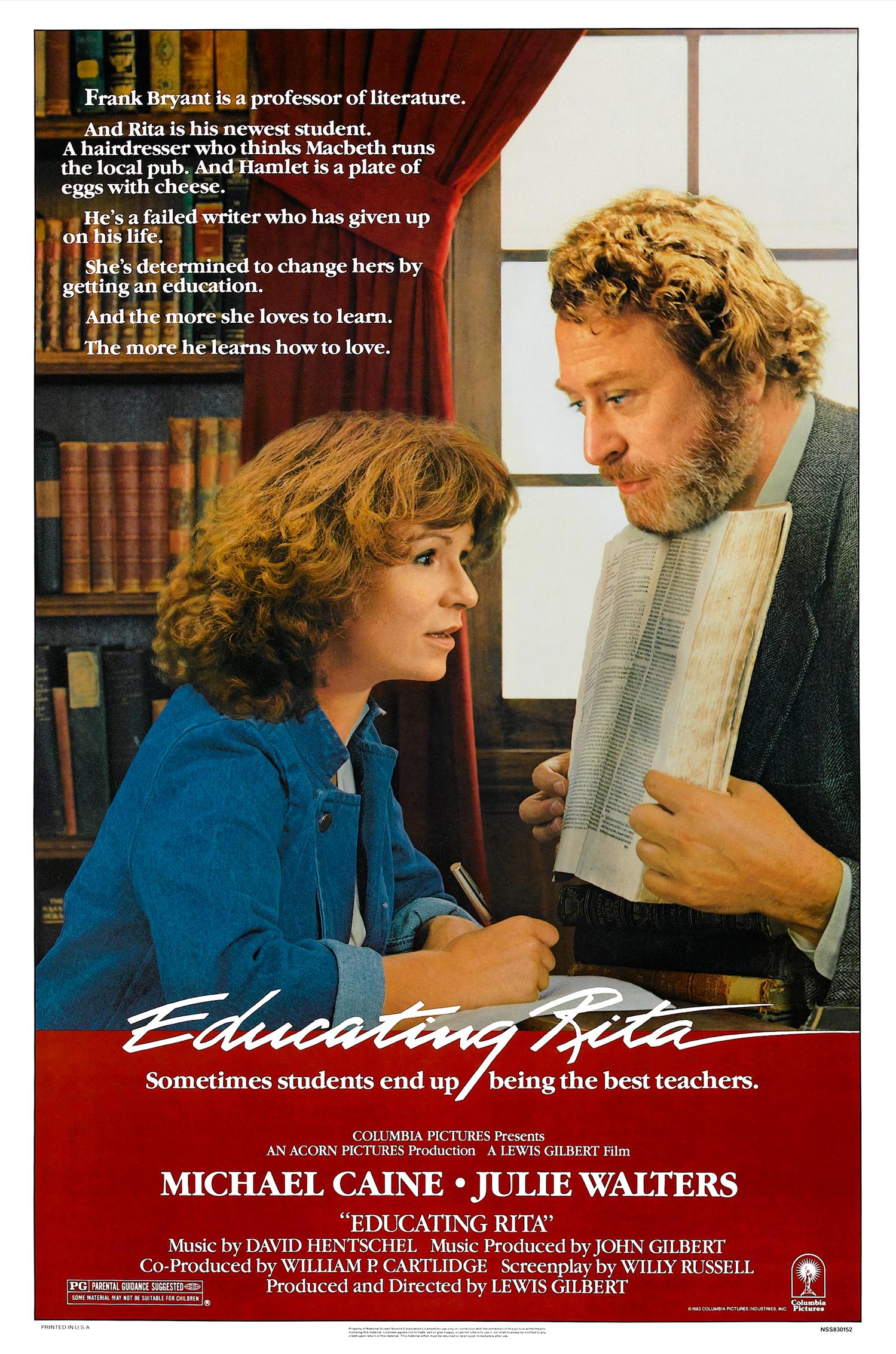
Educating Rita (1983)

By Richard Winters

My Rating: 5 out of 10

4-Word Review: Trying to better herself.

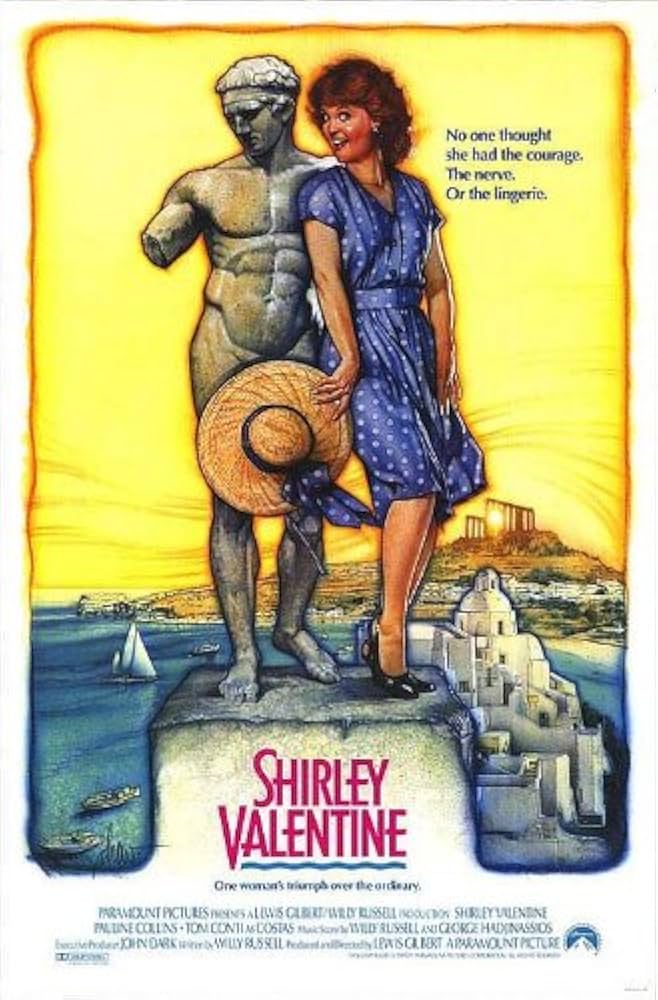
Rita (Julie Walters) is a young working-class woman who finds her job as a hairstylist and marriage to Denny (Malcolm Douglas) to be unrewarding. Denny wants her to have a child, but she fears that will just tie her down more. In an attempt to ‘better herself’ she decides to enroll in Britian’s open university where she takes a course in English literature.  Frank (Michael Caine) is a disillusioned college professor who lost the zeal for his job years earlier and has now taken to the bottle. Rita wants him to be her tutor, but Frank initially resists only to eventually agree. Despite their contrasting personalities the two ultimately form a bond and Frank uses Rita’s passion for learning to reignite his own dormant desires that allows him to breakout of his loveless relationship.  However, Rita too begins to see things differently when her roommate/friend tries to commit suicide and she realizes that things aren’t always greener on the other side of the fence.

The film is based on the play of the same name by Willy Russell that premiered in London in 1980 and also starred Walters in the title role. Unlike the movie the play had only two characters and everything took place inside the tutor’s office.

The story’s theme does have an inspiring quality, which is what galvanized the critics to it, but the main character and her transition is a bit hard to believe. On the surface she’s quite likable and well played by the star, but her ambition seems awfully extreme. It would’ve helped had we seen the moment when she first got the idea to go back to school versus having it just briefly be discussed. Wanting to learn a trade in order to make more money and move out of one’s humble surroundings is both commendable and understandable but becoming well versed on the plays of Henrik Ibsen isn’t really going to do that. To pay the bills she’s still going to be stuck working as a hairdresser, which was supposedly the boring routine she wanted to get out of. Expanding one’s literary knowledge may allow her to have lofty conversations among elites at posh parties, but as a whole she’d still be in her same predicament financially.

The Pygmalion-inspired theme was unnecessary. Without sounding snotty I couldn’t buy into the idea that this working-class woman with a limited education could learn to fully appreciate the great literary works or would even want to. The story acts like all that is needed is a great deal of enthusiasm and you can do accomplish anything, but history is full of people who jump into lofty goals with the best of intentions and still fail. Realistically I think this type of person would’ve eventually gotten overwhelmed and realized she was in over-her-head. To solve this the character should’ve been modified to being someone who was middleclass with a literally background, but who had to drop out because her parents died forcing her to go to work at the factory in order to make ends meet, but still longed to get back into what she really enjoyed and thus hired a tutor to help her, which would’ve been for the discerning viewer easier to swallow.

Rita’s ultimate transition is more off-putting than inspiring. I didn’t like her change in hair color where she goes from blonde to brunette, which makes her seem like a different person instead of someone who’s evolved. There needed to be more challenges and roadblocks. A brief spat with her husband, in which he throws her books into a fire, blows over too quickly and she’s able to grasp the complex material, even able to write in depth term papers with a relative ease that didn’t come off as wholly believable. Having her get a bad grade in a course and using this to reassess her goals would’ve allowed in a broader angle and not have been so fanciful, which the film starts to become.

Caine plays his part wonderfully and he certainly is much more into this role than he was in Blame it on Riowhich he did the same year. However, his character’s motives were difficult to understand. I thought this would’ve been the classic case, which can occur with a lot of academics in higher education, where the students aren’t into learning and are apathetic, which frustrates the professors, and this then turns them to alcohol. Here though that didn’t seem to be the case making him come off more like he was just tuning out on his own accord and thus making him less relatable. I also felt he should’ve been fired much sooner as the young adults attending his classes knew that he was drunk, even verbally said as much, so he likely would’ve been reported, and for him to then on top of this get a second chance when he fell over inebriated during a speech, seemed rather implausible.

I did enjoy the scenes involving Frank’s girlfriend Julia (Jeananne Crowley) and her relationship with a married man named Brian (Michael Williams) and how every time Frank comes into the room, and they are there Brian pretends, as a ‘cover’, that he is speaking to someone on the phone. These scenes, which becomes a running-joke, were amusing, but near the end Frank informs Brian that the phone was disconnected and thus revealing that he was in on their charade. This though doesn’t jive because with the old fashioned rotary phone, such as the ones shown here, there would always be a dial tone when one put the receiver to their ear, except of course if the service had been cut and thus Brian would’ve already known that it had been disconnected when he didn’t hear the tone and no need then for Frank to explain it.

My Rating: 5 out of 10

Released: May 3, 1983

Runtime: 1 Hour 46 Minutes

Rated PG

Director: Lewis Gilbert

Studio: Columbia Pictures

Available: DVD, Blu-ray

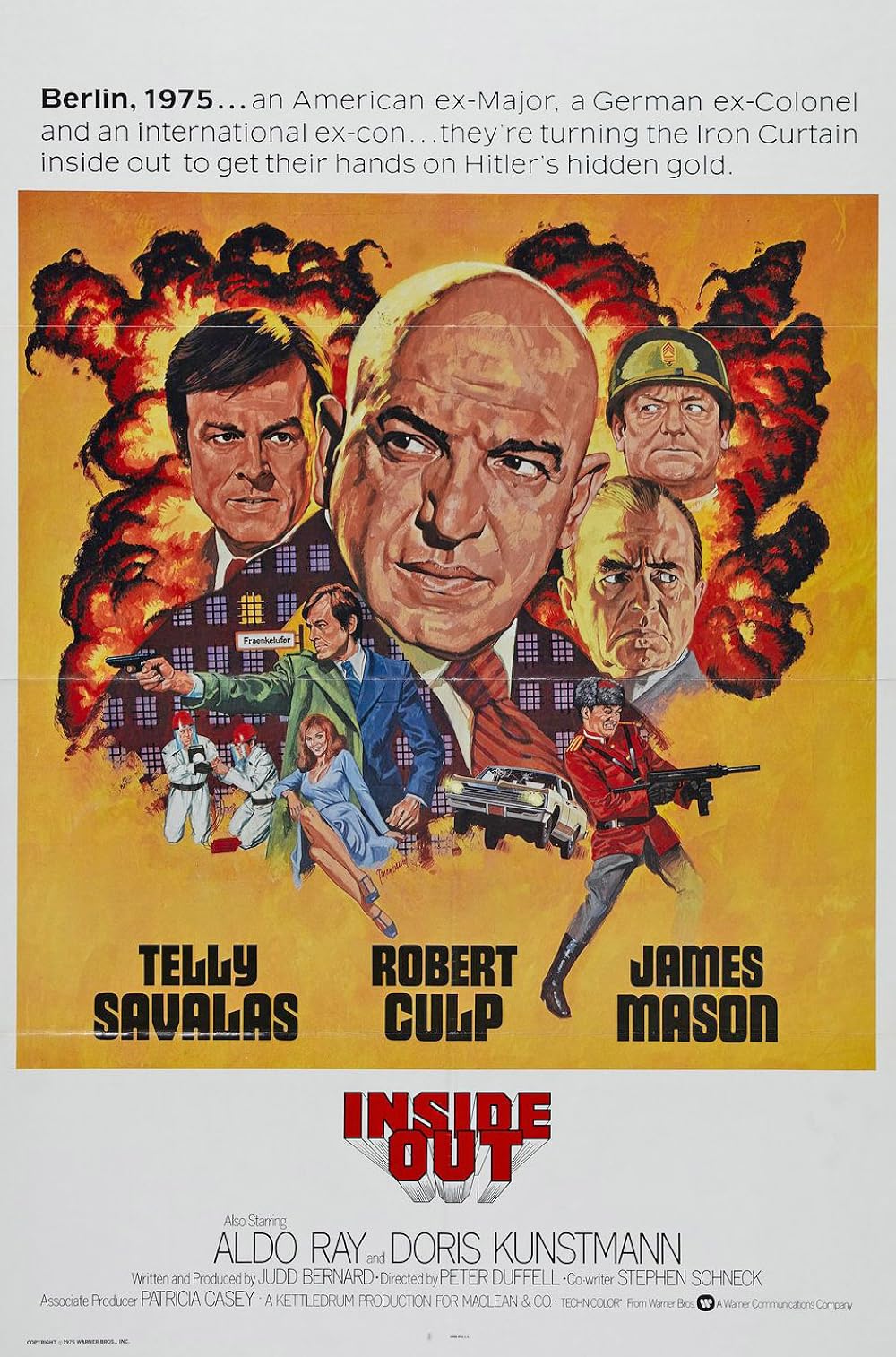
Inside Out (1975)

By Richard Winters

My Rating: 5 out of 10

4-Word Review: Tracking down nazi gold.

Harry (Telly Savalas) is head deep in bills when he comes across a letter from Ernst (James Mason) an old friend inviting him to meet him the next day at a hotel. Since Harry has nothing to lose he shows up at the agree upon location and learns that Ernst has plans to retrieve some gold that had been misplaced during the war. The problem is that the only one that knows the exact location of where it’s hidden is Holtz (Wolfgang Lukschy) who is locked up in a high security prison. Harry must then hire a team of men that can not only find a way to infiltrate the prison, but also trick Holtz into giving away the secret and then dig up the loot despite it being behind enemy lines.

The film, which was surprisingly written directly for the screen and not based on any book even though I think it would’ve made a great novel that could’ve been actually better than the movie, approaches the material in all the wrong ways. I’ll admit it’s a great concept, but director Peter Duffell unwisely decided to enter comedy into the proceedings, which wasn’t necessary. He also implements a goofy sounding music track that would’ve been better suited for a TV-sitcom. The facility that houses Holtz was shot at Plotzensee Prison in Berlin, which looks like an old rundown building that is barely able to stand on its own and like it’s ready to crumble at any minute. To really make it exciting and daring the place should’ve been modern and state-of-the-art and thus making it more of a challenge to break into.

Spoiler Alert!

Everything comes off too easily and thus hurts any potential tension. The kidnapping of Holtz is especially problematic. The group is able to infiltrate the prison by dressing up in guard costumes, but those costumes wouldn’t be an exact replica of the real guard’s uniform and thus should be easily spotted by a prison employee, and yet that doesn’t happen.

They blackmail Holtz’s doctor Maar (Adrian Hoven) to agree to take Hotlz’s place in the prison cell and pretend to be him while disguising Holtz as the doctor in order to sneak him out, but it’s unlikely anyone would agree to stay in a prison for even a day and trust that this group, whom he really didn’t know, would come back and get him out and not just leave him there. Maar, is also much shorter than Holtz, so the real guards would notice the difference in height and realize he was an imposter, but for whatever reason they don’t.

The drug that they inject Holtz with, which is never named, is unusual in that it puts him to sleep, but still allows him to walk. Most of the time drugs that could knock a person out would make their limbs go limp and force the group to have to drag him away as he slept versus here where they are somehow able to get him to sleepwalk.

The sequence where one of them disguises themselves as Hitler, played by Gunter Meisner, in an effort to trick Holtz to divulge the location of the gold since he had sworn only to give it out to the Fuhrer himself is highly improbable as well since the man really doesn’t look all that much like Hitler and you’d think Holtz, even in the drugged state that he is in, would notice the difference and not share the secret, or give out incorrect information.

I’ll give the script some credit as it does come up with a few unexpected wrinkles, but all these do is stymie the group’s efforts slightly and don’t really put a monkey wrench into the whole thing. For instance, they learn that an apartment building has been constructed on the site where the gold is buried, which most likely would’ve ruined their chances of getting at it, but here they’re able to sneak into the building’s basement via an unlocked door (don’t facilities lock their doors in East Germany?) and then create a ruse to get the tenants out of the building so they can plant a bomb that will cause an explosion to crack the cement floor. There’s even a little boy who sneaks in to witness their efforts and risks getting injured but like with everything else it gets quickly resolved when Telly spots him at the last second and whisks him away to safety and then eventually back to his mother’s arms. However, what’s to say he won’t tell his mommy what he saw? Apparently here he doesn’t, but in reality, he probably would’ve and thus another potential loophole that the film glosses over.

I enjoy Telly more when he’s playing bad guys, but he’s still fun as the protagonist and something that helps keep the movie watchable. Overall though the direction should’ve been tighter and the complex mission gets pulled off too seamlessly and thus seeing them walk away with the fortune isn’t all that satisfying as the complication would’ve been too immense for it to have ever succeeded in real life.

My Rating: 5 out of 10

Released: November 27, 1975

Runtime: 1 Hour 37 Minutes

Rated PG

Director: Peter Duffell

Studio: Warner Brothers

Available: DVD-R (Warner Archive)

Diversion (1979)

By Richard Winters

My Rating: 5 out of 10

4-Word Review: Sex fling becomes problematic.

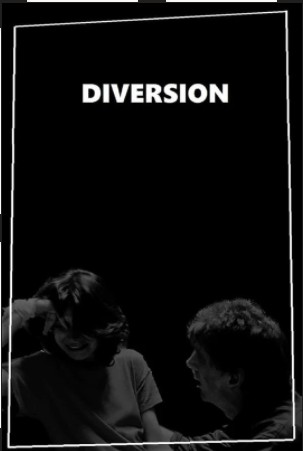
Guy (Stephan Moore) is a writer who is happily married to Annie (Morag Hood) with a toddler son named Charlie (Dickon Horsey). Annie decides to take a trip with Charlie to visit her parents and Guy stays home to work on a writing assignment. While he’s typing away, he remembers meeting Erica (Cherie Lunghi) at a party some months earlier where she gave him her phone number. Now with the wife gone he concludes this would be a good time to give her a call. Erica is excited to hear from him and they go on a mini date before ultimately ending up in her bed. The next morning, he tries to leave but she won’t let him go easily and insists that she’s not a one-night-stand material and instead wants to have a relationship with him. Guy reminds her that he’s married, but she says he can divorce her, which Guy is reluctant to do as he still considers himself content in his marriage and simply had sex with another woman as a diversion. Erica continues to call him, and his phone is constantly ringing even after Annie returns. Guy tells her it’s a wrong number, but Annie becomes suspicious and the next time Erica calls she decides to pick-up. 

If this synopsis sounds familiar it’s because it was the basis for Fatal Attraction. Producer Stanley R. Jaffee became aware of this short film and was convinced it could be expanded into a feature length movie. He even hired James Dearden, the writer-director of this one, to write the script. However, Paramount, the studio that agreed to finance the film, ordered all existing copies of this one to be destroyed, but fortunately a few survived including a bootleg version that was recorded straight off of an A&E broadcast from several decades back. 

I’m a big fan of Fatal Attraction and didn’t feel this version was as good. Too much time is spent at the beginning of Guy taking his wife and child to the airport, which I didn’t think was necessary. The party scene where Erica gives Guy her phone number should’ve been shown in flashback and the Guy character comes off like a geek that probably would only be able to fantasize about having sex with a hot woman like Erica, but not brazen enough to follow through nor would a woman like Erica want to go to bed with him as she could’ve found a better looking guy just about anywhere. In Fatal Attraction, both participants were equally attractive and working at the same firm, so their fling was more organic and made far better sense. 

Fortunately, in this one we don’t see any of the wild sex, which I felt was good as I thought that got in the way in the remake and became a distraction from the main story. Much of the dialogue though between Erica and Guy is almost word-for-word from what gets said between Glen Close and Michael Douglas though here Erica is portrayed as being this cold psychotic while in the other one Close played the role more as a desperately lonely woman, which humanized the character and helped the story be three-dimensional. 

Spoiler Alert!

My biggest grievance is that it leaves open too many loose ends. There is one scene where Guy calls Annie, while she’s still on her trip and supposedly knows nothing about what is going on, to touch base, but Annie is strangely aloof, and Guy doesn’t know why. She had always been very peppy before, which made it seem like Erica had called Annie and informed her of the affair, at least that’s what I thought, but this never gets confirmed and Annie arrives home later back to her perky self, so why did she behave differently during that one call?

The ending works like a gimmick as it has Annie answer the phone, which may or may not be Erica, while Guy stands nervously by. However, once Annie picks-up the receiver the film cuts to the closing credits, so we never know what happens next, which to me was a cop-out. 

My Rating: 5 out of 10

Runtime: 40 Minutes

Not Rated

Director: James Dearden

Studio: Dearfilm

Available: None at this time. 

A Private Function (1984)

privatefunction

By Richard Winters

My Rating: 6 out of 10

4-Word Review: Couple hides a pig.

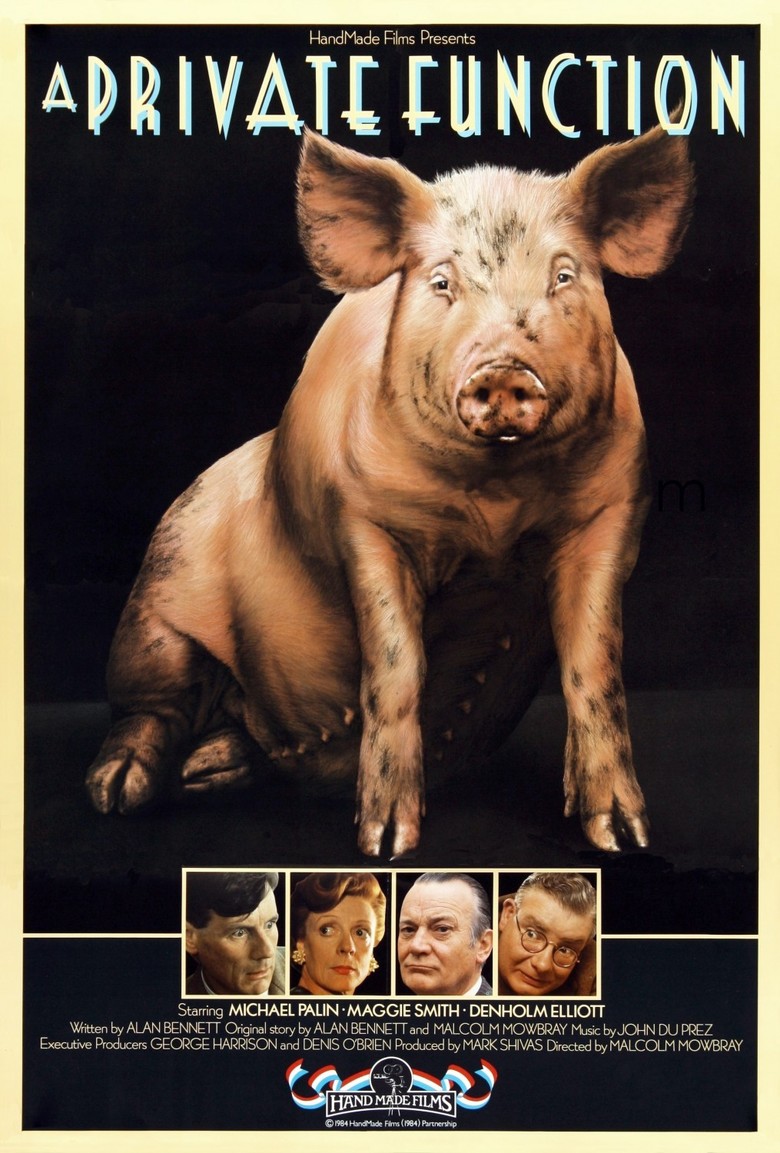
The year is 1947 and even though the war has been over for 2 years there’s still food rationing going on in this small England town. Gilbert (Michael Palin) works as a podiatrist and travels to residential homes where he cuts the toenails of the women who live there. During some of his visits he comes upon families who are hiding meat in their homes, and they must rush to cover-up any evidence of it when the local food inspector (John Normington) comes around to investigate. One such home has been illegally raising a pig in hopes to use it for a private party to celebrate the upcoming Royal Wedding between Princess Elizabeth and Prince Philip. Gilbert tells his wife Joyce (Maggie Smith) about it, and she convinces him to steal the pig, so that they can sell it off to the bacon black market but trying to hide a pig from both their neighbors as well as Joyce’s noisy elderly mother (Liz Smith) let alone being able to kill it proves quite challenging.

The film is a perfect mix of droll English humor and quirky moments. It starts out with a very original idea and manages to add one amusing moment, or sly comment, after the other becoming one of the better foreign comedies of the year where you can pick-up on funny little things that you might’ve missed on the first viewing, each time you watch it. Palin is especially good as a timid man who finds himself in the middle of chaos that he didn’t want and his unique profession along with the giant plastic foot that he orders to help represent his business are all on-target as are his engagingly consternated facial expressions.

Initially I thought Smith, a two-time Academy Award winner, was wasted here as she isn’t seen much during the first act and pushed mainly to the background making it seem almost like a token role that doesn’t have much pizazz, but she comes on strong by the end by having an interesting arch where she is just a passive, doting wife at first, but proves to be quite controlling, conniving and even demanding by the end. Liz Smith is equally engaging as the sometimes-confused aging mother ‘she’s 74’ whose dialogue is limited, but the few lines that she does say are doozies.

Spoiler Alert!

The pig though becomes the main star even though behind-the-scenes it made things quite difficult to film. This led to one 12-year-old boy getting his ‘big break’ into show business. When he heard that they were going to be making a movie in his area he proudly proclaimed that he’d be ‘willing to do anything’ in order to ‘get into the movies’ so the producer handed him a pail and told him to follow the pig around and collect its droppings every time it defecated and for this he got his name proudly billed during the final credits as ‘the bucket boy’.

As pigs go this one struck me as being quite small. Apparently, this was intentional as the filmmakers were advised by animal experts to choose a 6-month-old female pig as it was deemed, they’d be easier to control and less unpredictable, but visually she looked too scrawny and certainly not the type of pig to be used as the centerpiece for a giant feast such as the one that the townspeople were excitedly planning. It’s also a bit of a downer, even depressing, when the animal is eventually killed and served up on a platter. There’s a lot of close calls where the animal evades death and it makes it seem almost like the human captors were ultimately too afraid to do it, but when it does finally occur it hurts the film’s levity and makes it feel like murder when it does die and thus sucks all of the comedy that came before it right out.

The climactic party isn’t eventful either making the story go out with a whimper. It had been relatively lively up to then with all sorts of subtle twists and goofy turns only to end things on a dry note. There needed to be some sort of ultimate confrontation between the couple and the former owners of the pig, so things could’ve ended with more of a bang as it’s not quite able to hold-up feeling almost like it ran out of ideas with an uninspired conclusion.

My Rating: 6 out of 10

Released: November 9, 1984

Runtime: 1 Hour 32 Minutes

Rated R

Director: Malcolm Mowbray

Studio: HandMade Films

Available: DVD

The Devils (1971)

devils1

By Richard Winters

My Rating: 9 out of 10

4-Word Review: Burned at the stake.

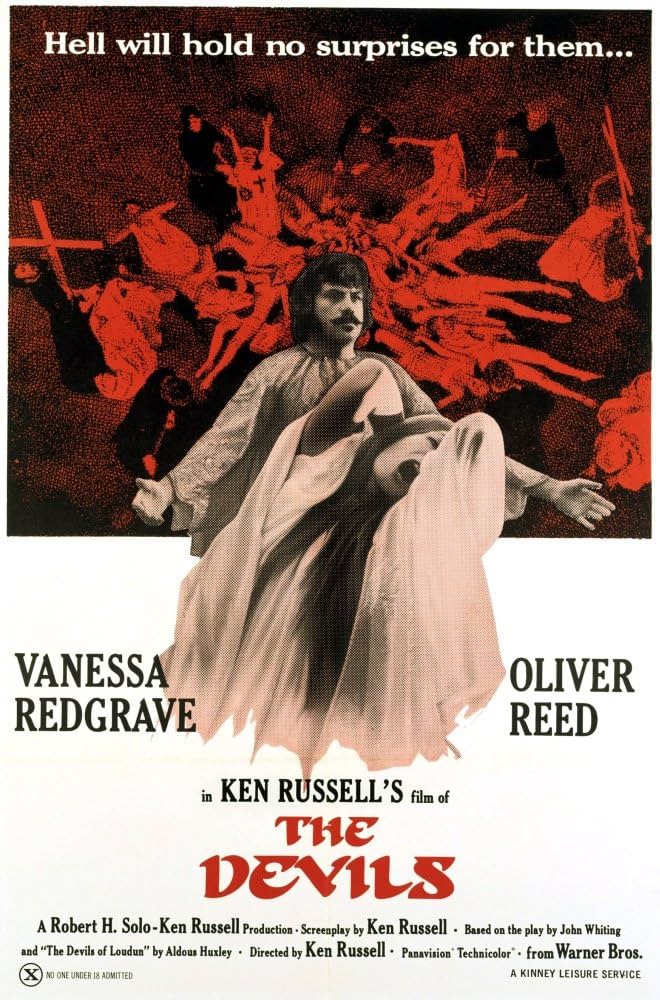
In the year 1634 the governor of Loudon, a small fortified city, dies, making Urbain Grandier (Oliver Reed), a priest with a secretly decadent lifestyle, the one in control. He’s idolized by the townspeople and the head nun at the local convent, Sister Jeanne des Anges (Vanessa Redgrave), secretly has sexual fantasies about him though because she suffers from having a hunch on her back is rarely ever seen outside and Urbain himself doesn’t know she exists. When Urbain secretly marries Madeleine (Gemma Jones) Jeanne becomes jealous causing her to confide to Father Mignon (Murray Melvin) that she’s been possessed by Urbain as well as accusing him of dabbling in witchcraft. This then leads to an inquisition headed by Father Pierre Barre (Michael Gothard) and a public exorcism, which has the nuns in the church strip and perform perverse acts before Urbain and his new wife are arrested and put on trial.

The story is based on the actual event, which was written about in the book ‘The Devils of Loudun’ by Aldous Huxley that was later turned into a stageplay. After the play’s success United Artists became interested in turning it into a movie and signed-on Ken Russell to direct due to his recent success in helming Woman in Love. Russell read the source material and became in his words ‘knocked-out by it’ and ‘wanted others to be knocked-out by it too’. This then compelled him to write an extraordinarily over-the-top script full of sex, violence, and graphic torture that so shocked the studio execs when they read it that they immediately withdrew their initial investment and refused to fund the picture threatening the project from being made even though many of the sets, constructed by set designer Derek Jarman, has already been painstakingly completed, but fortunately for them Warner Brothers swooped-in at the eleventh hour, which allowed the production to proceed.

The film’s release was met with major controversy with many critics of the day, including Roger Ebert who gave the film a very rare 0 star rating, condemning it. Numerous cuts were done in order to edit it down to a version that would allow it to get shown with the original British print running 111 minutes while the American one ran 108. Both were issued with an ‘X’ rating though even these cut out the most controversial scene, known as ‘The Rape of Christ’ segment, in which a group of naked nuns tears down and then performs perverse acts on a giant-sized statue of Jesus. This footage was deemed lost for many years before it was finally restored in a director’s cut version, that runs 117 minutes, that was shown in London in 2002. Yet even today this full version is hard-to-find with Warner Brothers refusing to release it on either DVD, or Blu-ray. They’ve even turned down offers from The Criterion Collection who wanted to buy it. While there was a print Warner released onto VHS back in the 80’s, this same version, got broadcast on Pay-TV, it’s edited in a way that makes the story incomprehensible, and only the director’s cut is fluid enough for the storyline to fully work.

It’s hard to know what genre to put this one into as this isn’t your typical movie and watching it is more like a one-of-a-kind experience that very much lives up to its legend and just as shocking today as it was back then. Yet, outside of all of its outrageousness it is quite effective. Each and every shot is marvelously provocative and the garishly colorful set pieces have a mesmerizing quality. The chief color scheme of white that lines the walls of the inside of the convent seemed to interpret to me the interior of a mental hospital, which helps accentuate the insanity of the frenzied climate. While things are quite over-the-top its ability to capture the mood of the times, the cruel way people treated each other and how they’re all steeped in superstition as well as the dead bodies from the plague that get stacked about, are all on-target and amazingly vivid.

The acting is surreal with both Reed and Redgrave stating in later interviews that they consider their performances here to be the best of their careers. Reed’s work comes-off as especially exhausting as he gets his head shaved and then is ridiculed in a large room full of hundreds of people before burned to death with make-up effects that are so realistic it’s scary. Redgrave, who walks around with her head twisted at a creepy angle, is quite memorable during the scene where she physically punches herself for having sexual fantasies, even puts a crucifix in her mouth at one point and masturbates with a human bone. Dudley Sutton and Murray Melvin with their very unique facial features and Michael Gothard, who initially comes-off with his long wavy hair as an anachronistic hippie flower child, but who becomes aggressively evil as the makeshift exorcism proceeds, all help round-out a most incredible supporting cast.

While the cult following for this remains strong and getting stronger and demand for a proper, director’s cut studio released DVD/Blu-ray is high Warner continues to rebuff the requests. There are though ways to find versions through Bing searches. Streaming services Shudder and Criterion Channel have shown the most complete prints to date, running roughly 111 minutes with most of the controversial scenes, including the Rape of Christ moments though these scenes are of a poorer, grainy and faded color quality since they never went through a professional digital transfer, but overall it’s still one of those movies you should seek-out because not only is it fascinatingly brilliant, but it’s something that could never be  made today and a true testament to the wild, unfiltered cinema of the 70’s that will forever make it the groundbreaking, unforgettable decade that it was.

My Rating: 9 out of 10

Released: July 16, 1971

Runtime: 1 Hour 57 Minutes (Director’s Cut)

Rated R (Originally X)

Director: Ken Russell

Studio: Warner Brothers

Available: DVD-R

White Mischief (1987)

whitemischief

By Richard Winters

My Rating: 7 out of 10

My Rating: Unsolved murder in Kenya.

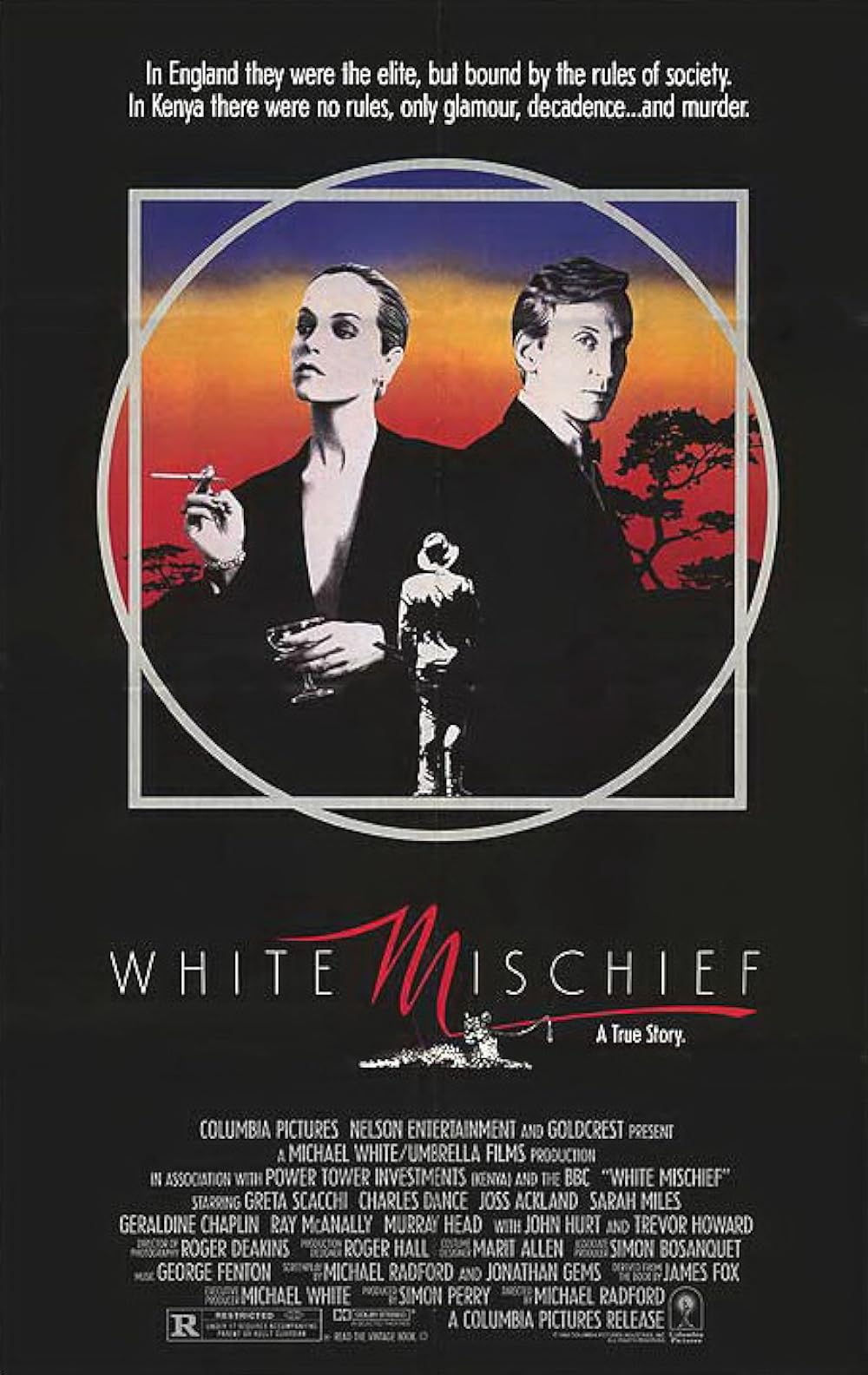
During the Second World War many British aristocrats with money escaped the tensions and horror in Europe by relocating at a settlement in Kenya that became known as Happy Valley. Here without the typical societal restraints of back-home they were able to indulge in all their provocative desires including rampant drug use and promiscuous sex. One such philanderer, possibly the most notorious of the bunch, was Josslyn Hay the Earl of Erroll (Charles Dance). He had already had various trysts with many of the women there including Alice (Sarah Miles) before dumping her due to her drug addiction. He then sets his sights on Diana (Greta Scacchi). She is married to Jock (Joss Ackland) who is older than her by several decades, and the two share a marriage of convenience with a pre-nuptial agreement that if either falls in love with someone else the other person will not impede it. Earl goes after Diana aggressively and despite some initial reluctance the two eventually become an open couple. Jock puts up a stoic front and allows her to go with him without any resistance, but internally he seethes with rage. Then one night Earl gets shot dead while driving his car in an isolate area. Did Jock pull the trigger?

The film is based on the book of the same name written by James Fox that was published in 1982 and in-turn based on the real-life incident that occurred on January 24, 1941 where the Earl of Erroll, like in the movie, is was found dead in his car and Jock, being the prime suspect, was put on trial, but then found not guilty due to a lack of evidence. For decades it sat as an unsolved case with no answers to what really happened until 1969 when Fox, along with fellow writer Cyril Connelly, became fascinated with the subject and began researching it vigorously. The book contains many interviews with people who lived through the ordeal and give first person accounts of the trial proceedings. Fox even traveled to the Kenya region to get a better understanding of the area and people and came to the conclusion that Jock had been the culprit with new evidence he unearthed, which makes up the book’s entire second-half though officially the case remains open.

The movie’s best quality is its visual element especially its ability to capture the expansive beauty of Africa as the film’s director Michael Radford proudly proclaimed before production even started that “films of Africa should be made by Africans” and you really get that sense here. The screenplay by noted playwright Jonathan Gems is also superb with it’s use of minimalistic dialogue where the conversations and characters never say too much, many times just brief sentences, and the emphasis is much more into what is implied.

On the negative end the attempts at eroticism are pathetic and overdone. The most absurd moment comes when the Sarah Miles character, during the open casket viewing portion of Earl’s funeral, reaches under her skirt and masturbates in full view of everyone before eventually putting her ‘love juices’ on the deceased, which came off as ridiculous and simply put in for a cheap laugh, or misguided ‘shock value’ and hard to imagine it occurred in reality. Both Scacchi’s and Dance’s characters are quite boring and their love scenes lack spark making the whole affair angle seem quite predictable.

The film’s saving grace though is with Ackland’s character where you really get inside his head and see things from his perspective. Normally in most films the jilted spouse is portrayed as someone to fear and a one-dimensional jealous machine who serves no purpose other than to get revenge. Here though we feel his quandary and sympathize with his internal struggle of trying to take the high road while also wracked with hurt and betrayal. Instead of being the culprit we ultimately see him as a sad victim even as his personality completely unravels by the end and because of this aspect I felt the movie works and is worth seeking out. Director Radford probably said it best when he stated that the film was about “people who have everything and yet have nothing. It’s about people who want to possess what they can’t possess” and with the excellently crafted Josh character you can really see that.

This is also a great chance to see acting legend Trevor Howard in one of his last performances. He was suffering severely at the time from his alcoholism and cirrhosis that he comes-off appearing like a wrinkled corpse put upright and there’s several scenes where he’s seen just standing there, but says nothing due to the filmmakers fear that he wouldn’t remember his lines, or if he did wouldn’t be able to articulate them. However, he does come through during a pivotal moment inside the prison when he visits Ackland and what he says and does there is great. John Hurt’s performance is the same way as initially he’s seen little and says no more than a couple of one word responses to the point I thought he was wasted, but then at the end he reappears and comes-on strong in an unique way.

My Rating: 7 out of 10

Released: November 10, 1987

Runtime: 1 Hour 47 Minutes

Rated R

Director: Michael Radford

Studio: Columbia Pictures

Available: VHS, DVD (Import Reg. 2), Amazon Video, Roku 

The Hit (1986)

hit

By Richard Winters

My Rating: 5 out of 10

4-Word Review: Not afraid to die.

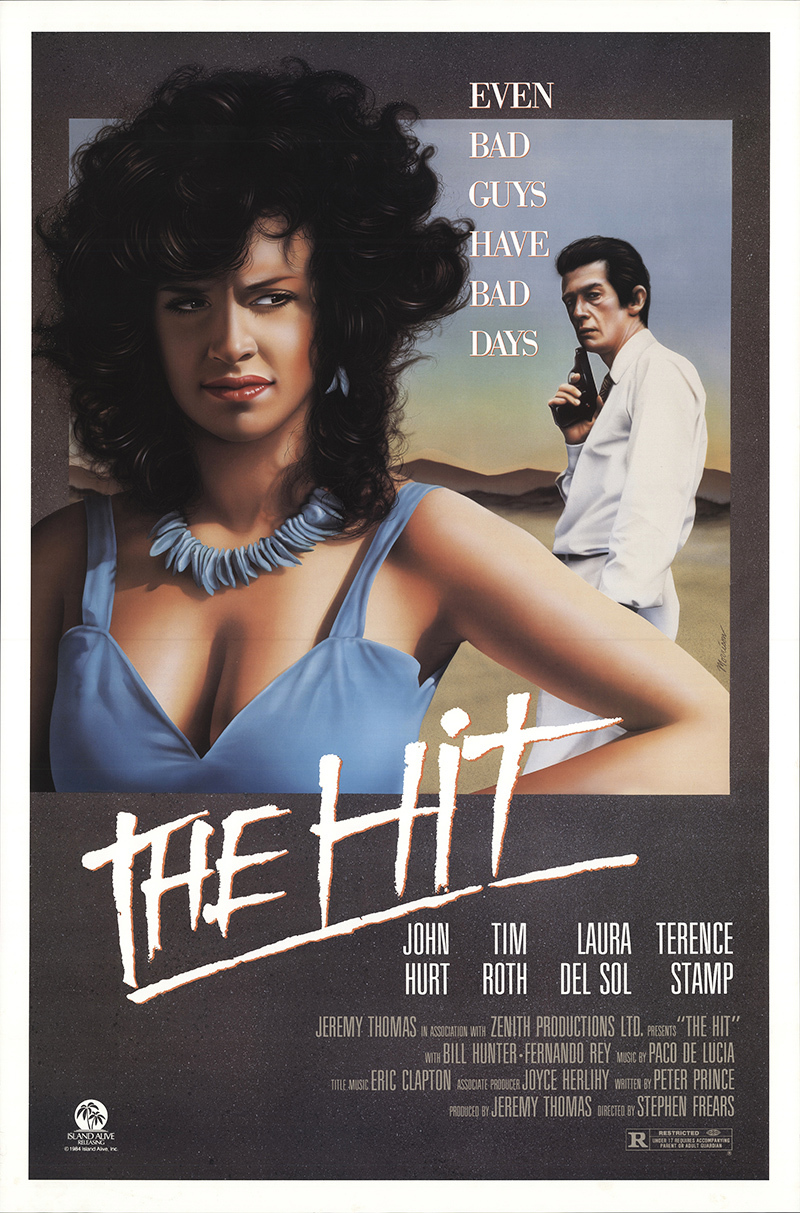
Willie (Terence Stamp) turns states evidence against the criminal underground that he’d been apart of, which then sends his former partners away to prison, but before they go they sing ‘We’ll Meet Again’ just as he leaves the court room. Ten years later Willie is living the quiet life in Spain as a part of the witness protection program only to have his home invaded by a group of teens who kidnap him and take him to hitman Braddock (John Hurt) who was hired by the kingpin that Willie helped put away. Braddock along with his young partner Myron (Tim Roth) are instructed to take Willie, via a car, to Paris where the kingpin hopes to inflict harm on Willie before eventually killing him. However, things don’t go quite as planned as Willie shows no fear of death insisting that he’s accepted it as a part of the cycle of life and this throws the two hit men off convinced that he must have something up-his-sleeve, but does he?

This is another example where a movie I enjoyed when I first watched it years ago, but doesn’t quite live up to expectations upon the second viewing. For the most part this doesn’t happen that often and there has been some cases where a movie I didn’t like when I first saw it I’ve come to appreciate when seen a second time. This one though is definitely a case of the former and I came away a bit miffed on what its point was. When I first saw it I was impressed by the scene at the waterfall where Willie, who had a chance to escape, but doesn’t and instead decides to spend his time appreciating nature’s beauty until Braddock catches up to him, I found at the time to be quite memorable and unique moment as it revealed that the bad guy in this instance was the one more afraid and insecure of death than the intended victim.

However, there’s a lot of stuff that doesn’t mesh, or could’ve been more convincing. I had a hard time understanding why this sophisticated criminal group would hire a bunch of teen boys to break into Willie’s home (hideout). How could they trust these novices to get the job done and the fact that they’re able to do it so easily makes it seem that Willie’s ‘protection’ as it were wasn’t too impressive. It also negates the effect of the criminal unit. They’re supposedly this cunning, evil, underground group relentlessly pursuing their man against this supposedly intricate government program, but if literal kids can just break down the door with just a bit of effort then the whole operation from both sides comes-off as rather amateurish.

The casting of Hurt as the bad guy isn’t effective mainly because of his meek stature. Stamp was originally intended for that role and with his big build and piercing blue eyes would’ve been perfect, but it was ultimately decided for both actors to play against type and thus the parts got reversed, but it really doesn’t work. Hit men should have an intimidating presence, but with Hurt’s slim figure and quiet, exhausted looking demeanor that doesn’t happen. Roth as his quick-triggered, youthfully naive henchmen makes matters worse as he’s a walking cliche of a teen in over-his-head just biding time before his knee-jerk reactions to do them in. Thus the psychological games that Willie plays with them are not that interesting, or impressive since these two come-off as badly dis-coordinated right from the start and like any average person could easily outfox them.

Stamp’s character is baffling as well. During the courtroom moments he states his testimony is an almost hammy way like he’s making fun of the whole situation, which maybe he is, but it’s not clear as to why and his ulterior motivations are never answered. It’s hard to tell whether he really is a good guy, or maybe secretly a bad one as there are scenes where he puts other potential victims in definite danger and then feigns ignorance about it afterwards. He spends the whole time telling everyone how death doesn’t scare him and yet when a gun does finally get pointed at him he panics and tries to run while also pleading for his life, so which is it? The same goes for Roth’s character who during the course of the movie he seems to be falling for the lady hostage, played by Laura del Sol, and even protective of her and yet when the time comes for Hurt to shoot her he puts up no fight, or resistance, which defeated the momentum and missed-out on what could’ve been an interesting confrontation.

I like movies with multi-dimensional characters and the film does have that and certainly humans can be a bag full of contradictions. However, at some point it kind of needs to explain itself and it fails on that end. Intriguing elements about these people get thrown-in, but the story fails to follow through with it ultimately making it too vague, ambiguous to be full satisfying and in many ways it will most likely leave most viewers frustrated and scratching their heads as they ask themselves what the point of the whole thing was supposed to be.

I did though really enjoy the scenes with Australian actor Bill Hunter who is marvelous in support playing a man who takes over one of Hurt’s friend’s apartments while on vacation only to get the shock of his life when the hit man and his entourage show up unexpectedly. His rather pathetic attempts to mask his fear and trying to somehow carry-on a casual conversation knowing full well he could be blown away at any second is dark comedy gold and by far the film’s best moments.

My Rating: 5 out of 10

Released: May 18, 1984

Runtime: 1 Hour 38 Minutes

Rated R

Director: Stephen Fears

Studio: Zenith Entertainment

Available: DVD, Blu-Ray (Criterion Collection), Tubi, Plex

A Day in the Death of Joe Egg (1972)

deathjoe

By Richard Winters

My Rating: 9 out of 10

4-Word Review: Caring for disabled child.

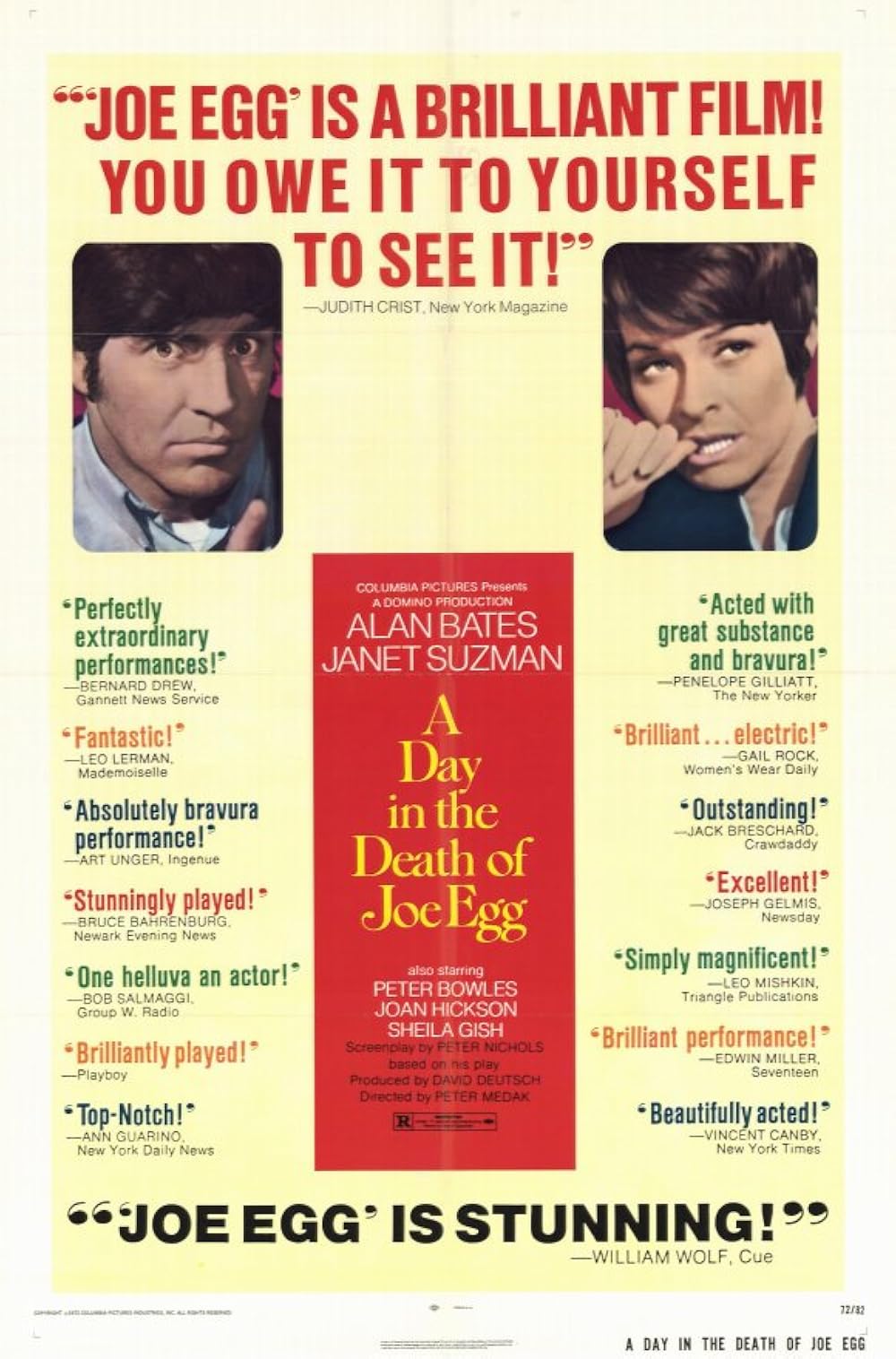
Bri (Alan Bates) and Sheila (Janet Suzman) are a British couple caring for their daughter Josephine (Elizabeth Robillard), who they’ve nicknamed ‘Jo’ or ‘Joe Egg’. Sheila had a narrow pelvic, which caused Jo’s birth to be a difficult one. The couple had wanted the delivery to occur at home, but due to the complications they were forced to go to the hospital. Initially Jo seemed to be a healthy baby, but she began to suffer from ongoing seizures that eventually put her into a coma. She never came out of it and by age 10 sits in a wheelchair unable to speak, care for herself, or show any type of emotional response to anything. Bri and Sheila pretend to have ‘conversations’ with her in an attempt to lessen the stress of caring for her. Bri feels she should be placed in an institution, but Sheila won’t hear of it, which causes a rift to form in their marriage. Eventually Bri becomes so frustrated with the situation he begins to consider killing Jo and even starts to joke about his intentions to not only his wife, but also their friends (Peter Bowles, Sheila Gish).

The film is based on the stage play of the same name written by Peter Nichols who used his own experiences of caring for a child with cerebral palsy as the basis for the story. It premiered at the Citizen’s Theatre in Glasgow, Scotland in 1967 before eventually moving to Broadway a year later where it starred Albert Finney and Zena Walker and won rave reviews. The movie was filmed in 1970 and completed on time, but the studio decided to then shelve it fearing due to the downbeat storyline that they’d have no way to market it and it would be unable to find an audience. It was only after Suzman’s acclaimed performance in Nicholas and Alexandra that they eventually released it to theaters hoping to capitalize off the attention she got from that one in order to get people to see this one.

Many sources refer to this as being a ‘black comedy’, but I found absolutely nothing funny and in fact it’s instead brutally bleak. I guess the humor as it were was in the way the parents have ‘conversations’ with the kid, but this doesn’t really come-off as being even the slightest bit amusing particularly when you have the child just sitting there with her eyes rolled-up in her head and resembling someone who has died.

This doesn’t mean I didn’t like the film as in-fact I found it quite powerful, but clearly much more from the dramatic end. I admired the way it pulls-no-punches and forces the viewer to confront some very uncomfortable questions like what is the point of caring for a child that will never be able to recognize them, or show any response, or emotion to anything? Granted there’s many kids with disabilities out there and some can grow to lead productive lives, but when one is in a literally vegetable state such as this it does make it infinitely more severe and emotionally challenging. Director Peter Medak approaches the material, which is certainly no audience pleaser, in an earnest way with many varied cutaways and dream-like segments including one memorable moment where Bri and Sheila are on a gray, stormy beach and he imagines throwing the baby carriage that the child is in into the sea, which helps give the production a moody, surreal-like vibe and keeps it on the visual scale quite inventive.

The acting is superb especially Suzman whose character must deal with the inner turmoil of dealing with the stark reality a child who won’t ever grow into anything, but also a husband, whom she loves and is emotionally dependent on, who wants out. It’s interesting too seeing Sheila Gish in a supporting role as a friend who places a high degree on physical appearance and can’t stand anything that is ugly, or deformed and yet she in real-life many years later lost an eye to skin cancer and was forced to walk around with an eye patch.

I was most impressed though with Robillard whose career never really took-off, but proves up to the challenging task here and was picked out of over 100 other children who auditioned for the role. Remaining motionless and unresponsive and whose only noise is periodic moans isn’t as easy as you’d think especially when everyone else is moving and speaking around you. The best moments of the whole movie is when Sheila envisions what Jo would be like if she were a normal kid and we see shots of her jump roping and playing with the other children, which effectively accentuates their sad situation even more.

Spoiler Alert!

The ending, where Bri essentially runs away from home and leaves Sheila alone with the kid, I felt was realistic and most likely what would happen to most any couple stuck in the same environment. The shots of seeing Sheila lying down in bed fully aware that Bri is gone and looking almost at peace with that to me spoke volumes. My only complaint is that I felt the couple’s tensions and cracking of their relationship should’ve been apparent right from the start. They seemed to get along too well at the beginning, but with the child already age 10 by that point and with no signs of ever getting better I felt there should’ve already been plenty of arguments and disagreements and sleeping in separate bedrooms instead of showing them still having a robust sex life and only by the second act do things finally start falling-apart between them.

My Rating: 9 out of 10

Released: June 4, 1972

Runtime: 1 Hour 46 Minutes

Rated R

Director: Peter Medak

Studio: Columbia Pictures

Available: DVD-R

Absolution (1978)

absolution

By Richard Winters

My Rating: 7 out of 10

4-Word Review: Pranking a strict priest.

Father Goddard (Richard Burton) is the head of an English Boy’s School and uses his influence to control those who attend and is unflinching on his policies. Goddard constantly displays a cold and detached demeanor particularly with Arthur (Dai Bradley) a handicapped student that the Father doesn’t seem to care for. Benjie (Dominic Guard) on the other-hand is the teacher’s pet and routinely shown favorable treatment. Benjie though grows to resent the Father’s stern ways when he’s told he can no longer visit with Blakely (Billy Connolly) a motorcycle riding vagabond who has set-up an encampment just outside of the school grounds. Benjie decides to play a prank on the Father after hearing the lecture about the seal of confession, which a priest cannot break even if what he’s told is about a murder, so during confession Benjie tells Goddard that he’s murdered Blakely. Goddard initially doesn’t believe him, which sets off a myriad of twists that soon sends Goddard’s life, career and even his sanity spiraling out-of-control.

After the success of The Wicker ManAnthony Schaffer was commissioned by director Anthony Page to write another script that could be made into a movie and Schaffer decided to choose one that had initially been meant as a stageplay, but had never been produced. However, once Schaffer had completed his adaptation Page was unable to find a studio willing to fund it and he was ultimately forced to use his own money and Burton agreeing to slash his normal fee in order to get it made.

The lack of a budget is sorely evident at the start featuring a grainy print with faded color and what initially seems like misplaced banjo music that would be considered more appropriate for a film set in the American south instead of England. Having it shot on-location at Ellesmere Collage helps as many of the local pupils played the students here and the film gives-off a realistic atmosphere about what a boys school would be like with all of the kids looking age appropriate for their grade level and not like, as with other teen school movies, older actors in their 20’s trying to come-off as if they were still adolescents.

Billy Connelly, in his film debut, is terrific and it’s fun seeing Bradley, who was better known for his starring role in KesBurton though is the standout as his jet setting persona that he had at the time with Elizabeth Taylor gets completely erased and he fully sinks into his role of a steely-eyed, cantankerous man who rules with a rigid, iron-fist and whose simple presence wields terror in the boys as he walks-by and to some extent the viewer too. It’s a commanding performance that helps the movie stand-out.

Spoiler Alert!

The story though, while intriguing, doesn’t fully work. It becomes obvious that Goddard is being tricked by the boys, but you feel no empathy for his quandary. He has spent so much time up until then being a jerk that you end up siding with the boys, at least initially, which seriously hurts the tension as normally in a thriller/mystery such as this you’re supposed to side with the protagonist and want to emotionally see them get out of their predicament. Here though you like his mental breakdown and not as invested in finding out the resolution beyond it. The final explanation, dealing with the Arthur character supposedly disguising his voice to sound like Benje’s is too much of a stretch and ultimately hurts the credibility.

Shaffer stated in interviews that this was not meant to be an anti-Catholic movie, but I feel he said this in order not to alienate potential viewers as it’s clearly written by someone who grow-up in the church and had many problems with it. Father Goddard is more a caricature meant to represent Catholicism as a whole and how the religion with its very rigid rules ends up trapping those who follow it with a damned-if-you-do, damned-if-you don’t scenarios leaving its followers in a perpetual state of guilt and paranoia. This becomes quite evident at the end where the Father feels unable to break his seal of confession for fear of divine wrath, but also fears it for the murder he committed and his thoughts of suicide that would equally lead him to hell, per the teachings, making him more a victim of the religion than of the boys, which I feel was the whole point.

My Rating: 7 out of 10

Released: December 8, 1978

Runtime: 1 Hour 35 Minutes

Rated R

Director: Anthony Page

Studio: Bulldog Productions

Available: DVD, Blu-ray, Amazon Video