Category Archives: 80’s Movies

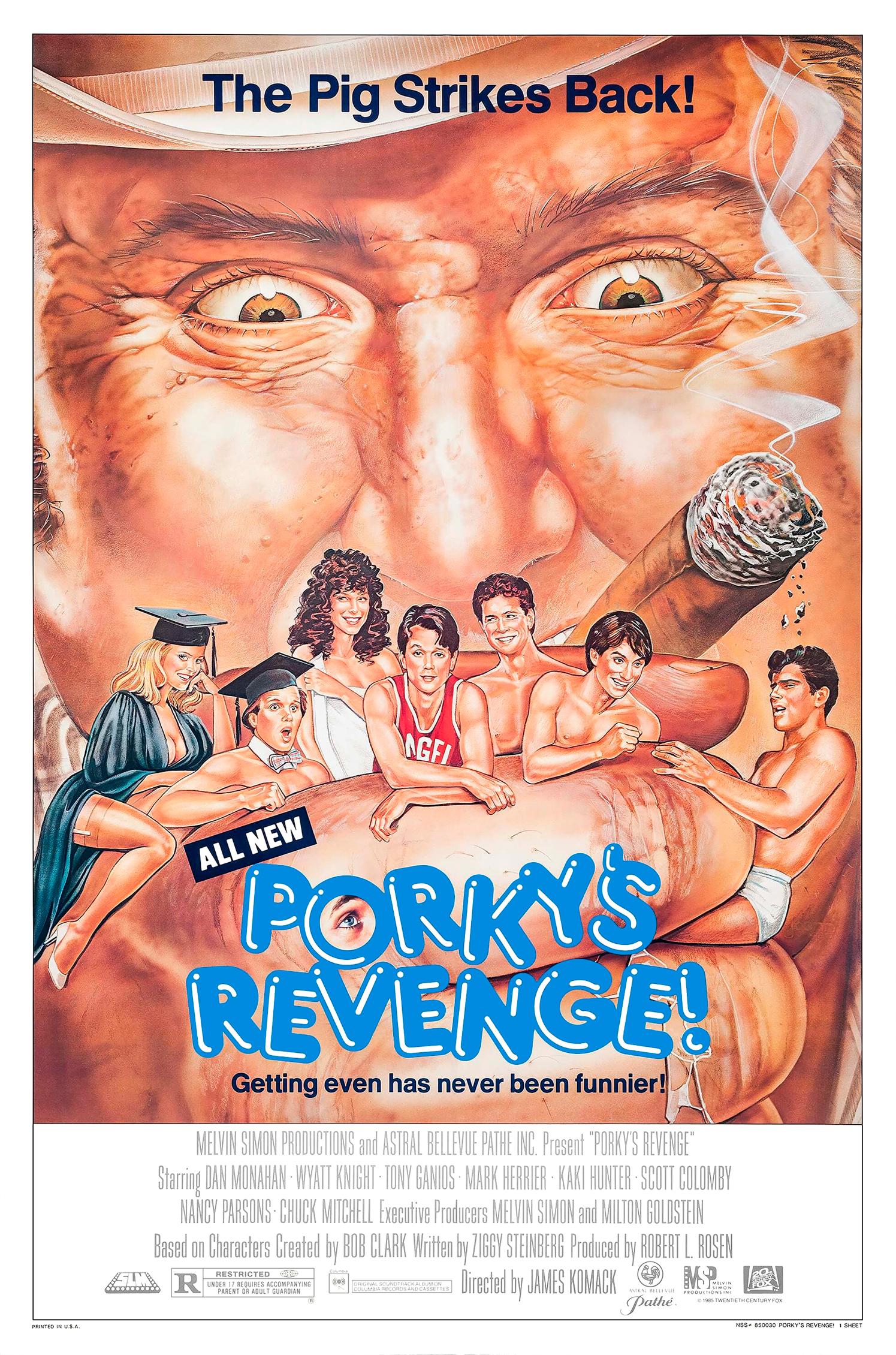
Porky’s Revenge (1985)

By Richard Winters

My Rating: 4 out of 10

4-Word Review: Rescue from shotgun wedding.

Porky (Chuck Mitchell) has rebuilt his casino that was destroyed by the teens in the first film by turning it into a riverboat. To help pay for this he extorts Coach Goodenough (Bill Hindman) for money and other such favors since he owes him on a gambling debt. Pee Wee (Dan Monahan) and his friends try to come to their coach’s rescue by sneaking onto the boat and taking pictures of the illegal gambling activity, which they hope to show to the district attorney. Porky though catches them in the act and threatens revenge, so to get out of their jam they agree to throw their next basketball game, so that Porky can bet against them and win a lot of money. Meanwhile Meat (Tony Ganios) is having problems of his own when he gets ‘forced’ into having sex with Porky’s daughter Blossom (Wendy Feign) causing Porky to insist that the two now must get married.

While fans of the franchise traditionally rate this at the weakest of the three films I found it to be a step up and even, at least at the beginning, to be moderately amusing particularly the pool scene where the cheerleaders concoct a scheme to get the boys to take off their bathing suits and prance around in front of the parents naked. The script was written by Ziggy Steinberg, whose career is the perfect encapsulation of Hollywood, where if you’re considered ‘up and coming’ you can find plenty of work, but the second your material is perceived as getting stale you can quickly become a leper and no offers to be found. This though came at a point where he was still a sought-after commodity, and I felt the script was better structured and seemed much more like a sequel continuing the elements from the first one versus going off on wild tangents like the second one did.

It helps having Chuck Mitchell back as the title character. It’s not like his acting is all that great, but his big presence and gruff, unfiltered delivery keep it fun and he offers a bona fide nemesis for the kids to go after. The casino boat is impressive, and the majority of the film’s $8 million budget was used just to build it. Seeing it get destroyed, which comes near the end, is exciting too and probably more memorable than the destruction of Porky’s original backwoods casino.

The characters though lack growth. Pee Wee for example is still obsessed about getting laid even though he had already lost his virginity in the first film, so his personality needed to evolve into something else. He should, especially being a senior, be the confident one who now takes some insecure freshman under his guidance to show him how it’s done instead of acting as a perpetually immature junior high kid, which by this point is no longer even remotely interesting.

The pranks continue to go overboard and boarder on cruelty. The one that gets played on Beulah Balbricker (Nancy Parsons) is especially stupid. She is set up to believe that she’s going to have a rendezvous with her long-lost boyfriend Snooky (Sandy Meilke), so she goes to a hotel room lying in bed in her nightie waiting for him to enter, so that they can return to their ‘passionate ways’ of the past. In reality though it would never work that way. These two had not seen, or corresponded with each other in many years, so there was no guarantee that both would still have the same feelings for the other. Since so much time had passed they were by this point theoretically strangers, so to avoid embarrassment and possible rejection they would instead get together at a restaurant, or over drinks in order to ‘catch up’ with things and then if they still both felt the same spark they might check into a hotel room, but nobody would just do that right off the bat.

I did though like the way her character changes, she’s the only one that does, by having her behaving like a completely different person once she’s finally able to get together with the real Snooky. However, I feel it would’ve made more sense had she been portrayed as someone who had never had sex versus one that just hadn’t had it in a while. Having her being lifelong frigid would’ve explained better why she was so hyper obsessed with suppressing everyone else’s sexuality. A better payoff would’ve had her really have sex with Tommy (Wyatt Knight) and found much to her surprise to liking it and this would then inspire her evolution.

Spoiler Alert!

The prank involving the bridge operator (Mal Jones) gets botched as well. It hinges on him believing that Wendy (Kaki Hunter) and Tommy are jumping off it to commit suicide, which distracts him enough so that he leaves to bridge operator room and allows Pee Wee to go in and close the bridge and thus destroy Porky’s boat that is trying to go underneath it. However, the bridge isn’t high enough from the water to be that dangerous. In fact, if it was truly that dangerous then both Tommy and Wendy would’ve died when they jumped off of it, but they don’t so the operator would never have been fooled. If anything, he would’ve thought they were just a couple of teens going out for a late-night skinny dip and wouldn’t have panicked at all.

My Rating: 4 out of 10

Released: March 22, 1985

Runtime: 1 Hour 32 Minutes

Rated R

Director: James Komack

Studio: 20th Century Fox

Available: DVD, Blu-ray

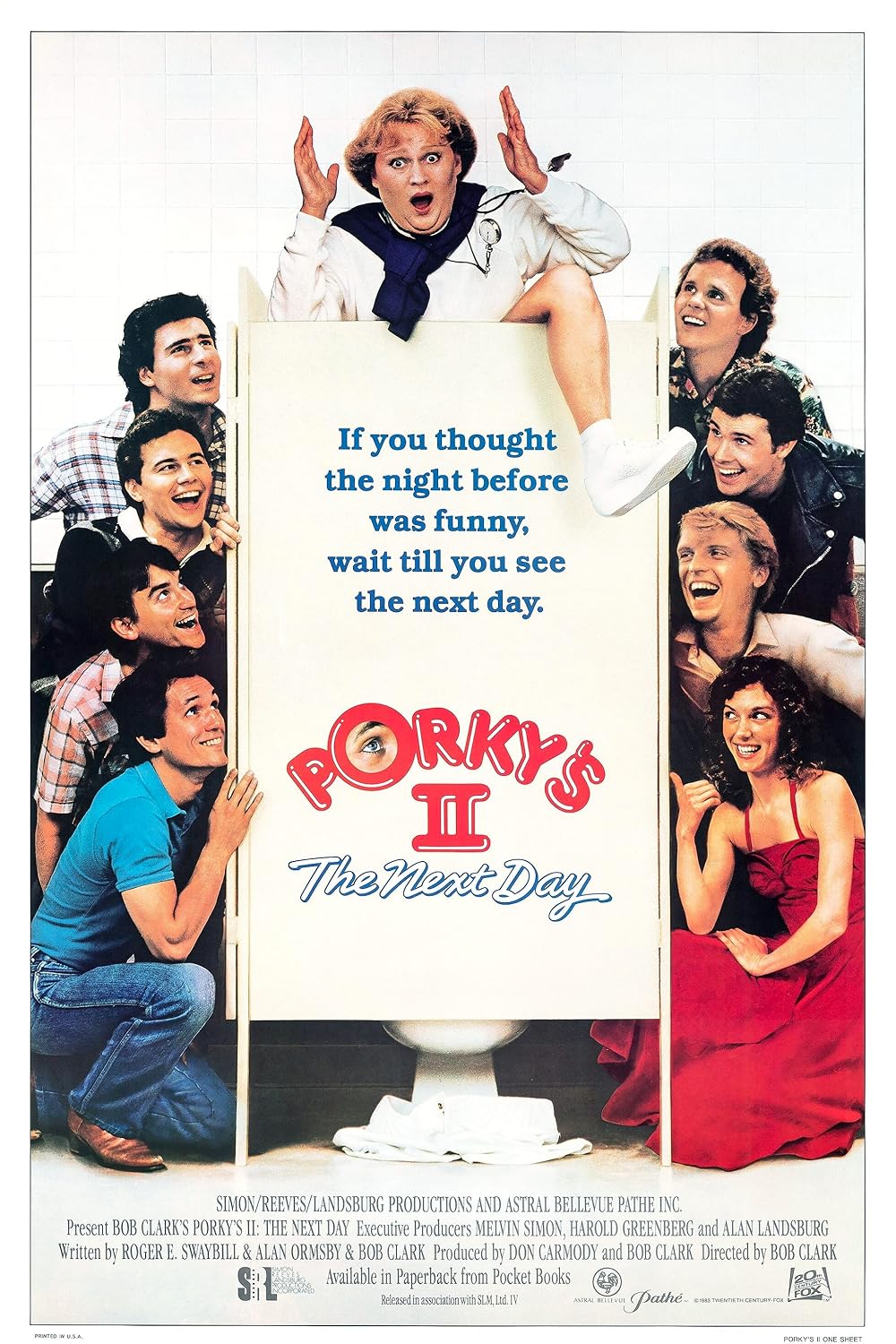
Porky’s II: The Next Day (1983)

By Richard Winters

My Rating: 0 out of 10

4-Word Review: Banning a Shakespeare play.

Now that Pee Wee (Dan Monahan) has lost his virginity to Wendy (Kaki Hunter) they decide that their next project will be putting on a production of ‘Romeo & Juliet’ at their high school, which will be directed by Mrs. Morris (Ilse Earl) Pee Wee’s mother. Problems though ensue when John Henry (Joseph Runningfox), a Seminole Indian, gets cast in the lead where he will then kiss Wendy, a white woman, on stage, which gets the local Klux Klan upset and they proceed to ambush things, so it won’t be able to proceed. There’s also outcry from a local Reverend named Bubba Flavel (Bill Wiley) as he and his religious constituents feel that the play is ‘obscene’ and therefore must be shut down in the name of ‘decency’. The teen cast then visits the office of County Commissioner Bob Gebhardt (Edward Winter) hoping he can use his influence to help keep the play going and while he initially promises them that he will, he eventually renegades. This angers the kids, and they devise an elaborate revenge on not only him, but the Klan and Reverend Flavel.

It’s quite clear that writer/director Bob Clark, who was working on Christmas Story while helming this one, had no idea that the first installment was going to be as big of a success as it was and there had clearly been no plans for a sequel. When the studio came begging for one, he felt obliged and spent 6 months, with the help of two other screenwriters, to come up with something. The result though is a movie in desperate search for a story with a script that’s a mishmash of over-the-top nonsense. What made the first one so good was that as crude as it was it still showed teens as they were with dialogue and situations that rang true, but here all of that gets thrown out with everything played up in an extreme way simply for the sake of a cheap laugh.

The most annoying aspect are the one-dimensional characters particularly the Reverend who is a cartoonish caricature in a silly send-up of a southern preacher. The same goes with the City Commissioner that is well played by Winter, which helps keep it remotely entertaining, but portraying a politician as being sleazy and two-timing is quite cliched and redundant. The return of Beulah Ballbricker, played by Nancy Parsons, is problematic as well. In the first film she was very strict with the rules, but here she’s turned into a religious fanatic, which seems like two different people. The scene where she sits on a toilet and begins singing loudly is dumb. Sure, people may talk on the phone while taking a dump, or read a magazine, or even browse the internet, but bellowing out a loud rendition of ‘That Old Black Magic’ while in a public stall is not one of them making her beyond ‘goofy’ and more into someone who should be institutionalized.

The pranks come off as unnecessarily cruel especially the scene in a graveyard where Pee Wee is made to believe that he accidentally killed a prostitute while having sex with her, which could be quite traumatic for someone and yet his ‘friends’ act like it’s ‘all in fun’. What’s worse is that Pee Wee never brings it up afterwards apparently having no qualms whether a sex worker dies at his hands or not just as long as he’s not blamed, which unintentionally makes him cold and uncaring.

The climactic bit where Wendy dresses up as a big bosomed 17-year-old prostitute who makes a major scene at a posh restaurant in an effort to embarrass the commissioner gets overdone too. For one thing it’s seems awfully extreme to put so much effort to get revenge on what’s nothing more than a tacky high school play with cheap props that isn’t going to make any money and cast members who weren’t all that excited about being in it, so why get so upset if it gets canceled? It also begs the question why these kids are so sure they can get away with their hijinks and not suffer any consequences. The ‘prank’ that gets done inside the restaurant causes a lot of damage and since these teens live in the same community as the adults they would most assuredly get recognized by someone and be either arrested for causing a disturbance and handed a very hefty bill for the repairs, or their parents would, which for them would be just a bad.

The only small funny bit, and I kid you not, comes at the very end during the closing credits, when the head waiter at the now ravaged restaurant tries to save face by convincing the patrons that it had all been an ‘April Fool’s joke’, which got me to chuckle. It’s also kind of amusing how Pee Wee gets so aroused by pics in National Geographic, or sexually stimulated by strippers who aren’t even naked, but just scantily clad enough to excite him anyways, which in this porn saturated era probably wouldn’t be deemed all that titillating, so in that aspect it’s interesting, but everything else is a disaster. It doesn’t even have Porky. How can you have a film titled ‘Porky’s’ if that character never actually shows up though he does reappear in the third installment, which will be reviewed next.

My Rating: 0 out of 10

Released: June 24, 1983

Runtime: 1 Hour 38 Minutes

Rated R

Director: Bob Clark

Studio: 20th Century Fox

Available: DVD, Blu-ray

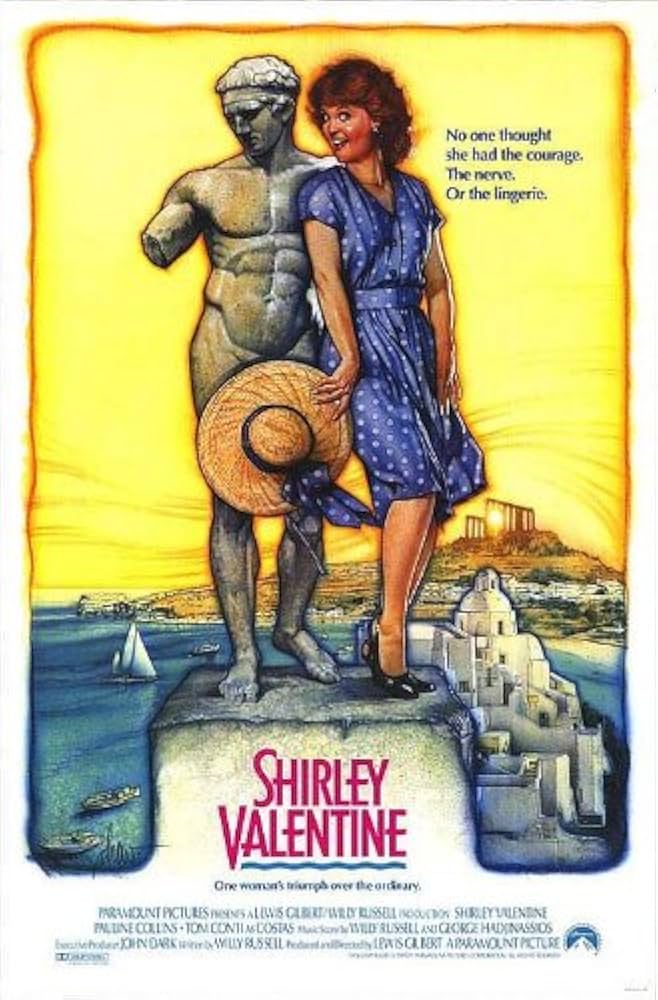
Educating Rita (1983)

By Richard Winters

My Rating: 5 out of 10

4-Word Review: Trying to better herself.

Rita (Julie Walters) is a young working-class woman who finds her job as a hairstylist and marriage to Denny (Malcolm Douglas) to be unrewarding. Denny wants her to have a child, but she fears that will just tie her down more. In an attempt to ‘better herself’ she decides to enroll in Britian’s open university where she takes a course in English literature.  Frank (Michael Caine) is a disillusioned college professor who lost the zeal for his job years earlier and has now taken to the bottle. Rita wants him to be her tutor, but Frank initially resists only to eventually agree. Despite their contrasting personalities the two ultimately form a bond and Frank uses Rita’s passion for learning to reignite his own dormant desires that allows him to breakout of his loveless relationship.  However, Rita too begins to see things differently when her roommate/friend tries to commit suicide and she realizes that things aren’t always greener on the other side of the fence.

The film is based on the play of the same name by Willy Russell that premiered in London in 1980 and also starred Walters in the title role. Unlike the movie the play had only two characters and everything took place inside the tutor’s office.

The story’s theme does have an inspiring quality, which is what galvanized the critics to it, but the main character and her transition is a bit hard to believe. On the surface she’s quite likable and well played by the star, but her ambition seems awfully extreme. It would’ve helped had we seen the moment when she first got the idea to go back to school versus having it just briefly be discussed. Wanting to learn a trade in order to make more money and move out of one’s humble surroundings is both commendable and understandable but becoming well versed on the plays of Henrik Ibsen isn’t really going to do that. To pay the bills she’s still going to be stuck working as a hairdresser, which was supposedly the boring routine she wanted to get out of. Expanding one’s literary knowledge may allow her to have lofty conversations among elites at posh parties, but as a whole she’d still be in her same predicament financially.

The Pygmalion-inspired theme was unnecessary. Without sounding snotty I couldn’t buy into the idea that this working-class woman with a limited education could learn to fully appreciate the great literary works or would even want to. The story acts like all that is needed is a great deal of enthusiasm and you can do accomplish anything, but history is full of people who jump into lofty goals with the best of intentions and still fail. Realistically I think this type of person would’ve eventually gotten overwhelmed and realized she was in over-her-head. To solve this the character should’ve been modified to being someone who was middleclass with a literally background, but who had to drop out because her parents died forcing her to go to work at the factory in order to make ends meet, but still longed to get back into what she really enjoyed and thus hired a tutor to help her, which would’ve been for the discerning viewer easier to swallow.

Rita’s ultimate transition is more off-putting than inspiring. I didn’t like her change in hair color where she goes from blonde to brunette, which makes her seem like a different person instead of someone who’s evolved. There needed to be more challenges and roadblocks. A brief spat with her husband, in which he throws her books into a fire, blows over too quickly and she’s able to grasp the complex material, even able to write in depth term papers with a relative ease that didn’t come off as wholly believable. Having her get a bad grade in a course and using this to reassess her goals would’ve allowed in a broader angle and not have been so fanciful, which the film starts to become.

Caine plays his part wonderfully and he certainly is much more into this role than he was in Blame it on Riowhich he did the same year. However, his character’s motives were difficult to understand. I thought this would’ve been the classic case, which can occur with a lot of academics in higher education, where the students aren’t into learning and are apathetic, which frustrates the professors, and this then turns them to alcohol. Here though that didn’t seem to be the case making him come off more like he was just tuning out on his own accord and thus making him less relatable. I also felt he should’ve been fired much sooner as the young adults attending his classes knew that he was drunk, even verbally said as much, so he likely would’ve been reported, and for him to then on top of this get a second chance when he fell over inebriated during a speech, seemed rather implausible.

I did enjoy the scenes involving Frank’s girlfriend Julia (Jeananne Crowley) and her relationship with a married man named Brian (Michael Williams) and how every time Frank comes into the room, and they are there Brian pretends, as a ‘cover’, that he is speaking to someone on the phone. These scenes, which becomes a running-joke, were amusing, but near the end Frank informs Brian that the phone was disconnected and thus revealing that he was in on their charade. This though doesn’t jive because with the old fashioned rotary phone, such as the ones shown here, there would always be a dial tone when one put the receiver to their ear, except of course if the service had been cut and thus Brian would’ve already known that it had been disconnected when he didn’t hear the tone and no need then for Frank to explain it.

My Rating: 5 out of 10

Released: May 3, 1983

Runtime: 1 Hour 46 Minutes

Rated PG

Director: Lewis Gilbert

Studio: Columbia Pictures

Available: DVD, Blu-ray

Porky’s (1981)

By Richard Winters

My Rating: 6 out of 10

4-Word Review: Revenge on nightclub owner.

Pee Wee (Dan Monahan) is a teen living in the Florida everglades during the 1950’s who suffers from a small penis size, which has prevented him from losing his virginity. He and his high school pals have hatched a plan of pooling their money together and then hiring a prostitute, which they can then all have sex with. Their first attempt doesn’t work out, so they decide to go to a nightclub that sits in a lagoon on stilts and is called Porky’s, which is the nickname of the owner of the establishment, ‘Porky’ Wallace (Chuck Mitchell) that he attained for being overweight. The boys feel they’ll be able to hire one of the strippers at the club to have sex with and Porky agrees to ‘set it up’ and takes their money only to then have the teens fall through a trap door and into the water below. This enrages Mickey (Roger Wilson) who set-up the deal and he becomes consumed with getting revenge on Porky, but when he goes there to ‘settle things’ he gets badly beaten-up, which sends him to the hospital and convinces his friends that even sterner justice is needed in order to get the proper payback.

I remember when this movie came out and there were TV ads capturing people as they left the theaters and getting their first reaction. At the time this was considered ‘outrageous’ and many of the folks in the ad seemed either shocked or embarrassed. Nowadays though it’s unlikely most will consider it extreme, and some might even call it boring particularly in between the moments when it’s raunchy. The idea for it was conceived in 1972 by writer/director Bob Clark who based the story on his own experiences as a teen going to school in rural Florida during the 50’s. The studios though didn’t like the script, and it got shopped around for years before finally getting modest funding out of Canada where it could be used as a tax write-off and thus even though it was filmed in the U.S. by an American director it still gets labeled as one of the highest grossing films in Canadian movie history.

The critics like with the studio heads, didn’t care for it with both Siskel and Ebert naming it one of the worst movies to come out of the 80’s though when compared to the other teen sex comedies from that decade this one doesn’t seem all that bad. The characters have distinct personalities and much of the dialogue while raunchy seemed realistic for that age group and not all that different from what got talked about during my own high school days. The film also manages to tackle some serious topics like antisemitism, which was also a part of that era, so it has an adequate balance and doesn’t just stay hyper-focused on the sex.

On the negative end Nancy Parsons as the female coach version of Nurse Ratched is one-dimensional and Kim Catrall, playing a cheerleader nicknamed ‘Lassie’, plays too much of the bimbo caricature to be even remotely interesting. Neither is the fault of the actresses, who are okay, but more the writer. On the other hand, I loved the bit part of Susan Clark playing a prostitute. She had been in a few Disney movies just before this and later the TV-show ‘Webster’, so seeing her playing against the family image is fun.

I also loved Kaki Hunter who seems just as dirty minded as the guys and how she’s very average looking as I’ve found those types tended to be a little more ‘easy’, as evidenced by her doing it with Pee Wee, in order to get the guys’ attention and make up for not being as attractive versus in other teen flicks where it’s only the super-hot ones that sleep around. In that vein too I enjoyed the fact that during the shower scene when the boys are peeping at the girls there’s an overweight one impacting Pee Wee’s ability to see the thin ones, which is realistic too as in most high schools there’s a mix of body types and not all skinny like most other teen comedies would make you believe.

I did have some problems though with the nicknames mainly with Pee Wee and ‘Meat’ the name for Tony Ganios’ role. Supposedly this is for their penis size, but how would anyone know what their penises looked like? Normally one gets nicknames for physically attributes that everyone can see for instance if they’re a short height they could be called ‘shorty’. Yes, there is a scene where all the boys strip naked together, but their nicknames had already come about long before then. One could argue that maybe it started while they took showers after gym class, but in my high school if some guy was caught looking at another’s genitals, they’d be accused of being ‘gay’, which during that time period would be considered a stigma.

While the plot is lean and there are a few lulls there are enough comical moments to keep it afloat. The segment dealing with Nancy Parsons character going to the principal to ‘report’ seeing a penis in the girl’s shower and advocating for all the boys to undress so she could spot which one had a dick with a mole on it, is a gem especially with the way the camera zooms in on a hanging portrait of a smiling Dwight Eisenhower like even he too is in on the humor. The demolishing of Porky’s bar, which comes near the end, isn’t bad either and helps to make this thing a minor cult classic.

My Rating: 6 out of 10

Released: November 13, 1981

Runtime: 1 Hour 38 Minutes

Rated R

Director: Bob Clark

Studio: 20th Century Fox

Available: DVD, Blu-ray

Celia (1989)

By Richard Winters

My Rating: 8 out of 10

4-Word Review: Revenge for her rabbit.

Celia (Rebecca Smart) is a head-strong 8-year-old living in the suburbs of Melbourne, Australia during the end of the 50’s. She is mourning the recent loss of her grandmother while also fearing the hobyahs, which are mythical creatures she read about in school that she has nightmares about breaking into her bedroom late at night. When Alice (Victoria Longley) and her three children move in next door it allows Celia to get her mind off of things as she becomes fast friends with the kids and even Alice herself, but their relationship is soon hampered when Celia’s father, Ray (Nicholas Eadie), finds out that Alice and her husband are supporters of the Communist Party. Ray forbids Celia from seeing them and offers her a pet rabbit, something she’s wanted for a long time, as a bribe insisting that she can keep the pet as long she no longer socializes with the neighbors. However, this brings up more problems as the Australian government has deemed rabbits to be an invasive species and has outlawed anyone from having one. Burke (William Zappa), the local police Sargent, confiscates the rabbit in the middle of the night and then it’s later found dead while being housed at the local zoo causing Celia to come up with a devious plan in order to exact her revenge.

The film, which was inspired by a news article writer/director Ann Turner read when she was 24 involving the rabbit invasion that plagued Australia during the 50’s, is labeled a horror movie, though in a compromised form as IMDb calls it a ‘folk horror’ while other movie sources call it a ‘horror drama’. In any case fans of the conventional horror film may not take to this or find it off-putting as the typical scares and tension are not present. There are some creepy moments particularly the dream sequences involving the hobyhahs, which I wished had been in it more, and a segment dealing with Celia’s dead grandmother tapping on her bedroom window late one night, but overall, that’s about it. Most of the rest of the film comes-off more like a coming-of-age drama, which is excellent, but the real disturbing part doesn’t come until the very end. It’s effective and well earned, but whether all viewers will be patient enough to wait for it I’m not sure.

With that said it’s still a great movie with characters that are three dimensional, something that Australian cinema does very well, and the viewer gets wrapped up into the drama quite quickly. The best element is that the kid characters are genuine. These are like real children that I knew growing up where they could be cute and precocious one minute and mean and bratty the next. The inner rivalries that Celia has with the other kids in the neighborhood are quite real too. Kids don’t just automatically get along, there can be contrasting egos and personalities that can easily get in the way, just like with adults, that can quickly turn playmates into enemies. It’s rare that I can say this, but I really felt while watching this, that I had been transported back into my own childhood as the encounters and exchanges very closely reflected my own in many ways.

The adults are portrayed much better here too. Usually, movies that revolve around young people have the grown-ups stigmatized in one extreme or the other. Either they’re clueless dimwits that are totally out-of-it or overly controlling. Here though they’re well meaning, but so busy with their own lives that just can’t stay attuned with everything their kids are doing and much of the time is spent with them just trying to catch-up with the drama that they didn’t even know was occurring. Celia’s father isn’t mean here either, he simply has a different perspective of things and doing what he thinks is best for his child even as this gets Celia to hate him but like with many households this type of scenario can and does happen even with the best of intentions.

Spoiler Alert!

The ending should leave you with an unsettling feeling when it’s over. This is the rare time when if fully works too. No loose ends, or loopholes. Everything fits perfectly with the characters fleshed out so it all makes sense. This is also a unique film in that there really aren’t any villains. No one is ‘bad’, or ‘evil’. It’s just people, young and old, with different ideas about things and their inability, through no real fault of their own, to effectively communicate it to the other, or for the other to fully listen and understand, which is ultimately what makes it so horrifying as this could easily and believably happen anywhere.

My Rating: 8 out of 10

Released: March 3, 1989

Runtime: 1 Hour 43 Minutes

Not Rated

Director: Ann Turner

Studio: Seon Film Productions

Available: DVD, Blu-ray

Student Bodies (1981)

By Richard Winters

My Rating: 6 out of 10

4-Word Review: Who is ‘the breather’?

A killer, simply known as ‘the breather’, is stalking students of Lamab High School. His first victims are Julie (Angela Bressler) and her boyfriend Charlie (Keith Singleton). He then proceeds to hack away more students with the police seemingly unable to do anything about it. Fellow student Toby (Kristen Riter) decides to take matters into her own hands by investigating things on her own only to end up getting incriminated as the killer, which forces her to try and convince others that she’s not the one.

This film, like Jekyll and Hyde…Together Again, is the product of the 1980 writer’s strike where Paramount was looking for scripts that could be produced on a modest budget with a nonunion crew in an effort to have some movies released to the theaters while the strike wore on. This was deemed at the time to be a perfect fit as studio heads were impressed with the box office smash Airplane that had come out a year earlier and been a parody of disaster flicks and they were hoping this film would not only cash in on audiences that had liked that one, but also for those who were into slasher films, which at the time were proving to be quite popular. The end result was a modest success with the movie making a $5.2 million profit off of a $510,000 budget. Though it really didn’t obtain its cult following until it began airing on late night cable TV during the 90’s.

While there had been horror movie parodies before those made fun of the standard haunted house theme while this was the first to satirize slasher movies, which up to that point had only been around for a few years. I was though leery as this was written and directed by Mickey Rose, best known as a script collaborator on many of Woody Allen’s movies, but who had ventured on his own to write and direct I Wonder Who’s Killer Her Now? 5 years earlier, which I considered incredibly lame and feared more of the same here. However, to my surprise, this one wasn’t bad, with probably the best moments coming right at the start, which is a perfect send-up of When a Stranger Calls. What makes this one work is that those behind the scenes, including the talented writer Jerry Belson and producer Michael Ritchie, is that they had clearly watched a lot of horror movies and therefore the humor, at least at the beginning, is laser sharp, versus other horror parodies, including Pandemonium, which came out a year later, that seemed to be made by people who really hadn’t watch horror and were just throwing in any dumb gag that they could.  The film also has an engaging protagonist, played by Riter who gives a splendid performance and it’s a shame this was her only movie.

Of course there are some detractions. The onscreen titles that flash on every once in a while, get annoying. I didn’t mind it alerting us to the body count, including when Riter kills a fly, which gets considered as a ‘1/2’ a death, but flashing on every time someone leaves a door unlocked, became a bit overdone and heavy-handed. There’s also a few ‘ program interruptions’ like when a spokesman comes on to advise that he must say the work ‘fuck’ in order to get an R-rating as those movies tend to make more money, which while somewhat funny, gives the film too much of a skit-like feel.

The film also lacks any gore or violence even though that was the whole mainstay of slasher movies to begin with. There could’ve been several reasons for this, but I think the main one was that the cultural elites at the time, and I know because I was around then, considered slasher films to be ‘lowbrow’ and onscreen blood effects as ‘tasteless’. The chic argument was that horror movies shouldn’t need gore to be scary and slasher flicks were simply a ‘passing fad’ that would eventually die off into obscurity though 40 years later the exact opposite has happened. Horror movies are now the fastest growing genre and the ‘distasteful’ slasher films of the 80’s are now considered classics. Films like Shaun of the Dead have proven that you can have a lot of blood and guts and still be funny, so this movie misses out and leads to a very boring middle half in which the humor starts to become strained mainly because they run out of ideas, which some funny gore could’ve helped fill-in. It also makes it seem like only half a parody when the main modern horror ingredient, the violence, gets completely glossed over. 

Spoiler Alert!

I did though really like the wrap-up, despite Leonard Maltin, who called the ending ‘really bad’. I considered it one of the best aspects especially the dream sequence where Riter goes down the school’s hallway and victims seemingly come back to life and pop-out of the classroom doors. The Wizard of Oz spin in which the characters from the dream, which is basically the entire movie, are shown to have the exact opposite personalities in ‘real-life’ when Riter wakes-up, I found to be quite creative. I got kick out of the Carrie take-off too, which I knew had to be coming at some point, that had Riter’s hand bursts out of the ground after she’s dead. My only quibble here is that, since it was her boyfriend who killed her and he’s the one bending over her grave, there should’ve been a knife in her hand when it comes out of the ground and thus stabbing him in revenge. 

My Rating: 6 out of 10

Released: August 7, 1981

Runtime: 1 Hour 25 Minutes

Rated R

Director: Mickey Rose

Studio: Paramount

Available: DVD, Blu-ray, Amazon Video, YouTube

Tenebrae (1982)

By Richard Winters

My Rating: 5 out of 10

4-Word Review: Novelist hounded by stalker.

Peter Neal (Anthony Franciosa) is a successful novelist who travels to Rome, Italy to promote his latest work titled ‘Tenebrae’. Once he arrives, he is soon met by detective Germani (Giuliano Gemma) who advises him that a murder has recently been committed that was done in the style of one that occurred in his book. Neal scoffs that anything he’s written could’ve motivated someone to kill, but soon after he receives an anonymous letter from the murderer detailing how he’s going to commit more killings using methods that Neal described in his book. This then sets Neal off on doing his own investigation convinced that the police have a ‘tunnel vision’ and only he can find the true culprit using his own detective skills that he acquired while doing research on his book.

The film was inspired by writer/director Dario Argento’s own experiences that he had while meeting a fan via the telephone who initially introduced himself as being a great admirer of his work. The calls were friendly in nature at the beginning but became increasingly more menacing as time wore on. Argento eventually was threatened by the fan who claimed that his film Suspiria had affected him mentally and he wanted to harm Argento in the same way his movie had ‘harmed’ him causing Dario to leave the U.S. and return to Italy for his own safety, which is where he began writing the screenplay for this movie.

The sets are atypical for an Argento movie as they lack the garish colors and shadowy interiors most noted in his other films and this was intentional as he wanted to give the film a more ‘futuristic’ look and a one-note color scheme that more closely resembled cop TV-shows, which he felt the story reflected. Visual change is refreshing and helps the action seem more reality based versus in his other movies where everything seemed like it was set in someone’s dark fantasy in some parallel universe though I wasn’t as crazy about the camerawork, which was highly praised by others. Some may find the three-minute tracking shot that goes from one apartment window and across the complex to be captivating, but I found it more dizzying and unnecessary.

The story holds enough adequate suspense to remain moderately riveting and the pounding soundtrack by the rock group Goblin holds the tension. American actor Franciosa is nicely cast though Argento apparently had many behind-the-scenes conflicts with him, but the guy, despite his career decline, looks almost ageless and I was impressed with the opening bit where; despite nearing 60, he’s seen biking down a busy highway amongst tons of traffic with seemingly no worry or sweat. John Saxon though, the only other American in the movie, is badly wasted in a part that doesn’t give him much to do other than make a big deal about his hat that he seems quite fond of. Thankfully though, despite other performers having their voice dubbed, the film was shot in English in order to broaden its American appeal and so both of these actors speak with their actual voices while it’s quite evident with the others that they’re not.

The biggest disappointment for me were the special effects that look cheap and done with no imagination. The blood is bright colored and looks like dye mixed with water. The victims show no actual cuts, or abrasions and the blood appears painted on, or gently poured on via a cup and didn’t look authentic. There are also some ill-advised reaction shots where the film will quickly cutaway and show the victim looking scared with their mouth agape that came off as unintentionally funny. The only real frightening moment comes when a young lady gets chased down a dark street by a large dog who ultimately traps her inside the house of the killer, but other than that I was wanting way more than this film seemed able to give. I did though like one murder scene, which is purportedly one of Quentin Tarrantino’s all-time favorites, that features a woman getting her arm cut off and then proceeding to turn around and paint the walls of her apartment with its spurting blood though even this gets compromised because you can plainly tell it’s a mannequin arm when the ax goes through it.

The story gets a bit convoluted too as it adds in a flashback scene, without telling us it’s a flashback, involving a prostitute, played by Eva Robin’s, who really does spell her name with an apostrophe, and some teen boys that she meets on a beach. Only at the very end does it come into focus what this scene, which gets interspread throughout, means to the story, but until then it’s rather confusing why we’re seeing it and even a bit off-putting. It also features the prostitute as having a perfectly chiseled super model’s body, which I didn’t feel was realistic, and even though it’s supposed to be set decades earlier from the present day no effort was made to make it seem like it was shot in a bygone era.

Spoiler Alert!

The twist ending may be a surprise to some as ultimately, we learn that there wasn’t just one killer, but two of them. One being a TV interviewer named Christiano, played by John Steiner, who kills the first several due to his feelings that the victims were ‘immoral’ and then the last few committed by the protagonist himself. However, I started to suspect Franciosa when he’s found conveniently hit over the head by a rock, which supposedly ‘incapacitated’ him though I thought it was simply a ploy to divert attention away from him, so for me the final reveal was very predictable. Logically it doesn’t completely hold up either as his friend Gianni, played by Christian Borromeo, witness Christiano getting killed by Franciosa, though in disguise, and then runs back to the backyard bushes where Franciosa is supposedly hiding, but it didn’t seem like Franciosa would’ve had enough time to leave the murder scene and get back to the bushes before Gianni got there.

My Rating: 5 out of 10

Released: October 27, 1982

Runtime: 1 Hour 41 Minutes

Rated R

Director: Dario Argento

Studio: Titanus

Available: DVD, Blu-ray, Amazon Video, Plex, Tubi

Julie Darling (1982)

By Richard Winters

My Rating: 7 out of 10

4-Word Review: Wanting father to herself.

Julie (Isabelle Mejias) is a possessive daughter with weird interests like having a pet snake in which she enthusiastically feeds it live mice much to the shock of her best friend (Natascha Raybakowski). She also shows an unhealthy affection for her father (Anthony Franciosa) even going as far as fantasizing about making love to him. Because of this she hates her mother (Cindy Girling), so when her mom is attacked one day by the delivery boy (Paul Hubburd) she does not make any attempt to stop it despite having a rifle in her hand. Instead, she watches him crush her mother’s head onto the cement floor, which instantly kills her and then later when he is a part of a line-up at a police station she does not identify him and allows him to go free, but she does this for ulterior reasons. As her father has remarried to Susan (Sybil Danning) causing her jealousy to start all over again and motivating her to ‘hire’ the delivery boy to do what he did to her mother to Susan.

This is a surprisingly inventive story that works for the most part despite the majority of the action taking place in one setting, namely the house, which creates a boring visual. I was a bit taken back why this isn’t better known, or at the very least acquired a small cult following, though the fact that it has very little gore, with the exception of the groin stabbing via a glass bottle, it may have been enough to turn off the horror diehards though if you’re a patient viewer the climax should be rewarding.

Unfortunately, there are some eye-rolling moments as well. The mother’s inability to pick-up on the fact that the delivery guy was coming on to her even after making remarks about her ‘nice figure’, until it was too late didn’t jive with me. I’ve found females are very alert to guys making a pass to them, or ‘flirting’ as it were, so having this woman be completely oblivious, especially when the guy was at the age where you’d expect him to make some moves, proved unrealistic. The father’s relationship with Danning needed better fleshing out. Apparently he was already having a hot-and-heavy- relationship with her without the mother or daughter being aware, which is kind of hard to do, but most of the time the other woman doesn’t want to stay in that position forever and usually pushes the guy to get a divorce, so at the beginning of the movie he shouldn’t have been so conciliatory to the wife’s demands like he is, knowing of course that he already had a ‘spare tire’, and instead used that as an opportunity to request a break-up.

Having Danning move in with the father, and even get married to him, so soon after the wife’s murder should’ve created suspicion with the police chief. Normally the husband is always the initial suspect in these types of investigations especially since the daughter states that she didn’t get a good look at the assailant and could not describe any defining features, which means it could very well have been the husband who did it, or hired someone to do it, in order to get her out of the way and bring his new lover in and the fact that the cops never ever consider this makes them quite inept.

Mejias is badly miscast in the lead. Her moody facial expressions signal right from the start that she’s a psycho nutcase and there’s no character arc, or transition making all of her scenes one-dimensional. What’s worse is that she’s supposedly playing someone who’s 10-to-12, but even with being dressed in clothes for a pre-adolescent she still looks to be at least 16 and in fact was actually 20 at the time of filming. Having an actual age-appropriate child actor in the role with a more angelic face would’ve been far more interesting particularly if she were portrayed as being a ‘good girl’ at first and then had her dark side slowly emerge later. 

Despite all this I still found the twists that occur during the final 30-minutes makes up for the most part the other issues. While it’s remained obscure, I feel it has cult potential. Horror fans tired of the same old formula may enjoy its offbeat nature. 

Alternate Title: Daughter of Death

My Rating: 7 out of 10

Released: May 21, 1982

Runtime: 1 Hour 30 Minutes

Rated R

Director: Paul Nicholas

Studio: Twin Continental

Available: DVD, Blu-ray, Amazon Video, Roku Channel

The Dead Pool (1988)

By Richard Winters

My Rating: 4 out of 10

4-Word Review: Harry marked for murder.

Inspector Harry Callahan (Clint Eastwood) is still getting ambushed by assassins hired by the criminals he puts away. The department decides to assign him with a new partner, Al Quan, (Evan C. Kim) who’s judo skills will come in handy. The two begin working on a case involving a dead pool, which is a list of San Francisco area celebrities that are expected to die soon either by natural causes, or by murder. The list was created by B-horror director Peter Swan (Liam Neeson) who immediately comes under suspicion when one of the stars of his own movie, Johnny Squares (Jim Carrey) turns up dead from what initially seemed like a drug overdose but later deemed murder. Harry is not happy to find his name is also on the list and this leads to an interview by local TV-reporter Samantha Walker (Patricia Clarkson) who wants to do a bio on him, but Harry resists convinced that she’s only trying to exploit the situation for ratings. 

This marked the fifth and last entry in the Dirty Harry series, which was a film Eastwood had not wanted to do, but was a part of the bargain he made with Warner studio in an effort to get his pet project Bird, which was a bio of jazz musician Charlie Parker, financed. Eastwood along with the studio were aware that that film most likely wouldn’t be a box office hit, so he agreed to do this one, which was sure to be a definite money maker. Yet this one ended up being the least successful of all the films from the series and ultimately helped hasten an end to ever producing another one. 

The formula had clearly run its course by this point, and the action is too predictable to be fun anymore. Things start out absurdly right away when the car Harry is driving gets hit with a hundred different bullets and yet our hero comes out completely unscathed, but there’s no way that could’ve realistically happened. Since the film’s theme is a movie-within-a-movie this part should’ve been done as a cameo appearance that Harry did for one of Swan’s movies, which might’ve offered a cute twist, or an even better idea would’ve had Harry getting injured by one of the bullets and no longer able to, at least for a while, use his hand to pull a trigger and thus forced to come up with creative ways to put away the bad guys, which would’ve added a needed wrinkle that would’ve kept this sequel fresh and different from the others versus the stale way that it quickly becomes.

Teaming him up with an Asian American isn’t interesting either. The other entries all dealt with him partnering with a minority, so by this time the concept lacked any edge. It also wastes Kim’s talents as it’s kind of cool seeing him take down bad guys using his karate talents, but unfortunately, it’s only shown once briefly when it should’ve been spread out all the way through. Having Kim and Harry not see eye-to-eye on things or even challenging his approach would’ve offered some dramatic energy, but overall, the scenes between them, where Kim is compliant and easy going just like all of Harry’s previous partners, makes their moments generic and dull. 

Spoiler Alert!

Harry’s relationship with the reporter is equally unengaging. At first the two sparred and I felt that’s where it should’ve remained but having them eventually ‘connect’ saps away all of the potential spice. Even the mystery angle gets botched. Granted we really don’t know who the killer is as his identity during the killings isn’t shown though we’re led to believe it’s Neeson then it turns out it’s somebody completely different, but it’s a character that isn’t shown upfront, so the viewer can’t try to figure out who it is on their own and the ultimate explanation for what motivates the killer is too pseudo psychological. The final confrontation that he has with the villain, played by David Hunt, who again is a weaker actor and not completely right for the part (Neeson would’ve been far better) is so achingly cliched that it’s almost laughable. 

It does feature a unique car chase, which was one of the few elements from Steven Sharon’s original script that the producers decided to leave in, that has Harry driving a regular sized car as he desperately attempts to outrun a miniature toy car that’s packed with explosives. Everything else though is quite formulaic and uninspired. It’s a good thing that this was the last one as any more would’ve just tarnished the brand further though it would’ve been good to have some finality to it. Instead of just having Harry walk-off after killing what seems to be his 500th bad guy he should’ve been shown handing in his badge and retiring as he was at that age anyways and after having gone through all the violent ambushes he had most would’ve done it much sooner.

My Rating: 4 out of 10

Released: July 13, 1988

Runtime: 1 Hour 31 Minutes

Rated R

Director: Buddy Van Horn

Studio: Warner Brothers

Available: DVD, Blu-ray, Amazon Video, YouTube

Sudden Impact (1983)

By Richard Winters

My Rating: 6 out of 10

4-Word Review: Harry investigates revenge killings.

Inspector Harry Callahan (Clint Eastwood) continues working in the San Francisco police department despite his perpetual disregard of proper police procedures, which gets many of the crooks that he has arrested freed due to legal technicalities. His superiors are frustrated with him, but since he does get results keeps him on the force though reassigned to the small town of San Paulo where he works with a sheriff Jennings (Pat Hingle) in hopes he’ll be less problematic. It’s there that he comes upon a case of various men being found shot to death in similar ways. This is being done by Jennifer (Sondra Locke) an artist in residence who 10 years earlier was raped along with her younger sister by a group of men and now she’s out to get her revenge by killing them off one-by-one. Harry is starting to piece together the clues but is surprised that Jennings is reluctant to follow-up on them giving him the impression that the sheriff may have something to hide.

The story is based on a script written by Charles B. Pierce better known for his rural horror movies from the 70’s that were shot in Arkansas and loosely based off of real events like The Town that Dreaded Sundown. This was meant to be a starring vehicle for Locke, but when Eastwood decided to renew the franchise after several years of dormancy, he felt the plotline here would be a good fit for the next Dirty Harry movie and thus hired Joseph Stinson to revise it.

The result is a mish-mash that’s never quite as compelling as it should. For the majority of the runtime Eastwood’s heroics and Locke’s crimes are working in a parallel universe and not connected making it seem like two different movies. Harry’s non-stop shootouts with crooks becomes redundant and cartoonish while Locke’s killings and flashbacks make it too reminiscent of other better-known films like I Spit on Your Grave and Death Wish. The bad guys are caricatures to the extreme making their moments boring and predictable. If the violence wasn’t so over-the-top you’d be convinced, like critic Pauline Kael mentioned in her review, that this thing was meant to be a parody.

Locke and Eastwood are both good and this is the last film that they did together as a couple before their break-up. In Locke’s case I liked how her cynical and brash persona mixes with Eastwood’s brooding and quiet one. Eastwood speaks more here than in the previous entries, but the character doesn’t seem to be evolving. The opening scene inside a courtroom where Harry is shocked to learn that the criminals he apprehended will be set free because he didn’t get a search warrant seemed ridiculous as after being on the force for so many years, and going through the exact same predicaments in the earlier films, that you’d think by now he’d learn his lesson and do things that conform within the legal framework, or at the very least not be so surprised when a judge sees it differently. The number of near-death shootouts he goes through is exhausting making me wonder how he maintained his mental state and didn’t take the vacation time when he’s asked even if he’s ‘not up for it’.

My biggest grievance though is with the structure. I really felt it would’ve worked better had it been approached as a mystery. We could’ve still seen the killings being done, but the identity of the killer would’ve been masked. Instead of Locke being an artist she could’ve been on the police force working on investigating the case and Harry could’ve started up a friendship/quasi relationship with her and at the start been impressed with her work only to slowly become aware that she was intentionally mudding the evidence. Sheriff Jennings too could’ve initially been portrayed as a ‘good guy’ with down to earth sensibilities that Harry liked and then as it progressed would his intentions become more dubious. The flashback sequences, which get interspersed throughout, could’ve instead been saved until the very end.

Spoiler Alert!

The film also continues to reveal Harry’s zig-zagging moral logic. In the first film he was all for playing outside the rules, then in the second installment he came to determine that vigilantism wasn’t the answer. Now here, by letting Locke off-the-hook and not arresting here, he’s acting like street justice is okay. It makes you wonder; is he really growing as a person and seeing things differently or simply floating along with whatever way the plotline wants?

My Rating: 6 out of 10

Released: December 9, 1983

Runtime: 1 Hour 57 Minutes

Rated R

Director: Clint Eastwood

Studio: Warner Brothers

Available: DVD, Blu-ray, Amazon Video, YouTube