Category Archives: 70’s Movies

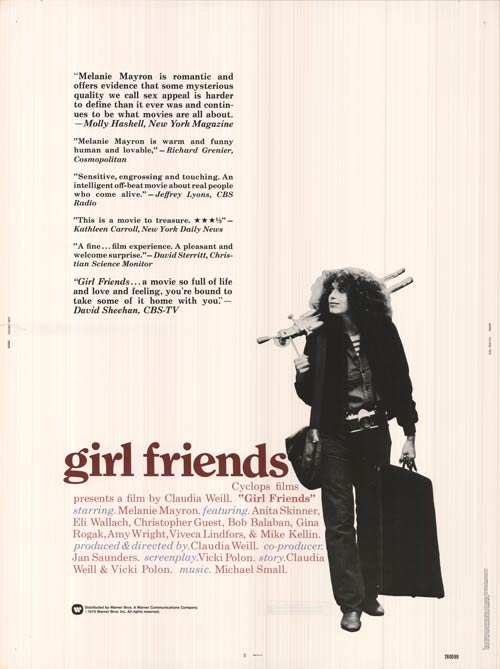
Girlfriends (1978)

By Richard Winters

My Rating: 6 out of 10

4-Word Review: She misses her friend.

Susan (Melanie Mayron) and Anne (Anita Skinner) are best friends and roommates, but when Anne decides to get married to Martin (Bob Balaban) and move out Susan can’t handle the solitude. She picks-up a hitch-hiker named Ceil (Amy Wright) who moves in for a bit, but it doesn’t work out. She then gets into a relationship with Eric (Christopher Guest) and even a 60-year-old married rabbi (Eli Wallach), but both of these end in heartache. The more Susan tries to ‘move-on’ the more she longs for the old days with Anne and Anne starts to feel the same way.

This was Claudia Weill’s feature film debut that met with high accolades including director Stanley Kubrick who considered it his favorite film of 1978. There’s a nice understated quality here that not only brings out a vivid late ‘70s feel, but also the very real day-to-day struggles of a young adult trying to swim through the quagmire of relationship and career obstacles. Melanie Mayron is certainly not a beauty by the conventional standard, but her plain appearance helps accentuate the challenges of the regular person trying to break-out and get noticed.

Susan’s struggles at trying to become a full-time photographer had me hooked the most as it portrays the universal challenges anyone can have in trying to get ‘their foot-in-the-door’ no matter what the profession, but I was a bit stunned when she forgets about the exhibition of her work at an art show. If someone is truly excited about getting their first big break then there is simply no way that would happen. It’s also hard for the viewer to completely empathize with someone’s career struggles if they themselves aren’t doing all they can to achieve it.

Another misguided wrinkle to the story was Susan’s relationship with a married rabbi who was almost 40 years older than her. These types of relationships suffer from extraordinarily long odds  and just about anyone would realize that from the get-go, which makes Susan’s ‘shocked’ reaction when the rabbi is unable to get together for a date due to family obligations seem almost  irrational. How a relationship like this could even begin to blossom is a whole other issue that never even gets addressed.

The film suffers from a few awkward scenes too. One has Wallach sitting down to play a game of chess with Melanie only for him to get up a minute later and leave for no reason. Why does he bother to show up for a chess game if he isn’t even going to make a single move on the board? Later Viveca Lindfors appears wearing a neck brace and yet no explanation is ever given for why she has it on. Later she’s shown without it, so why did she have it in one scene and not the other? Maybe it was for a minor accident, which can happen, but film is a visual medium and when something slightly askew gets shown it needs to get addressed even if it’s just in passing otherwise the viewer will key in on that and not the story.

Even more amazingly, and I can’t believe I’m saying this as I’ve never seen it in any other movie that I’ve ever watched before, but there’s an actual scratch on the camera lens that can be spotted in just about every scene. It appears on the top right hand side as a small white mark. If the sun is shining through a window it will reflect the light and be more pronounced. If a character walks in front of the window it fades a bit, but you can still see it and this continues throughout the entire run of the film. I can only presume that cinematographer Fred Murphy was aware of this, but due to the budget constraints they didn’t have enough money to replace the lens and decided to simply chug along with the scratch in place and hope no else would notice.

Ultimately though I found the story, in its simple way, to be touching and poignant this is particularly evident at the end where the viewer can see firsthand how friendships help add insight and support to a person’s life and are an important dimension to the human experience.

My Rating: 6 out of 10

Released: August 4, 1978

Runtime: 1 Hour 26 Minutes

Rated PG

Director: Claudia Weill

Studio: Warner Brothers

Available: DVD-R (Warner Archive), YouTube
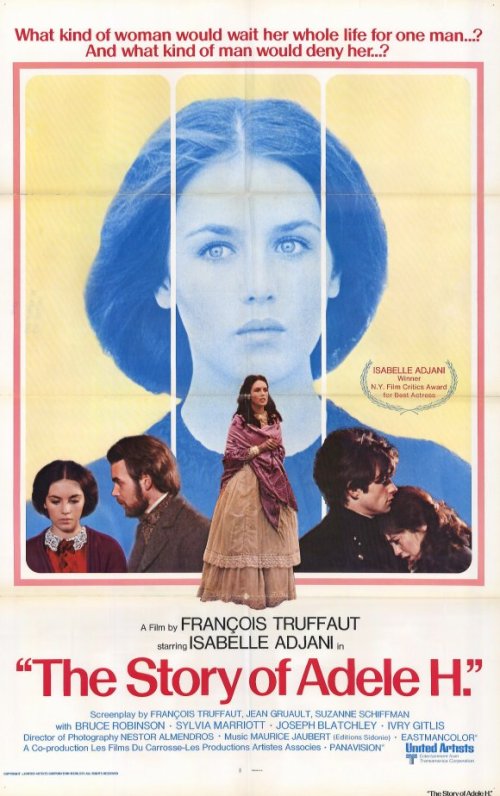
The Story of Adele H. (1975)

By Richard Winters

My Rating: 7 out of 10

4-Word Review: She obsesses over soldier.

Based on actual events the story centers around Adele Hugo (Isabelle Adjani), the second daughter of famous French writer Victor Hugo, who in 1863 travels across the Atlantic to Halifax, Nova Scotia where she tries to rekindle her relations with Albert Pinson (Bruce Robinson). Pinson is now an officer in the British army and no longer has any interest in Adele. Adele though refuses to accept his rejection and makes numerous attempts to get him to marry her. The more indifferent he becomes the harder she tries, which eventually drives her into a complete madness.

Director Francois Truffaut took the accounts from Adele’s actual handwritten diary to help recreate the story. Unlike most films nothing was altered from the documented facts and although the stalker /jilted lover theme may seem like an overused storyline by today’s standards it was still a fresh topic back in the ‘70s and one of the first documented cases in human history of what has now become known as erotomania where a person becomes convinced that the object of their desires is in love with them even when they really aren’t.

What helps this film to stand out is that the audience isn’t made to fear the woman and her actions are not portrayed as being menacing. Instead the viewer feels genuinely sorry for her as we witness firsthand how debilitating mental illness can truly be as it destroys this otherwise beautiful woman’s personality and leaves her only a shell of a person in the process.

Adjani is excellent and although the film remains compelling it still comes off as feeling incomplete. Part of the problem is that we only see the character at one stage of her life. Reportedly in real-life Adele only started to show signs of mental illness when she reached her mid-20’s, so it would’ve been interesting to have seen scenes from when she was younger and behaving more normally. Flashbacks of when Adele first met Pinson, who was initially interested in Adele and even proposed marriage to her, would’ve been intriguing to see as well.

We’re never shown Adele’s relationship to her father either, which could’ve been quite revealing. We hear voice-overs from when he sends her letters, but seeing the two interrelate in-person was needed. This may have been the result of Truffaut given the rights to film the story by Jean Hugo, but only if Victor Hugo did not appear onscreen, but in either event the film is lacking in budget and scope where a wider biopic of the woman’s life would’ve been more satisfying including showing her later years while inside a mental institution, which gets only glossed over here.

As in most cases what occurred behind-the-scenes while the film was being made is sometimes more interesting that what happened in front of the camera and this production proved to be no exception as the cast and crew went through many of the same scenarios as the characters. Truffaut tried to start up a relationship with Adjani, but was rebuffed and then she turned around and had an affair with the actor who plays the character that rebuffs her character in the movie. This caused Truffaut great jealousy as he was forced to deal with the two’s affair from afar much like Adele had to do in the story when Pinson eventually marries someone else. Truffaut later described making this movie and dealing with his unrequited love for Adjani as a ‘daily suffering’.

My Rating: 7 out of 10

Released: October 8, 1975

Runtime: 1 Hour 50 Minutes

Rated PG

Director: Francois Truffaut

Studio: United Artists

Available: DVD, Blu-ray, Amazon Video

McQ (1974)

By Richard Winters

My Rating: 3 out of 10

4-Word Review: Old cop breaks rules.

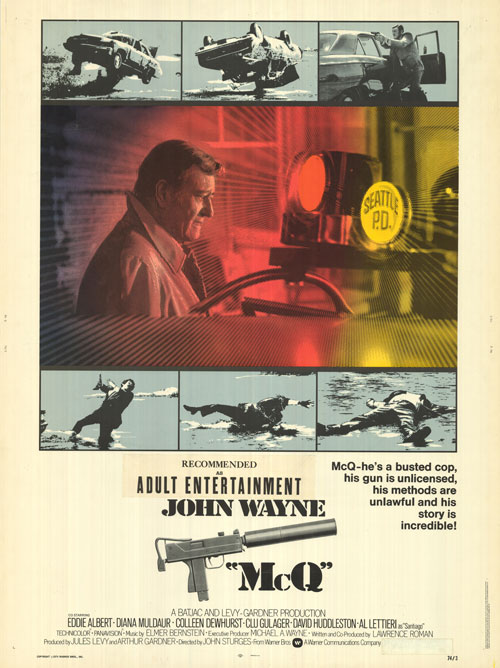
Lon ‘McQ’ McHugh (John Wayne) is a retired cop lured back onto the force to investigate the death of his former partner Stan Boyle (William Bryant). Boyle was shot dead in a deserted alleyway and the head of the homicide division (Eddie Albert) thinks it’s the work of radical militants, but McQ has other ideas. He believes local narcotics dealer Manny Santiago (Al Lettieri) is behind it and he goes after him with a vengeance only to learn that the corruption lies far deeper and the bad guys may have infiltrated his own department.

Wayne’s ego was bruised when he had lost out in his bid to star in Dirty Harry as director Don Siegel felt he was just too old for the part, so he went on a mission to prove them wrong by not only playing a tough-guy cop here, but also a year later in Brannigan.

However, the aging Duke looks completely out-of-shape. Since a 1965 operation Wayne was unable to run due to having only one lung and could barely even walk long distances without needing oxygen. His acting style was by this time completely passé. The rest of the cast were consummate method actors genuinely trying to create a different character while Wayne simply plays himself for the hundredth time, but only without the cowboy outfit.

I was also not sure whether he was wearing a wig or it was just dyed, but it looks terrible either way. For my money it’s a rug, which I found amusing as this was a man who built his reputation on being tough and gritty and yet too vain to simply let himself age gracefully, which even if he was completely bald by that time would’ve looked infinitely better than the thing he had plopped on his head.

The run-of-the-mill plot offers few twists and no interesting characterizations or dramatic angles and is saved only by the Seattle scenery and some really cool car chases. One includes Wayne chasing a laundry truck while driving his vintage 1973 Pontiac Firebird Trans Am only to become confused about which truck he is after when a completely identical one suddenly comes onto the scene. There’s another thrilling chase at the end that was shot on the Olympic Peninsula and an equally exciting moment when Wayne’s Firebird gets crushed from both ends by two Big Mac trucks while it’s parked in an alleyway. You also get to hear Wayne deliver his immortal line: “I’m up to my butt in gas!”

My Rating: 3 out of 10

Released: January 4, 1974

Runtime: 1 Hour 51 Minutes

Rated PG

Director: John Sturges

Studio: Warner Brothers

Available: DVD, Amazon Video, YouTube

City on Fire (1979)

By Richard Winters

My Rating: 3 out of 10

4-Word Review: Title says it all.

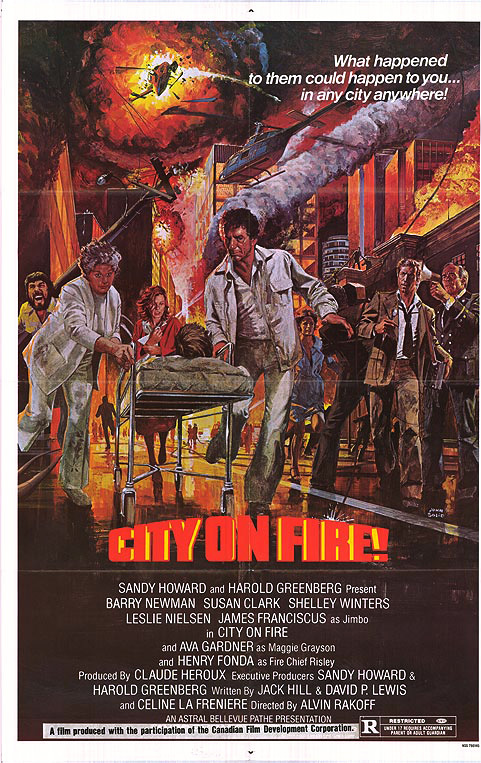
When Herman Stover (Jonathan Welsh) gets fired from his job at an oil refinery he decides to get his revenge by opening the valves on the storage vats, which sends gasoline spewing out into the water system that soon sets the entire city on fire. Dr. Frank Whitman (Barry Newman) realizes that his hospital is in line of the approaching blaze and tries desperately to get the place evacuated.

Despite the American cast the film was financed by a Canadian production company and filmed on-location in Montreal with a few shots done in Toronto. While the movie bombed at the box office and later got mocked in an episode of ‘Mystery Science Theater 3000’ it’s actually decent on the special effects end.

In fact I found the effects to be quite impressive particularly at the beginning where two firefighters find themselves trapped in an apartment building in an actual blaze where the flames literally leap towards the camera and make the viewer feel like they are being engulfed by it. Most movies will show people set on fire, but only while wearing a protective body suit, but this one has them set ablaze while wearing regular clothes and with flames not only shooting out from their clothing, but their hair as well, which looked dangerous to film. It also graphically captures the charred burned skin of the victims.

The eclectic cast of old Hollywood veterans is fun for the most part with Ava Gardner hamming it up as an alcoholic newswoman trying to cover the disaster. It’s also nice seeing Shelley Winters playing a ‘normal’ person for once instead of a kooky, eccentric and she does it so well that she ends up not standing out at all, which never happens in any of her other movies.

Watching Susan Clark play a wealthy socialite who suddenly becomes a Florence Nightingale incarnate after the victims start piling up is too much of a dramatic arch and the film should’ve just had her as a regular nurse from the start. The part though where she helps with a delivery at least has the baby coming out of the womb with an umbilical cord as too many other movie births never show this.

Outside of the effects there’s little else to recommend. The scenes dealing with the culprit, played by Welsh, are dumb. For one thing he doesn’t seem unhinged enough to do what he does and in fact comes off as quite bland and even tries helping the victims later on. Also, when an employee gets fired they are usually escorted out of the building by security especially in a refinery and not allowed to just run around the facility freely and unmonitored like here.

It would’ve worked better had the number of characters been cut down to just a few and the story focused solely on their efforts to survive instead of coming off more like a news report trying to capture the chaos as a whole.  The idea of mixing pyrotechnic special effects with a lame storyline and hallow characters doesn’t work and becomes just a poor excuse for a movie.

My Rating: 3 out of 10

Released: August 29, 1979

Runtime: 1 Hour 46 Minutes

Rated R

Director: Alvin Rakoff

Studio: AVCO Embassy Pictures

Available: DVD, Blu-ray

Puzzle of a Downfall Child (1970)

By Richard Winters

My Rating: 3 out of 10

4-Word Review: Fashion model is troubled.

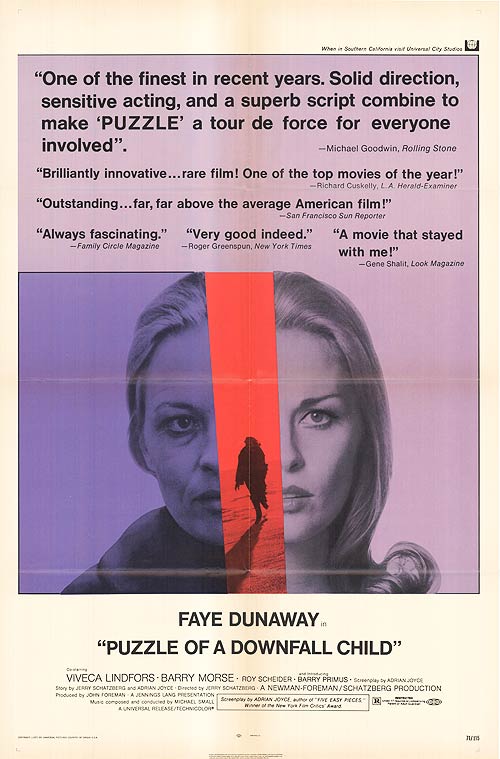
Lou Andreas Sand (Faye Dunaway) was a once famous fashion model who now sits in an isolated seaside cabin telling her life story to Aaron (Barry Primus) who records her conversations which he plans to use as a basis for an upcoming film. Through her stories she describes of being molested at the age of 15 by a much older man, her bouts with drugs and alcohol, her time spent inside a mental hospital and how she jilted her fiancé (Roy Scheider) by running out on him on their wedding day.

This film marks the directorial debut of Jerry Schatzberg who up until that time was best known as a still photographer and having captured the cover of Bob Dylan’s seventh album Blonde on Blonde. The inspiration for the movie was the life of model Anne Saint Marie who Schatzberg interviewed much the same way that the Aaron character does in the movie.

Unfortunately the director clearly doesn’t understand what makes his main character tick as she comes off as this one-dimensional, self-destructive cliché whose perpetually sad tales of woo become increasingly more contrived as the film goes on. We get no insight as to why she behaves the way she does turning her into a maddening caricature that frustrates the viewer and allows for no empathy.

A great deal of effort was put into the film’s visual style and on that level it’s a fascinating achievement. Adam Holender’s cinematography is quite vivid and makes you feel like you’re right there in the same room with the characters, but the fragmented narrative that comes with it is unappealing. Certain interesting dramatic moments get dropped and never gone back to, or readdressed at a much later time long after the viewer has lost interest. I suppose this is the reason that the word ‘puzzle’ gets used in the title as we are supposed to ‘piece together’ this woman’s life and personality through the erratic bits that she gives us, but she only succeeds at becoming an enigma.

Dunaway is a great actress, but tends to do better in parts calling for strong or emotionally ambivalent women. Playing the roles of vulnerable people is definitely not her forte. She’s managed to do it a few times, but it’s not easy for her and here she fails at it completely as she doesn’t understand her character’s motivations any better than the viewer.

The one actress that does do well here is Viveca Lindfors who was a beauty in her day, but by this time was already aging into her later years and yet she commands the screen with the brief time that she is on it and had she been seen more she might’ve saved it. However, the story lacks substance fails to be compelling and leaves the viewer with a lot of fleeting, fragmented images and nothing more.

My Rating: 3 out of 10

Released: December 16, 1970

Runtime: 1 Hour 45 Minutes

Rated R

Director: Jerry Schatzberg

Studio: Universal

Available: DVD (Region 2), Blu-ray (Region B/2)

The Million Dollar Duck (1971)

By Richard Winters

My Rating: 4 out of 10

4-Word Review: Duck lays golden eggs.

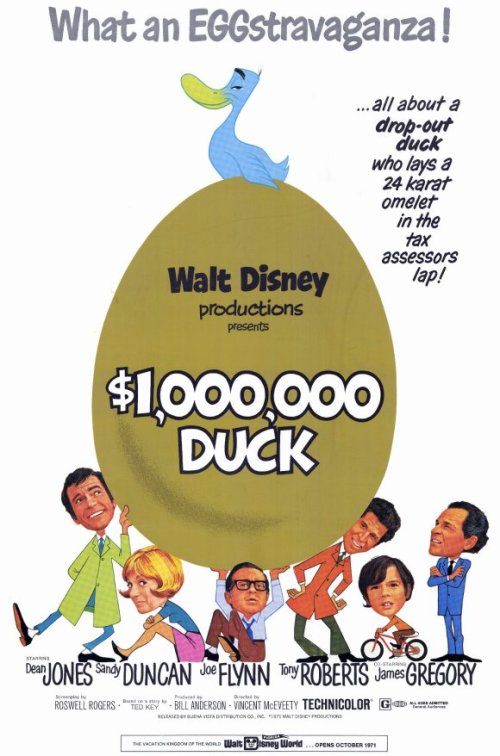
Albert Dooley (Dean Jones) is a research scientist who brings home a duck as a pet for his young son Jimmy (Lee Montgomery) after the bird accidentally gets exposed to radiation while at the lab. To his shock he finds that the duck can now lay eggs with a golden yolk every time she hears the sound of a barking dog. Albert decides to use this to his advantage as he is drowning in unpaid bills, but his neighbor (Joe Flynn), who works at the United States Treasury Department, tries to take the duck away from Albert, so that the government will control it and used the eggs for their own purposes.

The film became notorious as being one of the three that critic Gene Siskel walked out of during his film reviewing career and to which he would brag about for many years later. Roger Ebert described it as “one of the most profoundly stupid movies I have ever seen.” and while I agree it’s no classic I failed to see how it was any sillier than any of the other Disney movies that came out during the same decade.

With that said the plot is loopy although it does define what the term bullion means, so in that respect it’s actually a bit enlightening. The concept though of having a duck lay an egg every time it hears barking is pretty dumb especially when the barking comes from humans who don’t sound anything like a real dog especially Jones’s pathetic attempts. I also didn’t understand why a pinging noise resembling a bell had to be heard each time an egg was laid. Did the radiation cause this to occur too?

The action is pretty light for Disney standards and the only two funny parts are when Sandy Duncan, who plays Jones’s wife, tries to a deposit a golden yolk at a bank as well as when they try to find their duck on a farm amidst hundreds of other ducks who all look the same. The film also comes with a car chase finale that seemed to be a standard plot device for Disney movies of that era although this one is more restrained and not as funny or exciting.

Jones is bland while Duncan and Tony Roberts, who plays Jones’s lawyer friend, are far more amusing. Both Roberts and Duncan had starred together that same year in Star Spangled Girl and they could’ve easily have played the couple while Jones been cut out of it completely and not missed at all.

Montgomery is cute in his film debut and Flynn is funny as the exasperated neighbor. He had co-starred in many Disney films during his career and seemed to have a different color of hair with each role. In some of them his hair was graying while in others it was jet black and here it had a reddish tint. I also found it ironic that he plays a character with a backyard pool and at one point he gets pushed into it as in real-life he ended up drowning in his own backyard pool just three years after this film came out.

My Rating: 4 out of 10

Released: June 30, 1971

Runtime: 1 Hour 29 Minutes

Rated G

Director: Vincent McEveety

Studio: Buena Vista Distribution

Available: DVD, Amazon Video, YouTube

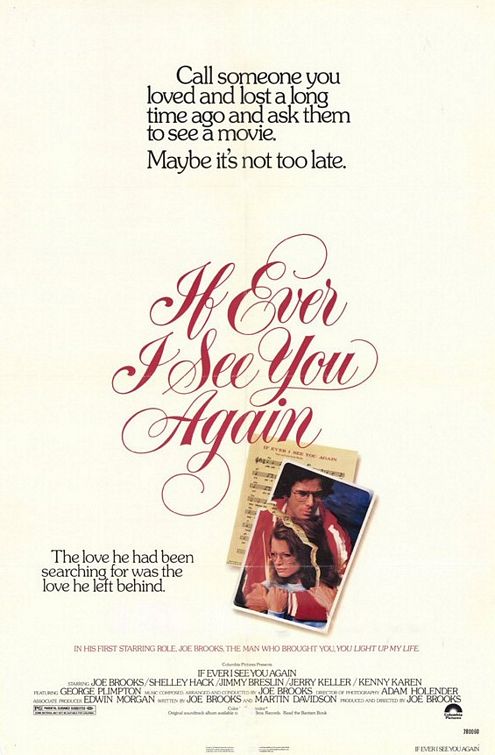
If Ever I See You Again (1978)

By Richard Winters

My Rating: 1 out of 10

4-Word Review: Rekindling an old romance.

Bob Morrison (Joe Brooks) is a successful composer of commercial jingles, but despises the many compromises he is forced to make in order to please his clients. He wants to write a film score and his agent Mario (Jimmy Breslin) gets him a meeting with some movie producers in Hollywood and while there he decides to look up Jennifer (Shelley Hack) his former girlfriend while in college. He finds that she still has feelings for him and they begin dating again only to have her, like in college, back off when the relationship starts to get too serious.

Brooks was coming off great success with the box office hit You Light Up My Life that won him the Grammy for song of the year (1977) the Academy Award for best original song as well as the Golden Globe and the ASCAP award. His over-confidence though exceeded his talents as he followed it up with this trifling mess that reeks of self-indulgence and is so unrelentingly schmaltzy that it will make even the most die-hard of romantics feel like gagging.

The film starts out okay as it analyzes the rigors of the music business and its overly demanding clients. You even get to listen to some cheesy jingles that he is forced to write, which are kind of funny. Had it stayed as a behind-the-scenes look at the commercial jingle world it might’ve been passable

The romantic storyline though kills it. The idea that this beautiful woman would have no other male suitors and simply jump back into the arms of a dopey guy that she had dumped years before is ridiculous.  At least having her married or in some other relationship would’ve made it realistic and allowed for added drama, which is lacking and the love songs that are played during this segment sound worse than the goofy jingles.

Brooks had no acting experience, but casts himself in the lead anyways, which was a terrible mistake as he mumbles his lines and shows no emotion or inflection. His hair looks disheveled and with his glasses off like a beady-eyed, would-be stalker. The character is portrayed too ideally turning the production into a narcisstic foray instead of a story.

The supporting cast is filled with non-actors as well including newspaper columnist Jimmy Breslin and author George Plimpton who are just as blah and my guess is that Brooks did this to make his own bad acting seem not quite so glaring by comparison. Hack for her part is okay and at least has a beautiful face although I wished she hadn’t covered it up with her big, bulky glasses.

The most interesting aspect to the film is what occurred behind the camera as Brooks was nothing like the sentimental songs he wrote or lovable guy that he tried to play. Instead his friends labeled him an egomaniac and his daughter, actress Amanda Brooks, accused him of abusing her as a child while his son Nicholas was convicted of murder in 2013. Brooks himself was accused of raping over 13 women whom he had lured to his apartment through Craiglist ads under the disguise of being a film producer looking for fresh young talent. In 2011 while awaiting trial he killed himself, but not before becoming one of the creepiest looking guys you’ll ever see (pictured below).

Capture 282

However, the biggest irony is that in 2005 he wrote and produced a play about a woman with OCD who is brought together with a man who suffers from Tourette’s by a jingle singling God, which Playbill descried as being ‘one of the strangest shows to ever grace the Broadway stage.’ and even though it clearly sounds absurd I’d still take it over this crappy film any day.

My Rating: 1 out of 10

Released: May 24, 1978

Runtime: 1 Hour 45 Minutes

Rated PG

Director: Joe Brooks

Studio: Columbia Pictures

Available: VHS

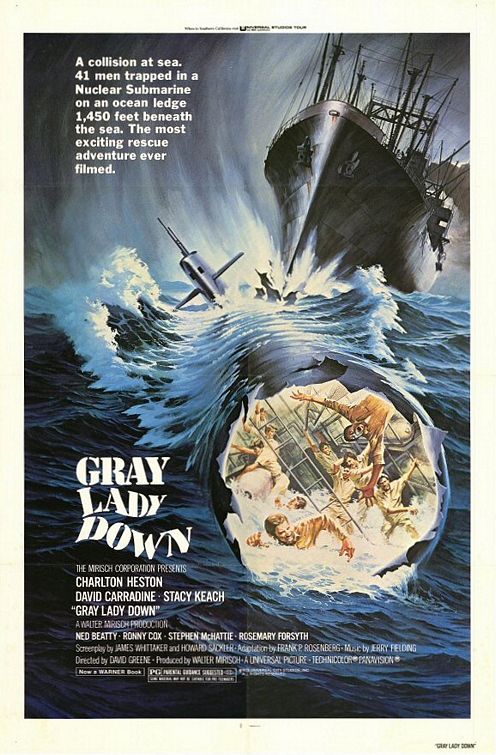
Gray Lady Down (1978)

By Richard Winters

My Rating: 7 out of 10

4-Word Review: Submarine crew needs rescue.

Captain Paul Blanchard (Charlton Heston) is on his final submarine mission, but just as the vessel surfaces it gets struck by a Norwegian freighter, which sinks it to the ocean bottom. The navy’s rescue team is unable to get to the crew due to a rock slide that covers the escape hatch. Eccentric Navy Captain Gates (David Carradine) is brought in as he has created a submersible vehicle that can go down the depths of the ocean and remove the rocks from the sub, but his personality clashes with that of Captain Bennett’s (Stacy Keach), which further hampers the rescue efforts.

The story, which is based on the 1971 novel ‘Event 1000’ by David Lavallee gets off to a shaky start. Although the interiors of the vessel look quite authentic the exterior shots, especially those showing the crew sticking their heads outside the vessel’s port hatch, were clearly done on a soundstage in front of a green screen and nothing is worse than a film that tries hard to be meticulous in one area only to compromise in another. When the sub gets hit many of the crew, which were made up of stunt men and not professional actors, overreact giving it an unintentionally comical feel.

The cutting back and forth to scenes inside the Norwegian ship and how that crew becomes panicked was not necessary. Again, the acting gets a bit over-the-top here too and the dialogue is shown in subtitles due to them speaking in their native language. It might’ve actually added to the intrigue had we not seen what went wrong with the other ship to cause the collision especially since the focus of the film is on the rescue effort anyways.

Once the rescue gets going it gets better with a solid pace that keeps things on a realistic level and continues to throw in new twists that makes the attempted rescue continually more difficult. Although it does get to a point where it seems nightmarish scenarios are introduced simply for the sake of drama and almost like it was piling-on the problems making the submarine crew look like they were the most unluckiest people on the planet in order to have one bad luck situation happen after another.

The scenes involving Carradine and his relationship with his pal Mickey (Ned Beatty) as well as his animosity with Stacy Keach are more interesting than the ones involving the crew stuck in the ship. Part of the reason is there is no backstory given to any of the characters, so we never see them as three dimensional people and our empathy for their welfare isn’t as much as it could’ve been. A brief bit shows the wives of the crew upset at the news, but an added side-story would’ve helped. In fact I was genuinely shocked that Rosemary Forsyth, who plays Heston’s wife, has only a single line of dialogue. I realize she may not be an A-list star, but she has a respectable enough body of work to expect something more than a just a token walk-on bit and I’m surprised she took the part.

Spoiler Alert!

The ending is tense and filmed in a way that you’ll never realize that the subs used were simply miniaturized models shot on a soundstage with smoked used for the underwater effects. However, the drama could’ve been heightened especially when one of the characters sacrifices their life to save the others, which should’ve come off as a shock, but the film telegraphs it, which lessens the effect.

End of Spoiler Alert!

Heston’s a stiff acting doesn’t always work, but here he’s excellent and despite being well over 50 appears amazingly young and agile. This marks Christopher Reeve’s film debut who looks absolutely boyish as well as a reunion of sorts for Ned Beatty and Ronny Cox who starred together 6 years earlier in Deliverance although here they do not share any scenes together.

My Rating: 7 out of 10

Released: March 10, 1978

Runtime: 1 Hour 51 Minutes

Rated PG

Director: David Greene

Studio: Universal

Available: DVD, Amazon Video, YouTube

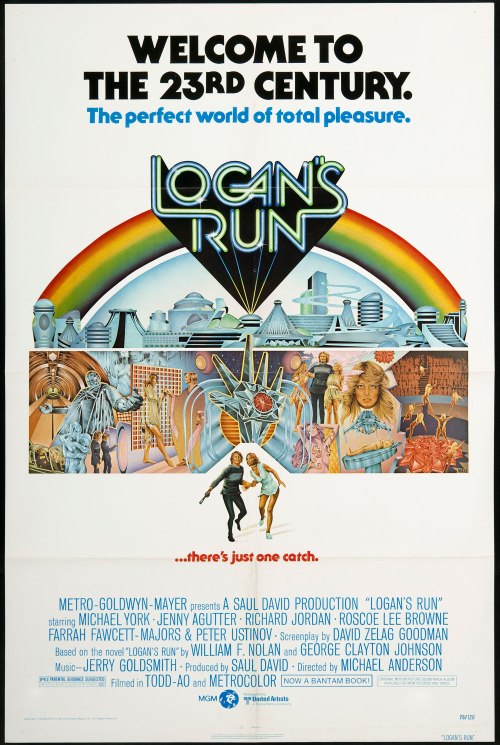
Logan’s Run (1976)

By Richard Winters

My Rating: 6 out of 10

4-Word Review: Life ends at 30.

In the year 2274 no one is required to work and all desires fulfilled with the only catch being that everyone must die at 30, or at least go through the so-called carrousel to see who can be ‘renewed’. Logan (Michael York) works as a sandman who is in charge of tracking down the ‘runners’, which are people who try to escape the fate of the carrousel and instead find refuge in a secret underground community known as the sanctuary, which is somewhere outside of the domed city where everyone lives. The computer, which runs the domed city where Logan resides, orders him to find the sanctuary and destroy it. To do so Logan must pretend that he is a runner and uses the help of fellow runner Jessica (Jenny Agutter) to guide him, but what they end up discovering shocks them both.

The film’s selling point is its special effects, which weren’t bad for its time period. The most impressive is the sequence dealing with the carrousel where actual holograms were used. The opening bit where the camera shows a bird’s-eye view of the domed city then zooms into it is impressive too due to all of the painstaking detail that must’ve been put in to create it, but it also becomes clear that it is simply a miniaturized reproduction that looks a bit hokey. The interiors resemble the lobby of a swanky hotel and isn’t visually interesting while the costumes show no imagination as everybody wears essentially the same outfit with the only difference being some are red and others green.

The film deviates quite a bit from the 1967 source novel, which was written by William F. Nolan and George Clayton Johnson with the biggest change being that in the book the age to die was 21. Supposedly the reason the age got upped was to allow for a broader range of actors to choose from, but even here they cheat because York was already 33 when he did this and Richard Jordan, who plays a fellow sandman was 38. Having the script stick to the original age of 21 and hired actors who were that exact age would’ve made a far stronger visual impact especially having them put to death when they barely looked ready for adulthood.

York’s character is annoyingly naïve as he never questions the authority while fully drinking into their propaganda and it takes Jessica to get him to see things differently, but it’s hard to empathize with a guy who can’t think for himself and kills others without question. Also, when they make it outside the dome they have no idea what the sun is, which seems almost absurd. Yes, they’ve been living in a doomed city all of their lives, but wouldn’t they at some point have some curiosity of what was outside of it, or learn in school about the outside? Maybe it was just me, but the character seemed too transparent and almost non-human.

Spoiler Alert!

The weakest point is the ending where they find out unlike the book that there really isn’t any sanctuary, which comes off as anti-climactic and then having them instead come upon a desolate grounds of Washington D.C., which seems too reminiscent to the ending in Planet of the Apes. It also doesn’t make sense. Although never fully explained one can surmise that apparently civilization was destroyed by some sort of nuclear holocaust, but if that were the case it would’ve caused a nuclear winter, which would’ve blotted out the sun and not allowed anything to grow for decades. Having all the green foliage everywhere would’ve been impossible and how exactly was the old man character played by Peter Ustinov that they come upon able to survive it?

The way Logan is able to destroy the computer, which then destroys the whole city when he returns to it by simply not giving it the answer it wants to hear is too convenient. A computer system that is able to run a city for so long would’ve had  some sort of back-up system installed in case something overloaded it otherwise the city would’ve blown many years earlier if it were really that easy to do. It also never explains who ultimately was behind the creation of the doomed city and secretly running things from behind-the-scenes as every computer must have some person, or group of people who initially made it and then programmed it, so who were they?

End of Spoiler Alert!

Farrah Fawcett has a good bit part as a girl working at a saloon that allows people through laser surgery to change their identities. Ustinov is also quite good as the old man who easily steals the film from the younger performers without much effort. The story it mildly compelling, but compared to classic sci-fi films it is pretty vapid.

My Rating: 6 out of 10

Released: June 23, 1976

Runtime: 1 Hour 58 Minutes

Rated PG

Director: Michael Anderson

Studio: MGM

Available: DVD, Blu-ray, Amazon Video, YouTube

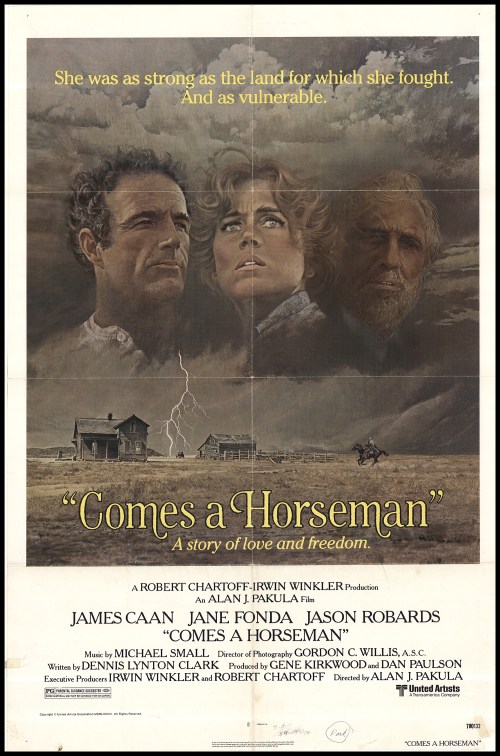
Comes a Horseman (1978)

By Richard Winters

My Rating: 6 out of 10

4-Word Review: Ranchers battle for land.

Recently widowed Ella (Jane Fonda) must struggle to run her ranch in the middle of the desolate west by herself. Frank (James Caan) is her neighbor who is being harassed by Jacob Ewing (Jason Robards) to sell his land and Ewing has also made a strong play for Ella’s property as well. Both refuse his offers and then band together to defend themselves and Ella’s ranch from Ewing and his men who are willing to do anything it takes in order to get what they want.

The film’s main charm is its stunning cinematography by Gordon Willis who captures the expansive western landscape in breathtaking fashion and this is indeed one film that must be watched on the big-screen, or in widescreen to be fully appreciated. Director Alan J. Pakula instills a wonderfully slow pace with a minimum of music, which gives the viewer an authentic feel for what life out in the country during the 1940’s must’ve been like.

I also really liked the fact that Ella and Frank didn’t immediately fall-in-love and jump into bed together. Too many times films made during the post sexual revolution depicted characters from bygone eras as being far more liberated than they really were and here they’re authentically reserved and in fact they don’t even show any affection for one another until well into the story and when it does happen it seems genuine instead of just sexual.

Jane gives an outstanding performance. Usually she commands the screen and gives off a sexual allure, but here she literally disappears in her role of a humble farm woman until you don’t see the acting at all. Former stuntman Farnsworth at the age of 58 makes an outstanding film debut in a supporting role that will emotionally grab the viewer.

The story, which was written directly for the screen by Dennis Lynton Clark, lacks depth and has too many elements stolen from other similar films. Stanley Kramer’s Oklahoma Crude, which came out 5 years has almost the exact same plotline, but done in a darkly comic manner. Both deal with a man moving onto a woman’s ranch to help as a farmhand. The woman initially rebuffs the male’s advances, but eventually softens. Both deal with an oil company pressuring her to sell her land and harassing her when she doesn’t and they both have a memorable scene involving a windmill.  The oil subplot, particularly in this film seems rather unimaginative and like it was thrown simply to create more conflict while Ella’s past relationship with Ewing and the dark secret that they share should’ve been more than enough to carry the picture.

The one thing though that really kills the picture is the ending where Ella and Frank find themselves being attacked and in an effort to build up the tension loud music similar to what’s heard in a modern-day thriller gets thrown in. This had been a movie that had been very quiet up until then and it should’ve stayed that way. The actions seen on the screen was more than enough to horrify the viewer and no extra music was needed. Hearing nothing more than the howling wind on the prairie would’ve made it more effective as it would’ve reminded the viewer how remote the location was and how no one else was nearby to help Frank or Ella. For a movie that tried so hard to recreate the feel of a past era only to suddenly go downright commercial at the very end is a real sell-out.

The fact that all the night scenes were filmed during the day using a darkened filter is another letdown. There have been many films that have been shot in actual nighttime darkness so why couldn’t this one? If you want to see a film set during the same time period with equally captivating visual approach, but stays more consistent in theme then I’d suggest Days of Heaven, which was also released in 1978.

My Rating: 6 out of 10

Released: October 25, 1978

Runtime: 1 Hour 59 Minutes

Rated PG

Director: Alan J. Pakula

Studio: United Artists

Available: DVD, Blu-ray, Amazon Video, You Tube