Category Archives: 70’s Movies

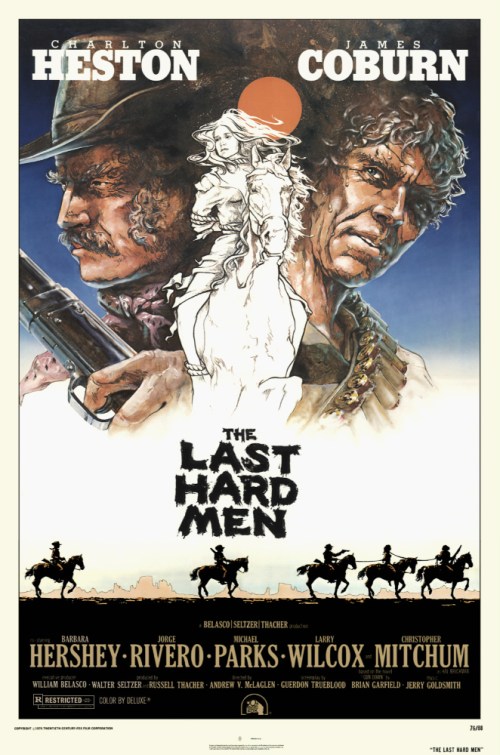
The Last Hard Men (1976)

lasthard

By Richard Winters

My Rating: 3 out of 10

4-Word Review: Kidnapping a lawmen’s daughter.

Based on the 1971 novel ‘Gundown’ by Brian Garfield who’s better known for having written Death Wish, the story is set in 1909 and centers on Sam Burgade (Charlton Heston) a retired lawman living with his grown daughter Susan (Barbara Hershey) who is engaged to Hal (Christopher Mitchum). They though are tormented by Provo (James Coburn) and his gang who have just busted out of a Yuma prison. Provo seeks revenge on Sam because years earlier Sam killed Provo’s Indian wife during a shoot-out. Provo though doesn’t want to just kill Sam, but instead inflict the cruelest revenge possible by kidnapping Susan and then having his men gang rape her while both Sam and Hal are forced to watch.

A stale, unimaginative approach that lacks any atmosphere and makes getting into it rather hard. Coburn and Heston are given equal screen time, so it’s confusing who we’re supposed to be rooting for. Sure Coburn has dark motives, but he also at one point gets rid of one of his own men (Robert Donner) for being a racist, so he’s not completely bad. The film’s biggest transgression is that it never shows, via flashback, the crucial shoot-out between the two that caused Provo to get so angry. Just having Heston briefly describe the incident to his daughter is not enough we needed to see what happened for ourselves especially since Heston becomes downright skittish about what went on and like maybe he had something to hide. Without having it played-out the movie lacks much needed context.

Coburn is a personal favorite, but as the protagonist, which he always does quite colorfully. As the villain it doesn’t work and he seems unable, or unwilling to go to the nasty depth that the script demands and instead leaves this to his henchmen, played by John Quade. Heston is adequate and Mitchum (Robert’s son) certainly displays a youthful, wide-eyed quality and it’s intriguing seeing how he grows from a young man who doesn’t seem rugged enough to take on the challenge to eventually proving himself.

In support I enjoyed Larry Wilcox, but known for starring in the ‘CHIPS’ TV-show, as he’s one of the evil henchmen that manages to show some redeeming qualities and it’s genuinely sad when he gets shot. While I’m a fan of Hershey and appreciated how she took a stretch here by playing a part outside her comfort zone I still felt she was miscast. The character needed to be sheltered and helpless in order to get the viewer to care about her predicament, but she’s too savvy and streetwise from the start making it seem like she can handle matters and take care of herself, which lessens the tension. Having her grow into becoming this way during the ordeal would’ve been more interesting.

Spoiler Alert!

The third act does have a few moments that enliven things including a large bush fire that gets started by Heston that traps Coburn and his men, but the scene that really stood out is the gang rape of Hershey, which gets done in slow-motion on the side of a hill. I’ve seen many films that feature a rape, but never done in this way, which almost gives it a sort-of lyrical quality and the only thing from the movie that stands-out. Yet even this gets botched as Heston doesn’t run out from his hiding spot to save his daughter when it occurs making it seem like he might’ve been cowardly and this was a personality trait he had been hiding only for us to learn that it was because Mitchum who knocked him out, but this seemed implausible. Heston was much bigger than Mitchum and proved to be far more astute than him in everything else, so why would this be the one moment when the young kid would be able to overpower him?

The story would’ve been more intriguing had this moment exposed a flaw in Heston’s character, which would’ve given this otherwise one-dimensional story the depth and unexpected twist that was needed and it’s just a shame it didn’t take it. Certainly if put in better hands this is the kind of material that could have strong potential, but the way it gets played-out here, even with the violent moments, it’s boring and a disappointment.

My Rating: 3 out of 10

Released: June 1, 1976

Runtime: 1 Hour 37 Minutes

Rated R

Director: Andrew V. McLaglen

Studio: 20th Century Fox

Available: DVD, Amazon Video, YouTube

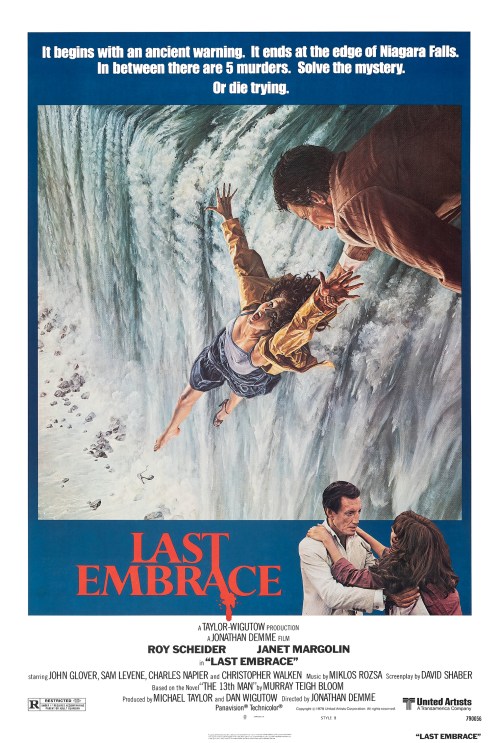
Last Embrace (1979)

lastembrace

By Richard Winters

My Rating: 7 out of 10

4-Word Review: Someone wants him dead.

Loosely based on the novel ‘The 13th Man’ by Murray Teigh Bloom the story centers around Harry (Roy Scheider) a government agent who has a nervous breakdown after his wife gets killed during a shootout while he was on a secret mission. After spending time in a sanitarium he gets out to realize that his agency no longer has any assignments for him and he fears they may want him dead while trying to make it look like an accident. When he gets back to his apartment he finds that it’s been sublet to Ellie (Janet Margolin), a doctoral student at Princeton University. He tries to get her to move-out, but can’t and then starts to receive threatening notes in Hebrew and uses Ellie’s background in that language to help him decipher what they’re saying. Soon the two go on the run convinced that the same person after Harry may also now be targeting Ellie, but nothing is exactly as it seems.

Jonathan Demme, despite his immense talent and admirable film output, never received name recognition and for the greater part of his career failed to have a hit at the box office. In fact it wasn’t until the success of The Silence of the Lambs that he even became a sought after Hollywood commodity. Even then when most people think about that movie it’s Anthony Hopkins, or even Jodie Foster that comes to mind while Demme’s directorial efforts seem overlooked. In many of his interviews this was his biggest complaint and that no matter what he did he could never break-out of the bubble to have his name put over the title like with Spielberg, Scorssese, or Hitchcock. I could understand his frustration as his movies were step above your basic indie flick and while not perfect still had far more going for it than a usual B-picture and if anything this film should’ve been the one that got him noticed.

There’s been many Hitchcock imitations with a lot of them done by Brian Di Palma, but those seemed overdone while this one gets just the right balance. The on-location shooting is splendid with my favorite moments being at Princeton University bell tower and of course the climactic sequence at Niagara Falls. I’ve personally been to the falls, but found this movie made me feel closer and more immersed in it than in person especially with the sequences shot inside the Robert Moses Niagara Power Plant and another done in the Cave of the Winds, which is what really makes the film stand-out. The music score by Miklos Rozsa, has the perfect blend of what would’ve been used by Bernard Herrman, which was Hitch’s main composer, which helps to make this seem like a movie Hitch himself could of very well done himself.

Scheider’s acting is good as he’s constantly cranky and irritable, which anyone going through his situation would be, so it was realistic and relatable, but I really hated the white suits that he wore. For one thing the guy was out of work and no longer a professional agent, so why he felt the need to dress-up all the time when he really wasn’t on the job anymore didn’t make much sense. Why they were all white was even more head-scratching. Outside of Pat Boone I don’t know of anyone who wears a white suit and it made him stand-out in all the wrong ways. If this guy is afraid that he’s being targeted then he should be dressing down so he could then blend-in, which in this movie he definitely wasn’t.

Margolin, best known for her work in the landmark indie flick David and Lisa, is good too especially with her dual personalities where she plays a nerdy student and her alluring, sexy vamp alter ego at other points. She though was not the original choice for the part as Demme wanted Lynn Lowry, who had been in his previous film Fighting Mad, but Scheider, who was dating Margolin at the time, preferred her and studio backed him on it forcing Demme to drop Lowry, but out of guilt he still paid her and allowed her to collect residuals despite her never appearing in any of it.

Spoiler Alert!

The plot is fast-moving and well crafted and keeps you guessing while also introducing a wide array of new twists without ever getting too confusing. The final twist though, in which we find that Ellie is the one after Harry and has been murdering other men as well in a revenge plot for what Harry’s and the other men’s grandfathers did to her grandmother who was gang raped by them at age 15. The idea was to tie the Ellie character to the Biblical avenger of Goel, which sounds cool, but ultimately an overreach. Had Ellie been raped directly by these men then I could see her going out of her way to seek rough justice, but doing it all for a grandmother she barely knew just didn’t seem all that believable. Also, how does this then ‘right the wrong’ by taking vengeance out on the grandchildren of the men who committed the actual crime? The grand kids had no control over what their grandparents did and weren’t even around when it happened, so how is any of this fair, or even make sense?

A better way to have ended it was to have Ellie portrayed as being a crazy kook going after these men due to a belief in some conspiracy theory only for the viewer to finally realize that she was an actual rape victim and Scheider, who we thought was this good guy, was instead the villain. Since she was raped at 15 her features could’ve changed, which would thus explain why Scheider didn’t recognize her initially. With a movie so compelled to have one twist after the other, this would’ve been the ultimate jaw-dropper. It’s just a shame they hadn’t chosen this route as the film, as slick as it is most of the way, leaves the viewer with an empty feeling after it’s over.

My Rating: 7 out of 10

Released: May 4, 1979

Runtime: 1 Hour 42 Minutes

Rated PG

Director: Jonathan Demme

Studio: United Artists

Available: DVD, Blu-ray, Tubi

The Savage is Loose (1974)

savage1

By Richard Winters

My Rating: 3 out of 10

4-Word Review: Shipwrecked family becomes incestuous.

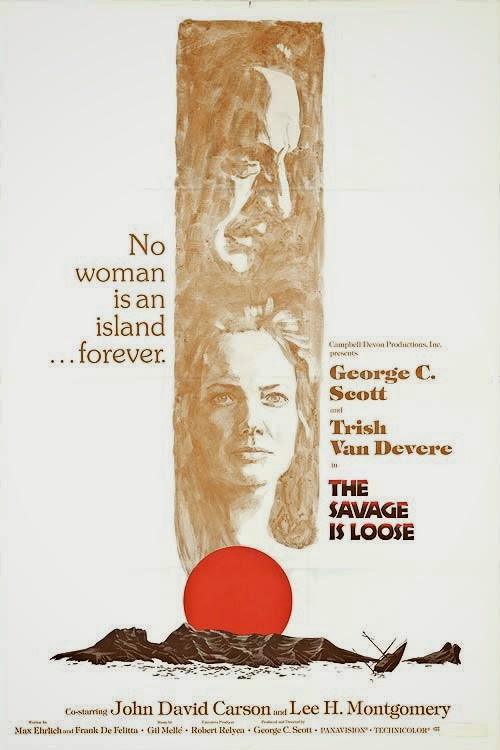
In 1902 John (George C. Scott) and his wife Maida (Trish Van Devere) take their infant son David (Lee H. Montgomery) on a sea cruise. Unfortunately the ship hits some rocks and sinks killing all those onboard except for the young family who manage to swim ashore to a deserted island. They make a home for themselves and slowly begin to age. By the time David reaches adolescence (now played by John David Carson) he begins to have sexual urges especially as he watches his father make love to his mother late at night. As his sexual feelings grow stronger he begins to lust after his own mother and compete with his father for her affections.

Unusual production that was directed by Scott and financed mostly with his own money. After the disaster of The Day of the Dolphin you’d think he’d have learned his lesson and gone with a script with a more mainstream storyline, but instead he dove into something that was sure to offend many and then proved incredulous when it didn’t score well with either the critics, or the box office. Despite starting the decade with an Academy Award win his career, especially after two financial duds back-to-back, began to peter-out after this one and he was really never able to regain his star status, or get offered top parts afterwards.

The film runs hot-and-cold. The opening is a bit cheesy as it features only a painting of a ship hitting some rocks and sinking, most likely the budget was too small to recreate an actual shipwreck, which surprisingly, despite the compromise, kind of works especially with the sound effects of the people screaming particularly the young child. It’s once they get on land that the action really begins to sink. The huts that they build, which we never actually see them make, but can only presume, look too well crafted, when factored in all the utensils, eating bowls, table, chairs, and even bamboo blinds, to have been built by two people with limited resources. It’s also hard to understand, with the front end of the ship still always in view, why they didn’t bother to create a raft, since their carpentry skills are clearly quite superior, in order to leave the island and find help. They eventually do, with relative ease but only after coming up with the idea 18 years later, but why the hell did it take them that long to eventually consider it?

The characters are quite dull and don’t have much to say and it would’ve helped had there been a fourth survivor on the island with them to allow for some diverse dramatic perspective, or even for some much needed comic relief. Montgomery plays the young David quite well, but Carson is terrible as the older version and fails to effectively convey the intense inner frustrations of his character and his acting delivery is robotic. Van Devere is okay as an actress, but her character fails to age. The father and certainly the son do have their appearances change, as you’d expect during almost two decades, but the mother remains youthful and glowing. Maybe this was done to keep her looking ‘desirable’ to the two men, but in reality she should’ve taken on gray hair and wrinkles especially after having to deal with all the stress and hardships of being stranded for some many years.

The incest theme is not handled in any type of interesting way. Instead of being this shocking twist that we’re not expecting it gets telegraphed right from the start and even ponderously talked about amongst all three of the characters until the viewer is totally expecting it to happen and to a degree even waiting for it. It’s confusing too why the son only has his eyes set on the mother. If his quandary is really just trying to release this strong sexual urges and having hardly anyone around to do it with then why doesn’t he try having sex with some of the animals that inhabit the island, or even the old man? Why not have sex, or at least attempt to, with all three at different times? Again, the movie wants to force the viewer out of their comfort zone by exposing the animalistic urges people can have, which in civilization will be repressed, but out in the wild it won’t. With that in mind then why not go ‘all-in’ and explore all the various types of perversions besides just the mother-son one?

Spoiler Alert!

While it remains strangely captivating, despite lots of lulls and slow spots, the ending doesn’t get played-up enough to make it worth it. I commend the idea, showing the mother deep kiss the grown son, but since they’re going for shock value why not show them from a bird’s eye view on the sand, naked and humping? Movies succeed by having unforgettable images and that would’ve been one hard to get out of most viewers heads. Having the father view them going at it was a bit ridiculous as he had been tied-up just moments earlier and trapped by a fast moving fire and no chance for escape, so how he was able to survive it is not clear and doesn’t make much sense.

My Rating: 3 out of 10

Released: October 30, 1974

Runtime: 1 Hour 54 Minutes

Rated R

Director: George C. Scott

Studio: Campbell Devon Films

Available: DVD

Who’ll Stop the Rain (1978)

wholl

By Richard Winters

My Rating: 8 out of 10

4-Word Review: Drug deal gone bad.

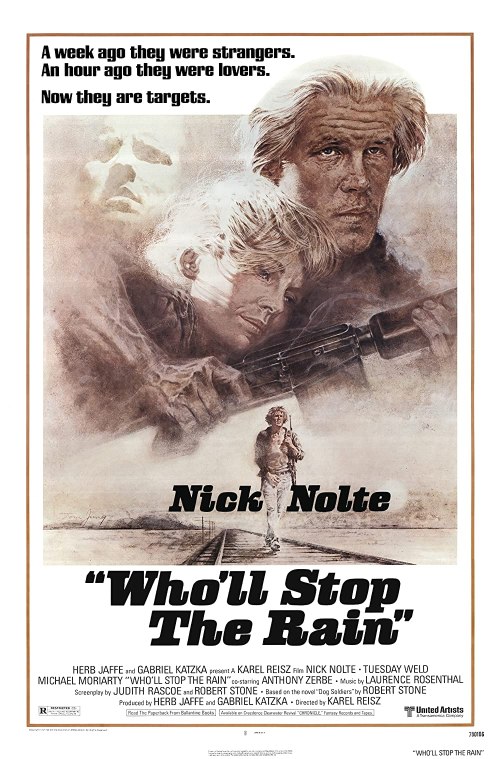
John Converse (Michael Moriarity), a war correspondent working in Saigon, approaches his friend Ray (Nick Nolte), a merchant marine, about smuggling a large bag of heroin out of the country and into the US. Ray has dealt marijuana before, but never the hard stuff and is reluctant at first, but due to his friendship with John he eventually agrees. He is told to go to San Francisco where he’ll drop-off of the drugs for payment with John’s wife Marge (Tuesday Weld). Once he gets there though he realizes he’s been followed forcing both he and Marge to go on a dangerous trip to not only elude the bad guys, but also get rid of the incriminating evidence.

The film is based on the 1974 novel ‘Dog Soldiers’ by Robert Stone, who also co-wrote the screenplay. The theme of the novel was to examine the loss of optimism and youthful ideals of the 60’s and the beginning of the age of cynicism that came during the 70’s, which for that purpose the time period should’ve been 1970 as keeping it in the present day, in this case 1978, makes it seem a bit dated and losses the context of the message. The story itself though is still quite engrossing with some of the most disturbing scenes being the ones dealing with a young, affluent suburban couple (James Granna, Timothy Blake) going to a drug party of sorts that had Ray, Marge and Ray’s friend Eddie (Charles Haid) who give them illicit substance for the first time and their immediate hallucinogenic reaction I found both frightening and impactful.

The performances are uniformly excellent especially Nolte, who was not yet an established movie star and the producers wanting instead Kris Kristofferson for the role only to finally give-in after the persistent lobbying of director Karel Reisz. Tuesday Weld is also dynamic falling into the role of a drab, middle-aged housewife with ease and completely losing the young, sexy starlet appeal that she had previously. My favorite though was Moriarty, whose glazed over eyes and emotionless demeanor perfectly reflects the apathy and soullessness of his character.

On the downside I found the character’s motivations to be confusing particularly the way Marge, who did not know Ray before this, agrees to go with him as he tries to outrun the baddies, but how would know she could trust him, or that he wasn’t in on the scheme? When she dropped her child off with some friends that’s where I felt she should’ve also gone and going back into Ray’s car, instead of calling the police, or advising her friend to do so, seemed reckless and too trusting that this stranger had her best interests at heart. In the book Ray’s intentions are not quite as noble as he decides to bring Marge along more for insurance as he think’s he’s been double-crossed by John, but presumes with Marge along he can use her as a decoy, while in the film it’s because he’s genuinely concerned for her safety. Marge too is betrayed differently as she’s not aware of the drug deal in the film, but in the book she was and I felt these nuances should’ve been brought up in the movie and the fact that they aren’t makes it less realistic and losses the whole point of the story.

John’s relationship with Danskin and Smitty (Richard Masur, Ray Sharkey), the two henchmen to corrupt FBI agent Antheil (Anthony Zerbe) gets botched too. For one thing the make-up effects are too slight as John is put through a wide array of physical tortures by the two in an attempt to get him to tell them where the heroin is and yet after it’s all over the only sign of the struggle is a slight cut on his forehead when instead his entire face should’ve been severely bruised, bloodied, and swelling. Afterwards he becomes too palsy with them even reading a book in their presence and joking around though you’d think he’d remain frightened after what they put him through and never letting down his guard in their presence because he’d know their violent side. I also didn’t like how the two start out as nasty criminals, but by the end become clueless comic foils, which hurts both the tension and grim realism.

The film though does recover especially in the final act when Ray takes Marge to an isolated cabin in New Mexico to hide-out in and then are followed by the villains culminating in a unique showdown. The isolation of the place, which sits amongst the beautiful mountains of the region is both picturesque and tranquil, and is based off of author’s Ken Kesey’s home in California where he wired the nearby trees with lights and sound effects to enhance their LSD experiences, and thus this creates an interesting battle between Ray and the thugs as he uses these same props to disorient them and it helps the movie stand-out with its memorable conclusion.

My Rating: 8 out of 10

Released: August 11, 1978

Runtime: 2 Hours 6 Minutes

Rated R

Director: Karel Reisz

Studio: United Artists

Available: DVD, Blu-ray

Starting Over (1979)

starting1

By Richard Winters

My Rating: 7 out of 10

4-Word Review: Can’t get over ex.

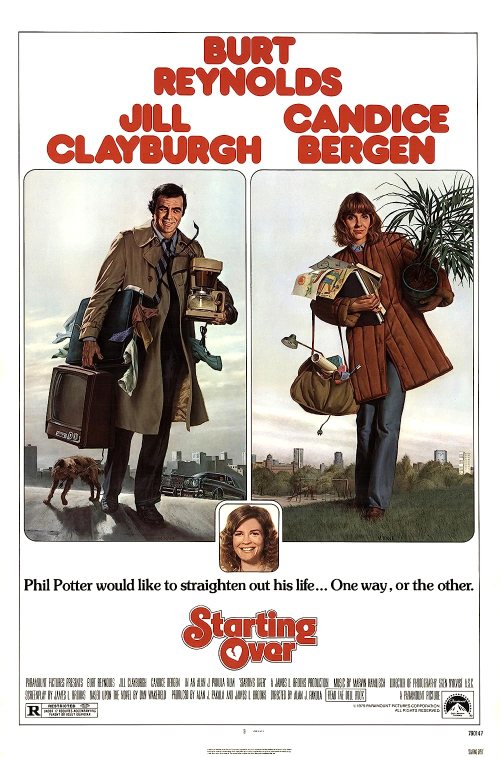
Phil (Burt Reynolds) gets a divorce from Jessica (Candice Bergen), a successful songwriter, when he finds out she’s been having an affair. He then moves to Boston where his brother Mickey (Charles Durning) and sister-in-law Marva (Frances Sternhagen) set him up with Marilyn (Jill Clayburgh) a nursery school teacher. They don’t initially hit-it-off, so he instead goes out with Marie (Mary Kay Place), but that doesn’t go over well either, so he again calls up Marilyn and this time she relents. Despite the usual ups-and-downs things between them begin to gel and soon they decide to move in together only to have Jessica reappear wanting to get back with Phil and Phil becoming torn as to what he should do.

Based on the novel of the same name by Dan Wakefield with a screenplay by James L. Brooks best known for producing the classic TV-show ‘Mary Tyler Moore Show’. Like with that show the story focuses heavily on the pitfalls of dating life with much of it on-target though it does have a serious out-of-touch quality that’s no longer in-tune with today’s generation. The big one is that they meet on their first date inside the women’s apartments, which because of safety concerns doesn’t happen much now and usually it’s always advised to meet in a public setting and not give out personal addresses until you really get to know the person better. There’s also a scene where Jessica, who wears a highly revealing outfit, meet in Marilyn’s apartment and have what we’re told is a civil three hour conversation though in this day and age it’s hard to believe two women, knowing that the other one is clearly after ‘their man’, could be that composed and most likely a fight would break-out and I’m kind of surprised knowing how emotional Marilyn was and wearing her insecurities on her sleeve, that one didn’t happen here.

On the flip side there’s some terrifically funny moments.  One is when Marilyn and Phil initially get off the bus together, before they’ve officially met, and she thinks he’s a stalker, which has a good true-to-life feel. Another great scene is when Phil and Marilyn briefly break-up and he goes to her school, where they’re having a dunk-a-teacher water party and he manages to hit the bullseye with the ball he’s throwing and she’s goes into the water repeatedly before eventually losing her cool and swearing. Phil’s anxiety attack inside a department store is memorable too as his Jessica’s call to Phil at his apartment while he’s serving Thanksgiving dinner to Marilyn and his guests, which creates quite the awkward moment. Phil’s first date with the aggressive Marie is a terrific bit too.

The acting is top notch especially Clayburgh who creates the perfect composite of single women during the 70’s who desperately wants to get into a relationship, but many times allow her fears and anxieties to get in the way. Reynolds is excellent playing against type. Normally he’s a brash womanizer, but here he’s far more reserved and indecisive.  This is also the last movie where he didn’t have his patented mustache and I felt he looked way better and younger without it. Even Bergen, in a much smaller role, is memorable particularly with her off-key renditions of the songs her character has written.

Overall I consider this one of the best romantic movies made. I will admit a modern remake would give the story a more timely update, but the situations nicely reflect the dating conundrums that affect us all.  My only complaint would be with the Clayburgh character, who seemed too insecure to be able to get into a healthy relationship. Most guys would be scared off with her constant emotional outbursts and accusations and I didn’t see why Phil stuck with it. This is one instance, especially since Phil was pretty much a hunk, that I felt the woman he fell for should’ve been better looking, or at least equal to the Jessica character that he left. I just couldn’t understand exactly why, being that there were a lot of women who could easily get into him, he’d choose, or settle for, Marilyn over all the others. Had they had more in common then maybe, but she came-off like a woman who would eventually become a cat lady and too emotionally needy to be someone you could have a long term relationship with.

My Rating: 7 out of 10

Released: October 5, 1979

Runtime: 1 Hour 45 Minutes

Rated R

Director: Alan J. Pakula

Studio: Paramount Pictures

Available: DVD-R, Amazon Video, YouTube

How to Frame a Figg (1971)

how

By Richard Winters

My Rating: 1 out of 10

4-Word Review: Tricking a dumb bookkeeper.

Hollis Fig (Don Knotts) is an inept bookkeeper working as an accountant at City Hall. The place is run by the Mayor (Edward Andrews), his staff, and the richest man in town who is also quite elderly, Charley Spaulding (Parker Fennelly). Together this bunch, unbeknownst to Figg, are skimming city funds. They decide though that they must cover their tracks by firing all of the other accountants and keeping only Figg who they deem as not smart enough to catch-on to what they’re doing. They also install a computer to do the bookkeeping and tell Figg it’s his job to maintain it, but nothing more. However, Figg and his friend Prentiss (Frank Walker) become suspicious when the computer readouts involving the city’s budget show that much of the money has gone missing. When Figg brings these findings to the mayor they divert his attention by hiring him a sexy secretary (Yvonne Craig) who will flirt so heavily with him that he’ll forget about everything else that’s going on, but this doesn’t sit well with Figg’s girlfriend Ema Letha (Elaine Joyce) who works across the street as a waitress.

This was the final movie produced from Knotts’ 6-picture deal that he signed with Universal in 1964 after he rose to fame in the ‘Andy Griffith’ TV-show. While none of the movies produced from that contract were very good this one has to be the weakest. The story is slow moving and lacks any action, or sight gags, which will bore most kids who are the intended audience. Visually it’s quite banal and looks like it could’ve easily been an episode for a TV-show with the biggest failing being that it was shot on a studio backlot, so the town is nothing more than propped up buildings. While it would’ve cost more shooting it in a real town it would also have given the production more of a distinct look, but at least it uses the same courthouse that was eventually also in Back to the Future.

Knotts is a funny guy, but he’s just playing the same Barney Fife caricature over and over and thus making everything that he does here quite predictable. Edward Andrews and Joy Flynn are both talented character actors, but together they end-up negating the other. In this instance Andrews totally dominates making Flynn’s efforts negligible and not worth appearing at all. Frank Welker, who later became a very famous voice artist including speaking for the Fred character in the ‘Scooby-Doo’ cartoons, makes for a strange buddy to Knotts since there was over a 20-year difference between the two and it shows. It would’ve been better if they were around the same age and Welker’s character not so painfully stupid as having two dimwits becomes tiring and monotonous.

I did however enjoy Yvonne Craig, best known for playing Batgirl on the ‘Batman’ TV-show, here she enlivens things as the vixen.  Parker Fennelly, who was 80 at the time, but looking more like 100, is very funny, and in many ways the best thing in the movie, as the crotchety, but still conniving codger, who violently slams down his cane when he gets angry and has everyone else at his beck-and-call.

Spoiler Alert!

Had the script not spelled everything out right at the start and instead had the viewer to see things completely from Figg’s perspective would’ve allowed for a few twists and surprises, but the way the plot gets presented here is quite routine. The ending, in which Figg and his new bride travel to Rio de Janeiro for their honeymoon and explicably bump into the Mayor and his staff who are hiding-out there is disappointing.  Do the bad guys ultimately escape justice, or does Figg figure a way to take them down? Or do they kill/kidnap Figg to keep him from talking? Either way none of this gets answered, which is a letdown. At least with the Disney films of that era everything would end with one big car chase, or ultimate showdown of some kind, which is what this film, as dull as it already was, sorely needed.

how2

My Rating: 1 out of 10

Released: February 2, 1971

Runtime: 1 Hour 43 Minutes

Rated G

Director: Alan Rafkin

Studio: Universal

Available: DVD

Buster and Billie (1974)

buster2

By Richard Winters

My Rating: 5 out of 10

4-Word Review: Dating a loose woman.

Buster (Jan-Michael Vincent) is a high school senior living in rural Georgia during the late 1940’s. He’s been dating Margie (Pamela Sue Martin), but finds her to be stuck-up and her unwillingness to have sex makes him frustrated. He begins seeing Billie Jo (Joan Goodfellow), who has moved into town and due to having limited social skills puts-out for the other boys by allowing them to have sex with her, one after the other, in the woods late at night. Buster at first dates her simply for the action, but eventually the two get into a serious relationship and he breaks-up with Margie. They begin going out publicly letting the whole town know that they’re a couple, but the other boys become jealous as they can no longer have easy sex like they use to and thus plot a dark revenge.

The story is based loosely on an actual event that occurred in Florence, South Carolina in 1948 that the film’s screenwriter Ron Turbeville remembered hearing about growing up. The recreation of the era though lacks style and this may be in large part due the film’s limited budget. While it gets a zero in  atmosphere I did at least like the way it doesn’t sugar coat things for nostalgic purposes. The teens behave in the same ways they do now and thus it’s gritty on that level.

The acting is good surprisingly even from Jan-Michael who in his other films tended to have a cardboard presence, but here he gives the thing most of its energy. He even appears, shockingly, fully nude and in fact this was the first mainstream American movie to show a male naked from the front, of which Jan stated in later interviews he was quite proud to expose of his well-endowed ‘equipment’. Goodfellow is also seen nude and is quite attractive though I wish she had more to say. Robert Englund, in his film debut, is the most memorable playing an albino with brown hair and his pale complexion makes him look creepier, at least I felt, than he did as Freddy Kruegar.

I didn’t understand though why Buster would risk his social standing for this ostracized girl. I got that Margie was annoying, so breaking-up with her wasn’t a stretch, and Billie was essentially ‘easy-pickings’, but why go public with it? It made more sense that they would’ve seen each other on the sly, but not wanting to risk the social scrutiny of letting everyone know about it. This would’ve clearly lost Buster’s social status not only amongst his friends, but the town as a whole including his own parents, so why add on all that needless stress? Billie too was very shy, so becoming center stage and having all eyes on her would be something she most likely would’ve wanted to avoid, which makes the second act overly idealistic.

It’s also frustrating that Billie doesn’t say much. You want to get to know this person, but never really do. The only time she’s ever given any insight is when Buster explains to his parents why she had sex with all the other guys (in order to be liked), but this is something we should’ve heard coming-out of her lips instead of his. By having Buster do almost all the talking, even when they’re alone together, makes it seem like she’s mentally handicapped, which I don’t believe was the intent and yet ultimately that’s how it comes-off and thus making their romantic moments sterile and uninteresting.

Spoiler Alert!

The final sequence though is where it really falls apart as the boys inadvertently kill Billie when they gang rape her (during a rainstorm even though the sky is still clear and sunny). Buster then tracks them down at a pool hall where he single-handily beats them up and ultimately kills two of them, but the guys just allow themselves to be beaten without attempting to throw a punch, which is not only unrealistic, but boring. Having a big brawl, where each side fights equally would’ve been far more exciting. The twist in which Buster somehow gets released from jail the day after her funeral, so that he can decorate her gravesite with all the flowers that he’s stolen from everyone else in town is far-fetched and overly forces the sentiment.

My Rating: 5 out of 10

Released: August 21, 1974

Runtime: 1 Hour 40 Minutes

Rated R

Director: Daniel Petrie

Studio: Columbia Pictures

Available: Amazon Video

The End (1978)

end2

By Richard Winters

My Rating: 7 out of 10

4-Word Review: His days are numbered.

Sonny (Burt Reynolds) is a real estate broker known to make crooked deals. He gets diagnosed with an incurable disease and told he has only a limited time left. He says goodbye to his ex-wife (Joanne Woodward) who seems more interested in her new boyfriend, his daughter (Kristy McNichol) and his folks (Pat O’Brien, Myrna Loy) and even his live-in girlfriend (Sally Field) without actually telling them his condition. He then attempts suicide, but this gets him stuck in a mental hospital where he comes into contact with Marlon (Dom DeLuise) who agrees to help kill him, so Sonny can avoid going through the agony of the disease, but then after several aborted attempts Sonny decides he wants to live, or at least as long as he can, while Marlon continues to try and kill him and can’t seemingly be stopped.

The script was written by Jerry Belson, who also did the brilliant satire Smile and the original Fun With Dick and Jane, two of the funniest films to come out during the 70’s. This one is no exception, yet despite be written in 1971 and purchased by a studio, no one seemed to want to touch it. Many stars and producers felt the theme was too maudlin and wouldn’t be able to sell as a comedy. Reynolds though felt it was one of the funniest scripts he had read, and the character most closely identified to who he really was, and therefore jumped at the chance to direct and star in it though the studio was still reluctant and only agreed to finance it once he accepted starring in Hooper, which they felt was the sure money-maker though this one ended up doing quite well, surprising many, at the box office too.

Much of the credit goes to Reynolds who plays the part perfectly. Somehow he can create the slimiest of characters, and this one is a bit scummy with his admittedly shady real estate deals, and yet with his comic talent are still able to make him seem endearing. The studio had wanted the character’s profession to be a stock car racer, but this seemed too stereotypical, so I was happy that he kept it in the white collar realm and openly able to expose all of his personal flaws, which made him quite relatable. It’s also one of the rare times you get to see him with both a mustache and beard, or at least through the whole movie. The studio wanted to nix this too, but it helps give him a distinctive look.

Like with most actors turned director Burt allows for long takes, particularly during the first act, where the supporting cast is given ample time to play out their scenes without any interruption, which leads to many funny moments. I enjoyed Norman Fell as the doctor, and Robby Benson’s as a young priest who listens to Burt’s confession while he takes off his collar and puts it into his mouth, which creates a weird popping noise. These segments have an entertaining quality, but come-off more as vignettes and don’t help to propel the story along.

The second act, in which Burt ends up in the mental ward, are the best and his teaming with DeLuise is hilarious. I realize not all the critics enjoyed Dom’s take on a crazy man, Variety Magazine, labeled his performance as being ‘absolutely dreadful’, but there’s no denying the infectious chemistry he and Burt have, making the scene where he tries to drop Burt from a bell tower, or the segment where he tries to hang him up by a noose, quite memorable. The segment though where Burt goes swimming out into the ocean in an attempt to drown and then has a change of heart and tries getting back to shore and the voice-over prayer that he gives to the Almighty he order to help him back is laugh-out-loud and not only the top comedy moment in this movie, but quite possibly any movie ever.

Spoiler Alert!

The only problem I had was with the ending. In the original script the DeLuise character was supposed to kill Burt after he got out of the ocean, but Burt felt the movie needed some ‘hope’, so instead he has DeLuise attempting to chase Burt along the shoreline, in a sort of stop-action way that looks cartoonish. I felt there needed to be more of a resolution. If Reynolds does decide to live out the rest of his days what does he do with it? Does he try to mend his ways by paying back all those he had swindled? Or does he make amends with the people in his life including his ex and daughter? None of this gets answered, which is disappointing. A good movie needs a healthy character arch and this one doesn’t really have any. A better third act would’ve shown how the diagnosis had changed him and had the film not labored so much with the comical vignettes of the first half we might’ve gotten there and it’s just a shame that we never do.

My Rating: 7 out of 10

Released: May 10, 1978

Runtime: 1 Hour 41 Minutes

Rated R

Director: Burt Reynolds

Studio: United Artists

Available: DVD, Blu-ray, Amazon Video, YouTube

Summertree (1971)

summertree

By Richard Winters

My Rating: 6 out of 10

4-Word Review: Dropping out of college.

Jerry (Michael Douglas) is a 20-year-old university student who finds going to college to be drag as he’s disinterested in the subjects being taught and would rather play his guitar for a living. Since the year is 1970 his parents (Jack Warden, Barbra Bel Geddes) fear that this could get him drafted and advise against it, but Jerry refuses to listen convinced that he’ll get accepted into the conservatorium, which will restore his student draft deferral. In the meantime he also starts up a relationship with Vanetta (Brenda Vaccaro), a local nurse he meets when he brings in Marvis (Kirk Calloway), a black youth he’s spending time with through the big brother program, into the hospital after he skins his knee. Everything seems to be going Jerry’s way, he even gets a job playing his guitar at a local coffeehouse, but then the draft notice comes in the mail and the  music school decides, to his shock, not to accept him. He feels he has no other choice but to escape to Canada, but Vanetta does not want to go with him and his parents don’t think this is a good idea and secretly plot to prevent it.

The film is based on the stageplay of the same name by Ron Cowen that was produced in 1967 and originally had Douglas cast in the lead only for him to get fired during the rehearsal phase and replaced by David Birney, which so incensed his father Kirk, that he bought the rights to the play in order for it to be made into a film that his son could star in. It’s directed by Anthony Newley, which is an unusual choice since Newley was from Britain and not as affected by the Vietnam war and also for the fact that he was mainly known as an actor, writer, and singer with very little hand in directing. Overall he does okay, but the song done over the opening credits, which is sung by actor Hamilton Camp, is atrocious and makes you want to turn it off before it’s even begun. The stop-action ‘comedy’ done through a home movie type look, that gets shown while the horrible song is played, is bad too making this thing really stumble out of the gate though it manages to recover.

The plot works like three stories compressed into one. The segments dealing with Jerry’s relationship with the child, who is very streetwise and foul mouthed, but still quite engaging, are the best. His attempts to form a relationship with Vanetta though prove awkward as he follows her down a lonely dark alley late at night, which would make him seem by today’s standards like a stalker, and then taking her out to a cemetery on their ‘first date’ when it’s pitch black out would not be something most people would find romantic and instead quite creepy. Vaccaro is a great actress though more in roles featuring strong women and not necessarily as a love interest. This did precipitate a long on-going relationship between the two in real-life that lasted 6 years and for voyeurs you also get to see her topless as she rarely ever did nude scenes, but for whatever reason decided to do it here.

Spoiler Alert!

His relationship and conversations with his parents I initially found interesting. Coming into the movie I thought this would be a long, drawn-out arguments of conservative old-school parents and the liberal kid, but that’s not really the way it works. The parents are against him going to war as much as he is and it’s only the staying in school part that they find disagreement, but then when he decides to go to Canada in a last ditch effort to avoid the draft suddenly they’re against that too even to extent of trying to bribe a mechanic to fiddle with Jerry’s car, so he can’t drive it, but why? The shift in their perspectives seemed too quick. If they’re concerned they might not be able to see him much if he’s stuck in another country it would still be better than him coming home in a body bag and even if he does come out of it alive he’d be emotionally scared, or physically disabled for life, which wouldn’t occur if he was in Canada, so from my perspective the parents should’ve supported his ‘escape plan’ and the fact that they don’t needed more explaining.

The ending in which the parents are in their bedroom, with Jerry now off to war, and them acting like ‘everything will work out’, which is a far cry from what they thought before, gets botched. For one thing there’s an issue of Life magazine sitting on top of the TV talking about the weekly body count from the war on it’s cover, but I would think the parents would’ve thrown that out as they wouldn’t want to be reminded that their son may soon become one of those statistics and just leaving it in a place where they’d constantly be reminded of it didn’t seem realistic. They also both roll over and go to sleep while leaving the TV on, but who does that? Seeing an image of Jerry’s dead body being carried away on the TV isn’t the shocking surprise that the filmmakers though it would be as as the film spends a lot of time priming the viewer that is what it’s leading up to making the final image corny and even tacky instead of riveting.

My Rating: 6 out of 10

Released: June 9, 1971

Runtime: 1 Hour 29 Minutes

Rated R

Director: Anthony Newley

Studio: Columbia Pictures

Available: DVD, Amazon Video, YouTube

Corky (1972)

corky

By Richard Winters

My Rating: 7 out of 10

4-Word Review: Race driver self destructs.

Corky (Robert Blake) works as a car mechanic during the day, but on weekends he drives in some of the local races. He’s aggressive nature though causes many accidents and damages in the race, so his boss Randy (Patrick O’Neal) decides to replace him with another driver named Steve (John Gruber). Corky resents being replaced and thus enters the next race anyways and rigs the front hood of his car, so it will pop-up at a strategic time, so that he can crash into Steve’s car while feigning that it was an ‘accident’ because he couldn’t see where he was going due to the hood. The crash though puts Steve in the hospital and it’s enoough for Randy to fire Corky from his job. Now, with no money left, he goes traveling to Georgia with his buddy Billy (Christopher Connelly). They enter a few races there, but Corky parties away all the winnings and eventually come back to Texas penniless. He tries to get back with his wife Peggy Jo (Charlotte Rampling), but finds that Randy has been helping her out and giving her enough money, so that she can go back to school to get a diploma and eventually be able to earn a living without Corky. This causes him to seethe with rage and he goes back to Randy’s place of work in order to exact a violent revenge.

The film was directed by Leonard Horn, who shot to fame for having directed some of the highest rated episodes of the ‘Mission Impossible’ TV-series, which garnard him enough attention to get him a contract to helm two cinematic features. His first one was The Magic Garden of Stanley Sweatheartwhich starred Don Johnson and while it wasn’t completely successful, and very little seen, it did have an interesting cinema verité style. This works the same way with a strong emphasis on atmosphere that gets small town living in rural Texas just right. Even the little moments like when Corky turns on his friend Billy in the middle of a desolate road during an impending rain storm leaves a memorable impression as does the envelope-pushing moment where Corky decides to strip down and go skinny dipping with two young boys (Matt Nelson Karstetter, Richard McGough) at a country watering hole.

Robert Blake is excellent. Sometimes it’s hard to imagine him as a leading man due to him at one time being a part of the ‘Little Rascals’ ensemble, and then rising to becoming a TV-star before falling into infamy at being accused of killing his child’s mother. However, with all that being said he was still a great actor who probably didn’t get as much starring roles as he deserved, but he plays the angry loner role to a perfect-T. Rampling as his wife, who was born in England, masks her British accent quite well and creates an odd, but interesting sounding Texas one in the process. I also liked that she sports blonde hair. O’Neal is good in support and there’s an fun collage of actual race driving champions like Richard Petty and Cale Yarborough who appear briefly as themselves though I was upset to read that Roddy McDowell’s scenes, where he plays a salesmen, got cut out completely as his appearance could’ve added an intriguing element.

Spoiler Alert!

The story itself is rather tepid at first. There were many films from the 70’s dealing with rugged individualists and hard drinking, womanizing rebels who couldn’t, or didn’t want to conform to societal rules and thus hit the road looking for adventure and to ‘find themselves’. This though, at least during the first two acts, adds nothing to the equation, or give us any new insights and in fact seems more like the same old, same old generic character study, but all that changes in the third act when Corky unravels completely and goes on a shooting spree. The films from that era always had the non-conformist getting ‘reeled-in’ at some point usually through the love of a romantic partner, or some familial obligation, but here it’s a meltdown to the extreme and it’s a movie way ahead of its time as it deals with what’s commonly known as a mass shooter these days. At that time this concept was rarely seen and for that it deserves definite kudos as does the message that being too irresponsible will catch-up with you and one can’t just live the outlaw image and not eventually have to pay the price.

My Rating: 7 out of 10

Released: March 15, 1972

Runtime: 1 Hour 28 Minutes

Rated PG

Director: Leonard Horn

Studio: MGM

Available: DVD-R (Warner Archive)