Category Archives: 60’s Movies

Wait Until Dark (1967)

wait

By Richard Winters

My Rating: 8 out of 10

4-Word Review: They want the doll.

Horror writer Stephan King, in his non-fiction book ‘Dance Macabre’, lists Wait Until Dark as the scariest movie ever made and Alan Arkin as one of the scariest film villains. Of course that is a statement that could be wildly debated, but as a thriller it is very well structured with a original storyline, a fantastic heroine, and a terrific climatic sequence that still rates as one of the best.

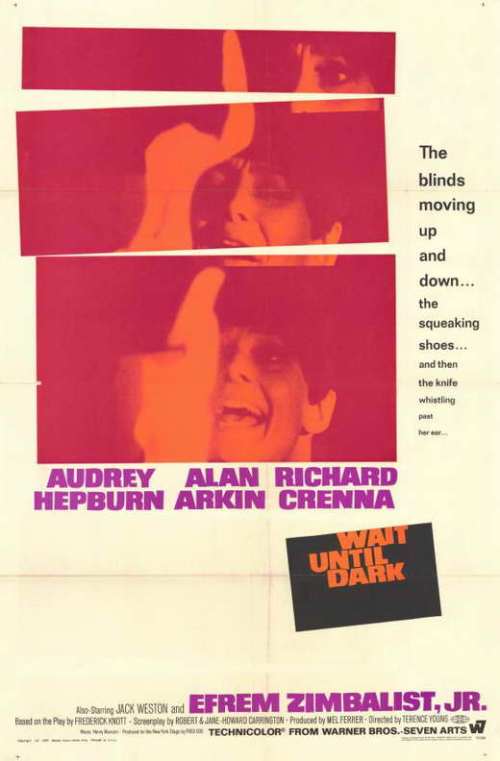
The film is based on the hit Broadway play by Frederick Knott and follows that script very closely.  It centers on a recently blinded woman named Susy Hendrix (Audrey Hepburn) who accidently acquires a doll filled with heroin and then becomes terrorized by the three drug dealers (Alan Arkin, Jack Weston, Richard Crenna) when they come to retrieve it. Trapped in her small apartment by the three men with her phone line cut off, she decides her only possible recourse is to smash all the light bulbs and then, in the pitch blackness, use her handicap to her advantage and try to escape.

Normally stage plays transferred to film don’t usually work too well namely because all the action takes place in one setting, which eventually creates visual boredom, but here this becomes an asset.  As the story progresses the viewer begins to feel claustrophobic and as entrapped as Susy as well as successfully tapping into the fear of isolation. The lighting is also impressive.  It may not be something one consciously thinks about, but good lighting can really help accentuate a film’s mood and style, which it does here.  I enjoyed the interesting color schemes and the contrasts between light and shadows that becomes more apparent as it goes along.

Of course the element that really makes this film special is the fantastic performance of Hepburn, which I consider to be her best.  She was nominated for the Academy Award and she should have won it.  She displays just the right level of emotions, which creates empathy from the viewer almost immediately. Her reactions as well as the fear and panic that she shows are very convincing. Arkin, as the villain, tends to get a little too flashy and hammy. I felt Hepburn easily out performed him and everyone else. The film just would not have been as good had anyone else played the part.  This also marks her career pinnacle as she went on a nine year sabbatical after this and when she did finally return, the films she did weren’t all too great.

I also like Julie Herrod as the child named Gloria who lives upstairs and becomes a very crucial link to the story.  So many movies portray children as either total brats, or overly wide-eyed innocents solely put on this planet to say cute and amusing things on cue.  Here the balance is just right and so believable she will remind you of kids that you know in real life as it certainly did with me.  She is sneaky and precocious at certain times, but also genuinely helpful and concerned at others, just like adults are.  The line she says to the Hepburn character just before she runs out to find help is a gem.

The climatic sequence still ranks as one of the best.  The clever ways that this petite, handicapped woman manages to outwit the brutal thugs are classic.  The viewer also gets the satisfaction of seeing the character grow and find an inner strength that she didn’t even know she had. It also features a very well staged scare/shock that sent viewers jumping out of their seats when it was first released and still does today as evidenced by the other people who watched the film with me and all screamed out loud when it happened.

As with any film released 40 years ago, there are some dated qualities that do hurt it.  Some of the ‘tough guy’ talk between the thugs seems a bit stilted.  The film was released a year before the ratings system took effect, so there is no cursing, but a little bit of it would have helped make it more authentic.  It would have also been a little more gritty had the bad guys actually carried guns instead of the brass knuckles and silly looking knives.  Air travelers of today will also be shocked at just how easily it was for people to get through airports in the old days.

However, even with these few weaknesses I still feel this film is a pretty solid, compact thriller that can be used as a blueprint for all other thrillers to follow.  There is also the excellent music score by Henry Mancini that is really creepy although the song played over the closing credits should have been avoided.

My Rating: 8 out of 10

Released: October 26, 1967

Runtime: 1Hour 48Minutes

Rated NR (Not Rated)

Director: Terence Young

Studio: Warner Brothers

Available: VHS, DVD, Blu-ray, Amazon Instant Video
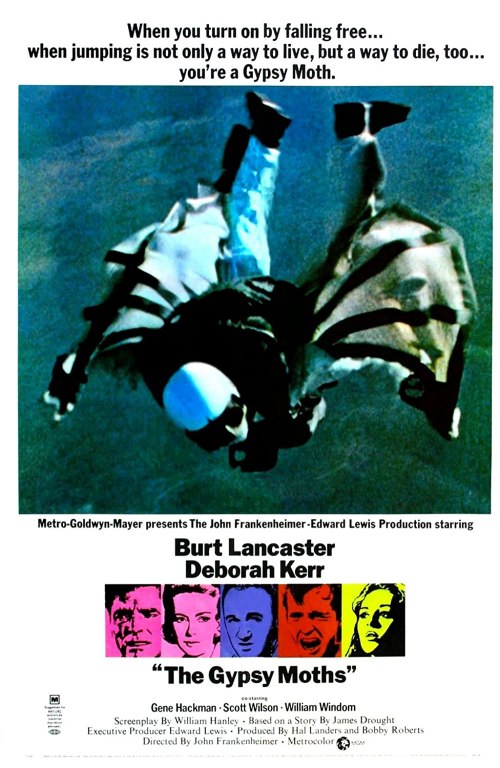
The Gypsy Moths (1969)

gypsy

By Richard Winters

My Rating: 4 out of 10

4-Word Review: Skydivers travel to Kansas.

Three skydivers, who make a living going around the country doing airshows for the public, stop off at a small Kansas town on a fourth of July weekend that ends up changing all of their lives. Mike Rettig (Burt Lancaster) is the eldest and the leader of the group. He seems unhappy and suffering from some inner turmoil that he is reluctant to elaborate on.  He ends up having an affair with one of the attractive middle-aged women in town named Elizabeth Brandon (Deborah Kerr).  Joe Browdy (Gene Hackman) is restless and impatient and has a fling with the town stripper (Sheree North).  Malcolm Webson (Scott Wilson) is the introspective member of the trio.  He grew up in the town that they are in and uses the visit as a way to reconcile with his demons from the past.

MGM was hoping for a big hit with this one as it reteamed Lancaster and Kerr 16 years after their famous embrace in From Here to Eternity. The film broke ground as it was the first to feature an established and respected actress who was nearly 50 years of age doing a nude scene. Kerr, who looked great both with her clothes on and off, can be seen fully nude from the front and back during a lovemaking scene with Lancaster.  Yet the film failed to gel with the public.

There were some things that I did like. One is the fact that it was filmed on location in Kansas. The opening shots capturing the countryside of the Midwest really gives a strong visual sense of Americana.  The scenes taking place in the neighborhoods of the small town give the film an added dimension that a studio back-lot just couldn’t do.  The skydiving sequences, which take up the majority of the time, are breathtaking and exciting. The aerial photography makes you feel like you are right there jumping out of the plane and free falling into the air.

The basic plot though is dull and uninteresting.  The characters and situations are contrived and derivative.  It is almost like the story was a second thought to the stunt work and put in merely as filler. I also didn’t like the pretentious quality of the production that made it seem like it was making some sort of profound statement when in reality it was nothing more than second rate soap opera.  The whole thing would have worked better had they skipped the story and made it into a documentary on skydiving instead.

Spoiler Alert!

The most frustrating thing about the movie is the fact that the Mike character dies at the end when he decides, for no apparent reason, not to open his chute and goes, literally, splat on the ground right in front of a throng of spectators. I actually thought this was one of Lancaster’s better later career performances and I was intrigued as to what was causing his character’s inner-strife, but the film offers us no clue, or hint.  I thought there should have been a backstory and even some flashbacks. The ambiguity leaves the viewer cold and unsatisfied and makes the film seem incomplete.

The only possible explanation may come through researching actual Gypsy moths and then correlating the species to the characters. Per Wikipedia, the female gypsy moth is unable to fly. This would then explain why Elizabeth refused to run off with Mike despite her unhappy marriage simply because she could not ‘spread her wings’.  The adult male moth always dies in July, which would then explain Mike’s death. No reason for his demise was needed because his life cycle was ending regardless. July is also the time when the moth lays her eggs, which would explain why Joe and Malcolm, who were much younger than Mike, decided to go off on their own separate ways at the end.

End of Spoiler Alert!

I  ended up finding more misses than hits with this one and can’t help but label it as a misfire.

My Rating: 4 out of 10

Released: August 28, 1969

Runtime: 1Hour 47Minutes

Rated R

Director: John Frankenheimer

Studio: MGM

Available: VHS, DVD

Privilege (1967)

By Richard Winters

My Rating: 5 out of 10

4-Word Review: Teen idol is pawn.

A British pop singer by the name of Steven Shorter (Paul Jones) becomes a major hit with the young teen audience of the day and his managers realize they have a powerful and influential weapon on their hands.  They assign him to do an ad for apples and soon everyone is eating apples. They then use him as an example to support God and Country by making him sing a rock rendition of ‘Onward Christian Soldiers’.  With the help of some high-ranking church leaders they get him to introduce a Nazi type salute to everyone in order for them to show their allegiance.  Steven is aware of how he is being manipulated and is unhappy with it, but can’t seem to find a way out it.

This reminded me a lot of the Fonzi character on the old ‘Happy Days’ TV-show from the 70’s, a character with a rebel image who eventually became benign and unrealistic when the producers tried to turn him into a role model for his young audience. The film’s message is certainly a good one and as pertinent today as ever.   Unfortunately it is done in an extremely heavy-handed way that made this viewer feel like he was being hit over-the-head.

I became a fan of director Peter Watkins after seeing the pseudo-documentary Punishment Park where a group of hippies are thrown into the dessert and forced by the military to play a brutal game of survival.  That film featured some emotionally charged scenes that were amazing and the execution was so flawless that it seemed almost authentic.  This film takes the same documentary approach, but it is not as consistent with it nor as effective.  The result is a weird mishmash between the surreal and allegorical to the dramatic and satirical and it never comes together as a whole. It does contain a few moments of funny humor, but there needed to be more of it and most of it comes in film’s first half. The drama is awkward and at times clumsy. It ended up leaving me alienated with it.

I had equally mixed feelings with the lead character.  He was played by Paul Jones better known as the lead singer to the 60’s group Manfred Mann who did such hits as ‘Do-Wah Diddy’ and ‘Mighty Quinn’.  He certainly had the chiseled, boyish good looks that one would expect from a teen idol and resembled Jim Morrison from The Doors.  However, he seems passive to extreme with no ability to ever stand up for himself.  Although looks are certainly one element, a rock star also needs to have some charisma and this guy had none and I would think the public would quickly see that.  He allows his managers to almost completely dominate him and the constant shots of his pained and unhappy facial expressions become, like everything else in the film, way over-done.  I could never understand why a singer with millions of adoring fans would feel so powerless. I would think he would have a healthy ego and sense of empowerment and if was unhappy with his managers then he would simply fire them, which happens all the time in the music world.

I did think that the camera work and cinematography were excellent and probably has a lot to do with director Watkins background.  The scene at the assembly where there is a giant picture of Steven and then the actual Steven stands in front of it making it look like he is being devoured by his own image was effective symbolism.

The points that the film makes in regards to conformity, those in position of power, and the superficiality of pop idols are all right on target.  I just wished that the narrative and storyline were done in a little more sophisticated way and that the characters were more fleshed out. The works of British director Lindsay Anderson came to mind as I watched this film. A lot of his films had the same types of themes like If, Britannia Hospital, and O Lucky Man. However, those films were more cerebral and layered and the wit was more consistent and biting.

My Rating: 5 out of 10

Released: February 28, 1967

Runtime: 1Hour 43Minutes

Rated NR (Not Rated)

Director: Peter Watkins

Studio: Universal

Available: DVD

Fathom (1967)

fathom1

By Richard Winters

My Rating: 4 out of 10

4-Word Review: Dental assistant becomes spy.

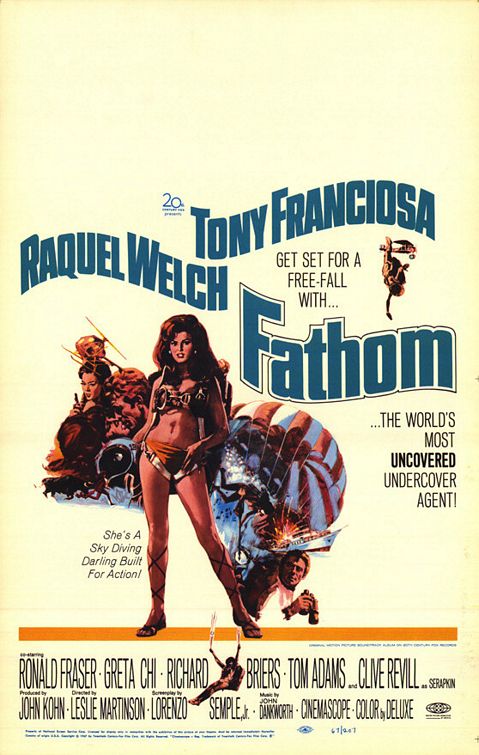
The spy genre became a big craze in the late 60’s with the success of the James Bond films.  Studios were busily either coming out with imitations of the genre, like the Matt Helm films with Dean Martin, or spoofs of the genre.  This film, starring the voluptuous Raquel Welch, is a combination of both.

The premise is slightly unique as the Welch character, whose name is the same as the film’s title, is not actually a spy. She is a dental assistant and part-time parachutist. This attracts the attention of the British secret service who want to use her parachuting skills to have her ‘drop-in’ to the island mansion of bad guy Tony Franciosa and plant a bug on his premises. They need this done so that they can monitor his conversations and find the whereabouts of a priceless Chinese dragon statue that they are after.

Initially I was intrigued with the idea of the Welch character being just a regular person who gets trained to be a spy from the ground up. However, this concept almost immediately falls flat and ends up pretty much ruining the whole film.  One of the problems is that the Welch character goes through no training to speak of and agrees to this potentially dangerous mission that comes out of nowhere without any conversation regarding her compensation.  She also ends up thinking way too quickly on her feet and behaving like a seasoned spy without any of the expected awkwardness. The character is also poorly fleshed out having no personal life, relationships, history, or even a few odd little quirks.  There are constant references to her beauty, but this quickly become tiresome.  Raquel’s typically one-dimensional performance doesn’t help.

The storyline becomes too convoluted and suffers from having too many plot twists. Reportedly even the cast members found the story confusing.  The good guys become the bad guys and then become good guys again with boring regularity.  A decent spy film needs one true bad guy who is evil and nefarious and seemingly unstoppable because that is what builds the tension.  This film has no tension whatsoever and the musical score sounds like Herb Alpert or Sergio Mendes, which would be better suited for a romance.

The one thing that did impress me was the stunt work.  There are a few that look genuinely dangerous and are shot and edited very well.  One involves Raquel trapped in a bull ring while wearing a red dress.  There is no question that it is a real bull and several shots have her stumbling to the ground while the bull stands right over her. The editing is so well done that I could not tell when the stuntwoman was put in, as usually I can spot this.  Even if a stunt person was used it still looked quite dangerous and very real.  Another good one features Raquel swimming away from a bad guy who continues to shot at her with a spear gun. Both the underwater and aerial photography in this segment are outstanding.

Alas, none of this is good enough to save the film as a whole.  The tongue-in-cheek humor and pacing is poor, and the film ends up being boring and contrived.

My Rating: 4 out of 10

Released: December 13, 1967

Runtime: 1Hour 39Minutes

Rated NR (Not Rated)

Director: Leslie H. Martinson

Studio: 20th Century Fox

Available: DVD

Who’s Been Sleeping in My Bed? (1963)

who1

By Richard Winters

My Rating: 3 out of 10

4-Word Review: Carol Burnett does striptease.

Every time I get annoyed by many of today’s Hollywood comedies that seem to be nothing more than a stretched out idea for an episode of a sitcom, one only has to go back into time to find that the comedies of yesteryear weren’t always much better. Of course there were some classics, but a lot of vapid ones in the mix as well. In fact this one is so trite that it becomes almost agonizing to sit through. It was considered in its time to be a ‘sex farce’, but fails to deliver on either.

The old adage ‘it’s not what you know, but who you know’ has never been truer in this instance. I have attended many screenwriting classes and seminars and can verify there is a lot of good stuff out there that hasn’t been read unfortunately because the authors don’t have the right connections. In this case the screenplay was written by Jack Rose who had previous writing success with such films as My Favorite Brunette, Houseboat, and The Road to Rio. Judging from its lack of creativity Rose probably wrote this real quickly to make some fast cash and the studio heads gave it the green light simply based on his past success without ever looking at it critically.

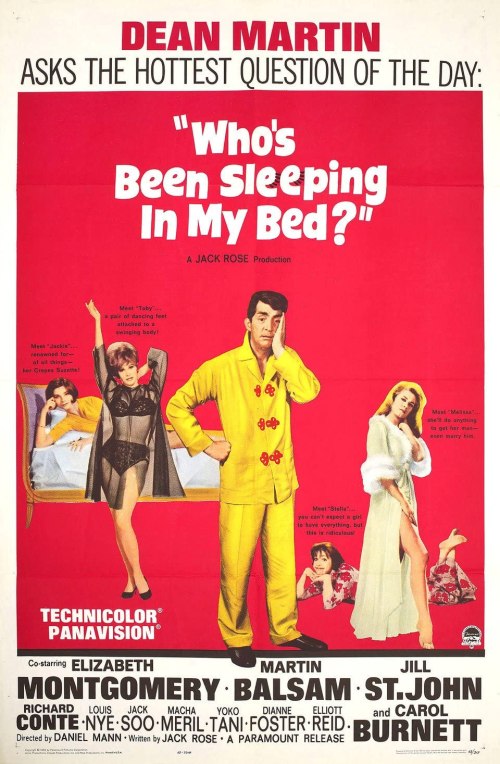
The plot, if you can call it that, has to do with TV-star Jason Steel (Dean Martin) who plays the part of a popular Dr. on a TV-series.  His TV character matches all the ideal qualities that women want in a man and thus he always has women chasing after him in real-life. He even has the wives of his friends coming on to him. With so many married women telling him how unhappy they are in their marriages he begins to fear that marriage may not be a good idea and thus calls off his impending engagement to beautiful Melisa Morris (Elizabeth Montgomery).  Melisa is devastated by this, so her goofy roommate Stella Irving (Carol Burnett, in her film debut) hatches up a kooky scheme in order to get him to reconsider.

This film gets tiring right from the beginning.  Jason goes out with his buddies every Thursday night to play poker, but then during the game he always gets a call from one of his buddy’s wives telling him they have to see him.  He leaves the game and meets them at his place and then fights off their advances. This silly scenario gets repeated four different times with all four of his friend’s wives and it’s like being told the same dumb joke over and over. This triviality ends up taking up the whole first hour before it moves into the scheme portion, which really doesn’t even measure up to a weak episode of ‘I Love Lucy’.

Out of the whole ninety minutes there are only two scenes that are mildly amusing.  One is when Jason pushes everyone into a pool and they fall in like dominoes and the other is when Stella goes to a strip club and is forced to go onstage and do a striptease when she can’t pay for her drinks, which makes great use of Burnett’s ad-libbing abilities.

Burnett and Montgomery make an interesting pair. Montgomery is a good straight-man to Burnett’s zaniness and with a better script this could’ve been ideal casting. Montgomery did this film just before she started her long running series ‘Bewitched’. She looks gorgeous and gives the film’s best performance.

There is a long list of excellent male character actors here including: Martin Balsam, Jack Soo, Richard Conte, Louis Nye, and Johnny Silver. All of them are wasted with very little to do. Except for the money I don’t know why any of them took their parts.

The satirical jabs at TV-dramas are too gentle and not even good for a chuckle.  If one is considering getting married then I would definitely not suggest it as the script takes so many potshots at the institution that it is liable to give anyone second thoughts.

Although this was made as a vehicle for Martin I feel even fans of Dino will be disappointed. It really doesn’t take advantage of his persona and he seems as bored with the material as the viewer and just going through the paces. Despite the interesting cast this is an all-around disappointment.

My Rating: 3 out of 10.

Released: December 25, 1963

Runtime: 1Hour 43Minutes

Rated NR (Not Rated)

Director: Delber Mann

Studio: Paramount

Available: Netflix Streaming

Targets (1968)

targets

By Richard Winters

My Rating: 6 out of 10

4-Word Review: He kills his family.

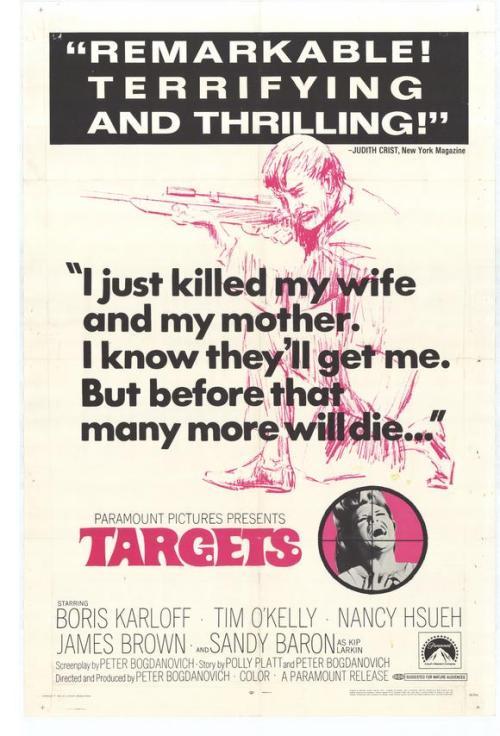
In 1967 producer Roger Corman gave fledgling director Peter Bogdanovich the green light to make any movie he wanted as long as he followed two stipulations.  The first one was that he had to use footage from Corman’s earlier film The Terror and the second one required that he use the acting services of Boris Karloff as Karloff still owed Corman two day’s work per his contract.  This movie is the result of that agreement, which kind of works and kind of doesn’t and seems more like two movies rolled into one.

The first story deals with a young, clean-cut man starting to have homicidal urges. The second scenario involves an aging actor played by Karloff, who decides he wants to retire despite the appeals of his agent and film studio. He plans to attend a showing of one of his films (The Terror) at a local drive-in where the sniper is waiting to shoot him.

I enjoyed the scenes involving the sniper and felt it helped elevate this film from the typical exploitation fare.  The character is based very closely on Charles Whitman, an All-American ex-marine, who on August 1, 1966, climbed to the top of the clock tower at the University of Texas in Austin and shot 32 people, killing 14. It was one of the very first mass-shootings in American history and it caused worldwide headlines.

Tim O’Kelly, the actor who plays the gunman, looks almost exactly like Whitman. What I liked about these scenes is the way it follows the character around and shows his interactions with his family. Like in real life there were no indicators, or violent past.  It is creepy watching him say grace at the dinner table, or having wholesome conversations with his wife when you know what’s going to happen.  The film goes into almost meticulous detail with the build-up and I found it gripping despite the fact that there is little action, or music.

The shootings are uniquely done.  Like in the actual incident, he shoots his mother and wife first and then puts a towel over their blood stains while carrying their dead bodies back to their bedrooms so it would look more ‘tidy’ when the police came.  This is all done with a docu-drama approach, which heightens the impact and realism.

The scenes involving the sniper shooting at people while they drive in their cars along a busy roadway are excellent as well.  It was done on an actual freeway and the viewer watches the action from the killer’s perspective through the telescope of his rifle, which is chilling. The cars veering off the road and people getting shot are vivid.  The only fault here is that Bogdanovich had the killer climb up on top of an ordinary tank at an oil refinery to do the shootings.  The clock tower in the actual incident was a very distinct structure and it would have been stronger visually had they found another one that was similar to it.

The parts involving Karloff are weak and tend to be cluttered with a lot of uninteresting dialogue.  Bogdanovich casts himself as the screenwriter for Karloff’s next proposed project.  I always thought it was a bit weird for a director, especially one that at the time was young and unknown, to cast himself in his own movie.  I know Woody Allen and Spike Lee, as well as others have done this, but it always came off as a bit narcissistic to me. However, I saw Bogdanovich in person a few months ago and he hasn’t seemed to have aged a day.

The climactic sequence in the drive-in is poorly handled. The dark lighting makes it hard to follow the action.  The final confrontation between Karloff and the killer is dull and unimaginative.  The only good points here is that it gives you a chance to see both Randy Quaid an Mike Farrell in their film debuts playing two of the sniper’s victims.

The film ends with a bird’s-eye view of the drive-in’s empty parking lot taken the next day with the sniper’s car being the only one left.  It was shot during the early morning hours so the sunlight gives it a surreal quality.  It also has a moody feel because the only sound is of blowing wind as the credits scrawl over, which I liked. However, the police would certainly have impounded his car and gone through it for clues and not have let it just sit there.

Under the conditions that he was given I think Bogdanovich did a commendable job. It is hard to know what category to put this film into.  At times it seems like a horror movie and then at other points it’s a drama. Some may even argue that it is a sentimental tale dealing with an aging actor moving into the final years of his life. Personally I wished it had gone all out as a horror film because the ingredients were there except that the tension was inconsistent. Fans of Bogdanovich may want to check this out because it is radically different from any of his later works.

My Rating: 6 out of 10

Released: August 15, 1968

Runtime: 1Hour 30Minutes

Rated R

Director: Peter Bogdanovich

Studio: Paramount

Available: DVD, Amazon Instant Video

The Great Race (1965)

By Richard Winters

My Rating: 3 out of 10

4-Word Review: Slapstick isn’t always funny.

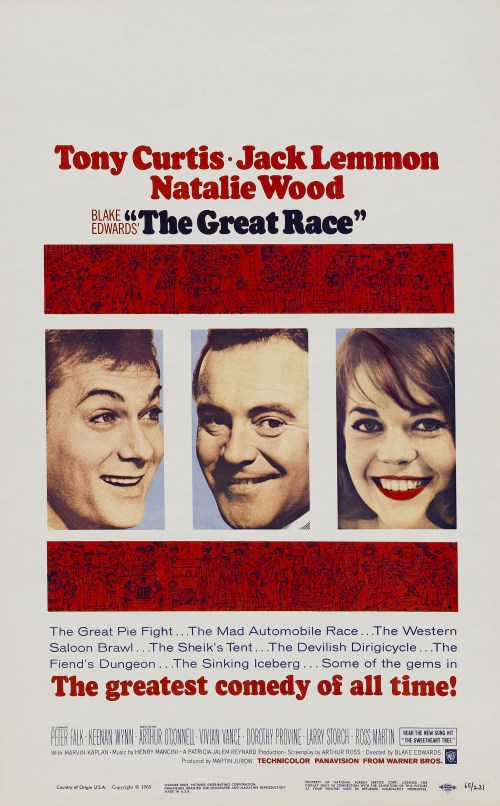
            The Great Leslie (Tony Curtis), who makes a living performing in wild stunts during the early twentieth century, decides to stage the world’s longest car race that will span over three continents. It will pit him against the evil Professor Fate (Jack Lemmon) and Fate’s slightly dimwitted assistant Maximilian Meen (Peter Falk) who will employ any dirty trick that they can in order to win.

It promises to be a grandiose comedy, but comes off as overlong and trite. In fact out of the total 160 minute run time I didn’t find any of it funny, it’s not even good for a chuckle. The gags are unimaginative, strained, and forced. It reverts to all the age-old shtick like a tired pie fight and equally tiring barroom brawl without adding anything new to it. Although the cinematography is excellent the action is cartoonish and will easily bore someone who is looking for something slightly more sophisticated. The film fails to achieve any momentum and seems to rely solely on its many lame jokes and stabs at unfunny humor to carry it.

The story is staggeringly threadbare with nowhere to go. The film’s title is misleading when you factor in that very little of an actual race is ever shown. The script goes off on a lot of side-stories and tangents all of which become increasingly more stupid as it goes along.  The worst one comes near the end when the audience should be gearing up for an exciting climax, but instead are treated to an inane scenario were the group find themselves trapped in a palace and dealing with a drunken prince who looks identical to Professor Fate (Jack Lemmon in a dual role).

It would have been better had there been more participants in the race instead of just the two. At the beginning there are several more drivers, but their vehicles all either crash, or break down right away in a highly uninspired fashion.

Curtis is boring in the lead and having him always seen in white makes him annoyingly clichéd. Lemmon’s character, who wears all black, is irritating as well in the opposite way.  Initially it was fun seeing Lemmon ham it up, but the character gets overplayed. I also didn’t like that medieval castle that he resided in, which appeared to be nothing more than a miniaturized model made of paper.

There are also many irritating logistical flaws that go overboard even for silly slapstick. One of the worst is the scene where both racers are stranded in a blizzard presumable somewhere in Alaska. Then the next morning they somehow find themselves on an iceberg that quickly melts as it floats into warmer waters, but how does that happen when before they were landlocked? Also, the Professor slips into the icy waters several times, which should have killed him.

If there is one good thing I can say about this film it is in the presence of Natalie Wood who plays a feisty feminist named Maggie Dubois. She is stunning and easily steals every scene that she is in. I loved the character’s gumption and I wished that she had been able to have her own car the whole way and competed against the two instead of having the derivative romance with Leslie. I also didn’t particularly care for ‘The Sweetheart Tree’ song that she sings, which is sappy, nor did I like the lyrics getting printed onto the screen along with a small bouncing ball.  Did writer/director Blake Edwards actually expect movie audiences to start singing along with her?

Supposedly this whole mess is a tribute to the slapstick films of the 20’s and 30’s particularly the Laurel and Hardy comedies, but as is the case with most of these things the originals are far better. The production values are high, there is a pretty good dual scene between Curtis and actor Ross Martin, and in the scene requiring a polar bear it is nice to see that a real one was used instead of a guy in a bear costume, which always looks tacky. Still, overall, it is a waste of celluloid that seems geared for an audience that no longer exists.

My Rating: 3 out of 10

Released: July 1, 1965

Runtime: 2Hours 40Minutes

Rated NR (Not Rated)

Director: Blake Edwards

Studio: Warner Brothers

Available: VHS, DVD, Amazon Instant Video

Closely Watched Trains (1966)

closely watched trains

By Richard Winters

My Rating: 7 out of 10

4-Word Review: Boy loses his virginity.

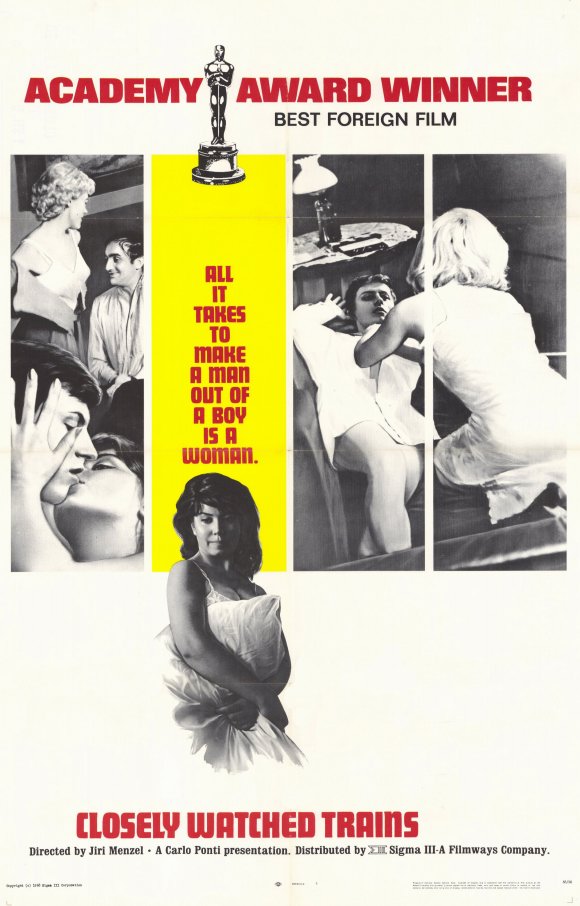
This is an engaging, amiable Czechoslovakian import that won the Academy Award for best foreign film of 1966. The story pertains to a young man named Milos (Vaclav Neckar) who follows in his father’s footsteps and gets a job at the local railway company during World War II. He almost immediately becomes bored with it and gets preoccupied with a beautiful young train conductor named Messa (Jitka Scoffin). The two have a sexual tryst, but Milos is unable to ‘rise to the occasion’.  He becomes despondent and even tries to commit suicide, but is saved at the last minute. While he is recuperating in the hospital the Dr. informs him that he suffers from premature ejaculation.  Milos then spends the rest of the time scouring the village for some prostitutes that he can ‘practice on’ so that he can learn to control his condition and become a ‘real man’.  A subplot involves plans to blow-up a German train carrying some high level ammunition.

Despite the fact that it is very leisurely paced and everything happens at one not very exciting location I still found the film to be immensely enjoyable. I had the feeling that director Jiri Menzel spoke straight from the heart with this one. The bleakness of the characters situation and the poor, hopeless conditions of their country is vivid and yet the ingenuity and perseverance of the human spirit never fades. Anyone who has dealt with an oppressive situation will most assuredly relate. The fact that this film stays so highly amusing and touching despite the depressing elements is what makes this a winner.

In a lot of ways this was years ahead of its time. The very liberal sexual attitudes and provocative scenes were stuff not yet seen in most movies and didn’t really become the norm, even for European films, until the 70’s and 80’s. Although not extreme there is indeed some lingering eroticism and even nudity. One segment involves Milos’s very amorous co-worker Hubicka (Josef Somr) rubber stamping the naked rear of Zdenka (Jitka Zelenohorska) who works as the station’s secretary. When her shocked mother finds out about this she parades her daughter all around town, exposing her rear to everyone, so that they can witness the ‘outrageous crime’ while the amused Zdenka finds it a turn-on.  There is also another scene, which another reviewer considered to be the most unique scene ever put on film that involves an old woman and a goose. I’ll agree it is very different, but I am not exactly sure what she was doing with it, or if I want to know, or if it is even legal, but it does indeed catch your attention.

Of course the drawback to this is the fact that the character’s attitudes seem far too modernistic for the era. At no time did I feel like I was really being transported back into the 1940’s.  There was also a little too much preoccupation with the sex angle and I felt there needed to be a little more balance with the actual war.

The Milos character is a bit too wide-eyed. He looks literally like a ‘deer-in-headlights’ through the entire progression of the movie. He seems overtly naïve for someone of 18. I know it was done for comical purposes, but having his mother dress him for his first day of work was going over the top. For the first half of the film he has hardly any dialogue and it is difficult for the viewer to relate to him, or get inside his head. Things do even out at the end when he ‘transforms into a man’, which I liked, but the opening half paints him too much as a caricature.

If there was one thing that really rubbed me the wrong way it would be the downbeat ending. I didn’t think it was necessary and tended to go against the film’s theme, which was human survival and coping. Still, it’s a good film with a great message. The budget was clearly very low, but it’s entertainment value high.

My Rating: 7 out of 10

Released: November 18, 1966

Runtime: 1Hour 33Minutes

Rated NR (Not Rated)

Director: Jiri Menzel

Studio: Filmove

Available: VHS, DVD (The Criterion Collection)

The Innocents (1961)

innocents 1

By Richard Winters

My Rating: 6 out of 10

4-Word Review: Children frighten their governess.

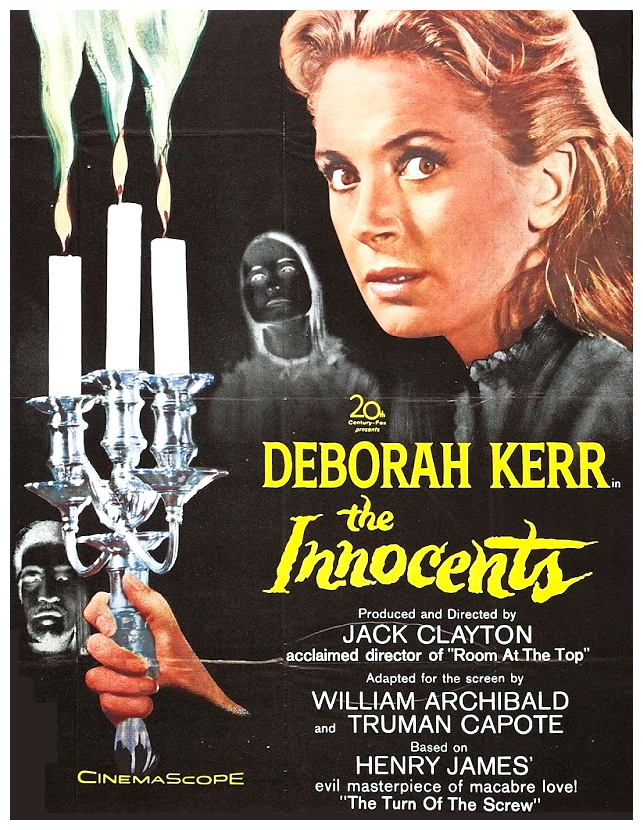
Legendary British actress Deborah Kerr plays Miss Giddens, the governess hired to care for two children at a sprawling English estate. However, the children are not exactly as they seem. Strange occurrences and behaviors begin to manifest as well as several ghostly sightings, which leads Miss Giddens into believing that the children may actually be possessed.

The film is based on the Henry James novel The Turn of the Screw. I have not read the book, but those that have feel this is a pretty satisfying adaptation. I did like the slow, methodical pacing. It helps to build the tension as well as enhance the mystery. Things are revealed in deliberate layers, which kept me intrigued throughout.

Director Jack Clayton shows a marvelous handle on the material.  The estate that they chose for the setting is perfect and captured well in glorious black and white by famed cinematographer Freddie Francis.  There is a lot of spooky imagery throughout including a creepy nightmare sequence in the middle.  The garden with its hulking, strange statues is used quite effectively especially in the haunting finale.  The music also grabs your attention right from the start with a very eerie song that is played before you see a single image on the screen. The song is similar to the one used in Rosemary’s Baby.  In fact there are several things here that reminded me of that film as well as The Shining.

Kerr was a good choice for the increasingly frightened governess.  I loved that scared expression on her face, which becomes progressively more frequent. Yet she is also effective when the character decides to become proactive by taking matters into her own hands and singlehandedly trying to ‘cure’ the children herself.  This also helps make both the character and the story a more multifaceted because you are never sure if this stuff is really happening or all just inside her head.

What really impressed me the most though was the performances of the two children especially Martin Stephens who plays Miles the young boy. His character shifts through many different moods, playing an innocuous child one minute and then a menacing, volatile one the next. He does each one flawlessly and becomes practically mesmerizing in the process.  Pamela Franklin is also fine in the role of Flora. This was her film debut. Eight years later her career would peak playing her signature role as Maggie Smith’s nemesis in The Prime of Miss Jean Brodie.

Another thing that I liked about the children is that they are initially portrayed as being normal and even engaging.  This is unlike other films with a similar theme like Children of the Damned or Children of the Corn where the kids are given creepy features right from the start. Here it works better and is more chilling to the viewer because the children’s dark side is unsuspected.

Unfortunately, despite the film’s impeccable technical quality, I still went away feeling unsatisfied. Part of the problem is that nothing really happens.  The ghosts appear but then do nothing but just stand there, which quickly becomes tiresome. One scene in particular has the camera constantly cutting back to the lady ghost standing across the lake until she starts to look like a mannequin, which I suspect she was.  The buildup is good, but I would have liked more of a payoff.  The ending is much too vague and gives no explanation as to why this was happening, if it was happening, or whatever became of the main character.

I couldn’t help but feel that this story would have worked better as an episode from one of the old horror anthology series like The Alfred Hitchcock Hour or even The Twilight Zone where it could have all been compacted into an hour. A hundred minutes seems like much too long for such little to happen. It is also interesting to note that in 1972 a film came out entitled The Nightcomers starring Marlon Brando that attempts to speculate what happened to the children before the main character of the governess arrives and before James’s original story begins.

My Rating: 6 out of 10

Released: December 25, 1961

Runtime: 1Hour 40Minutes

Rated NR (Not Rated)

Director: Jack Clayton

Studio: 20th Century Fox

Available: VHS, DVD

Lady in a Cage (1964)

lady2

By Richard Winters

My Rating: 4 out of 10

4-Word Review: Lady trapped in elevator.

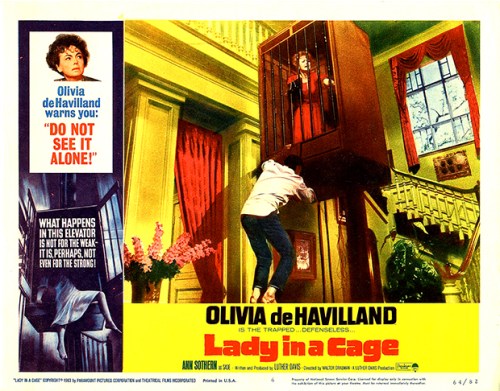
Olivia de Havilland, who as of this writing is the last surviving cast member from the film Gone With the Wind, plays a upper-middle class woman by the name of Cornelia Hilyard who gets stuck in her household elevator when the power goes out. A homeless man (Jeff Corey) becomes aware of her predicament and with the help of his sleazy girlfriend (Ann Southern) tries to rob the place. When they sell some of her items at a pawn shop a trio of juvenile delinquents (James Caan, Jennifer Billingsley, Rafael Campos) follow the two back to the place where they spend the rest of the film terrorizing Ms. Hilyard and ransacking her house further.

As a concept the film has some interesting ideas and imagery. The stark black and white photography looks great and helps accentuate the plot’s grim reality. The opening sequence is pretty good with an announcer reading off various startling news reports that are coupled with troubling images like a young girl on roller skates kicking at a homeless person lying in the street. There is also the fact that this all occurs within a large home amidst an upscale neighborhood that is right next to a busy street, which makes for some intriguing symbolism.

However, as a thriller it ends up being quite dull.  There is very little action and much too much talking that seems to go nowhere. There are no twists of any kind and the climax is forced, unimaginative, and unexciting.  Any violence that does happen is conveniently done out of view. The bad guys are portrayed as being dumb, careless, and just waiting to screw up. It is probably due to the period it was made in, but this potentially brutal subject matter seems way too restrained to the point that there is never much tension. There is also the issue of the elevator, which isn’t all that high up. Cornelia could have dropped herself out of it, which she eventually does, but had she done it earlier none of this would have needed to happen.

De Havilland does a good job here, but at times comes close to over-acting especially with her scared facial expressions, which some might find unintentionally funny. This marked James Caan’s film debut.  He is a great actor with an impressive career, but his performance here is lacking.  He seems uncomfortable in the role as the antagonist and he never manages to reach the level of being menacing. The final shot of his demise though is very graphic especially for the time. Jennifer Billingsley is probably the best thing about the film. She is attractive and gives a solid performance as the most jaded member of the gang.

Normally I always say these one-note thrillers that get stretched too thin at feature length would work better in one of those old horror anthology series like “The Alfred Hitchcock Hour”, however even there this story would be pushing it. Basically, in this instance, if you have read the synopsis then you have essentially ‘seen’ the film.

The trailer for the film and movie poster as seen above is actually much more entertaining than the film itself.  An announcer sends dire warnings that this film is ‘extremely shocking subject matter’ and ‘should not be viewed alone’.  It is pretty funny and even funnier when you see how lame the movie actually is.

My Rating: 4 out of 10

Released: July 8, 1964

Runtime: 1Hour 34Minutes

Rated NR (Not Rated)

Director: Walter Grauman

Studio: Paramount

Available: VHS, DVD, Amazon Instant Video