Category Archives: 60’s Movies

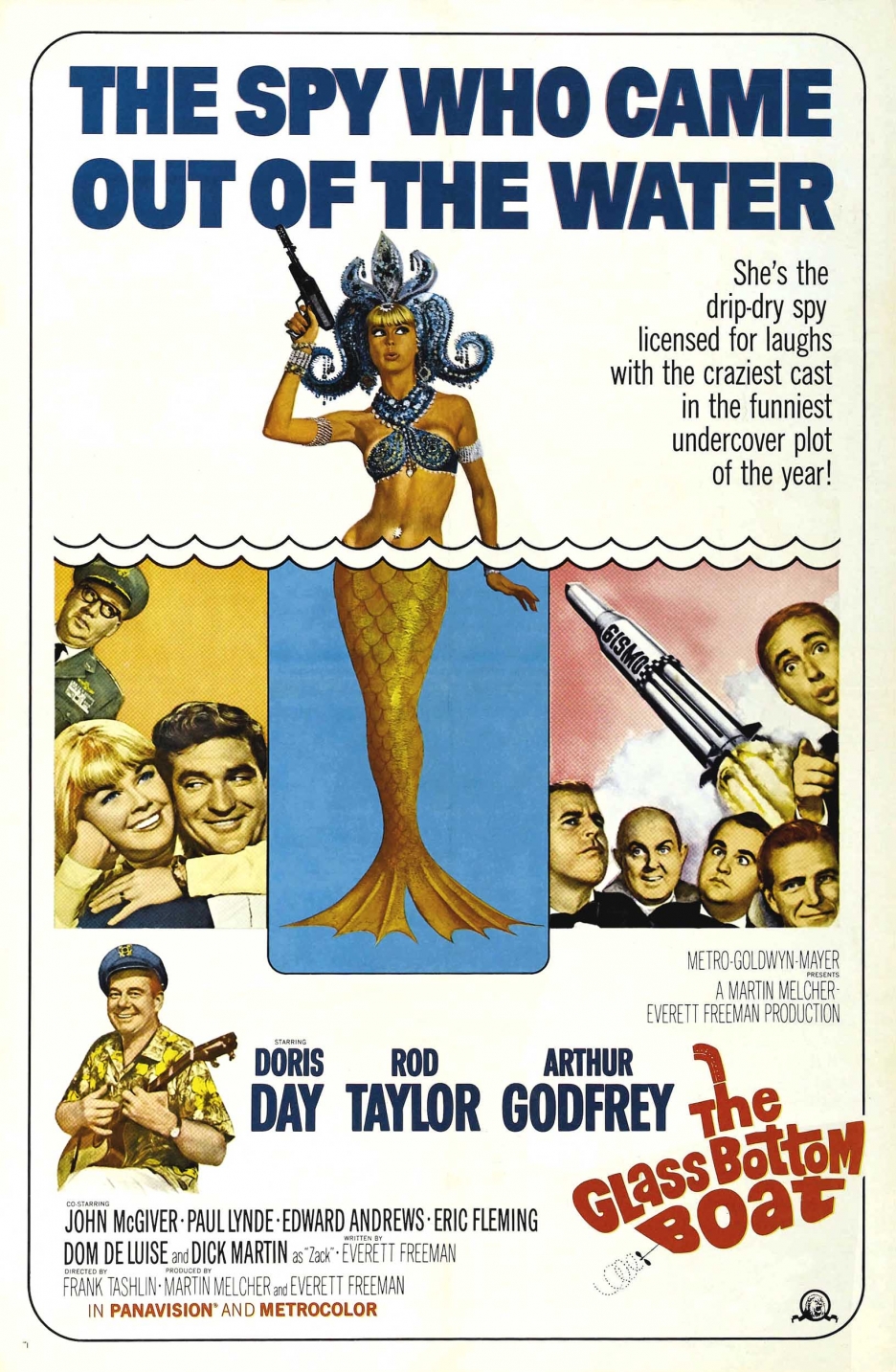
The Glass Bottom Boat (1966)

By Richard Winters

My Rating: 7 out of 10

4-Word Review: Doris is a spy.

            This is an energetic and zany Doris Day vehicle featuring her as Jennifer Nelson a tour guide at the NASA Space Center. She meets Bruce Templeton (Rod Taylor) who at first she can’t stand, but when she finds out that he is one of the top scientists at the lab and makes a lot of money she immediately becomes infatuated. This certainly does nothing to help fight the gold-digger stigma that some women have, but it was made over forty years ago, so I guess it was more acceptable. Through quirky circumstances she comes under suspicion as being a Russian spy and spends the rest of the time trying to prove otherwise while continuing her romance with Bruce.

Day looks gorgeous and is hammy at just the right level without going overboard and becoming cartoonish. Her best segment is when Taylor imagines here as a Mata Hari spy complete with skimpy outfit, which she looks great in, as well as dreaming that she is blindfolded and speaking in a foreign accent while ready to be shot by a firing squad. She sings the film’s title tune, which is bouncy, and even does, later on, a goofy rendition of her signature song ‘Que Sera Sera’.

Taylor is perfect as the love interest and I think he is the best out of all of Day’s male co-stars. His funniest moment, although brief, is when Day crosses her eyes to be goofy and then keeps them that way, which makes him momentarily panic. I got a kick out of his model of the solar system that he had in his office that displayed the planets in a symbolic fashion after the Greek gods they were named after.

The supporting cast is full of familiar comic pros. Alice Pearce and George Tobias appear as Jennifer’s neighbors and a variation of the Kravitz couple that they played on the ‘Bewitched’ TV-series. Pearce is hilarious and it was a shame that she wasn’t in more scenes and died before the movie’s release. Dom Deluise is amusing as the actual spy, who goes undercover as an electrical repairman. Normally his goofy fat-guy persona becomes tiring, but here it worked especially during the climatic sequence. Paul Lynde, who was always hard to cast and in the process usually got meaningless parts, has one of his best roles as the lab’s security guard and even dresses up in drag at the end. Dick Martin, Edward Andrews, and John McGiver help round out the cast. Arthur Godfrey, as Jennifer’s father, is the only one who is boring, but his part was dull, so it might be hard to completely blame him.

Director Frank Tashlin creates sets with bright, vivid colors and each scene is a Technicolor dream. Being a former cartoonist he creates some nicely played-out comic scenarios including Bruce’s hands-free futuristic kitchen that has a little robot that comes out of the wall and cleans-up any messes that are left behind and ends up attacking Jennifer. The out-of-control boat ride is also amusing, but the best part is the wild, fast-paced ending when Jennifer decides to turn the tables on her accusers.

Sure it is silly, but you know that going in and on a non-think level it is perfect entertainment for all-ages.

My Rating: 7 out of 10

Released: June 9, 1966

Runtime: 1Hour 50Minutes

Rated G

Director: Frank Tashlin

Studio: MGM

Available: VHS, DVD, Amazon Instant Video
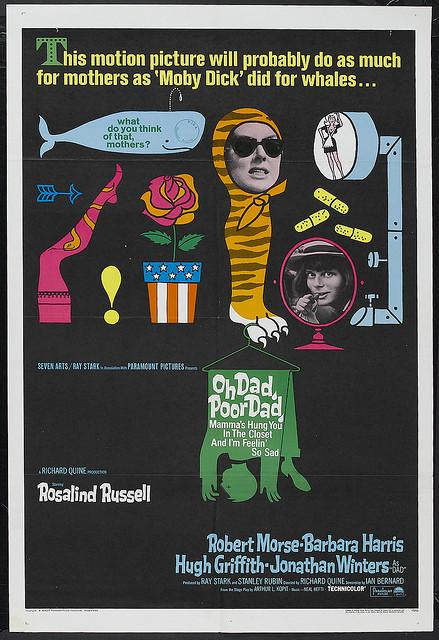
Oh Dad, Poor Dad, Mama’s Hung You in the Closet and I’m Feelin’ So Sad (1967)

oh dad poor dad

By Richard Winters

My Rating: 1 out of 10

4-Word Review: Overprotective mother dominates son.

This is an awful, awful film based on the Arthur Kopit stage play of the same name. Overly domineering mother Madame Rosepettle (Rosalind Russell) keeps her son Jonathan (Robert Morse), who is 25, in a near infantile state. She also travels around with her dead husband in a coffin. Problems ensue when they arrive at a resort and meet up with nubile Rosalie (Barbra Harris) who tempts Jonathan and threatens to break him away from his mother’s clutches.

If done right this film could have, I suppose, gained some sort of cult following. Yet it is so poorly realized and so thoroughly botched that it is impossible to know where one could begin to improve it as it deserves to be in the top ten of worst movies of all time.

One of the problems is the setting itself. For some reason it was filmed in Montego Bay, Jamaica. This certainly does provide for sunny and exotic scenery, but it does not at all work with its twisted, dark subject matter. The music score is also really bad. It was done by Neal Hefti the same man who did the music for the “Batman” TV-show and the soundtrack here sounds just like that one. He also has the theme song sung by children which is as irritating as nails scratching on a blackboard. The color schemes are garish and ugly. The humor is flat and the story itself is threadbare. When you get past the weird fringes all you have left is a stale, plodding coming-of- age tale.

Morse seems a natural for the part as the ‘man-child’ since he has always had a very boyish face. Yet, in an attempt to show that he is never let outside, he is made to look extremely pale and the effect is a bit sickening to look at. His infantile state is played too much to the extreme and comes off as pathetic. It is not at all funny even in an absurd, or dark way.

Russell’s presence makes it somewhat interesting. She was a legendary actress and this was certainly a very unique career move. Maybe she wanted to prove herself versatile after her Mother Superior part in The Trouble with Angels, which she had done just a year before doing this, yet in hindsight it was bad judgment. Seeing her in the strange part is fun for a few seconds, but eventually it gets over-the-top. She ends up looking like Faye Dunaway’s Joan Crawford in Mommie Dearest. You do however get to see her wear a variety of wigs and even do a wild water ski stunt at the end.

Harris has always been one terrific actress and she is good even here and the only reason I’m giving this film one point. She made a career out of playing neurotic women, but here plays a more normal one and it is interesting to compare this performance with her others.

Jonathan Winters (no relation) adds some amusing bits doing voice-over as the dead father. He was brought in after the film was completed and some of his lines have nothing to do with the plot.

The message of the story is nebulous. The video box cover states that it is a study of “human confusion”. Yet the characters seem too extreme to be relatable on any human level. They also don’t evolve and act the same idiotic way at the end as they did at the beginning so neither they nor the viewer come to any better understanding of anything. It is a complete waste of time.This film deserves its near extinct status and isn’t fun even as a curio.

My Rating: 1 out of 10

Released: February 15, 1967

Runtime: 1Hour 26Minutes

Rated NR (Not Rated)

Director: Richard Quine

Studio: Paramount

Available: VHS

The Notorious Landlady (1962)

By Richard Winters

My Rating: 4 out of 10

4-Word Review: Landlady could be killer.

            William Gridley (Jack Lemmon) is an American who has arrived in London and looking for a place to stay. He rents a room from a home owned by Carly Hardwicke (Kim Novak) a gorgeous woman who Bill immediately becomes smitten with. The problem is that many people think Carly has killed in her husband even though his body has not been found. When Bill gets word of this he becomes determined to investigate the case and prove her innocence.

You would think a script written by Larry Gelbart and Blake Edwards would be funnier and full of zany scenarios and slapstick, but instead it gets grounded in a lot of dialogue for much of the first hour and forty-five minutes and only starts to get interesting during the final fifteen. The conversations lack any wit, or sharp one-liners, and the premise plods along at a much too leisurely pace. There is a segment where Bill accidentally sets fire to the patio, but I think this was simply thrown in for some action as there is very little else of it. The plot is formulaic and fails to add any new twist or perspective and once it is over it is easily forgettable. Lemmon’s character is bland and transparent and more than a little naïve since he falls in love with her immediately and is then convinced that she is innocent even though he has only known her for a day.

The best part comes at the very end where the two find themselves at a recital for a group of senior citizens that are all sitting in covered wheelchairs. This scene gets drawn out amusingly and includes a bit where an old lady named Mrs. Dunhill (Estelle Winwood) is pushed down the side of a hill, which is nicely captured in a silhouette style with Bill chasing after her. Winwood, who was already seventy-nine at the time, hams it up perfectly as the daffy old woman.  Of course all this comes much too late to really help the picture, or story, but at least it saves the film from being a complete bore, which it otherwise would have been.

Novak gives a surprisingly strong performance and a convincing British accent that I wish she had spoken in for the entire duration.  She was always a stunner, but here she may look her all-time best. One scene taken with her in the bathtub was highly risqué at the time and doesn’t leave much to the imagination. British character actor Lionel Jeffries is engaging as the inspector, but Fred Astaire is essentially wasted as Bill’s boss. The production values are decent, but the results are middling.

My Rating: 4 out of 10

Released: July 26, 1962

Runtime: 2Hours 3Minutes

Rated: NR (Not Rated)

Director: Richard Quine

Studio: Columbia

Available: VHS, DVD (Region 1 & 2)

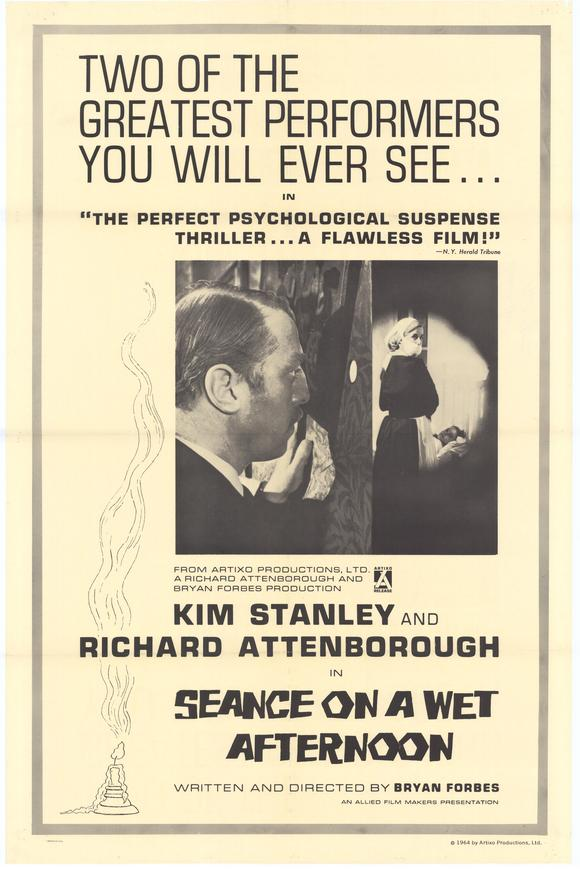
Seance on a Wet Afternoon (1964)

seance on a wet afternoon

By Richard Winters

My Rating: 6 out of 10

4-Word Review: Psychic is a phoney.

Myra Savage (Kim Stanley) is an emotionally unbalanced woman and failed psychic who comes up with an idea that she hopes will revive her career. The plan is for her husband Billy (Richard Attenborough) to kidnap Amanda Clayton (Judith Donner) who is the young daughter of a rich businessman. They will then place her at a strategic location and hold a public séance at which time Myra will ‘miraculously’ predict her whereabouts. This will then, they hope, make her famous and world renowned, but of course things don’t work out as expected.

This is indeed a unique and unusual film that taps into some rare qualities. First and foremost is the black and white cinematography. Every camera shot and angle has a certain evocative flair that is well captured and vivid. The on-location shots pick up just the right amount of ambiance and lighting with each setting. The music score is great and helps create excellent tension. You also will love the little girl that they kidnap. She is adorable without it being forced. Her matter-of-fact sensibilities are a great contrast to Attenborough and Stanley whose characters are child-like and pathetic.

Yet the film doesn’t completely work. The story is handled in a plodding and methodical way without any twists or surprises. There is very little action, some definite slow spots and the conclusion is limp.

If you watch it for the performances then you will be more intrigued. Stage actress Stanley gives a rare film appearance here. It is easy to see why she took the role even though she was known to dislike doing films. The takes are long and give almost unlimited possibilities in creating a character, which is what all stage actors enjoy. She does well and at times may remind one of another legendary actress Geraldine Page who would have also been perfect for the part. Attenborough proves almost her equal. His expressions of shock and worry are memorable. The interplay between the two is fun especially towards the end when this otherwise passive man stands up to the domineering woman.

Overall there are some unique moments, but it is just not suspenseful enough and results in being only slightly above average.

My Rating: 6 out of 10

Released: November 5, 1964

Runtime: 1Hour 55Minutes

Rating: NR (Not Rated)

Director: Bryan Forbes

Studio: Artixo Productions

Available: VHS, DVD (Region 1 & 2)

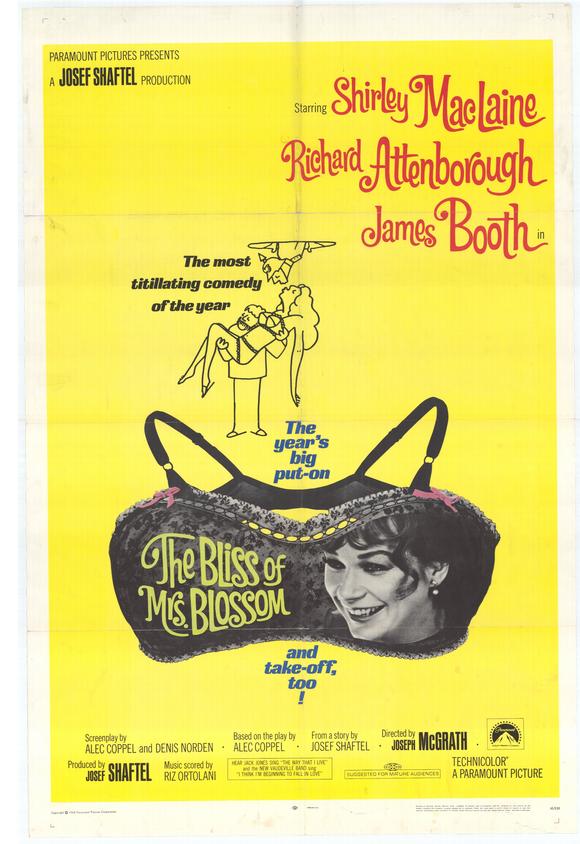
The Bliss of Mrs. Blossom (1968)

By Richard Winters

My Rating: 6 out of 10

4-Word Review: Lover in the attic.

This wacky film nicely exudes the mod, experimental wave of filmmaking that permeated the era of the late 60’s. The story takes place in London and is about a clothing manufacturer’s wife named Harriet Blossom (Shirley MacLaine) who one day calls her husband Robert (Richard Attenborough) while he is at work to tell him that her sewing machine has broken down. Robert sends his lowly assistant Ambrose Tuttle (James Booth) over to their house to help her fix it. Harriet is a bit bored with life and feels neglected by her husband, so she not so subtly seduces Ambrose and then hides him in the attic where he soon takes up residence.  He comes out only when Robert is away, but the unexplained strange noises that Robert hears and the many close calls make him think he is going insane and leads him to a nervous breakdown.

Director Joseph McGrath’s highly visual style is the real star. The lighting, editing, camera angles, set design, and costumes are creative and imaginative.  The home that was chosen for the setting has a nice architectural flair especially the attic and billiards room, which seems to be draped by a large stain glass window. Certain film professors show this movie to their classes as an example of how stylish direction can help accentuate a story as well as deftly define its era. I was disappointed to see that although McGrath is still alive he hasn’t done a film since 1984, which is a shame as it is obvious from this that he is quite gifted and I would have liked to see him doing more.

This is generally considered a vehicle for MacLaine, but to me her performance isn’t interesting. I think she is a first rate actress, but her character here is the only normal one in the film and she acts more like an anchor trying to corral the craziness around her. Booth, as her lover, goes to the other extreme, but doesn’t fare any better. He is too clownish and is always wearing various disguises and going through different personas, which makes the character unrealistic and cartoonish. If anything, out of the three main leads, it is actually Attenborough who does the best. His nervous and confused facial expressions are priceless. The scenes were he comes home from work and to ‘unwind’ pretends to be a conductor of a large orchestra while listening to a loud record, is amusing.

The colorful supporting cast though, full of legendary British Pros, is what steals the film. Some of them appear just briefly, but they still make a memorable and funny impression. Barry Humphries, playing a male character and not Dame Edna, is good as an art dealer. John Cleese, in one of his very first roles, is engaging as an argumentative postal clerk.  The best however is far and away Freddie Jones as the snippy, suspicious, relentless detective that will leave no stone unturned in his pursuit of Ambrose, who once he moves into Harriet’s attic proceeds to completely drop of society and disappear.

Although generally entertaining the plot doesn’t go anywhere and is simply a set-up for a lot of absurdity. What is worse is the fact that this based on a true story that in its own right was very intriguing.  In the real-life incident that took place in 1913 a 33 year old woman by the name of Dolly Oesterreich met a 17 year old named Otto Sanhuber. She, like the character in the movie, was a bored wife of a wealthy textile manufacturer, and took in the young man as her ‘sex slave’, which he readily accepted. To avoid possible suspicion she had him move into their attic, where he remained for five years and despite some close calls was never caught.  When the Oesterreich’s moved to Los Angeles in 1918 Dolly made sure that their new home had an attic as well and Otto then took up residence there and the deception continued until 1920 when Otto finally ended up killing the husband.

Of course none of that happens here. In fact Ambrose is fond of the husband and considers the three to be one big happy ‘family’, which is offbeat for sure, but not particularly satisfying. Again, this film does have some funny moments. I thought the scene where Robert invents the world’s first inflatable bra only to have the system go awry during an exhibition, which forces the model’s breasts to grow to unbelievable proportions before they go floating in the air, to be hilarious.  Still the end result of this production can best be described as cinematic soufflé.

My Rating: 6 out of 10

Released: September 11, 1968

Runtime: 1Hour 33Minutes

Rating: NR (Not Rated)

Director: Joseph McGrath

Studio: Paramount

Available: VHS

Lady in Cement (1968)


My Rating: 4 out of 10

4-Word Review: Tony solves the case.

Frank Sinatra returns as detective Tony Rome in this sequel to the 1967 hit. Here, while going on a diving expedition off the coast of Florida, he finds a naked woman underwater with her feet encased in cement.  He then meets a large and mysterious man by the name of Gronski (Dan Blocker) who hires him to find the girl’s killer, but he is not so sure that Gronski himself may have something to do with it.

            One of the things I really liked about the film as well as in the first one is the very cynical, world-weary, streetwise nature of the detective character. It seems to be a part that Sinatra was born to play and he does it well. I don’t think it was too far off from Sinatra’s real personality, which is why it works. I loved the cryptic dialogue and snappy one-liners. The banter is fun and intoxicating. It was the best thing about the first film and continues to be the case in this one. If anything it is the one thing that really carries it.

            The mystery itself is dull.  In the first film the case was more intriguing and complex. Here it seems mechanical and uninspired. It gets played out in a formulaic way with the standard suspects that seem borrowed from other, better stories. The twists and turns aren’t exciting, or surprising. The movie is more concerned with being amusing and filled with hip banter making the case itself seem like a side-light and not allowing the story to move forward. Yes, the bickering is fun, but there still needs to be a plot to match it and that was not the case here. The suspense is lacking with a final denouncement that is nothing special. The climatic fight sequence is particularly clichéd and forced.

            The opening bit where Tony finds the dead woman underwater is poor as well. It happens right away with no build-up even though I felt one was needed. I would think if a dead person had been trapped underwater for any period of time there would be some discoloration and decay. Instead the woman looks gorgeous, wearing a provocative expression one would find on an erotic model. Her skin is unblemished and she even still has her lipstick and make-up on, which I thought was unrealistic and pretty much ruins the story’s validity before it even gets going.

            The presence of actor Dan Blocker is a major asset and helps the film’s appeal. Blocker was probably better known for playing the character Hoss in the hit TV-series ‘Bonanza’. The fight sequences that he is in are amusing because he can simply throw the other men around like they are toys and seems unstoppable in the process. Like in the TV-series he exudes a lot of charm and is very engaging. There is even a brief in-joke where he is sitting in his room watching an episode of ‘Bonanza’. He and Sinatra make an unlikely, but interesting pair although when shown together he does make Frankie look puny, out of shape, and even a bit washed-up by comparison.

            One of the biggest issues I had with the first film was that there were a lot of loopholes. Particularly one scene where Tony kills a man and then he glibly tells the police that it was ‘clearly self-defense’ and he is never brought in for questioning, or arrested. That just didn’t jibe with me as there are many cases where a person kills someone in self-defense, but the case still ends up being brought to trial. Tony is very good friends with the police chief (Richard Conte), but I still didn’t think that would make him untouchable. At least here when Tony gets framed for a murder the police tell him they are going to have to take him in, which seems more plausible.  This culminates into an extended car chase sequence, which due to the long edits, slow speeds, bird’s eye view camera shots, and laid-back music, make it one of the least riveting and most uninteresting car chases you’ll ever see.

The production values are high and I have no real complaint on it from a technical stand point.  Everything is slickly handled despite a weak story.  There are some strong homophobic undertones, which may offend some, but I felt it fit the era. If you like Sinatra then you will find this passable, but if you enjoy a good mystery then don’t bother because in that area this thing falls flat.

My Rating: 4 out of 10

Released: November 20, 1968

Runtime: 1Hour 33Minutes

Director: Gordon Douglas

Studio: 20th Century Fox

Available: VHS, DVD

The Detective (1968)

detective

By Richard Winters

My Rating: 8 out of 10

4-Word Review: Up against the system.

Many people may not realize that Frank Sinatra was the original choice of Harry Callahan for Dirty Harry.  Due to various reasons he turned down the part despite the fact that he was interested.  You can’t help but wonder what that film might have been like had he accepted.  A good indication may be the character of detective Joe Leland that he plays hereIt has a similar theme of a tough cop tired of ‘the system’ and breaking off on his own to solve a bizarre case.

The murder itself is particularly gruesome and ahead of its time as it deals with the killing of a gay man found nude on the floor of his apartment with his genitals cut off. The actual shot of the victim is conveniently framed so that a fern, yes a fern, is strategically placed over the offending area, which is a little corny.  Yet the dialogue and description of the case seems incredibly graphic for the time. Ol’ Blue Eyes even says the word penis, which I think has to be a movie history first.

The way it deals with the homosexual topic is also surprisingly enlightening. Gays are not labeled as ‘sick’ and ‘perverse’, at least not by the Leland character. In one good bit the Sinatra character even slugs another officer, played by Robert Duvall, in retaliation for getting  rough with a gay man that he was questioning for no apparent reason except that he was gay.

There is another electrifying sequence involving Leland questioning the victim’s live-in lover and chief suspect. The part is well played by actor Tony Musante who gives his character all sorts of weird body gestures and nervous ticks, which makes the viewer feel uneasy but still compelled to keep watching until it becomes a fascinating experience. The Leland character again shows an amazing amount of compassion and enlightenment for the gay lifestyle during the interrogation, which should be enough to give this film a landmark status.

However, for all of its apparent sophistication, there are also things that hold it back and make it dated. One is reverting to what was a trend in the 40’s and 50’s, which was to film a person driving their car while sitting in front of a blue screen and holding onto a steering wheel that is not connected to any dashboard. It was considered a ‘ingenious’ way to stay under budget and not having to go through the ordeal of mounting a camera onto an actual car, but for today’s sharp audiences it comes off looking obvious and cheesy.

The casting of Sinatra is another drawback. He was already 53 at the time and he looked it.  The part seems to be screaming for a younger, more rugged method type of actor like Steve McQueen or Paul Newman, who would have done better.  Sinatra overplays the tough guy thing too much until it becomes one-dimensional and boring. The character needed more personal quirks and odd habits in order to make him more filled out and interesting.  He also wears outfits worn by the ‘old school’ investigators of yesteryear even though the character is one looking to break from tradition and fighting the mainstream.

I also wasn’t quite sure why Lee Remick’s role as Sinatra’s love interest was necessary. I usually dislike it when crime dramas feel the need to work in a romance angle as a side story because it usually bogs everything down and in this case was no different. Now Remick is always reliable and her character was interestingly flawed, but how that was supposed to connect with everything else was not clear.

The story works in three different parts. The first deals with the murder and the homosexual community of the period.  The second analyzes the politics of the police department while the third involves a mysterious suicide of a successful businessman. The third part, which doesn’t start until the second hour of the film, was the most intriguing for me. The suicide is shown from the point-of-view of the victim. They literally took a camera and heaved it over the edge of a building until it crashes directly onto the pavement below, which actually made me flinch. It is not until the very end where you see how all three of these parts come together, but the twist is excellent and made viewing this film well worthwhile.

Overall the cinematography, editing, writing, directing, and supporting acting are first rate.  There are a lot of familiar faces in supporting roles including: Jack Klugman, William Windom, Lloyd Bochner, Jacqueline Bisset, Horace McMahon and Al Freeman Jr. They all do splendidly. The subject matter and the way it is handled easily elevates this from other melodramas of the period.  The resolution should make this entertaining even for today’s viewers and enough to overlook a few dated elements.

My Rating: 8 out of 10

Released: May 28, 1968

Runtime: 1Hour 54Minutes

Rated R

Director: Gordon Douglas

Studio: 20th Century Fox

Available: VHS, DVD

Number One (1969)

By Richard Winters

My Rating: 0 out of 10

4-Word Review: Heston plays a quarterback.

            Ron Catlan (Charlton Heston) is an aging quarterback for the New Orleans Saints football team. At one time he was the best in the league and even won a championship, but now at age 40 his skills are declining and there’s a second string quarterback eager to take his place yet Ron isn’t emotionally ready to move on from the game even though he knows he should.

This is the type of film that gives dramas a bad reputation. The dialogue and scenarios are soap opera like. A few amusing bits would have helped eleviate an otherwise relentlessly downbeat tone. The same basic issue gets talked about and discussed over and over again until it is nauseating. There is no beginning middle and end to this thing. The storyline is introduced right from the start and then goes nowhere with it. The pacing is unbearably slow with no action and conversations that are general in nature and have no verve. The brief cutaways that are used are heavy handed and add nothing.

Heston looks goofy in a Saints helmet. Apparently he was unable to throw the ball accurately, or at a long distance, so they were forced to show a close-up of him going through the throwing motion, but then cut to a long shot of a professional player completing the throw, which becomes obvious and tacky looking. He also has the same grouchy expression on his face the whole time and the character is unlikable and uninteresting. The viewer never becomes emotionally caught up in his plight and it surprised me that the filmmakers ever thought that they would.

The climactic sequence consists of Catlan being hit by three Dallas Cowboy players, which injuries him enough to end his career. The intention was to make this stark and jarring for the viewer and the image of him lying on the field can be seen on the film’s promotional poster as seen above.  Supposedly the actual hit done during filming was so violent that it ended up cracking three of Heston’s ribs. However, capturing the hit and making the intended impact on the viewer is botched. The edits are too fast and it goes by so quickly that it doesn’t seem like a big deal when you see it. Most people will see similar types of hits during actual games while watching them on a regular Sunday. If anything the scene should have been done in slow motion and I am not sure why it wasn’t since other segments of the football action was.

The music choice was another mistake. I realize that the setting is New Orleans and in order to help create the ambience of the city director Tom Gries decided to give the film a jazz score and even has jazz legend Al Hirt make a cameo appearance, but the soft, light, laid back jazz sound does not coincide with the hard hitting and high adrenaline elements of the game.

Bruce Dern is terribly wasted. The women seem to give stronger performances than their male counterparts, but the movie is so bad as a whole that it hardly seems to mean anything.

The Saints seemed to be an odd choice as the football team since they had become an expansion team only two years prior to this film being made. I like the team’s unique colors and logo, but in the movie Catlan has supposedly won a championship with the team in prior years, which doesn’t make sense if one knows the team’s history.

I wrote previously in this column that The Longest Yard may very well be the best football movie ever made and if that is the case then this film is clearly the worst one. This film even makes the actual game itself and the action shown on the field seem boring and uninspired.

My Rating: 0 out of 10 

Released: August 21, 1969

Runtime: 1Hour 45Minutes

Rated M

Director: Tom Gries

Studio: United Artists

Available: None

Paper Lion (1968)

By Richard Winters

My Rating: 6 out of 10

4-Word Review: Scrawny guy plays quarterback.

            Lighthearted adaptation of George Plimpton’s best-selling novel detailing his account of playing for the Detroit Lions football team as a back-up quarterback despite having no real experience.  Alan Alda plays Plimpton and the movie’s main focus is during the team’s training camp and his shock at just how hard and rigorous being a pro-quarterback really is.

The film’s most amusing moments come during the many weeks of practice when Plimpton finds that even throwing a pass is difficult because the defenders are so quick that they are in his face and have him on the ground before he is even able to react. Even taking a hand-off from his center proves to be a difficult process as it jams his thumb. Director Alex March does a fine job of giving the viewer a feeling of Plimpton’s experience by having the defenders come barreling towards the camera until you feel like you’ve been tackled yourself.

What makes the story interesting is the fact that despite being an intellectual man from Harvard Plimpton still ends up having the same competitive spirit as the rest of the players. He becomes determined to prove himself by memorizing the playbook and practicing until he is able to function decently in the position. He even finds himself getting into a potential fist-fight with another man at a bar when the man makes a disparaging remark about the team.  Although the players quickly realize that he is not a legitimate athlete and try to scare him away they become impressed enough with his perseverance and fiery spirit to eventually be willing to play for him, which is a nice touch.

The cast is loaded with actual players and coaches incluing: John Gordy, Mike Lucci, Alex Karras, Sugar Ray Robinson, Roger Brown, Frank Gifford and the then head coach Joe Schmidt. All of them are given a lot of screen time and a surprising amount of lines. Despite what one may think they do an exceptionally good job. They are likable and believable especially coach Schmidt. In fact it is their presence that really helps make the movie succeed and gives the viewer the impression that they are experiencing the NFL as it is, or at least as it was at that time. There is even a segment featuring legendary coach Vince Lombardi, which is special.

Probably the only character that I felt wasn’t necessary was Lauren Hutton as Plimpton’s super-hot model girlfriend.  Now, I have never read the book, so I am not sure if Plimpton had an attractive girlfriend in real-life, or not, but the character here seemed to be put in for eye candy and added little if anything to the story.

The footage shown of an actual exhibition game that the Lions play against the St Louis Cardinals at the old Busch Stadium is vivid. So many times film of this nature will borrow footage from another source and then incorporate it in, but the grainy film stock always makes this evident and distracting and here that wasn’t the case. The camera gets right down on the field with the players and you see the plays and hits up close. You even hear the trash talk and a bit of cursing although they do edit some of that out.

The film’s drawback is that it is too serene for its own good. There is never any dramatic tension, or conflict. The pace and music is so easy going that at times it seems ready to put you to sleep. The film had the backing of the league, which I felt ended up compromising it. Some of the harsher ugly elements of football boot camp were clearly glossed over. I would have wanted something a little bit meatier, even if it had been for a only a few brief scenes. The film hasn’t particularly aged well. The ‘big’ players of yesteryear look rather puny by today’s standards. The game and conditioning has evolved a lot and I felt this story should be revisited in the modern day setting.

My Rating: 6 out of 10

Released: October 23, 1968

Runtime: 1Hour 47Minutes

Rated NR (Not Rated)

Director: Alex March

Studio: United Artists

Available: VHS, Netflix streaming

The April Fools (1969)

By Richard Winters

My Rating: 2 out of 10

4-Word Review: Affair between married people.

Director Stuart Rosenberg was on a high note in 1967.  He had just won rave reviews for his cult hit Cool Hand Luke and many felt he was well on his way to being Hollywood’s next top director only to follow it up with this incredibly vapid and stupid romance movie.

It involves a married man by the name of Howard Brubaker (Jack Lemon) who meets an attractive woman named Catherine Gunther (Catherine Deneuve) at a party. They spend the evening walking around outside and having nothing more than a casual conversation, which is enough to make him decide to leave his wife (Sally Kellerman) and child, quit his high paying executive job, and run off with her to Paris.

The story is pretty threadbare and filled with a lot of characters and situations that are not fleshed out at all.  This almost seems like a partial treatment to a main script that never got completed.  This movie provides no real tension, conflict, or subplots.  Most movies dealing with potential romances usually has one or both of the participants second guessing themselves as to whether they should move ahead with the relationship especially when both of the people are married like they are here.  These two fall in love so amazingly quickly that they make the art and act of dating seem completely unnecessary.

A much better idea would have been to have this quick romance act as only the starting point.  The film then should have cut to 5 or 10 years later where we could have seen how this relationship fared, or evolved. This would have given much better perspective to both the movie and characters.

I also have never felt that two people having an affair is a real good catalyst for a love story because it seems to go against the whole ‘true and everlasting love’ theme that propels most romance stories.  After all if someone can’t stay fully committed to one person what is to say that they will be able to do so with someone else.  To give the argument that they are just ‘crazy’ about this new person doesn’t work because at some point they must have been ‘crazy’ about the person they are currently with or they wouldn’t have married them. So what is to say that in a few years time when the newness of the relationship wears off that the whole vicious cycle won’t just get repeated.  I don’t have the exact statistics in front of me, but research has shown that people who cheat on one person are prone to doing it with their next partner simply because it is in their nature.

In some ways I could see why Catherine would consider leaving her husband, which is well played by Peter Lawford, simply because the guy is a womanizing lout in the worst way.  It is understandable that she may have been initially mesmerized by his wealth and charisma and only had her eyes opened to his shallowness years later.  However, Howard’s marriage didn’t really seem that bad and what is worse is the fact that he had a 5 year old son whom he seemed to have no problem abandoning without even a second thought.

The whole thing comes off like some uninspired idea by some studio head who wanted to make a ‘sure-fire’ hit by throwing together every contrived romantic element he could think of, piecing it together with a flimsy script, and then using the star-power of Lemon and Deneuve to cover up all the holes.  Everything here seems forced and that includes the humor.  Lemon’s duel with Charles Boyer is overdone and irrelevant.  There is also a scene where Howard’s friend (Jack Weston) drives him to the airport while being completely drunk and weaving in and out of on-coming traffic.  Today’s audiences would find this to be highly irresponsible and also terribly unfunny, which it is.

There are some potentially funny ideas that scriptwriter Hal Dresner never seems to think of.  For instance Catherine ends up being the wife of Howard’s new boss.  This could have been a goldmine of a lot of funny scenarios as the two tried sneaking around behind his back. The Lawford character does eventually corner Howard at the airport just as he is ready to board the plane and go off to Paris with Catherine, but even this potential confrontation gets botched badly.

I did really like Deneuve and her presence is the only real good thing about this movie. She looks radiant and I enjoyed the cool, chic way she responds to all the situations she is put in. This also marked her American movie debut.

Lemon though does not fare as well.  He overplays the high-strung businessman persona until it becomes tiresome.  He is nervous and befuddles every second that he is on the screen until you wonder how he was ever able to impress anyone enough to be able to obtain the prestigious position that he has at his company.

The supporting cast is stellar, but not used enough.  Jack Weston has a funny bit as he explains the goofy way that he handled an affair of his own.  Harvey Korman is amusing as a man who tries stealing the alluring Deneuve away from Lemon at the last minute.  It is also fun to see Melinda Dillon in her film debut.  She is best known for her supporting dramatic roles, but here she plays a giggling, ditzy blonde.  She is paired up with comic character actor Kenneth Mars and the two have the makings of being a great hammy couple. Unfortunately they are not given enough screen time, nor enough good lines, to really make it gel. Myrna Loy and Charles Boyer, as a long-time married couple, are essentially wasted.

Besides Deneuve there were a few other things that I did like about the movie.  The Burt Bacharach score is certainly pleasing on the ears.  There is a funky, mod 60’s party that takes place at the beginning of the film that features a lot of weird art exhibits that are nicely realized by award-winning set designer Richard Sylbert. I found the exhibit that featured a faucet dangling in mid-air while running a constant stream of water to be fascinating. I also enjoyed the scene where Deneuve and Lemon go to a wild nightclub where they are handed pop guns as they sit down which they can use to shoot at the rear-ends of the waitresses when they want to get their attention. I thought this was a genuinely neat idea that should be used at every restaurant.

My Rating: 2 out of 10

Released: May 28, 1969

Runtime: 1Hour 35Minutes

Rated PG

Director: Stuart Rosenberg

Studio: National General Pictures

Available: VHS, DVD (Import)