Category Archives: 60’s Movies

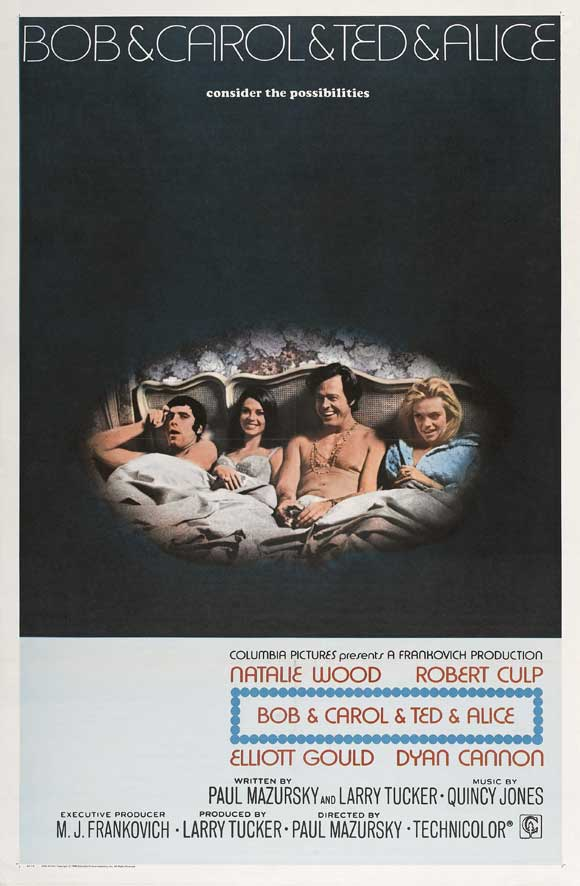
Bob & Carol & Ted & Alice (1969)

bob and ted and carol and alice 2

By Richard Winters

My Rating: 7 out of 10

4-Word Review: 60’s style mate swapping.

Bob and Carol Saunders (Robert Culp, Natalie Wood) attend a group therapy session at a remote cabin location. There they encounter other couples who learn to become open with their feelings and sexuality. When they return home they find that their friends Ted and Alice (Elliot Gould, Dyan Cannon) are too repressed and need to open up more with their true selves. At first the other couple is reluctant, but after spending more time with Bob and Carol and adjusting to their new way of thinking, which includes allowing their spouse to have sex with other partners they slowly come around and eventually all four have sex together.

Paul Mazursky makes a splendid directorial debut. During the late sixties most filmmakers were trying to reflect the times by making movies that featured quick edits, zany plots, and surreal elements, but Mazursky slows it all down keeping the humor on a subtle level and making great use of silence. The envelope pushing subject matter is handled in refreshingly non-judgmental way. Some films from the era would take on some of the more racy topics of the day, but still feel the need to put in a ‘moral center’, but fortunately here that is not the case. Mazursky shows a respect for his adult audience by keeping the entire thing on an uncompromised sophisticated level. When I first saw the film over 20 years ago I felt it was too talky, but upon second viewing that opinion has mellowed and I now find the long takes gives it a nice improvisational feel.

One of the best moments of the film is the very beginning where we see an aerial shot of the remote cabin where the group encounter takes place as well as the open nudity by the participants and Bob and Carol driving up through the scenic locale on a curving road. Quincy Jones’s booming orchestral score adds to the already striking ambience. The scenes from the encounter group is handled almost in a documentary style analyzing not so much what it talked about, but instead on the different emotional reactions that the members have throughout it. The scene where Bob admits to Carol that he had an affair and instead of being angered by it she accepts it, which turns them on enough that they end up making love on their bathroom floor is funny as is the opposite reaction that Ted and Alice have when Carol tells them the ‘good news’.  I also found Alice’s therapy session to be fascinating namely because it seemed quite authentic and was done by an actual licensed psychiatrist (Donald F. Muhich) who at the time was Mazursky real life therapist.

Wood gives a strong and amazing performance in one of her best and unfairly neglected roles. Having seen interviews that she gave I was aware that she was raised in a sheltered environment, so it is interesting seeing her in a part of a liberated woman embracing the new modern morality. The wild look in her eyes sizzles from the screen and she looks awesome in a bikini a well.

Cannon is good as Wood’s polar opposite a woman who is reluctant to let go of the values of her more repressed era and yet still curious about trying. Having the character evolve as the film progresses makes it  interesting.

The two male leads are okay, but the underpants that Gould wears during the final scene where they undress are overly big to the point of almost looking like adult diapers.

The only real complaint that I have with the film is that the famous scene where the four characters all go to bed together doesn’t happen until the very end, which could prove frustrating to some viewers since that scene is the film’s most famous and one that was used for its promotion. I had no problem with the film showing the various events that led up to it happening as it was essential and intelligently done, but it does not show what happens to the characters after they do it. I felt a better structure for the film would have been to have the scene where they go to bed together happen right away at the beginning and then spend the rest of the film cutting back and forth showing what lead up to it as well as scenes showing how the characters went on with their lives and how they dealt with each other afterwards.

This is a great film because it shows the 60’s experience from a middle-aged person’s perspective and the confusion that it created. People observing the new free love generation from the outside looking  in still straddled with the more repressive values of the past and unsure about how or even if they should jump in.
bob and ted and carol and alice

My Rating: 7 out of 10

Released: September 17, 1969

Runtime: 1Hour 45Minutes

Rated M (Later changed to R)

Director: Paul Mazursky

Studio: Columbia Pictures

Available: VHS, DVD, Amazon Instant Video
All the Way Home (1963)

all the way home 2

By Richard Winters

My Rating: 8 out of 10

4-Word Review: Life must go on.

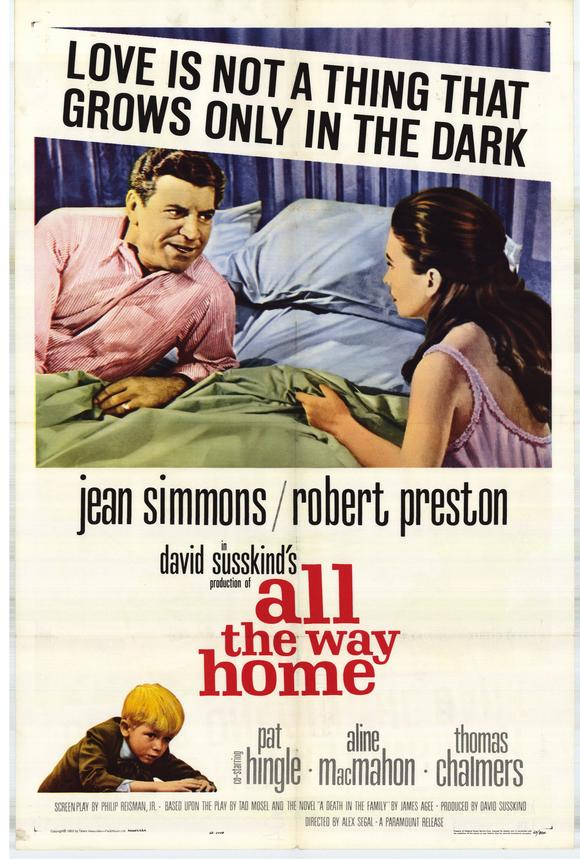
Based loosely on the childhood experiences of writer James Agee who is best known for penning the screenplay to the classic film Night of the Hunter.  The story here looks at how a southern family copes and in particular the young boy Rufus (Michael Kearney) after their father (Robert Preston) is tragically killed in a car accident.

Based on Agee’s unfinished novel ‘A Death in the Family’, which was also made into a stageplay the film makes loving tribute to the era. The sets and even the Model T car driven by the father are all authentic. In fact it was filmed near the exact neighborhood in Knoxville where Agee grew up. The mannerisms and dialogue are true to the period without any compromising for a more modern audience. The revisionism which has become so trendy in today’s period piece films is thankfully missing here. The slower and gentler pace seemed reflective of the era and I found it refreshing.

Preston gives one of his best roles second only to his signature one in The Music Man. He doesn’t get killed until the second half of the film, so the viewer gets to know and like the character and thus feels the pain of the loss along with the family members. We never see the actual accident nor given any explanation for what happened, which is just as well. Too many times filmmakers seemed compelled to have to give a reason for everything even though in life that is not always possible, so it is nice that here they did not fall into that trap. This emphasis instead is on how the family members cope and the emotional impact of the loss, which is something everyone must go through at some point and it ends up being quite compelling.

Kearney gives a terrific performance and one of the best from a child actor that I have seen. He is cute without ever being precocious. Watching him observe everyone else around him are some of the best moments in the film. It also brings up the great point that sometimes children are better at adapting to tragic events than their adult counterparts.

Durable character actor Pat Hingle gives one of his most interesting performances as Preston’s nervous and hyper brother. Preston has a great line in describing him when he says: “Talking to him is like putting socks on an octopus.”

Aline MacMahon is good as the kind, but stern aunt. I particularly liked the moment where Rufus falls to the ground in an emotional tantrum, but she restrains the others from helping him and insists that it is important that he learns to get himself up on his own. Jean Simmons as the mother and wife is also splendid, but seems to get better as the movie progresses particularly in her conversation with Rufus at the end, which is touching.

My Rating: 8 out of 10

Released: October 17, 1963

Runtime: 1Hour 37Minutes

Not Rated

Director: Alex Segal

Studio: Paramount

Available: Amazon Instant Video

Alice’s Restaurant (1969)

alices resturaunt 2

By Richard Winters

My Rating: 7 out of 10

4-Word Review: Nobody likes the draft.

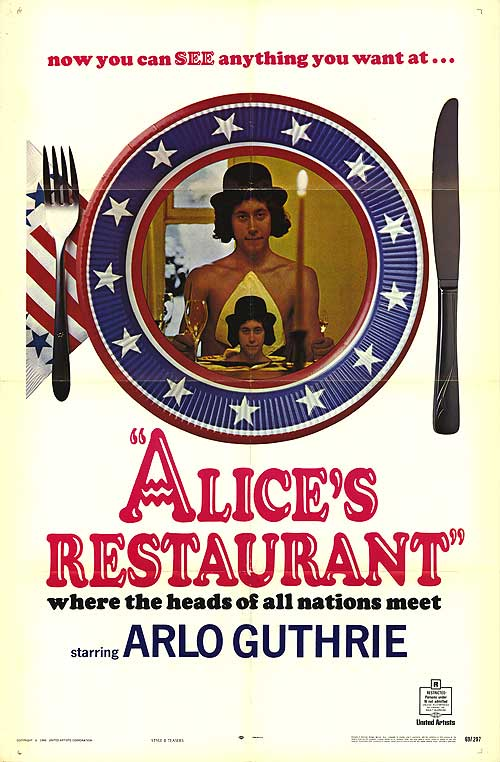
Attempt at making a movie out of Arlo Guthrie’s famous 18-minute song, which in itself was based on actual events succeeds for the most part although it seems to be biting off little more than it can chew. Pat Quinn plays Alice a middle-aged woman who along with her husband Ray (James Broderick) buys a church and turns it into a hippie retreat as well as a restaurant. Arlo plays himself and a friend of the couple who helps them in their endeavor. Things go well for a while, but then infighting, the draft, the death of some of the members, and basic overall disorganization do it all in.

Although Guthrie’s song has a bouncy, upbeat, and humorous quality to it the movie works in an opposite fashion. There are a lot of long dramatic takes with a tone that is overall downbeat and depressing. To some extent it succeeds at giving the viewer a vivid look at the late 60’s experience, but compared to the song it seems to be a bit of a letdown. However, there are still some great moments that will connect with you on a purely emotional level. One of them is seeing legendary folk singer Pete Seeger and Arlo playing a song for Arlo’s bedridden father Woody (Joseph Boley) and another includes the sights and sounds of an outdoor wintry funeral for one of their troubled friends.

There are some good comedic moments, but they all come pretty much in the second half making the film seem a bit disjointed and almost like two films rolled into one. The best moments in this area include Arlo’s attempts at dumping out garbage, which features a lot of good quick edits as well as the actual Officer William Obanhein mentioned in the song. Arlo’s army physical is also quite funny especially his experiences in the ‘Group W’ room, which also has an early appearance by character actor M. Emmet Walsh who talks so fast that he becomes incoherent.

The idea of casting Arlo in the lead works to some extent. Obviously the presence in his own story makes it more authentic, but he also seems too detached and shows little if any emotional range. He also looks incredibly young almost like he is only 14.

It is Broderick who comes off best and this is easily his best performance of his otherwise sporadic career. He seems light years away from the more conservative, fatherly figure that he played in the 70’s TV-show ‘Family’ and the fact that the character here is a middle-aged man trying to submerge himself with the youth movement while displaying obvious frailties in the process makes him fascinating to watch and help give the film an added layer.

When I first saw this film years ago I came away feeling that it was too downbeat and disjointed, but upon second viewing I have a greater appreciation for it. It seems now more prophetic and forewarning to the beginning of the end of the hippie movement and how their carefree youthful ideals simply weren’t going to survive amidst the harsh, practical realities of the world that it was in. The long, continuous shot of Alice’s sad, forlorn expression seen at the very end seems to be conveying this and thus makes this movie less of a relic and more perceptive than most people may realize.

My Rating: 7 out of 10

Released: August 20, 1969

Runtime: 1Hour 51Minutes

Rated R

Director: Arthur Penn

Studio: United Artists

Available: VHS, DVD, Amazon Instant Video
Send Me No Flowers (1964)

send me no flowers 2

By Richard Winters

My Rating: 7 out of 10

4-Word Review: Hypochondriac thinks he’s dying.

Seriously funny story about hypochondriac George (Rock Hudson) overhearing a conversation from his Dr. (Edward Andrews) about one of his patients having only a short time to live and mistakenly thinking he was talking about him. He decides to set his beautiful wife Judy (Doris Day) up with another potential mate before he leaves, but she starts to get the idea that this is all just a cover-up for an affair that she thinks he is having, which creates all-out calamity.

Screenwriter Julius J. Epstein, who based this on the stageplay of the same name, hits all the right cylinders. The comedy shifts smoothly between engaging banter, parody, satire, and action. One of the best moments comes at the beginning with animated sequence of commercial parodies.

Hudson is great. Playing a dopey guy lost in his own little world works with his acting style. He and Day have a good chemistry and it is a shame that this was the third and last film that they did together.

The supporting cast is at the top of their game. Andrews is funny as the flippant Dr. Paul Lynde is also amusing as an aggressive cemetery plot salesman. Tony Randall is the funniest as George’s long-suffering friend Arnold. His new found fetish of ‘feeling tables’ is hilarious as is his frequent revisions of George’s eulogy, which he reads to him to ‘cheer him up’.  Although actor Clint Walker isn’t funny in his performance the shot showing this giant of a man getting out of one of the smallest cars you’ll ever see is a crazy sight.

Day is energetic and gorgeous as ever and I liked her opening title tune in which she sounds almost like Lesley Gore. However, the best moments go to the rest of the cast and she is left with slapstick segments that have nothing to do with the story. The scene where she takes all of George’s medications from the medicine cabinet and puts them into a bucket, which she then dumps onto his head while standing on a balcony is good, but the rest of her scenes don’t really gel.

One scene with her gets botched and involves her driving an out-of-control golf cart. The close-up shots make it obvious that she is in front of a blue screen and not really driving it to begin with. However, there is a moment where she drives through a bunch of sprinklers which makes her hair all wet and matted down, but then the camera cuts to some long shots showing her hair is still dry and fluffy, which exposes the fact that it was being driven by a stunt double wearing a wig.

There is another segment where she gets into a car and starts it up and even backs it out a little before she realizes that it is not her car. Another scene later on has George doing the same thing with another stranger’s car. Both times it is because the keys were conveniently left in the ignition, but how many times does this occur in real life? Since neither of these segment had anything really to do with the story and weren’t all that funny I would have left it out since both moments especially to happen twice are implausible.

The movie ends with a shot of the empty medicine cabinet while the credits scroll over it. Supposedly this was used to symbolize that George was now ‘cured’ of his hypochondria and no longer needed all of the medications, but mental illness is not something that just goes away and I thought it would have been funnier had medicines started to pop back into the cabinet until it became full again.

My Rating: 7 out of 10

Released: October 14, 1964

Runtime: 1Hour 39Minutes

Not Rated

Director: Norman Jewison

Studio: Universal

Available: VHS, DVD, Amazon Instant Video

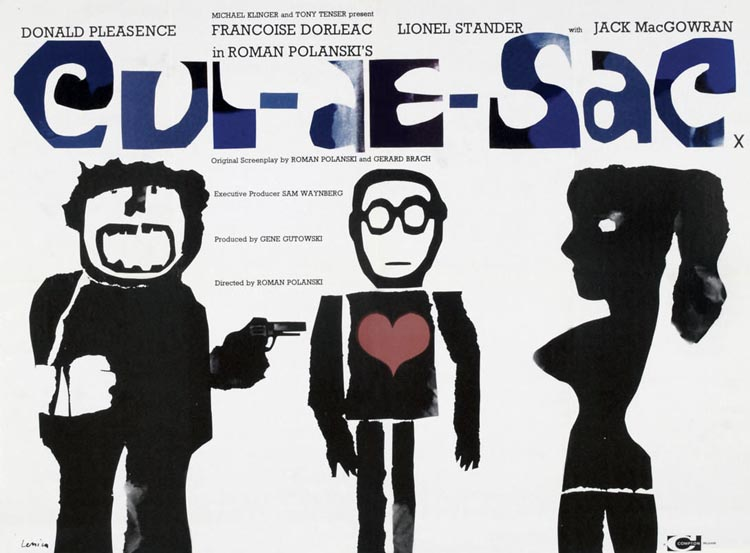
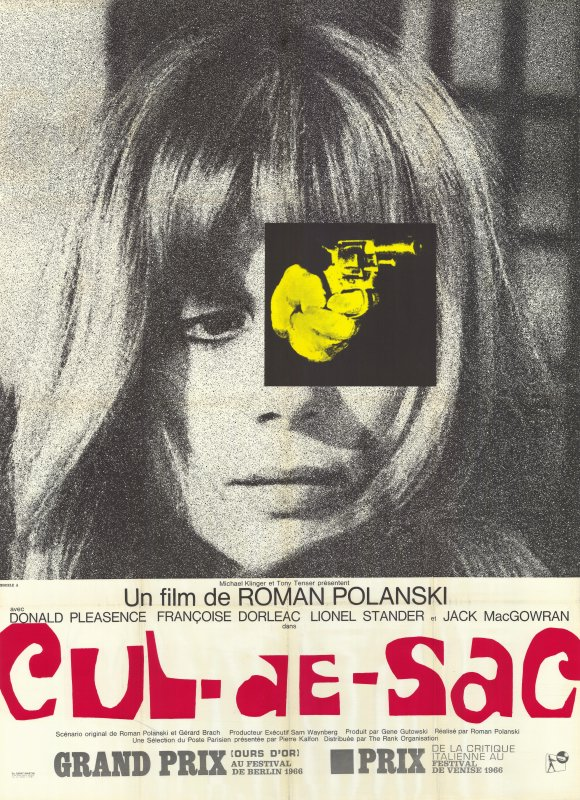
Cul-De-Sac (1966)

cul de sac 2

By Richard Winters

My Rating: 8 out of 10

4-Word Review: Bubbling beneath the surface.

Albie and Richard (Jack MacGowran, Lionel Stander) are two gangsters on the run. Albie is injured with a gunshot wound and their getaway car has broken down. They come upon an isolated castle owned by George (Donald Pleasance) who lives there with his new wife Teresa (Francoise Dorleac, who tragically died in a car accident just one year after this film was released). George is very passive and timid and pretty much allows Richard to have his way as he takes over the place and his wife and yet as the situation progresses different shades of the character’s personalities begin to come to light.

Roman Polanski leaves his strong directorial touch from the exquisite opening shot, which shows an old car being pushed along on a desolate road amidst a very flat landscape until the end. In the hands of any other director this otherwise odd story probably would not have worked. Like with A Knife in Water Polanski makes great use of the quiet and serene atmosphere and as a viewer you feel like you are right there with the characters.  Filmed on-location at the Lindisfarne Castle on Holy Island in Northumberland, England the movie makes great use of the tranquil setting. I found it almost hard to believe that there was a film crew there as the isolation really grabs you and sucks you in. The quiet moments are the film’s strongest and I just loved the hooting owl heard in the background. The idea of filming it in black and white nicely compliments the film’s dark psychological undertones.

The film’s novelty is watching how the characters evolve and interact with one another. Donald Pleasance gives one of his best performances as the cowardly George. There have been many weak and frighten characters in cinema history, but Pleasance makes the character here quite interesting and the way he finally shows some bravado at the least likely moment is fascinating. Stander also excels with a character that initially comes off as a brute, but at strange times reveals a trusting and even child-like manner.

The movie can be viewed in different ways and doesn’t fit distinctly into any type of genre. To a degree it can work as a dark psychological character study, a mystery, film noir, a thriller, or macabre comedy. Approaching it as a comedy works best Polanski has not always had great success in that area and some of his comedies in particular the ill-advised Pirates have been complete disasters, but this one works. The best scene is when some of George’s old friends come to visit and bring along their bratty son who becomes an absolute terror to everyone.

The odd ending is open to interpretation and leaves a lasting impression. This is also a great chance to see Jacqueline Bisset in her film debut. She appears during the second half wearing glasses and saying little, but is as beautiful and alluring as ever.

cul de sac 1

My Rating: 8 out of 10

Released: November 7, 1966

Runtime: 1Hour 57Minutes

Not Rated

Director: Roman Polanski

Studio: Tekli British Productions

Available: DVD (The Criterion Collection) Blu-ray, Amazon Instant Video, Netflix streaming

The Flim-Flam Man (1967)

flim flam man 2

By Richard Winters

My Rating: 6 out of 10

4-Word Review: Con-man finds apprentice.

Curley (Michael Sarrazin) is a young army deserter living in an over-turned and abandoned freight car in the rural regions of Kentucky. By chance he meets up with Mordecai Jones (George C. Scott) a traveling con-man who decides to use Curly as his apprentice as well as his assistance in some of his more elaborate schemes. At first Curley goes along with it, but when he fall in-love with Bonnie (Sue Lyon) one of Mordecai’s intended victims he decides he wants out much to Mordecai’s reluctance.

Scott really shines and this may be his best comic performance. Although he was only 38 at the time he looks and acts like a genuine old man even though his gray hair looks like it was frosted on much like what is done to white Christmas trees. In some way it might have been more authentic had an older actor played the role, but Scott is so much fun in the part that the movie may not have worked as well.

Sarrazin is solid in support. His quiet demeanor and understated performances never allowed him to get the recognition that he deserved, but he was always effective in these types of roles and having the character walk the moral tightrope and sometimes fall off makes him interesting and believable. Lyon is also good as the romantic interest. Although I felt the romance bogged things down a bit I still enjoyed her natural acting style that is devoid of any pretension.

Harry Morgan is fun as the headstrong sheriff who chases after Mordecai and Curly as is Albert Salmi as his dim-witted deputy. Salmi’s blank looking facial expressions are tops and the car chase that they have with the two culprits features some impressive comical stunt work and seems to tear-up the entire main street of the town.

The soundtrack by Jerry Goldsmith has wonderfully soothing melody with some great harmonica and trumpet solos. The on-location shooting in Kentucky captures the countryside and the hazy late summer sunshine of the region well.  For the most part the film is quite amiable and amusing, but predictable. The script lacks the unexpected twist or unique insight that would elevate it above being just the fluff that it is. The ending, which features Curly rigging the courthouse with dynamite and threatening it blow it up has a touching quality to it, but proves frustrating as it doesn’t show us what ultimately becomes of the characters.

My Rating: 6 out of 10

Released: August 22, 1967

Runtime: 1Hour 44Minutes

Director: Irvin Kershner

Studio: 20th Century Fox

Available: VHS 

Tall Story (1960)

tall story

By Richard Winters

My Rating: 6 out of 10

4-Word Review: The game is rigged.

June Ryder (Jane Fonda) is a boy-crazy college coed who has her sights set on Ray Blent (Anthony Perkins) the star of the school’s basketball team. Ray ends up being as infatuated with June as she is with him and the two decide to get married, but before they do they purchase a motor home from Ray’s friend Fred (Tom Laughlin). Unfortunately they don’t have enough of the required money until a mysterious stranger gives Ray $2,500 to blow the upcoming game his team has with the Russians, which puts Ray in a difficult quandary.

The film has a nice fluffy appeal and was based on the hit stage play, which in turn was based on the novel ‘The Homecoming Game’ by Howard Nemerov. The college campus atmosphere for its time period seems realistic. It is refreshing to have the adult faculty portrayed as normal human beings relating to the students on a relatively equal level and vice versa as opposed to the trend that started in the 70’s and went full-throttle in the 80’s where adults in these types of films were written as preachy, oppressive, out-of-touch, authoritative humorless pricks. In fact Marc Connelly as Professor Osman was my favorite character as he looked and spoke like a true professor and helped balance the silliness by being the most normal of the bunch. Anne Jackson as the wife of Professor Sullivan (Ray Walston) comes in a close second and has some amusing moments and a few good comeback lines particularly near the end.

Fonda is perfect as a character lost in her own little world and enthusiastically going by the beat of her own drummer while oblivious to the consternation she causes to those around her. Initially the character is written a little too aggressively making her too deluded and like a stalker, but fortunately that gets toned down and she becomes likable enough. Perkins is great as her boyish counterpart and the two even sing a duet together.

The pacing is a bit poor. Initially it is very zany and fast paced making the thing seem almost like a live action cartoon, which doesn’t work at all. The film then slows down and becomes a draggy only to rectify things with a funny conclusion. If you like things that are cute and undemanding then this should work although the sequence in which Ray comes into the game and singlehandedly wins the game after the team is far behind is just too contrived and over-blown for even Hollywood standards. The humor is light and comes in spurts with some of it managing to elicit a few chuckles. One of the few interchanges that I liked consisted of:

June: “Did you know that elephants only mate once every seven years?”

Ray: “There are some that do it every six years.”

June: “They’re nymphomaniacs”

Spoiler Alert!

One of the biggest problems with the film is the ending as Ray decides to play in the game and win it for his team despite keeping the money that he was paid in order to throw it. However, there is just no way a criminal organization would let anyone keep that money especially when the other party did not uphold their end of the bargain. Most likely they would track down Ray and June and exact a very unpleasant revenge. However, the film never even touches on this and instead shows Ray and June buying the motorhome and riding happily off into the sunset while leaving open a major loophole in the process.

My Rating: 6 out of 10

Released: April 6, 1960

Runtime: 1Hour 31Minutes

Not Rated

Director: Joshua Logan

Studio: Warner Brothers

Available: VHS, DVD (Warner Archive), Amazon Instant Video

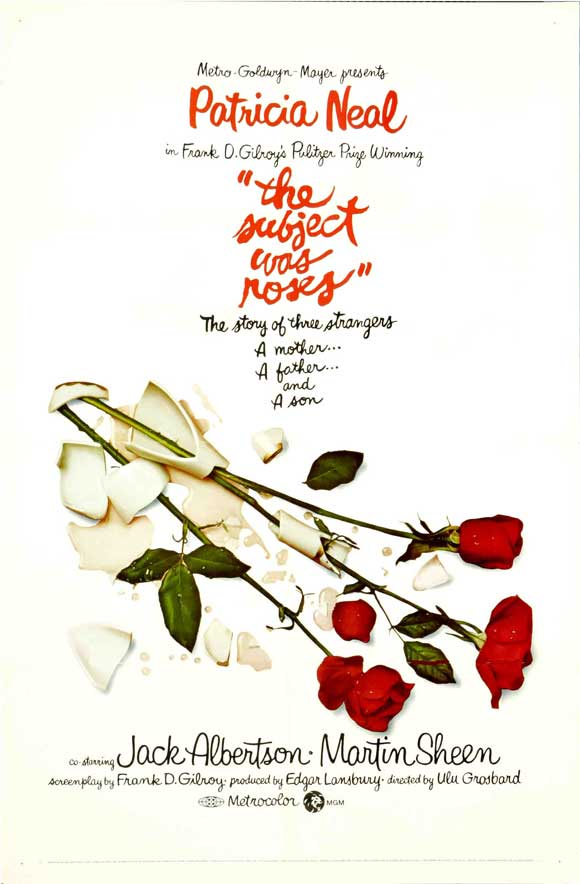
The Subject Was Roses (1968)

subject was roses

By Richard Winters

My Rating: 7 out of 10

4-Word Review: This homecoming isn’t happy.

Tim (Martin Sheen) arrives home from the war to find that things aren’t going well with his parents John and Nettie (Jack Albertson, Patricia Neal). Their aloofness towards each other slowly becomes more apparent and seems to come to a head when Tim decides to buy his mother a bouquet of roses and his dad pretends it was his idea. When Nettie realizes it wasn’t John who bought them she leaves the house and doesn’t return, which causes John to panic and try to find her.

This movie has a compelling quality to it and is the old-fashioned type of drama that they don’t seem to make anymore. The characters are real and believable and will probably remind one of their own parents, or even themselves and their marriages. The dialogue has a great conversational style and the viewer feels like they are eavesdropping onto an actual household. The action happens slowly, but deliberately and is devoid of any neat and tidy wrap-ups.

However, the film is also a bit frustrating. We are never explicitly shown what it is that is troubling Nettie so terribly. We are given some definite hints of things bubbling just underneath the surface, but there is nothing that completely comes out into the open. The viewer becomes primed for some great revelation, but when it doesn’t come and the characters end up remaining in the same situation as when it began it makes the whole thing seem pointless.

Neal is outstanding and the main catalyst for why this works. This was her first film after she had suffered several near fatal strokes in 1965. Although she does very well one can still see some subtle effects of it like the way she walks and her speech being just a little bit slower, but in context with the role it makes her seem older than she really is and therefore better for her role. I was surprised at how physically demanding the part was including having her dance rigorously around the living room with Sheen as well as having to aggressively fight off Albertson’s unwanted advances. Her sad and pained facial expressions leave the most lasting impressions.

Although it was Neal who I felt should’ve won the Oscar it was actually Albertson who did. His performance, which he recreated from the Broadway play that also netted him the Tony, is solid especially for doing a character that at times is off-putting. He does get the film’s best line “The humping that I am getting isn’t worth the humping that I am getting.”

The story takes place in the 1940’s and is basically a loose autobiographical story of Frank D. Gilroy who wrote both the award winning play and screen version. For the most part it succeeds with its retro look, but the music by Judy Collins doesn’t fit. Personally, I love Collins as a vocalist, but her raw, moody folk music sound seems out of place for a 40’s setting and takes the viewer out of the story in the process.

Transferring a story done for the stage to the big screen is never easy, but director Ulu Grosbard manages to make it cinematic. None of it was done on a soundstage, but instead the apartment was built inside a warehouse in the same Bronx neighborhood where Gilroy grew up and painstaking detail was done to give it an authentic lived-in look. The scenes done at their lakeside cabin is also effective as it captures the blossoming spring time landscape and gives a nice soothing feeling. You also get to witness Sheen skipping stones across the lake several times something that I could never get the hang of myself.

My Rating: 7 out of 10

Released: October 13, 1968

Runtime: 1Hour 47Minutes

Not Rated

Director: Ulu Grosbard

Studio: MGM

Available: VHS, DVD (Warner Archive)

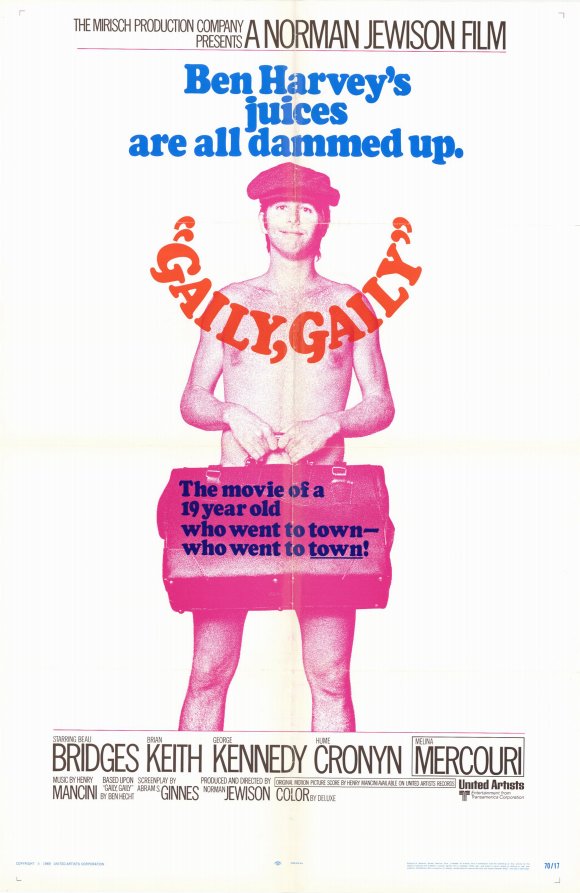
Gaily, Gaily (1969)

gaily gaily

By Richard Winters

My Rating: 5 out of 10

4-Word Review: Naive fellow becomes wise.

Ben Harvey (Beau Bridges) is a sheltered young man who decides to leave the safe confines of his humble little town and make a go of it in the big city of Chicago in 1910. However, soon after arriving he is robbed of all of his money and then taken in by Lil (Melina Mercouri) a Madame at the local brothel. Ben then gets a job at the city newspaper, but finds corruption at every turn and when he tries to stop it he ends up falling victim to its allure like everyone else.

The first hour is engaging. It features just the right mix of Americana and whimsy. The pace is quick with a wonderfully quirky sense of humor that comes flying fast and furiously. Opening the film by having Ben dreaming of topless women and featuring some very old turn-of-the-century black and white porno pics is funky. I also liked the scene where Ben manages to make all the prostitutes at the bordello he is staying at teary-eyed after reading them a sad story that he had written. The look at Lil’s face when he tells her that his life’s ambition is to ‘change the world’ is a hoot.

Unfortunately the second half deteriorates badly. The scenes become stretched out too long and the attempts are farcical humor lack any cleverness. The side-story about the attempts of a mad scientist Dr. (Charles Tyner) at using a serum he has invented to revive the dead is stupid. The slapstick like chase sequence gets overblown and the whole thing ends on a flat and boring note, which is a shame. The sets and costumes recreating the period atmosphere are wonderful, but put to waste by the silly script. I felt the film could have been more interesting had it taken a more realistic and dramatic route.

Bridges is actually pretty good. He has played the wide-eyed idealist so many times that it becomes a bit annoying, but here he seems to be making fun of it and it works to an extent. However, his extreme naivety at not catching on that the women he is living with are prostitutes is just too over-the-top and makes you almost want to hit him on his head in order to drive some sense into it.

Brian Keith does well playing the type of gruff, brash character that he excels at. George Kennedy though seems stiff and out of place in the setting and does not appear to be particularly adept at comedy.

Mercouri looks to be having a lot of fun here and her singing isn’t bad either. Margot Kidder is fantastic in her film debut and one of the best things about the film. She plays one of Lil’s prostitutes who takes a liking to Ben and I enjoyed how her character goes from being jaded to idealistic and rather naïve. Melodie Johnson is great simply because she is gorgeous to look at. She is now a successful novelist and judging from the pictures on her website is still looking quite attractive.

My Rating: 5 out of 10

Released: December 16, 1969

Runtime: 1Hour 47Minutes

Rated R

Director: Norman Jewison

Studio: United Artists

Available: Amazon Instant Video, Netflix streaming

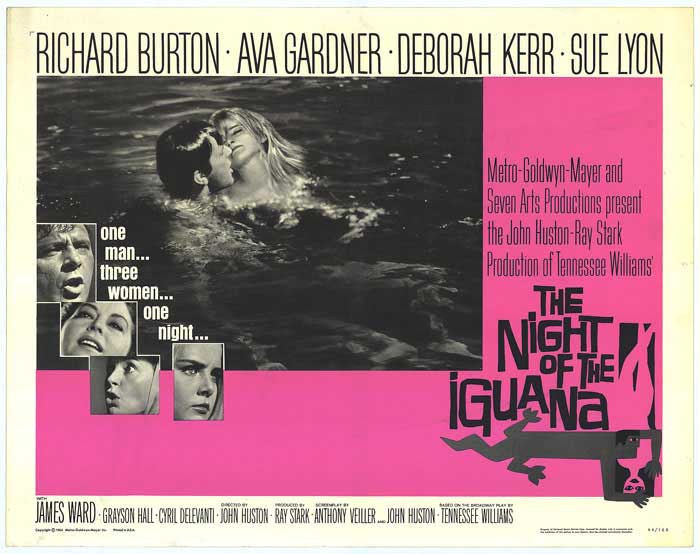
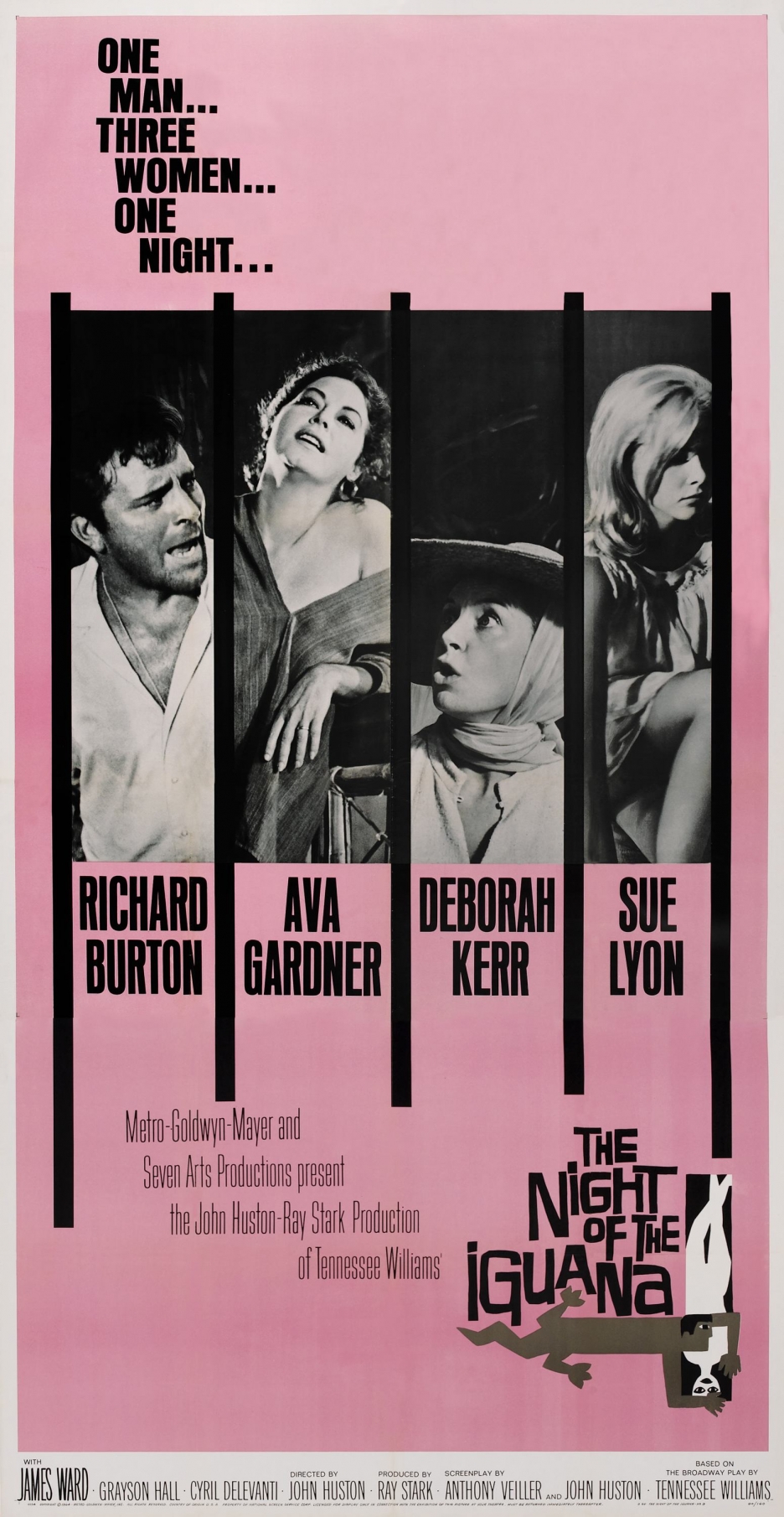
The Night of the Iguana (1964)

night of the iguana 2

By Richard Winters

My Rating: 6 out of 10

4-Word Review: Flawed clergyman loves women.

Lawrence Shannon (Richard Burton) loses his job as a clergyman when rumors surface of indiscretions he had with a young female parishioner, which pushes him to preach a ranting sermon at the pulpit that eventually drives all the members of the congregation out of the building. He then gets a job as a tour guide in Mexico and has the chore of leading a bus load of middle-aged women around the country. Charlotte (Sue Lyon) is a young nymph who takes a liking to Lawrence much to the chagrin of her over-protective chaperon Judith Fellowes (Grayson Hall). When Charlotte is caught in Lawrence’s bedroom late at night Ms. Fellowes promises that she will have it reported and get him fired. Unable to handle a another potential job loss Lawrence takes the bus load of women to an isolated seaside hotel run by Maxine (Ava Gardner) an old friend of his. He hopes that by somehow trapping them there he will be able to convince Ms. Fellowes to drop the charges, but along the way he meets Hannah (Deborah Kerr) who he starts to fall in-love with.

Unlike most of Tennesse William’s other plays this one, at least the first half, is full of energy and comical nuance. I found the group of ladies and Lawrence’s exasperated dealings with them to be quite amusing and the film moves along at an engaging pace. The second half though bogs down with more of William’s signature brooding drama that ends up hurting the flow. In many ways this film seems like two movies in one and the difference in tone and pace never gels. Despite a good nighttime conversation between Kerr and Burton I kept hoping the ladies and Ms. Fellowes would come back and felt the film was weaker without them.

Legendary director John Huston hits most of the right buttons here although it is not his best work. I was surprised and impressed to learn that Maxine’s hotel was built specifically for the production in an otherwise deserted region of the country. The building had an authentic old look and helped give the film added style and personality. I had mixed feelings with the black and white photography. On one had it helps bring out the dark recesses of its flawed characters and accentuate the moodiness of William’s script, but it also takes away from the exotic beauty of the locale.

Burton is good as usual and playing the part of an emotionally fractured, alcoholic character seems right up his alley. Gardner is great as the brassy Maxine and the scene of her making out with her two young, shirtless, maraca playing male assistants along the beach late at night is genuinely steamy. Kerr is in fine form as well and her more restrained demeanor makes a nice contrast to Gardner’s.

Lyon’s acting isn’t quite up to her costars and she seems particularly out of her league during her scene with Burton, but in the looks department she is unmatched. She is more filled-out and mature than in Lolita and in many ways even hotter. The scene of close-up shots of her moving her hips to a tune at a Mexican bar may excite some of the male viewers.

The under-rated Hall is excellent in her role as the heavy. Her craggy face and personality are perfect for the part and it rightly got her a supporting actress nomination.

In the final analysis this is not a bad version of Tennessee William’s material, but not a great one either.

night of the iguana 1

My Rating: 6 out of 10

Released: August 6, 1964

Runtime: 1Hour 58Minutes

Not Rated

Director: John Huston

Studio: MGM

Available: VHS, DVD, Amazon Instant Video