Monthly Archives: September 2025

The Dead Pool (1988)

By Richard Winters

My Rating: 4 out of 10

4-Word Review: Harry marked for murder.

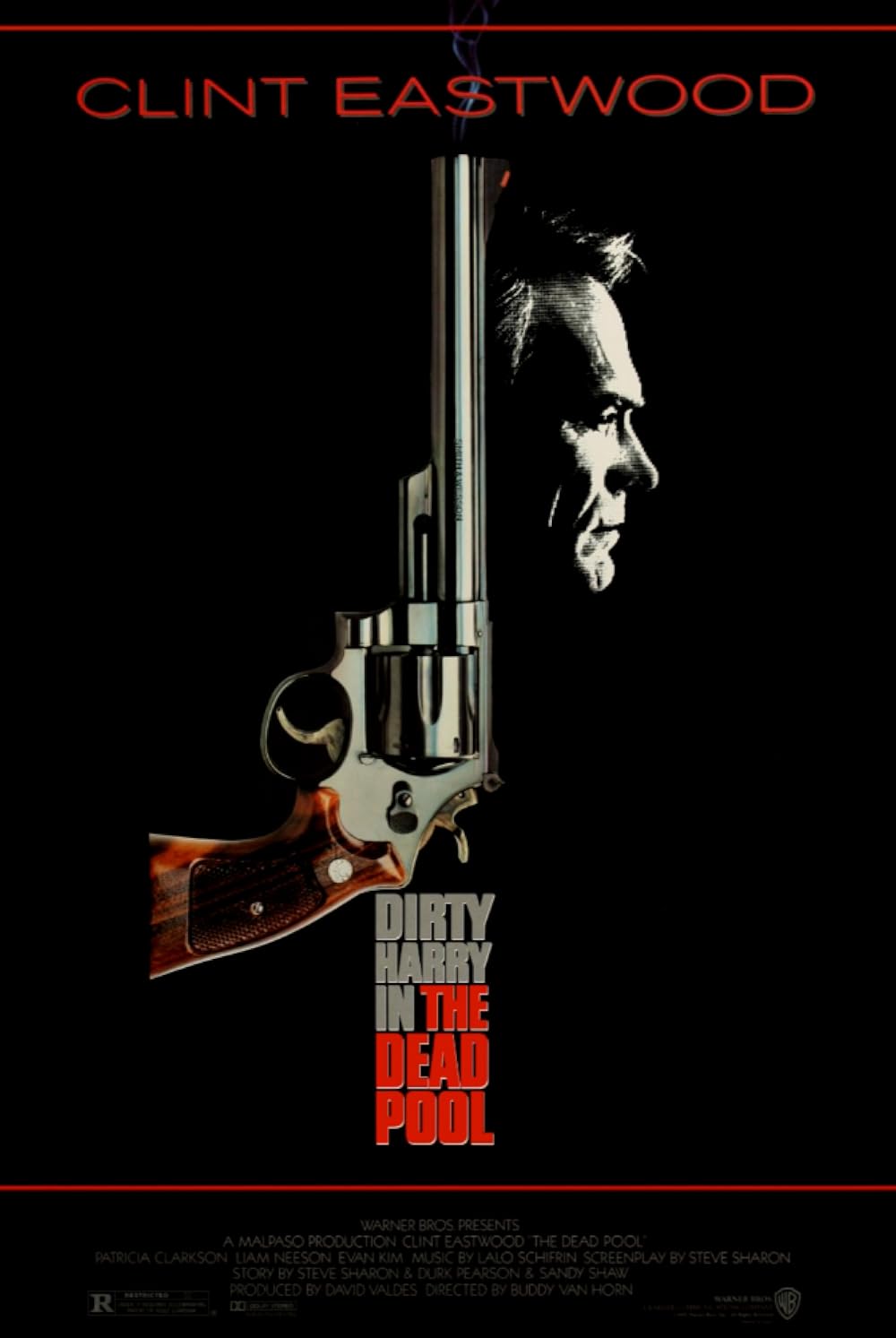
Inspector Harry Callahan (Clint Eastwood) is still getting ambushed by assassins hired by the criminals he puts away. The department decides to assign him with a new partner, Al Quan, (Evan C. Kim) who’s judo skills will come in handy. The two begin working on a case involving a dead pool, which is a list of San Francisco area celebrities that are expected to die soon either by natural causes, or by murder. The list was created by B-horror director Peter Swan (Liam Neeson) who immediately comes under suspicion when one of the stars of his own movie, Johnny Squares (Jim Carrey) turns up dead from what initially seemed like a drug overdose but later deemed murder. Harry is not happy to find his name is also on the list and this leads to an interview by local TV-reporter Samantha Walker (Patricia Clarkson) who wants to do a bio on him, but Harry resists convinced that she’s only trying to exploit the situation for ratings. 

This marked the fifth and last entry in the Dirty Harry series, which was a film Eastwood had not wanted to do, but was a part of the bargain he made with Warner studio in an effort to get his pet project Bird, which was a bio of jazz musician Charlie Parker, financed. Eastwood along with the studio were aware that that film most likely wouldn’t be a box office hit, so he agreed to do this one, which was sure to be a definite money maker. Yet this one ended up being the least successful of all the films from the series and ultimately helped hasten an end to ever producing another one. 

The formula had clearly run its course by this point, and the action is too predictable to be fun anymore. Things start out absurdly right away when the car Harry is driving gets hit with a hundred different bullets and yet our hero comes out completely unscathed, but there’s no way that could’ve realistically happened. Since the film’s theme is a movie-within-a-movie this part should’ve been done as a cameo appearance that Harry did for one of Swan’s movies, which might’ve offered a cute twist, or an even better idea would’ve had Harry getting injured by one of the bullets and no longer able to, at least for a while, use his hand to pull a trigger and thus forced to come up with creative ways to put away the bad guys, which would’ve added a needed wrinkle that would’ve kept this sequel fresh and different from the others versus the stale way that it quickly becomes.

Teaming him up with an Asian American isn’t interesting either. The other entries all dealt with him partnering with a minority, so by this time the concept lacked any edge. It also wastes Kim’s talents as it’s kind of cool seeing him take down bad guys using his karate talents, but unfortunately, it’s only shown once briefly when it should’ve been spread out all the way through. Having Kim and Harry not see eye-to-eye on things or even challenging his approach would’ve offered some dramatic energy, but overall, the scenes between them, where Kim is compliant and easy going just like all of Harry’s previous partners, makes their moments generic and dull. 

Spoiler Alert!

Harry’s relationship with the reporter is equally unengaging. At first the two sparred and I felt that’s where it should’ve remained but having them eventually ‘connect’ saps away all of the potential spice. Even the mystery angle gets botched. Granted we really don’t know who the killer is as his identity during the killings isn’t shown though we’re led to believe it’s Neeson then it turns out it’s somebody completely different, but it’s a character that isn’t shown upfront, so the viewer can’t try to figure out who it is on their own and the ultimate explanation for what motivates the killer is too pseudo psychological. The final confrontation that he has with the villain, played by David Hunt, who again is a weaker actor and not completely right for the part (Neeson would’ve been far better) is so achingly cliched that it’s almost laughable. 

It does feature a unique car chase, which was one of the few elements from Steven Sharon’s original script that the producers decided to leave in, that has Harry driving a regular sized car as he desperately attempts to outrun a miniature toy car that’s packed with explosives. Everything else though is quite formulaic and uninspired. It’s a good thing that this was the last one as any more would’ve just tarnished the brand further though it would’ve been good to have some finality to it. Instead of just having Harry walk-off after killing what seems to be his 500th bad guy he should’ve been shown handing in his badge and retiring as he was at that age anyways and after having gone through all the violent ambushes he had most would’ve done it much sooner.

My Rating: 4 out of 10

Released: July 13, 1988

Runtime: 1 Hour 31 Minutes

Rated R

Director: Buddy Van Horn

Studio: Warner Brothers

Available: DVD, Blu-ray, Amazon Video, YouTube
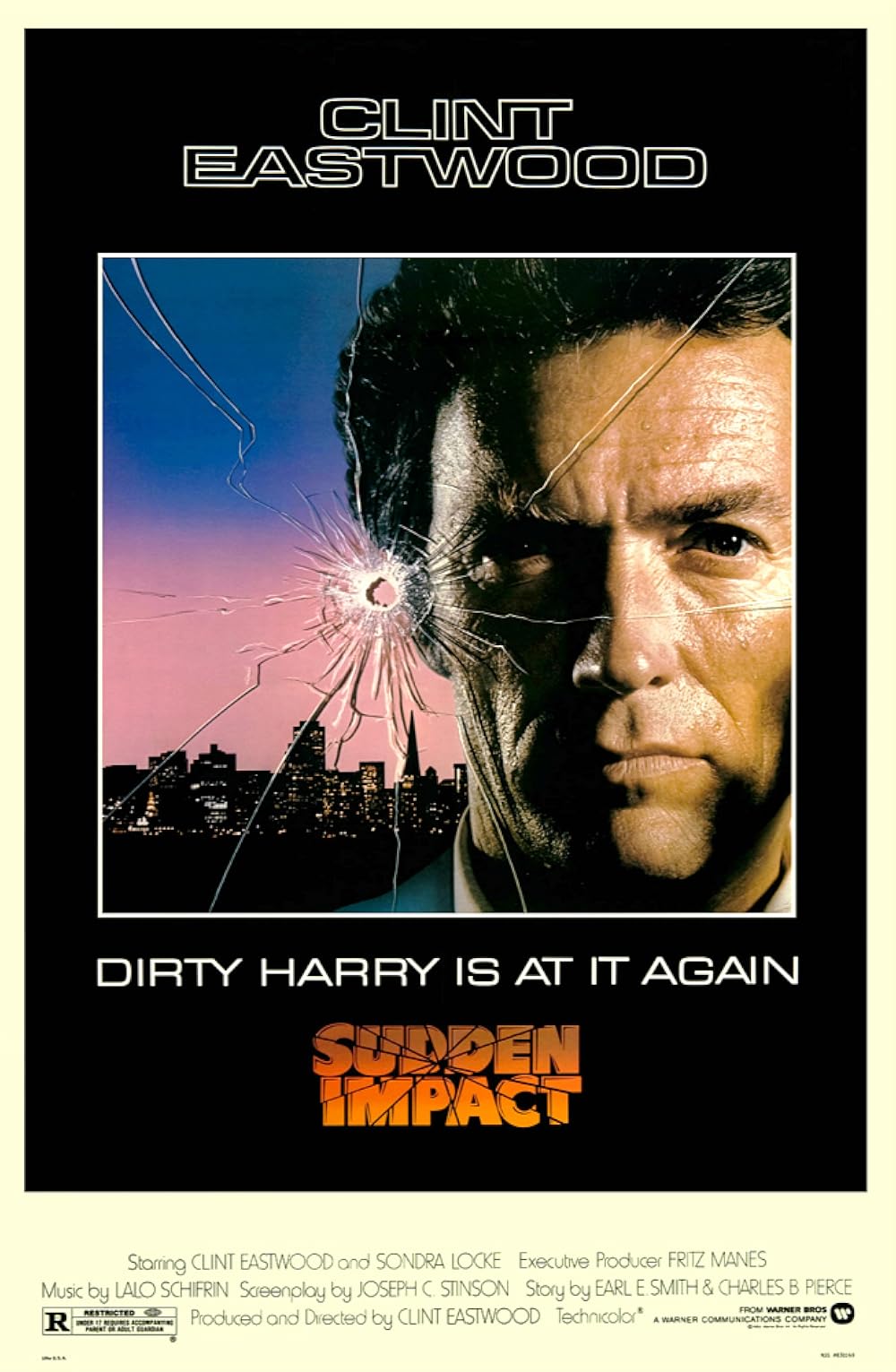
Sudden Impact (1983)

By Richard Winters

My Rating: 6 out of 10

4-Word Review: Harry investigates revenge killings.

Inspector Harry Callahan (Clint Eastwood) continues working in the San Francisco police department despite his perpetual disregard of proper police procedures, which gets many of the crooks that he has arrested freed due to legal technicalities. His superiors are frustrated with him, but since he does get results keeps him on the force though reassigned to the small town of San Paulo where he works with a sheriff Jennings (Pat Hingle) in hopes he’ll be less problematic. It’s there that he comes upon a case of various men being found shot to death in similar ways. This is being done by Jennifer (Sondra Locke) an artist in residence who 10 years earlier was raped along with her younger sister by a group of men and now she’s out to get her revenge by killing them off one-by-one. Harry is starting to piece together the clues but is surprised that Jennings is reluctant to follow-up on them giving him the impression that the sheriff may have something to hide.

The story is based on a script written by Charles B. Pierce better known for his rural horror movies from the 70’s that were shot in Arkansas and loosely based off of real events like The Town that Dreaded Sundown. This was meant to be a starring vehicle for Locke, but when Eastwood decided to renew the franchise after several years of dormancy, he felt the plotline here would be a good fit for the next Dirty Harry movie and thus hired Joseph Stinson to revise it.

The result is a mish-mash that’s never quite as compelling as it should. For the majority of the runtime Eastwood’s heroics and Locke’s crimes are working in a parallel universe and not connected making it seem like two different movies. Harry’s non-stop shootouts with crooks becomes redundant and cartoonish while Locke’s killings and flashbacks make it too reminiscent of other better-known films like I Spit on Your Grave and Death Wish. The bad guys are caricatures to the extreme making their moments boring and predictable. If the violence wasn’t so over-the-top you’d be convinced, like critic Pauline Kael mentioned in her review, that this thing was meant to be a parody.

Locke and Eastwood are both good and this is the last film that they did together as a couple before their break-up. In Locke’s case I liked how her cynical and brash persona mixes with Eastwood’s brooding and quiet one. Eastwood speaks more here than in the previous entries, but the character doesn’t seem to be evolving. The opening scene inside a courtroom where Harry is shocked to learn that the criminals he apprehended will be set free because he didn’t get a search warrant seemed ridiculous as after being on the force for so many years, and going through the exact same predicaments in the earlier films, that you’d think by now he’d learn his lesson and do things that conform within the legal framework, or at the very least not be so surprised when a judge sees it differently. The number of near-death shootouts he goes through is exhausting making me wonder how he maintained his mental state and didn’t take the vacation time when he’s asked even if he’s ‘not up for it’.

My biggest grievance though is with the structure. I really felt it would’ve worked better had it been approached as a mystery. We could’ve still seen the killings being done, but the identity of the killer would’ve been masked. Instead of Locke being an artist she could’ve been on the police force working on investigating the case and Harry could’ve started up a friendship/quasi relationship with her and at the start been impressed with her work only to slowly become aware that she was intentionally mudding the evidence. Sheriff Jennings too could’ve initially been portrayed as a ‘good guy’ with down to earth sensibilities that Harry liked and then as it progressed would his intentions become more dubious. The flashback sequences, which get interspersed throughout, could’ve instead been saved until the very end.

Spoiler Alert!

The film also continues to reveal Harry’s zig-zagging moral logic. In the first film he was all for playing outside the rules, then in the second installment he came to determine that vigilantism wasn’t the answer. Now here, by letting Locke off-the-hook and not arresting here, he’s acting like street justice is okay. It makes you wonder; is he really growing as a person and seeing things differently or simply floating along with whatever way the plotline wants?

My Rating: 6 out of 10

Released: December 9, 1983

Runtime: 1 Hour 57 Minutes

Rated R

Director: Clint Eastwood

Studio: Warner Brothers

Available: DVD, Blu-ray, Amazon Video, YouTube
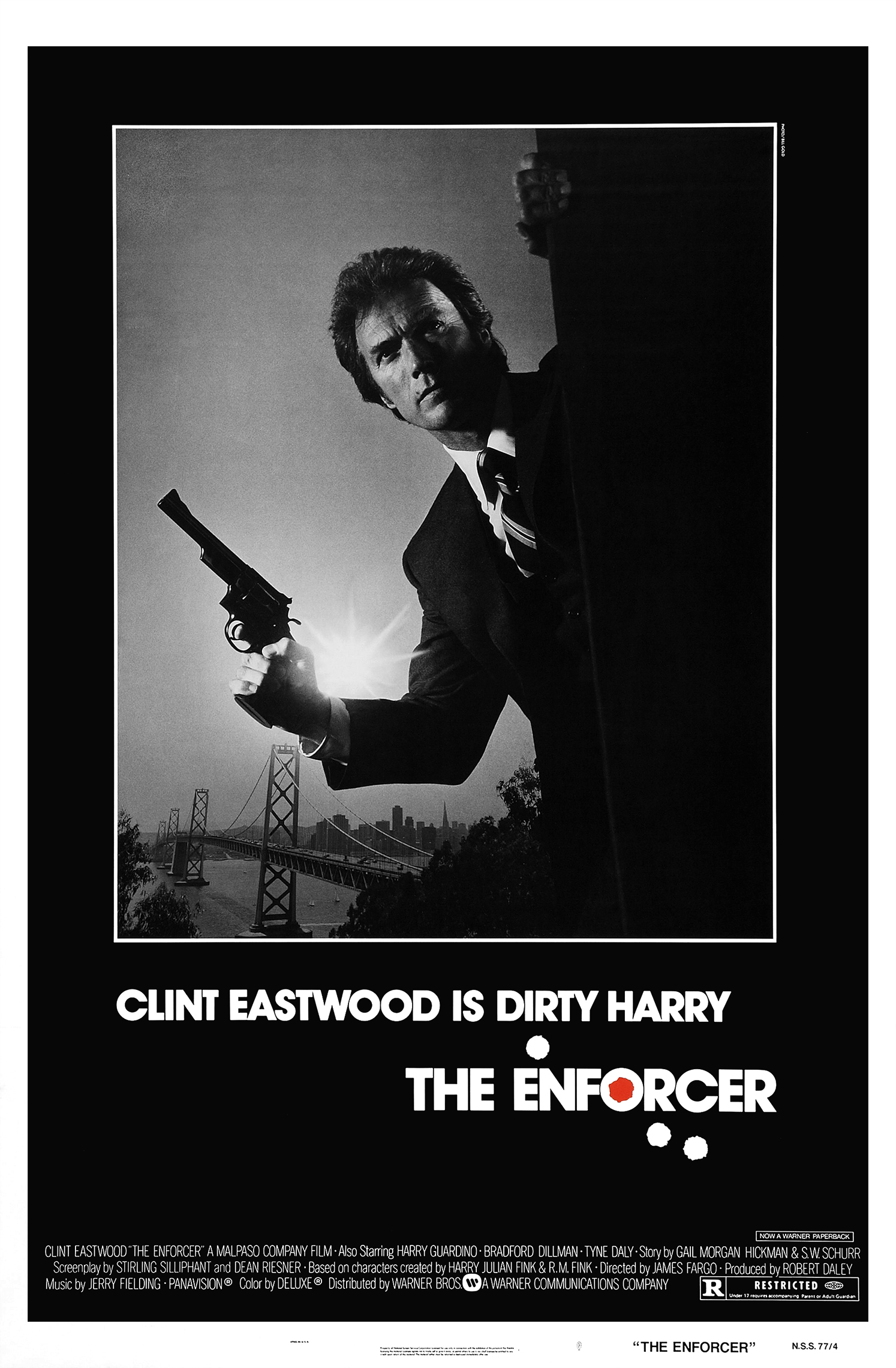
The Enforcer (1976)

By Richard Winters

My Rating: 7 out of 10

4-Word Review: Partnering with a woman.

Bobby Maxwell (DeVeren Bookwalter) leads a group known as the People’s Revolutionary Strike Force that is made up of young adults engaged in underground criminal activities. Harry (Clint Eastwood) must work with Big Ed (Albert Popwell) the leader of a black militant group, in an effort to track down Bobby before they do any more damage, but his efforts are stymied by his superior Captain Jerome Kay (Bradford Dillman) who arrests Big Ed before Harry is able to get the information he needs. Things are further complicated by pairing him with Kate (Tyne Daly) as his new partner. Harry doesn’t think much of having women on the force and feels she won’t be able to meet the demands of the job though Kate is intent to prove him wrong.

The original script was written by two young San Francisco area film students who based it off of the 1974 kidnapping of Patty Hearst by the Symbionese Liberation Army. Then after watching some Dirty Harry movies, they decided to rewrite it by incorporating his character into the story. They then visited the Hog’s Breath Inn, a restaurant owned by Eastwood, and handed the script to his business partner Paul Lippman, who in turn gave it to Eastwood. Another script by Stirling Silliphant had already been given to Clint that involved Harry being partnered with a lady cop, a concept that he liked, though he didn’t feel there was enough action in it, so he hired Dean Reisner for a rewrite that would combine elements of both scripts, which is what ultimately became this movie.

The franchise seems to have lost some of its magic. Watching Harry come upon a crime in progress and casually blow away the criminals is no longer as riveting, or shocking and in many ways comes-off as predictable and even cartoonish. The first film did a good job of showing how police work wasn’t always exciting and sexy and could entail doing some boring duties, but here it creates the idea that it’s one pulverizing shootout after another. I didn’t care for the pounding score played over the chase sequences, which the first one didn’t do and was better for it as the music gets a bit distracting and more formulaic like something out of a cop TV-show. Bradford Dillman’s character, as an exasperated police chief, is a complete caricature like a puppet created solely so it can yap at Harry and get him to snarl in return. I wasn’t so crazy either about the humor that seeps in as the first two films had a very serious tone though the scene involving a group of old ladies sitting around a table writing love letters while inside a whorehouse is a definite gem. 

The casting is unique particularly Bookwalter as the head of the criminal gang, who up to this point was best known for starring in Andy Warhol’s experimental film Blow Job, which was a 35-minute movie that had the camera focus solely on Bookwalter’s face as he received fellatio. He also had a brief bit in the second installment of the series playing a naked man who gets killed in a shootout during a sex orgy. Here though he doesn’t have enough of an acting presence to make his moments onscreen interesting like Andrew Robinson did in the first one. He pretty much just seems like a male model with an angry stare and a gun. It’s the same result with popular radio deejay Machine Gun Kelly (Gary D. Sinclair) who gets cast as the priest who runs cover for the bad guys but clearly doesn’t have much acting ability and it’s quite possible that Eastwood intentionally put these guys into these roles knowing this, so that way they’d have no chance of upstaging him. 

I did though like Tyne Daly as Harry’s new partner. She had rejected the role three times due to issues with the script and how her character was portrayed but eventually agreed to get on board once her demand for revisions were met and I’m sure glad she did. She’s not sexy, or beautiful, which is good, and portrays a no-nonsense quality and genuinely seems like she wants to prove herself and dedicated and thus making her appealing right from the start. The only issue is that she’s constantly carrying around a shoulder purse, but why? I’ve never seen a policewoman have one and it seems ridiculous as it impedes her ability to chase after people as she has to grab a hold of it so it doesn’t flop against her body as she moves. 

Spoiler Alert!

Fortunately, the two don’t end up falling in love, the original script had this happening, but this was one of the things Daly insisted had to be taken out before she’d agree to do it, which is good because in real life, especially between professionals, that shouldn’t be occurring. Having her die at the end took me by surprise but is good too as it shows how dangerous police work is and how not every time is the good guy going to come out of a shootout unscathed. 

My Rating: 7 out of 10

Released: December 22, 1976

Runtime: 1 Hour 36 Minutes

Rated R

Director: James Fargo

Studio: Warner Brothers

Available: DVD, Blu-ray, Amazon Video, YouTube
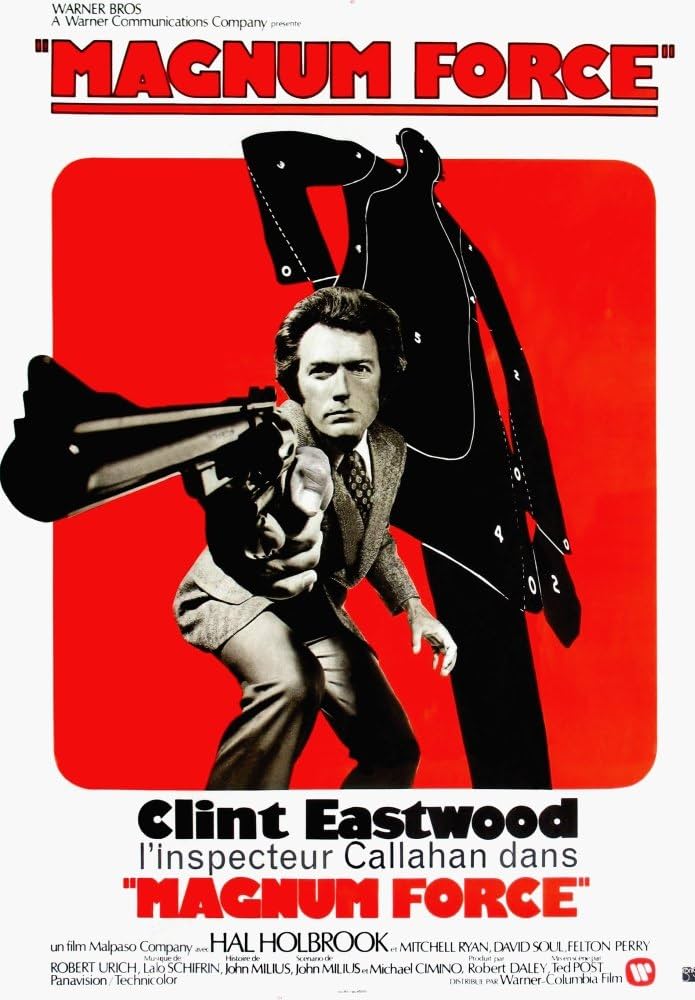
Magnum Force (1973)

By Richard Winters

My Rating: 8 out of 10

4-Word Review: Harry battles renegade cops.

Somebody is killing San Francisco’s well-known criminals who have been able to manipulate the courts in a way that they’ve gotten off and have not served any time. “Dirty” Harry Callahan (Clint Eastwood) isn’t sure at first who’s behind it, but every time he tries to get investigate his superior, Lt. Neil Briggs (Hal Holbrook) tells him to essentially ‘back off’ and go back to stakeout duty of which he’s been assigned, but in his off hours he continues to pursue it. He comes to the conclusion, after a pimp is shot at close range while sitting in the driver’s seat of his car, that a policeman pretending to be a traffic cop is behind it. He then begins to focus in on four new recruits (David Soul, Robert Urich, Kip Niven, Tim Matheson), who all show remarkable aim on the gun range, as being the ones behind it, but how does he prove it before they kill again, or set their sights on him in order to keep him quiet?

In this follow-up to the classic Dirty Harry the direction isn’t as stylish as Don Siegal didn’t return to helm this one, so the reins were handed over to Ted Post who’s better known for his TV work and which Eastwood knew through them working together on the ‘Rawhide’ TV-show from the 50’s. While not all bad there were certain segments that appeared a bit off like when the motorcycle cop pulls over the mob boss, played by Richard Devon, who’s riding in a limousine. The car clearly comes to a stop on a well-traveled bridge, but when the men inside the vehicle get shot you can see through the rear window that the car now appears parked in some urban neighborhood street. The segment where Harry drives into the parking garage of his apartment complex and then gets out of his car after parking it only to be surprised when the four renegade cops, who are also parked there on their motorbikes, begin speaking to him, is botched too as Harry would’ve seen them already there when he drove up and thus the scene should’ve been shot from his point-of-view through the front windshield of his car.

The action segments though are top notch. The scene inside an airplane where Harry disguises himself as a pilot in order stop hijackers from taking it over is both funny and tense as is his shooting down thieves trying to rob a grocery store. The gun range segment, where he and David Soul compete to see who’s the most accurate shooter, is well-handled as is the final chase inside an abandoned airplane hangar in a shipyard. There’s also a cool, but grisly sex orgy shootout in which a naked woman’s body tumbles out a high-rise apartment and then down several flights. You can also spot a nude Suzanne Somers during a poolside massacre.

The film also features the infamous Drano scene where a pimp, played by Albert Popwell, forces a prostitute, played by Margaret Avery, to swallow drain cleaner, which inspired a group of criminals in Ogden, Utah to try and replicate it when they robbed a record store and took the employees hostage on April 22, 1974 in what became known as the Hi-Fi Shop murders. However, instead of instantly killing the victims like it did in the movie it instead created blisters on their mouths and internal burning, which caused them to go through extreme suffering for hours.

My biggest complaint is how Harry is too nice and has lost some of his edge that made him so interesting. In the first film he was described as someone that didn’t like minorities, but here he’s matched up with an African American partner, played by Felton Perry, right off-the-bat with no complaints. He’s also seen with children in one segment and seems to enjoy them, but I’d think with Harry’s irritable temperament he’d find kids running around and making noise to be annoying. A downstairs neighbor lady, played by Adele Yoshioka, comes on to him quite strongly, she literally walks out into the hallway as he’s coming home and asks him what she needs to do in order to go to bed with him, which seemed too forward even for the carefree 70’s. I agree with John Milius who wrote the original draft of the screenplay where that scene was not in there but got added later at Eastwood’s behest. Harry was not the sociable type and if anything, he’d be doing prostitutes simply as a release for his sex drive. The character really didn’t have the capacity nor desire for a relationship and if he was married to anything it would be his job and mowing down bad guys making this romantic segment forced and not believable.

The bad guys are a bit too cliched and dull, especially the mob bosses, which is a far cry from the first one where Andrew Robinson made his psycho character quite distinct and intriguing. One scene has a group of mafia guys sitting around a table eating Chinese food, but none of them says a word, which to me was not realistic. Even bad people still follow sports, weather, and current events and would like to chat a little with those around them, supposedly these are their ‘friends’ since they work closely together, and not just eat in stone cold silence, which paints them too much as robots with no life, or personality outside of being killing machines.

While it’s fun seeing Urich and Soul in early roles and in Urich’s case looking downright boyish, the four renegade cop’s presence onscreen is quite flat. There’s no distinction between their personalities and no backstory given to how they came together, or what brought them to becoming vigilantes. Did they have a loved one, for family member die at the hands of a criminal who then was given a lenient sentence? This is never explained, or elaborated on, but really should’ve.

It’s also confusing to have Harry, who in the first installment was fed-up with the politics of policework and looking to work ‘outside the system’ suddenly dislike these guys for doing what he himself had previously advocated. Would’ve been more interesting had they invited him to join the group, and he initially obliged thinking this would be a good to solution to criminals getting off easy only to eventually realize the group was taking things too far and then work to stop them. 

My Rating: 8 out of 10

Released: December 25, 1973

Runtime: 2 Hours 3 Minutes

Rated R

Director: Ted Post

Studio: Warner Brothers

Available: DVD, Blu-ray, Amazon Video, YouTube
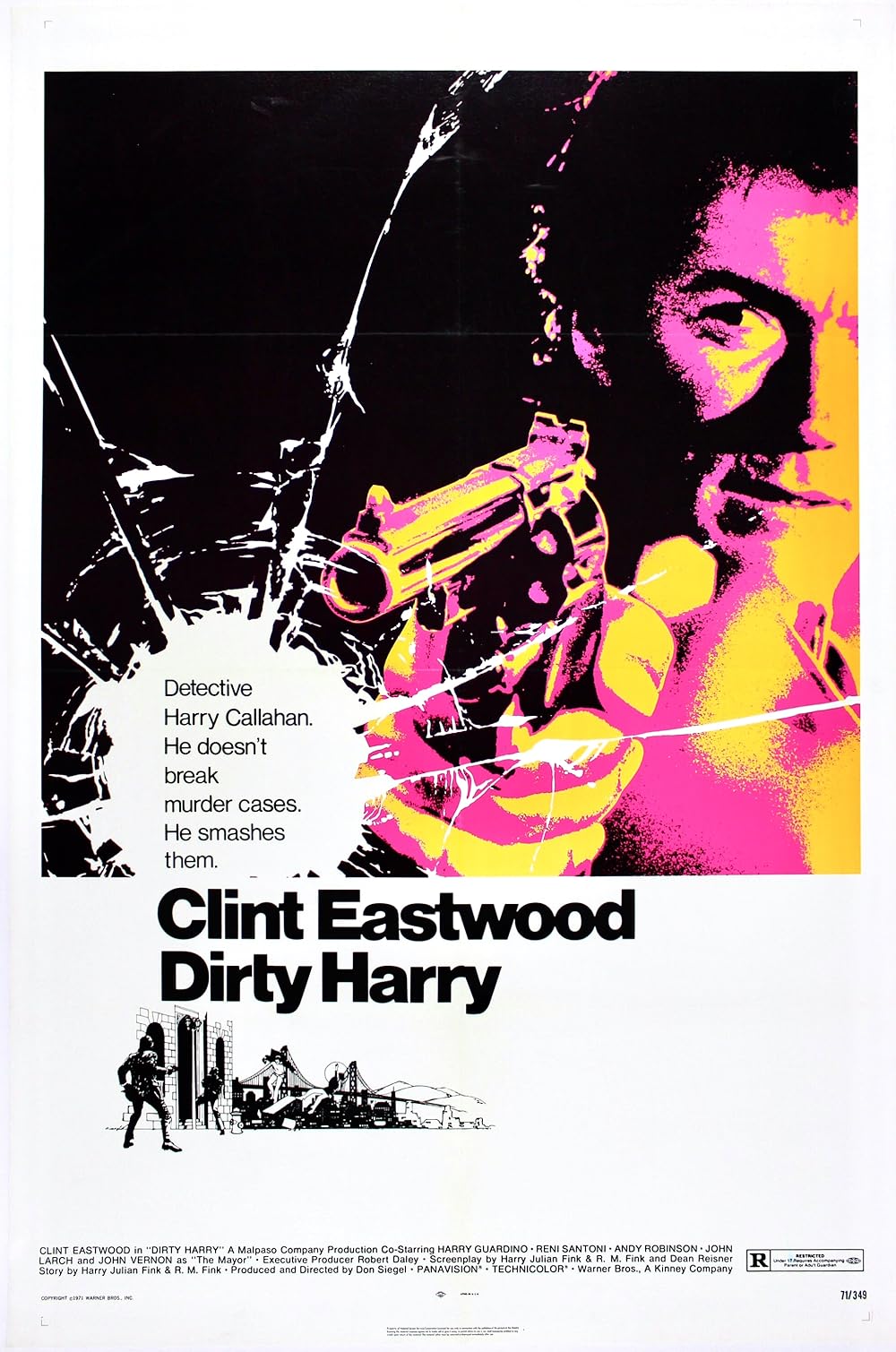
Dirty Harry (1971)

By Richard Winters

My Rating: 10 out of 10

4-Word Review: Cop doesn’t like rules.

A psychotic who goes by the nickname of Scorpio (Andrew Robinson) has pledged to kill one person a day unless the city of San Francisco forks over $100,000 with his first victim being a woman (Diana Davidson) taking a swim in a pool on a rooftop of a high rise. The mayor (John Vernon) agrees to give into the killer’s demands much to the objections of Harry Callahan (Clint Eastwood) a hard-nosed cop who believes criminals are coddled by the system at the expense of their victims. Yet Harry, who’s known by his fellow cops as Dirty Harry, which he acquired for his well-known ability to circumvent rules that he doesn’t agree with, must go along with the demands of his department forcing him to act as the delivery of the ransom. This causes him to go through the humiliation of running all around the city at the whim of Scorpio who gives him directions of where to go next via different pay phones in the area. When Harry almost gets killed by doing this and then asked to be the delivery guy again, he walks out insisting that appeasing the killer is the wrong way to go. This causes even further irritation when Scorpio is later caught by Harry and then freed on a technicality convincing him that he must work on his own time in order to get the Scorpio put away permanently.

The script was written by the married team of Harry Julian Fink and his wife Rita. The inspiration came from the real-life Zodiac case who terrorized the city of San Francisco during the late 60’s and was never caught. The main character was supposed to be someone in their 50’s and was originally offered to Frank Sinatra, who had difficulty holding the Smith and Wesson gun, and decided to bow out. It was then offered to Paul Newman, Steve McQueen, who had just gotten done playing a cop in a movie and didn’t want to have to do another one, as well as George C. Scott and Burt Lancaster who both rejected it due to their feelings that the story’s theme was right-wing.

As a cop film it’s by far one of the best and has a lot of unique moments. Because Bullit had come out just a few years earlier, which featured a very famous car chase, it was decided not to replicate that one and instead we get treated to some very exciting foot chases with one occurring inside a factory mill and another at Kezar Stadium late at night. What makes these chases so interesting is that there’s no musical score played over them like in most movies, but instead we hear the pounding of their feet on the pavement and other outside ambience that helps to make these sequences grittier and more captivating. When the music does get played it’s when Scorpio is aiming his rifle to kill someone, but has the distinct sound of female vocals, which composer Lalo Schifrin put in to represent the voice he felt Scorpio was hearing inside his head.

Eastwood has made a career of playing this type of role, but here it comes off as fresh and like it was perfectly written for him and no one else could’ve played it better. His patented grimace and squint really work here and it’s interesting seeing the way his crusty exterior softens a bit as the film progresses and I liked the contrast of pairing him with a younger, less experienced cop, played Reni Santoni, that Harry initially thinks very little of, but eventually grows to like and respect. The conversation that he later has with Reni’s wife, played by Lyn Edgington, in which they discuss the emotional toll that being a cop can do to an individual really exposes the challenging job that it is as does Harry’s night on patrol where he’s forced on the spot without preparation to take on many difficult tasks including talking a man down from jumping off a building. This all helps to unglamorized the life of a cop while also revealing the underlying stressful nature of the position and why so many men and women that do it will eventually get burned out. 

Andrew Robinson, in his film debut, is excellent as well with a distinct eyes and face that looks constantly creepy. Normally I’d complain that we learn very little about his character nor the motivation for why he kills, but keeping him as an enigma helps put the focus on the main message, which is the rights of the victims and cops who try to protect them and by making Scorpio have a distinct personality would’ve humanized him and thus deluded the theme. Even so Robinson makes the most of each scene he’s in and he consistently stands out no matter what he’s doing, like the almost comical facial expression he makes when he gets stabbed in the leg. I also liked how after he does get stabbed that he then continues to walk and run with a limp versus other films where someone gets injured and they quickly recover, and it eventually becomes all but forgotten. 

Spoiler Alert!

My only complaint is how at the very end Harry throws away his badge and walks off the job. Director Don Siegel and Eastwood argued about this with Eastwood feeling Harry wouldn’t do this as being a cop was the only job he knew and his relentless pursuit for justice and putting bad guys away would overpower his urge to quit. Even if he was unhappy with some of the police procedures, he’d still put up with it, or fight to improve things from within. This is why at the end he should’ve taken out his badge and looked at it like he was thinking of throwing it, but then eventually put it back into his pocket. 

My Rating: 10 out of 10

Released: December 23, 1971

Runtime: 1 Hour 42 Minutes

Rated R

Director: Don Siegel

Studio: Warner Brothers

Available: DVD, Blu-ray, Amazon Video, YouTube
The Seven Ups (1973)

By Richard Winters

My Rating: 7 out of 10

4-Word Review: Cops use unorthodox methods.

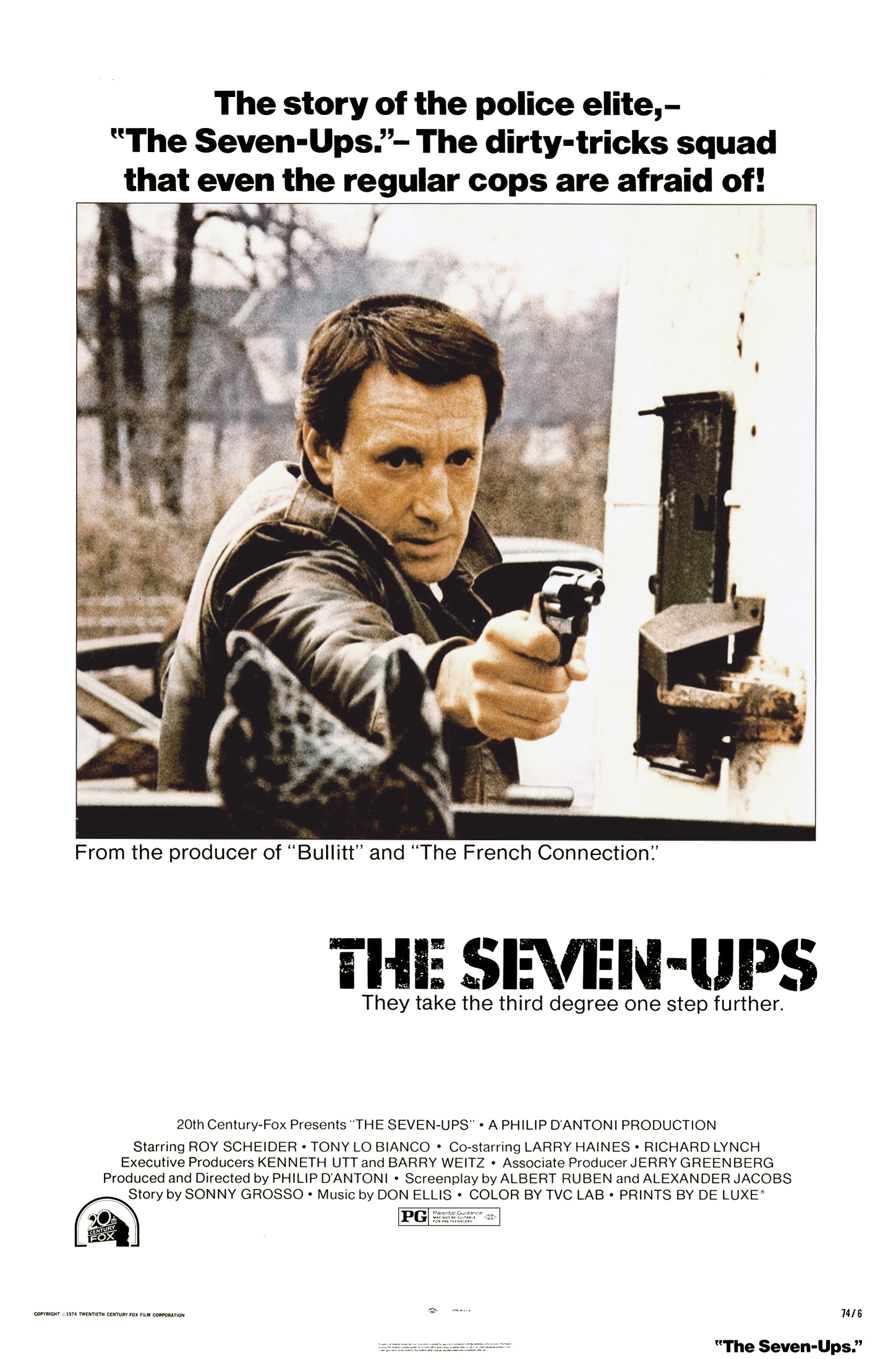
Buddy (Roy Scheider) is a police detective who runs a group of renegade cops who employ unusual and sometimes questionable methods to nab crooks. Once apprehended the criminals they arrest usually end up serving 7-years or more in the penitentiary, which gives their group the nickname of the ‘Seven Ups’. The groups most recent mission is investigating kidnappings occurring in the city and Buddy uses the help of Vito (Tony Lo Bianco) a childhood friend who works as an undercover informant for the police, but who unbeknownst to Buddy is actually behind the recent crimes going on and even the orchestrator.

After the success of The French Connection producer Phil d’Antoni became inspired to produce another similar crime film dealing with the true-life event that occurred in the 50’s in New York that had mobsters being kidnapped by criminals posing as cops. He wanted William Friedkin, who had done so well with the first film, to direct this one, but Friedkin didn’t like the script and passed as did several other directors, which eventually lead the studio to choose d’Antoni to take the helm himself in his one and only foray behind the camera with results that are both good and bad.

The production lacks cinematic flair and shot in a flat way almost like a documentary, which to some degree actually helps it. It was filmed between January and April of 1973 and the crisp, gray, frigid look helps build an atmosphere by accentuating the grimy, cold life of the underworld and how the detectives themselves get foisted into it. The plot is basic and linear, so it’s easy to follow and not cluttered with unnecessary mystery angles and tangents as the viewer knows right away who’s behind everything. There’s also a tense scenes inside a car wash, not exactly sure the perpetrators would’ve been able to pull-off as effortlessly as they do, but it definitely keeps you riveted as you feel the same unease as the two guys in the car though having another scene come later that also takes place in a car wash wasn’t needed.

The film though doesn’t have the interesting characters like in The French Connection where Popeye Doyle’s lifestyle and temperament contrasted in fascinating ways with the man he was pursuing and in fact it was Doyle’s fractured personality that made the movie so compelling. Here, through no fault of Scheider who plays the part well for what is asked, but his character is quite one-note. We learn nothing about him, or his home life. He’s just a typical New York cop obsessed with getting the bad guys, which is fine, but doesn’t have the multi-dimensional quality to help make him memorable.

The supporting characters aren’t necessarily much better, but the actors who play them at least help give them some life. Larry Haines, probably best known for playing one of Felix and Oscar’s poker playing buddies in The Odd Couple, has a good turn here as a crime boss who’s nonchalant initially when he thinks he’s being taken to the cop station for a routine arrest only to cower in fright when he realizes he’s been duped and then when he survives shows no mercy in his unrelenting pursuit for revenge. My only quibble though is that Scheider and his cohorts are able to break into Haines’ house too easily and even able to catch him and his wife sleeping in bed, but you’d think with him being a well-known target with the police he’d have burglar alarms set-up all over his home to detect anyone trying to get in and since he’d just had a traumatic kidnapping incident earlier you’d think he wouldn’t be able to sleep soundly again, or paranoid enough to sleep lightly and aware of any noise.

The car chase sequence is by far the best moment, and some may say the only real reason to watch it. It certainly has you holding your breath, but in a lot of ways is too similar to Bullit, another film produced by d’Antoni, so it really doesn’t stand out as much as it should. There’s also the issue of Scheider pursuing the bad guys even as there’s pedestrians all around. Most real-life cops will stop chasing after a culprit’s car if they feel  it will put others at too much of a risk and this comes to a horrifying moment when school children are playing on the street and must quickly run to the curb when the bad guys drive their car through only a few seconds later to almost get hit by Scheider’s car as he plows through at high speeds without even a thought of putting on his breaks making him seem more like an irresponsible cop who’s more of a problem than a solution.

Nonetheless it’s gripping and I enjoyed how it ends with Scheider ducking under the windshield just as his vehicle hits the underside of the backend of a truck in an intended ‘homage’ to Jayne Mansfield’s wreck. It’s also great watching Richard Lynch’s facial expressions as he plays the crook sitting in the passenger’s side of the fleeing car. Some could say it’s great acting, which maybe it was, but I believe his looks of nervousness and fear was genuine, which just helps to make these shots of his face, which get intercut throughout the chase all the more entertaining and help to have a human side to the action as I and almost anyone else would be reacting the same as he does if we were in the same situation.

My Rating: 7 out of 10

Released: December 14, 1973

Runtime: 1 Hour 43 Minutes

Rated R

Director: Philip D’Antoni

Studio: 20th Century Fox

Available: DVD, Blu-ray

Pretty Poison (1968)

By Richard Winters

My Rating: 7 out of 10

4-Word Review: Manipulated by attractive teen.

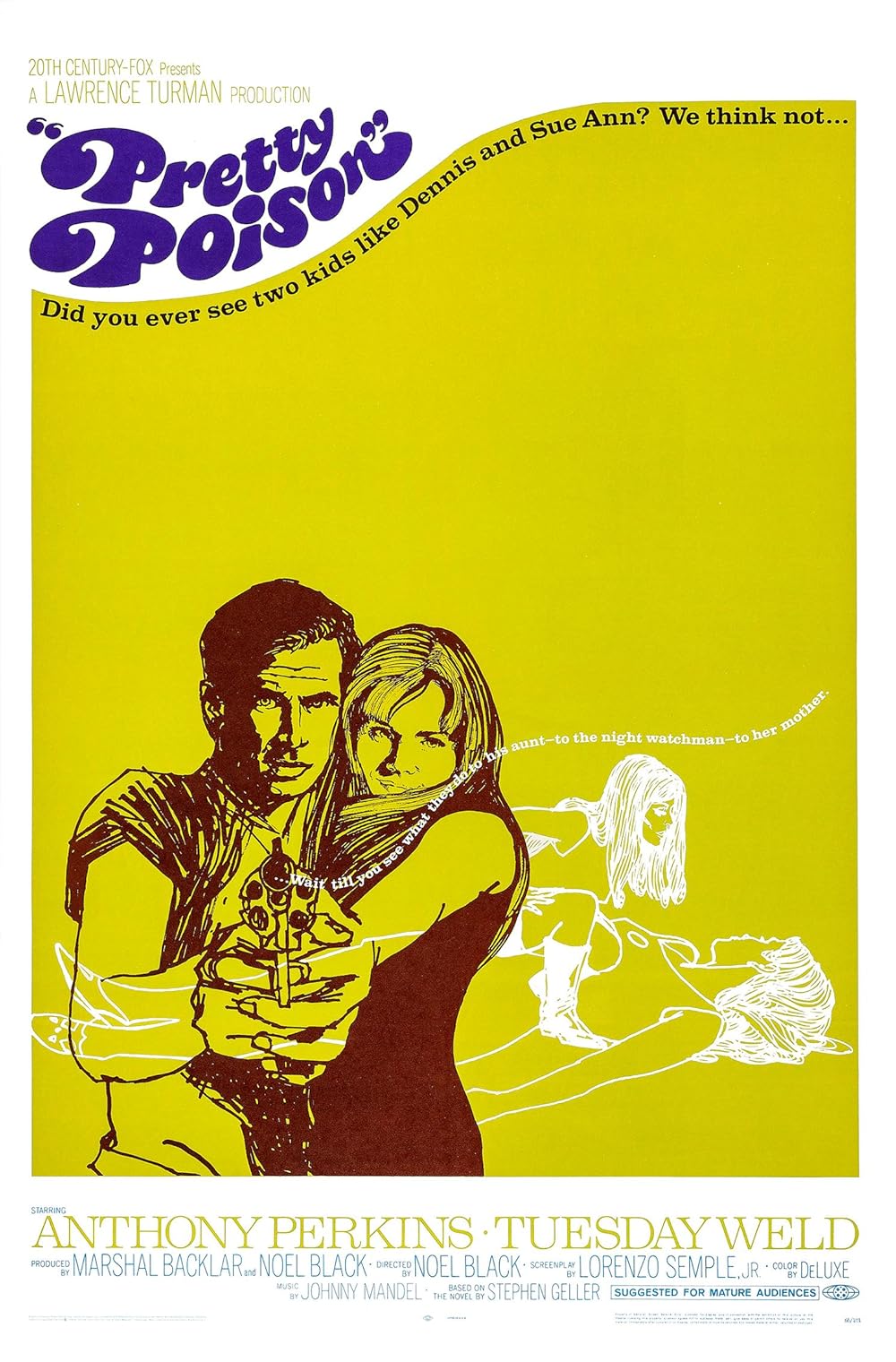
Dennis (Anthony Perkins) has been released from the mental institution after serving several years there for setting a home on fire. He gets a job at the local factory but finds it boring and begins to escape into fantasies. He spots pretty 17-yeard-old Sue Ann (Tuesday Weld) while she rehearses with her high school marching band and immediately becomes smitten. He’s never had experience dating anyone, so he decides he’ll pretend to be a CIA agent on a secret mission as a way to impress her and get her attention. He’s disgusted at the way the factory where he works at dumps pollution into the river and thus comes up with a scheme to destroy it using her help, but when a security guard spots them, Sue Ann kills him. Dennis is shocked with Sue Ann’s brazenness and realizes she’s not as innocent as she appears. He tries to cover-up the killing but finds that Sue Ann’s only getting started as her next target is her mother (Beverly Garland). Will Dennis try and stop it, or figure that appeasing her murderous desires may be the only way to keep her from going after him?

The film is based on the 1966 debut novel ‘She Let Him Continue’ by Stephen Geller and directed by Noel Black, who was just coming off the success of his award winning short Skaterdater and this was considered perfect material for his feature film debut. He described the story as “a Walter Mitty type who comes up against a teenybopper Lady MacBeth”. It was shot on-location in Great Barrington, Massachusetts, which gives it a quant small town atmosphere where supposedly ‘nothing ever happens’ and Beverly Garland gives a terrific supporting performance as the caustic mother.

However, Black had no background in working with actors leading to many confrontations behind-the-scenes between he and Weld and keeping the shooting production on schedule proved equally challenging, which got the studio to believe they’d hired a director who was in over-his-head and helped bring in added pressures. When the movie finally did get released, it fared poorly at the box office. Black felt this was because of the recent assassinations of Martin Luther King and Robert Kennedy, which made the studio timid to distribute it and thus few people saw it though in recent years its acquired a small cult following. 

One of the elements that really makes it work is Perkins who gives a splendid performance. Initially I thought it was a mistake to cast him as he would seem too much like his earlier, more famous character of Norman Bates, but he plays this part much differently. Here he comes off as smarter and less crazy. He does dabble in make believe at times but only does it to mask his insecurities and lack of life experience. Watching his emotional arc where he goes from feeling confident, thinking he’s in control with this supposedly naive young teen, only to ultimately have to grapple with his slow realization that it’s really she who’s pulling-the-strings is the most captivating thing in the movie. 

Weld seemed initially to be perfectly cast as she had already shown a propensity at playing characters quite similar to this one in classic episodes of ‘Route 66’ TV-show and ‘The Fugitive’. However, her age clearly belies her as she was 24 at the time it was filmed and looking nowhere near 17. Having a true teen playing the role may have made what she does even more shocking. She later said in interviews that she hated working on this project mainly because Black wouldn’t let her improvise her lines and you could see she just wasn’t fully into it, and it diminishes somewhat the full effect.  

Spoiler Alert!

While it’s intriguing the whole way the ending, which has Dennis calling the police and allowing himself to be put into jail, didn’t have quite the bang I was hoping for. Dennis had fallen hard for Sue Ann to the extent he felt she had ‘changed his life’ and gave meaning to his otherwise lonely existence. When people are in love with someone, they tend not to see the same red flags that others do, so even though she does some evil things I was expecting him to make excuses for it. Like she killed the nightwatchman not so much because she was a sociopath, but more because of her ‘love’ for him and knowing it would help him in his ‘secret mission’. The murder of the mother could’ve been approached the same way in his mind. She killed her only so they could be together, and he would view it as an ‘unselfish’ act versus a selfish one.

Seeing someone who starts out a bit cocky thinking he can ‘trap’ others with his fantasies only to learn that his own fantasy had trapped him would’ve been quite ironic. He could still be convinced of her love even as he’s arrested and thus his final meeting with her, in which he realizes that she’s betrayed him by going to the police, would’ve had more of an impact.

I didn’t feel that Dennis should’ve had to spoon-feed to his psychiatrist, played by John Randolph, that Sue Ann was really the killer, as the doctor should’ve been smart enough to figure this out for himself. Watching the psychiatrist then follow Sue Ann around in his car as she finds another man (Ken Kercheval) that she intends to manipulate leaves things too wide open. What exactly will this lead to? Will the doctor stop her from killing again before it’s too late, or will Sue Ann realize she’s being followed and have the doctor killed? This is something I feel the film should’ve answered. 

My Rating: 7 out of 10

Released: September 18, 1968

Runtime: 1 Hour 29 Minutes

Rated R

Director: Noel Black

Studio: 20th Century Fox

Available: DVD, Blu-ray, Amazon Video, YouTube
Sunburn (1979)

By Richard Winters

My Rating: 2 out of 10

4-Word Review: Couple investigates insurance fraud.

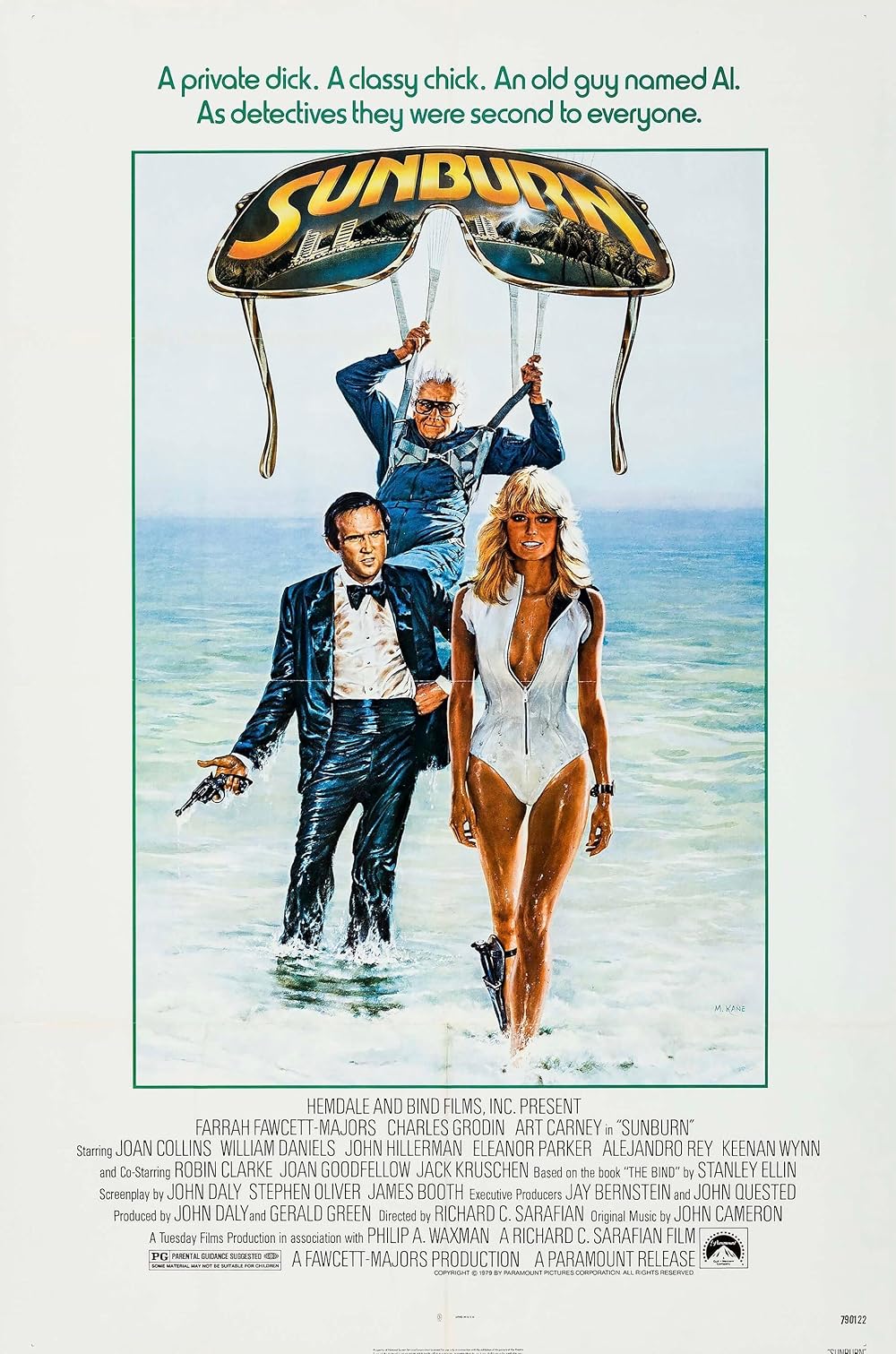
Jake (Charles Grodin) works as a private eye and gets hired by an insurance company wanting him to investigate a case that took place in Acapulco of a man who crashed his car into a building and died. The authorities have labeled it an ‘accident’, which would put them on the hook to have to pay out a large sum of money, so they’d like Jake to travel down there and find out if that were really the case, or if it could be deemed as a suicide. Jake decides to hire an actress from a modeling agency named Ellie (Farrah Fawcett-Majors) to act as his wife. Ellie takes an interest in the case and helps him search for clues while also forming a romance with him, which starts out rocky but becomes stronger as they find themselves sucked further into the mystery and the potential dangers.

The film is based on the 1970 novel ‘The Bind’ by Stanley Ellin, which had a grittier tone than the movie. Farrah’s agent Jay Bernstein felt this would be a good vehicle for her, but wanted the script turned into more of a lighter and comical story that the book did not have. This was at a crucial point in her career as the first film he got her cast in Somebody Killer Her Husbanddid badly with both the critics and public, so it was important that she prove her box office ability with this picture and when this one also bombed she fired him complaining that both movies had been ‘put together with hustle and bubble gum’.

One of the elements that really hurts it is the casting of Charles Grodin, who by his own admission was their sixth choice for the role as they had initially pursued Robert Redford and even Harrison Ford, who would’ve both been way better. Grodin can certainly be funny, but this part doesn’t give him much to work with. He has a few amusing moments when he’s trying to scare away a lizard from entering their bedroom and then in an effort ‘to protect her’ from a further ‘lizard invasion’ agrees to sleep on a nearby chair, which cause him to do nothing but toss and turn the whole night in an effort to find a ‘comfortable’ position.

His character though didn’t seem all that professional as he leaves it up to her to place a listening device into one of the suspect’s phones, but she had no background in this kind of thing, so what would happen if she screwed it up? The insurance company is promising him a lot of money so it should be up to him to do most of the legwork to make sure it gets done right and if any ditzy amateur blonde can be pulled in off the street to do what he does then what’s the point in hiring him to begin with?

Farrah does much better here than her previous film. I enjoyed her dialogue with Grodin and how just because she was hired to play his wife didn’t mean she was automatically going to be one during their off hours when he for some chauvinistic reason expects her to make him a sandwich, which she immediately declines to do. I was confused though why her character would want to get so involved in the case. She’s just there to play a part, so why not just do her job and enjoy the sun? Instead, she constantly puts herself in increasingly dangerous situations for no real reason. She’s gets paid whether the case gets solved or not, so why jeopardize her life over something that she has no emotional or financial investment in?

It’s also hard to believe that such a hot looking lady wouldn’t be in a relationship. It would’ve been far more enjoyable had there been a jealous boyfriend who secretly followed her on her mission and even threw a few monkey wrenches into the investigation, which could’ve added extra spark into a movie that’s otherwise too leisurely. For her to then fall in love with Grodin was equally dumb. The guy could’ve been her father and lacked any type of sexual pizazz. Had Redford or Ford been cast then the romance might’ve made more sense, but such a beautiful woman like her would have no reason to settle for a doofus like him and would simply be there for the payout and then be long gone.

Art Carney is great in support and actually does most of the work making it seem like Grodin’s character wasn’t even necessary and in fact having Carney and Farrah team up would’ve made it unique and more entertaining as Carney despite his advanced age shows a lot of energy particularly when he goes out onto the disco floor. The rest of the cast though gets wasted with many of them having only one or two lines making you wonder why they’d bother to sign on at all.

The film does have one memorable moment where Carney and Farrah, in an effort to escape the bad guys who are pursuing them, inadvertently crash their car into a bull fighting ring and then must avoid the bull who goes after them. This action is both humorous and exciting, but otherwise unless you’re some super Farrah fan the movie offers little else that’s interesting.

My Rating: 2 out of 10

Released: August 10, 1979

Runtime: 1 Hour 45 Minutes

Rated PG

Director: Richard C. Sarafian

Studio: Paramount Pictures

Available: DVD-R (MGM Limited Edition Collection)

The Boss’ Wife (1986)

By Richard Winters

My Rating: 3 out of 10

4-Word Review: She comes on strong.

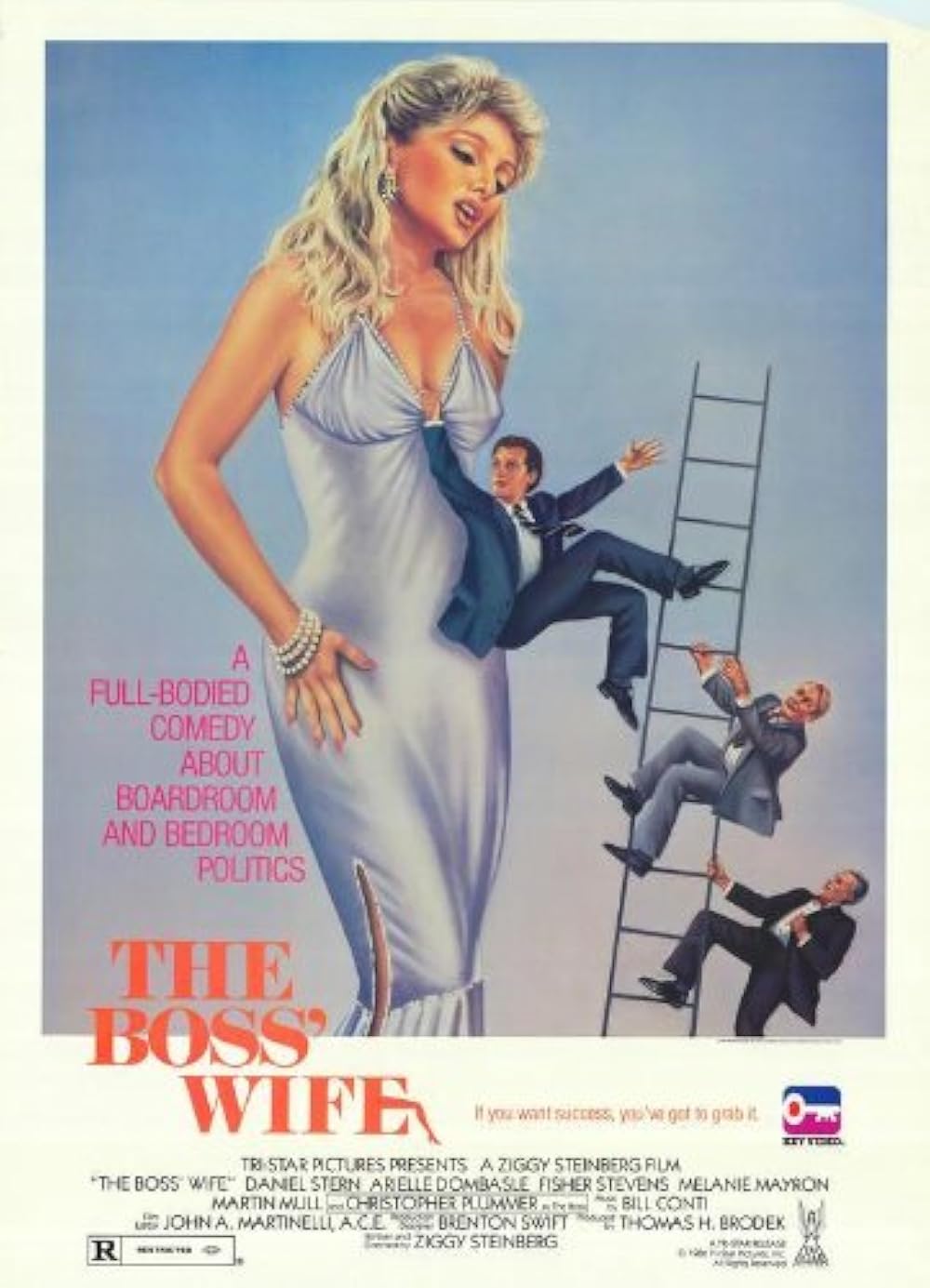
Joel (Daniel Stern) works at a stock firm and wants to impress his boss (Christopher Plummer) with some stock analytics and competes with fellow employee Tony (Martin Mull), who’s a major corporate brown noser. The boss though is not the smartest and misreads everything including thinking that Joel is a smoker, which he isn’t, and giving him the nickname of ‘smoky’. He also thinks that Joel is gay and having a fling with Carlos (Fisher Stevens), which neither is true, but this allows the boss’ wife Louise (Arielle Dombasle) to openly come-on to Joel while the boss, so worried that Joel may come on to him, feigns naivety at what his own wife is doing. Joel tries to avoid the woman because he fears that if he doesn’t, he’ll get caught, which will not only hurt his job advancement, but also his shaky marriage to Janet (Melanie Mayron). 

The film is the product of Ziggy Steinberg who started his careers in the 70’s writing for episodes of TV-shows and then graduating to feature films like Porky’s Revenge and then ultimately Another You, which to date has been the last writing gig he’s done. This film marked his debut as both a writer and director, but the results are so-so. The concept is predictable and better suited for an episode of ‘Three’s a Company’, which he also wrote for, than the big screen. While the attempt is for screwball the pacing is slow and not a lot of gags going on and as satire/parody its target is so obvious and been done so many times before that it hardly seems worth the effort as one could simply watch How to Succeed at Business Without Really Trying and get a lot more laughs. In fact, the only amusing moment comes when Plummer has a toy choo-choo train ride onto his desk carrying drinks and hamburgers and then Stern fumbling around to get ketchup on his burger, which causes a red mess on the boss’ desk.

The acting from the two male leads is adequate. Stern’s character is benign, but he plays it in a likable way making you connect to him and his quandaries. Plummer is quite good particularly with the way he roles his blue eyes every time he comes to a mistaken conclusion to something. Stevens has some good crude moments who initially starts out as Mayron’s employer only to create a haphazard buddyship with Stern while on the train. 

Dombasle though is quite possibly the film’s weakest link. She enters in almost like a fantasy figure and has little dialogue. Why this voluptuous woman would get so focused on Stern for no apparent reason doesn’t make a lot of sense. He does not stand out in any way and therefore a woman like her would overlook and even ignore him. She comes onto him in such a shameless and extreme manner even while in public you could argue she was mentally ill. Even if she’s desperate for sex cause she’s not getting enough from her older husband she could still, with her money, find ways to get it, through like male escorts, than groveling in such a ridiculous level towards a chump like Stern. Later it does come out that she is ‘attracted to men who resist’, which helps explain her motivations a little, but it would’ve been more entertaining had the Mull character paid her, or worked out some deal with her, to come onto Stern in  order to get him into trouble with Plummer, which would’ve offered a nice unexpected twist, which unfortunately the script doesn’t have. 

Spoiler Alert!

The final 10-minutes in which Plummer corners Stern in his rental home with both his wife and Stern’s and the myriad excuses Stern comes up with to try and get out of the jam is sort of funny, but it takes too long to get there. That frantic, hyper-pace should’ve been present from the very beginning and it just isn’t. Stern’s character arc where he finally concludes that the company culture is too conform-ridden for his liking is strained as well. If anything, he should’ve figured that out long before he goes to a company party and asked to where a silly hat like everyone else, which was one of the least problematic things at that place and yet this is where he suddenly decides to ‘draw-the-line’. 

My Rating: 3 out of 10

Released: November 7, 1986

Runtime: 1 Hour 23 Minutes

Rated R

Director: Ziggy Steinberg

Studio: Tri-Star Pictures

Available: DVD-R, Amazon Video, YouTube

Good Luck, Miss Wyckoff (1979)

By Richard Winters

My Rating: 1 out of 10

4-Word Review: Spinster teacher is raped.

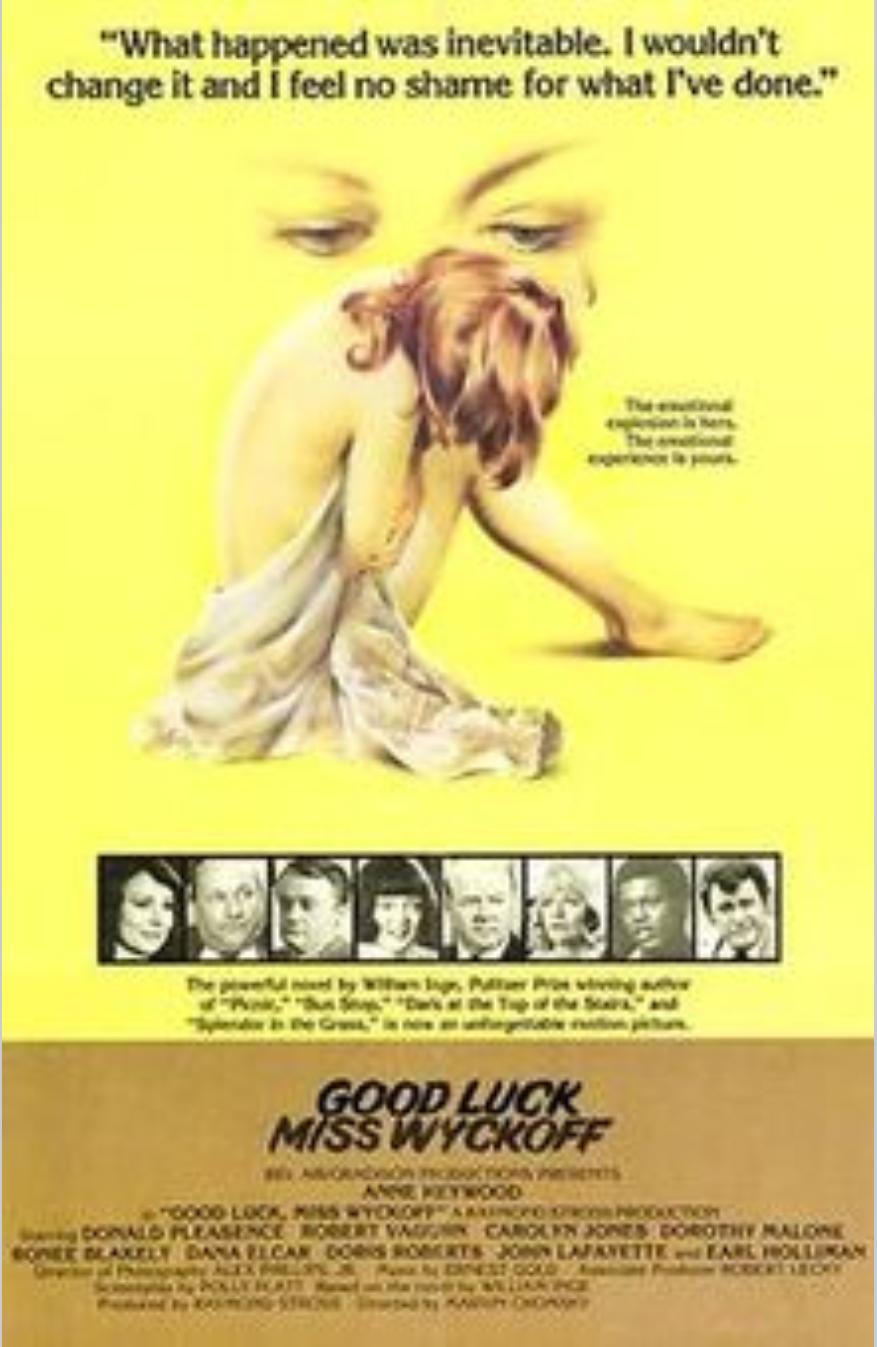
Evelyn Wyckoff (Anne Heywood) is a middle-aged single woman who teaches high school in a small town in Kansas. She has never married and is showing signs of severe depression, which alarms her best friend Beth (Carolyn Jones) as well as the older couple (R.G. Armstrong, Joycelyn Brando) whom she’s living with. Both her doctor (Robert Vaughan) and her psychiatrist (Donald Pleasance) believe it’s because she is not in a relationship or having any sex and that she needs to get out more and meet people. She attempts at starting something with fellow teacher Chester (J. Patrick McNamara) but finds him to be too shy and embattled with his own problems to be able to recognize her interests. She also considers friendly bus driver Ed (Earl Holliman) only to call it off when she learns he’s married. Left alone after school one evening she comes into contact with Rafe (John Lafayette), a black man who works as the janitor, who sees her loneliness as a weakness that he can exploit. He comes onto her strongly and abrasively eventually forcing her to submit to his sexual demands, but she doesn’t go to the authorities and instead starts to enjoy the degradation and continues to come back for more until the rest of the students and teachers find out about it putting her job and reputation in peril.

The story is based on the 1970 novel of the same name written by William Inge. The film rights were sold in 1971 but sat on the shelf for many years until producer Raymond Stross found it and felt it would be a good vehicle for his actress wife Heywood who had already made a name for herself in tackling controversial, edgy material and even sought it out, so this was considered a perfect next project. While she had received critical accolades for her earlier work, The Fox, where she played a lesbian in a  relationship with Sandy Dennis, which was envelope pushing for its era, this one did not go over as well and was genuinely lambasted causing her career to take a downfall from which it couldn’t recover and she ended up retiring from acting just a decade later.

On a surface level it’s okay. The recreation of the 1950’s Kansas, while shot in Stockton, California, is still effective and the personalities of the people isn’t as cliched. There are those that show prejudices and oppressive mind sets, but there’s a healthy balance that don’t, which helps make it feel more realistic. The supporting cast is full of familiar faces though most of them are wasted in small roles that don’t add much and Carolyn Jones, in her last feature film appearance, stands out best albeit with an awful hairstyle.

The biggest detriment, besides the flat direction and booming music score, is Heywood who doesn’t offer enough nuance to her part. I’ll commend her for taking on a very difficult role that required at age 48 to be fully nude and allowing herself to be put into some very vulnerable and demeaning positions, but her facial expressions and responses are one-note. Her constant crying for no reason, which alarms those around her, and unexplained impulsive behavior, like smashing a mirror during a party, is too dramatic. Instead of using this to reveal that she’s unhappy it makes her seem more like a complete mental case that has far worse issues than just being lonely and I felt more sympathy for her friends trying to put up with her erraticism than I did with the main character who for the most part is rather whiny and annoying.

There’s never any explanation for why she’s unable to get into a relationship. She’s attractive, so you’d expect there would be eligible suitors who’d ask her out. All we see is a bus driver who’s already married, but what about other single men who would have to be out there? Why don’t we ever see one of them make a move and if so, how would she respond to them, which would be far more revealing than anything she says to her shrink, which amounts to talky pseudo-science.

The rape scene isn’t either shocking or effective and seems to come out of nowhere. It occurs in the middle of the second act, but before then we see the Rafe character only once while cleaning the chalk boards for a few seconds, so we have no idea what makes him tick, or why he chooses to prey on this woman and none of the others. Had she made the first move in an attempt to connect with someone and relieve her of her isolation, and this then inadvertently incited some inner aggression with him it might’ve made more sense and worked with the flow of the story, but the way it gets handled here makes it seem like two different movies: one dealing with the pain of being alone and the other about a man who enjoys exploiting women.

Ultimately nothing comes together. We don’t learn much about the protagonist. Yes, she’s sexually repressed, but the root cause is never made clear. The fact that she accepts her degradation at the hands of Rafe makes her even more confusing. When her friend Beth says that she feels like she didn’t really know her at all I the viewer felt like saying the same thing. The result is shallow using shock elements that are no longer effective causing the film to be both forgettable and boring.

My Rating: 1 out of 10

Released: April 13, 1979

Runtime: 1 Hour 46 Minutes

Rated R

Director: Marvin J. Chomsky

Studio: Bel Air/Gradison Productions

Available: DVD, Blu-ray, Tubi