
By Richard Winters
My Rating: 8 out of 10
4-Word Review: Man defends his home.
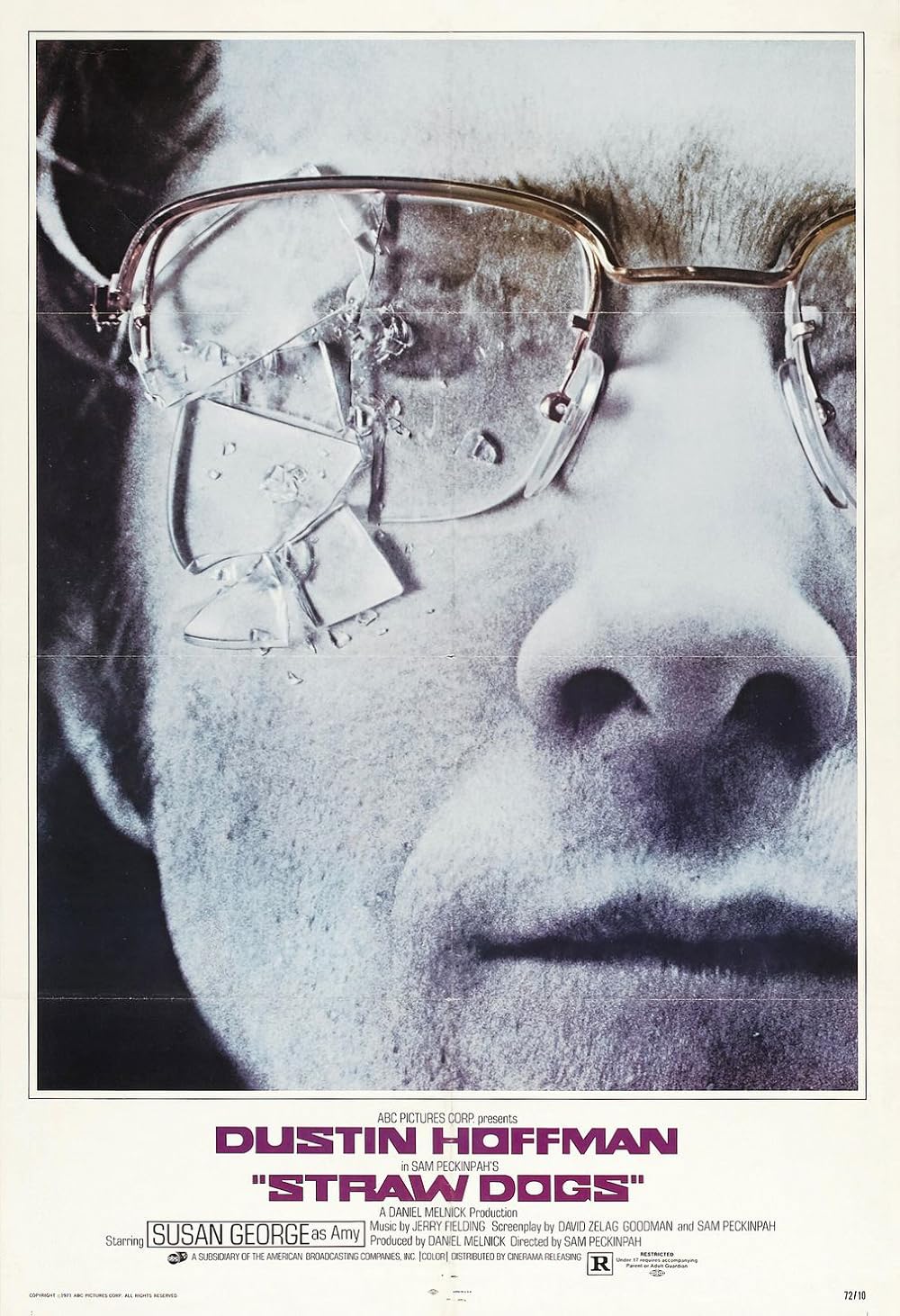
David (Dustin Hoffman), a nerdy mathematician, has been given a research grant and uses it to relocate to the rural countryside of England with his wife Amy (Susan George). They move into a farmhouse that was once owned by Amy’s father and they hire four men (Del Henney, Ken Hutchinson, Jim Norton, Donald Webster) to fix up the roof. The men though don’t work much and spend most of the time making fun of David and ogling Amy. After several bad encounters, including the grizzly death of their pet cat, David fires them and hopes that’ll be the last it, but things only get worse. When a teen girl named Janice (Sally Thomsett) disappears her violently drunken father Tom (Peter Vaughan) thinks it was caused by Henry (David Warner) a mentally handicapped man that Janice had shown an affinity for. Tom, along with the four other men, become a lynch mob determined to find Henry and bring him some ‘street justice’. David and Amy, while returning from a church service, hit Henry with their car as he’s running from the other men. David agrees to take the injured Henry into his home until a doctor can arrive, but the five men insist on getting inside to beat and kill Henry for his perceived crime. Since David had avoided having any confrontation with the men previously even when they had openly mocked him, they presume he’ll be a pushover this time as well, but David has finally decided to take a stand and will defend his home from the intruders in any way he can.
While it was controversial at the time many now consider this the pinnacle of director Sam Peckinpah’s career and his directorial touches are supreme. The capturing of the brown empty vast landscape of nothingness, shot during the winter of 1971, brings out a surreal sense making it seem like the characters are living in a purgatory outer world where everything is dead and helps explain the deadness of the men’s souls that have been forced to endure their entire lives there. The climactic sequence where David’s home comes under siege is deftly handled. Normally in thrillers pounding music gets played during these segments to ramp up the tension, but here there’s only the sound of a distance foghorn, which makes it much more creepy, distinct, and helps accentuate the isolation.
Some have been critical of the film’s violence especially at the time when there was activism going on that tried to stymie violent material on both TV and movies with the idea that violence was a ‘learned’ behavior and if people didn’t see it so much in entertainment, then they wouldn’t do it in real life. Peckinpah though saw it differently as he felt violence was an instinctual reaction that couldn’t just be ‘unlearned’ and that in certain situations it was necessary and not every conflict could be resolved peacefully, a message the film brings out quite well.
While Susan George gives an excellent performance, as do the four villainous men, particularly Vaughan as their ringleader making them some of the creepiest bad guys in film history, I did find her character confusing. I didn’t understand why she’d marry a guy that she found by her own admission cowardly even bringing up that he was ‘running away’ from problems he was having at his university and his ‘hiding behind his studies’ in order to avoid it. She also shows no respect for his work and several times even vandalizes his chalk board that has his mathematical equations, so what attracted her to him in the first place? Would’ve made more sense had she initially idolized him for his academic status and then became painfully aware of his meekness as the film progressed, which would’ve made for a more interesting arch.
Spoiler Alert!
The film is based on the 1969 novel The Siege of Trencher’s Farm by Gordon Williams, but with many changes some of which worked while others didn’t. In the novel the couple had an 8-year-old girl, but in the film there is no child. To a degree it doesn’t make that much of a difference though when the bad guys attack the house it might’ve heightened the urgency more knowing that David was not only defending his ‘home’, but also the safety of his terrified daughter. The biggest change that the film does is that it creates a connection between Henry and Janice where Janice sneaks away with him during a church party where she invites him to be intimate with her, but in the process, he accidentally kills her, which seemed too similar to Of Mice and Men. It’s confusing too why this teen girl, who outside of her buck teeth seems reasonably attractive, would feel the need to throw herself at a mentally handicapped man, or get flirty with David, who is married. Why can’t she find guys her own age to fool around with? Knowing the hormones of most teen boys that shouldn’t be too hard, so without further explanation to her psyche, which doesn’t happen, her ‘inviting’ of Henry is quite unnatural and forced.
In the book Henry is instead a child killer who’s being transported back to prison when the vehicle he’s in gets stuck in the snow, which allows him to escape. At the same time Janice, who’s mentally disabled, which isn’t made clear in the movie, runs away from a Christmas party where she ends up dying from the exposure to the cold, but otherwise it has nothing to do with the escape of Henry and is only presumed to have a connection by the five men, which makes more sense and the screenplay should’ve have kept it this way.
On the other hand, in the book none of the attacking men die and are only badly injured, but I think death gives it a more final resolution, so the movie scores there. I also liked how David is forced to resort to items he can find around the house, much like in the film Last House on the Left, which came out a year later, to fight off the bad guys versus the cliched machoism of having a big gun to blow them away and it also helps to show how intellectual wits can ultimately be used to overpower the otherwise physically stronger attackers.
The rape scene in which the wife gets assaulted by not only one, but two men was another problematic moment as the book had no such segment. For one thing it makes it seem like she’s actually enjoying the attack, at least with the first one, and she recovers from it much too quickly and doesn’t even bother to tell David about it and able to go on relatively normally afterwards, which didn’t seem realistic and thus I think it should’ve been excised since it comes off as exploitive and doesn’t have that much to do with the main plot.
My Rating: 8 out of 10
Released: December 22, 1971
Runtime: 1 Hour 57 Minutes
Rated R
Director: Sam Peckinpah
Studio: 20th Century Fox
Available: DVD, Blu-ray (Criterion Collection)
 Scopophilia