Monthly Archives: December 2024

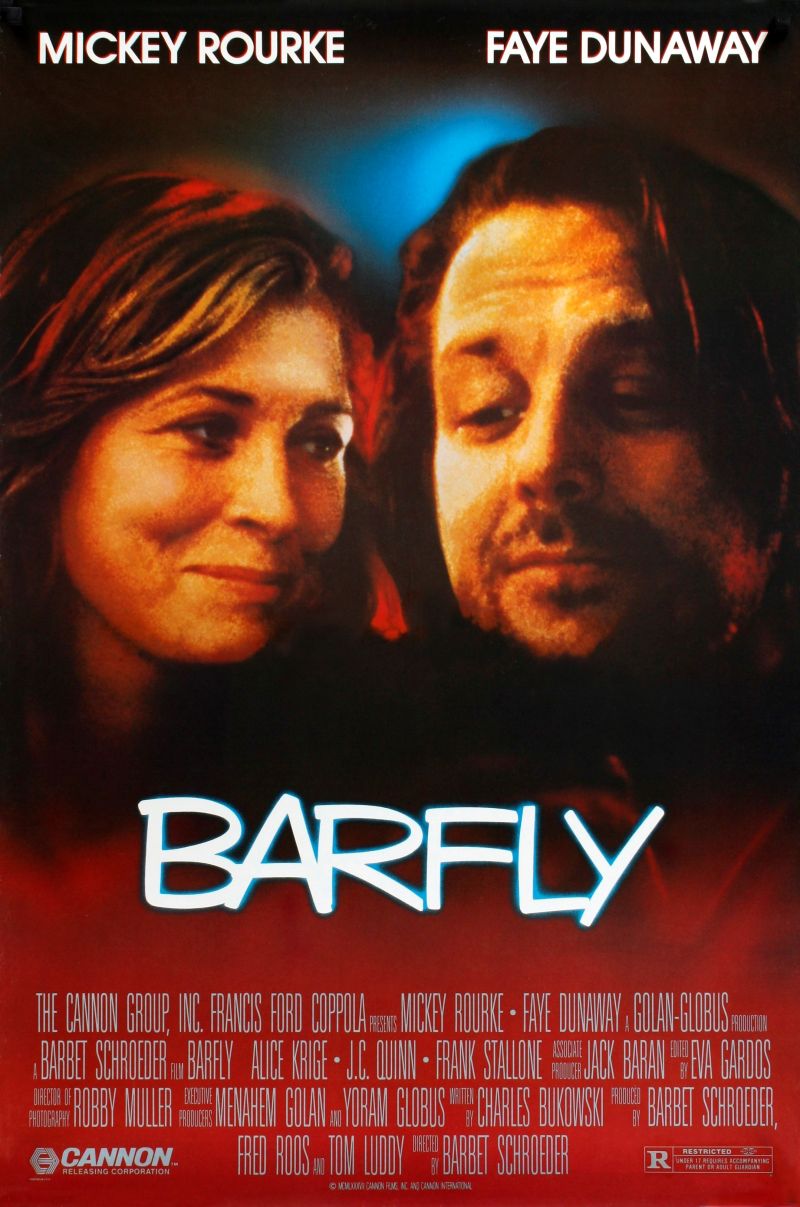
Barfly (1987)

barfly

By Richard Winters

My Rating: 6 out of 10

4-Word Review: Drunks at a bar.

Henry Chinaski (Mickey Rourke) is a bum who has very little money, lives in a small rundown apartment that’s more like a sleeping room, and spends most of his time getting drunk at a bar across the street called The Golden Horn. It’s here where he gets into arguments with Eddie (Frank Stallone) the bartender. During one of their confrontations the two go out back and have a fistfight behind the building, which Henry unceremoniously loses. Feeling embarrassed and dejected he goes on a crusade to ‘win his title’ back by finding food in order to regain his energy, but when he rips a sandwich out of another customer’s hand, since he doesn’t have money he must steal from others, he gets thrown out of the bar by Jim (J.C. Quinn) the bar owner. He then stumbles his way to another waterhole named Kenmore where he meets Wanda (Faye Dunaway) a fellow alcoholic. The two create a makeshift bond and end-up going back to her place, an apartment paid for by a married man who covers for her life necessities, as a kept woman, as long as she’s willing to put-out when he wants it. Just when Henry thinks he might be falling in-love she betrays him by have a tryst with Eddie. Feeling dejected Henry turns back to the bottle only to have Tully (Alice Krige) show-up at the doorstep. She’s a publisher offering him a check of $500 in compensation for some of the poems and short stories that he had submitted, which she found to be both gifted and profound. Henry though isn’t sure he can accept the money as he’s more comfortable being poor and not used to being liked, or a part of the upper class, which for decades he had found snotty. Then Wanda comes back into his life and when she finds out about Tully she makes a personal vendetta to ‘put her out’ as she feels rightly or wrongly that Henry is ‘hers’ and no other woman can have him.

The film is based loosely on the life of Charles Bukowski, who used the character of Henry Chinaski in five of his novels and was considered his alter-ego. It was produced by the notorious Cannon Group a production company that had a portfolio of a hodge-podge of movies some of them of a decent quality and others that were anything but. Although they had made a commitment to finance this one it almost didn’t get made as the studio was going through a period of financial distress and felt this one required too much money to fund, so they threatened to pull-out until director Barbet Shcroeder appeared at their office with a Black and Decker power saw warning that he would cut-off one his fingers to show the world that ‘Cannon was cutting-off a piece of him by pulling out of the project’, which was enough to get the execs to change their mind.

As a film it works mainly because it used authentic Los Angeles locations, many of which Bukowski frequented in real-life, as the setting. The dismal interiors really help create a vivid look making the viewer feel they’re as trapped in the skid row surroundings as the protagonist and with no discernable way to get out. The apartment sequences are especially engaging not only for the scene, that comes near the end, where Henry finally busts in on his noisy neighbors where he has a memorable confrontation, but also at the beginning when he accidentally goes into an apartment that isn’t his, but since it looks just as bleak as his sans for some decorative window curtains, he at first doesn’t even know it.

As a character study it’s revealing though it does hinge on how much tolerance the viewer will have towards someone whose decidedly self-destructive at every turn. Rourke plays the part in an over-the-top way particularly the weird style he walks almost like he’s trying to put a touch of camp to it and I don’t blame Bukowski, who stated in a later interview that Rourke was ‘too exaggerated and a bit of a show-off’ in the part, which Bukowski ultimately felt that he ‘didn’t get right’ though he later warmed-up to it and possibly other viewers may as well.

Dunaway seemed more problematic playing a woman on the skids was definitely not a part of her repertoire and she seems miscast. She almost makes-up for it by appearing topless during the bathroom scene and then getting into a climactic catfight with Krige at the end, but I didn’t understand why the woman would be wearing what appeared to me as female business attire as that was something her character was not and therefore she should’ve had something more ragged to wear even if it was just a simple jeans and T-shirt.

Spoiler Alert!

The film has many quirky moments including the two paramedics that come to visit Henry on a couple of occasions, which almost steals the movie and make this seems more like a surreal, dark comedy than a drama. The leisurely pace I liked and seems more suited for a European audience that isn’t so plot driven, but I would’ve liked seeing Henry working more at his craft. He’s only shown writing a couple of times, which is so brief that I really didn’t think he was that committed to it and almost like a novice writing words on notebook paper making it a complete surprise when a publisher eventually does show-up. You’d think if he hadn’t even bothered to type out what he had written most publishers would’ve thrown it away making the moments with the agent seem almost dream-like and more a fantasy than the intended reality.

I was a bit turned-off by the ending. I remember reading an article back in the 80’s that this movie was an example of a ‘downbeat ending’ that Hollywood studios were shying away from. During the 70’s sad endings had become the standard, but by the 80’s they tended to not register as well with the public and thus making upbeat conclusions became the norm. However, the article had specifically pointed out this movie as having an ending, which ‘wasn’t a happy one’, but I didn’t get that impression. I thought maybe it would have Henry getting knocked out by Eddie during their fight ‘rematch’, but the camera tracks out of the bar, so we never see the results of the confrontation and it’s all left open, so it’s neither sad nor happy. My only conclusion is that the article’s author felt this was a ‘sad’ ending because Henry went back to his old ways of drinking versus becoming a successful writer, but for some people success is a scary thing and falling into their familiar habits, as bleak and destructive as they may seem to others, offers a weird form of security, so I felt it ended on a high note because Henry was doing what was right for him and with the type of people he felt comfortable with. Being rich and famous would never have worked with his personality and therefore he was better off without it.

My Rating: 6 out of 10

Released: October 16, 1987

Runtime: 1 Hour 37 Minutes

Rated R

Director: Barbet Schroeder

Studio: The Cannon Group

Available: DVD, Blu-ray, Amazon Video
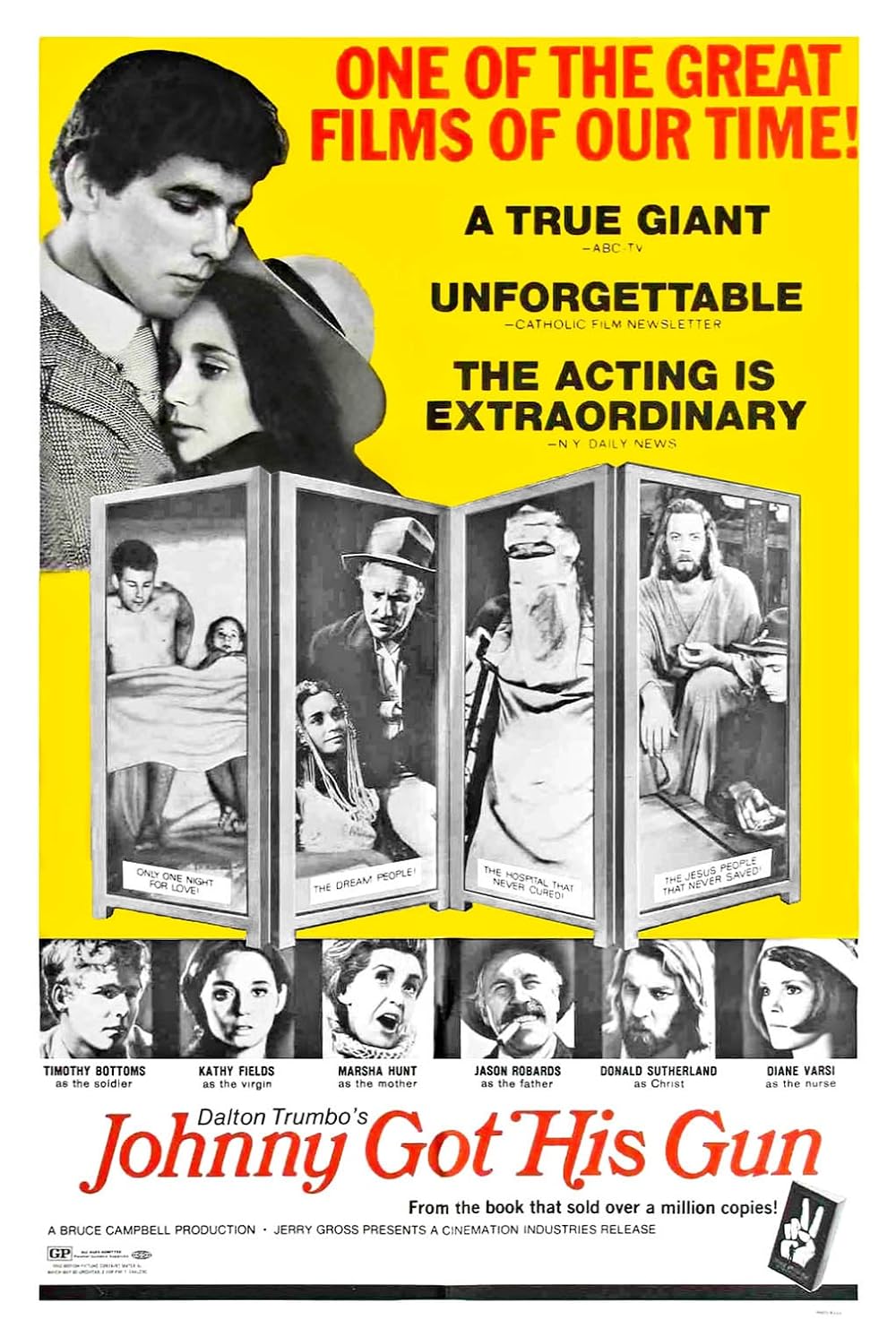
Johnny Got His Gun (1971)

johnny1

By Richard Winters

My Rating: 4 out of 10

4-Word Review: Left with no face.

Joe (Timothy Bottoms) finds himself stuck on a hospital bed, covered with a white sheet and unable to communicate with any of the doctors or nurses. As a soldier fighting in WWI, the last thing he remembers is being hit with an artillery shell and he presumes he’s injured and the medical staff is just trying to make him well again, but ultimately, he comes to the conclusion that he’s lost all of his limbs and even his face. The only thing left is his brain, which allows him to relive the memories of the past, but with no ability to express himself, or see or hear anything, like a prisoner in his own body. Locked away in a utility room, so his disturbing condition won’t be seen by others, he tries to suffocate himself but finds even that to be impossible. Eventually he’s able to use morse code by banging his head against his pillow to alert the staff that he’s still conscious and not a vegetable, but his demands to be toured around in a glass coffin in order to show the public the horrors of war go unheeded.

The film is based on the 1939 novel of the same name by Dalton Trumbo, which was inspired by the real-life case of Curly Christian, a Canadian WWI soldier who lost all four of his limbs during battle. The book was met with many accolades from the critics and was even considered for a movie as early as the 1940’s when it was to star a young William Holden, but funding for the project fell through. By the 1960’s when anti-war sentiment grew during the Vietnam years renewed interest in bringing the novel to the big screen mounted and plans were put in place to have Luis Bunuel direct, but yet again funding became an issue and the pre-production was paused for several years until Trumbo himself decided to take it on by working with private investors to get the required capital. The modestly budgeted film was then given a limited release in the summer of ’71 but was never a hit and largely forgotten until revived in 1989 when the heavy metal group Mettalica used footage from the film in their music video ‘One’.

The film has some interesting aspects including having the present-day scenes shot in black-and-white while Joe’s memories and dreams are done in color. Timothy Bottoms, in his film debut, is excellent. For most of the movie we only hear his voice-over of his thoughts, but within that limitation he plays it well and uses his tone eloquently to convey his emotions and inner angst. The supporting cast such as Jason Robards as Joe’s caustic father help give the movie a bit of an edge and Diane Varsi as the sympathetic nurse who shows compassion with Joe’s dismal predicament and quarrels internally about what to do including considering shirking her professional responsibility in order to put him out of his misery, is quite good too.

The structure though doesn’t fully work. The memories of past events, including his home life and upbringing, are too general, stuff that could’ve happened to anybody and thus nothing stands-out. The dream sequences don’t have enough visual flair and are much too talky. Trumbo may be the master of the written word, but his cinematic sense is lacking, and the film drones along putting the viewer to sleep instead of reeling them in emotionally. The anti-war message may have been ground-breaking for the ’30’s, but by the time of the movie’s release there were too many other art mediums saying the same thing, so what gets said here is nothing new and comes-off as redundant and even preachy.

My biggest complaint though is that we never see Joe’s actual physical state. During the whole movie he remains conspicuously covered by a white sheet, which I found to be a cop-out. I wasn’t opposed to keeping what he looked like a mystery for most of the way as revealing it right away would’ve taken away the shock effect, but at some point, it needed to be exposed to the viewers horrified eyes. Just constantly describing something doesn’t work in movies, maybe in books, but in film one should always go for the visual. Not sure why it wasn’t done here. Maybe they thought it would be too costly to create the special effects, or the gruesomeness would sicken the audience, but wasn’t that supposed to be the whole point? By keeping it at a ‘tasteful’ level it misses-the-mark and one of the main reasons why the movie doesn’t have as strong of an impact as it could’ve.

My Rating: 4 out of 10

Released: August 4, 1971

Runtime: 1 Hour 52 Minutes

Rated PG

Director: Dalton Trumbo

Studio: Cinemation Industries

Available: DVD, Blu-ray, Amazon Video
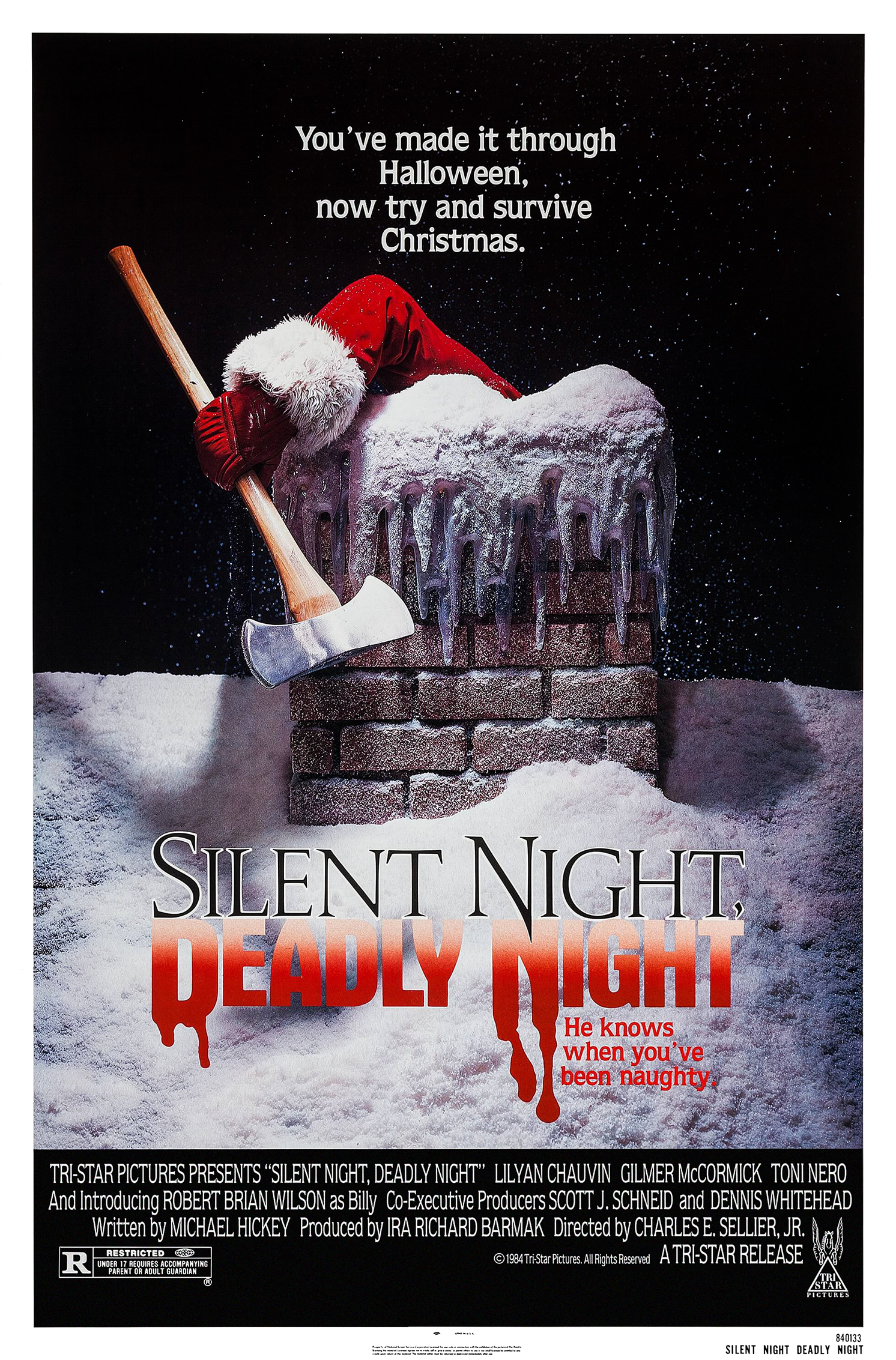
Silent Night, Deadly Night (1984)

silent

By Richard Winters

My Rating: 6 out of 10

4-Word Review: A killer Santa Claus.

When he’s only 5-years-old Billy Chapman (Jonathan Best) has a very traumatic experience. It starts when he and his family are visiting their grandfather (Will Hare) inside a senior living facility. While his parents and younger brother are temporarily out of the room his grandfather, who usually never says a word, suddenly speaks by warning him about Santa Claus and how he punishes those who’ve been naughty. On the car ride home, his family is attacked by a gunmen dressed as Santa (Charles Dierkop) who has just robbed a liquor store. Both his parents are killed by the man, but Billy manages to escape by running out of the vehicle and hiding behind some bushes. Things now flash forward to the year 1984 where Billy (now played by Robert Brian Wilson) is 18 and still suffering from the dark memories of the event as well as the abusive upbringing inside the orphanage he was sent to that was ruled by a tyrannical Mother Superior (Lilyan Chauvin). Working as a stock boy at a nearby toy store, he gets asked to fill-in as Santa when the man who usually plays him calls-in sick. Playing the part though brings back up all the repressed emotions of what happened years earlier causing him to have a mental breakdown and turning him into a killer. 

This film ended up becoming quite controversial and it all started when producer Scott J. Schiend accepted story submissions from the public to help him decide what movie project he’d like to finance next. One of those submissions was short story written by a recent college grad named Paul Caimi entitled ‘He Sees You When You’re Sleeping’, which involved a killer Santa. Schnied became intrigued by the concept and hired Michael Hickey to write a full-length screenplay around the premise. Once completed the script was shopped around until Tri-Star Pictures decided to pick-it-up and finance it as well as act as its distributor. 

Since there were already two other films that had been released that dealt with a killer Claus including the 1972 horror anthology Tales from the Crypt, and the 1980 slasher You Better Watch Out! no one behind-the-scenes was expecting this one to create much controversy since neither of those had. However, mainly because of an aggressive marketing campaign, it soon caused the ire of many parents who felt based off of the TV-ads that this film would tarnish the image of Santa Claus and make children fear him and thus a movement to have the movie removed from theaters was created. Even Siskel and Ebert got in on it by focusing an entire episode of their show to it and reading out the names of the cast and crew in order to ‘shame’ them for having worked on the production. The movie was soon pulled after having been in theaters for only a week, but the controversy ended up having a Streisand effect as it garnered it more attention than it would’ve otherwise, and it made a hefty profit at the box office and ultimately became a cult hit that spawned 4 sequels as well as a reboot.  

It seems to me that most people that protested the movie didn’t actually watch it because if they had they’d realize that it’s made very clear that the guy doing the killings isn’t really Santa nor does he even look much like him. The kid who plays him doesn’t even bother putting the beard on and his own face is constantly exposed while he does the butchering, so at no point does the viewer ever see him as being anyone other than a troubled teen with severe mental issues. I actually wished the part had been played by Dierkop who portrays the initial Santa during the hold-up and puts far better energy into the role and genuinely looks more like the classic Claus both in his age and physical build. 

The movie puts a lot of effort into showing how Billy became the way he does, but for me that was a problem as it gets too plodding and seems to take forever for the carnage to get going, which for a slasher fan is what you really want to see. Would’ve been better had it started out right away with this guy Santa killing people, maybe even one of the kids who sits on his lap at the store, and with no reason why he was doing it, and then through intermittent flashbacks allow his back story to be revealed versus having the background painfully elaborated from the start, which takes away any mystery, or surprise. There’s also the issue of young Billy having prominent brown eyes, but when he reaches adolescence his eye color suddenly turns to blue. 

Spoiler Alert!

My biggest complaint though is with the Mother Superior. Chauvin plays the part quite well making the nun scarier than the killer and somebody you really love to hate, but she’s never killed off, which is a huge disappointment. Many people who grew up going to a strict Catholic School might’ve enjoyed seeing a disciplinarian nun get hacked and it might’ve been cathartic and thus having it not occur doesn’t give the film a sufficient payoff. 

My Rating: 6 out of 10

Released: November 9, 1984

Runtime: 1 Hour 25 Minutes

Rated R

Director: Charles E. Sellier Jr.

Studio: Tri-Star Pictures

Available: DVD, Blu-ray, Amazon Video
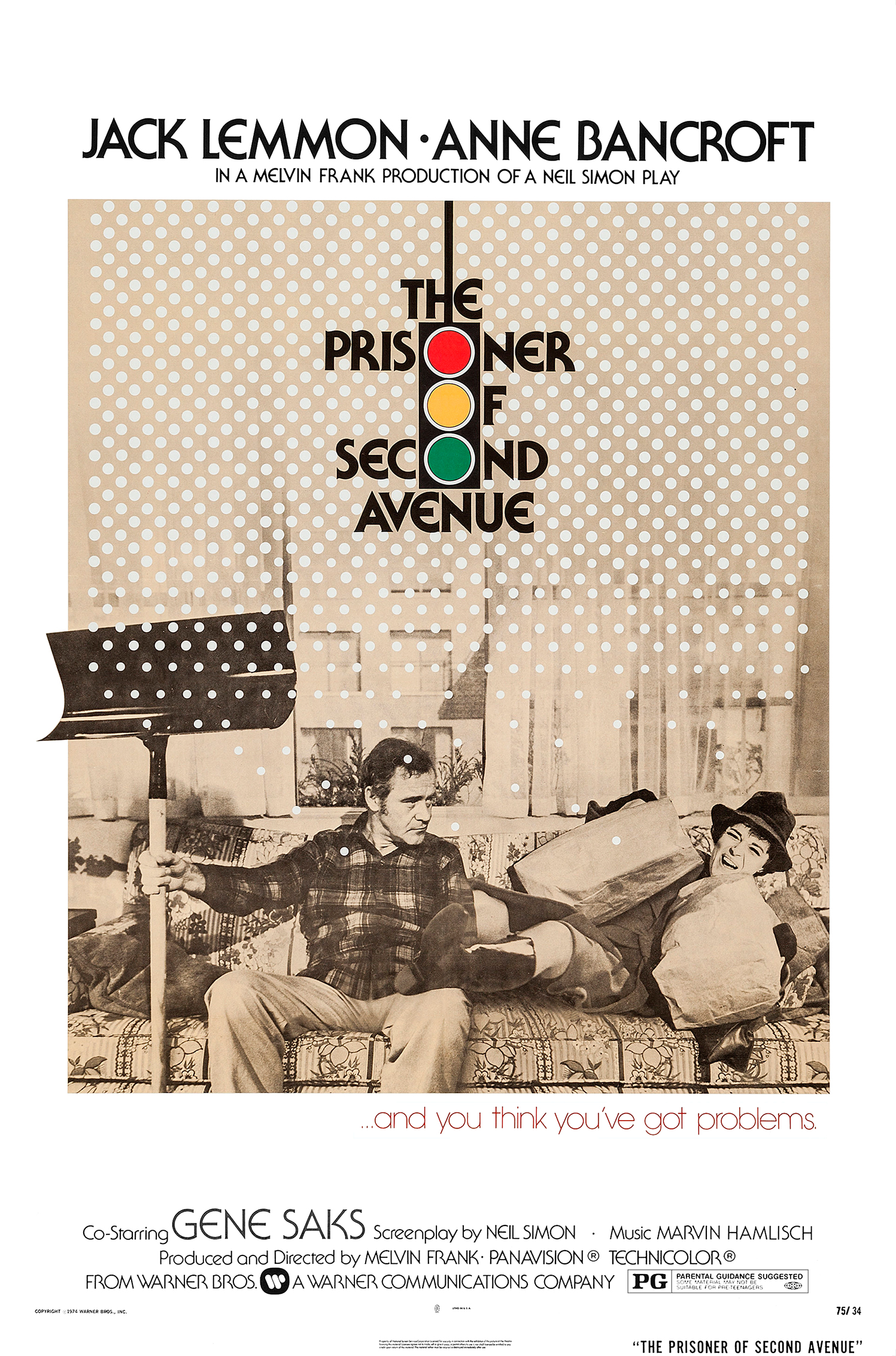
The Prisoner of Second Avenue (1975)

prisoner

By Richard Winters

My Rating: 4 out of 10

4-Word Review: Out of a job.

Mel (Jack Lemmon) has just lost his job that he’s had for 22-years and fears that at age 48 it will be hard for him to find another one. Edna (Anne Bancroft) goes out to find employment of her own in order to pay for the bills and while she’s initially sympathetic to Mel’s problems she becomes annoyed at the way he doesn’t do anything about it besides just complain about everything. Having their place get robbed in broad daylight, a garbage collector’s strike, noisy neighbors, and a massive New York heatwave all lead to Mel having a mental breakdown where he begins to believe all sorts of conspiracy theories. He also gets into loud verbal sparring with one of his upstairs neighbors. His brother Harry (Gene Saks) tries to get his two sisters, Pauline (Elizabeth Wilson) and Pearl (Florence Stanley) to chip-in to help pay for Mel’s therapy, but they’re reluctant making Edna feel like she’s in this all on her own while becoming openly frightened at Mel’s deteriorating state.  

The film is based on Neil Simon’s Broadway play of the same name that premiered on November 11, 1971, that starred Peter Falk and Lee Grant. The script was written by Simon but doesn’t do enough to differentiate it from a stage play with a boring visual design that falls flat and barely ever seems to get out of the apartment and when it does the moments are equally uninteresting. The ongoing potshots at New York City living have been done before and nothing that gets said here that is ground-breaking, or even mildly amusing. The plot and humor meanders and are too unfocused to be either riveting, or captivating. 

Lemmon gives a good performance, but he’s played this type of character before and his perpetual complaining about everything and anything quickly becomes tiring. I actually sided with the upstairs neighbor who throws cold water on him when he stands outside bellowing into the night air about his problems, which would annoy anyone. Bancroft’s Brooklyn accent is too affected and her wide-eyed responses to Lemmon’s constant shouting lends no spark making her character come off as transparent. Watching her fight-back a little or even get into a sparring match with Lemmon could’ve added some much-needed comic spark, but for the most part the scenes between them are dull and one-dimensional. 

It’s hard to feel sorry for a guy who makes no effort to help himself. Instead of him being shown moping constantly around the apartment each day in his bathrobe we should’ve seen him going out to job interviews, or even sprucing-up his resume and I was genuinely shocked why none of this happened. How does he really know the job market is so ‘tough’ if he doesn’t venture to go out and test it? Since his wife is able to get a job rather quickly it starts to seem like it’s not so hard to find one making the protagonist and his inactions all the more infuriating. 

Spoiler Alert!

What’s even more confounding is he’s able to somehow ‘snap out of’ his sorry state without actually finding another job. It’s not clear either what event gets him to change his thought patterns he just starts telling everyone that he’s ‘over it’ and back to being his old productive self, but in a good movie this should be seen by the viewer without the character having to explain it. Since he’s still not gainfully employed what’s to say he couldn’t easily fall back into the doldrums and therefore seeing him working at someplace new would’ve been a more complete ending. 

The side-story dealing with him buying a giant snow shovel in order to get back at his neighbor for throwing water on him, isn’t satisfying either. For one thing if money is so tight why waste it on something he really doesn’t need? His revenge plan is a bit confusing too. The idea, I guess, is that he’ll wait for the first big snowfall then climb up on the apartment roof and shovel the white stuff down on the neighbor’s balcony, but this is yet another thing that should’ve been put into action in front of the camera as him just alluding to what he’s going to do isn’t as satisfying. 

My Rating: 4 out of 10

Released: March 14, 1975

Runtime: 1 Hour 38 Minutes

Rated PG

Director: Melvin Frank

Studio: Warner Brothers

Available: DVD, Blu-ray, Amazon Video, YouTube

Max Dugan Returns (1983)

max1

By Richard Winters

My Rating: 4 out of 10

4-Word Review: Estranged father comes back.

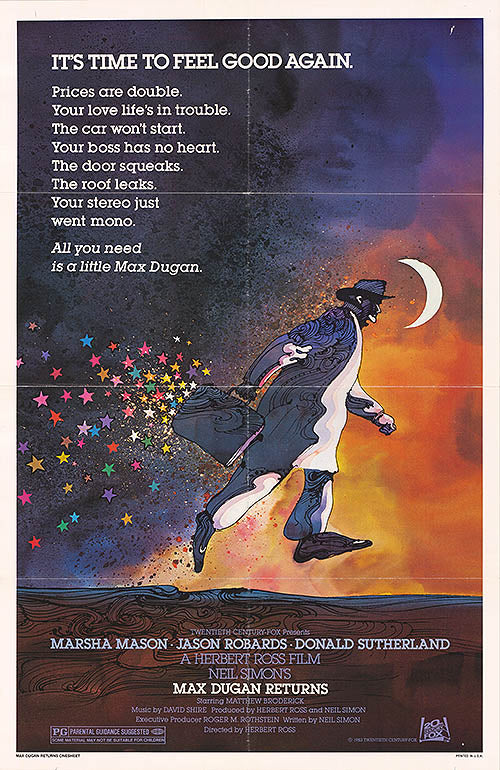
Nora (Marsha Mason) is a single mother living with her 15-year-old son Michael (Matthew Broderick) who’s struggling to make ends meet as a High School English Teacher. Things become particularly desperate when her beat-up 1964 Volvo car gets stolen and she no longer has any transportation to get to work nor the money to afford buying a new car, or even a used one. Fortunately, the officer working on the case, Brian (Donald Sutherland) takes a liking to her and offers her to use his motorbike even though she needs training on how to drive it. Once she goes through the crash course and begins using it she still has other financial concerns to worry about until one night she receives a mysterious visitor, which turns-out to be her estranged father Max Dugan (Jason Robards) who ran-out on his family 29 years earlier. Now he has returned with a briefcase full of $687,000, which he skimmed from a crooked casino that he used to work at. He tells her he has only 6-months to live and advises her to take the money, so that she and her son can live stress-free, but Nora isn’t so sure she wants to accept it, so Max goes about buying her stuff anyways including a fancy new car.

This has to be one of Neil Simon’s least imaginative efforts and the concept seems so contrived it’s like he thought it up for the 10-minutes that he was sitting on the john. I’ll admit when I was a teen and watched it when it first came out, I enjoyed it. I especially remembered the scenes dealing with Charley Lau, who regrettably died less than a year after the film’s release, where he plays himself the hitting coach for the Chicago White Sox baseball team, who Max hires to help Michael become a better hitter and these teaching scenes I found to be engaging. Unfortunately, the foundational premise has a lot of holes.

The idea that a father would suddenly want to see his daughter after 29 years of being away didn’t seem authentic. If he longed to reconnect then why not reach out earlier? Granted he was in jail for 6 of those years, but what about the other 23? If family was so important to him then why run out on them in the first place? Why doesn’t he at least make some attempts in-between those years to communicate like sending letters of phone calls before just showing up and expecting to be welcomed with open arms? The idea of throwing her and his grandson a lot of money comes-off in bad taste like he’s simply trying to buy their love and if anything seems quite shallow. During those 29 years away you’d think he would’ve met other people he’d become friends with, or other women he dated that he might’ve wanted to give the money to instead, or are we to presume that for 3-decades he lived in a cave and made no contact with anyone else?

I didn’t get why Nora didn’t recognize her father when he called. Yes, it had been awhile since she had last heard or seen him, it’s stated that she was 9 when he left, but he has a distinctive voice, so I’d think it would set something off in the back of her brain that she knows who this is, but can’t quite place it, versus having her immediately call the police in panic after getting a call from some ‘strange man’. He also tells her at one point that he may not actually be Max Dugan, but again she wasn’t a month-old infant when she last saw him, but instead someone entering the fourth grade, which should’ve given her a solid enough memory of what he looked like and thus know if this was her real father, or not.

To help solve all of this Nora should’ve been made a divorcee instead of a widow. The husband/father could’ve been the one who went to jail and then returned a 6 years later with stolen money hoping to use it to win back his wife’s and son’s favor. It would’ve made more sense because less time would’ve passed, and he’d have a more vested emotional interest in bonding with his son since he was directly his versus an elusive grandfather who didn’t even know the kid existed until being ‘tipped off’ that Nora had one by some secondary source.

Matthew Broderick’s character is problematic too. He seems just too obedient and goody-goody to be a believable teen as he promptly makes his bed every morning, even his mother’s, asks to be excused from the dinner table, and even lets his mother kiss him while in full view of his friends. Yes, there’s one brief moment where he tries to sneak a smoke, but otherwise I didn’t detect the typical rebellion to authority that most teens that age have, and it would’ve been improved had the kid been 9 or 10 where still being compliant with their parents’ wishes is a little more understandable.

Sutherland’s character was off as well as he seems way too aggressive about asking out a woman that he had just met while on-duty and actively investigating her case making it ethically questionable whether he should even be doing it. If a guy does come-on to a woman so quickly, simply because she’s attractive and single, as he knew nothing else about her, you’d presume he’s done this to other available women as well and thus should have a throng of casual girlfriends and Nora would just be one of many. The film should’ve just had him already her boyfriend from the start and thus avoided this otherwise awkward and rushed relationship. I also thought it was dumb that Kiefer Sutherland, who appears early on in a brief non-speaking role as one of Broderick’s friends, wasn’t cast as Donald’s son in the climactic baseball sequence at the end and instead the part was given to another young actor.

Spoiler Alert!

The money issue becomes yet another problem as Max spends it on so many lavish gifts that I started to wonder if there would be any left to put into savings. The idea that he could’ve had workers refurbish the house in just one day while Nora and son where in school is ridiculous as something that massive would take weeks if not months. He even ends up driving away with the car he had bought her leaving her again without a vehicle. Yes, he does open-up a bank account in her name and puts in $400,000, but her cop boyfriend was already aware of this and made clear he put his duty to uphold the law over his personal relationships making it very probable that she’d be forced to give it all back. Worse she might be considered an accomplice forcing her to hire an attorney, which would’ve sent her into even more debt making it seem like she’d be better off had the whole thing not even happened to begin with.

My Rating: 4 out of 10

Released: March 25, 1983

Runtime: 1 Hour 38 Minutes

Rated PG

Director: Herbert Ross

Studio: 20th Century Fox

Available: DVD, Amazon Video, YouTube

Goldengirl (1979)

goldengirl

By Richard Winters

My Rating: 2 out of 10

4-Word Review: Runner injected with hormones.

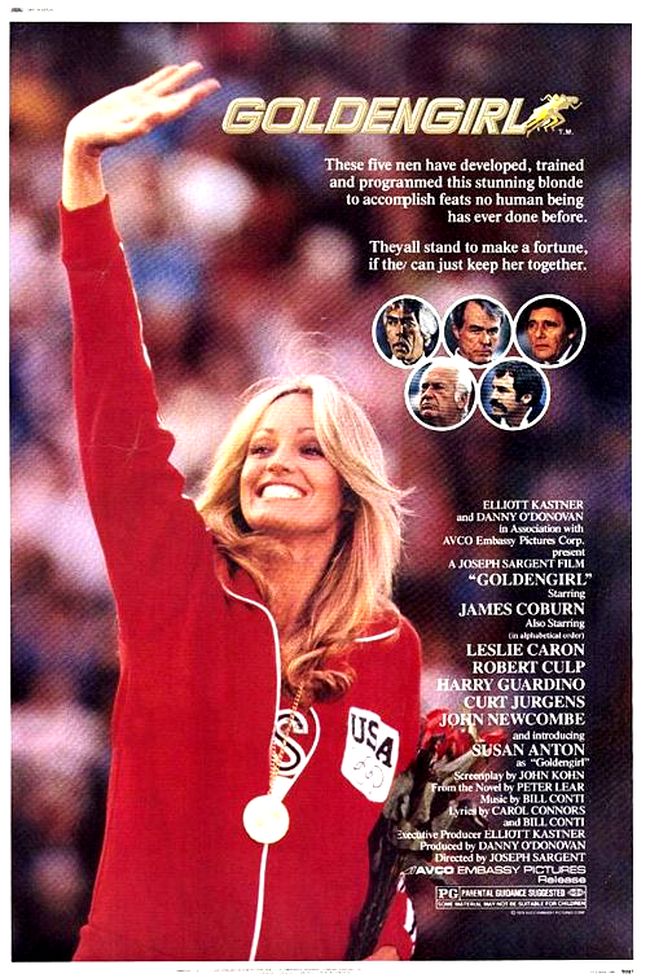
Goldine (Susan Anton) is a tall, 6-foot-2, athlete, who’s also quite beautiful, who shows a lot of talent as a runner and ends-up qualifying for the 1980 Summer Olympics in Moscow. However, behind-the-scenes there’s a sinister plot. Her father Serafin (Curt Jurgens) is a neo-Nazi who has injected her with hormonal drugs and vitamins from an early age in order to get her to be taller and stronger than the other athletes. This regimen has had a adverse effect on her system causing her to get diabetes of which she’s required to take two pills before every race in order to prevent her from going into shock. Dryden (James Coburn), who’s been hired by her father to help market her and make money off of her name and potential celebrity, recognizes these problems and tries to get her to drop-out, but the lust for fame and recognition are too much and Goldine decides to stay-in even as the warning signs mount.

Based on the 1977 novel of the same name by Peter Lovesey and originally intended for a miniseries on NBC-TV, who initially funded the production, but then scraped the telecast when the US pulled out of the Olympics due to the Soviet invasion of Afghanistan. The film was then re-edited from its initial 4-hour cut and paired down to less than 2-hours before being released to theaters where it managed to recoup only $3million from its $7million budget. Alot of the problem is that not enough happens to make sitting through it seem worth it. The sinister neo-Nazi story angle doesn’t get played-up to make it suspenseful, or even mildly diverting. In many ways this could’ve been just an average film about athletes training for the Olympics because for the most part that’s pretty much what it focuses on and even then, the interest level is only marginal.

Coburn is a great actor, but I didn’t know what he was doing in this type of movie as he seemed too old for the part. While he was only 50 when it was shot, he looks much more like 60, or even 70. Having him ultimately get into a sexual relationship with Goldine seemed absurd. I got nothing against May-December romances, but it just didn’t make sense why this beautiful, young woman would have to settle for some old guy, or would even want to, to satisfy her sexual needs. A woman looking like she did should’ve been able to attract a man her age, let alone many, possibly even a fellow runner and the story would’ve been stronger had she been in a relationship with someone else her age who was at odds with the father and fought for her right from the start versus some old guy waltzing-in who only takes a casual concern to her problems and could easily bow-out at any moment, which is what he ultimately kind of does.

The biggest detriment is with Anton. As an actress I thought she did quite well. She was known at the time for being crowned Miss California in 1969, but her work here did lead to a Golden Globe nomination and her own TV-series and given the fact that she didn’t go through the conventional acting training I felt she earned it and was effective. Her character though is bland, and she should’ve been the one uncovering her father’s dastardly plan instead of Coburn. She spends a lot of time reacting to things versus driving the action like a protagonist should. Her personality traits aren’t clear and seem almost robotic most of the way and it prevents the viewer from having any emotional connection to her, or her quandary. Having her start to ‘flip-out’ near the end, supposedly because of her ‘condition’, makes her even more of an enigma and might’ve had a more profound effect had she been better defined and three-dimensional from the beginning.

Spoiler Alert!

Curt Jurgens meltdown while being interviewed live on-the-air by reporter Robert Culp, and then his subsequent running-out onto the racetrack, while in full view of millions of spectators, in an effort to win his daughter’s affections back, is the best moment in the movie. It’s a bit campy and over-the-top for sure, but when a film is as boring as this one even a silly moment can help it and quite frankly there should’ve been more of them.

The warp-up though is terrible. Having her decide at the last second not to take her diabetic pills as directed and then proceed to go into the race anyways is the movie’s one and only suspenseful minute, but then director Joseph Sargent botches it by fading out and not showing her collapsing on the track. We’re told about it later, but it would’ve been more dramatic for the audience to have witnessed it first-hand. To then have her fully recover and not learn from the event and go on afterwards like it was ‘no big deal’ defeats the purpose of the movie. What’s the point of sitting through an almost 2-hour flick where the character doesn’t change, or grow in any way and the events that happen throughout it don’t really lead to anything?

My Rating: 2 out of 10

Released: June 15, 1979

Runtime: 1 Hour 45 Minutes

Rated PG

Director: Joseph Sargent

Studio: AVCO Embassy Pictures

Available: DVD, Blu-ray, Amazon Video, YouTube

Night Shift (1982)

nightshift1

By Richard Winters

My Rating: 6 out of 10

4-Word Review: Hookers in a morgue.

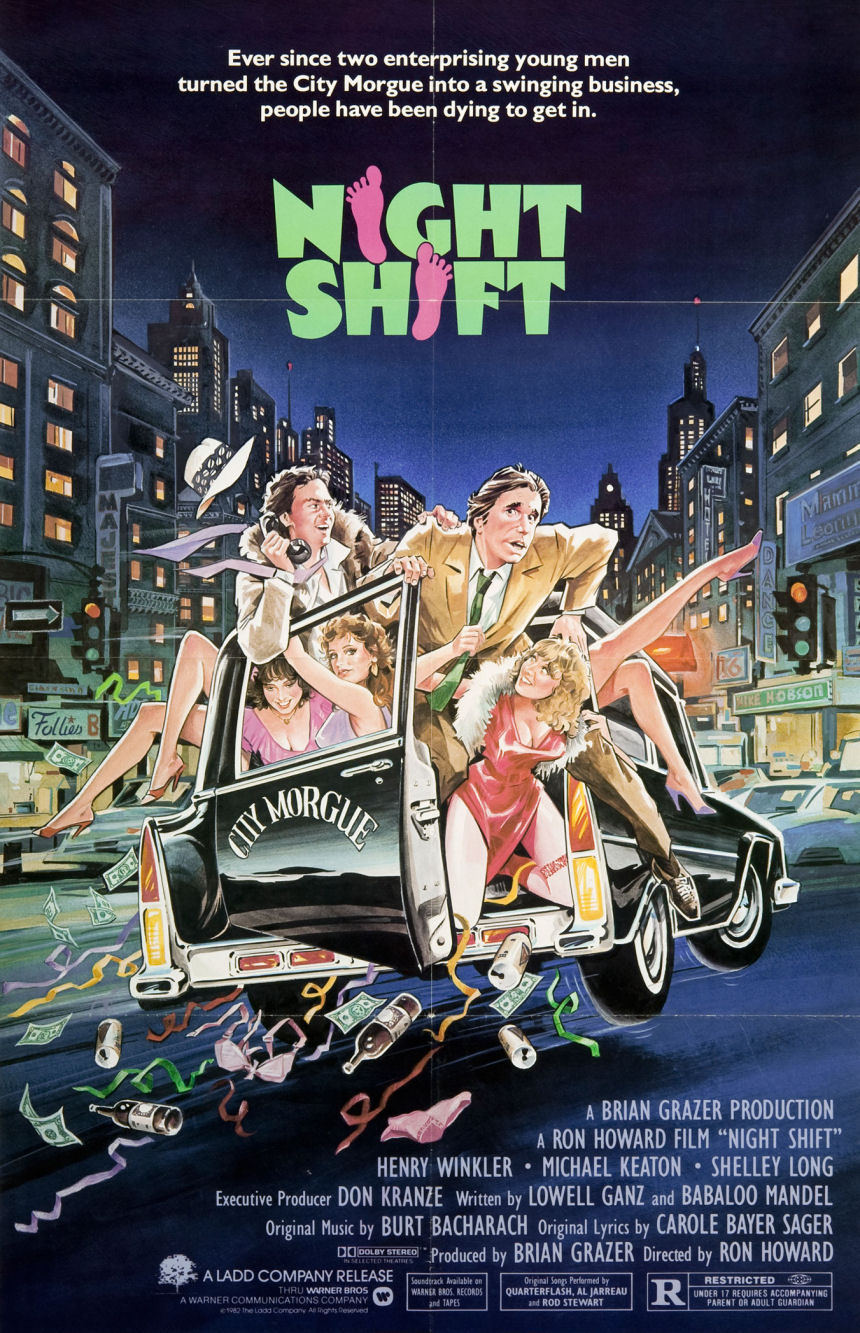
Chuck (Henry Winkler) has dropped-out of his former job as a stockbroker due to the stress and decided to work in a more tranquil setting as the night shift manager of a New York City morgue. He’s unhappy though to have to share duties with Bill (Michael Keaton) who’s talkative and partying ways are a complete contrast to Chuck’s introverted manner. Chuck’s home-life isn’t much better as he’s engaged to be married to Charlotte (Gina Hecht) though her habits and constant complaining are at odds with Chuck’s. His only solace is Belinda (Shelly Long) a prostitute whom he sometimes bumps into as she’s servicing his next-door neighbor Luke (Tim Rossovich). When Chuck finds her beaten-up inside an elevator he decides she needs to find a work environment that will afford her more protection, which gives Bill the idea to open-up a prostitution ring inside the morgue, which goes-off surprisingly well for  awhile before rival pimps become aware of it and threaten Bill and Chuck with their lives unless they agree to let them in on the payout.

This marked the second feature length film directed by Ron Howard and was inspired by a New York Times article about a real-life morgue that became a prostitution hang-out during its night hours. He decided to offer the leading role to Winkler, who had the choice of either playing Bill or Chuck but went with Chuck as he felt it would be fun playing against type, or in his words a ‘chance to play Richie Cunningham’. Winkler was still acting in ‘Happy Days’ TV-show at the time, so he’d shoot this on Mondays and Tuesdays in New York and then fly back to Hollywood to play Fonzie on Thursdays and Fridays.

While the change of pace may have shown what a good actor Winkler was it really didn’t help his image as the protagonist here is too wimpy. A somewhat passive guy is okay, but this guy lets people push him around too much making him look pathetic and his buttoned-down personality doesn’t show much energy making most of his moments in front of the camera too subtle to be either funny or engaging.

Keaton on the other-hand is too flamboyant, and his talkative ways become obnoxious instead of endearing and I personally didn’t blame Winkler for telling the guy to shut-up and leave him alone as I would’ve felt the same way. The story could’ve worked just as well if not better had Keaton not been in it at all and let Winkler carry-it alone, which would’ve allowed for a more interesting character arch at seeing this nebbish guy run a prostitution ring and thus learn to open-up more because of it.

Winkler’s relationship with Charlotte made little sense as the two had nothing in common and all she did was nag and complain. Why would anyone want to date someone like that let alone get engaged with them? I realize this was supposed to be part of the ‘comedy’ but for it to be funny there actually has to be some truth in it and these two shared no chemistry and at least one of them would’ve in reality come to their senses and broke it off and logically it’s surprising that it didn’t happen. The Charlotte character wasn’t even needed because the focus is on Winkler’s budding romance with Long, so why not just have him be a single guy who’s lonely and can’t make it with women and thus becomes entranced with Long despite her being a hooker simply because she showed him some attention.

While she gives a really good performance that’s light years removed from her Diane Chambers role from ‘Cheers’ that she’s best known for, and she sure looks great in the scene where she wears skimpy panties, her character here is problematic. She’s too wide-eyed and innocent for a woman whose been working as a call girl on the big city streets and even been badly beaten-up a few times by her pimp and johns. Seems like she should’ve formed a very hardened, crusty exterior for her own basic mental defense and the fact that she doesn’t show any of this and instead is so openly sweet seemed not remotely believable.

The premise has great potential, but it doesn’t do enough with it. For most of the way the pace is leisurely and the comedy subtle. I was expecting dead bodies coming-in amidst the sex and lots of mix-ups and confusion, but that stuff barely even gets touched upon. The prostitutes are portrayed as an extreme caricature with no distinct personalities, which reveals how shallow the whole thing is. Back-in-the-day, and I know because I was around, movies dealing with the subject of prostitution was considered ‘edgy’, but now stuff like this is looks trite and barely even touching the surface in regard to realism.

My Rating: 6 out of 10

Released: July 30, 1982

Runtime: 1 Hour 46 Minutes

Rated R

Director: Ron Howard

Studio: Warner Brothers

Available: DVD, Blu-ray, Plex, Roku, Tubi, Amazon Video, YouTube

The Devils (1971)

devils1

By Richard Winters

My Rating: 9 out of 10

4-Word Review: Burned at the stake.

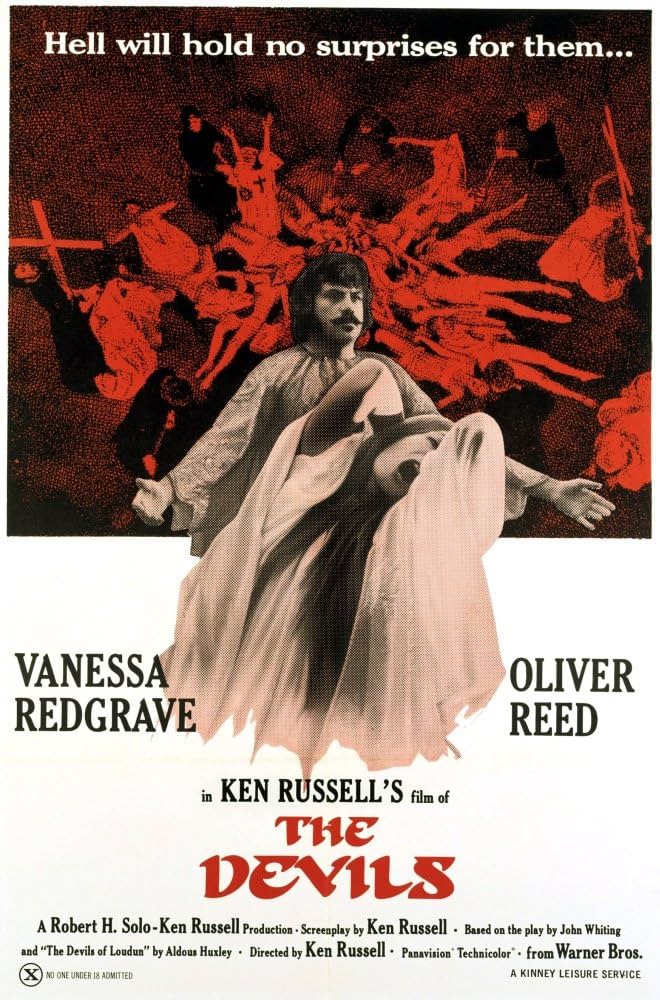
In the year 1634 the governor of Loudon, a small fortified city, dies, making Urbain Grandier (Oliver Reed), a priest with a secretly decadent lifestyle, the one in control. He’s idolized by the townspeople and the head nun at the local convent, Sister Jeanne des Anges (Vanessa Redgrave), secretly has sexual fantasies about him though because she suffers from having a hunch on her back is rarely ever seen outside and Urbain himself doesn’t know she exists. When Urbain secretly marries Madeleine (Gemma Jones) Jeanne becomes jealous causing her to confide to Father Mignon (Murray Melvin) that she’s been possessed by Urbain as well as accusing him of dabbling in witchcraft. This then leads to an inquisition headed by Father Pierre Barre (Michael Gothard) and a public exorcism, which has the nuns in the church strip and perform perverse acts before Urbain and his new wife are arrested and put on trial.

The story is based on the actual event, which was written about in the book ‘The Devils of Loudun’ by Aldous Huxley that was later turned into a stageplay. After the play’s success United Artists became interested in turning it into a movie and signed-on Ken Russell to direct due to his recent success in helming Woman in Love. Russell read the source material and became in his words ‘knocked-out by it’ and ‘wanted others to be knocked-out by it too’. This then compelled him to write an extraordinarily over-the-top script full of sex, violence, and graphic torture that so shocked the studio execs when they read it that they immediately withdrew their initial investment and refused to fund the picture threatening the project from being made even though many of the sets, constructed by set designer Derek Jarman, has already been painstakingly completed, but fortunately for them Warner Brothers swooped-in at the eleventh hour, which allowed the production to proceed.

The film’s release was met with major controversy with many critics of the day, including Roger Ebert who gave the film a very rare 0 star rating, condemning it. Numerous cuts were done in order to edit it down to a version that would allow it to get shown with the original British print running 111 minutes while the American one ran 108. Both were issued with an ‘X’ rating though even these cut out the most controversial scene, known as ‘The Rape of Christ’ segment, in which a group of naked nuns tears down and then performs perverse acts on a giant-sized statue of Jesus. This footage was deemed lost for many years before it was finally restored in a director’s cut version, that runs 117 minutes, that was shown in London in 2002. Yet even today this full version is hard-to-find with Warner Brothers refusing to release it on either DVD, or Blu-ray. They’ve even turned down offers from The Criterion Collection who wanted to buy it. While there was a print Warner released onto VHS back in the 80’s, this same version, got broadcast on Pay-TV, it’s edited in a way that makes the story incomprehensible, and only the director’s cut is fluid enough for the storyline to fully work.

It’s hard to know what genre to put this one into as this isn’t your typical movie and watching it is more like a one-of-a-kind experience that very much lives up to its legend and just as shocking today as it was back then. Yet, outside of all of its outrageousness it is quite effective. Each and every shot is marvelously provocative and the garishly colorful set pieces have a mesmerizing quality. The chief color scheme of white that lines the walls of the inside of the convent seemed to interpret to me the interior of a mental hospital, which helps accentuate the insanity of the frenzied climate. While things are quite over-the-top its ability to capture the mood of the times, the cruel way people treated each other and how they’re all steeped in superstition as well as the dead bodies from the plague that get stacked about, are all on-target and amazingly vivid.

The acting is surreal with both Reed and Redgrave stating in later interviews that they consider their performances here to be the best of their careers. Reed’s work comes-off as especially exhausting as he gets his head shaved and then is ridiculed in a large room full of hundreds of people before burned to death with make-up effects that are so realistic it’s scary. Redgrave, who walks around with her head twisted at a creepy angle, is quite memorable during the scene where she physically punches herself for having sexual fantasies, even puts a crucifix in her mouth at one point and masturbates with a human bone. Dudley Sutton and Murray Melvin with their very unique facial features and Michael Gothard, who initially comes-off with his long wavy hair as an anachronistic hippie flower child, but who becomes aggressively evil as the makeshift exorcism proceeds, all help round-out a most incredible supporting cast.

While the cult following for this remains strong and getting stronger and demand for a proper, director’s cut studio released DVD/Blu-ray is high Warner continues to rebuff the requests. There are though ways to find versions through Bing searches. Streaming services Shudder and Criterion Channel have shown the most complete prints to date, running roughly 111 minutes with most of the controversial scenes, including the Rape of Christ moments though these scenes are of a poorer, grainy and faded color quality since they never went through a professional digital transfer, but overall it’s still one of those movies you should seek-out because not only is it fascinatingly brilliant, but it’s something that could never be  made today and a true testament to the wild, unfiltered cinema of the 70’s that will forever make it the groundbreaking, unforgettable decade that it was.

My Rating: 9 out of 10

Released: July 16, 1971

Runtime: 1 Hour 57 Minutes (Director’s Cut)

Rated R (Originally X)

Director: Ken Russell

Studio: Warner Brothers

Available: DVD-R

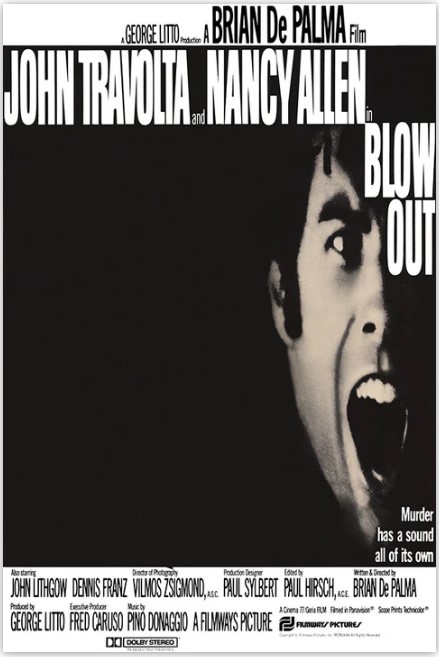
Blow Out (1981)

blowout2

By Richard Winters

My Rating: 5 out of 10

4-Word Review: He hears a murder.

Jack (John Travolta) works as a sound effects technician for a film studio that specializes in low budget horror movies. He gets instructed by his producer Sam (Peter Boyden) to come-up with a more realistic sounding scream, as well as other audio noises, for the most recent exploitation production that they’ve been working-on. Jack then goes out one night to capture the necessary noises, but while doing so witnesses a car drive-off the road and into a nearby river. He immediately jumps into the water and saves a passenger named Sally (Nancy Allen), who had been sitting in the backseat, but he’s unable to get to the driver. Later it’s revealed that the driver was a candidate running for governor and Sally was his escort and pressure is put on Jack by the campaign officials not to reveal this to the press. Jack also comes to the realization, while going back and listening to what he had recorded, that the car going to into the river was no accident as he had initially thought, but instead it had been caused by a gunshot from an undisclosed assassin who intentionally shot at the tire so the vehicle would swerve-off the road, but when Jack goes to the authorities about this they don’t believe him.

The film is noted for having been heavily inspired by the Michaelangelo Antonioni’s classic Blow-up, which came-out 15 years earlier and focused on a photographer who inadvertently witnesses a killing via a picture he takes, while this one is on what the protagonist hears. This could also be considered quite similar to The Conversation, a masterpiece that was released in 1974 and dealt with a sound expert that gets in over-his-head with a criminal underground. Both of those films though were better than this one, which has some flashy camera work, but little else.

I did like Travolta. This was the first film where he becomes essentially an adult and no longer stuck in that quasi-age of a post teen growing into manhood and needing to prove himself. Here we get the bona fide thing and the character’s cynical nature about his job and being stuck in an industry that he doesn’t really respect, or all that excited about, is a refreshing change-of-pace from his more wide-eyed, idealistic roles of the past. The behind-the-scenes look at the movie business, including all the posters from actual horror films that line the walls of the studio hallways, and the wannabe starlets dying to break-in even if it meant just letting-out a simple voice-over scream in order to be a part of the cast, I enjoyed and helps add an authentic ambience to what it would be like working in that type of culture.

The character development, or if you could even call it that, is incredibly weak. Nancy Allen is especially annoying not so much for anything she does, she actually puts-on an effective Brooklyn accent, but more for her cliched character. Portraying a prostitute as a blank-eyed, dim-witted simpleton, who still has a ‘heart-of-gold’, is about as overused as it gets making it a laughable caricature and succeeding at causing one long eye roll every time she appears and opens her mouth. The gangsters and police officials are equally contrived though Dennis Franz plays his role, as the corrupt low-life pimp, with such amusing gusto that I was willing to forgive his scenes, and was even entertained by them, but found the rest of the supporting cast to be wasted and transparent.

There are also a few too many plot holes. For instance, the assassin, played by Jon Lithgow, sneaks into an auto repair shop late at night, to remove the tire from the car that had been retrieved from the river, so no one would find out that it had a bullet hole, but wouldn’t the police have thought about looking for that already? The fact that they don’t seems shockingly shoddy as the first thing to investigate after any accident is the cause and not immediately removing the tire and sending it away to a lab for further analysis seems beyond incompetent. Some may argue that the police were paid-off to look the other way and were a part of the ‘cover-up’, but if that were the case then they would’ve still removed the tire, knowing that it was crucial evidence, and then just conveniently ‘lost it’ versus leaving it on the vehicle in some unguarded repair shop that anyone could walk into.

Having Travolta drive his jeep through a parade and nearly kill hundreds of people in the process and then crash into a storefront window where pedestrians come to his aid and call for an ambulance seemed questionable as well. Maybe it was a more innocent era, but I would’ve thought those same people would’ve beaten the crap out of him when they caught-up versus helping him as they would’ve presumed, he had plowed into the parade intentionally and therefor deserved some rough ‘street justice’ for having put so many lives at risk.

Revealing who the killer was in the second act and the reasons for why he did it ruined the suspense and would’ve been more intriguing had the viewer only figured out his identity right when the protagonists do, which comes near the end of the third act. I also thought his killing of other prostitutes who looked similar to Allen, in order to create this fictional serial killer known as the “Liberty Bell Killer, were rather fake. For one thing if a bad guy is intent on killing somebody and stalking them, they come prepared with their own weapons and not hope to inadvertently pick-up some sharp object along the way like he does here. The scene inside a public restroom where he stands over the toilet stall wall in order to strangle his would-be victim who’s standing on the other side and the woman does not sense someone hoovering over her, she looks around, but doesn’t bother to look-up, is baffling since his body was blocking the overhead light and his shadow would’ve tipped her off that there was someone above.

Spoiler Alert!

The biggest head-scratcher gets saved for the end where Travolta essentially gives-up on pursuing the bad guys, even after Allen is murdered, and goes back to his ordinary life as a sound man though in a more guilt-ridden state. The explanation for this is that when Lithgow throws the film of the assassination into the lake along with the audio tape that means the evidence was ‘gone forever’, but it really wasn’t. He had made a copy of the audio tape already and the film was from motion picture stills he had obtained from a tabloid magazine, so all he had to do was buy another copy of the magazine, resync the pics up with his audio tape copy, and his evidence to take to the authorities would be as good as new.

My Rating: 5 out of 10

Released: July 24, 1981

Runtime: 1 Hour 48 Minutes

Rated R

Director: Brian De Palma

Studio: Filmways Pictures

Available: DVD, Blu-ray (Criterion Collection), Amazon Video, YouTube, Pluto TV, Tubi