Monthly Archives: February 2024

The Gambler (1974)

gambler

By Richard Winters

My Rating: 5 out of 10

4-Word Review: Can’t control his addiction.

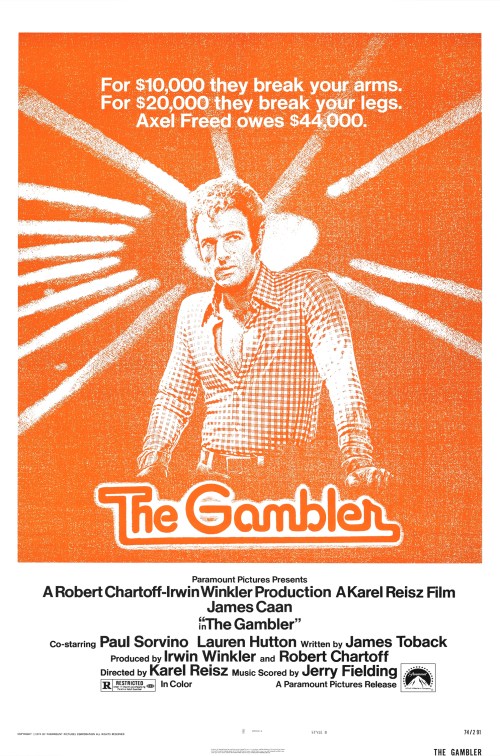
Axel (James Caan) is a college professor with a serious gambling addiction. He enjoys making bets on anything and everything whether it’s in a casino, over the phone betting on sports games, or out on the street playing one-on-one hoops with the neighborhood kids. No matter how much he loses he can’t stop from continuing the same pattern. When he owes $44,000 to the mob and they come looking for him and threatening his life he’s forced to ask his mother (Jacqueline Brookes) for the money and despite her disapproval she gives it to him out of her life savings, but then instead of paying off his debt he just uses it to gamble some more.

The screenplay was inspired by writer James Toback’s own life experiences and was initially written as a semi-autobiographical book before he decided to turn it into a script. The film is intriguing to a degree as gambling addiction is not anything that I’ve ever fully understood, so trying to fathom why some people would put up such huge sums of money to make a bet that they know they have a very good chance of losing, and even if they do lose will still continue to go on making bets anyways is baffling to me. Toback makes good efforts to try to explain the psych of a gambler’s mindset, which mainly gets revealed through Axel’s lectures to his class and at one point during a conversation with his bookie (Paul Sorvino) where he admits he could beat him with safe bets in competitions he was sure to win, but that this wouldn’t give him the same adrenaline rush, or ‘juice’, that placing a more riskier bet would.

Even with these explanations it still becomes gut wrenching watching him spiral out-on-control and dig himself deeper and deeper in a hole until you feel almost like turning away as it becomes genuinely painful, and frustrating, at seeing someone self-destruct the way this guy does. There are some very powerful moments including the scenes where the mother begrudgingly takes her money out of the bank to help him for fear he may lose his life if she doesn’t and her pained expression on her face as she does it really gets etched in your mind. Axel sitting in a bathtub listening to the final moments of a basketball game that he’s also bet big money on where the final score doesn’t go the way he wanted is also quite compelling.

The acting is strong with Caan giving a great performance that Toback originally wanted to go to DeNiro, who campaigned heavily for it, but director Karel Reisz choose Caan instead, only for Caan to state in later interviews that he hated working with him. Comedian London Lee, wearing an incredibly garish bowl haircut, is good in a very sleazy sort of way and Burt Young has a dynamic bit as an enforcer who tears up a lady’s apartment when her boyfriend is unable to repay what he owes. James Woods can be seen in a small role as a flippant bank teller though overall I still felt it was Brookes who steals it as the concerned mother and I was surprised she was not in it more nor that she didn’t get an Academy Award nomination as she really should’ve.

Despite a few powerful moments the pace is slow and there’s a lot of periods where it gets boring and nothing much happens. A lot of the blame goes to the fact that the main character has very little of an arch. He starts out already with the addiction gripping him and we can see what a problem it’s causing and the rest of the movie just continues to hit home this same point until it becomes redundant. It would’ve been better to have seen him before he had gotten into the whole gambling fix took over his life and personality, which would’ve created a far more interesting and insightful transition.

My Rating: 5 out of 10

Released: October 2, 1974

Runtime: 1 Hour 51 Minutes

Rated R

Director: Karel Reisz

Studio: Paramount

Available: DVD, Amazon Video
Fast-Walking (1982)

fastwalking

By Richard Winters

My Rating: 7 out of 10

4-Word Review: Guard helps prisoner escape.

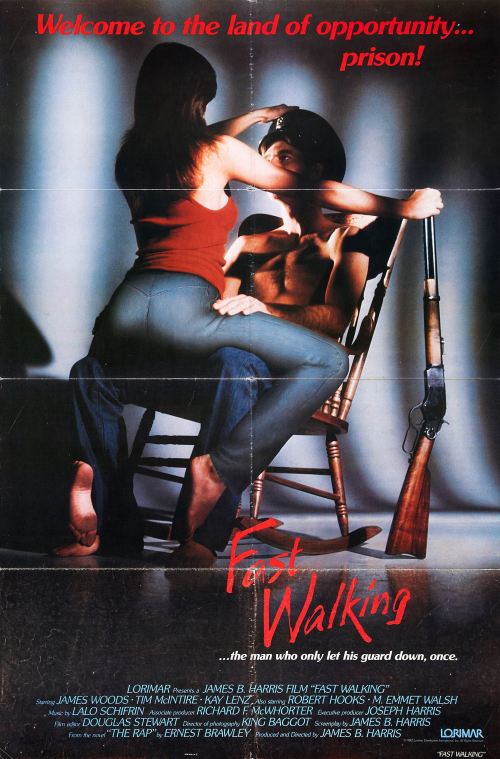
Based on the 1974 novel ‘The Rap’ by Ernest Brawley the film centers on prison guard Frank Miniver (James Woods) a pot smoking man who’s unhappy with the low pay of his current job and helps supplement his income by pimping prostitutes to the local Mexican laborers. Wasco (Tim McIntire) is a prisoner at the jailhouse Frank works at who has many outside connections. When a black political prisoner William Galliot (Robert Hooks) arrives at the prison Wasco fashions to have him assassinated by Frank, but Frank has other ideas. He’s already made a deal with Galliot to have him sprung from the inside and in so doing he’ll be given a cool $50,000. Wasco become aware of this other deal, but insists that Frank follow his plan, or he’ll put a hit on Moke (Kay Lenz) an attractive, sharp-shooting lady friend that Frank’s been sleeping with who is also Wasco’s girlfriend. Will Frank choose money over the girl, or will he have a plan-B of his own?

Filmed on-location at the old Montana State Prison building in Deer Lodge, Montana the film has an interesting look to it, which helps accentuate the characters. The American west has always had the allure of escape and individualism, so the rustic landscape here brings out not only Frank’s need to get out of the shackles of his dead-end job, but the prisoners as well. The small town setting has a sort-of renegade vibe where everyone is eager to  push-the-envelope of the law and feeling more than confident that they can get away with it. The guards seem almost as corrupt as the men they incarcerate and in some ways even worse. The entertainment is not seeing good conquer evil, but more with which side will manage to out con the other.

The story takes its sweet time getting told with the entire first hour spent just showing Frank’s on the job frustrations before it even gets to the prison break plan. It works more as vignettes than a plot with one amusing moment taking place in the visiting room with one prisoner named Ted (Sydney Lassick) more fascinated with Moke taking off her panties underneath her skirt than with what his own wife (Helen Page Camp) is saying who sits directly in front of him. The cat-and-mouse game that Frank plays with Moke who each challenge the other with their rifle skills with Frank shooting flat the tire of Moke’s motorcycle from a long distance only to have Moke do the same to Frank’s tire on his jeep while he’s driving it is a lot of fun too.

The acting is excellent and the film’s main driver. Lenz looks great, both with her clothes on and off and this marked her career peak as her roles after this were of the supporting variety, or stymied in obscure, low budget flicks. Tim McIntire is also quite good in his second-to-last feature before his untimely death. He spouts a lot of dialogue, which seems almost like a never ending rant at times, but he conveys it in such a snarky, articulate way that it’s still fun to listen to though I was confused why, being a prisoner himself, he was allowed to sleep in the same room as the guards and even socialize with them out in the open. At first I thought he was a guard since he’s given a lot of their responsibilities including lowering the lever each morning that open up the other cell doors. I could only presume that given the corrupt environment and the fact that he was Frank’s cousin that he was given some under-the-table leverage to get these perks and privileges, but it would’ve helped had it been explained better, or given some backstory.

It’s also interesting seeing M. Emmet Walsh here doing yet another nude scene. He has an aging, out-of-shape body type that you’d think no one on this planet would want to see naked, nor would ask to, and yet in a span of 2-years his bare body figured prominently in two different films. In Straight Time he gets his pants pulled down while chained to a fence overlooking a busy highway, which I thought was edgy enough, but here he again gets shown sans his clothes this time from the front side where you get to see underneath his bulging belly his little wee-wee dangling about as he stands outside the front door and yells at Woods who is pulling away, which makes for an image you may want to forget, but might have problems doing.

As for the action there’s not much of it. Sure there’s a couple of shootings, which are quick, and a few fleeting scenes of prisoners falling to their deaths, but that’s about it. No riots, rapes, knife fights, or prison yard fist-fights all stuff that most viewers have come to expect with these types of movies and thus unless they get into the subtle quirkiness may leave disappointed. The inmates are also strangely docile and respectful of authority and even though they greatly outnumber the guards and at times could easily over power them they don’t, which makes it seem not as gritty as it could’ve been though others may not mind this and instead enjoy the film’s offbeat quality including Lalo Schifrin’s bouncy score.

My Rating: 7 out of 10

Released: October 8, 1982

Runtime: 1 Hour 55 Minutes

Rated R

Director: James B. Harris

Studio: Lorimar Productions

Available: DVD-R (Warner Archive), Amazon Video

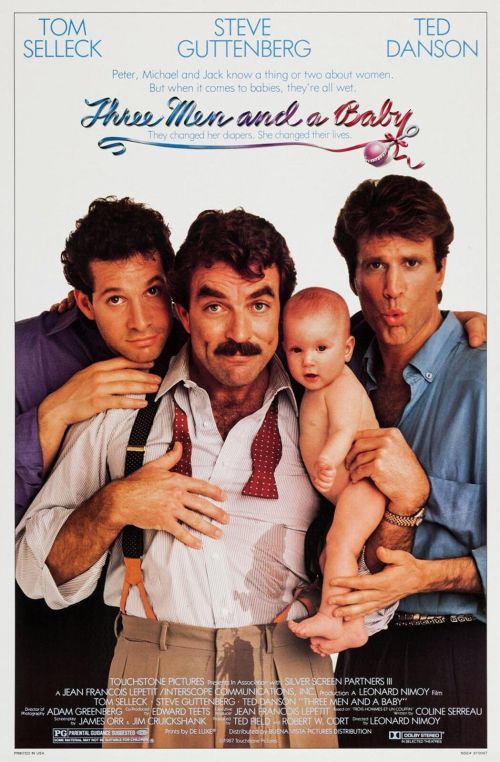
Three Men and a Baby (1987)

threemenbaby

By Richard Winters

My Rating: 7 out of 10

4-Word Review: Infant on their doorstep.

Peter (Tom Selleck) is an architect, Michael (Steve Guttenberg) is an artist, and Jack (Ted Danson) is an actor. All three live in a large apartment in downtown Manhattan. None are married and spend most of their time, when not working, hosting lavish parties and dating beautiful women. One day a baby gets left at their doorstep while Jack is away starring in a movie that’s filming in Turkey. Peter and Michael find the infant and attached note stating that it’s from one of Jack’s previous girlfriends whom had a brief fling with while starring in a play. The two men have no idea how to take care of it, which leads to many amusing mishaps. Once Jack returns they find themselves in even more chaos when drug dealers appear at the apartment looking for a package of heroin that had also been delivered there.

This is the American version of the French hit Three Men and a Cradle and while I’ve been routinely critical of most Hollywood remakes from European films this one, which was directed by Leonard Nimoy, makes many improvements on the story. There’s nothing that’s hugely different, but there’s enough small changes to the plot that helps fill in the caveats from the first one.

One of the things this one does better is it shows the men’s partying side, which the first one didn’t do as well as it started pretty much right away with the baby’s arrival and only elaborated about their wild ways while here, in perfect movie fashion, we see it. Although a bit garish, I enjoyed Michael’s artwork that gets drawn all over the outside walls of the apartment and creates a rather surreal look. There’s also definite strong 80’s vibe that permeates almost every shot at the beginning from the colorful lettering of the opening credits to the theme of ‘Bad Boys’ by Gloria Estefan and the Miami Sound Machine, which was a big band back in the day. There’s even Guttenberg doing a corny imitation of Robin Leach from ‘Lifestyles of the Rich and Famous’ though anyone that didn’t live through the decade will most likely not get that one.

The characters are much better defined with each having a distinct personality. While his movie career never really took-off Selleck shines as the leader of the group due to him being the oldest and at times the most stern. Guttenberg, with his boyish face, is perfect as the immature and clueless one while Danson scores as the eccentric actor. I liked that the men continued to work their jobs even as they looked after the baby, while in the first one they would just call in ‘sick’, which became excessive and unrealistic. In fact probably the funniest moment in the whole movie, at least for me, is when Danson is on stage rehearsing a play with the baby strapped to his back.

Even the drug dealing scenario gets handled better. In the first one the guys return the drugs to the dealers by putting it into one of the babies diapers and then tossing it into a trashcan in a park, but here the men use the opportunity to catch the crooks in the crime by having Guttenberg secretly filming them as they take the drugs back and there’s even some legitimate tension as they try to outrun them when the bad guys catch-on to the scheme. I also liked that the dealers infiltrate the apartment while a babysitter is there as in the French version the infant gets left alone and even though it was supposedly only for a short time was still irresponsible.

There’s a girlfriend character as well, or in this case ex-girlfriend, gets added for Selleck, she gets played by Margaret Colin, and reveals how Selleck just automatically presumes because she’s a woman she’ll know exactly what to do with a baby even when she states she doesn’t. This I felt finely observed how the different sexes can misjudge the other, or project characteristics onto them that they may not actually have.

Spoiler Alert!

Even the ending is a bit better though there’s still the issue of the girlfriend leaving a helpless child at someone else’s doorstep without warning, or making sure there would be someone there to take care of it, which in the real world would be dangerously reckless. At least though there’s more action as the three rush to the airport to try to stop the plane the girlfriend is on with the baby while in the French version the three guys just sit at home moping around, which isn’t as interesting.

It’s still problematic that the girlfriend, played by Nancy Travis who speaks with an accent, moves into the apartment with the bachelors to help take care of the kid. This though goes against the title as it states Three MEN and a baby, so I felt the Travis character should’ve just given up her parental rights and let the guys do all the parenting since they had become better at it anyways.

End of Spoiler Alert!

The only change that I didn’t like is when Danson brings his mother, played by Celeste Holm, to see the baby and tries to get her to agree to take care of it for awhile. In the French version the Jacques character tries the same ploy with his mother only to learn, to his shock, she has no interest in raising another kid and wants to spend her retirement having fun like traveling the world, which I felt was a good statement on ageism and how not all seniors want to be stuck being homebodies. Here Holm’s acts like a strict parent who doesn’t want to be bothered with a kid because Danson needs to ‘grow-up’ and learn to amend for his mistakes though if she was really a proper parent she probably should’ve warned him when he was younger to always wear a condom, so he wouldn’t have gotten himself into this mess in the first place.

This is also the scene that became a bit notorious back around August of 1990 when a rumor started that an image of a little boy, who it was said had killed himself in the place where it was filmed, can be seen in the window that Holm and Danson walk past. Granted it does look a little spooky at first, but upon second glance you can plainly see that it’s actually a cardboard cut-out of Danson wearing a top hat. The whole film was shot on a soundstage in Toronto and not a house where any boy past or present had ever lived.

My Rating: 7 out of 10

Released: November 23, 1987

Runtime: 1 Hour 42 Minutes

Rated PG

Director: Leonard Nimoy

Studio: Touchstone

Available: DVD, Blu-ray, Amazon Video, YouTube

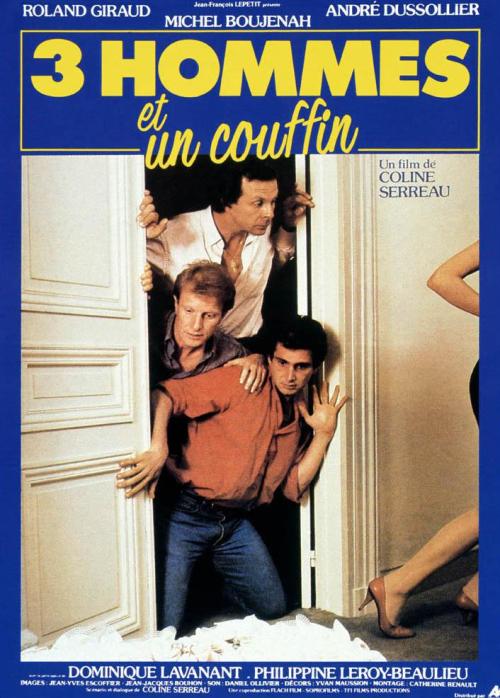
Three Men and a Cradle (1985)

threemencradle

By Richard Winters

My Rating: 7 out of 10

4-Word Review: Stuck with a baby.

Pierre (Roland Giraud), Michel (Michel Boujenah), and Jacques (Andre Dussollier) are three bachelors living in a swanky apartment who routinely bed hot women and throw wild parties. During a party one of Jacques’ friends informs him that he has a package and wants to have it delivered to their apartment for safe keeping. Jacques agrees and then goes flying off to Japan for a month as an airline steward. Pierre and Michel then find a baby at their doorstep that gets left by Jacques former girlfriend. Thinking this is ‘the package’ they begrudgingly bring her in and try caring for her despite having no idea what they’re doing. Meanwhile the actual package also gets delivered, which is a small box secretly full of heroin, which they think nothing of until the dealers arrive looking to pick it up and mistakenly take the baby instead.

A highly insightful look at bachelors and their ineptness and downright ignorance at infant care is brought splendidly to screen, at least with the first act. There’s many keen moments as they run around to pharmacies not knowing what sized diapers to get the kid, or the type of baby food, thinking it’s ‘all the same’ and needing to constantly go back and speak to the female druggist for clarity.  In fact the first 30-minutes are probably the funniest and could’ve just kept it at that theme and been a success though having Jacques away so much starts to make it seem like the title should’ve just been ‘2 Bachelors and a Cradle’ since the third one is little seen until much later on.

I also really adored the kid who is able to somehow cry on cue. Most infants are understandably hard to control, but this one reacts to the scene and situations perfectly and is in it surprisingly a lot. In most other films dealing with babies they usually get only shown in a crib for a few seconds here and there, with these shots spliced in, but here she’s like a genuine character that’s in it almost as much as the main ones. We also see her grow where at the end she’s doing her first walk and it’s cool that the ‘music’ done over the closing credits amounts to recordings of her baby blabbering.

Where the film starts to fall-off a bit is with the drug dealer side-story. I think the baby chores that the men had to go through could’ve been enough to carry it and adding in the crime thing made it seem unnecessarily exaggerated. It’s also ridiculous that the dealers tear up the entire apartment, and I mean they literally ransack the place cutting up and breaking all the furniture to the point that’s it’s an extraordinary mess. Then suddenly a little later it all goes back to normal, but how could they find the time to clean it all up while also taking care of the kid? This clean-up would’ve quite frankly taken many weeks and buying all new stuff, so this should’ve at least been shown, but instead it gets portrayed like they’re genies who can seemingly turn a trashed place into a clean one with a snap-of-a-finger.

The characterizations are rather weak as Pierre and Michel respond to things too much the same way and have very little distinction between them and could’ve easily morphed into being one person. The idea that these guys could just call off from work for not only days, but weeks at a time without even giving an excuse as to why and not lose their jobs for it seemed implausible. Granted the French culture isn’t a workaholic one like in America, but it’s pushing the bar to the extreme here and might’ve been more amusing seeing the guys taking the baby to their work and trying to somehow still get things done.

Spoiler Alert!

My biggest beef though comes with the girlfriend named Sylvia, played by Philippine Leroy-Beaulieu, who has the audacity to leave a helpless infant on somebody’s doorstep, walks away, and doesn’t think anything of it. What’s to say some stranger couldn’t come along and snatch the kid up before the occupiers of the apartment find it? What’s to guarantee that the guys in the apartment are even going to want to take the baby in, or if they do won’t inadvertently harm the child since they have no training on how to handle it? The fact that she returns months later with this bright beaming smile demanding to see her baby immediately like she’s some loving mother entitled to her kid whenever she pleases makes her seem even more outrageous. In most jurisdictions her behavior would’ve been considered reckless child abandonment and her parenting privileges taken away. Instead of handing over the baby she should’ve received a very stern lecture

Granted the film tries to make-up for this by having her return to the apartment saying she can’t keep up with the mothering duties and agrees to hand the baby over to the men. She also gets shown lying in the baby’s crib in a fetal position in order to symbolize that she’s immature, but still for a playful comedy this has some serious undertones that it glosses over, but are still readily there if you think about it.

My Rating: 7 out of 10

Released: September 18, 1985

Runtime: 1 Hour 46 Minutes

Rated PG-13

Director: Coline Serreau

Studio: Soprofilms

Available: DVD

A Boy and His Dog (1975)

Version 1.0.0

Version 1.0.0

By Richard Winters

My Rating: 7 out of 10

4-Word Review: Surviving after nuclear holocaust.

The year is 2024 and the landscape of the U.S. has been turned into a wasteland due the after effects of a nuclear war that occurred in 2007. Vic (Don Johnson) is an 18-year-old that wanders around with his telepathic dog named Blood (voice of Tim McIntire). Blood helps Vic find women to rape while Vic scavenges for food for their survival. One night while watching an X-rated movie at a makeshift theater Blood is able to gain the scent of a woman nearby named Quilla (Susanne Benton). Quilla and Vic eventually have sex, but then she disappears to the underground society that survives inside a biosphere. Vic decides to follow her there while Blood remains above ground waiting for Vic’s return. Once Vic arrives he finds everyone there to be in whiteface and dressed like people living on the farm during the turn-of-the-century. He meets Lou (Jason Robards) along with Dr. Moore (Alvy Moore) and Mez (Helene Winstone) who all three run things. They convince Vic to stay there as he has a ‘purpose’ of becoming a stud and impregnating the young women since the men there can no longer do so. At first Vic is excited about his newfound ‘job’ as he is always quite horny, but after he finds out the details of what he must do he relinquishes his duty, but realizes it may be too late.

The story is based on the novella of the same name by Harlan Ellison who wrote the original screenplay that was later finished by director L.Q. Jones who used his own money to help get the film financed. While the movie does have some intriguing and memorable visuals, logic-wise there are some holes. One of the biggest ones is that, at least hypothetically, there would most likely have been a nuclear winter, which is what would be created after a nuclear war due to so much soot being blown into the atmosphere that it would block out most of the sunlight for several decades and create a night time effect and for this reason the outdoor scenes should’ve been filmed at night in order to replicate the ongoing darkness.

Vic’s conversations with his dog, which all gets done telepathically, is odd too and never sufficiently explained. How does this dog attain this ‘gift’ and why is it only him and not other mutts that can do it too? It would’ve been better had it been explained that some modern invention had been created that would allow communication between owners and their pets, but even this fails to explain how the dog manages to be so incredibly smart. Don’t get me wrong the voice-over work by McIntire is delightful, but how did the animal get so well-read that he even knows the Latin origin of words? Is there a dog college that teaches them this?

Vic’s extreme urges to have sex all the time seemed out-of-place too. Granted he’s a young guy with raging hormones, but psychologically when a person is in a desperate situation, in this case simply trying to survive in a hostile environment with very little food, then a person’s most basic needs come first and it’s all they’ll think about. Finding something to eat, they’re forced to go out each day and hunt for something, and acquiring shelter for sleep, would be their pressing needs and what would occupy their minds most day-in and day-out while the sex need would become secondary and only have his focus once the other needs were met, but in this story the sex urges seem to take precedent, which doesn’t make sense from a human behavioral perspective, nor where he’d get the energy to do it since he’s pretty malnourished to begin with.

The X-rated movie that they watch at a ‘theater’ is goofy too as it amounts to nothing more than a grainy black-and-white stag film from the 50’s even though technically by 2007, which is when the bombs dropped, there was porn on the internet and explicit DVD’s some of which would’ve probably survived the blast and thus they’d be watching those instead of something found in grandpa’s ancient collection. Though this is what makes the movie entertaining not so much for what it gets accurate in their predictions, which isn’t much, but more what it gets wrong.

The one thing though that really stands-out, at least for me, and makes the movie memorable, though this apparently wasn’t the case with the film’s initial test audience who called these scenes ‘slow’ and ‘boring’, are the moments that take place in the underground society. The look of everyone walking around like robots and resembling farmers from a bygone era has a kitschy flair like something out of a Federico Fellini movie. Hal Baylor, as one of the main menacing robots that can’t seem to ever go down even when being directly shot at, steals every scene he is in and helps create some definite tension. I also got a kick out of everyone wearing white face, which I thought was to explain their pale complexions due to not be out in the sun, but it seems to be instead obviously painted on, so I’m not sure what that was meant to represent.

The twist ending is terrific and the film’s final line, which Ellison detested and tried having taken out, is a keeper. While its attained a cult following there are still the detractors who feel its ‘misogynistic’ though I don’t really see it.  Sure Vic sees women as sex objects and ‘conquests’, but there’s guys out there that are like that. Quilla is conniving and duplicitous, but some women are like that too. The movie isn’t saying that all men and women are like this, but in environments that are as desperate as this one it will tend to bring out the worst in human nature, which was all the film was trying to convey from my standpoint.

My Rating: 7 out of 10

Released: May 15, 1975

Runtime: 1 Hour 31 Minutes

Rated R

Director: L.Q. Jones

Studio: LQ/Jaf Productions

Available: DVD, Blu-ray, Amazon Video, Pluto, Roku, Tubi, YouTube

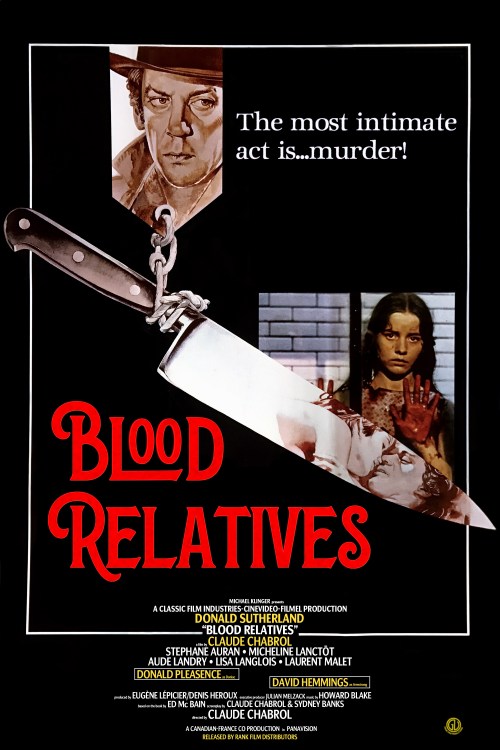
Blood Relatives (1978)

bloodrelatives

By Richard Winters

My Rating: 6 out of 10

4-Word Review: First cousins become intimate.

Based on the Ed McBain novel of the same name, but with the setting changed from New York to Montreal the story centers around police inspector Steve Carella (Donald Sutherland) who takes on the case of a teen girl named Patricia (Aude Landry). She arrives at the police station, in a bloody condition, late one night saying that she and her cousin Muriel (Lisa Langlois) were attacked in an alley by a strange man. When the cops arrive at the scene they find Muriel dead. Initially Patricia can not identify who the man was, but later after the funeral, she comes forward to say that it was her brother Andrew (Laurent Malet) that did it. She details how he and Muriel were having an illicit affair despite being first cousins and when Muriel tried to break-up with him due to having a romance with her boss (David Hemmings) he snapped and killed her and then tried to do the same with Patricia since she was a witness, but she managed to escape. Carella though still has his suspicions and when he finds Muriel’s diary he begins reading it, which confirms the affair, but also something even more sinister that was lurking beneath the surface.

This film received a very limited release and was only shown in the theaters for a few weeks before it was removed and has basically sat in obscurity ever since. Much of it may have to do with the incest theme and a couple of really odd moments. One scene was when Donald Pleasance, who appears briefly as a suspect and speaks in a Canuck accent, admits to having an on-going affair with a 13-year-old named Jean (Tammy Tucker) despite him being 46. Carella then goes to the girl’s home to interview her not so much about her being a minor having sex with an older man, but instead in order to vouch for his alibi that he was with her the night of the crime. She’s told that her answers can help get him ‘off-the-hook’ and ‘prevent him from going to jail’ if she can confirm his whereabouts and the whole sex thing she’s having with him is apparently ‘not a big deal’ (they even end up releasing Pleasance once they determine he wasn’t the killer), which for many viewers today will find quite baffling.

Plot-wise the pacing is poor. It starts out alright and is even riveting as we see this young, blood stained teen girl running through the dark streets that’s littered with trash everywhere. However, the flashback moments, done while Carella reads the diary, don’t have the same compelling impact and tends to slow everything down and even manages to turn it into a soap opera. Even though Sutherland is the main character there’s long stretches where he’s not in it and doesn’t seem to have much else to do, but interrogate the witness, particularly Patricia, again and again. His relationship with his own family isn’t captivating though here too there’s an odd moment where his own teen daughter (Nina Balogh) describes her and her father as potential ‘lovers’ as they’re walking outside in public, which again would be deemed a pretty cringey line if said between father and daughter in virtually any other movie.

The acting by Langlois I found to be terrible and helped drag the whole thing down especially during the second act when Sutherland all but disappears. Granted she’s gone on to have a rather successful career and maybe she just needed more experience in order to find her footing, but she delivers her lines in a flat monotone manner and her pretty face seems unable to show any other expression than a vapid smile. Even when she’s getting stabbed she continues to smile and doesn’t even scream, which came-off as unnatural. Though she did very little else after this I felt it was Landry who was the better actress. She is very convincing and has an angelic looking face, so you really see her as an innocent though equally effective when her character’s dark nature comes out later.

Spoiler Alert!

The twist ending I figured out while there was still an hour to go and most other viewers should start to see it well before the ‘big reveal’ occurs. The main issue with Patricia being the ultimate killer is that it really doesn’t make much sense. Supposedly she was intensely jealous of her cousin’s relationship with her brother, but why? Woman usually get envious of someone if they consider them a rival to a person that they have affections for, so is the film implying that she too was having a sexual relationship with her brother, if so it doesn’t confirm it, but should’ve.

A better way to have ended it, in my view, would’ve had Muriel get pregnant, she actually does think she’s pregnant earlier, but it turns out to be a false alarm. Instead it should’ve been the real thing and Andrew would’ve become upset at this and coerced Patricia to kill her in order to get him off-the-hook. He’d promise her that they’d get into a relationship in return (this version would make clear that she had intimate feelings for him and he knew it), but then after the killing gets done, he reneges, which gets her upset, so she implicates him to the police. This scenario would’ve at least given clear motivations to the characters, which is otherwise murky. Sure it would be pretty tawdry and sleazy, but the story was going in that direction anyways, so it might as well go all the way with it.

My Rating: 6 out of 10

Released: February 1, 1978

Runtime: 1 Hour 40 Minutes

Rated R

Director: Claude Chabrol

Studio: Filmcorp

Available: DVD (Region 2) (Dubbed), DVD-R (dvdlady.com)

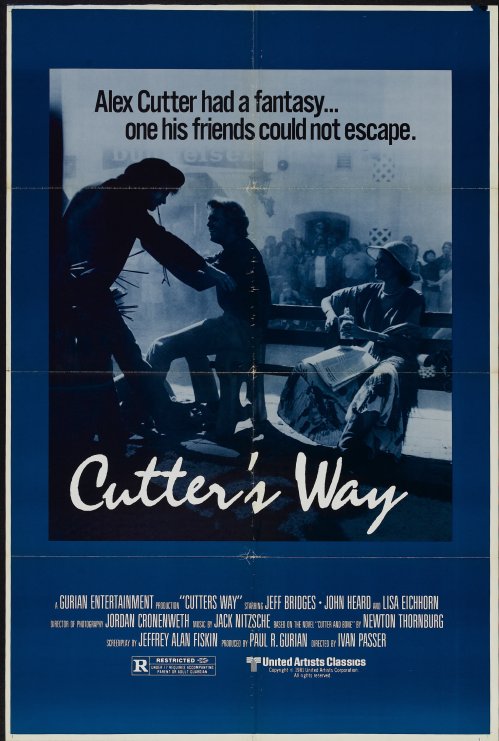
Cutter’s Way (1981)

cutter1

By Richard Winters

My Rating: 6 out of 10

4-Word Review: Friends help catch murderer.

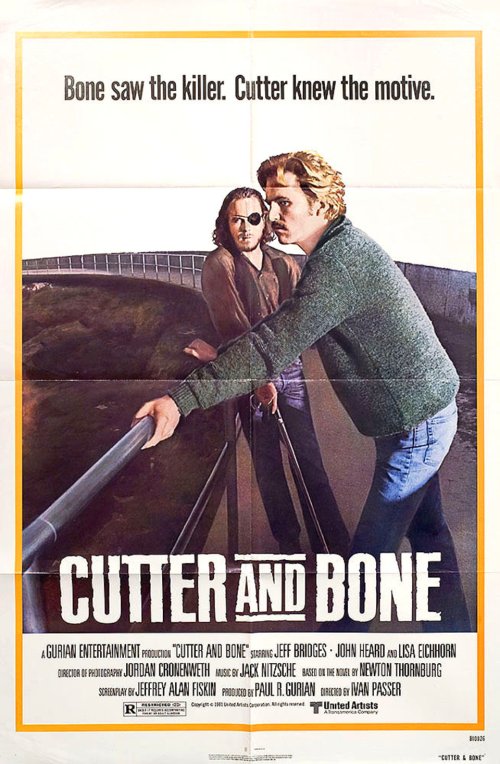
Richard Bone (Jeff Bridges) driving his old beat-up car, a 1966 Austin-Healey, which breaks down in a dark alley during a late night rain storm. From behind comes another vehicle where the driver dumps something into a nearby garbage can that turns out to being the dead body of a young girl. Since Bone’s car is still at the crime scene the next day when the authorities arrive he quickly becomes suspect number one. Bone’s friend, Alex Cutter (John Heard), a Vietnam vet struggling with alcoholism and PTSD, takes on the process of investigating the case to help get his friend out of trouble. The two soon hone in on a rich local businessman named J.J. Cord (Stephen Elliot) whom Bone swears was the man he saw driving the car that dumped the body.

The film is based on the 1976 novel ‘Cutter and Bone’ by Newton Thornburg. Producer Paul Gurian bought the rights to the book and asked struggling screenwriter Jeffrey Alan Fiskin if he’d be interested in adapting it to a screenplay. Since Fiskin was broke at the time, he last sold a screenplay, Angel Unchained, 10 years earlier, he was forced to shoplift the book in order to read and adapt it. David Field from United Artists was open to backing it for $3 million, but only if they could find a big-name star. Gurian then went to the home of Jeff Bridges, where he got attacked by one of Bridges’ dogs thus motivating Bridges to accept the part unseen in order to avoid a possible lawsuit. The film was released in the Spring of ’81 where it fared poorly with the critics and the studio was ready to scrap it only for it to pick-up good reviews a few weeks later. The studio then decided to place the film in their ‘classics’ division where it got retooled from it’s former title of ‘Cutter and Bone’, which they felt made it seem like a comedy about surgeons, to it’s current one and then rereleased it in the fall of that year were through good word-of-mouth it managed to recoup a modest profit.

Director Ivan Passer has stated that his motivation for directing the film was to go against what he felt was the ‘cripple mania’ at the time where film characters would get maimed usually through being in the war and then come back better, stronger people. Here he wanted to show that it didn’t make them better, but instead more dangerous.

While Heard certainly gives a good performance, it was originally intended for Richard Dreyfus, I felt he was too much of a caricature of an angry, wounded war vet and I didn’t find him interesting at all. Bridges was his usual transparent self and thus the interactions between two not all that captivating. Elliott is rather blah as well as the bad guy since for most of the runtime he’s only seen from a distance and never has any lines of dialogue until the final 9-minutes, though this does at least give him a certain creepy/mysterious vibe. Out of everyone I was most intrigued with Lisa Eichorn who plays a woman who bounces between the two friends and seems to want to play-off them both.

The emphasis is on the character study with long takes of Heard snarly at everybody he meets including the next door neighbor’s whose car he crashed into and the the subsequent police report, which goes on too long and doesn’t help the film or story move forward. The mystery isn’t as intriguing as it could’ve been because elements of it fall into place a little too conveniently. Bridges witnesses the killer driving away and then right away the next day spots the guy in a parade. Then a couple of days later the friends are talking about the case at a restaurant where the guys’ wife (Patricia Donohue) is sitting right next to them and overhears everything, which again is letting things fall too neatly into place without much effort.

There’s also questions about why the killer didn’t just run Bridges over with his car when he had the chance in order to avoid any witnesses. Also, Bridges is able to recognize the killer/driver, but when I saw the scene it was impossible to see the face of the driver. The viewer’s perspective should be the same as the protagonist, so if he’s able to get a good look at the culprit then we should’ve too.

Spoiler Alert!

Since everything is tied into circumstantial evidence I was hoping for some unexpected twist at the end. For instance having Bridges’ house get burnt down not because of Cale like they initially thought, but instead from the neighbors still angry over their car. The final confrontation in which Bone apparently shoots Cale (the screen fades to black and we only hear the noise of the gun going off) leaves more questions than answers. Does Bone and to an extent Cutter, who was there in the room with him, now go to jail for this? Seems like that should’ve been confirmed one way or the other and leaving it vague is like showing the viewer only half of the story.

cutter2

My Rating: 6 out of 10

Released: March 20, 1981

Runtime: 1 Hour 49 Minutes

Rated R

Director: Ivan Passer

Studio: United Artists

Available: DVD, Blu-ray, Amazon Video, Pluto, Freevee, Roku Channel, YouTube