Monthly Archives: January 2024

Travels With My aunt (1972)

travels1

By Richard Winters

My Rating: 4 out of 10

4-Word Review: Kooky lady cons nephew.

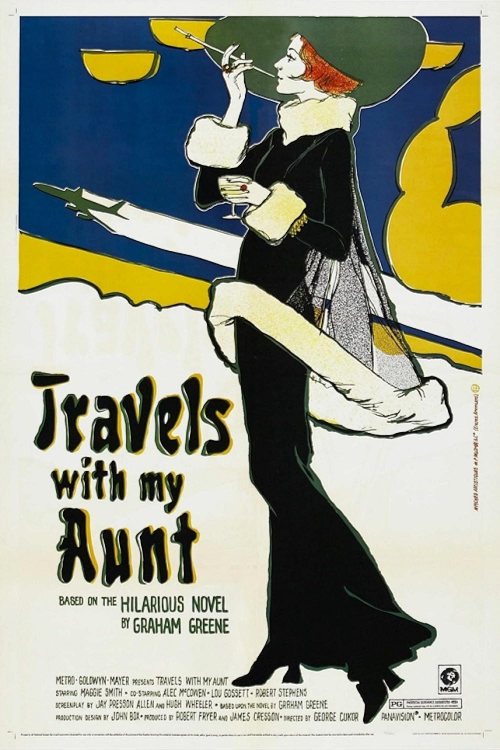
Henry (Alec McCowen) is a middle-aged bank manager who attends his mother’s cremation where he meets his kooky Aunt Augusta (Maggie Smith). She invites him over to her residence where he finds that she’s living with a black man named Wadsworth (Louis Gossett Jr.) who works as a fortune teller. It is here that she receives a package holding the severed finger of her longtime lover Visconti (Robert Stephens) and told that she must deliver $100,000 in ransom in order to see the rest of him alive. She convinces Henry to go with her to Paris to meet the kidnappers demands and in the process the two go on a wild jaunt across the globe that ends with them in North Africa.

The film is based on the novel of the same name by Graham Greene that was originally intended for Katherine Hepburn in the lead. Director George Cukor, whose career was winding down at this point, had worked with Kate in several projects from decades earlier and felt this role would be the right fit though she disagreed, but then decided that if she could rewrite the script, she’d consider doing it. Jay Presson Allen, who had done the original adaptation, which Hepburn didn’t like, gave full control over to her to rewrite it anyway she’d like, but ultimately the studio felt she was too old for the part especially since she was expected to play a younger version of the character during flashback sequences and they didn’t feel she at her advanced age could come effectively as someone in their early 20’s, so the part went to Smith instead.

Maggie to her credit is quite good and although she was only in her late 30’s really seems quite old during the sequences where the aunt is portrayed in the present. There’s even realistic wrinkles on her face especially around the cheekbones that gives the character the look of someone in their 70’s and 80’s. In the flashbacks she comes-off equally effective as a youthful free-spirit. Unfortunately her daffy character was for me a turn-off as she’s too much of an eccentric caricature that’s more obnoxious than amusing and building a whole film around her doesn’t work.

Henry is equally perplexing as I couldn’t understand why he’d believe this nutty lady when she tells him the mother he had always known wasn’t his biological one. For all he knew she was a goofball that shouldn’t be taken seriously unless she can supply more evidence, which she doesn’t. Most rational people would’ve kept her at an arm’s length instead of galivanting across the continent with her especially whom he had just met. In the book Henry is portrayed as being bored with his life and longing for adventure, but the film doesn’t make this clear, so his motivations and personality become muddled. Also in the book he was in early retirement, which would help explain why he had so much free time to go traveling, but the movie doesn’t bring this up either, so you wonder what he told his employer that would allow him to be off of work for so long and not get fired.

Having the Aunt and Henry bicker about, as their personalities were quite opposite, could’ve been fun, but this doesn’t get played-up. Too much time gets spent on this outlandish James Bond adventure that gets more ridiculous and unbelievable. The flashbacks bog down the pace and weren’t really needed and everything should’ve remained in the present day. The coin flip ending, in which Henry can’t decide what he wants to do moving forward, go back to his old life or continue on with his aunt, is a cop-out and only done because they couldn’t figure out how else to end it, so they do a freeze-frame of the coin in the air and the  let the viewer feel-in-the-blanks, which was far different than the novel. There Henry becomes a changed man who enjoys the excitement of getting involved in illegal activities, but because the film was not centered around him, which it should’ve been, we don’t witness any type of character arch making the whole thing quite trite and saved only by the brief appearance of Cindy Williams who plays a free-spirited hippie that he meets on a train.

My Rating: 4 out of 10

Released: December 17, 1972

Runtime: 1 Hour 49 Mintutes

Rated PG

Director: George Cukor

Studio: MGM

Available: DVD-R (Warner Archive)
Camera Buff (1979)

camera1

By Richard Winters

My Rating: 7 out of 10

4-Word Review: Husband’s hobby ruins marriage.

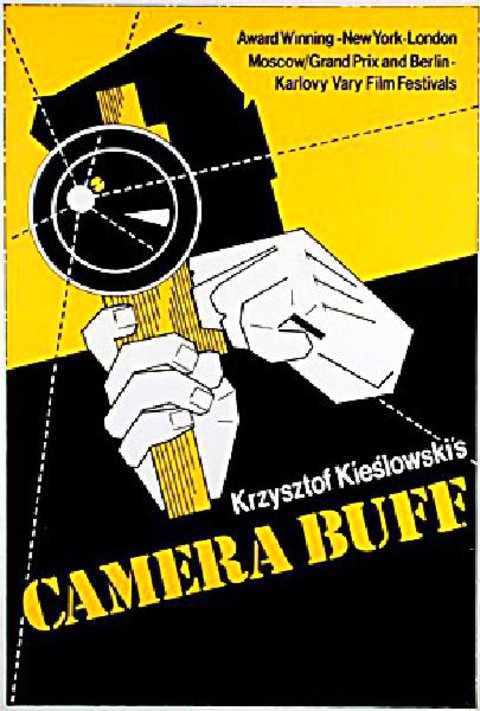
Filip (Jerzy Stuhr) is a factory worker living in the small town of Wielice, Poland. To celebrate the birth of his newborn child he decides to buy a camera to record the event and watching him grow. Because he’s the only one who owns a camera in the town he soon comes to the attention of his boss (Stefan Czyzewski) at the plant he works at who asks him to film an upcoming jubilee celebration that they’re having at the factory. Filip reluctantly agrees, but soon finds himself enjoying the filmmaking process and he begins to record everything around him including some of the corruption that he sees, which gets him into trouble. His wife Irka (Malgorzata Zabkowska) also does not like his newfound hobby as she feels it’s taking too much time and attention away from her and the baby. As his marriage begins to disintegrate Filip is forced to make a hard decision: give up something that he enjoys in order to conform and get along with those around him.

This marks one of the earlier efforts from famed filmmaker Krzysztof Kieslowski. When originally released it was met with a lukewarm response, but as his fame grew it has been reassessed as a classic.  What stood out for me was the interminable grayness that permeates every shot and really helps to hit home for the viewer the bleakness of the everyday living situation of people in a communist country and allows one to understand the need of Filip to find an outlet for his frustrations. It’s darkly amusing how he has to spend so much money, 2-months of his salary, in order to afford this tiny little contraption that can be held in the palm of one’s hand and can only do the most basic of film recording that isn’t even in color and offers no zoom or focus and yet is considered a ‘prized possession’ amongst everyone else around him.

I did appreciate the way it brings out the positive things about movies. The fact that a man who loses his mother can still go back and see the recordings of her that Filip did with his camera to make it seem like she was essentially ‘still alive’ was quite touching and one of the reasons why I enjoy films so much personally in that it has a quality of ‘holding time in place’. The scene where a dwarf worker, who had become the subject of one of Filip’s movies, became so overcome with emotion at seeing himself on the big screen in what had been until then a very ordinary and anonymous life for him, was equally moving.

On the negative side the film tends to go overboard with the dramatics. Having his wife get so upset at the way he enjoyed filming everybody at the jubilee that she goes home and smashes a mirror that cuts her hand was too extreme of a reaction and unintentionally made it seem like she had far more internal issues than just her husband’s hobby. The segment where a woman (Ewa Pokas), an amateur filmmaker herself who works as a judge at one of the festivals he submits his film to, gets so overcome by one of his movies that she leans over and kisses him was overdone as well especially when she later admits she didn’t think much of his movie and only said she liked it to motivate him to continue making more and getting better at it.

The wife’s behavior was the most perplexing. If she really loved the guy then she should be supportive of his hobby since she could see that it made him happy. The fact that she immediately dislikes what he’s doing and openly wants him to fail at it, so he could then turn all of attention back to her and the baby made her seem selfish and that their subsequent separation was a good thing since ultimately they didn’t have much in common. Their conversation where he tells her that he needs more in life than just ‘peace and quiet’ and she looks at him blank-eyed like she can’t fathom what else that would be hits-the-bullseye as there are many people out there, and I’ve known some, who just can’t relate to the artistic endeavors that others may have, which is all the more reason why their marriage was far from ideal and therefore better to expose the flaws of it now then go on living a lie that they were ‘a great couple’ when they really weren’t. The film though seems to parlay the message that it’s a ‘sad thing’ when the marriage disintegrates, but I saw it as a positive because now he has the freedom to pursue his artistic aspirations and meet people who better connect to his interests. The marriage as it was, was nothing but a trap that was holding him back.

Spoiler Alert!

The ending has Filip giving up on his moving making hopes and even destroying the negatives of one of them that was set to be delivered to a TV-station. He does this when he finds out that his last film cost some of the people at his factory to lose their jobs and thus having him conclude that the whole idea was a ‘mistake’. I saw it as the opposite. His movies brought joy and inspiration to people that hadn’t had much of that previously. Sure, it also brought him some trouble, but that was to be expected when living in an environment where self-expression was taboo, but to completely throw-in-the-towel as he does was unnecessarily defeating. I would’ve wanted him to continue on with his new hobby while learning how to be more sophisticated at it to avoid the problems he had earlier. His movie making was not the problem instead it was the flawed society that he lived in.

My Rating: 7 out of 10

Released: November 16, 1979

Runtime: 1 Hour 57 Minutes

Director: Krzyszlof Kieslowski

Studio: Zespol Filmowy

Available: DVD, Blu-ray

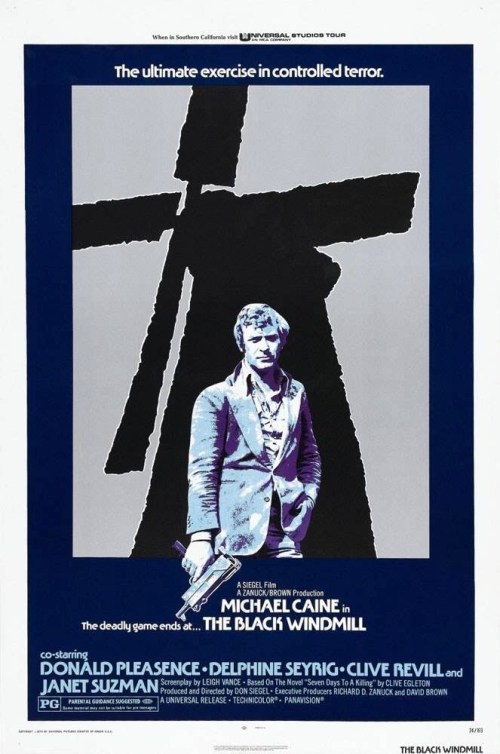
The Black Windmill (1974)

black

By Richard Winters

My Rating: 5 out of 10

4-Word Review: Agent’s son is kidnapped.

Michael Caine plays Major John Tarrant, a British Intelligence Officer, whose young son David (Paul Moss) gets kidnapped by an underground criminal organization headed by McKee (John Vernon). McKee is aware of John’s profession and insists that to get his son back he must fork-over some uncut diamonds, which had already been purchased to fund another operation. John informs his supervisor, Harper (Donald Pleasance), about their demands, but Harper begins to suspect that John may have orchestrated the kidnapping himself and thus refuses to go along with the turnover of the diamonds. Frustrated John decides to deliver them himself, but finds that he’s put himself into a perilous situation that he might not be able to get out of.

The film is based on the novel ‘Seven Days to a Killing’ by Clive Egleton and directed by Don Siegal who’s most notable for having done Dirty Harry. On the technical end it’s masterful. The lighting and editing are pristine and shot on-location in England in many scenic spots including the historic, but now closed Aldwych underground train station and the Shepherd’s Bush station as well as the climactic sequence, which takes place at the Clayton Windmills, known as Jack and Jill with Jill being built in 1821 and Jack in 1866. There’s also a terrific supporting performance by Pleasance who plays this uppity agent who won’t allow smoking in his office, nervously fiddles with his mustache, and is shocked by the forwardness of one of the other elderly agent’s younger wife, played by Catherine Schell. In fact his eye brow raising expression during his visit with her is one of the more amusing moments in the film.

The story seems a bit pedestrian with elements stolen from other better spy films including a Q-like moment where a  researcher shows Harper and John how they’ve come-up with a new invention, which is a briefcase that can shoot bullets just like a gun. Another segment has John being followed by a bad guy while hopping onto the subway, which looks like it was taken straight out of The French Connection, though much better done there.

There’s also the part where John, upset with Harper’s refusal to deliver the diamonds, breaks into Harper’s office and steals the key to the bank safe that has the diamonds in it, but this seems much too easy. You’d think an operation that has lights on top of the office doors, with green to be allowed in and red to be locked, would have a better contraption to stop someone from breaking in like burglar alarms to sound when somebody trespasses, or laser beams that would trip off and sound alarm on a mobile device carried by a security guard. Yet John is able to break-in with hardly any effort and the way he tries to disguise his voice to sound like Harper is pathetic and should’ve been enough to alert the bank manager that something fishy was going on. Also, you’d think Harper would have his eye on John, or had someone else keep tabs on him since he’d most likely be angry over the news that the agency wasn’t going to help him and thus already be predicting that he’d make an effort to steal the key before it actually happened.

The biggest issue though is that John is not emotional. His stoic nature makes him seem almost inhuman and like he may not actually care about his son’s safety at all. Supposedly this is because he’d been trained as an agent to hide his feelings, but the viewer still needs to see his softer side at some point, so we know he’s suffering inner turmoil about what’s going on and the fact that this is never shown makes it hard for us to side with him. It also gives Caine one of the flattest performances I’ve ever seen and is so stone cold it could’ve been done by a robot and you’d never know the difference.

The kid is far more engaging and if the movie had shown him more it might’ve worked better, or at least shown John and the boy together, we only see a fleeting few seconds of a photo of them, but we should’ve viewed them in a fun activity before the kidnapping, so we could feel the bond that is otherwise quite hollow. John’s relationship with his wife, played by Janet Suzman, doesn’t gel either. They’re already separated apparently because John put his career ahead of the family, but there needed to be more of an arc to make it interesting like having them bitterly at odds at the beginning only to realize they must put their animosities behind them in order to work together to find their son, but here there isn’t enough dramatic friction between the two, so seeing them rekindle things near the end packs no punch at all and like with everything else here emotionally vanquished for the audience.

My Rating: 5 out of 10

Released: May 17, 1974

Runtime: 1 Hour 46 Minutes

Rated PG

Director: Don Siegel

Studio: Universal Pictures

Available: DVD, Blu-ray

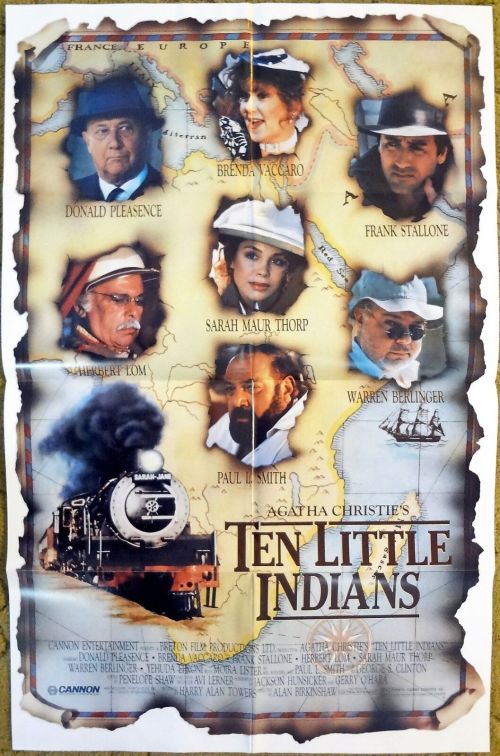
Ten Little Indians (1989)

tenlittle

By Richard Winters

My Rating: 3 out of 10

4-Word Review: Everybody is getting killed.

Ten strangers get together on an African safari. The group includes: A doctor (Yehuda Efroni), a judge (Donald Pleasance), a captain (Frank Stallone), an actress (Brenda Vaccaro), a General (Herbert Lom), a nanny (Sarah Maur Thorpe), a detective (Warren Berlinger), along with a man named Marston (Neil McCarthy), and a couple with the surname Rodgers (Paul L. Smith, Moira Lister). They’ve been invited by a man named Mr. Owen, but upon their arrival he’s nowhere to be found. Instead they hear his voice that’s been recorded onto a phonograph where he tells them that they’ve been invited because they’ve been accused of committing a crime years ago and gotten away with it, but he intends to put a stop to that by killing them off one-by-one. As each guest gets murdered one of the heads from the ten little Indians statues that sits in the middle of the dining room table goes missing.

The film has the distinction of being the third movie version of the story done by producer Harry Alan Towers as the first one was produced in the 60’s and the second, which also starred Lom, in the 70’s. The story itself is based on the Agatha Christie novel ‘And Then There Were None’ though the ending was changed to replicate the stage play, which was considered more upbeat. While in the novel and play the setting was an island here it’s the desert of South Africa, which I liked as it gives the proceedings a distinct atmosphere. However, there’s an unusual moment at the beginning where the natives help carry the guests’ luggage to the camp site, but then halfway there for no explicit reason they turn on them by clicking their tongues in unison and ultimately abandoning them, which is creepy, but there’s never an explanation for why they do this.

The landscape looks hot and dry though there’s no sweat glistening off the actor’s faces leading me to believe it was shot in the winter time and thus the complaints about the heat, which are casually mentioned are invalid. I did get a kick out of one of the tents, the main one, having an upright piano. Don’t know who in the world would want to painstakingly haul a piano into the desert sands, or essentially the middle of nowhere, but the appearance of it gave me a chuckle. I was also amused by the elevated lift, held together by a frayed rope, that each guest is forced to sit-in as it takes them many feet in the air of a wide gorge, in order for them to get to the campsite. The contraption looks flimsy and it’s rather unnerving seeing them get into it and ride it all the way down.

The acting is entertaining and made-up of many B-stars whose faces you’ll recognize though not necessarily their names. Vaccaro fares best as a bitchy, spoiled, Hollywood star whose career has gone on the decline. Lom is good as an aging man whose memories plays tricks on him, but Stallone, who’s the younger brother of Sylvester and could almost pass of as his twin, has little to add. Berlinger had gained a lot of weight to the point that he’s rounder than a beach ball, is adequate, but the normally reliable Pleasance appears elderly and lacking energy making his presence almost sad. Smith continues in the mold of the jail guard in Midnight Express, a part that made him famous, but his heavy breathing and lurking ways are not interesting and his acting one-note.

The mystery angle doesn’t get played-up too well as the guests get killed-off with a boring regularity making it at times seem almost like a low-grade slasher. The characters don’t respond to their stressful conundrum realistically. For instance one of the guests dies by drinking alcohol that was linked with cyanide, but the rest of them in the ensuing days go on eating and drinking even though you’d think they’d be nervous about ingesting anything for fear that whatever they put in their mouths could also poisoned. They also go back to their tents each night and peacefully sleep despite seeing the other guests get offed by a unseen killer, which would’ve made me, and most others too fearful to get any shut-eye and instead stay wide awake for fear that the killer would attack the minute anyone closed their eyes.

Spoiler Alert!

The tension is nil and there’s really no interest in finding out who the culprit is. In the book everyone dies and the authorities are only able to figure out what happened from a message that they find written by the judge. Here both Stallone and Thorp make it out alive though Thorp lets go of the rope that had been around her neck just as Stallone comes to her rescue making me believe that she would’ve hung herself before he would’ve been able to get her out of the noose. The rescue plane flies over them instead of landing making it unintentionally seem like they had been left stranded and not saved after all. Having everyone die except for Stallone, which is what I thought was going to happen, and then having him arrested for the murders he really didn’t commit would’ve been a much more ironic twist.

My Rating: 3 out of 10

Released: May 17, 1989

Runtime: 1 Hour 38 Minutes

Rated PG

Director: Alan Birkinshaw

Studio: Cannon Films

Available: Blu-ray, Tubi

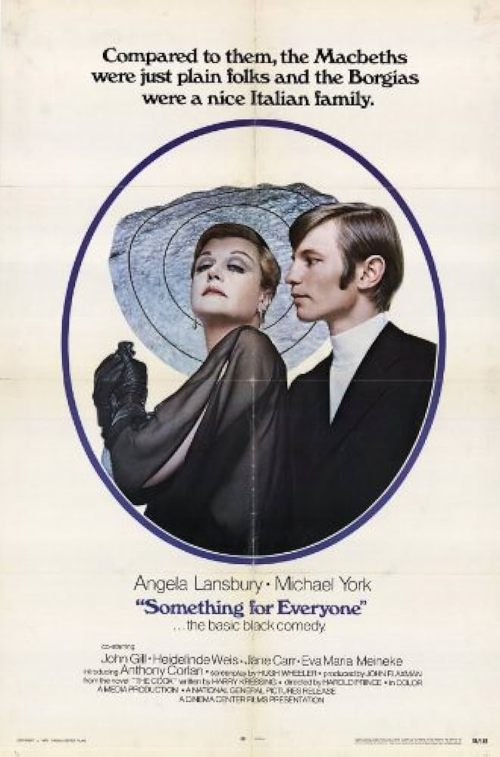
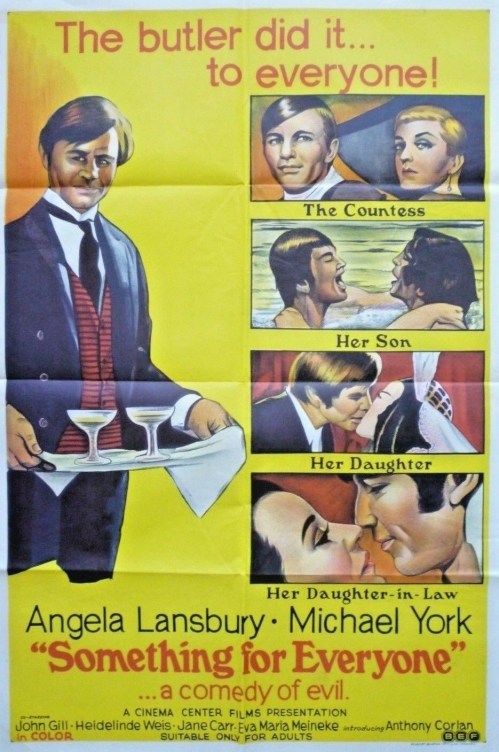
Something for Everyone (1970)

something1

By Richard Winters

My Rating: 7 out of 10

4-Word Review: Charming his way up.

Konrad (Michael York) is a young man with no money, or status, who dreams of one day owning the large Bavarian castle that he spots in the outskirts of a town that he’s passing through. He learns that it’s the property of the widow Countess Herthe (Angela Lansbury), who’s unable to live in it due to lack of finances. He schemes to become one of her servants by getting her regular butler, Rudolph (Klaus Havenstein) run over by a train. He then gets into a romantic relationship with Anneliese (Heidelinde Weis) whose parents (John Gill, Eva Maria Meineke) are quite wealthy while he also becomes lovers with the Countess’ son Helmuth (Anthony Higgins). Konrad hopes that Anneliese’s wealthy parents can use their money to reopen the castle and convinces Annelise to get into a fake romance with Helmuth that will lead to a marriage and then this will hopefully have her parent’s money flowing into the castle to get it reopened. He assures both Anneliese and Helmuth that he’ll remain their lover on the sly, but without each one knowing that they’re having sex with the same man. The elaborate plan though comes to a crashing halt when Anneliese accidentally walks in on Konrad and Helmuth and sees them kissing.

This super black comedy may be one of the darkest every made as it has no let up and absolutely everyone of the characters is a schemer and no better than the others. It’s based loosely on the novel ‘The Cook’ by Harry Kressing, but the story here is much different. In that one the main character is Conrad who spells his name with a ‘C’ instead of a ‘K’ and portrayed as a gaunt man who’s over seven feet tall and dresses in an all black unlike here where Konrad is young and handsome. In the book Conrad uses his cooking skills to get everyone to be ‘eating out of his hand’ with his delectable dishes while in the movie Konrad shows no such talent. The book had a much creepier tone while the film plays it all up for dark laughs and keeps the horror elements completely out.

I’m not exactly sure why there was such big changes made from its source material as keeping it truer to the novel had the potential of making this into a ‘food porn’ movie, which could’ve been visually sumptuous. However, the way it’s done here is still enjoyable with the majority of props going to York’s splendid performance whose boyish smile and dashing looks keeps it all quite engaging no matter what dastardly thing his character does. Reviled by the critics at the time for its ‘glorification of homosexuality’ it’s pretty amazing in retrospect how daring it was as this was filmed in 1969 and quite possibly the first film to ever show two men kissing. I remember in 1982 it was considered still quite shocking when Michael Caine and Christopher Reeve did it in Deathtrapso much so there was a report about it on CBS Evening News under the theme of movies ‘going too far’ while this movie had already been showing it, in a rather gleeful way, 13 years earlier, but maybe that’s all because this was done in Europe and not stuffy old America.

On the flip side I didn’t feel Lansbury had much of a presence. A talented actress for sure, but she doesn’t have a lot to do until well into the second act and even then isn’t real funny, and seems upstaged by the supporting cast who come-off as more colorful. It’s also frustrating that we spend the whole runtime seeing this gorgeous castle in the distance, in this case the famous Neuschwanstein Castle in Germany, but never able to go inside it. The few scenes that were supposedly its interior were instead very obviously shot on a soundstage.

Spoiler Alert!

While the script is full of many crafty twists and witnessing each nefarious character go down in a unique way is quite fun I did feel the way Konrad kills Anneliese and her parents by acting as their chauffer who crashes the vehicle down an embankment didn’t work. For one thing the killing of a wealthy family would’ve lead to a major investigation and since Konrad was driving the car, which he ‘miraculously’ jumps out of before it crashes, but he would still have to come up with a reason for why the car spun out of control. Since he doesn’t have one he would come under suspicion of the authorities instead of getting off scot-free like here.

Having Herthe’s nerdy daughter Lotte (Jane Carr) suddenly become instrumental in the whole thing by exposing the fact, at the end, that she’d been spying on Konrad the whole time and using what she knew to force him to marry her, leaved even further plot holes. The viewer should’ve been tipped off about what she was doing, even subtly, during the story as having her just turn up with all this new information makes it seem like it was tacked-on as a convenience without having it thought through with the rest of the plot. Not sure why Herthe, who was expecting to marry Konrad herself, would’ve gone along with Lotte marrying him instead, or what explanation was given to her in order for her to accept, which again just leaves open even more questions that in a truly well-crafted script should’ve been answered.

something2

My Rating: 7 out of 10

Released: July 22, 1970

Runtime: 1 Hour 52 Minutes

Rated R

Director: Harold Prince

Studio: National General Pictures

Available: DVD-R, Blu-ray

Garde A Vue (1981)

garde1

By Richard Winters

My Rating: 6 out of 10

4-Word Review: Interrogation of a lawyer.

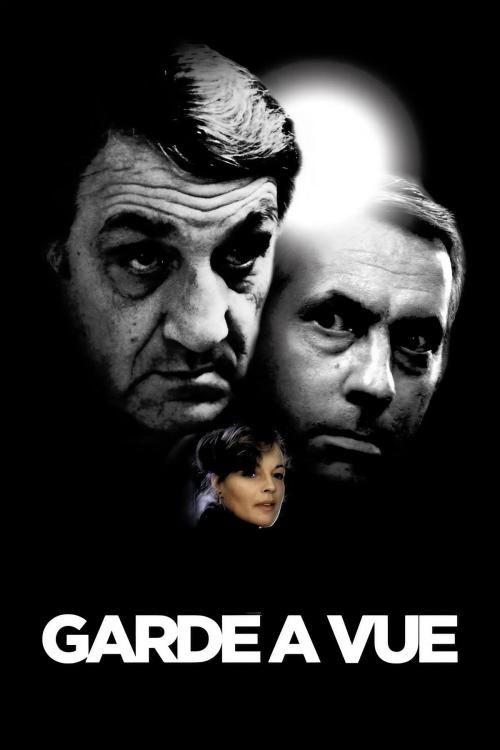
Jerome (Michel Serrault), is a rich and powerful lawyer who is brought into a police station late one night during New Year’s Eve in order to be questioned about the rape and murder of two young girls. Antoine (Lino Ventura) is the lead investigator while Marcel (Guy Marchand) sits in the back and assists him during the interrogation. At first the conversation is light and civil, but as Antoine brings more circumstantial evidence to the forefront Jerome becomes nervous yet insists he’s still innocent. Marcel even implements some physical force against him, but Jerome’s stance never changes. In another room Antoine has a conversation with Jerome’s wife, Chantal (Romy Schneider), who confides to him that she secretly suspected Jerome to be in-love with an 8-year-old girl. Once Jerome gets confronted with this his story soon begins to change.

The film is based on the novel ‘Brainwash’ by John Wainwright and shot entirely in a studio soundstage and in chronological order. Why director Claude Miller would want to film a story that had very little if any cinematic elements to it is a mystery and if anything this might’ve fared better as a stage play. I was initially impressed with the police station room as you’d swear it was an authentic building and not just a prop built for the production. The drenching rain seen pouring down outside the windows is impressive as it gives the viewer a claustrophobic feel and I liked how eventually, when the clock hits midnight, you hear car horns honking outside to represent the New Year. However, every interrogation room I’ve seen, and I watch a lot of confession videos on Youtube from real-life cases, the rooms are very small and with no windows and the film would’ve been better served had it reflected a setting like this as it would’ve brought out better the psychological tension of the suspect and his feelings of the ‘walls closing in on him’, which with here you don’t get.

You can’t help but connect this movie with The Offencewhich starred Sean Connery and was directed by Sidney Lumet. That movie came out 8 years before this one, but had the exact same theme of a suspect being brought in over the murders of some school girls. That movie was well directed but did annoy me for the fact that in that one the suspect, played by Ian Bannen, did nothing, but give off this smirk the whole time.  This one has a much better back-and-forth between the investigator and suspect, which helps keep it compelling as more evidence gets introduced. However, in the Lumet film it had constant shots of this big bright light shining into the camera giving the viewer a point-of-view feeling of what someone in that situation would feel and thus helping hype the sense of urgency of wanting to get out of there, or say anything one needed to in order to stop the pressure, which this film doesn’t do very well. Both films though have cutaways showing the dead girl’s bodies from a distance in a secluded area, which are visually creepy, though again Lumet’s film scores a bit higher in that category too.

Spoiler Alert!

Ultimately the ending is a letdown and rather baffling as it features Jerome caving and admitting to a crime that he really didn’t commit due to the perceived police pressure. For one thing it’s hard to imagine that a seasoned lawyer would be that dumb and wouldn’t just ‘lawyer up’ himself and demand counsel of his own when interrogation got to be too much. I’ve seen a lot of true life interrogations where the pressure put on the suspect was far worse and those people refused to buckle, so seeing the character fall to pieces so relatively quickly especially when he was educated to know better makes the whole thing pathetic.

Didn’t quite get why the wife shoots herself at the end either. Supposedly it’s because she feels guilty about tabbing him for the murder when the real killer eventually gets exposed, but she did it out of honesty as she really felt he had a thing for young girls, so why should she feel tortured about saying something she truly believed? It would’ve been more surprising if she had pulled the gun on Jerome himself as he got into the car and shot him as she would feel, even if he hadn’t been arrested for this crime, that he still had some dark perversions and thus should be killed before he goes and carries out his fantasies on some other girl. Of course if she lied about him having a thing for an 8-year-old in order to get back at him over their contentious marriage then her guilt and suicide would’ve been more plausible, but I didn’t get that from watching it, so if that was ultimately her motivation then the filmmakers should’ve done a better job at intimating it.

This is the rare case where I’d say the Hollywood remake, which came out in 2000 as Under Suspicion and starred Gene Hackman and Morgan Freeman was much better done. It had a better visual balance that didn’t keep the whole thing stuck inside a police room and it better tied-up loose story ends that this one leaves open.

My Rating: 6 out of 10

Released: September 23, 1981

Runtime: 1 Hour 27 Minutes

Not Rated

Director: Claude Miller

Studio: AMLF

Available: DVD, Blu-ray

Silver Streak (1976)

silver

By Richard Winters

My Rating: 8 out of 10

4-Word Review: Murder on a train.

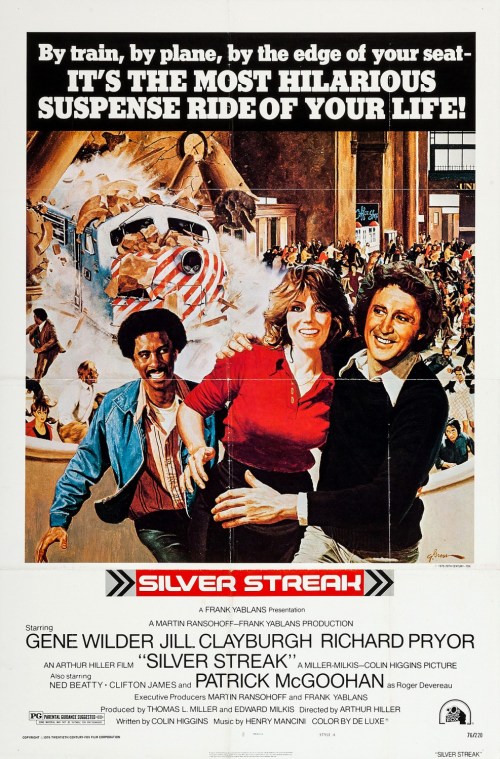
George (Gene Wilder) is a book editor taking a train ride from Los Angeles to Chicago. Along the way he gets into a relationship with Hilly (Jill Clayburgh) who is staying in the neighboring compartment. After a night of drinks they go back to her bed and begin making-out only for George to see a murdered body of a professor, whom Hilly works for as his secretary, get thrown off the train. Nobody else sees it except for him and everyone, including Hilly, believe it was a figment of his imagination, but George persists by doing the investigating himself. He goes to the compartment that the professor was staying in to see if he’s there, but instead he meets two men (Ray Walston, Richard Kiel) who throw him off the train. George then must find a way, in the middle of the empty desert, to get back on the train, so as to warn Hilly, whom he fears may be their next victim.

The script was written by Colin Higgins who up to that time was best known for having done Harold and Maude. He said he had always fantasized about meeting a beautiful blonde on a train and when it never panned-out in real-life he decided to write it into a story. Initially he was expecting an uphill battle to get it sold, but to his amazement it instead set-off a bidding war between Paramount and 20th Century Fox who both wanted to purchase the rights and it ended up selling for a then record $400,000. Originally Amtrak was going to be used as the setting for the Silver Streak, but the company became panicked that the film could cause bad publicity for them and ultimately refused to allow the studio to use any of their trains, so the film crew was forced to go north of the border and use the Canadian Rail System in its place while still pretending that it all takes place in the US when really all exteriors are Alberta, Canada and the skyline that gets seen in the distance that’s supposed to be Kansas City is really Calgary.

The reason the film works so well is that the comedy is on-target the whole way, but also manages to deftly blend it in with some nerve wracking action making the viewer let out belly laughs while also sitting-on-the-edge-of-their-seat at the same time. The pace is brisk with some amazing and very realistic stunt work that not only shows the train crashing through the wall of Chicago’s Central station, but also a few scenes with the character’s dueling it out on the roof of the locomotive as it’s going at high speeds. In fact the only slow spot in the entire movie is when Gene and Jilly make-out in the train car, which goes on too long and may make some people, including my conservative parents who watched the film with me when I first saw it on Showtime in 1982, as thinking this might be more a soft core porn flick than an action thriller and about ready to turn-if-off before it finally gets going with the plot.

Wilder, who was not Higgins’ first choice for the role as he intended it to be played by George Segal, is quite engaging and this was the first of several pairings that he did with Richard Pryor, who doesn’t appear until an hour in, but manages to take over quite nicely and makes a strong, memorable impression. Patrick McGoohan is sinister as the villain and one of the rare instances where in an otherwise comedy the bad guy isn’t funny and instead nasty, usually in comedies it’s considered mandatory that all the characters, even the bad guy, have some amusing moments, or lines, but McGoohan is just mean, which enhances the suspense element. Scatman Crothers, who initially seems to be playing an insignificant roles as the train’s porter, but in the end becomes quite crucial in getting everyone saved. Richard Kiel is good, though he speaks no dialogue, as one of McGoohan’s henchmen, in a role quite similar to the Jaws character that he played in two James Bond films that came out a year later, he even walks around with the same mangled up dental work in his mouth.

Spoiler Alert!

While the film works for the most part quite flawlessly I did find a few tidbits to quibble about. One is the scene where Gene accidentally bursts open the patrician door that divides his room from Jill’s who is busy dressing and doesn’t act startled when he suddenly breaks into her room, which I would think anyone, especially in a state of undress, would’ve responded with a scream and a look of shock, which would’ve made the segment funnier if she had.

Later on a police chief, played by Len Birman in a very bad impression of Mike Connors from ‘Mannix’, tells Gene that they know he’s innocent and have simply been putting-up manhunt posters with his picture on it for his own safety, so they could catch him and get him away from the evil McGoohan and his cronies who want to kill him. However, after he explains this he then hands Gene a gun and some bullets and tells him to come along with his men to help nab McGoohan who is still on the train, but how would this police chief know that Gene could handle a gun and was trained on how to shoot it, let alone even need him since his own men were well armed with rifles and could easily shoot down the bad guy themselves? There’s also another moment where the police chief shoots into a large crowd in an effort to hit McGoohan, which sends everyone into a panic and would be considered a major act of negligence for a cop to do.

Another scene has McGoohan explaining to Jill, Gene, and Richard about how he and his men never meant to really kill the professor, or at least not upfront, but when he did die that’s when they had to immediately ‘get’ a lookalike as an imposter to give everyone the idea that the professor was still alive. However, how exactly where they going to be able to find someone who looked so similar to the professor in such a quick, speedy way and then get him on the non-stop, fast-moving train?

The biggest exaggeration for me though is when Gene unhooks the back part of the train from the engine, while standing on a thin ledge and holding on for dear-life via a small metal rail and then able to successfully hop onto the train car that he had just decoupled from the other one. With them both going at high speeds I don’t think he’d be able to do it. Of course in the movie it gets done by a professional stunt man, who was able to time it, and rehearse it, to make it look easy, but in reality the average person would’ve either slipped, or missed grabbing the rail and thus fallen to the side of the tracks. This though could’ve actually been funny as we would then see Gene’s body roll on the ground and initially make it seem like he was hurt, or injured and then have him look up in aggravation and go: ‘Damn, I got thrown off the train for a fourth time!”

My Rating: 8 out of 10

Released: December 8, 1976

Runtime: 1 Hour 54 Minutes

Rated PG

Director: Arthur Hiller

Studio: 20th Century Fox

Available: DVD, Blu-ray, Amazon Video, YouTube

Eureka (1982)

eureka1

By Richard Winters

My Rating: 6 out of 10

4-Word Review: He discovers some gold.

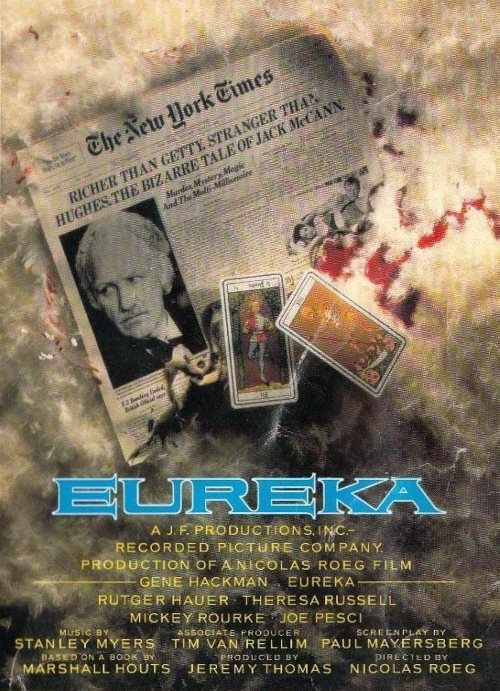
Jack (Gene Hackman) has been searching the Yukon for over 15 years in the hopes of one day coming upon some gold. Then one day he finds it and becomes super rich. 20 years later he’s living on his own island, married, and with a grown daughter named Tracy (Theresa Russell). Jack though has grown ornery through the years and has managed to alienate most of his family including Tracy’s husband Claude (Rutger Hauer) whom Jack can’t get along with and the two regularly argue to the point that it also affects his relationship with his daughter. Jack is also at odds with the local mobsters headed by Mayakofsky (Joe Pesci) who wanted to open a casino on the island and are willing to resort to any violent means necessary in order to get that done.

The film is based loosely on the life of Sir Harry Oakes who, like with the main character here, scoured many countries looking for gold for 15 years before finally laying claim to a fortune. He then retired to the Bahamas and ultimately was found murdered in 1943 in a crime that has remained unsolved. The studio though did not know what type of audience to aim the film to and thus shelved it for a year only to release it to limited theaters where it managed to recoup a paltry $123,572 out of its initial $11 million budget making it one of the biggest box office bombs in history.

As a visual exercise, given its director, its a spellbinding ride. Director Nicholas Roeg approaches it as a fable-like tale and creates the artic in a surreal type of way giving it an almost outer-worldly look and feel. To an extent this works and there’s a few memorable scenes including a barefoot man lying in the cold who blows his head-off, via a loaded gun, in one very unexpected, shocking moment that’s very realistically grisly. The death by blowtorch, which happens a bit later is effectively vivid as well. However, there’s other metaphysical elements like a mysterious stone that gets handed to Jack that alludes a bit too much to a magical quality and takes away that this is actually based on a true story and instead makes it seem like it’s all just a made-up metaphorical fable, which starts to have a pretentious quality.

The plot is too thin and the second act labors badly. Joe Pesci is a dynamic actor, but here his part is boring and he doesn’t come-off as threatening enough to give his scenes the proper tension. There’s also no insight given to why the gangsters choose to pick-on Jack, as this is a man who is quite rich and could hire his own protection and enforcers and not someone you’d think could be easily intimidated. So why bother with him at all and just find another island to build a casino on? In the real-life incident Harry Oakes went out of way to try to ban casinos from the entire island nation as he did not approve of gambling and thus caused the ire of the criminal underworld, but the movie doesn’t bother to explain this and thus makes the motivations of the bad guys confusing.

Acting-wise its a joy to watch especially Hackman. He has played so many heroes in his film career that it’s fun seeing him be a jerk and he does it well particularly when he gets on his alcoholic wife about ‘laying off the sauce’. Ed Lauter, who’s usually a heavy, is entertaining with this constant nervous look on his face as he ends up being the reluctant middle-man who gets played by both sides. Rutger Hauer is brilliant as usual giving each of his moments a creepy finesse as only he can do. Two of his more memorable bits are when he swallows a small piece of gold while in Jack’s presence and when he has a meltdown at a formal dinner party and angerly, even frighteningly, demands they all must go home.

Of course being that she’s the director’s wife you get ample visuals of Theresa Russell with and without clothes on. The two became a couple while filming Bad Timing a few years earlier and despite a nearly 30-year age difference got married. I’ve often think it’s odd though when a husband directs a movie in which she’s in bed naked with another man, in this case Hauer, who’s also sans clothes. Don’t know if many other husbands would like that idea as the erotic scenes weren’t necessarily needed though I kind of wonder if it’s not another case of the trophy wife syndrome where the old guy wants to brag to the world: look at this hot little number I get to go home to and you don’t and thus the nude scenes are just there to make all the other guys jealous.

Spoiler Alert!

The climactic court room scenes, in which Hauer is placed inside a cage during the proceedings, aren’t effective. Mainly because he acts as his own lawyer and questions Russell on the stand who goes on a long, teary-eyed, rant about her father and his perceived psychological motives, that ceases to be the proper question/answer decorum that would be expected in a regular court setting. It’s unlikely that any judge would let this go on the way it does, or that the jury, or other attorneys would be so captivated as they are and not begin rolling their eyes after awhile, or objecting to the histrionics. Having Hackman killed off doesn’t help things as he was the guy the viewer most connected with while Hauer was a creepy guy who behaved erratically and expecting the audience to suddenly emotionally side with him at the end was an overreach.

Released: May 20, 1983

Runtime: 2 Hours 10 Minutes

Rated R

Director: Nicholas Roeg

Studio: United Artists

Available: DVD-R, Blu-ray

Strange Shadows in an Empty Room (1976)

strange

By Richard Winters

My Rating: 4 out of 10

4-Word Review: Cop’s sister dies mysteriously.

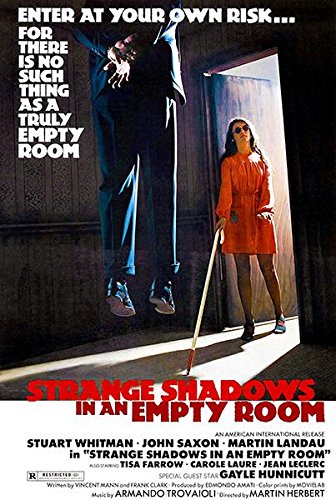
Tony (Stuart Whitman) is a tough-as-nails veteran cop who gets the shocking news that his younger sister Louise (Carole Laure) is found dead at a party she had attended. Initially he presumes it’s George (Martin Landau) a middle-aged doctor whom she’d been having an affair with and who gave her a injection at the party, but later he realizes there might be more to the story than he thought and begins investigating other avenues that leads him to a wild and completely unexpected conclusion.

The film was directed by Alberto De Martino who had done other Italian produced films that were rip-offs of better known Hollywood hits with this one clearly being inspired by Dirty Harry. It was filmed in Montreal and Ottawa, Canada, but done by an Italian film crew making it seem more like an overseas production with very little Canadian elements to it. Overall the quality looks cheap and the story has a lot of twists that don’t make a lot of sense, or are believable.

Two that stood out right away to me is during the party scene where Louise fakes illness simply to get George’s attention to make him come over there and away from his wife. Then when he tries to help her she lets him know it was all a gag. A few minutes later she passes out for real and he responds in a worried way, but you’d think since he got taken advantaged of just moments earlier he’d presume this was just another prank and not take it seriously. Also, at her funeral Tony begins to suspect there’s more to her death than what is known and requests an autopsy be done, but an autopsy is standard procedure that should be done after any unexplained death, especially since the victim was so young, and thus seems absurd that he should have to request it only as her body is already in the casket and ready to be buried.

Whitman, who was nearing 50, looks too old for this kind of thing and it’s hard to imagine he would, in reality, be able to physically keep up with these much younger suspects who force him to chase them around in airports, along crowded city sidewalks, and even in hospitals. He’s not the most ethical guy either as he has no problem drowning one of the men he’s questioning in a sink of water as a method of interrogation, which should normally get an officer in trouble. There’s also no glimpses of his personal life, so we never learn anything about him, or see any other dimension except for his rough cop persona. Most other cop movies, or at least the good ones, do have a few scenes dealing with the policeman’s private side, but here there’s none, which makes the character flat and uninteresting. Having the victim be his sister didn’t make too much sense since she was clearly quite a bit younger than him and making her his daughter would’ve been more believable and more devastating when he has to come to terms with her darker side.

The supporting characters are, just like with Whitman’s, poorly fleshed-out. It’s hard to be intrigued who the suspects are when they all seem alike and say and do nothing that’s interesting. The film does have one long car chase, which has some impressive stunts, but it seemed unnecessary as the man driving away from the cops really didn’t have much to hide and is essentially not interrogated once Whitman catches up to him, and he offers only a little piece to the puzzle, so why tear up the city streets and completely destroy two cars if he’s not in dire trouble? Better to have saved this for the finale with the bad guy who really is the culprit than just some minor player who isn’t seen, or heard of again.

I did enjoy the foot chase through the hospital that comes at the end and even goes through a maternity ward and ultimately onto the roof of the place. The story does feature many twists and I did appreciate the way it shows how policeman can make the wrong guesses on who they think is guilty and go on many long tangents that don’t lead anywhere before they realize their mistake. However, more effort should’ve been made to create unique characters as the ones provided here are wooden and banal.

Alternate Title: Blazing Magnum

My Rating: 4 out of 10

Released: March 9, 1976

Runtime: 1 Hour 39 Minutes

Rated R

Director: Alberto De Martino

Studio: Fida

Available: DVD, Blu-ray, Amazon Video, YouTube

A Perfect Couple (1979)

perfect2

By Richard Winters

My Rating: 5 out of 10

4-Word Review: Meeting through dating service.

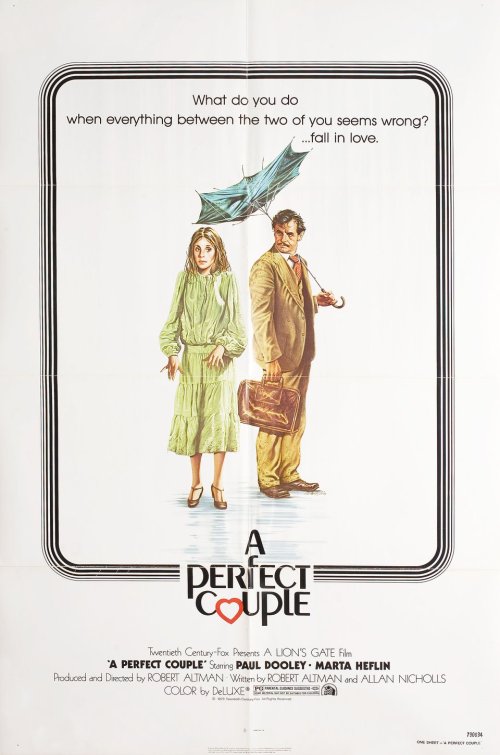
Sheila (Marta Heflin) is a singer in a traveling rock band run by Ted (Ted Neeley) who is quite demanding and openly berates and even fines members of the group who do not follow his orders. Alex (Paul Dooley) is a middle-aged Greek man still living at home with his domineering father (Tito Vandis) and extended family who berate him at every turn for not conforming to the family orthodox. Both are single and lonely and decide to join a dating service. From there they get connected and go on a first date at an outdoor orchestra concert where it rains and they both get wet. Despite the mishap Alex pressures Sheila for a second date, but miscommunication causes problems here as well. They eventually go their separate ways by dating other people they meet at the service, but Alex feels the need to try one more time to make it work and thus goes on tour with Sheila’s band as they hit the road, but finds their communal lifestyle is not for him.

The inspiration for the movie came while Robert Altman was shooting A Wedding and intrigued with the idea of what would happen if Paul Dooley’s character in that film started dating Sandy Dennis’ character and thus decided to write a whole movie about them. Problems though started right away during rehearsals when Dooley, who’s allergic to cats, could not handle being in the same room with Dennis, who was a major cat lover and would usually bring her pets to the reading, which would send him into a severe allergic reaction. Even when she quit bringing the felines with her it still caused issues with Dooley due to the cat hairs on her clothing. Altman then cut Dennis from the cast and had the part rewritten for Heflin, who was 33 at the time, but looked much younger like she was only 22 or 23 and thus accentuating the differences between the couple.

The film starts out with the two already on their first date instead of showing them viewing potential dates through the taped interviews that the service had available, which I felt was needed. As a guy I could see why Dooley would get into a young, semi-hot chick like Heflin as lonely guys, no matter their age, can instantly ‘fall-in-love’ with a woman from their looks alone, but both need to agree to the date before they go and I couldn’t understand why Heflin would to go out with a guy who was way older and didn’t seem to have much going for him. Maybe all of the other prospects were total duds and he was the best of the lot, so she decided to give it a try, or maybe she had some sort of father complex, but that’s something that still needs to be revealed and the fact that it isn’t leaves a big gaping logic hole.

The characters are palatable to some extent, but behave in ways that makes them at times quite infuriating. Dooley is especially problematic. Granted he’s playing someone who is socially clumsy and not real slick with the dating thing and trying a bit too hard to make it all work, but still insisting that he enter her apartment even when she makes it quite clear that she’s more comfortable just saying goodbye at the door is creepy. Having him show up at her place unannounced and demanding she see him for a second date and not leaving until she relents makes it even worse. There needs to be someone to tell him that his behavior is out-of-line and this isn’t a way to ‘woo a woman’ and in many cases will justifiably scare them off. Unfortunately the Heflin character doesn’t do this. Even though everything he does makes her quite uncomfortable she never protests it and lets him keep having his way, which makes her as annoying as he is.

Their unique living arrangements brings up even more issues. For Heflin I could understand her situation and it made sense. Sure the band manger is a demanding jerk, but I could see her feeling the need to put up with it because she wanted to break into the rock singing business and felt this was part of the crap she had to get through while she works her way up. For Dooley, his living arrangements are just downright baffling as he plays a 50-year-old who’s still residing at home with his father who’s highly demanding forcing Dooley to become a pathetic, obedient simp when around him. I could understand if the guy was like 20 how this might be somewhat believable, but by 50 he should’ve broken away a long time ago and the fact that he hasn’t needs to be explored and explained as it’s highly unusual and seems to intimate that there’s a serious personality disorder of some kind that begs for analyzation that never comes.

The entire runtime has the two going through every bad date moment you could think of. They have absolutely nothing in common and repeatedly talk past each other, so there’s no constructive communication whatsoever and yet somehow at the end they ‘fall in love’, but how? To make a relationship work there needs to be a connecting bond, but the film fails to show what it is making it quite shallow. There’s also an abundance of music played by the band Heflin’s a part of called ‘Keepin’ Em off the Streets’, which gets way overdone. There’s 12 different numbers, which bogs down the pace and makes it seem like a band’s demo reel instead of a movie.

The only memorable bit is when Allan F. Nichols, who co-wrote the script, appears as Dana 115, one of Heflin’s dates for the night and he has a physical confrontation with Dooley, which ended up making me laugh, but that’s about it. Nothing else happens that is either amusing or insightful. A fluffy movie that doesn’t go far enough to be either compelling or memorable.

My Rating: 5 out of 10

Released: April 6, 1979

Runtime: 1 Hour 47 Minutes

Rated PG

Director: Robert Altman

Studio: 20th Century Fox

Available: DVD