Monthly Archives: July 2013

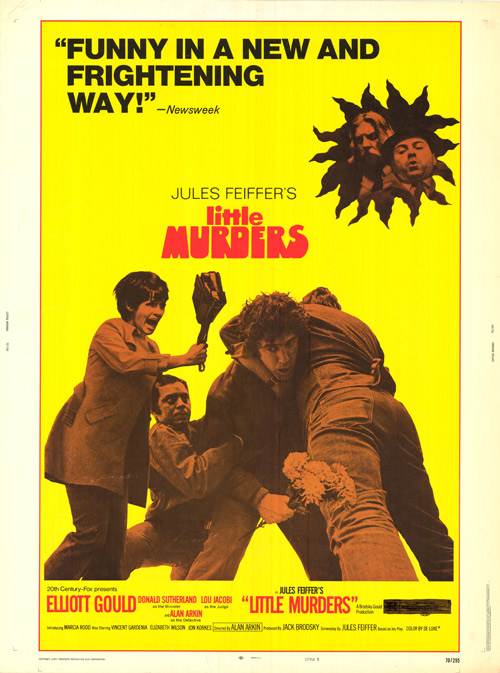
Little Murders (1971)

little murders

By Richard Winters

My Rating: 7 out of 10

4-Word Review:  They shoot at people.

Patsy (Marcia Rodd) is a woman who practices the art of positive thinking despite her dismal urban surroundings. She meets Alfred (Elliot Gould) who is very detached and dropped out of society and no longer shares any hope in humanity, but she decides to marry him anyways and ‘reform’ him.

For a black comedy this one has got to be tops. It stays on a grimly humorous level from the beginning and doesn’t let up especially with its wicked ending. Everything gets the offbeat treatment and if it starts out conventional it is soon turned upside down until it is absurd. The funniest scenes involve Patsy taking Alfred home to meet her parents where things become very odd until they are absolutely hilarious. The wedding scene is also a classic where Donald Sutherland plays a hippie minister and gives a speech about masturbation that is as outrageously funny today as it was back then. Yet it is the surreal scene of seeing Alfred riding a subway car while dripping with blood and nobody saying anything that leaves the strongest impact. The targets that this film satirizes are just as potent today as they were back then. The film also manages to dig a bit deeper than most and successfully analyzes the myriad of societal complexities while not siding with any particular social movement or philosophy.

Rodd is terrific in her film debut and Gould is good in a surprisingly restrained performance. Jon Korkes is also excellent as an infantile adult son in an over-the-top send-up of grown children still living at home. However, it is Vincent Gardenia that ultimately steals it playing a hard-liner conservative father who finds himself becoming literally imprisoned by the increasingly insane world around him.

Although still potent this outrageous story seems to have lost some of its zing through the years and doesn’t seem to be as offbeat or ‘out there’ as it once did. It also lacks any type of cinematic flair and at times seems to be nothing more than a filmed stage play.

However, for fans of black comedy and relics of a bygone era it doesn’t come much better than this. Although it has softened a bit there are still enough bizarre and funny moments to please those with an acquired taste.

My Rating: 7 out of 10

Released: February 9, 1971

Runtime: 1Hour 50Minutes

Rated R

Director: Alan Arkin

Studio: 20th Century Fox

Available: VHS, DVD
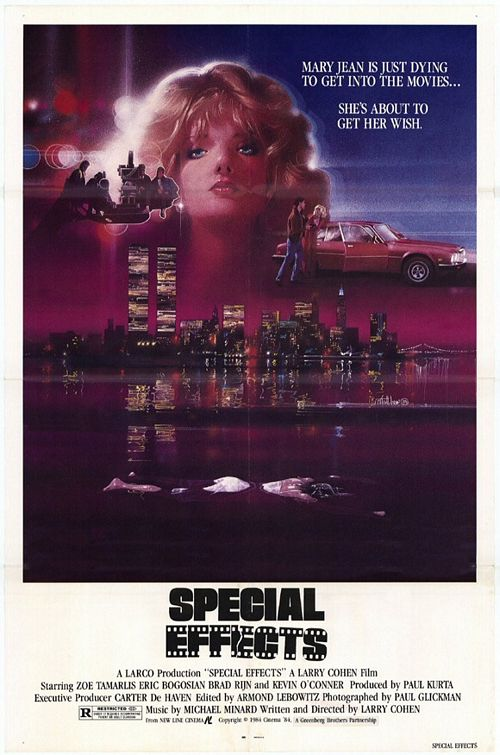
Special Effects (1984)

special effects

By Richard Winters

My Rating: 5 out of 10

4-Word Review: Murder her on film.

Snuff movies have become the thing of urban legends and apparently tapped into society’s morbid curiosity. It is really surprising how many movies and TV-shows have dealt with the topic especially recently. It all started in 1971 with the film Snuff that purportedly dealt with an actual murder of an actress done in front of the camera even though it was faked and not very good, but the film’s tagline ‘Filmed in South America where life is CHEAP’ is at least amusing. There have been films that have tried to make it look very convincing particularly the disturbing ‘Guinea Pig’ series from Japan as well as Cannibal Holocaust that got director Rogero Deodato taken to court to prove that he didn’t actually kill his cast. Although there have been executions, assassinations and suicides that have been recorded and sometimes put into documentaries there has yet to be a performer murdered in front of the camera for commercial purposes.

In today’s movie writer/director Larry Cohen takes this concept and gives it an intriguing spin. Neville (Eric Bogosian) is a down-and-out filmmaker. His last picture bombed at the box office and he is looking to make a buzz with his next project. He is fascinated with the capturing of the killing of Lee Harvey Oswald and how movies can never quite recreate death in the same way. Struggling actress Andrea (Zoe Tamerlis) answers an ad and shows up in his apartment/studio for an audition. Neville uses the allure of potential fame to get the women into bed with him, which he usually films with a camera hidden behind a two-way mirror. During the sex Andrea begins to belittle him, which angers him enough that he strangles her. Realizing that he has the murder captured on film he decides to use it to his advantage. He disposes of the dead body and then hires another woman named Elaine (also played by Tamerlis) who looks just like Andrea to star in his next film. He will then incorporate the scene of the murder into the movie. Audiences will think it was done with special effects and be so impressed with how realistic it looks that it will give Neville numerous accolades for his film making skill and bring him back to the top of the directing world.

Cohen uses the story as an excuse to expose the seedy, unglamorous side of low budget filmmaking many of which based on his own observations from working in the business. One of the more startling revelations that he shows is how the movie world is such an allure to some people that they will completely sell-out to get into it even if it means losing their dignity. This comes to a head in what is probably the film’s strongest scene when Neville is very rude and brash with Elaine when he first meets her. He shouts at her like she is sub-human and simply a piece of property, but the prospect of starring in a movie is so strong that she doesn’t walk out of there like most people would probably want to do. What is worse is the fact that Neville is aware of this and realizes he can get away with it.

The movie also looks how demeaning it can sometimes be being a filmmaker as well. Having to work and deal with various personalities and egos as well as fighting to remain in control of the project and vision. He also shows how exhausting the research phase of a production can be and how breakthroughs and inspirations usually come about by complete accident. The extended scene dealing with them trying to find an actress who resembles Andrea and auditioning hundreds of different women without any luck only to come upon Elaine by complete accident when they go to a Salvation Army store is a good example of this.

Cohen also infuses some creative camera work and directorial flair. The opening sequence showing Andrea prancing around topless in what looks to be the Oval Office of The White House has panache. The shot showing rows upon rows of hundreds of headshots of young and aspiring actresses, which includes an amusing one of Dustin Hoffman in his Tootsie character, lining the floor is impressive. I also liked the way Neville’s apartment is captured when Andrea first walks into it as well as extreme close-ups of circuit breakers being put back into a circuit box, which is really cool.

Tamerlis is fantastic in the lead. She shows a great awareness and natural acting ability in front of the camera. She plays the dual roles with two very distinct personalities and accents both of which are good. Her presence makes the film more interesting and the scenes that she is not in lack the same energy.

Bogosian easily conveys the obnoxious sarcastic personality of his character, but at times his facial expressions seem to be either lacking or over-exaggerated. Brad Rijn who plays Andrea’s husband who later gets involved in Neville’s project is weak and annoying. In some ways he seems to be the right pick for someone playing a country hick, but he has no charisma and looks too scrawny especially with his clothes off.

For a low budget 80’s flick the film has enough twists and a good enough pace to be marginally entertaining. The only thing that I really didn’t like was the synthesized electronic music score that drones on endlessly like in one of those 80’s porn flicks. I think the reason I liked the scene where Andrea’s dead body is shown inside a parked car in a lonely area of Coney Island is because it didn’t have any music and instead used the natural ambience of the location, which helped make it distinct and should’ve been done with the rest of the movie.

My Rating: 5 out of 10

Released: November 16, 1984

Runtime: 1Hour 33Minutes

Rated R

Director: Larry Cohen

Studio: New Line Cinema

Available: VHS, DVD

The Great Escape (1963)

the great escape 3

By Richard Winters

My Rating: 8 out of 10

4-Word Review: Tom, Dick and Harry

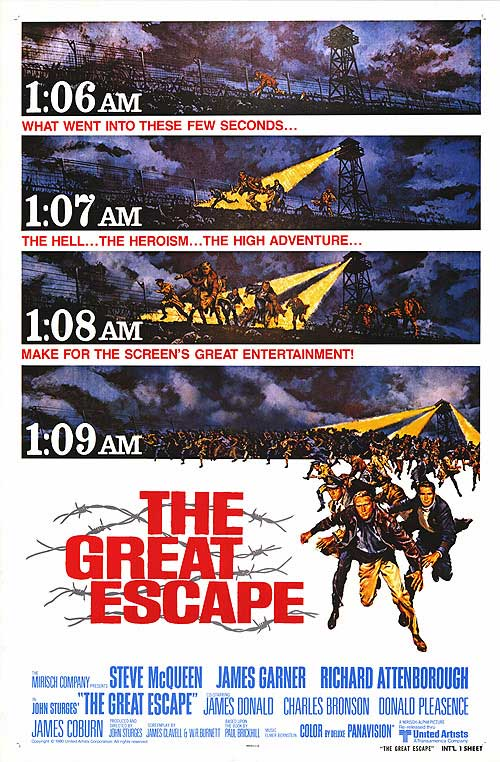
Based on a true story involving POW’s in an ‘escape proof’ German Prison camp who devise a way to get out by digging three tunnels, which will go under the barbed wire fence and allow them to get out under the cover of a nearby forest. They decide to build three tunnels and call them Tom, Dick and Harry, so if the German guards discover one of the tunnels they can simply continue to work on the other two.

The producers built a complete replica of Stalag Luft III were the actual events took place and used Wally Floody who was a prisoner of the camp and took part in the escape as an advisor. The movie moves at a polished pace grabbing in you immediately and keeping you involved all the way through. The characters share a great camaraderie and it’s a terrific testament to teamwork and how by everybody playing a little role can help make great things happen. Their resolve and ‘can-do’ spirit is infectious and one of the major reasons the film is so compelling. The bouncy, upbeat patriotic music is good although it gets played a lot and most viewers will most likely hear it playing in their head long after it is over.

I did feel that the depiction of the camp seemed a bit too cozy. The men are allowed to freely walk around and congregate in large meetings where they make their plans and it seemed to me that a heavily fortified prison camp wouldn’t allow for that, or at least be more on top of things. I wouldn’t say the German’s are portrayed on a ‘Hogan’s Heroes’ dumb level, but at times it gets close. For instance when the James Garner character lifts the wallet out of the pocket of one of the guards he does not become aware that it is missing for what seems like several days and then when he does he doesn’t suspect the Garner character and instead goes back to him and naively asks for his help in finding it. When the Germans find one of the tunnels there are no reprisals even though I and some of the others in my movie group who watched it with me felt that there should have been. Also, when the Steve McQueen character attacks one of the German guards when they shoot his friend who is trying to escape he is not sent to the cooler even though he had previously been sent there for far less infractions.

On the acting side it is all top-notch. McQueen is as cool as ever. I love his detached manner and rugged willing to take risks personality. His escape by motorcycle, which was added into the story by his request, is exciting and one of the most memorable moments in the film. Charles Bronson is good as one of the characters who are most instrumental at digging the tunnels however I felt that it seemed a bit far-fetched and like tacky Hollywood melodrama that he had spent so much time working inside the tunnels only to suddenly get claustrophobic about them just as they are trying to escape. David McCallum has very few words, but gets gunned down in exciting style at a train station. I normally love James Coburn and his character is appealing, but his attempt at an Australian accent is atrocious.

Spoiler Alert!

Despite its title the film really doesn’t seem like all that great of an escape. For one thing out of the predicted 250 that were supposed to escape through the tunnel only 76 made it out before the Germans caught onto it and closed it off. Of those 76 there are 50 who get caught, rounded up and shot at point blank range. 12 get returned to the camp and only 3 actually make it to safety. When the Steve McQueen character gets sent back to the cooler in the film’s final scene I felt a bit frustrated and depressed and that the big ballyhooed escape had really lead nowhere.

My Rating: 8 out of 10

Released: July 4, 1963

Runtime: 2Hours 52Minutes

Not Rated

Director: John Sturges

Studio: United Artists

Available: VHS, DVD, Blu-ray, Amazon Instant Video

Loot (1970)

loot 3

By Richard Winters

My Rating: 8 out of 10

4-Word Review: They are all greedy.

Every Friday this month I will review the Top 5 best and most outrageous black/dark comedies from the 70’s. There were many to choose from, but these five have stood the test of time and remain as potent and hilarious as they were when first released. Today’s film was written by Joe Orton who died before ever seeing his play made into a movie and despite being top-notch in every aspect remains unjustly overlooked and hard-to-find.

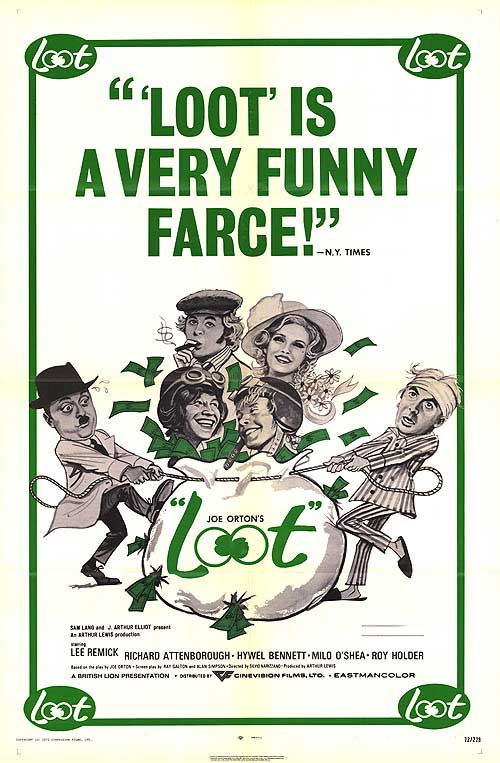
The story deals with Dennis and Hal (Hywell Bennett, Ray Holder) two friends who decide to rob a bank next to a funeral home and hide the stolen money inside the coffin of Hal’s late mother. Problems ensue when Inspector Truscott (Richard Attenborough) starts to suspect the boys have something to do with it and incorporates brutal interrogation tactics to get the truth out of them. Then there is Nurse Fay (Lee Remick) who may have had something to do with Hal’s mother’s death and is inclined to want a piece of the action. All of this occurs inside Hal’s house, which is also a bed and breakfast run by Hal’s Father McLeavy (Milo O’Shea) who remains oblivious to all of the shenanigans and only worried about getting a decent burial for his departed wife.

The film is fast and funny and retains all of Orton’s dark and acidic wit. It is full of one-liners, sight gags, odd characters, and bizarre, unexpected comical twists, with ninety-eight percent of it being clever and funny. The best is the funeral procession when Dennis, who is driving a hearse that is carrying the deceased, finds out that the vehicle has lost its brakes and careens down the streets at high speeds with all the other cars in the procession try to keep up with it while driving equally fast.

Director Silvio Narizzano shows a terrific grasp on the material. Unlike Entertaining Mr. Sloane the only other film adaption of Orton’s work this film has a terrific pace that starts with a bang and never lets up. Narizzano also infuses a lot of imaginative camera angles, edits, and set design to give the thing a nice edgy, off-color feel. Outdoor action is nicely balanced with the indoor scenes to create a good cinematic feel and it never seems like a filmed stage play. There are some interesting homoerotic overtones as well including having Dennis and Hal blow a hole in the bank wall, crawl through it and take the money, then crawl back out and stuff it into the coffin while being completely naked.

Remick has one of her most interesting and unique performances in her already illustrious career as she is quite amusing looking almost like Marilyn Monroe with her dyed platinum blonde hair and authentic sounding British accent. Attenborough is memorable playing against type. Usually he is best at meek and passive types, but here he almost steals the film as the aggressive Inspector with a Hitler mustache. His best moment comes when he picks up a glass eye from the floor and in one brief second sticks out his tongue and licks it, which is done in vivid close-up.

The bouncy, psychedelic score by Steve Ellis helps give the proceedings attitude and personality. Why this film has never been released on DVD or Blu-ray is a mystery. The humor remains sharp and a whole new throng of fans could be acquired if they were just able to see it.

My Rating: 8 out of 10

Released: May 1, 1970

Runtime: 1Hour 41Minutes

Rated R

Director: Silvio Narizzano

Studio: British Lion Film Corporation

Available: VHS

Cry-Baby (1990)

cry baby 1

By Richard Winters

My Rating: 4 out of 10

4-Word Review: The Greasers are cool.

Director John Waters films, which are sometimes referred to as ‘an exercise in bad taste’, are indeed an acquired taste.  Some label his films from the late 60’s and early 70’s like; Mondo-Trasho, Pink Flamingoes, and Female Trouble to be tasteless, exploitative, and trashy. Yet those films also have a very fervent following. I for one found them to be perversely brilliant.  However, when Waters decided to ‘sell-out’ and go more mainstream Hollywood, his stuff became too toned-down. The humor lost all of its edge. The original Hairspray that came out in 1988 was a particular disappointment. It seemed like nothing more than a stretched out sitcom with musical numbers.  This film, which came out two years later, does only slightly better.

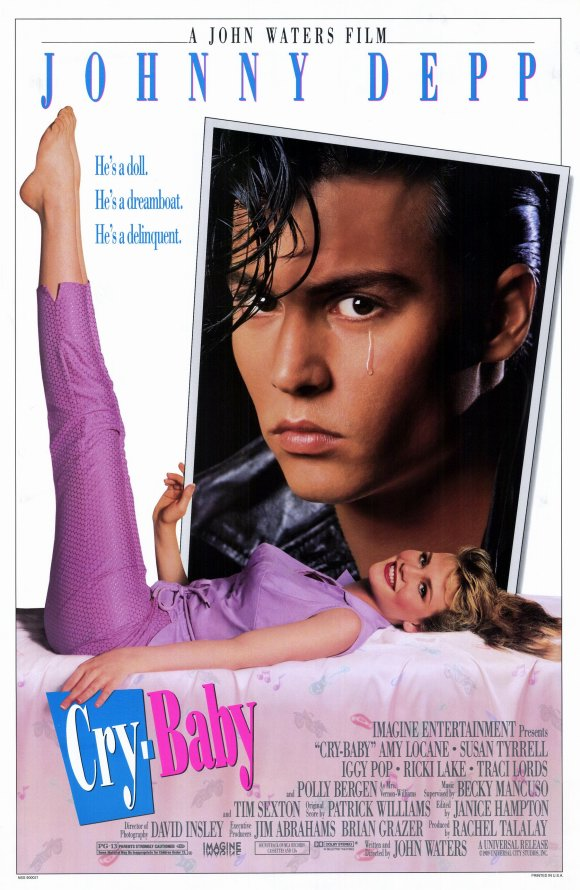
The setting is a 1950’s Baltimore High School that has an intense rivalry between the leather jacket wearing, motorcycle riding ‘greasers’ and the more refined All-American clique. The lightweight story  follows a young, clean-cut girl (Amy Locane) who secretly longs to go out with the head of the greasers (played by Johnny Depp), but can’t due to her social standing.

If the film does anything right it is the fact that, in typical John Waters style, everything gets played up to the extreme.  The ‘model’ students are really snobby and annoying and the animosity between the cliques is strong. However, I couldn’t help but feel that there was a certain grain of truth to all this especially in that era where ones ‘reputation’, whether it be good or bad, was taken more seriously than it may be today. I thought the casting of Locane in the lead was perfect.  She has an appealing, girl-next-door face and her hidden feelings of wanting to venture out of her repressive social role are certainly relatable.  I also loved Depp in the male lead role. He is a gifted actor, but sometimes he seems to take himself too seriously, so it was fun seeing him ham it up. Female viewers may also like the fact that there is an extended scene where he is shown wearing nothing but his underwear.

The casting of the supporting actors is equally inspired if not incredibly quirky.  Polly Bergen gets what might by her finest role in her long, but modest career. Here she plays Locane’s very rigid, upstanding Mother that ends up loosening up a bit in amusing fashion.  Joe Dallesandro and Joey Hetherton are a hoot as an extremist religious couple.  David Nelson and Patty Hearst (yes, the same one that was kidnaped in the 70’s) are equally funny as the surbanites.  Waters veteran Mink Stole has a bit playing the most entertaining iron lung victim since Jose Ferrer played one in The Big Bus.  Kudos must also go out to Kim Holden who sports one of the most hilariously ugly faces since Cloris Leachman’s Nurse Diesel character from High Anxiety. The only mistake here is that they didn’t make the Holden character a villain, which they should’ve in order to really play it up.

Some of the comedy does have its moments.  I liked the part where parents go to an adoption agency and ‘shop’ for children who are set up like mannequins in a display window. The climactic car chase sequence in which the rival gang leaders play the infamous game of ‘chicken’ while riding on the roofs of their cars only to end up crashing into an actual chicken coop, is good. The rest of the film though is too silly and cartoonish without the outrageousness of Water’s earlier films.

The story is also too pedestrian without offering any new insight or perspective.  The characterizations are over-the-top broad and the whole thing ends up being vapid and forgettable despite a few chuckles here and there.  There are also some musical numbers in this, but the songs all sound alike.  The dance routines are dull and unimaginative, looking like they were done without a choreographer present.

Waters earlier work is still far better as it was independent film-making at its purest. Those films also starred Divine who is sorely missed here (she died a few years before). Of course any film that has Susan Tyrrell in it, arguably the most eccentric actress to ever grace the screen, gets a few more points, but not enough to save it.

My Rating: 4 out of 10

Released: April 6, 1990

Runtime: 1Hour 25Minutes

Rated PG-13

Director: John Waters

Available: VHS, DVD, Blu-ray, Amazon Instant Video

Q (1982)

Q

By Richard Winters

My Rating: 5 out of 10

4-Word Review: Giant bird eats humans

In celebration of cult writer/director Larry Cohen turning 72 on July 15th all this month on Mondays I will review five of his films that he did during the 80’s. Now Cohen will probably never win an Academy Award and may never be mentioned in the same context as Spielberg, Kubrik, or Hitchcock, but the man has had one hell of a career nonetheless. He has been writing for either television or movies since the late 50’s and continues to churn out creative, innovative stories and scripts. Not all of them are completely successful and some of them do misfire, but his ability to survive in the difficult, competitive Hollywood landscape and make his movies on his terms with virtually no studio interference is an amazing achievement in itself and therefore deserves recognition.

larry cohen 3

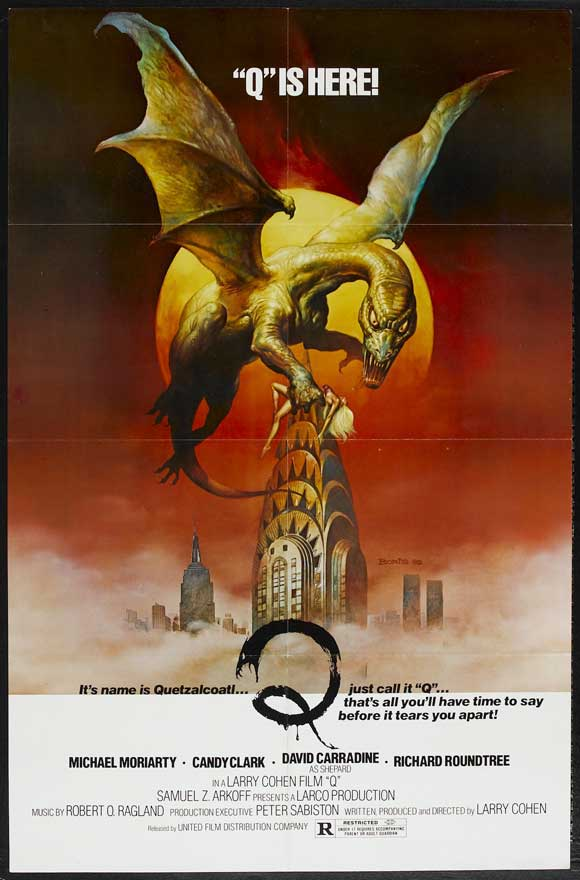
This film like most of his others has a completely outlandish plot this time involving a giant lizard-like bird that is actually the Aztec god Quetzalcoatl brought back to life and nesting inside the top crown of the Crysler Building in downtown Manhattan. The bird lays a giant egg and feeds itself on unsuspecting people.  Jimmy Quinn (Michael Moriarty) is an out-of-work lounge singer who comes upon the bird’s nest accidently while running from the cops after a botched jewelry store robbery. He decides to use his knowledge of the whereabouts of the bird to his advantage and demands that the city pay him a million dollars before he leads them to it.

Despite the crazy plot the execution is rather conventional. There are long periods of seemingly unending dialogue that is not interesting and does not propel the movie along. The bird attacks are too brief and needed to be strung out more. The movie would have worked much better and had it had a consistent tongue-in-cheek approach and editing that was more kinetic and lucid-like.

Moriarty saves the film with entertaining, edgy performance. This is a man who is known for his erratic behavior off-screen, which pretty much killed his career. In 1971 while performing on stage in a play in Houston he suddenly broke from character and told the audience as well as his fellow cast members that he felt tired and didn’t want to continue and then promptly walked off stage and went home. He was also fired from his most famous role as Ben Stone in the hit series ‘Law and Order’ for similar types of odd incidents and yet that is exactly why he is so perfect here. He gives the thing a much needed boost of weird energy and I especially liked the part when he leads two of his partners in crime up to the bird’s nest and when the bird starts feeding on them he climbs down the ladder shouting:

“Eat them! Eat them! Crunch! Crunch! Eat them! Eat Them!”

I also enjoyed when he is sitting at the bargaining table with the city and police officials demanding a million dollars before he tells them the whereabouts of the bird and insisting that it all must be tax free because:

“I’ve never paid taxes before in my life and I don’t intend to start now.”

His character is lazy, conniving, cowardly, bombastic, self-centered, egotistical, talentless, and deluded and yet strangely endearing and I even felt a bit sorry for him at the end. Candy Clark as Joan his more grounded and conscientious girlfriend makes for a good contrast.

I wasn’t as crazy about David Carradine as the tough New York cop who deals with Jimmy during his investigation. Carradine seems too aloof and detached and this doesn’t help to create any tension. Richard Roundtree as his partner is much better and I would have had him the sole investigator and cut Carradine out completely.

The special effects are a little bit better than what I had initially feared for a low budget 80’s flick, but they are not real great either. The bird when shown flying through the air just doesn’t seem gigantic or frightening enough and ends up looking like a poor man’s Ray Harryhausen creation. The final shootout with the bird was clearly done on a matted screen and looks very tacky. I actually thought the baby bird that comes out of the egg was the only halfway scary and effective moment in the whole film.

What Cohen does get right is reflecting the ambience and culture of the New York neighborhoods and crowded street culture. The aerial footage of New York’s skyline is also spectacular.

My Rating: 5 out of 10

Released: October 29, 1982

Runtime: 1Hour 33Minutes

Rated R

Director: Larry Cohen

Studio: Larco Productions

Available: VHS, DVD, Blu-ray