Tag Archives: William Goldman

Magic (1978)

magic

By Richard Winters

My Rating: 7 out of 10

4-Word Review: Ventriloquist has split personality.

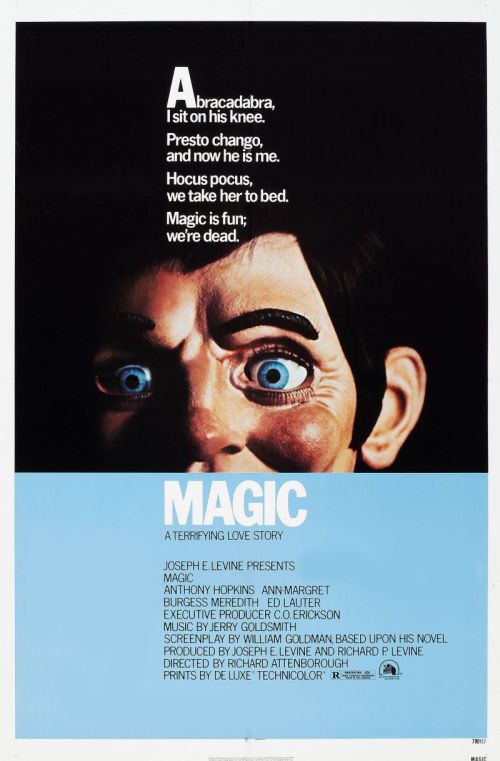
Corky (Anthony Hopkins) is an aspiring stand-up magician who’s finding it hard to play in front of live audiences. After a particularly disastrous effort he comes upon the idea of adding in a ventriloquist dummy named Fats into his act. The addition helps him become a top act and soon gets him the attention of well known agent Ben Green (Burgess Meredith). Ben wants to get Corky a TV contract, but first Corky must undergo a health physical, which Corky refuses to do. Ben insists that Corky has no other option, so Corky leaves the city and drives via a cab to the Catskills where he grew up and rents a lakeside cabin from his former high school sweetheart Peggy (Ann-Margaret). The romance between the two quickly renews, but then Ben finds out where Corky is staying and catches Corky alone in his cabin having an animated argument with his dummy convincing Ben that Corky has mental issues. Ben tells Corky that he’s going to get him psychiatric care, but Corky fears that if it gets out that he’s mentally ill he’ll never get another job offer and thus resorts to drastic action in order to keep Ben quiet.

The film is based on the novel of the same name by William Goldman who also wrote the screenplay. The novel was unique in that it was told through the voice and point-of-view of the dummy. While there had already been several stories and movies dealing with the ventriloquist/dummy persona including the film Dead of Night starring Michael Redgrave and a famous episode of ‘Twilight Zone’ where actor Cliff Robertson played a ventriloquist that gets tormented by his dummy. This film takes a slightly different approach where upfront the protagonist is clearly shown as having a major personality disorder and thus he’s the real threat while the dummy only symbolizes his inner turmoil between the ego and the id.

The film definitely has some creepy moments especially the dummy, whose spooky appearance is what makes it worth catching. It was modeled after Hopkins with oversized blue eyes, head, and mouth gives it an almost monstrous presence. Supposedly when it was completed and Hopkins first took it home to rehearse he got unnerved by it in the middle of the night and called Goldman to come over and pick-it-up or he was going to destroy it. The placid, gray setting of the isolated cabin, which was actually filmed in California despite it looking like northern New York, is perfect for this type of story and the serenity helps accentuate the suspense.

I really liked too the opening bit where a sweating Corky is seen bombing on stage in front of a apathetic crowd, which realistically hits home how nerve-wracking being up onstage for the first time can be though I wish we could’ve heard what Corky angrily shouted at the audience instead of having the sound of this blotted out by a voice over. It is though hard to believe that a man in his 40’s would get so addicted to his dummy, something he hadn’t used before then, that he couldn’t communicate without it and would have to take it everywhere he went. For a relationship to become this deep seated I’d think he’d have to have been doing a ventriloquist act from childhood on and thus the alter-ego of the dummy became meshed with his own as he grew older.

The acting is excellent by not only Hopkins, but also the supporting cast. Meredith is especially enjoyable playing the caricature of a Hollywood agent, which was modeled after the real-life one of Swifty Lazar, with his best moments coming whenever he takes out one of his expensive cigars, which are each separately incased inside a glass cannister. When he pulls the cigar out he then flings the cannister away, which can then be heard shattering onto the floor. Ann-Margaret known for her beauty and flair plays down her looks here as she wears no make-up and takes on a more earthy persona. Ed Lauter is also interesting playing her husband. Normally he’s a tough guy/bully and I thought this was going to come-out when he takes Corky out on a boat in the middle of a lake where he was going to threaten him to stay away from ‘his girl’, but instead he surprisingly displays a more vulnerable side and makes an emotional appeal to Corky to leave Peggy alone versus a strong-armed one.

Spoiler Alert!

The pacing is slow and the suspense builds very gradually though ultimately there are a few good spooky moments including a brief moment when Fats begins moving itself without the help of an operator and when Corky’s face suddenly begins to resemble the wooden dummy’s. Yet I felt it could’ve gone farther. The segment which has Corky crawling on the floor doing whatever the dummy tells him is certainly unnerving, but could’ve been accentuated more by showing it from Corky’s perspective where the dummy’s head would’ve grown to giant size as it looks down on the meek Corky as it gives him the orders.

The ending, at least when I first saw it, had me confused. The film climaxes with Corky returning to his cabin having stabbed himself and bleeding to death where he and Fats then slowly die together, but outside of the cabin Ann-Margaret appears telling Corky she has now changed her mind and wants to go away with him. Initially though it had been made to seem like Corky had killed her, so seeing her reappear as she does comes-off as almost dream-like. She also begins to speak in the dummy’s voice making it seem like his spirit had transferred to her.

Upon the second viewing many years later I came to the conclusion that this scene was meant to only be ironic. That if Corky had simply held-out longer Peggy would’ve agreed to go with him and thus him killing himself was a horrible waste, but in retrospect since he was suffering from such severe mental issues it was unlikely a long lasting relationship would’ve happened, so having her come back the way she does doesn’t really make much sense since she had been deeply offended by what he had said earlier, via the dummy. It would’ve been more horrifying had he chased her around the house and then killed her and the viewer seeing that get played-out.

My Rating: 7 out of 10

Released: November 8, 1978

Runtime: 1 Hour 47 Minutes

Rated R

Director: Richard Attenborough

Studio: 20th Century Fox

Available: DVD, Blu-ray, Amazon Video, YouTube
The Stepford Wives (1975)

By Richard Winters

My Rating: 7 out of 10

4-Word Review: Suburban wives become robots.

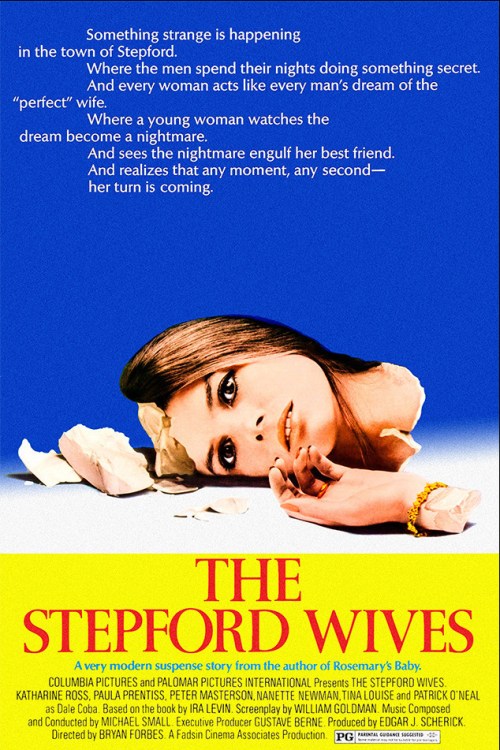
Joanne and Walter (Katharine Ross, Peter Masterson) decide to move with their two children (Mary Stuart Masterson, Ronny Sullivan) from the big city to the quiet suburb of Stepford, Connecticut. While Walter immediately starts to fit-in with the exclusive men’s club that they have there Joanne feels unable to connect with the other wives who all behave in a robotic fashion and more concerned with keeping their husbands happy and cleaning their homes than anything else. She manages to find one other woman named Bobbie (Paula Prentiss) who like her find the women’s behavior in the town to be a bit odd and they team up to investigate what the cause of it may be.

When this film was first released it was met with controversy particularly by feminists who felt the storyline was misogynistic and one protester even went as far as attacking director Bryan Forbes with her umbrella. When the movie was screened to a group of feminists they all hissed and groaned at it during the viewing while some other women, like screenwriter Eleanor Perry, came to the film’s defense calling it more of a sharp satire on men and their superficial views on women than on the women themselves.

I saw it more as a trenchant take on the suburbs, which can initially seem like a quiet, safe refuge, but ultimately can become a trap with a lot of hidden strings that you don’t initially see. While the Stepford wives do behave as overly conforming to domestic roles it’s really not all that much different than what you’d find in reality making you wonder if the rest of us suburbanites all slowly getting sucked into the Stepford trap too and just don’t realize it.

While the ill-advised 2004 remake tried to turn the concept into a comedic tale the story really works best as a horror film, which is what the 1972 Ira Levin novel, of which the film was based, intended and there are some good creepy moments. I particularly liked the moment when Joanne is talking to her therapist, played by Carol Eve Rossen, about how she feels the men in town are turning the women into robots and she fears she will be next. Her therapist advises her to grab her kids and leave town, but Joanne admits her other family members are dead and she has nowhere to go, which brought out what the truly frightening aspect of this story truly is, which is that women back then were completely dependent on their husbands for everything. Many of them weren’t in the job force and simply living off of their husband’s income. If the marriage went bad they were pretty much trapped in it, so even if a woman wasn’t getting turned into a robot like these women were they still weren’t really free either.

I also enjoyed the moment when Katharine Ross stabs Paula Prentiss, Ross had grown to like Prentiss so much during the production that she was nervous about doing this so director Forbes shaved the back of his hand and used it in place of Ross’ when the scene was shot. You may have seen many stabbing scenes in your film watching lifetime, but the one here is truly unique and quite memorable and voted as one of the 100 Scariest Film Moments by the Bravo Film Institute.

The film though still does have its share of faults. I liked how the viewer initially doesn’t know anything more than the main characters about what is going on, but ultimately the viewer starts to catch onto things more quickly than the protagonist, which proves frustrating. Joanne comes upon the creepy house where the exclusive men’s club meet, filmed at the historical Lockwood-Matthews Mansion in Norwalk, Connecticut, which looks quite ominous at night, at the film’s 60 minute mark, but then doesn’t go back to it until 50 minutes later. The viewer has already connected-the-dots that the bad things are happening inside that place, but instead of Joanne investigating the place more she goes on a wild-goose-chase with Bobbie about researching that town’s water supply, thinking that may have a chemical in it that is brainwashing the other women, which is clearly just a waste of time.

Spoiler Alert!

The film’s ending has a several issues as well. In the novel Joanne gets chased down by the town’s men, which should’ve been in the film as it would’ve allowed for some much needed action, but wasn’t. William Goldman’s script had originally called for Joanne to fight violently for her life when she gets attacked by her prototype robot, but Forbes decided to simply fade to black and not show the struggle, which makes it look like Joanne allowed herself to go down too easily.

When Joanne confronts the sinister Diz, played by Patrick O’Neal, he alludes to the idea that she wasn’t necessarily going to die, but would simply be ‘moving onto another phase’. He then describes to her about how nice it would be for a woman to be married to a husband who would adore her even when she grew ‘old and flabby’ making me think that Joanne was simply going to be taken away to another suburb somewhere else where the husbands would be the robots that the women controlled while the men remained in Stepford enjoying the wife robots. Seeing this scenario would’ve been a more interesting and unexpected twist and ultimately was later done in the 1986 TV-Movie The Stepford Husbands. 

My Rating: 7 out of 10

Released: February 12, 1975

Runtime: 1 Hour 55 Minutes

Rated PG

Director: Bryan Forbes

Studio: Columbia Pictures

Available: DVD, Amazon Video

The Barefoot Executive (1971)

By Richard Winters

My Rating: 6 out of 10

4-Word Review: Chimp picks the hits.

Stuck working in a television network’s mailroom, Steven (Kurt Russell) longs for his big-break into the programming department as his previous attempts to impress upper management (Harry Morgan, Joe Flynn) have all failed. Then his girlfriend Jennifer (Heather North) is put in charge of taking care of her neighbor’s chimp while they are away. To Steven’s surprise the chimp shows an uncanny ability to know which TV shows will be a success and which will flop. He decides to use the chimp’s talents and pretend that they are his own, which he hopes will finally let him climb up the corporate ladder.

This film is a little bit different from all the other Disney flicks from that era in that there aren’t the slapstick hijinks or the patented car chase. The emphasis is instead on satire that for the most part hits the mark. It also has a protagonist that isn’t so squeaky clean either. Russell’s character is more than willing to lie and even cheat if he thinks it can help him move ahead and although he has a slight tinge of guilt about it’s never enough to get him to completely mend his ways, which helps to make him seem more human and the situation more believable.

Joe Flynn is quite funny in support. He was a comic character actor who had a great ability to play both exasperated authority types as well as meek subordinates and here he does both. He also has an amusing scene with Wally Cox on top of a ledge of a high rise building and I couldn’t help but think about the irony as I watched these two carry out the scene that only three years after this film’s release these otherwise healthy looking middle-aged men would both be dead. There’s also the novelty of seeing two alumni from ‘I Dream of Jeannie’ appear here with Hayden Rorke, who played Dr. Bellows on the TV-show and a TV exec here, and Bill Daily who ironically plays an airplane navigator, which he also later did on ‘The Bob Newhart Show’.

The film’s funniest moment though is actually just a throwaway bit where a news reporter, played by Jack Smith, goes out and gets the opinions of people on the street about their take on the rumors that a chimp is picking the TV shows that they watch. He interviews one woman (Iris Adrian) who at first scoffs at the notion, but then thinks about how all of her favorite shows get cancelled and how so many stupid ones gets put on the air and then comes to the conclusion that a monkey running the network makes perfect sense. It brought to mind a memoir written by legendary screenwriter William Goldman detailing in his opinion how studio execs really don’t have any clue what film will become a hits, which becomes the film’s best joke as in all honesty you’d have just as much luck with a chimp picking the stuff as you would a person.

My Rating: 6 out of 10

Released: March 17, 1971

Runtime: 1 Hour 36 Minutes

Rated G

Director: Robert Butler

Studio: Buena Vista

Available: DVD, Amazon Video, YouTube

No Way to Treat a Lady (1968)

By Richard Winters

My Rating: 6 out of 10

4-Word Review: Killer enjoys taunting police.

Christopher Gill (Rod Steiger) is a Broadway theater owner suffering from a mother complex who vents his anger by strangling older women at random. He uses a variety of disguises to get into their homes and then when they let down their guard he kills them while leaving a lipstick drawing of lady’s lips on their foreheads as his ‘signature’. Detective Brummell (George Segal), who still lives at home with his overly protective mother (Eileen Heckart), is assigned to the case and quickly forms a communication channel with Christopher who displays a strong narcissistic trait by becoming quite upset if his crimes aren’t given the front page attention that he feels they deserve.

The film is based on William Goldman’s first novel of the same name and inspired by an article he read involving the Boston Strangler. However, in the book version there were two stranglers on the loose and both competing with each other to see who could top the other with their outrageous crimes while in the movie we’re given only one.  To an extent the film works pretty well and has an almost Avant garde flair to it as director Jack Smight gives his actors great latitude to improvise their lines while also allowing the scenes to become more extended than in a regular production.

Steiger’s strong presence gets put onto full display and the wide variety of accents that he uses is impressive. He manages to successfully create a multi-faceted caricature, which keeps it intriguing, but eventually he becomes too self-indulgent with it and in desperate need of a director with some backbone to yell ‘cut’ and reel him in a little.

Originally he was offered the role as the detective, but chose the strangler part instead forcing the part to be enlarged. Segal though holds his own and does so by not competing directly with Steiger’s overacting, but instead pulls back by creating this humble, passive character that’s just trying to do his job, which helps make the contrasting acting styles work and the film more interesting.

The film though fails to ever be effectively compelling. Most thrillers tend to have a quick pace particularly near the end in order to heighten the tension, but the scenes here remain overly long right up to the end. The side story regarding Segal’s budding romance with Lee Remick doesn’t help nor does Heckart’s Jewish mother portrayal, which comes off as a tired caricature. Had these things been put in only as brief bits of comic relief then it might’ve worked better, but with the way it’s done here it takes away from the main story until the viewer loses focus and ends up not caring whether the bad guy gets caught or not.

My Rating: 6 out of 10

Released: March 20, 1968

Runtime: 1Hour 48 Minutes

Not Rated

Director: Jack Smight

Studio: Paramount

Available: DVD, Amazon Video, YouTube