Tag Archives: William Friedkin

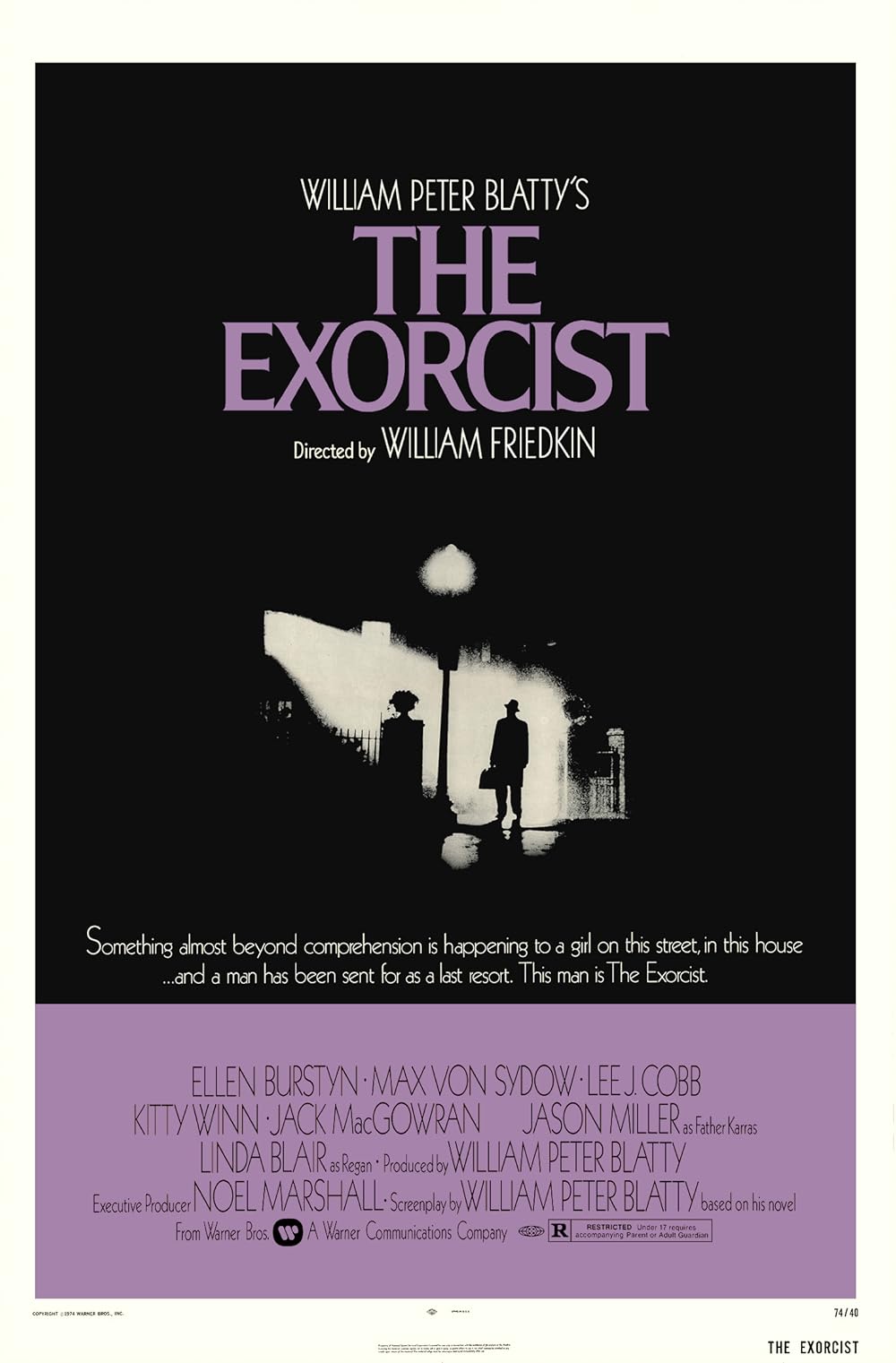
The Exorcist (1973)

By Richard Winters

My Rating: 10 out of 10

4-Word Review: Possessed by the devil.

Chris McNeil (Ellen Burstyn) is a famous Hollywood actress living on location in a neighborhood of Washington D.C. known as Georgetown where the latest movie she’s working on is being shot. She’s renting a posh home along with her two servants (Rudolf Schundler, Willi Engstrom), her secretary Sharon (Kitty Winn) and her 12-year-old daughter Regan (Linda Blair). Things start out fine, but then Regan begins exhibiting odd behaviors. Chris takes her to several doctors as Regan’s anti-social traits continue. The doctors prescribe various drugs, but nothing works. At her wits end Chris, a non-believer, finally resorts to asking a local priest, Father Karras (Jason Miller) if he’ll perform an exorcism on her daughter. Karras though is going through a crisis of faith and doesn’t believe the archaic ritual will help her but becomes more convinced after he visits the girl who displays knowledge of his personal life that she would not have known about otherwise. Eventually he asks the church for permission to conduct one, but under the condition that he do it alongside Father Merrin (Max Von Sydow) an elderly man with a heart condition who had done an exorcism many years earlier in Africa.

The film was based on the bestselling novel of the same name that in-turn was inspired by the true-life event that occurred in 1949 where priests performed an exorcism on a troubled 14-year-old boy named Ronald Edwin Hunkeler. Author William Peter Blatty, read about the incident while a student attending Georgetown University. After having become a successful screenwriter during the 60’s where he wrote mainly comedies for director Blake Edwards, he approached his agent about writing a horror novel about a child possessed but was initially talked out of it. Then in 1968 he watched Rosemary’s Baby, which he felt had a weak ending that he could’ve done better, so he brought up the exorcism concept to a book publisher while attending a cocktail party and he agreed pay him a $25,000 advance to write the book in 10-months. Upon publication the sales were at first sluggish, but then after an appearance on the ‘Dick Cavett Show’ they skyrocketed, which soon lead to a movie rights deal with Blatty commissioned to write the script.

The movie follows the book closely though in a more condense form with scenes that were groundbreaking in its level of explicitness and perversity including an infamous crucifix masturbation moment. However, it’s the angiography that many viewers found the most disturbing. While it’s shockingly explicit it’s also lauded by medical professionals as being highly accurate and for many years afterwards was used in radiological training films. Many critics at the time condemned the scene labeling it ‘irresponsible’ and ‘needless’, but I liked it. A good horror movie should put the viewer in an uneasy state right from the start and then continue to turn the screws tighter as it goes on. This moment clearly telegraphs to the audience that the filmmakers will not shy away from showing something graphic even if it’s outside of good taste and if they’re going to be this brazen with this scene then it makes it all the more unsettling about what’s to come next. 

In many ways, and I don’t believe it was intentional, but the film does become an inadvertent satire on the medical, psychiatric community as their ‘diagnosis’ on Regan are really just guesses and the extreme reliance on prescribing medications, which they feel will somehow ‘resolve everything’. I didn’t really have a problem with this as I think many doctors at the time, and maybe even now, would respond the same way if given such a bizarre case. My one issue though is that eventually one of them, played by Peter Masterson, gets up in front of a roundtable of other doctors and suggests that Chris take Regan to an exorcist. I don’t believe any real medical doctor would ever suggest it or certainly be met with pushback by the other medical professionals in the room. I realize the movie had to find a way to progress to the third act, so the idea of an exorcist needed to be brought up at some point, but it would’ve made more sense had it come from Chris’s servants, who were deeply spiritual already. Chris could’ve scoffed at it at first, but then after thinking and even reading up on it, would eventually relent. 

The performances are uniformly excellent. Burstyn was not the first choice as there were other actresses more famous than her at the time, but her ability to display distraught emotion and continue to do so as it progresses and still keep it fresh and genuine makes her the best person for the role bar none. Blair is quite good too though Mercedes McCambridge does voice the demon during the exorcism moments, which kind of affects things. Don’t get me wrong McCambridge’s deep vocals makes it scarier, but had the lines, which are quite obscene, been recited by Blair herself it would’ve made it more shocking. Plus, it would still allow credence for the doctors to say it was a mental illness and not a possession since whatever was being said was coming from her natural voice. 

The real star though is Father Karras as he’s the one that goes through an actual internal change during the course of the story, from a person who’s had a crisis of faith to ultimately regaining it. Miller, who’s perfect, was not the original choice as Stacey Keach had already been offered the role and signed on, but then director William Friedkin went to watch the play That Championship Seasonwhich Miller had written and afterwards the two met backstage and Friedkin talked about his new project that got Miller to describe his own Catholic upbringing and his quarrels with it, which convinced Friedkin that he’d be the better actor and thus the studio bought Keach out of his contract. As much as I like Keach this was still a good move as Miller’s guilt-ridden face, which gets on full display every time he’s in front of the camera, leaves a lasting visual impression. I also liked the way the character remains skeptical until the very end versus other horror films that would have the people believing in the supernatural right away, or pretty quickly. However, in real-life there’s always going to be cynical people, so allowing in their apprehension through Karras makes the story stronger and more three-dimensional. 

Spoiler Alert!

I felt the ending, in which Chris pronounces Regan to be ‘cured’ and not remembering a thing and then driving away, to be a bit lacking. Chris was portrayed as being secular, but you’d think after what she saw her daughter going through would’ve changed that. This could’ve been done subtly by having her holding a crucifix, something she had despised her staff putting underneath her Regan’s pillow earlier or just shown wearing a small one around her neck. 

I also didn’t like the side-story dealing with the Burke Dennings character, played by Jack MacGowran, being apparently pushed out the window by the demon and falling to his death down a flight of cement stairs as this takes away the impact of when it happens to Father Karras at the end. Instead of Karras’ death being the shocking, unexpected twist that it should’ve it comes off more like a ‘here-we-go-again’ thing. If I had been the director I would’ve removed both Dennings death and Lee J. Cobb character completely as I really didn’t think he added much or helped progress the story forward. I would’ve still had the steps being shown in the early part of the film as a forewarning by having Karras runup them during his early morning workouts and this could’ve been when he first met Chris as they’d bump into each other one day while she was leaving to go somewhere. The head being twisted all the way around, which is described as happening to Dennings, but never shown, could’ve been revealed as occurring with Karras, possibly with his eyes glowing when the pedestrians come running to his aid, which would’ve been a good creepy final horror visual. 

My Rating: 10 out of 10

Released: December 26, 1973

Runtime: 2 Hours 15 Minutes

Rated R

Director: William Friedkin

Studio: Warner Brothers

Available: DVD, Blu-ray, Amazon Video, YouTube
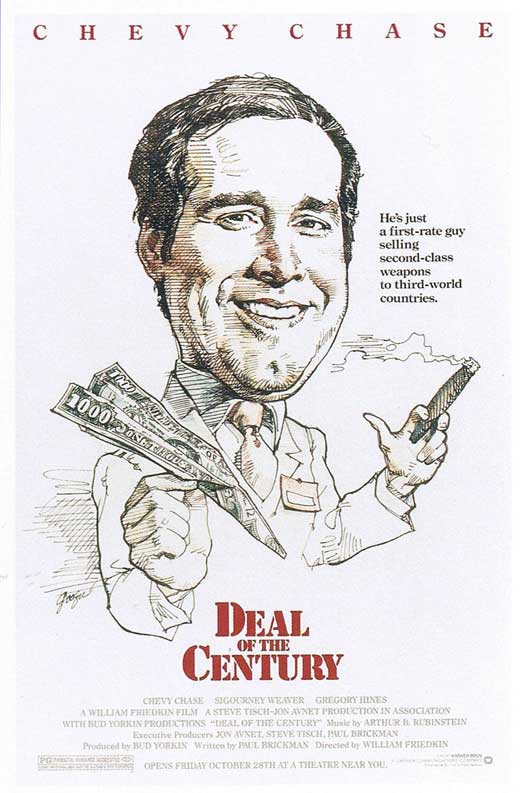
Deal of the Century (1983)

By Richard Winters

My Rating: 5 out of 10

4-Word Review: Making money selling weapons.

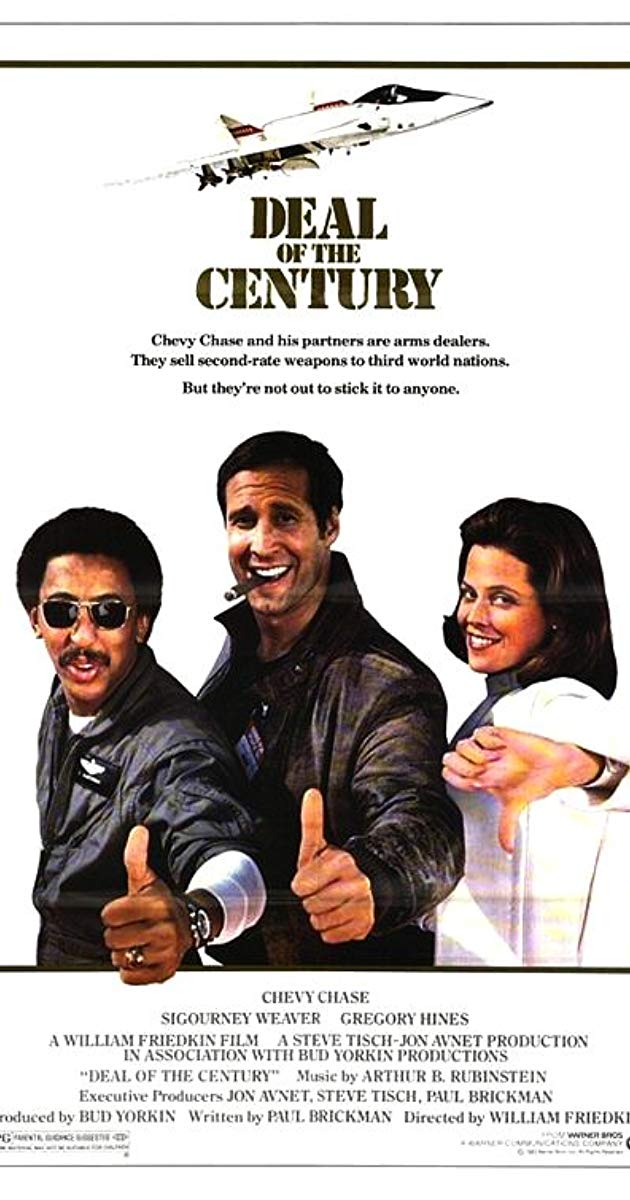
Eddie (Chevy Chase) is a American arms dealer selling weapons to both the rebels and military dictator of a small South American country. While there he meets Harold (Wallace Shawn) who works for a large contractor known as Luckup. Their weaponry is much more sophisticated and cutting edge so after Harold kills himself Eddie takes over the deal and successfully wins a big contract, but upon returning to the states he finds that the deal fell through, which forces him to return to the small country along with Harold’s widow Catherine (Sigourney Weaver) and his partner Ray  (Gregory Hines) to see if they can make another pitch.

The film is based on the novel of the same name by Bernard Edelman and makes some really good satirical points about how the arms race being driven more by corporate greed, which only helps to create wars instead of preventing them. Unfortunately the film’s tone is too muddled and goes haphazardly from lighthearted fare to dark humor while throwing in graphic violence that is jarring. There’s also a surprising number of scenes where the three main characters don’t appear in it at all.

Chase can be appealing if given the right material but his cynical smart-ass sense of humor doesn’t exactly make him lovable. Here his character is so consumed with making a deal that he becomes no different than the bad guys and someone the viewer doesn’t connect with or care for. The only positive thing about his character is that he gets shot in the foot early on and then unlike most other movies where the healing power gets sped up he instead spends the rest of the film in a cast, which is more realistic. The scene where he gets shot in the foot a second time and blood spews out of the cast until Sigourney stops it up with a cork is the film’s best moment.

Hines on the other hand is quite likable and his convergence to Christianity is funny and should’ve been played-up more. The scene where he gets into a confrontation with a Latino couple after a car accident is amusing, but having him suddenly go rogue at the end makes little sense and is kind of stupid.

Weaver, who doesn’t have any significant presence until almost 45 minutes in, is wasted and there’s no way that anyone as beautiful as her would marry a chump like Wallace Shawn, which makes the casting here quite nebulous. Vince Edwards, famous for starring in the 60’s medical drama ‘Ben Casey’, gets a surprisingly large role as a Luckup executive and I can only guess that this was because of his longtime friendship with director William Friedkin as otherwise by the 80’s he was way past his prime and largely forgotten.

There are some humorous bits here and there, but overall the pacing is poor and quite jumbled. Friedkin, better known for his dark dramas and horror films, appears to be out of his league and when compared to other Hollywood comedies this thing lacks finesse. The special effects are also really tacky, which ultimately sends this to a schlock level and becomes an embarrassment to all those who were involved.

My Rating: 5 out of 10

Released: November 4, 1983

Runtime: 1 Hour 39 Minutes

Rated PG

Director: William Friedkin

Studio: Warner Brothers

Available: DVD, YouTube

Cruising (1980)

cruising2

By Richard Winters

My Rating: 4 out of 10

4-Word Review: Cop infiltrates gay underground.

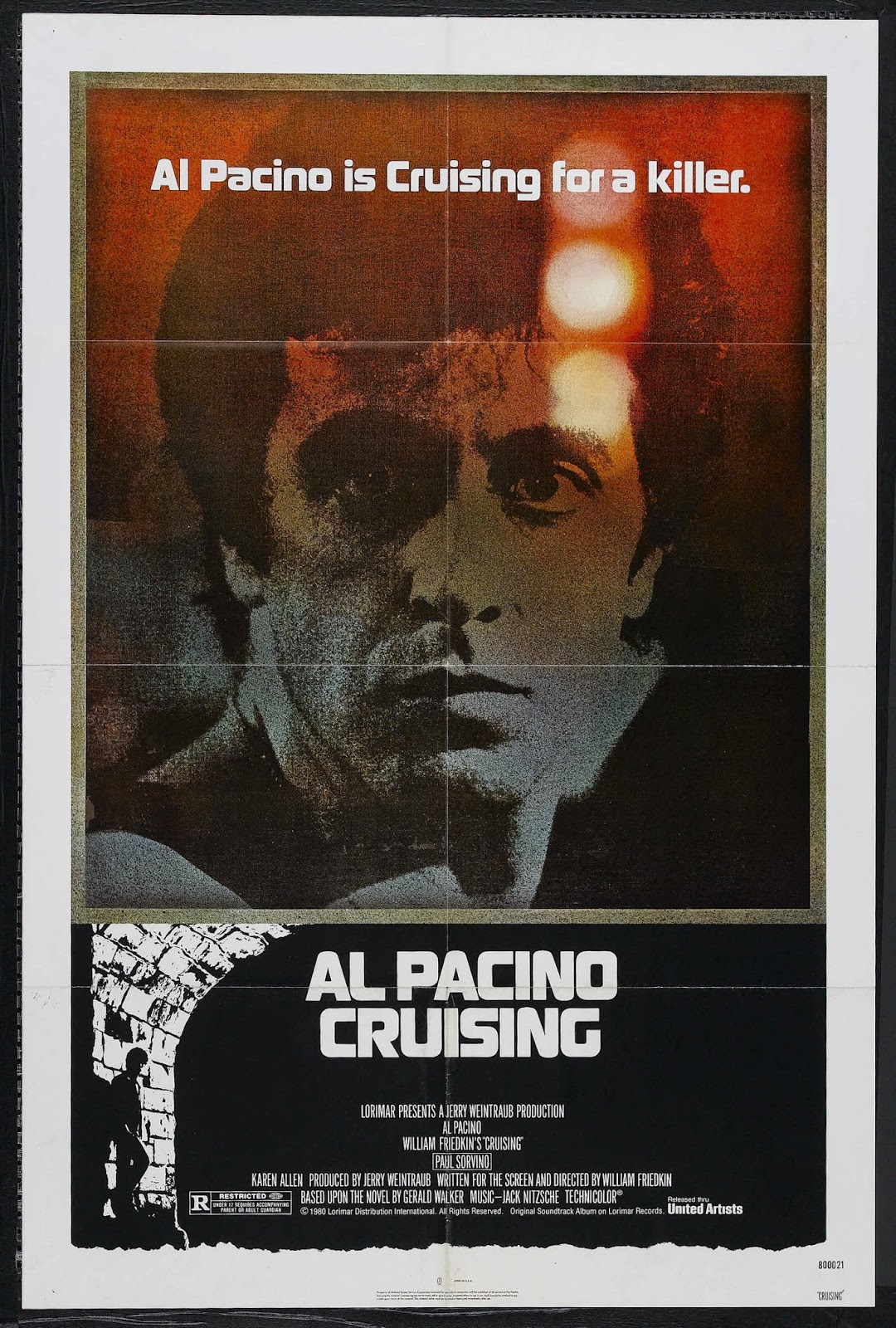
A serial killer is attacking gay men who frequent New York’s S&M bars and young cop Steve Burns (Al Pacino) is chosen to go undercover as a gay and infiltrate these ‘leather clubs’ in order to bring out the killer. However, the job requirements demand that he must be completely isolated from the rest of the force and not carry a gun, which eventually causes a strain on his personal life particularly in his relationship with his girlfriend Nancy (Karen Allen).

The film, which is loosely based on actual events that occurred during the late 70’s and captured in Gerald Walker’s novel of the same name, was considered quite controversial at the time of its production. Protestors who felt the film accentuated the gay stereotype tried to create loud noises during filming and even shine reflective lights on the actors in an attempt to mess up the scenes. In retrospect it is hard to imagine that director William Friedkin is in anyway homophobic as just ten years earlier he did the brilliant adaptation of The Boys in the Band, which remains to this day one of the better films dealing with gay issues. The story certainly does wallow in ugly elements, but also makes the point to describe this as an extreme subculture and  not reflective of the gay lifestyle as a whole, which in my opinion made the film seem more enlightening to New York’s gay underground of a bygone era and less propaganda as its critics ascertained.

To some degree I liked the explicit uncompromising approach, but after a while it became one-dimensional and predictable. The scenes of the killings are unnecessarily prolonged and some of the segments showing large groups of men having sex at a bar come off as overly-stylized and looking reminiscent of a homoerotic scene from a Fassbinder film.

Friedkin does manage to add a few unique touches including having a well-built black man wearing nothing but a jock strap enter the room during police interrogations and violently slap suspects who he felt weren’t telling the truth, which according to one of the film’s advisors was an actual technique used by police at the time.  The way the movie captures the monotony and frustrations of investigating a complex case such as this and leaving open that there may have been more than one killer is also well done and helps elevate this a bit from the usual formulaic cop thriller.

Pacino gives a gutsy performance including one scene showing him tied up in bed naked during some kinky S&M play, but the character’s motivations are confusing particularly the way he so quickly accepts this difficult assignment that most others would be very reluctant to do. The fact that his experiences ends up affecting him psychologically isn’t compelling since that becomes a foregone conclusion right from the start.

Paul Sorvino is perfect as the police captain. His gray hair dye was a little overdone, but his limp was great. Allen has a good moment at the end when she tries on Pacino’s leather hat and coat that he brought home with him and Joe Spinell makes the most of his small role as a corrupt cop who harasses gays only to end up patronizing gay bars on his off hours. You can also spot Powers Boothe in an early role as a hankie salesman and Ed O’Neil as a police detective.

The idea of exposing the dark side of police life is no longer original or interesting and the film’s shock value has lessened through the years and thus failing to leave any type of lasting impression or message.

My Rating: 4 out of 10

Released: February 15, 1980

Runtime: 1Hour 42Minutes

Rated R

Director: William Friedkin

Studio: United Artists

Available: VHS, DVD, Amazon Instant Video

The Boys in the Band (1970)

boys in the band 1

By Richard Winters

My Rating: 9 out of 10

4-Word Review: This party turns sour.

A group of gay men get together for an intended night of food and laughs as they celebrate Harold’s (Leonard Frey) birthday. Things begin to unravel when Alan (Peter White) appears who was an old college roommate of party host Michael (Kenneth Nelson). He insists that he is not gay, but Michael and the rest of the group intend to prove otherwise, which leads to many harsh and interesting revelations.

This film packs a wallop and is as relevant and daring now as it ever was back then. Director William Friedkin does a terrific job of making this story, which was originally an off-Broadway production seem cinematic. I loved the capturing of the apartment, which makes you feel like you are right there.

The performances are outstanding and all are the original cast from the stage production. Cliff Gorman as the flaming gay personality is a particular standout. The script by Mart Crowley is captivating from beginning to end as it brings out all the different personalities and myriad issues that make up the gay community and the whole thing is a tour-de-force on all levels.

My only complaint would be the character of the Cowboy played by actor Robert La Tourneaux who is the dim-witted, but good looking ‘gift’ giving to Harold for his birthday. I realize the intention is to make him a bit dumb, but it gets overdone. It’s one thing to be an ‘airhead’, but a complete other thing to sound so stupid it’s like he is from another planet. His character is the only one that does not get fleshed out at all and his utterly inane comments come off as hollow and annoying. Ironically La Tourneaux was unable to find many acting parts afterwards and became a gay prostitute in real-life by the late 70’s in order to make ends meet.

The characters are believable and the dialogue moving. It’s a compelling study of those feeling isolated from society and sometimes even themselves.  Even if you are not gay the film can still have a great impact and its quality viewing either way.

My Rating: 9 out of 10

Released: March 17, 1970

Runtime: 1Hour 58Minutes

Rated R

Director: William Friedkin

Studio: National General Pictures

Available: VHS, DVD

The Birthday Party (1968)

the birthday party 3

By Richard Winters

My Rating: 8 out of 10

4-Word Review: Tear up the newspaper.

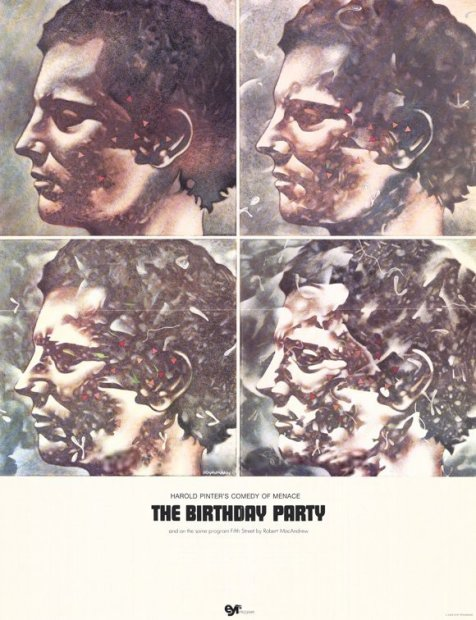
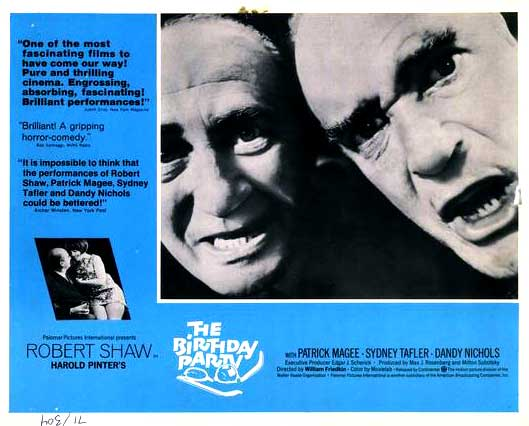
Since tomorrow will be my birthday I wanted to come up with a film that had birthdays as its theme and found this bizarre but fascinating obscurity. It is the story based on the play by Harold Pinter of Stanley Webber (Robert Shaw) a mysterious and private man who takes up lodging in a rundown British seaside house. He rents an upstairs room from Mr. and Mrs. Bowles (Moultrie Kelsall, Dandy Nichols) who are quite odd themselves. One day two men dressed in black suits (Patrick Magee, Sydney Tafler) come to pay Stanley a visit. They know something about Stanley’s past and their presence frightens him to the extent that it causes him to have a nervous breakdown.

On the surface this film shouldn’t work. There is an excessive amount of talking with dialogue that doesn’t say much and at times seems absurd. The set is drab and dirty with the camera seemingly locked down inside of it. There is never any explanation about Stanley’s past or what he is running from nor who the men are or what they know about him. The ending is elusive and the viewer will go away feeling more confused than they did at the start.

However, it is these ingredients that make the film so thoroughly intriguing. The seemingly banal dialogue is simply a façade for underlying thoughts and feelings. What Stanley is trying to run from is unimportant because it is really not about him at all and is instead more about ourselves, human nature and the quandary of our existence. It’s an examination of people’s futile attempts at trying to escape from who they are only to have society and life catch up with them. The set could be a metaphor for the inside of Stanley’s head. The grimy and decayed place symbolizes his decayed soul and the men in black suits are his conscience coming to haunt him.

Once you adjust to the eccentric narrative it then becomes a fantastic film for observing subtitles and nuance. Director William Friedkin shows a keenness for detail not only visually, but with the sound as well. The way the Magee character tears up a newspaper and the sound used for it could actually unnerve some viewers. Stanley’s meltdown scene is very unique and overall the direction is superb for such difficult material.

This movie was years ahead of its time, but for some it may be off-putting. However, it should be enjoyed by those who crave the avant-garde. It is also a rare chance to the see the normally strong-willed Shaw playing a very weak and vulnerable character. Nichols is also a stand-out playing an Edith Bunker type with a perverse streak lying just beneath the surface.

the birthday party 1

My Rating: 8 out of 10

Released: December 9, 1968

Runtime: 2Hours 3Minutes

Rated G

Director: William Friedkin

Studio: Palomar Pictures International

Available: VHS, DVD (Region 2)