Tag Archives: Vanessa Redgrave

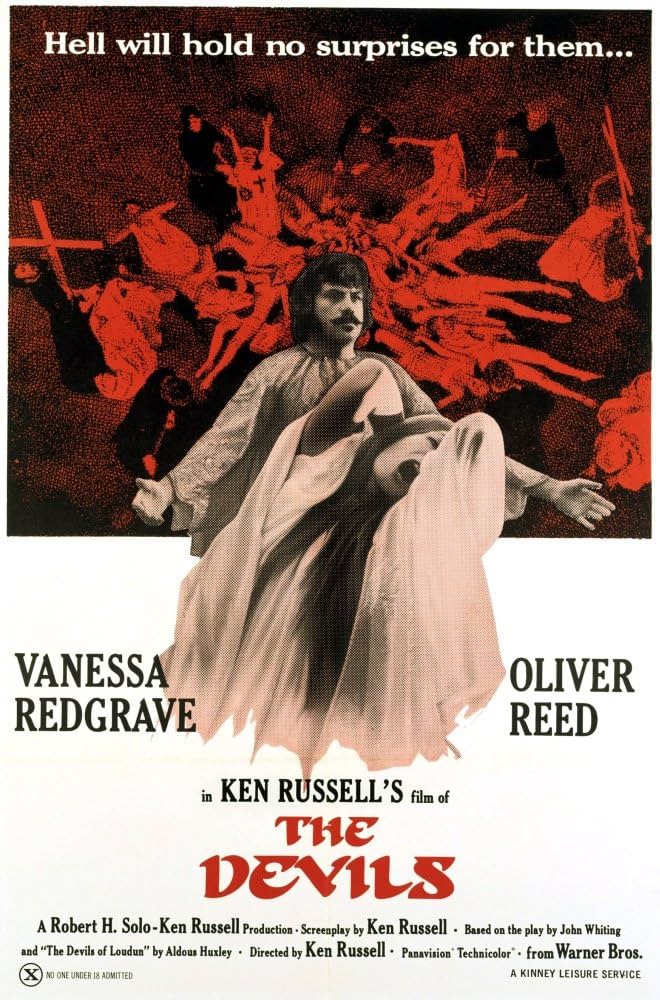
The Devils (1971)

devils1

By Richard Winters

My Rating: 9 out of 10

4-Word Review: Burned at the stake.

In the year 1634 the governor of Loudon, a small fortified city, dies, making Urbain Grandier (Oliver Reed), a priest with a secretly decadent lifestyle, the one in control. He’s idolized by the townspeople and the head nun at the local convent, Sister Jeanne des Anges (Vanessa Redgrave), secretly has sexual fantasies about him though because she suffers from having a hunch on her back is rarely ever seen outside and Urbain himself doesn’t know she exists. When Urbain secretly marries Madeleine (Gemma Jones) Jeanne becomes jealous causing her to confide to Father Mignon (Murray Melvin) that she’s been possessed by Urbain as well as accusing him of dabbling in witchcraft. This then leads to an inquisition headed by Father Pierre Barre (Michael Gothard) and a public exorcism, which has the nuns in the church strip and perform perverse acts before Urbain and his new wife are arrested and put on trial.

The story is based on the actual event, which was written about in the book ‘The Devils of Loudun’ by Aldous Huxley that was later turned into a stageplay. After the play’s success United Artists became interested in turning it into a movie and signed-on Ken Russell to direct due to his recent success in helming Woman in Love. Russell read the source material and became in his words ‘knocked-out by it’ and ‘wanted others to be knocked-out by it too’. This then compelled him to write an extraordinarily over-the-top script full of sex, violence, and graphic torture that so shocked the studio execs when they read it that they immediately withdrew their initial investment and refused to fund the picture threatening the project from being made even though many of the sets, constructed by set designer Derek Jarman, has already been painstakingly completed, but fortunately for them Warner Brothers swooped-in at the eleventh hour, which allowed the production to proceed.

The film’s release was met with major controversy with many critics of the day, including Roger Ebert who gave the film a very rare 0 star rating, condemning it. Numerous cuts were done in order to edit it down to a version that would allow it to get shown with the original British print running 111 minutes while the American one ran 108. Both were issued with an ‘X’ rating though even these cut out the most controversial scene, known as ‘The Rape of Christ’ segment, in which a group of naked nuns tears down and then performs perverse acts on a giant-sized statue of Jesus. This footage was deemed lost for many years before it was finally restored in a director’s cut version, that runs 117 minutes, that was shown in London in 2002. Yet even today this full version is hard-to-find with Warner Brothers refusing to release it on either DVD, or Blu-ray. They’ve even turned down offers from The Criterion Collection who wanted to buy it. While there was a print Warner released onto VHS back in the 80’s, this same version, got broadcast on Pay-TV, it’s edited in a way that makes the story incomprehensible, and only the director’s cut is fluid enough for the storyline to fully work.

It’s hard to know what genre to put this one into as this isn’t your typical movie and watching it is more like a one-of-a-kind experience that very much lives up to its legend and just as shocking today as it was back then. Yet, outside of all of its outrageousness it is quite effective. Each and every shot is marvelously provocative and the garishly colorful set pieces have a mesmerizing quality. The chief color scheme of white that lines the walls of the inside of the convent seemed to interpret to me the interior of a mental hospital, which helps accentuate the insanity of the frenzied climate. While things are quite over-the-top its ability to capture the mood of the times, the cruel way people treated each other and how they’re all steeped in superstition as well as the dead bodies from the plague that get stacked about, are all on-target and amazingly vivid.

The acting is surreal with both Reed and Redgrave stating in later interviews that they consider their performances here to be the best of their careers. Reed’s work comes-off as especially exhausting as he gets his head shaved and then is ridiculed in a large room full of hundreds of people before burned to death with make-up effects that are so realistic it’s scary. Redgrave, who walks around with her head twisted at a creepy angle, is quite memorable during the scene where she physically punches herself for having sexual fantasies, even puts a crucifix in her mouth at one point and masturbates with a human bone. Dudley Sutton and Murray Melvin with their very unique facial features and Michael Gothard, who initially comes-off with his long wavy hair as an anachronistic hippie flower child, but who becomes aggressively evil as the makeshift exorcism proceeds, all help round-out a most incredible supporting cast.

While the cult following for this remains strong and getting stronger and demand for a proper, director’s cut studio released DVD/Blu-ray is high Warner continues to rebuff the requests. There are though ways to find versions through Bing searches. Streaming services Shudder and Criterion Channel have shown the most complete prints to date, running roughly 111 minutes with most of the controversial scenes, including the Rape of Christ moments though these scenes are of a poorer, grainy and faded color quality since they never went through a professional digital transfer, but overall it’s still one of those movies you should seek-out because not only is it fascinatingly brilliant, but it’s something that could never be  made today and a true testament to the wild, unfiltered cinema of the 70’s that will forever make it the groundbreaking, unforgettable decade that it was.

My Rating: 9 out of 10

Released: July 16, 1971

Runtime: 1 Hour 57 Minutes (Director’s Cut)

Rated R (Originally X)

Director: Ken Russell

Studio: Warner Brothers

Available: DVD-R

Bear Island (1979)

bear

By Richard Winters

My Rating: 4 out of 10

4-Word Review: Killer in the artic.

A group of scientists travel to a small island in the artic to study the effects of climate change. They’ve been instructed by Gerran (Richard Widmark), the leader of the expedition, who forbids anyone to go near the U-boat base, which are ships leftover from WWII, but Lansing (Donald Sutherland) whose father was a U-boat captain, decides to sneak off one day with his friend Judith (Barbara Parkins) to check it out. Along the way they get struck by an avalanche that kills Judith, and which Lansing is convinced was started by a mysterious man with a rifle. He goes to the location again the next day and is able to find the cave the ships are in via snorkeling. He comes upon evidence that someone else from the camp had already been there and soon more people from the group begin turning-up dead.

The film is based on the Allistair MacLean novel of the same name, which was published in 1971. Great care was put into the production to make it seem as authentic as possible. Producer Peter Snell wanted it filmed at a cold location because he desired a real looking the snowy landscape and stated that audiences “can tell styrofoam snow”, and since I’m originally from a northerly region I can attest to that myself and one of the things I really hate about movies that take place in cold places, but shot inside a film studio. However, they weren’t able to shoot it at the actual  Bear Island, which is off the Norwegian coast, because they wanted to take advantage of the tax write-off that they would get by filming it in Canada and this in fact became the most expensive movie ever made in Canada up to that time.

While the film didn’t do well with either the critics, or the box office, there are some really cool scenes. I loved the bird’s eye views, especially the opening one of a man skiing all by himself amidst the otherwise barren, white landscape. The sequence between two snow scooters known as ‘The Caterpillar’, which are driven by Sutherland and Vanessa Redgrave, and two hydrocopters, which are maned by the bad guys, makes for a very unique and exciting chase over the frozen tundra. The collapsing of a giant radio tower and Sutherland getting involved in a bare knuckle fist-fight are also quite memorable.

The acting is good especially by Widmark who speaks in a German accent. I also liked Christopher Lee’s performance though for him he gets more captivating after his character gets injured and he lays dying. Vanessa Redgrave though is wasted. She speaks with a Nordic accent, which makes it somewhat interesting, but her character doesn’t have much to do and is just lead around by Sutherland and the forced romance between them is both annoying and ridiculous. You’d think someone who had just won the Academy Award for Best Supporting Actress just a year before would’ve had a better quality of parts to choose from though her outspoken politics may have had something to do with a more limited selection of offers making her feel that she had to take this one simply to stay busy.

The film’s fatal flaw though is that it doesn’t stay faithful to the book and makes many plot changes including having the group be scientists instead of a film crew like it had been done in the novel. This was director Don Sharp’s idea as he felt you couldn’t ‘make films about film units’, which I whole heartedly disagree. People working on movies have a far more eclectic personalities, ‘artsy types’ than scientists who are more matter-of-fact about things and tend to respond in a reserved manner. The characters are quite dull and there’s very little to distinguish them from the others. The viewer has no emotional investment in any of them and thus who gets killed, or even the identity of the killer becomes pointless and outside of the snazzy stunts it has no impact.

Spoiler Alert!

Having the killer turn-out to be Lawrence Dane was another disappointment as he had played villains many times before and his lurking eyes makes him almost a shoe-in for a bad guy and the first person you’d expect.  Some creativity to the killer’s identity was desperately needed possibly even have it turn out to being Redgrave, or even Sutherland might’ve been a big enough surprise to make the rest of it seem worth it, but ultimately this is yet another example where too much attention was put into the effects and not enough in the character development.

My Rating: 4 out of 10

Released: November 1, 1979

Runtime: 1 Hour 58 Minutes

Rated PG

Director: Don Sharp

Studio: Columbia Pictures

Available: VHS, DVD (Region 0), DVD-R

Prick Up Your Ears (1987)

By Richard Winters

My Rating: 7 out of 10

4-Word Review: Bio of Joe Orton.

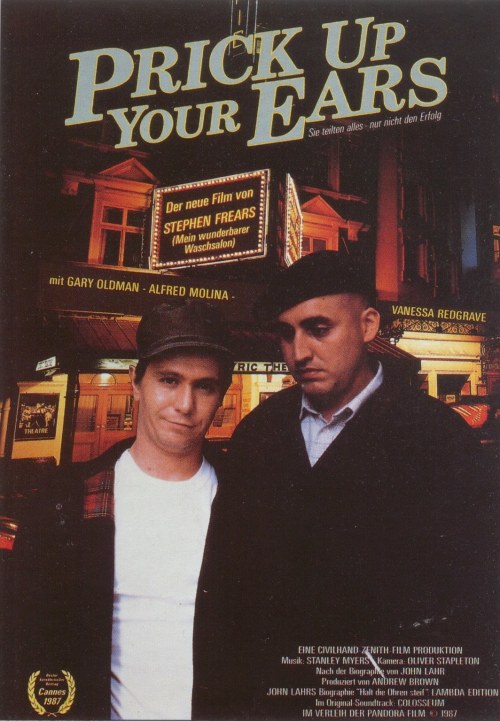
This film, which is based on the biography of playwright Joe Orton that was written by John Lahr, has two diametrically different story lines going on at the same time. One part has John Lahr, played in the movie by Wallace Shawn, going around interviewing people that knew Orton when he was alive, which includes Orton’s theatrical agent Peggy Ramsey (Vanessa Redgrave). The other part delves into Orton’s (Gary Oldman) relationship with his Kenneth Halliwell (Alfred Molina) showing how it began and then eventually ending in tragedy.

The film, which was directed by the usually reliable Stephen Frears, starts out right away with the murder scene showing Halliwell covered with blood as he stands over Orton’s body that he has just killed, which to me was a mistake. Sometimes using flashbacks in films can help accentuate the story, but here it gives too much away way too soon. What’s the point of continuing to watch the movie if the viewer knows exactly how it will end? Even if one such as myself was aware of Orton’s demise, which occurred on August 9, 1967 in Islington, England, it still should’ve approached the material in a linear way having the murder occur at the very end after we had gotten to understand and feel for the characters and therefore making the act all that more impactful.

The story should’ve started with the scene, which doesn’t occur until 30 minutes in, where Halliwell and Orton are attending a acting improv class, which is where the two first meet and the funniest moment in the movie. In the scene the students are instructed to pass around a make-believe cat and when this invisible cat gets handed to Halliwell, and to the shock of the other students, but to the amusement of Orton, he kills it and then hands it back to the instructor.  This moment also perfectly reflects the black humor that became so apparent in Orton’s plays as well as conveying the weird dynamic that the two had.

When the film focuses solely on the two lead characters and their love-hate relationship it is quite interesting. Molina gives a powerhouse performance and dominates every scene that he is in. His mental deterioration is both vivid and horrorifying and  leaves a lasting impression. Yet there are also other moments where you feel sorry the guy and it helps to make sense of what lead to the tragedy as you see how Orton, who is much younger and better looking, openly have trysts with other men that he randomly meets while Halliwell, fully aware of what is going on, gets pushed into the background and unable to do anything about it.

The film is also filled with some memorable imagery. The scenes where Orton and sometimes Halliwell would pick up strangers for indiscriminate sex, like in dingy public restrooms with the lights turned off and even at times inside the bathroom stalls themselves while constantly in fear of getting caught and arrested, is well captured. The tiny room that the two lived in for years, with pictures that cover every inch of the walls, gets recreated to a perfect tee. Based on images of the actual room found on Google it looks exactly like the one in the movie and its claustrophobic dimensions hits home making it seem amazing that such significant long lasting stage plays, that were later made into movies, could’ve been written in such an insignificant space that seemed no bigger than someone’s walk-in closet.

The opening bit that focused on Orton’s agent and having her reminisce about her experiences dealing with him is boring and should’ve been taken out of the final cut. Viewers come into this wanting to learn more about Orton and his relationship with Halliwell and that’s where the film should’ve started and stayed. I admit Redgrave gives a very good performance as the agent, so having brief scenes with her in them that intercut between the ones dealing with the lovers might have been interesting, but too much time gets spent on the side characters that almost dismantles the entire rest of the film.

Spoiler Alert!

I didn’t like how loud crashing music gets abruptly played during the murder sequence either. The soundtrack had been quite subtle up until then, so having it suddenly get loud is jarring and goes against the tone of the rest of the film. It also puts too much of a theatrical quality to the murder that was not needed. The  visuals are all that is needed to show the shocking and gruesome nature of the act without music needing to be any part of it.

My Rating: 7 out of 10

Released: April 17, 1987

Runtime: 1 Hour 45 Minutes

Rated R

Director: Stephen Frears

Studio: The Samuel Goldwyn Company

Available: DVD

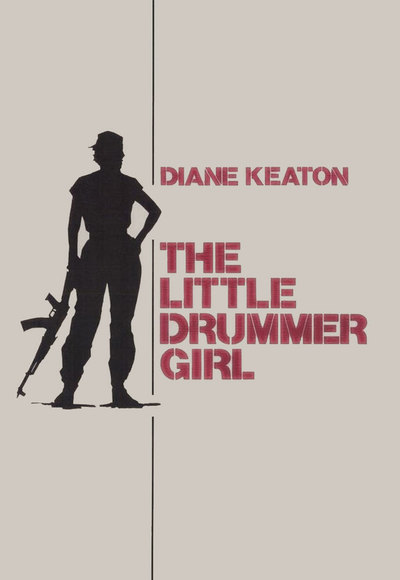
The Little Drummer Girl (1984)

By Richard Winters

My Rating: 5 out of 10

4-Word Review: Actress infiltrates terrorist organization.

Charlie (Diane Keaton) is a stage actress with pro-Palestinian leanings who’s living in Israel. After a Palestinian bomber kills a Israeli diplomat and his family she gets recruited by a pro-Israeli spy organization to pretend to be the bomber’s brother’s girlfriend. At first she resists, but eventually she puts her acting skills to work until she gets deeper and deeper into the quagmire and begins to question what she really stands for.

The story, which is based on the novel of the same name by John Le Carre, who appears briefly in the film as a police chief, has a lot of exciting moments and a few unexpected ones. For the most part I found the plot intriguing and the twists and turns to be interesting although if the viewer doesn’t pay close attention they could easily become lost.

Klaus Kinski’s performance makes it worth seeing. He suffered from mental illness in his personal life and due to that as well as his unique facial features usually stymied him in roles of madmen, or troubled individuals, but here he plays someone who is actually normal and does a convincing job of it. His presence definitely enlivens the proceedings to the point that he should’ve been the sole face of the Israeli organization and not crowded out by a throng of assistant players who are not interesting and become clutter to both the story and visuals.

Keaton is great here too and one of the main reasons that the film remains as interesting as it does. Her emotional confusion comes off as sincere and the fish-out-of-water concept where she gets thrown into a world that she is not used to and must use her wits and acting talent to get by is at first riveting.

Unfortunately the second half goes too far to the extreme where Charlie no longer resembles the same person that we met at the beginning. Some may argue that this is her character arch, but she still needs to have a consistent foundation and not morph into something completely different with no roots to what she was before. She starts out as someone only going along with the charade because she’s forced into it. She’s very clumsy at first, but then by the second half is able to put a gun together while blindfolded and seamlessly detonate a bomb without a sweat like a seasoned spy with years of experience.

She’s given an opportunity to get out and yet she decides to proceed even as things get more dangerous, which makes little sense since she didn’t conform at all with the political sentiments of the organization that recruited her. Any regular person would have a mental/emotional breakdown at seeing someone killed before their very eyes, or required to go to bed with a stranger that she barely knew, and the fact that she doesn’t reveals how the filmmakers had a very poor grasp on the character.

All of this could’ve been avoided had they modeled her after the one in the book. For the film the producers decided to portray Charlie as being similar to Vanessa Redgrave, but in the book the character was inspired after Janet Lee Stevens who was an American journalist, human rights activist, and Arabic literature scholar who traveled to the Middle East as an interpreter and had no connection to acting. Having the film focus on a young activist whose extreme idealism ends up getting her in-over-her-head would’ve been more compelling and believable. Throwing in the acting angle just doesn’t work and ends up becoming its biggest liability.

My Rating: 5 out of 10

Released: October 19, 1984

Runtime: 2 Hours 10 Minutes

Rated R

Director: George Roy Hill

Studio: Warner Brothers

Available: DVD (Warner Archive), Amazon Video, YouTube

Agatha (1979)

By Richard Winters

My Rating: 4 out of 10

4-Word Review: Agatha Christie runs away.

Despondent over her husband’s affair famous British novelist Agatha Christie (Vanessa Redgrave) decides to go away for a while to collect her thoughts. She then gets into a car accident while on the road and having her car disabled she first takes a train and then a cab to the Old Swain Hotel where she registers there under an assumed name. The police find her disabled car and fear that Agatha may have drowned in a nearby lake, been kidnapped, murdered by her husband Archie (Timothy Dalton) or committed suicide. A nationwide search begins that encompasses thousands of volunteers that scour the nearby countryside for clues. Meanwhile American reporter Wally Stanton (Dustin Hoffman), working off of  a tip from Agatha’s secretary, decides to check into the same hotel and begins following Agatha around where he keeps notes on everything she does while also falling in love with her in the process.

The film is loosely based on Agatha Christie’s real-life 11-day disappearance that occurred in 1926. No explanation was ever given for the reason nor was it even mentioned in her autobiography. Had there been some actual research about what might’ve transpired during those 11-days then this would be worth a look, but, as the film plainly states at the beginning, it is simply an ‘imaginary solution to an authentic mystery’, so then what’s the point?

Most likely it was nothing more than a woman looking to escape to some quiet location for a short respite that unfortunately due to the press getting wind of it, spiraled quickly out-of-control. The film’s low point comes in the side-story dealing with Agatha’s attempts to kill herself through a jolt of electricity from sitting in a Bergonic chair, but is saved at the last second by Wally who grabs her from the chair just as she’s shocked. Yet as he lays her limp body on the floor he doesn’t perform CPR, but instead shouts at her to ‘breath’ several times and despite no scientific study proving that this ‘technique’ can actually work she still miraculously begins breathing again anyways.

I have never read a biography on Christie, so I have no idea what her real personality was like, but the film portrays her as being a complete wallflower lacking any type of confidence and so painfully shy it’s pathetic. The character is so transparent it’s almost like she’s not even there. Hoffman’s character was completely made-up and the way he chain smokes reminded me too much of the character that he had played in Midnight Cowboy. His growing ‘love’ for her and the way he later expresses it is extremely forced and corny. Also, why is Hoffman given top billing when the main subject is Agatha?

Johnny Mandel’s soothing score is the best thing. I also liked the shot of the thousands of volunteers searching for her along the vast countryside, but everything else about the movie gets either under cooked or overbaked. The scene where Agatha tries to do a triple bank shot while playing pool gets badly botched. We initially see it captured from above where the entire pool table is in view. The pool ball banks off the side and rolls towards the corner pocket, but then it slows up and it becomes clear that it won’t make it to the pocket, so director Michael Apted cheats by cutting to a close-up of the ball and having it magically regain speed, which easily makes it into the corner pocket. The attempt was to ‘trick’ the viewer into believing that this was a continuation of the same shot but any halfway savvy person will realize this close-up was shot later and edited in.

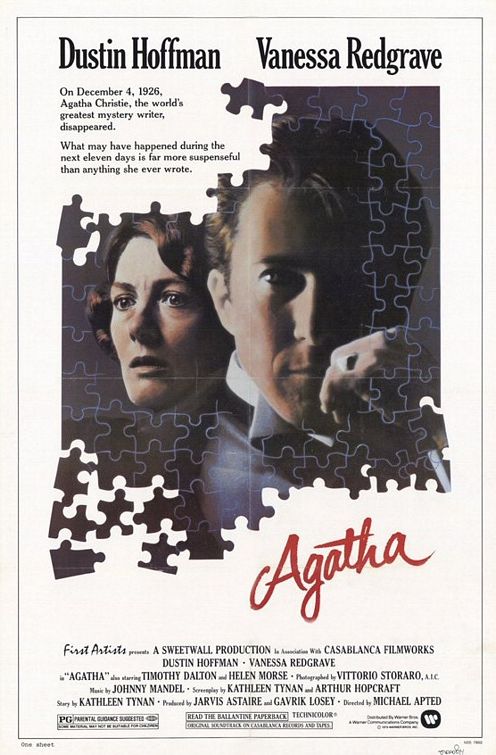
The film’s poster tells us that ‘What may have happened during the next 11 days is far more suspenseful than anything she ever wrote’, but it really isn’t and in fact it’s not even close. The original intent by screenwriter Kathleen Tynan was to make this into a documentary after researching the true facts of the case, which would’ve been far better than the flimsy fanciful thing we get here.

My Rating: 4 out of 10

Released: February 9, 1979

Runtime: 1Hour 38Minutes

Rated PG

Director: Michael Apted

Studio: Warner Brothers

Available: DVD-R (Warner Archive), Amazon Video, YouTube
Steaming (1985)

steaming

By Richard Winters

My Rating: 2 out of 10

4-Word Review: Saving a steam room.

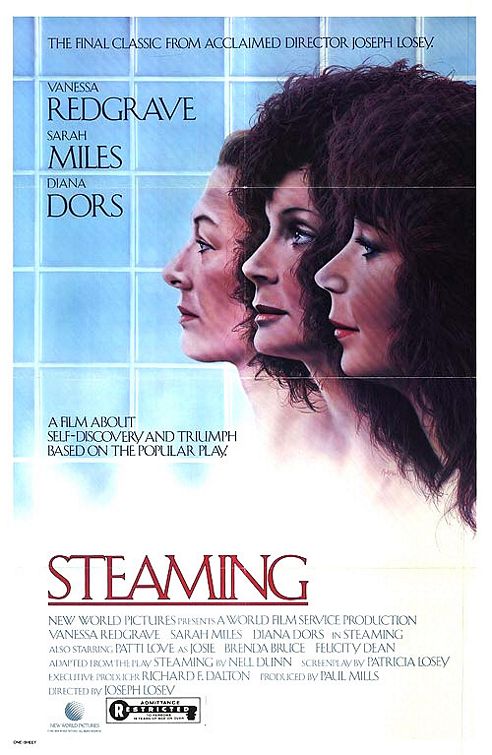
Three women (Vanessa Redgrave, Sarah Miles, Patti Love) congregate at a London steam room designed like a Turkish bathhouse. Despite their lifestyle differences they become good friends as they divulge their problems to one another and learn to lean on each other to help them cope with life’s difficulties. Then one day Violet (Diana Dors), who is the bath house owner, informs them that the place is set for demolition, which causes everyone to go on a mission to try and save it.

The film is based on the Nell Dunn play, which was highly regarded at the time, but makes for a very poor transfer to film. It starts out flat and never recovers. The dialogue has too much of a conversational quality that is not interesting and the problems that they discuss are not compelling, or original. The humor from the play is missing and the dry, somber tone only makes things even more boring. The only time it gains any traction is when it’s announced that the place is closing, but everything gets resolved in such a sitcom-styled way that it hardly seems worth the effort to watch.

The entire cast is made up of women and there is an abundance of nudity particularly from Miles, which doesn’t seem like a big deal these days. The biggest issue though is the fact that everything takes place from inside the bath house, which is gray, grimy, and rundown. The film should’ve had some segments shot from different locales if to only allow for some visual variety and to help the viewer understand the characters better by seeing how they react in different social settings.

Miles and Redgrave are wasted in drab roles and this goes likewise for Dors whose last film role this was. Love is the only one that shows any liveliness and although her character is a bit annoying she at least has an emotional breakdown near the middle, which adds some mild dramatic tension.

Joseph Losey was a competent director who made many interesting films, so it’s a shame that his career had to end with such a dud. He was already sick with cancer while he filmed this and like with Dors died a year before it was released. The disease may have sapped his creative energy and explain why this production is so ponderously sterile. It’s certainly a far cry from his other works as well as the Bruce Jay Friedman play Steambath, which had a similar setting, but a much more imaginative plotline.

My Rating: 2 out of 10

Released: September 28, 1985

Runtime: 1Hour 31Minutes

Rated R

Director: Joseph Losey

Studio: New World Pictures

Available: DVD (Region 2)