Tag Archives: Tony Lo Bianco

F.I.S.T. (1978)

fist

By Richard Winters

My Rating: 7 out of 10

4-Word Review: Laborer becomes union leader.

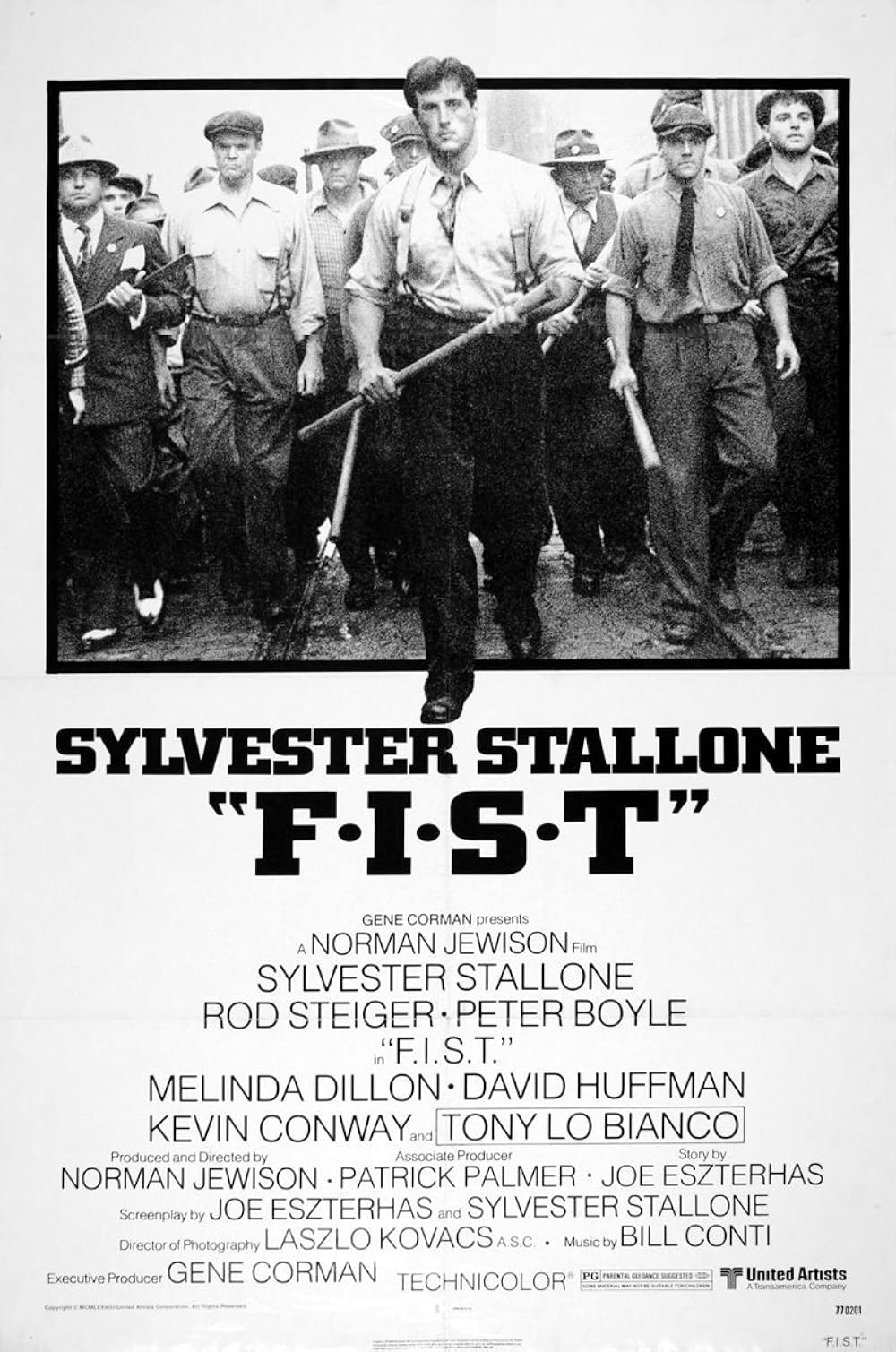
Set in the 1930’s in Cleveland the story centers on dock worker Johnny Kovac (Sylvester Stallone) who becomes so upset at the poor treatment of the employees that he leads a revolt that soon gets squashed by a management when Kovac goes to the office of Mr. Andrews (James Karen) who promises to bring his demands to ownership only for the next day to have Kovac and his friend Belkin (David Huffman) fired from their jobs. Impressed though by their tenacity truck driver Mike (Richard Herd) recruits them into his union telling them they would have a job of going out and recruiter others. Kovac initially refuses the offer until he finds out that a free car would come along with it. Kovac eventually rises up the union ladder until he becomes their national leader, but with the power and prestige also comes corruption and enemies.

This was Stallone’s first film after doing Rocky, which was a bit of a gamble by director Norman Jewison. He had wanted to cast Jack Nicholson in the role, Nicholson would later star in a similar film Hoffa, which came out 14 years later, but was so impressed at Stallone’s performance in the boxing film that he offered the role to him before he was even a household name. Jewison felt Sly was a star in the making just from what he saw in the preview of the film not knowing whether that movie was ultimately going to be a runaway success, or not. Had it not it might’ve put him in an awkward position as the studio wasn’t likely to finance a project that didn’t have guaranteed star power. As it was it became a blockbuster making the tables-turned a bit because Stallone could’ve easily backed out of the deal since it had only been a verbal agreement and he had since then been offered higher paying roles, but he kept to his word and took on this project, which surprised Jewison as many big names in Hollywood don’t always stick to their promises, but then later when the film didn’t do as well as expected Jewison’s blamed Stallone’s casting as part of the problem.

From my perspective I thought Stallone was terrific. His delivery does come-off as a bit monotone, but I felt that’s what added to the authenticity as this was a character with a limited education, so he probably wouldn’t sound real smart to begin with. Seeing Sly fight the system correlated with his real-life struggles as an actor trying to make it big in a competitive business, which helped to make it seem all the more genuine like this was a guy who had really lived the same type of life as the man he was playing.

In support I was highly impressed with David Huffman. This was an actor, whose career and life were sadly cut short in 1985 when he got stabbed to death, who I had always found quite bland. He had an attractive looking face, which I figured is what got him his foot-in-the-door, but his acting always came off as blah, but here he puts a lot of emotion into his role and it’s interesting to see the way his character grows and morphs throughout. James Karen and Tony Lo Bianco both have small parts, but there sinister facial expressions and ability to mug to the camera without it seeming obvious is what helps them stand-out. I was surprised though with Rod Steiger who gets second billing, but doesn’t appear until 1 Hour and 33 minutes in. His part, as a powerful senator, does ultimately become integral to the proceedings, but the fact that he underplays instead of his usual over-acting is what got me.

I thought the way Jewison captured the setting was great. It was actually shot in Dubuque, Iowa because by that time Cleveland no longer looked the way it once did, but the flavor and vibes from that period come-out strong and you feel right from the start that you’re being swept away to a bygone time. Stallone’s ascension into the ranks of union head prove riveting, but his corruption and downfall get glossed over and seemed rushed. I did though appreciated the way it examines worker’s unions from all angles both the good and bad making it seem less like a propaganda movie than Norma Rae, which came-out at around the same time, but only focused on the positive aspects of unions.

Spoiler Alert!

The ending, in which Kovac gets shot and killed while in his home came-off like a cop-out. It was intended to reflect at the time the recent disappearance of union head Jimmy Hoffa, but seeing the main character get assassinated without telling who was behind it proves unsatisfying. Sure we could probably surmise who the culprits were, but having to sit through a long movie only to be left with more questions than answers makes the viewer feel like watching it had been a big waste of time.

My Rating: 7 out of 10

Released: April 13, 1978

Runtime: 2 Hours 25 Minutes

Rated PG

Director: Norman Jewison

Studio: United Artists

Available: DVD, Blu-ray
Too Scared to Scream (1984)

tooscared3

By Richard Winters

My Rating: 3 out of 10

4-Word Review: Who’s killing the tenants?

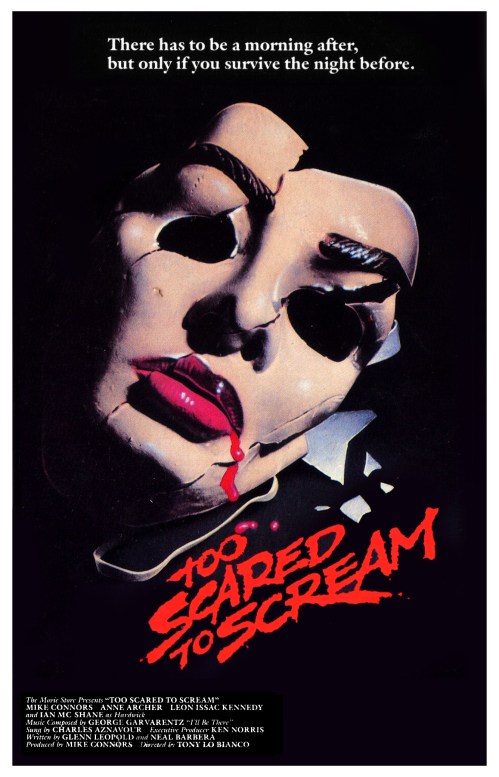
Female tenants living in a New York City high-rise building are turning-up dead in brutal fashion. Lieutenant Alex Dinardo (Mike Connors) and his younger, female partner Kate (Anne Archer) are convinced that the culprit is Vincent (Ian McShane) who works as the overnight watchmen at the apartment building and since all the crimes happen during his shift he quickly becomes suspect number one. Though getting enough evidence in order to arrest him becomes a delicate matter. Alex then decides to asks Kate to move-in to the building as a new tenant and thus keep tabs on what Vincent is doing and hopefully lure him into a situation where he’ll incriminate himself, but Kate soon finds herself in over-her-head as the killer is on-top of what’s going on and he soon bates her into a dangerous game of cat-and-mouse where Alex and the other policemen are not able to help her.

The film was an attempt at creating an American version of an Italian giallo complete with gory murders and an intricate mystery where you don’t know who the real killer is until the final twist ending. It’s also the only film to date to be directed by actor Tony Lo Bianco. Severely straddled during production as it was shot in 1982, but due to the production studio that financed the project going bankrupt it was never released until 3 years later where it was given little fanfare and came and went with few people seeing it.

The biggest problem with it is that it plays-up McShane’s role too much. Granted he’s a gifted actor who’s best known today for his work in the TV-series ‘Deadwood’, but by overemphasizing his character it makes it seem right from the start that he’s the culprit and thus making the investigation uninteresting because you feel it’s just a matter of time before he’s found out and thus little mystery, or intrigue. Granted there are a couple of other suspects, but they seem thrown-in simply as red herrings and aren’t seen much. The story would’ve had better tension had the suspects shared equal screen time and a more balance of clues making it seem like any one of them could’ve done it and thus some genuine interest at getting at what the truth is versus having it seem like it’s all spelled-out from the start. If anything Maureen O’Sullivan, who plays McShane’s near comatose mother whom he takes care of, is far more captivating, despite the fact that she doesn’t speak any line of dialogue and trapped in a wheelchair, then anything McShane himself does.

The unusual pairing of a 60-something male cop alongside a female one that appears to be only around 30 should’ve been what the film focused on as I found their contrasting personalities and different ways they approached their police work to be something that could’ve been played-off of more. Unfortunately the film taps into this just slightly and then quickly moves on and thus misses the opportunity for what could’ve lead to captivating confrontations and debates. Connor does seem a bit too old for this kind of thing and seeing him trying to chase down a young athletic man who was only 20 came-off as almost laughable and I was surprised he didn’t just fall over from a heart attack, or exhaustion before he ever managed to get near the guy. Having him lose a fight to the younger guy and have to depend on his partner to bail him out of it was realistic, so it gets props there, but the way he goes about his police work, which includes physically beating-up on suspects, is highly unethical and should’ve gotten him demoted, or fired.

Spoiler Alert!

I had issues with Archer’s character as well. This comes when she agrees to move into the apartment and work undercover, but seems woefully unprepared for it. She manages to carry a gun with her when she goes down to the basement of the building to do laundry, but then when she gets back to her place she does a goofy aerobics workout where she gets caught off-guard, but wouldn’t a seasoned cop know to carry a weapon on her at all times especially when she’s intentionally making herself a target to the killer? Also, what kind of person walks into their apartment and then doesn’t turn around and immediately lock the door once they’re inside? If you want to argue that this was intentional (I don’t think it was) because she wanted to lure the killer inside, so as to apprehend him, then fine, but she should then make damn sure she was a gun in-hand, pointed at him, when he does, which in this case she didn’t.

You must likely won’t be able to guess who the true killer is, but it’s not worth sitting through. The script doesn’t offer any clues, or hints either, so even an alert viewer won’t figure it out, but that doesn’t mean it’s a good mystery because it really isn’t. The story is sloppily put together without much imagination, or character development. Unlike a true giallo the murders are quick and without much blood, so if you’re a gorehound this thing won’t suffice. The concept had potential, but the execution is half-hearted.

My Rating: 3 out of 10

Released: September 28, 1984

Runtime: 1 Hour 40 Minutes

Rated R

Director: Tony Lo Bianco

Studio: International Film Marketing

Available: Blu-ray (Import), DVD-R

Goldenrod (1976)

goldenrod1

By Richard Winters

My Rating: 4 out of 10

4-Word Review: Injured champ seeks comeback.

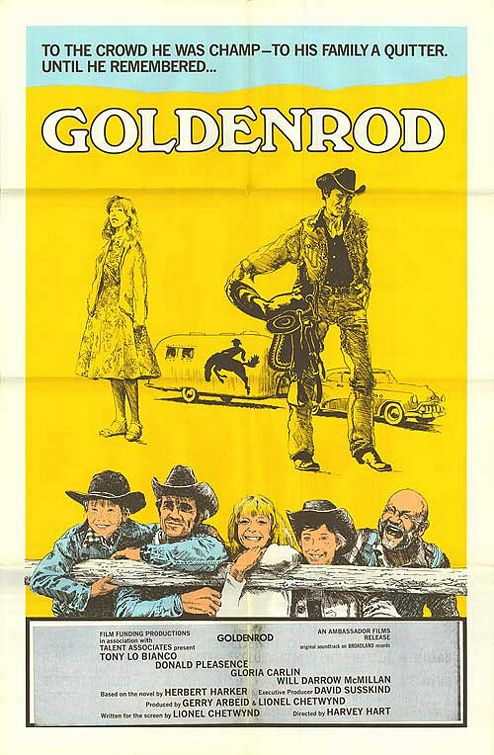
Jessie (Tony Lo Bianco) is a successful rodeo rider who’s idolized by his oldest son Ethan (Will Darrow McMillan). His fortunes though take a turn for the worse when he’s seriously injured by a horse who stamps on his hip. Doctors tell him he’ll never be able to ride again, which causes him to become depressed. His wife Shirley (Gloria Carlin) leaves him for another man (Donnelly Rhodes) forcing him to go searching for other employment. After doing odd jobs he finally gets hired by John (Donald Pleasance) a alcoholic who lives alone on a farmstead and promises big things, but delivers little. Jessie’s depression worsens and he even attempts to kill himself, but his son Ethan saves him. Ethan then tells him that he wants to be a rodeo rider, hoping that the money he wins can help get the family back on track, but Jessie worries that Ethan will face the same hardships that he did and tries to talk him out of it, but to no avail.

This Canadian entry, which was filmed on-location in the province of Alberta, and partially shot at the world famous Calgary stampede, works off the same formula as the Canadian classic Goin Down the Road, which focused on two losers with big dreams who get in way over-their-heads. Jessie character is the same way. When he’s winning he’s arrogant and thinks he’s above the common man only to then learn a hard lesson. This type of character arc though isn’t interesting as the viewer shares no emotional connection in the protagonist’s plight and in some ways delights at seeing his misfortune since he was so diluted at the start that it all seems like a good comeuppance to bring him back down-to-earth.

Lo Bianco plays the part surprisingly well being that he was an Italian-American born and raised in Brooklyn, so why the producers felt he’d be a good pick to play a Canadian cowboy is a mystery, but he pulls it off and even manages to speak in a Canadian accent while losing his Italian one that he spoke with in The Honeymoon KillersThe character though is almost cartoonish with a child-like optimism that you’d think by middle-aged would’ve been vanquished. He starts to show some humility towards the end, but more of it should’ve come-out already at the beginning in order to make him appealing and relatable.

The film focuses quite a bit on the wife at the start only to have her disappear and then eventually come back at the very end, but this is too much of a departure and the movie should’ve cut back and forth, at least a little bit, showing how she was getting along with her new hubby while Jessie struggled raising the kids. Also, you’d think if she really loved the kids she’d want to stay in contact with them and not just abandon them, which is how it comes-off. Pleasance, who spent the 70’s dotting-the-globe working on films in three different continents, gets wasted in a role that starts out with potential, but ultimately doesn’t lead to much.

The picturesque scenery is nice, but the benign story doesn’t have anything unique or memorable. The dialogue lacks a conversational quality and used more to help narrate the story and describe what’s going on that in a good film should’ve been shown visually. I was surprised too that it takes place in the 50’s because it wasn’t until halfway through when a poster advertising a rodeo and the date on it is 1953 that I had even became aware of this. Up until then it could’ve easily been the 70’s. The only two things that give it a bit of a period flavor are the older model cars, but since some people like to drive these refurbished vehicles I didn’t consider it a tell-tale sign that it was a bygone decade. There’s also brief shots of the Canadian Red Ensign, which was the Canadian Flag before the Maple Leaf one, which didn’t come into effect until 1965. Otherwise this could’ve easily been a modern day story and probably should’ve been as setting it in the past doesn’t give it any added insight.

My Rating: 4 out of 10

Released: September 22, 1976

Runtime: 1 Hour 37 Minutes

Not Rated

Director: Harvey Hart

Studio: Ambassador Film Distributors

Available: None