Tag Archives: Tom Conti

Shirley Valentine (1989)

By Richard Winters

My Rating: 7 out of 10

4-Word Review: Trying to find purpose.

Shirley (Pauline Collins) is a middle-aged woman married to Joe (Bernard Hill) and having two grown children but feeling like her life lacks purpose. While her marriage started out well the passion has now faded and the two find themselves at odds sometime for the most minor of things. Seeking change Shirley jumps at the chance of getting out of working-class England by taking a trip with her friend Jane (Alison Steadman) to Greece. During her vacation she meets up with bar owner Costas (Tom Conti) where he takes her on his boat and the two make love. When it’s time for her to return back home she instead skips out on taking the flight and remains in Greece while taking a job as a cook at Costas’ restaurant, but Joe won’t let go of his marriage and travels to where Shirley is now living in an attempt to woo her back.

The film is based on the stage play by Willy Russell, but with some big differences as the play had only one character, Shirley, and a running monologue. Some of the monologue remains by having her routinely break the fourth wall and speak directly to the camera, which most of the time works and isn’t a distraction. It even helps tie-in some loose ends by allowing us to understand Shirley’s inner motivations, but I didn’t like how the film ‘explains’ her running commentary by having her get ‘caught’ by some of the characters, like Costas, speaking out loud to herself and having them walk away thinking she’s gone ‘a bit batty’. Other films have done a similar concept but play it off more like time just freezes and thus allows the protagonist to speak their thoughts for a bit and I felt the movie should’ve stuck to this same rationale.

The acting is excellent with Collins reprising the same role she had played onstage. Her matter-of-fact delivery and the terse little frown she exudes when she’s with someone she secretly can’t stand help expose her character’s down-to-earth sensibilities though I could’ve done without her nude scenes from both the front and back. Conti is also good playing a Greek man with authentic sounding accent at least I felt it was though other critics weren’t all in agreement.

The story itself is a bit slow with Roger Ebert describing it as a ‘realistic drama of appalling banality’. However, for me that’s what made it work. There’s a lot of people like Shirley out there longing for some point to why we’re here and not able to find the satisfaction through the normal social functions of marriage and raising a family. Too many times, we’re told that having a family should be fulfilling and make us ‘happy’, but for some people that’s not always enough and sometimes just makes things worse especially in Shirley’s case where the kids, now adults, treat her like someone to be taken for granted.

I also liked the way it explored loneliness. Most films that deal with this subject usually portray the person as being the one at fault by having them afflicted with poor social skills, or behaviors that cause others not to want to be around them. Here though it’s Shirley’s ‘friends’ that are the annoying ones and could turn off most anyone. Just having people around doesn’t mean one is actually connecting, and the film deftly examines how a person can be smart and friendly and yet still fall through the cracks.

Spoiler Alert!

The trip sequence, which takes up the third act, is well done as Shirley’s loneliness doesn’t just automatically end with a change of scenery. The fling that she has is okay, but when she decides to stay on and overhears Costas feeding another woman the same lines he had given her about coming onto his boat, I thought she should’ve responded with a hurt, or angered look. Instead, she’s amused, but I’d think most other people in the same situation would’ve felt used and taken advantage of.

I did like the husband coming to Greece at the very end, but I believe his character should’ve been more toned down earlier. The way he gets so extremely upset at not being served the meal he was expecting and then throwing the food on her lap made him seem mentally unhinged. In some marriages people just grow apart. They can both be good people, but through no one’s fault, have much in common and I think the film could’ve approached it that way versus having him blow up in a very over-the-top way that was almost frightening.

My Rating: 7 out of 10

Released: August 24, 1989

Runtime: 1 Hour 49 Minutes

Rated PG-13

Director: Lewis Gilbert

Studio: Paramount Pictures

Available: DVD-R (Warner Archive Collection), Amazon Video, YouTube
Beyond Therapy (1987)

By Richard Winters

My Rating: 3 out of 10

4-Word Review: Therapists nuttier than patients.

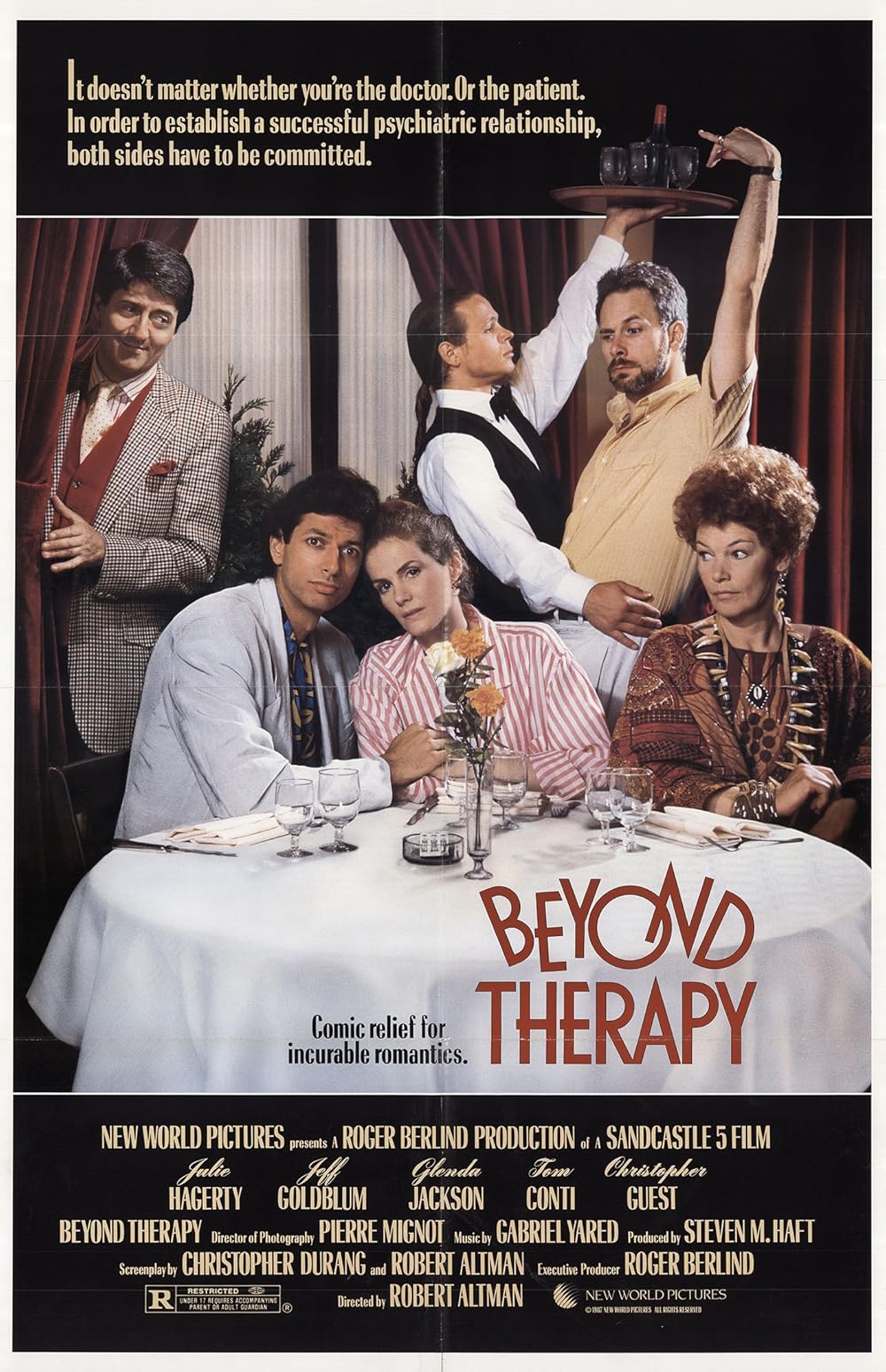
Bruce (Jeff Goldblum) is a bisexual who’s tired of his relationship with Bob (Christopher Guest) and thus decides to place a singles ad looking for a female companion. Prudence (Julie Hagerty) answers and the two meet-up at a restaurant, but they find there’s too many differences between them and fail to hit-it-off. Bruce then goes to Charlotte (Glenda Jackson), his therapist, while Prudence visits Stuart (Tom Conti) who’s her therapist and works in the next room beside Charlotte’s. After some counseling, and at Charlotte’s suggestion, Bob places another ad, but changes some of the personal details, causing Prudence to again answer it thinking it’s a different person. They meet at the same restaurant, but this time things click and they agree to go out again, but Bob and his meddling mother Zizi (Genevieve Page) don’t like the fact that Bruce is seeing somebody else and become determined to ruin the potential relationship as does Stuart, who once had a fling with Prudence, and wants to rekindle the old flame, but only if he can get Bruce out of the way.

The film is based on the hit stage play of the same name by Christopher Durang and while that one got rave reviews this version falls off its hinges right away and a lot of the blame should be pointed at director Robert Altman who rejected the screenplay that Durang had written and instead revised it severely causing Durang to feel that very little of his original work was left and lamenting in later interviews that his experience working on this project was an unhappy one. The story is supposed to be set in New York City, but because Altman was living in Paris at the time he choose to shoot it there, but New York’s ambience, where the single’s scene is quite strong, would’ve helped accentuate the theme and allowed for a more vibrant backdrop versus here where everything takes place in a bland cafe, or in the therapists office, with the exception of a few scenes done in Bruce and Bob’s pad, that hampers the visual flair and makes the production look stagnant and cheap. It also ends with a bird’s eye shot of the Paris skyline, but since everyone was speaking in English and without a French accent it makes it off-kilter, and they should’ve at least pretended it was New York even if it wasn’t.

Goldblum comes off as too detached and thus isn’t effective for this kind of role. Hagerty has her moments and at least gets some laughs, but her open disdain for gay people, along with some of her character’s other quirky hang-ups, may not go over well with viewers. Guest plays the gay lover role in too much of a cliched way making him seem like a walking-talking parody, while Page, as his overprotective mother, is excessively hammy and her exaggerated behavior gets in the way and doesn’t add much.

Jackson is a big disappointment though it’s not all her fault as Altman insists on shooting the majority of her scenes through the window of her office making the viewer feel cut-off from her and like she’s intended to be a caricature. Her confusion over words is more disconcerting than funny. Having a therapist that’s a bit daffy is okay and might even be good enough for a chuckle or two, but here she seems genuinely nuts to the extent that you wonder why Bruce would continue to see her. How she’s able to pick-up words said by Stuart in the other office is never made clear, they also seem to have sporadic sexual rendezvous in the room that’s in-between their offices, but this only gets implied and never actually shown though it should’ve been. Conti’s performance is annoying as he speaks in this fake sounding Italian accent, which he finally drops near the end, but should’ve done way sooner.

There are a few in-jokes in regard to Jackson that I did like. One is a refence where her son, played by Cris Campion, asks her to cry, which she does in a comic sort-of way and I think this was alluding to her performance in A Touch of Classwhere the script asked for her character to cry, but she refused insisting that crying was just something she didn’t do, so here you finally get to hear her do it, which is fun. Later there’s another bit where Bob talks about the movie Sunday Bloody Sundaya film that Jackson was in, though here he describes her as being ‘that English actress’, which is amusing, but would’ve been even funnier had, when he later meets her, he could’ve said ‘you look exactly like the English actress in that movie.’

Spoiler Alert!

While the film does become semi-engaging even with its rough, awkward start it manages to blow it up with a dumb conclusion, which has Bob shooting at Bruce with a toy gun while inside the restaurant. We already know it’s a toy because he tried to use it on Charlotte earlier, so having this extended slow-motion sequence where all the customers duck for cover, doesn’t work and becomes overdrawn instead of funny, or suspenseful. Having the group then remain in the restaurant afterwards and even get served food was equally ridiculous as anyone that would’ve caused that much of a melee would most certainly be asked to leave or arrested by the police for causing a disturbance.

My Rating: 3 out of 10

Released: February 27, 1987

Runtime: 1 Hour 33 Minutes

Rated R

Director: Robert Altman

Studio: New World Pictures

Available: DVD, Blu-ray, Amazon Video, YouTube

Reuben, Reuben (1983)

reuben1

By Richard Winters

My Rating: 6 out of 10

4-Word Review: Housewives lust for poet.

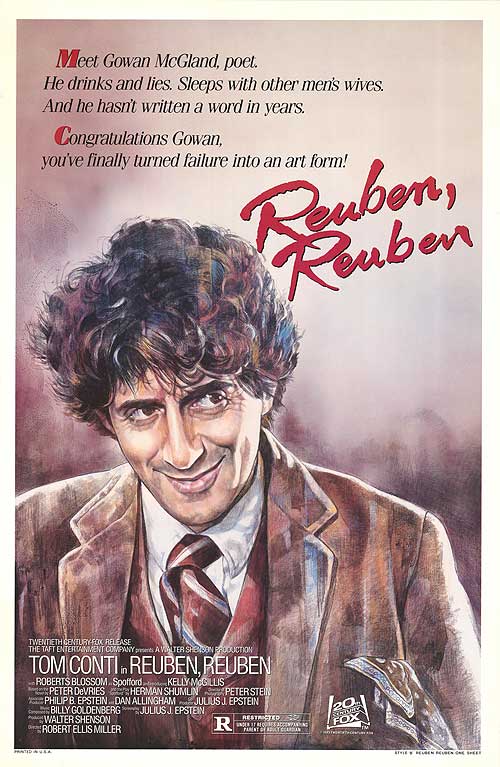
Gowan (Tom Conti) is a middle-aged poet going through writer’s block who hasn’t written anything in 5 years and manages to remain solvent by touring around a college town and reciting his older writings to women’s clubs. The stress though of not being able to produce anything new causes him to turn to alcohol and further rescinds his writing ability. Geneva (Kelly McGillis) is a college student several years his junior who spots him on a train one day and agrees to pay his fare when he’s found not to have any money. This generosity manages to have a profound affect on him and he makes a commitment to mend his ways while also going out with Geneva on casual dates. The awkward love affair doesn’t go far as Gowan continues to drink and embarrass her every time they go out. When Geneva finds out she’s pregnant the two then must decide how they will proceed.

Unusual romantic flick that has all the ingredients of failing, but manages somehow to have a certain light appeal. Much of this is thanks to McGillis, who in her film debut really shines and while this film is not one of her better known ones I still consider it her best work. Normally film’s dealing with May-December romances don’t work because the younger partner is always portrayed as being wide-eyed and naïve, but here it’s Geneva that’s the sensible one who calls all the shots and remains in control. This change of pace gives the old theme a refreshing new spin and made it palatable enough to hold my interest and in certain moments even becomes touching.

Conti gives a good performance, but he seems more like a caricature. He wears the same dowdy outfit all the way through making me wonder if that was the only suit he owned and if so whether he reeked of odor. I found it hard to believe that this guy, who looks like he was living on the streets, would attract all these frustrated housewives who’d be rushing to go to bed with him. With all the alcohol he consumed I’d have serious questions whether he’d be able to perform, or how sex with him could possibly be much better than with their husbands as I would think it might actually be worse.

Supposedly this was all meant as ‘satire’ and based loosely on the life of Dylan Thomas. Possibly in book form, as this was based on the novel of the same name by Peter De Vries and then later turned into a stage play, it might’ve worked, but as a film set in the modern day it’s confounding. Thomas hit his fame in the 30’s and 40’s when movies and television where just getting started and therefore writers held more clout, but by the 80’s there were so many other types of celebrities that some frumpy looking drunk guy who used big words to create long poems wouldn’t be someone a suburban housewife would get all that excited over. The opening sequence shows the reactions on their faces as they listen to him recite some of his writings and while one of them has a confused look on her face I felt they all should’ve and for my money that would’ve been really funny.

Spoiler Alert!

The finale, which Leonard Maltin in his review calls ‘curious’, but I’d describe more as ill-advised is the one thing that really hurts it. I’m not sure what the thinking was other than Dylan Thomas died young so possibly they felt Gowan needed to die too, but it was the wrong decision. Normally I get annoyed with movies that tack-on a happy ending and have everything work-out even when it’s not earned, but this film works in reverse by throwing in a very sad one that comes out of nowhere and doesn’t fit the tone of the rest of the movie, which for the most part had been quite whimsical.

The way it gets done is pretty dumb too as he elects to hang himself inside his apartment after he finds out all of his top teeth, many of which have been rotting for years due to neglect, would have to be removed. While losing teeth is no one’s idea of fun it does happen to a lot of folks of all ages and dentures (this was made before the advent of implants) if fitted properly aren’t always that noticeable, so to kill yourself over something like that seemed awfully rash.

Just as he’s about to hang himself he gets inspired again to write and even excited about finding new women to sleep with, but then a lovable sheep dog named Reuben runs into the room (you’d think someone planning to kill himself would have the sense to shut his door and lock it) and being overly affectionate jumps-up and knocks down the chair that he’s standing on, which comes-off as being more farcical than anything. I was fully expecting the wooden beam that the rope was tied around to break from the stress of all the weight, which in reality I think it would, but instead it doesn’t and he’s left hanging leaving me genuinely baffled. For such an otherwise light and quirky movie to end this way was very jarring.

My Rating: 6 out of 10

Released: December 19, 1983

Runtime: 1 Hour 41 Minutes

Rated R

Director: Robert Ellis Miller

Studio: 20th Century Fox

Available: DVD, Blu-ray