Tag Archives: Teri Garr

The Conversation (1974)

By Richard Winters

My Rating: 10 out of 10

4-Word Review: Someone is listening in.

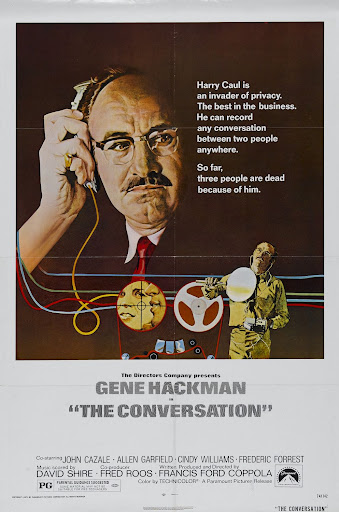
Harry Caul (Gene Hackman) is a surveillance expert who specializes in listening into people’s private conversations and has a reputation of being quite good at it. Many wealthy clients hire him to record things from their enemies that they might not be able to attain otherwise. However, one of these assignments led to the death of three people and Harry, being a highly religious man, has felt guilty about it ever since. He begins to have the same concerns with his new assignment when he overhears a couple (Fredric Forrest, Cindy Williams) who he’s recording mention that ‘he’d kill us if he got the chance’. Harry is unsure if he wants to give the tapes up to his client as he’s frightened the same scenario as before will occur. Martin (Harrison Ford) the man representing the client becomes aggressive in getting the tapes and warns Harry that they’ll get their hands on them one way or the other. Harry, a private man, soon realizes that this client is just as sophisticated in surveillance technology as he and maybe even more so as he becomes aware that his phone and even his apartment is bugged.

Inspired by real-life surveillance expert Martin Kaiser, who was a technical consultant on the production, the film deftly explores how today’s modern technology has easily evaded our private lives and how no one is safe from prying eyes and ears a concern that has become even more pronounced in the decades following its release. Many presumed that it was a testament about the Watergate break-in, which occurred a year before the movie came-out and uses much of the same sound equipment used the by criminals in the real-life event, but in actuality the script, by Francis Ford Coppola, was already complete in 1965, but was unable to get any financial backing until his success with The Godfather. 

The film scores on just about all levels especially with the way it captures San Francisco. I loved the bird’s eye-opening shot of Union Square as well as the terrific use of the fog that gets used to great effect during a memorable dream sequence. The soundtrack by David Shire is quite unique as it’s made to replicate sound waves changing frequency. I liked too that quite a bit of time is spent showing Harry inside his editing studio where he puts together the tape he’s recorded from different sources into a cohesive whole and watching him do it, even if it’s from equipment that would be deemed dated now, is impressive and makes you appreciate the expertise of the character.

Acting wise this may be Hackman’s best, and he stated in later interviews that he considers this to be his finest work, though at the time he felt it was an extreme challenge playing such an introverted person when he himself was highly extroverted, but the payoff is rewarding as he displays characteristics unlike any other role he’s played. What impressed me most was his body posture, which is hunched over, and he walks with a pensive gait, which reveals to the viewer the character’s inner angst without it ever having to be verbally explained. It’s interesting too how he’s mostly shy and stand offish during the majority of it making him seem like a wallflower, but when the subject of his sound expertise comes into discussion, he’s suddenly bragging about his state-of-the-art machinery showing how even the most unassuming of people can still have a big ego and helping to create a protagonist who’s three-dimensional.

There’s also great support from a young Harrison Ford, who appears with a scar on his chin, who despite presenting himself in a composed manner and speaking in a controlled tone of voice is quite menacing. Terri Garr is excellent as a prostitute that Harry frequents and acts as Harry’s only social outlet as well as Allen Garfield playing a huckster whose also Harry’s rival and clearly has a way about him that gets under his skin. Great work too by John Cazale who works as Harry’s assistant and their relationship runs hot-and-cold and there’s even Robert Duvall in a small, but pivotal part.

Spoiler Alert!

While the film is expertly crafted, I did find the scene where Harry’s landlady leaves him a birthday gift inside his apartment to be problematic. We see that Harry has three different locks on his door, which keenly reveals what a private person he is and how paranoid he is to protect it, and yet when he opens up his door there’s an item sitting on the floor left by his landlord. Through a subsequent phone conversation, he has with her we learn that she was able to get in by using her master key, but it’s highly unlikely that she would have three different keys for each lock.

Another issue happens at the end when Harry tears his apartment apart in desperate attempt to find the covert listening device that’s been planted by the client and is able to listen and record everything he says and does. He isn’t able to locate it despite a thorough and exhaustive search and then spends the rest of the time playing his saxophone as it’s the only thing he has left, which is where it finally dawned on me that was probably where they implanted the bug and the movie should’ve had him dismantle that too and then if he was unable to find it there, after destroying everything else, he could be seen lying in the barren, darkened room in a fetal position and completely defeated, which might’ve left an even more lasting and riveting final image.

My Rating: 10 out of 10

Released: April 7, 1974

Runtime: 1 Hour 53 Minutes

Rated PG

Director: Francis Ford Coppola

Studio: Paramount Pictures

Available: DVD, Blu-ray, Amazon Video, YouTube
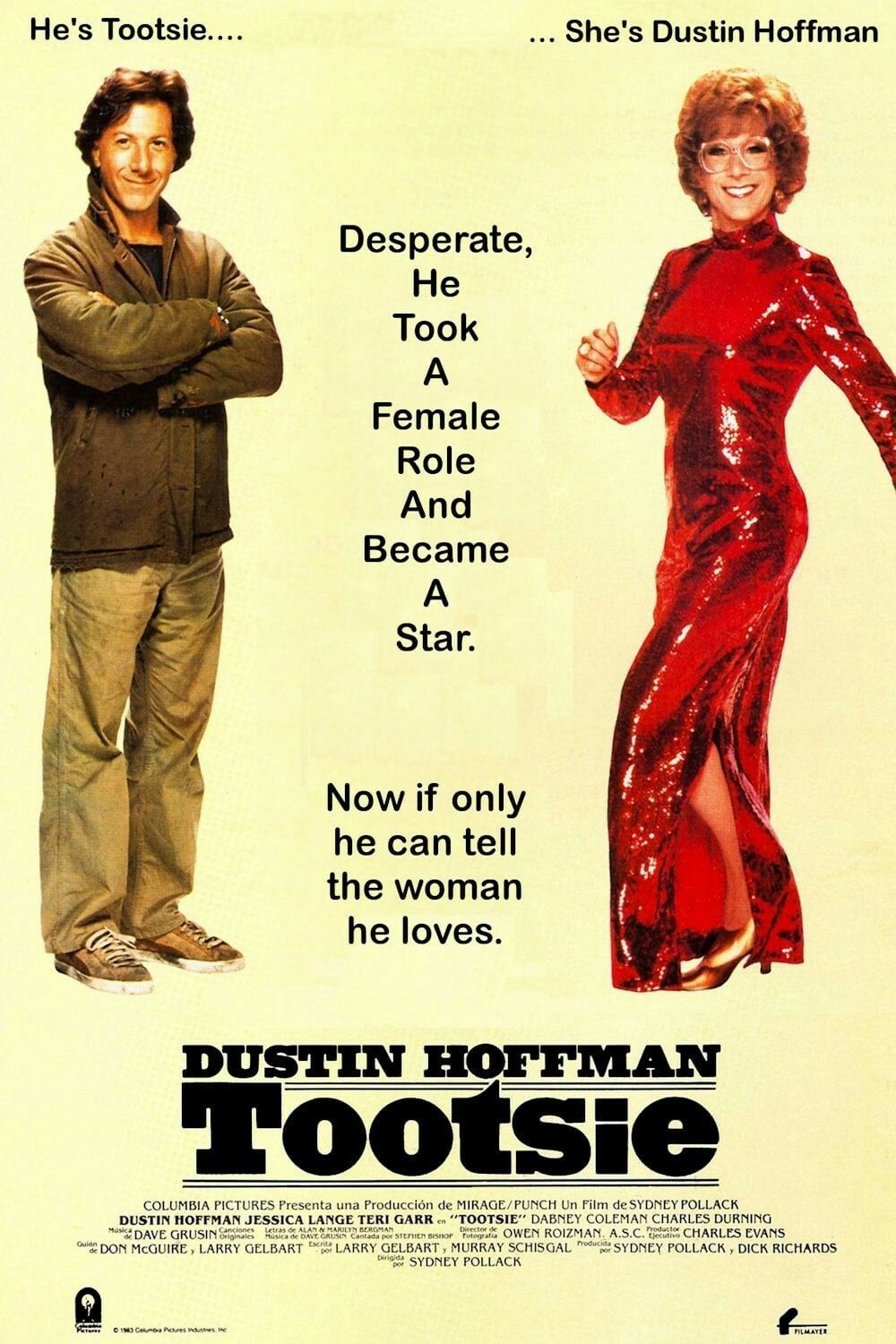
Tootsie (1982)

By Richard Winters

My Rating: 7 out of 10

4-Word Review: Pretending to be female.

Michael (Dustin Hoffman) is a talented actor but having difficulty finding employment due to his demanding nature and inability to get along with directors. His friend Sandy (Teri Garr) is auditioning for a part in a soap opera, and he helps her prepare for the role and even takes her to the audition only to learn that she was rejected before given any chance to do a screentest. It’s at this same time that he learns his agent George (Sydney Pollack) hasn’t gotten him a chance to audition for another role because in his words ‘no one will work with him’. Michael then decides to disguise himself as a woman named Dorothy Michaels in an effort to get the role that Sandy was turned down for so as to raise money to produce a play that will star Sandy. While he does get the part, he also becomes a big star with everyone believing that Dorothy really is a woman, which cause many complications in both his personal and professional life making him feel like he wants to end the charade and go back to his normal identity, but not quite sure how to do it. 

The genesis for the story began all the way back in 1970 and was based on an off-Broadway play by Don McGuire titled ‘Would I Lie to You?’ about an out of work stage actor who dresses as a woman to get a big part. Director Dick Richards adapted the plot into a screenplay, and it got shopped around for many years, but to no avail. Then in 1980 cross-dressing actor Christopher Morley played the role of a woman named Sally Armitage in the soap opera ‘General Hospital’. The part was played straight with the viewers under the impression that it really was a female, and Sally even gained the romantic interest from the character Luke, played by Anthony Geary, only to eventually reveal that she was really a man, which was a ratings hit and thus lead to renewed interest in this script. Eventually Dustin Hoffman got a hold of it and decided he wanted to take it on under the condition that was given full creative control and even hired his own people, Larry Gelbert and Murra Schisgal, to rewrite the story to his liking. 

Personally, my favorite parts of the film come at the beginning where we see Michael’s struggles as an actor as well as all of his thespian friends giving one a glimpse at just how hard the business is and how few people can make an actual living in it. Watching both him and his roommate Jeff, played by Bill Murray, working as waiters, but still talking about their acting ambitions while on that job was on-target. Garr gives a great performance as a struggling would-be actress who is full of insecurities and letdowns and a perfect composite of many young women who find the auditioning process grueling and thankless and for this reason, I felt she should’ve won the Oscar instead of Jessica Lange as her part as the love interest wasn’t as interesting, or honest. 

Murray is terrific as the roommate in an unusual part for him as his over-the-top clownish, snarky, frat boy persona is kept under wraps and instead he plays the part straight, but his sardonic responses to things are great. Director Pollack, who took on the role of Michael’s agent at the request of Hoffman and thus making it his first acting role in almost 20 years, is quite good too particularly with how his exasperated nature feeds off of Hoffman’s hyper one and their conversation inside his office is the movie’s highlight. Charles Durning has a few key moments as well playing Lange’s lovesick father who begins to fall for Dorothy though any man that would give a woman an engagement ring before they’d even been out on a single date has to be a bit loopy.

Hoffman falls into the woman role easily and it would be hard to recognize him had the viewer not known about the disguise beforehand though I felt the way Dorothy walked and moved her hands and arms made her seem like Mrs. Butterworth the animated character from the maple syrup commercials. It’s also hard to imagine he wouldn’t have been found out a lot sooner especially since he collected a weekly paycheck from the company, which would’ve required him to give them his social security number, which in-turn would’ve exposed who he really was. Being on magazine covers where he supposedly does interviews as Dorothy should’ve been equally problematic as the reporters would’ve asked him (her) about her past like what other stuff did she act in, where was she from, and where did she graduate. Stuff that’s very much standard questions in any interview and when he (she) couldn’t come up with anything or made-up stuff that could easily be background checked would’ve then raised red flags and brought the ruse to a very quick halt.

Spoiler Alert!

Soap operas were no longer broadcast as live and hadn’t been since 1963, so that story angle doesn’t fly either. Yes, I realize the idea was that it was taped and only had to done live as an emergency when one of the tapes got destroyed, but in reality, the taping would’ve been done so far ahead (usually by several weeks) that even if a video did somehow get corrupted there still should’ve been plenty of time to refilm it before reaching the actual air date. 

The ending it a bit disappointing as well. Sure, it’s nice seeing Lange putting her arm around him as they walk down the sidewalk showing that the two had made up after his secret identity was exposed, but it doesn’t answer what happened to his career. He did this whole thing to help finance a play for Sandy, so what became of that? Also, were casting agents so impressed with the way he fooled everybody that they now were willing to hire him, or was he still blacklisted? These were all major motivations for why he did the ruse, so there should’ve been clarity to what became of it. 

My Rating: 7 out of 10

Released: December 17, 1982

Runtime: 1 Hour 56 Minutes

Rated PG

Director: Sydney Pollack

Studio: Columbia Pictures

Available: DVD, Blu-ray, Amazon Video, YouTube
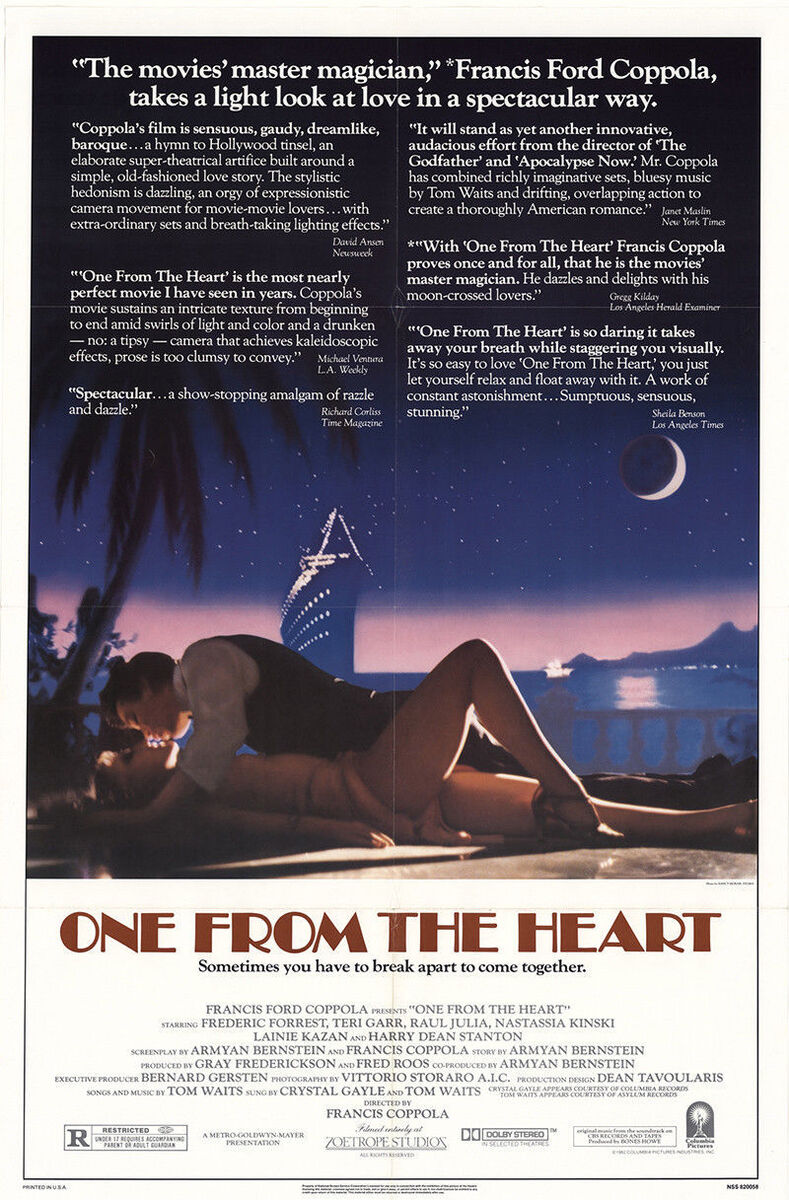
One From the Heart (1982)

oneheart

By Richard Winters

My Rating: 2 out of 10

4-Word Review: Break-up/make-up

Hank (Frederic Forrest) and Frannie (Teri Garr) have been together for 5-years but while celebrating their anniversary at home the cracks in their relationship begin to show. Frannie is upset that they can never go out and wants more adventure. Hank doesn’t see this as a problem, so the two break up. Frannie meets Ray (Raul Julia) a waiter who has ambitions to become a singer. Hank gets together with Leila (Nastassja Kinski) who is much younger than him and lives the fast lifestyle. Each spends a night with their new partner, but end-up longing for their former mates when it’s over. Ray offers to take Frannie to Bora Bora, but will she really board the plane, or will Hank catch-up with her in time and convince her to move back with him?

The movie has a weird look about it and this is mainly because director Francis Ford Coppola decided he wanted to film the entire thing on the soundstage of his Zoetrope studios. This in retrospect seemed absurd as the setting was Las Vegas with one of the most flamboyant downtowns of any city, so if the real thing is already visually arresting why trump it with a fake one that isn’t half as exciting? The artificial presence kills the movie from the very start and what’s worse is that it was so painstakingly expensive to create the set design, which is massive, that it sent Coppola and his studio into bankruptcy of which it took many years to recover and all of it wouldn’t have been necessary if they had just shot it on-location, which would’ve been a thousand times better.

The lighting is one of the more annoying aspects particularly the red light that shines through the couple’s home window making it look like they live in the red-light district of Denmark, or near a police station. The outdoor scenes look as phony as you’d expect including having the night sky shown to have a ‘ceiling’ and the distant mountain vistas appearing as nothing more than a cheap matted on paintings. Everything comes-off as loopy like a great director whose ego got the best of him, and he made a massive artistic overreach for no other purpose then just to see if he could. The music interludes by Crystal Gayle and Tom Waits don’t work either. If a movie is intended to be a musical, as this one kind of is, then each song needs to sound distinct and at least moderately peppy, but here it comes-off like the same droning song that just never ends and adds little to the already goofy set-up.

The characters are poorly fleshed-out and, with the modest exception of Harry Dean Stanton and Elia Kazan, wholly uninteresting. The break-up is the biggest problem as the ‘squabble’ appears to be over nothing more than the fact that Hank didn’t take Frannie out on their anniversary, but to move-out because of something like that seems awfully trite. Normally for relationships/marriages to go really bad there needs to be a lot of anger simmering underneath the surface and this thing at best is just a tiff especially when at the beginning they seemed content with other. To make it realistic there should’ve been clear underlining animosity right away and not go from ‘happy couple’ to break-up with a snap-of-the-finger.

Not sure either if it’s exactly possible to get back together after the other partner has slept with someone else. Granted there could be some exceptions, but most people would consider it an extreme betrayal and unforgivable and certainly not something that they could just conveniently forget about and return back to the ‘happy couple’ that they were. Yes, in this instance they both cheated, but that makes things even worse. Who’s to say you can ever trust the other again? If one tiny disagreement can get each one to suddenly jump in the arms of a perfect stranger what’s to say that won’t get repeated in the future?

Garr, who appears topless in several scenes and even fully naked from the back in one moment, is okay. The supporting cast is also good especially Allen Garfield as Julia’s perturbed boss. I even found Kinski a bit mesmerizing with her singing and the way she was able to balance herself on a big orange ball that used to be the sign for the Spirit of 76 gas stations, but overall the thing is so thinly plotted, with too much emphasis being put on the garish set design, that it can all be summed up as a hopeless experiment gone wrong. Even Coppola has admitted in subsequent interviews that it’s a ‘total mess’, so if the director is warning you that his own movie doesn’t have much going for it, you’d better listen.

My Rating: 2 out of 10

Released: February 11, 1982

Runtime: 1 Hour 39 Minutes

Rated R

Director: Francis Ford Coppola

Studio: Columbia Pictures

Available: DVD, Blu-ray, Amazon Video, YouTube
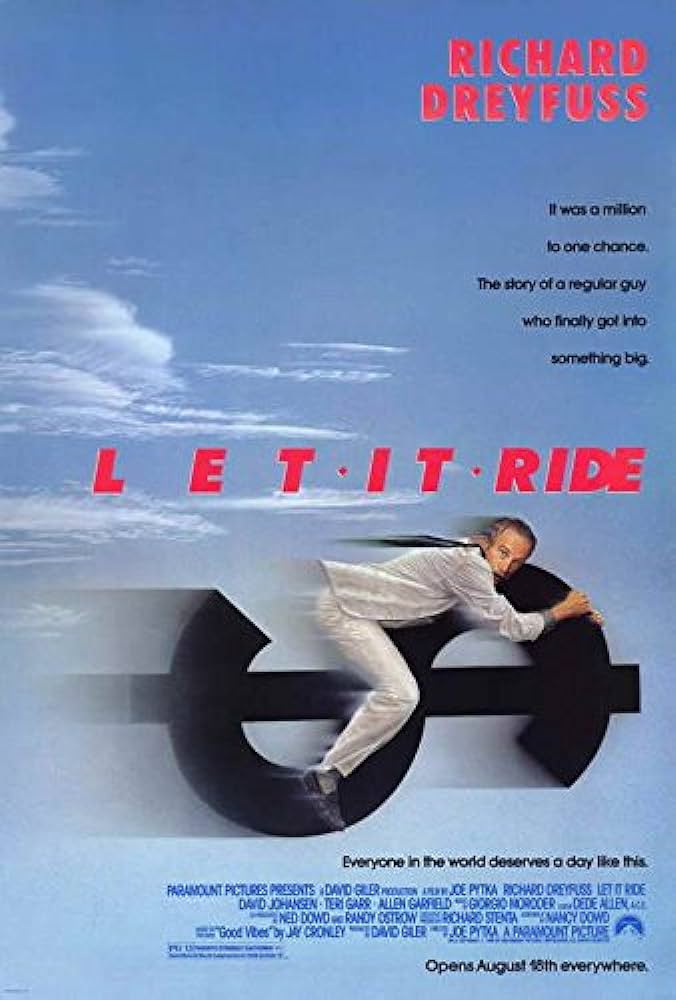
Let it Ride (1989)

let

By Richard Winters

My Rating: 5 out of 10

4-Word Review: Betting at horse racing.

Jay (Richard Dreyfuss) along with his friend Looney (David Johansen) are two struggling Miami cab drivers. One day Looney, who secretly records discussions that his passengers have while in the backseat of his cab, overhears a tip by two men of an upcoming horse race. He passes on the recording to Jay. Jay has not had much success in betting and has even promised his wife Pam (Teri Garr) that he will quit, but he can’t pass up this opportunity and places a wage on the horse that had been discussed. It turns out to being a photo finish in his favor and he spends the rest of the day making more bets by using all of his winnings as his wagering. Soon, he finds himself getting richer and richer even as his wife comes to the track in an effort to get him to stop. Will his luck hold, or run out?

Probably the best thing about the movie is the acting particularly by Dreyfuss, who’s known for playing aggressive, snarky types, but here comes-off as surprisingly sympathetic. You genuinely feel for the guy and his need to win at something and has one comically touching moment where he kneels at the toilet of a grimy bathroom stall and prays/pleads to God for a break. Garr, who reunites with Dreyfuss as the two starred 10 years earlier in Close Encounters of the Third Kind where they also played a husband and wife, is equally engaging though while seen right at the start disappears for quite awhile only to reappear briefly during the second act where it would’ve been better had she remained in it all the way through.

In support Johansen, better known as Buster Poindexter the lead singer of the punk band the New York Dolls, is amusing as Jay’s ever losing friend and Robbie Coltrane has some great reaction moments as the ticket seller. Jennifer Tilly almost steals it as a voluptuous vamp while Allen Garfield gets in a few funny quips as her Sugar Daddy boyfriend. A young Cynthia Nixon, wearing braces, can be seen as a underage girl trying to sneak in a bar with a phoney ID though her part doesn’t have all that much to do with the main plot and Michelle Phillips, singer from the Mama’s and the Papa’s, as a rich women who comes onto Jay at a luncheon.

The story, which is based on the 1979 novel ‘Good Vibes’ by Jay Conley, starts out well. I enjoyed the way it captures the working class life of Miami versus the usual glossy look at the chic neighborhoods of the area. All the actors including the stand-ins and those milling about in the background have a very ordinary, everyday quality, which nicely captures how people, who sometimes have very little money, will still flock to the track in a desperate attempt to ‘make it big’ even though it rarely ever happens. The shooting, done on-location at the famed Hialeah Park Race Track, one of the oldest in Florida, is terrifically done and you feel like you’re right there standing next to the track as the horses go thumping by while kicking up clumps of dirt.

The tone though is inconsistent. Instead of remaining this character study with a slice-of-life quality it instead skewers into becoming a camp comedy. Case in point comes when Jay gets arrested for mistaken identity, but still makes a mad dash to place his bet, which gets filmed in a sped-up fashion including having him crash through a wooden door with a cartoonish flair that’s jarring and out-of-place. It also gets highly exaggerated as in only one day’s time everyone at the track gets to know Jay and cheers him on, which is too quick of a turnaround for such a thing to realistically happen.

Spoiler Alert!

The ending leaves much to be desired as Jay just continues to win and win until his earnings amount to over $600,000 (or $2 million in today’s dollars), but what is causing him to have such a streak of luck? Did God really answer his prayers, or is some other mystic source at play? Everyone knows that you end up losing more than you win at gambling and a winner’s luck will eventually run-out at some point.  Showing a guy who never was good at gambling before without having earned it like learning some special skill, or insight, makes for a flimsy and fanciful movie. Getting lucky on one bet, maybe even a really, really big one that beats long odds, which is how the movie should’ve played it, might happen, but having him just continue to ‘get lucky’ with no explanation is too exaggerated and doesn’t show the harsh downside, which if you’re going to do a story about gambling in any type of realistic way, needs to be shown as well.

My Rating: 5 out of 10

Released: August 18, 1989

Runtime: 1 Hour 27 Minutes

Rated PG-13

Director: Joe Pytka

Studio: Paramount

Available: DVD, Blu-ray, Amazon Video, YouTube
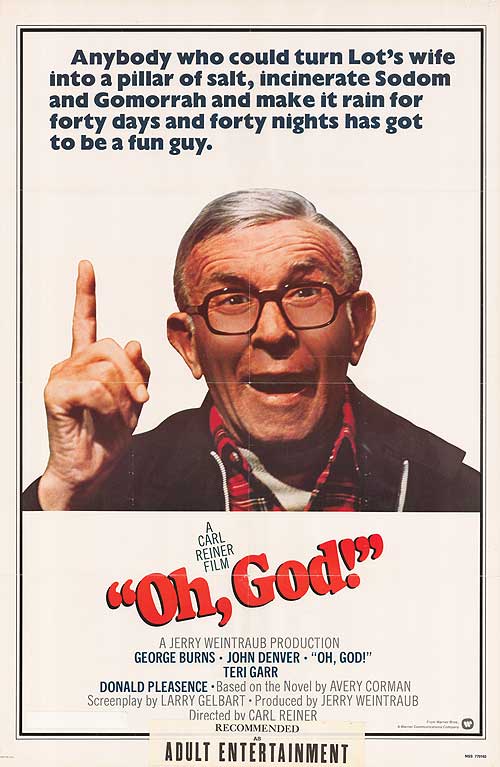
Oh, God! (1977)

By Richard Winters

My Rating: 7 out of 10

4-Word Review: An atheist meets God.

Jerry Landers (John Denver) is a married man with two kids (Moosie Drier, Rachel Longaker) who works as an assistant manager at a local grocery store. He doesn’t consider himself to be religious nor does he attend church (he most likely could be called an atheist, but I assume that term was considered ‘too toxic’ of a label to put on a protagonist that mainstream audiences of the day were expected to like, so he’s just given the much softer description of being a non-believer.) One day he receives a letter in the mail stating that God would like to interview him at a certain location, but Jerry considers this to be a practical joke and throws it away, but when the letter keeps popping up at the most unlikely places he finally decides to take it seriously. He goes to the location and meets God (George Burns) who at first he does not see, but only hears, but eventually the almighty takes the form of an old man. He tells Jerry to spread the word that he exists, which Jerry does only to have it all snowball against him when everyone thinks he’s crazy and even his own family becomes embarrassed to be seen with him.

The film is based on the 1971 Avery Corman novel of the same name though the book had more of a satirical tone and the protagonist was a journalist. The film though manages to retain the same jaded sensibilities of the modern-day public, which is what makes it so amusing and for the most part quite on-target. Denver, who was known more as a singer and did very little acting both before or after this, is quite good here, but only if you can get past his bowl haircut. Burns is excellent as well and I always felt this is the performance he should’ve won the Academy Award for instead of the one in The Sunshine Boys as it easily became his signature role.

The script though by Larry Gelbart is full of incongruities. For instance the God here claims to be a non-interventionist who sets the process in motion and then lets things happen without getting involved. Everyone is given free will and he doesn’t intervene to stop suffering or ‘bad things’ from occurring because that would upset the ‘natural balance’, but then turns around and admits that he had a hand in such superficial things as helping the 1969 New York Mets win the pennant. He is also forced to become a ‘side show magician’ by performing what amounts to being magic acts, like doing a tacky card trick in front of a judge, in order to prove to Jerry and others that he really is the almighty. Yet he then becomes shocked to find that Jerry’s simple word-of-mouth as well as having Jerry pass out God’s ‘calling card’, which is nothing more than a white card with the word God on it, as not being enough to somehow convince others of the same thing.

There’s also a weird conversation, which I found loopy even as a child, where God tries to prove a point by explaining to Jerry that people only dream in black-and-white, which apparently was an accepted belief a long time ago. This idea has later been found to be incorrect, which is good as I’ve always dreamed in color, but it’s still off-kilter to have this supposedly all-knowing God argue a talking point from a debunked myth.

The performances by the supporting cast help  and in fact I consider this to be Teri Garr’s best role as I found her character arch to be more interesting than Denver’s. The aging Ralph Bellamy is good as an aggressive defense attorney and I also like Barnard Hughes as the overwhelmed judge. William Daniels is amusing as Denver’s snippy boss and a type of authoritative character he’d put to perfection years later in the TV-show ‘St. Elsewhere’. Paul Sorvino gets a few laughs too in a send-up of an over-the-top TV evangelist.

The only one that I had a problem with was Donald Pleasance who gets fourth billing, but only 2 lines of dialogue. With such a versatile talent as his you don’t want to waste it by giving him such a small role and unless a lot of his work here ended up on the cutting room floor I’m genuinely surprised why he even took it.

The film is mildly entertaining, but ultimately quite benign and nowhere near as ‘profound’ as some considered it. Nonetheless it was a big hit and even knocked Star Wars out of the top spot for 1-week. It also spawned 2 sequels as well as a TV-movie called ‘Human Feelings’ where Nancy Walker plays a female God set to destroy Las Vegas with a flood unless Billy Crystal, who plays an angel, can find 6 virtuous people that live there.

My Rating: 7 out of 10

Released: October 7, 1977

Runtime: 1 Hour 38 Minutes

Rated PG

Director: Carl Reiner

Studio: Warner Brothers

Available: DVD, Amazon Video, YouTube

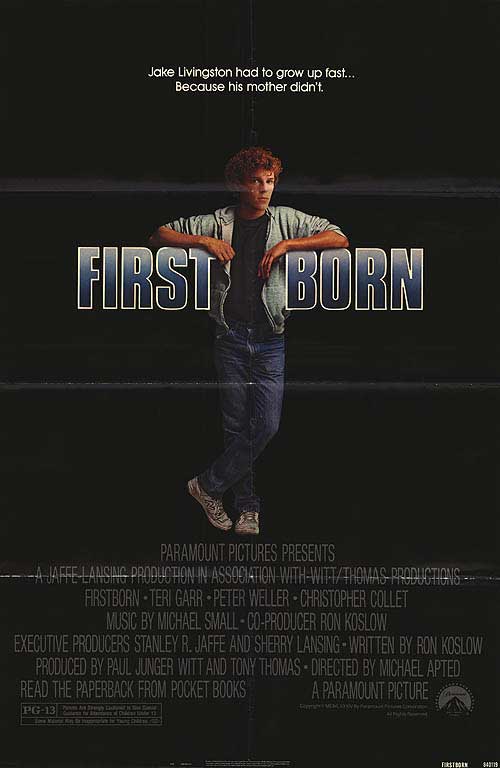
Firstborn (1984)

first born 2

By Richard Winters

My Rating: 4 out of 10

4-Word Review: Mom’s shitty new boyfriend.

Wendy (Teri Garr) is a divorced mother living with her two teenaged sons Jake (Christopher Collet) and Brian (Corey Haim in his film debut). She begins to feel lonely and insecure when her ex Alan (Richard Brandon) finds another woman and gets remarried. On the rebound she latches onto Sam (Peter Weller) a drifter who can’t seem to hold down a job and deals drugs on the side. He moves in and begins an antagonistic relationship with older son Jake that spirals out-of-control and turns the once peaceful household into a war zone.

I liked the realism particularly the way the anger and animosity come to a head slowly. The characters and dialogue are believable and the film portrays teenagers far more accurately than most other ‘80s flicks. The violent confrontation at the end is exciting, but in some ways I found the way Jake locks horns with his equally bullying English teacher Mr.  Rader (James Harper) as being just as compelling if not more.

On the negative end the plot is by-the-numbers and does not offer any twist or interesting added angle. The characters don’t grow or change and the film lacks a much needed denouncement where we could’ve seen how the ordeal helped them evolve as a family.

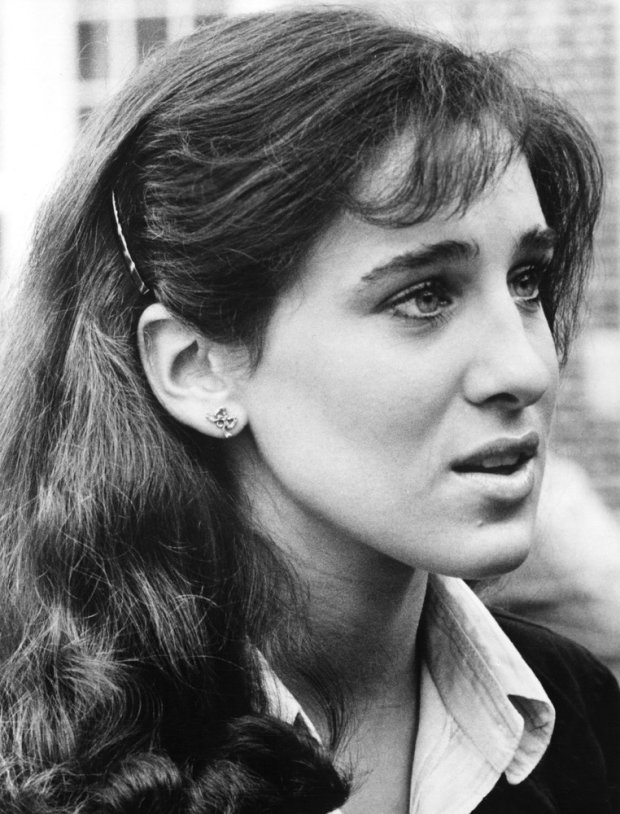
Garr is perfectly cast as a vulnerable character and the idea of a lonely divorcee finding someone on the rebound while conveniently ignoring the red flags until it is too late happens quite a lot. Collet is tolerable, but gets out shined by his younger costars including Sarah Jessica Parker as his girlfriend and Robert Downey Jr. as his school chum as well as Haim who clearly display more on-camera charisma and show why they all ended up with the longer, more memorable careers.

corey haim

sarah jessica 2

Weller is convincing as the heavy, but the film is one-dimensional and fails to offer any insight. If you want to catch this simply to see the young stars before they were famous then it will be a fun flick despite the subject matter, but overall it’s nothing special and has an atrocious music score.

My Rating: 4 out of 10

Released: October 26, 1984

Runtime: 1Hour 40Minutes

Rated: PG-13

Director: Michael Apted

Studio: Paramount

Available: VHS, DVD, Blu-ray

Witches’ Brew (1980)

witches brew 1

By Richard Winters

My Rating: 4 out of 10

4-Word Review: Witch has ulterior motives.

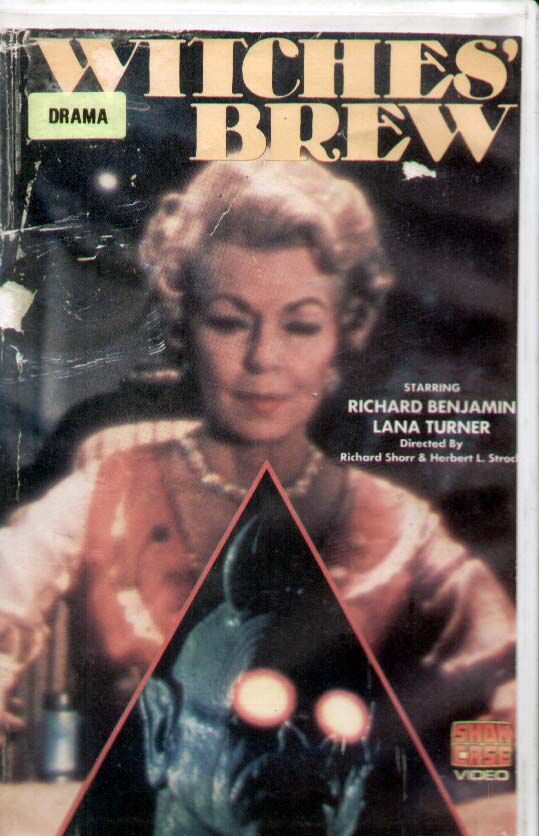
Margaret (Teri Garr) will do anything to help her husband Joshua (Richard Benjamin) get a promotion at a local college, so she decides to resort to witchcraft with the help of Vivian (Lana Turner) who is an expert on the matter. The problem is that two of Margaret’s closets friends Susan (Kathryn Leigh Scott) and Linda (Kelly Jean Peters) also have husbands that are vying for the same position, so they begin to practice witchcraft of their own, which conflicts with Margaret’s and causes Joshua to have a streak of terrible luck and even near tragedy. Vivian comes to their aid, but only because she harbors a dark secret that could cause Margaret her life.

This is a remake of 1944’s Weird Woman that starred Lon Chaney Jr. and Evelyn Ankers, which also got remade before in 1962 with Burn, Witch, Burn! Out of the three versions this one is considered the weakest. The set-up is alright, but the second half in which the cynical Joshua slowly comes to terms with the reality of witchcraft goes on way too long. The comedy and effects are much too restrained and do not take enough advantage of its wild concept. The final third does manage to have some interesting twists, but the climatic sequence is full of loopholes and unfinished story threads that left this viewer feeling unsatisfied and confused when it was over.

I’ve enjoyed Richard Benjamin and his sarcastic wit in other films, but here he comes off as a borderline jerk and has such a radically different temperament from his wife you wonder how they ever got married in the first place. Garr is far more appealing and should’ve been given the most screen time. Turner whose last film this was, doesn’t have all that much to do and locked into a role that is limited and rather thankless.

Director Richard Shorr was fired midway through the production and replaced by Herbert L. Strock, which may explain the film’s disjointed feel that never really comes off as the intended spoof that it wants to be and in some ways far edgier than you’d expect including one scene that has a disgruntled former student climbing to the top deck of a parking ramp and shooting at Joshua below in a Charles Whitman-like attack. There is also another segment that has a giant devil-like bat hatch from an oversized egg that might’ve worked had the special effects been better. In either case this film, which starts out with good potential never comes together and becomes rather flat and forgettable.

My Rating: 4 out of 10

Released: March 10, 1980

Runtime: 1Hour 38Minutes

Rated PG

Director: Richard Shorr, Herbert L. Strock

Studio: United Artists

Available: VHS