Tag Archives: Sylvester Stallone

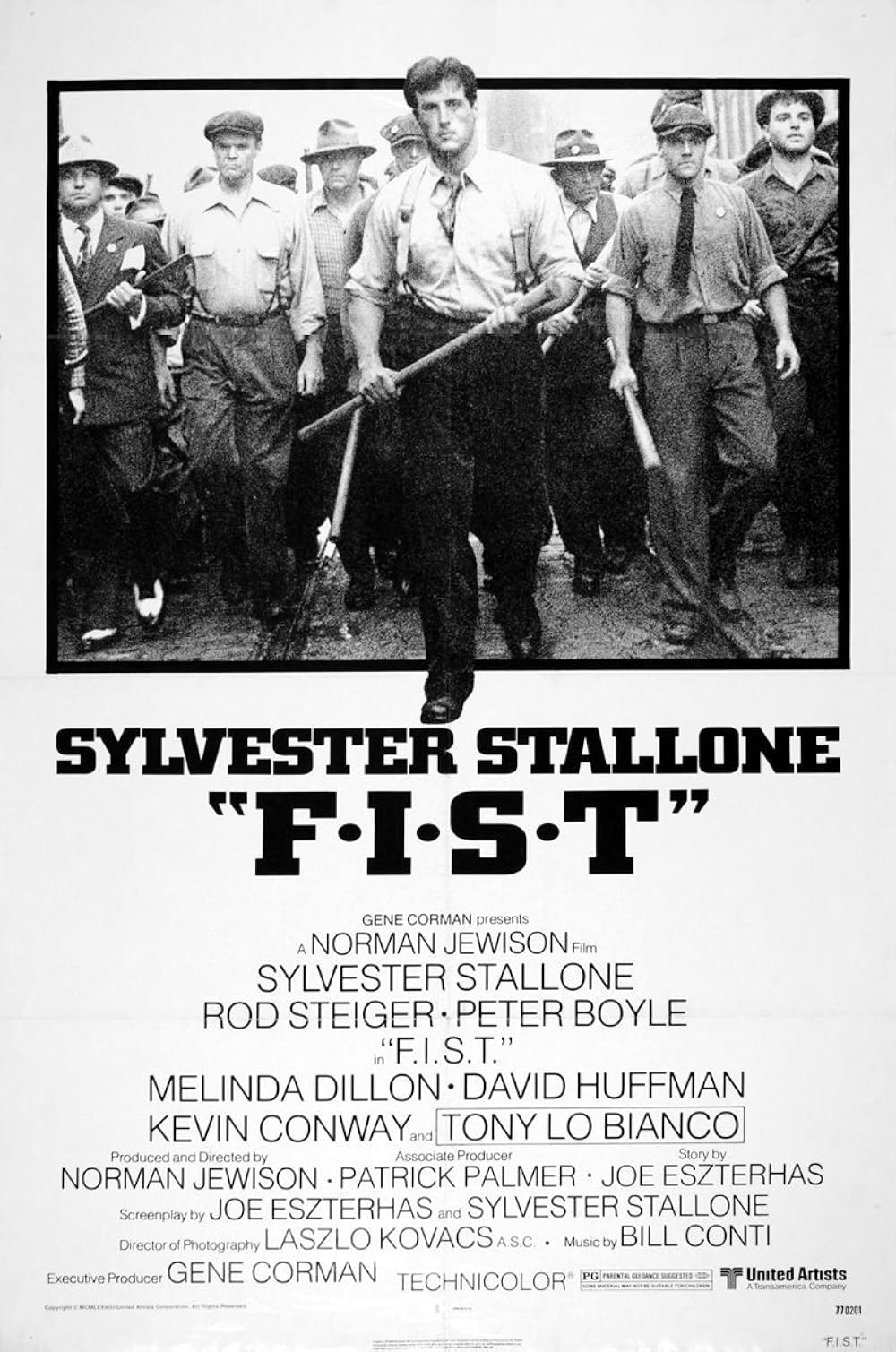
F.I.S.T. (1978)

fist

By Richard Winters

My Rating: 7 out of 10

4-Word Review: Laborer becomes union leader.

Set in the 1930’s in Cleveland the story centers on dock worker Johnny Kovac (Sylvester Stallone) who becomes so upset at the poor treatment of the employees that he leads a revolt that soon gets squashed by a management when Kovac goes to the office of Mr. Andrews (James Karen) who promises to bring his demands to ownership only for the next day to have Kovac and his friend Belkin (David Huffman) fired from their jobs. Impressed though by their tenacity truck driver Mike (Richard Herd) recruits them into his union telling them they would have a job of going out and recruiter others. Kovac initially refuses the offer until he finds out that a free car would come along with it. Kovac eventually rises up the union ladder until he becomes their national leader, but with the power and prestige also comes corruption and enemies.

This was Stallone’s first film after doing Rocky, which was a bit of a gamble by director Norman Jewison. He had wanted to cast Jack Nicholson in the role, Nicholson would later star in a similar film Hoffa, which came out 14 years later, but was so impressed at Stallone’s performance in the boxing film that he offered the role to him before he was even a household name. Jewison felt Sly was a star in the making just from what he saw in the preview of the film not knowing whether that movie was ultimately going to be a runaway success, or not. Had it not it might’ve put him in an awkward position as the studio wasn’t likely to finance a project that didn’t have guaranteed star power. As it was it became a blockbuster making the tables-turned a bit because Stallone could’ve easily backed out of the deal since it had only been a verbal agreement and he had since then been offered higher paying roles, but he kept to his word and took on this project, which surprised Jewison as many big names in Hollywood don’t always stick to their promises, but then later when the film didn’t do as well as expected Jewison’s blamed Stallone’s casting as part of the problem.

From my perspective I thought Stallone was terrific. His delivery does come-off as a bit monotone, but I felt that’s what added to the authenticity as this was a character with a limited education, so he probably wouldn’t sound real smart to begin with. Seeing Sly fight the system correlated with his real-life struggles as an actor trying to make it big in a competitive business, which helped to make it seem all the more genuine like this was a guy who had really lived the same type of life as the man he was playing.

In support I was highly impressed with David Huffman. This was an actor, whose career and life were sadly cut short in 1985 when he got stabbed to death, who I had always found quite bland. He had an attractive looking face, which I figured is what got him his foot-in-the-door, but his acting always came off as blah, but here he puts a lot of emotion into his role and it’s interesting to see the way his character grows and morphs throughout. James Karen and Tony Lo Bianco both have small parts, but there sinister facial expressions and ability to mug to the camera without it seeming obvious is what helps them stand-out. I was surprised though with Rod Steiger who gets second billing, but doesn’t appear until 1 Hour and 33 minutes in. His part, as a powerful senator, does ultimately become integral to the proceedings, but the fact that he underplays instead of his usual over-acting is what got me.

I thought the way Jewison captured the setting was great. It was actually shot in Dubuque, Iowa because by that time Cleveland no longer looked the way it once did, but the flavor and vibes from that period come-out strong and you feel right from the start that you’re being swept away to a bygone time. Stallone’s ascension into the ranks of union head prove riveting, but his corruption and downfall get glossed over and seemed rushed. I did though appreciated the way it examines worker’s unions from all angles both the good and bad making it seem less like a propaganda movie than Norma Rae, which came-out at around the same time, but only focused on the positive aspects of unions.

Spoiler Alert!

The ending, in which Kovac gets shot and killed while in his home came-off like a cop-out. It was intended to reflect at the time the recent disappearance of union head Jimmy Hoffa, but seeing the main character get assassinated without telling who was behind it proves unsatisfying. Sure we could probably surmise who the culprits were, but having to sit through a long movie only to be left with more questions than answers makes the viewer feel like watching it had been a big waste of time.

My Rating: 7 out of 10

Released: April 13, 1978

Runtime: 2 Hours 25 Minutes

Rated PG

Director: Norman Jewison

Studio: United Artists

Available: DVD, Blu-ray
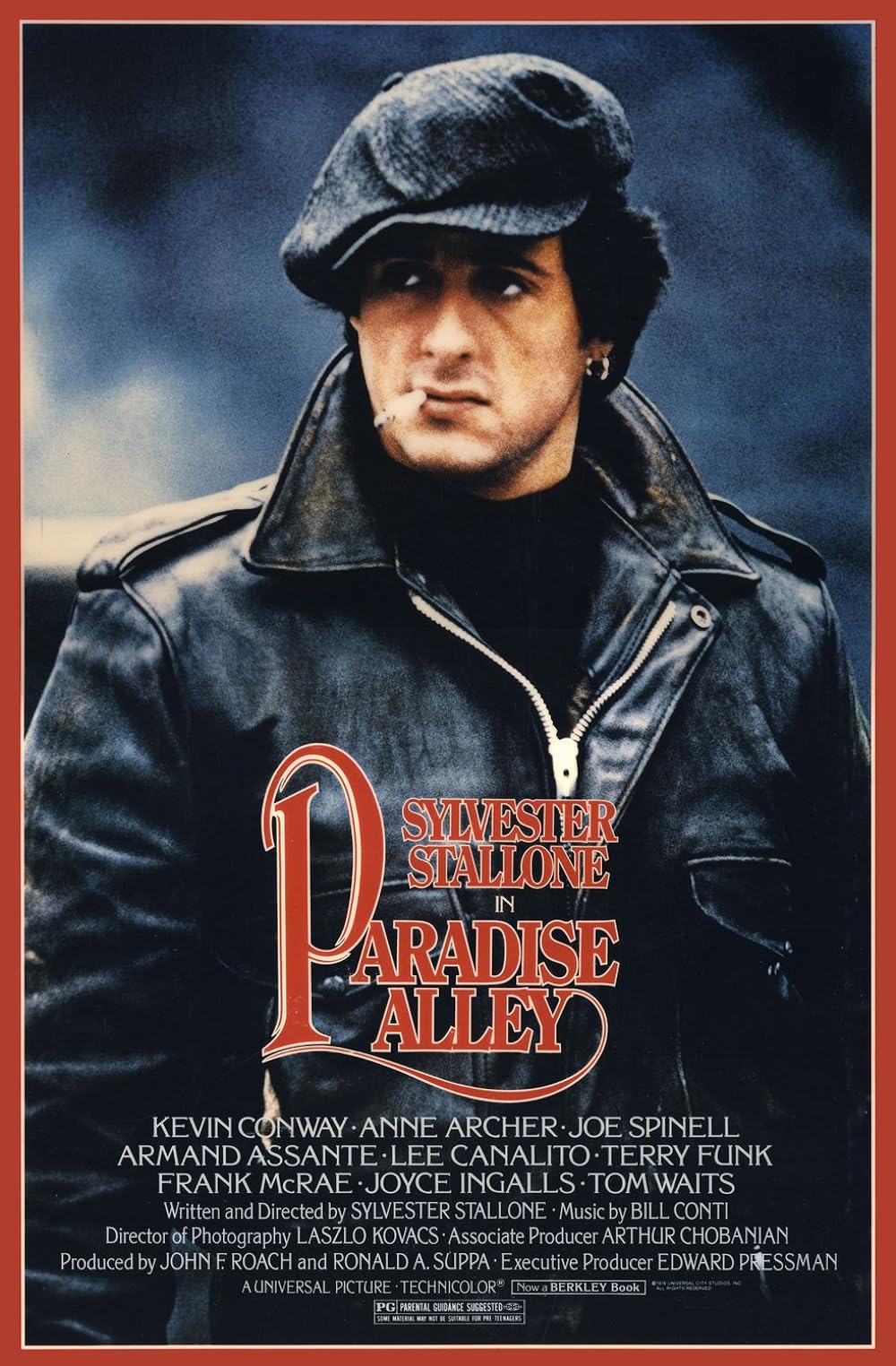
Paradise Alley (1978)

paradise

By Richard Winters

My Rating: 5 out of 10

4-Word Review: Promoting brother as wrestler.

Cosmo (Sylvester Stallone) is a local street hustler in Hell’s Kitchen who will attempt just about anything to make a buck even pretending to be a homeless person begging for money. Eventually he gets the idea of turning his younger brother Victor (Lee Canalito) into a wrestler and then promoting his bouts inside the ring with others. Victor, who’s strong and well built, initially resists, but he eventually grows tired of his job hauling ice blocks and decides to give in. Cosmo’s other brother Lenny (Armand Assante), a war veteran who walks with a limp, is not keen to the idea either, but through prodding comes onboard as Victor’s manager. Things start out well, but the despite winning the contests Victor’s body takes quite a toll and Cosmo ultimately believes it’s time to give up on it, but Lenny, who begins to enjoy the money he’s making as manager, refuses to let up and pushes Victor into more and more dangerous matchups, which Cosmo’s worries may be putting Victor at too much risk.

The script was written by Stallone that was initially started as a novel. He wrote this before Rocky, but couldn’t get anyone interested in financing it though he was at least able to get it optioned. He then had an acting audition with two producers, Irwin Winkler and Robert Chartoff, while he didn’t get the part he did mention, as he was walking out, about this script. The two men were interested in looking it over, but the other producer who Stallone had optioned it to refused to give it up, so Sly instead wrote Rocky, which he then handed over to Chartoff and Winkler, which was green-lit. Then when that became a runaway success the producers agreed to finance this one even allowing Stallone to not only star, but also direct.

Unfortunately the result here is a mish-mash with things being off-kilter right from the start. The absurd race that Stallone has with another man, done over the opening credits, where the two jump from one tall city building to another seemed hard to believe. At some point one or both are going to miss hitting the other side and fall most likely to their death, which does happen eventually, but the guy is lucky enough to conveniently hang onto an outdoor clothes line though with no explanation for how he got down from that and Stallone, supposedly his friend, just laughs at him dangling there and struts away. Stallone also sings the opening song, which is dreadful.

Things really don’t improve much from there. There are a few nice camera angles and provocative close-ups here and there, but the scenes meander to the point there doesn’t seem to be any momentum, or story. The tone shifts precariously from gritty realism to romanticized idealism. The characters aren’t consistent either. Stallone is the one that initially involved in pushing his reluctant brother into the ring while Assante is very cautious and then for some inexplicable reason this gets reversed with Stallone warning of the danger while Assante becomes overly driven. However, for it to make sense there needs to be an explanation for this big change between the two and none is given making their mutual character archs poorly fleshed-out.

Stallone is certainly engaging though his likability gets tested especially with the segment where he ties up a live monkey, even puts a gag in its mouth, and then dangles it from the ceiling. Anne Archer is fun and virtually almost unrecognizable sporting a red hairdo while playing a sassy Italian love interest. Kevin Conway is highly amusing as the heavy who talks tough when surrounded by his henchmen, but proves wimpy when all alone and his climatic pants pulldown is a hoot. Noted real-life wrestler Terry Funk is quite memorable as the muscled bully and the arm wrestling match-up between he and Victor where the mounting sweat glistens off his body as he struggles to keep his arm from hitting the table is one of the movie’s highlights.

The climactic wrestling match done inside a building with a very leaky roof where the action is done in slow-motion with water splashing all over does have its moments though it eventually becomes redundant. While there’s flashes of occasional brilliance it never fully comes together. A tighter script and more consistent tone were sorely needed and Victor, who’s the only likable guy of the bunch, required more of a multi-dimensional context. The fact that he could beat-up anyone and do it in such a humble way while never having to pay the ultimate price either physically or mentally just isn’t believable.

My Rating: 5 out of 10

Released: September 22, 1978

Runtime: 1 Hour 47 Minutes

Rated PG

Director: Sylvester Stallone

Studio: Universal

Available: DVD, Blu-ray, Amazon Video, YouTube

Farewell, My Lovely (1975)

By Richard Winters

My Rating: 4 out of 10

4-Word Review: Searching for missing lady.

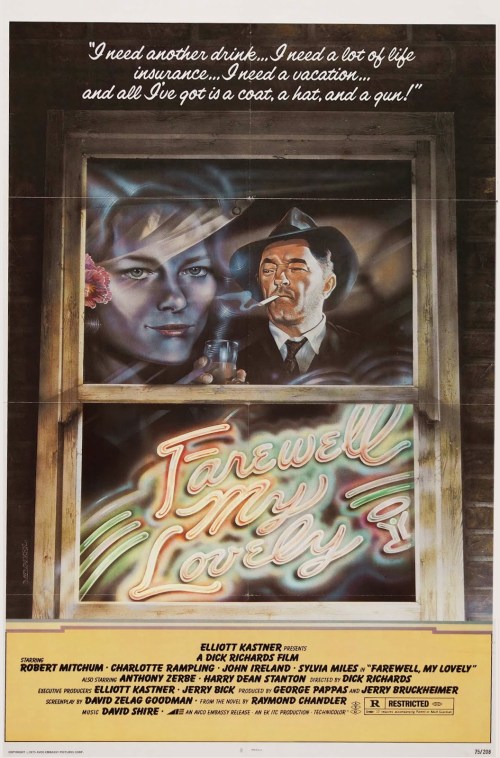
Based on the Raymond Chandler novel of the same name the story centers on private eye Phillip Marlowe who meets Moose Malloy (Jack O’Halloran) a recently released convict that asks Phillip to find his girlfriend Velma who worked as a dancer at a nightclub, but who has now gone missing. Marlowe decides to take the case, but finds a wide array of strange clues that leads him on a bizarre trail that has many twists.

The novel was filmed before in 1944 as Murder, My Sweet that starred Dick Powell, which has become a classic. This remake was noted for being able to stay closer to the source novel by retaining aspects of the story that was considered too provocative for 1940’s standards, but the edition of these elements really doesn’t make the mystery any more interesting. The direction doesn’t convey any feel for the material and despite the intricate plot everything plods along at a rather mundane pace. I also never really felt that the setting effectively reflected the 40’s as much as it could’ve.

The biggest issue though is Mitchum. The guy is certainly a legendary actor and his performance here isn’t bad I actually thought his timing with the way he conveys his lines was on-target, but he’s just way too old for the role. In the novel Marlowe was described as being in his 30’s, but Mitchum was 57 and looking more like 67. The guy comes-off as washed-up with no charisma, or ability to win a fight even though he does get into a few altercations anyways, which doesn’t seem believable.

The eclectic supporting cast is the only thing that makes it mildly interesting. Sylvia Miles got nominated for supporting actress Oscar as a lonely alcoholic lady with a secret, but I actually enjoyed Charlotte Rampling as a beautiful, but cold and conniving gold digger much better. It’s also great to see Kate Murtagh as this overweight woman who runs a whorehouse. Fat woman are usually never given prominent roles in most Hollywood films, but here she plays an intriguing part that culminates with a surreal, nightmarish segment that helps give the film a little extra verve that’s otherwise missing.

The film also has a couple of great cameos. One features Sylvester Stallone in a non-speaking role as a thug, which was just before he broke it big with Rocky. I found the cameo though by author Jim Thompson, who’s best known for writing such novels as ‘The Getaway’ and ‘Pop. 1280’ to be far more interesting. He plays the elderly husband to Rampling and the scene where he opens up a door to find her kissing Mitchum on a couch and all he does his just shut the door back-up and leave to be the funniest moment in the movie.

The budget should’ve been bigger as it’s not stylish. If you’re going to redo a classic you’ve got to go all-out, but the effort here is half-hearted. Yet despite this the producers forged ahead with another Marlowe film that had Mitchum again playing the part. That one was called The Big Sleep and will be reviewed later this month.

My Rating: 4 out of 10

Released: August 8, 1975

Runtime: 1 Hour 35 Minutes

Rated R

Director: Dick Richards

Studio: Embassy Pictures

Available: DVD, Amazon Video, YouTube

Nighthawks (1981)

By Richard Winters

My Rating: 6 out of 10

4-Word Review: Street cop versus terrorist.

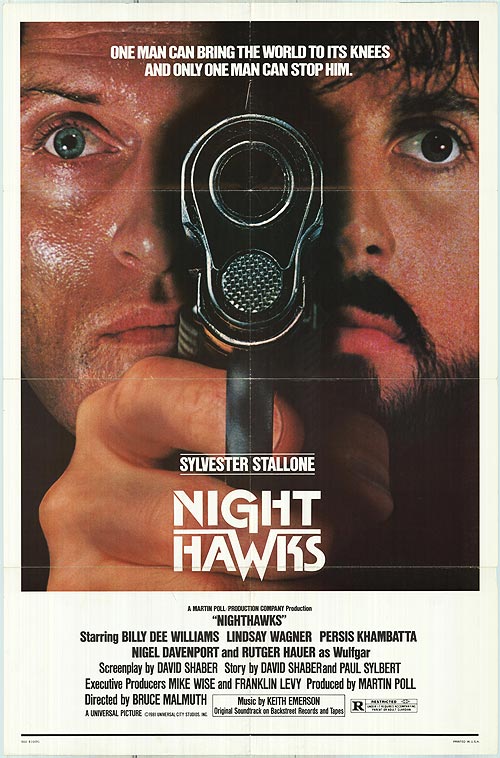
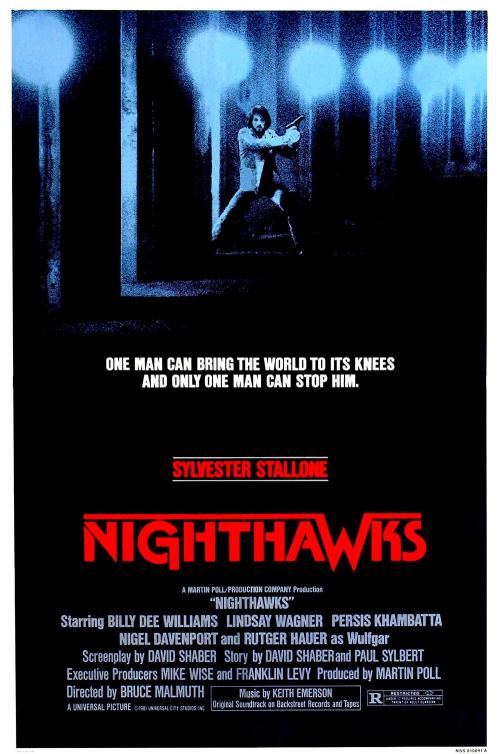
Deke DaSilva (Sylvester Stallone) and Matthew Fox (Billy Dee Williams) work as New York Street cops only to be suddenly pulled off of their beat and put into an elite anti-terrorism division. At first DaSilva resists the tactics taught during the training, which puts him at odds with the instructor (Nigel Davenport). However, once he gets past his initial reluctance he begins to use the methods that were taught to him by getting inside the mind of the international terrorist (Rutger Hauer) that they are after, which eventually helps him beat the man at his own game.

The film’s biggest achievement is that it was shot on-location in three major cities across two continents. Normally it’s nice when a film can just get out of a studio backlot and into a vibrant setting, but this film manages to get in three simultaneously and creates an almost head-spinning, globe-trotting visual show, which helps heighten the international intrigue. My favorite spot was where DaSilva and Fox go into the ghetto to do a drug bust. Normally film crews avoid the bad areas and try to compensate by dressing up a soundstage to look like one, but it always fails while this scene comes off as the real deal with the garbage strewn decrepit buildings being more prominent than the action.

The story succeeds to a degree as it nicely details the psychological aspect of police work as well as showing the many dead-ends investigators must go through before they are finally able to catch a break, but then the gritty reality unfortunately gets erased.

The main issue occurs when Stallone thinks he has spotted Hauer at a nightclub and wants to get nearer to him to get a ‘closer look’ only to proceed to just stand and stare at him in the most obvious way imaginable until it becomes achingly clear to Hauer that the guy is a cop, which causes him to panic and taking out a gun and running while killing a club patron in the process. It made me wonder if the Stallone character was a seasoned cop at all because why bother being undercover if you’re going to just stupidly give your identity away at the most inopportune moment?

Later Stallone gets blamed by Dee Williams for not shooting Hauer when he ‘had the chance’, but the truth is that Hauer had draped himself with a woman hostage and giving Stallone no clear view of him. Aren’t police trained not to shoot unless they do have a clear view? If anything Stallone’s character should’ve been commended for showing restraint. Being goaded into taking a risky shot would not have been ‘macho’ or ‘brave’ but seriously reckless and in no way was a sign of weakness despite the film portraying it like it was.

The film also fails to make much use of the buddy formula and in fact Dee Williams gets boxed out and becomes almost transparent. Stallone is excellent and Hauer is the epitome of a creepy villain, but the film could’ve been stronger had it not devolved into the formulaic tormented-cop-struggling-with-his-inner-demons thing and instead kept the two leads on equal footing as there are a few moments at the beginning where they share some engaging banter.

Lindsay Wagner is equally wasted with only two scenes and less than 10 minutes of total screen time. Davenport though is strong as the aging British instructor and quite engaging in his own right while Persis Khambatta, best known for playing the bald women in Star Trek: The Motion Picture, is effective as Hauer’s partner in crime.

The scene where a group of people are held hostage inside a cable car is intense and well shot. There is also an exciting foot chase inside the New York subway, which has traces to the one done in The French Connection, but the story itself doesn’t amount to much and seems more clichéd than original.

My Rating: 6 out of 10

Released: April 10, 1981

Runtime: 1 Hour 39 Minutes

Rated R

Director: Bruce Malmuth

Studio: Universal

Available: DVD, Blu-ray, Amazon Video, YouTube

The Lord’s of Flatbush (1974)

lords of flatbush 2

By Richard Winters

My Rating: 6 out of 10

4-Word Review: Sly and the Fonz.

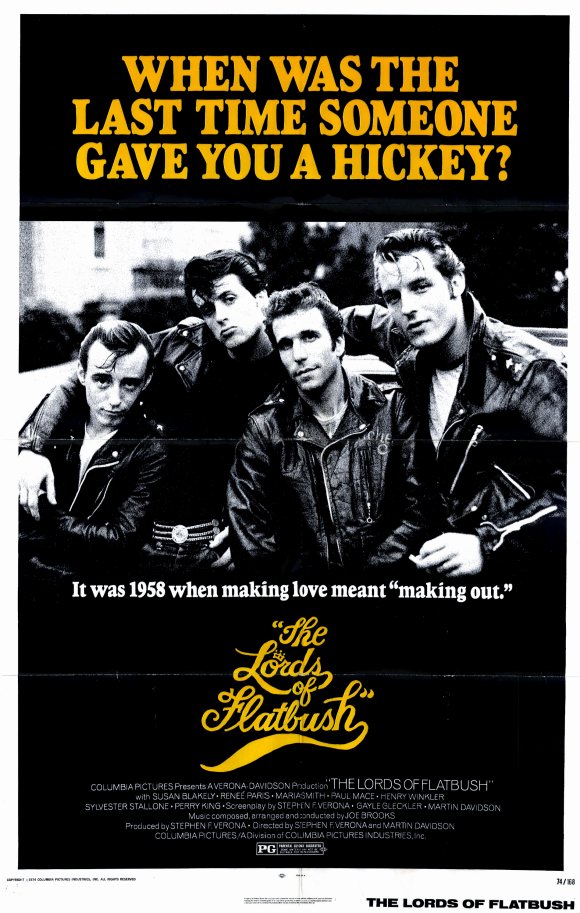
Butchey (Henry Winkler) forms a leather jacket gang with his friends at a Brooklyn city high school during the 1950’s. The group is made up of Stanley (Sylvester Stallone) who is forced to marry his girlfriend when he gets her pregnant and Chico (Perry King) who romances the pretty new girl in school named Jane (Susan Blakely). As they grow into adulthood they find themselves drifting apart as new interests and demands begin to appear.

This film can best be described as a B-version of American Graffiti that came out just a year earlier. The production values are shoddy with a grainy picture that looks like it was filmed on somebody’s home camera. The story works in fragmented style that comes off more like a series of vignettes than an actual plot. Chico’s romance with Jane happens too quickly and seems artificial from the start especially since they are from ‘opposite sides of the tracks’. The actors themselves are clearly well over 18 and in Stallone’s case almost pushing 30 making their presence and the overall 50’s feel seem unauthentic.

The one thing that saves it is that there are some funny scenes as well as moments of decent drama and character development. The part where Stallone barters with a jeweler over the price of the wedding ring is quite good. I also liked the scene where the boys get together to intimidate a guy who is dating Chico’s girl only to run in fright when the other guy brings in a team of football players to defend him. However, the opening bit dealing with the teens misbehaving in class is not funny at all and I ended up feeling sorry for the teacher who was only trying to do her job.

Although given top billing Winkler is underused and almost forgettable. King is the real star and does quite well while also creating a multi-dimensional character. Stallone steals every scene he is in and proves to be much more adept at comedy than you might think. You can also glimpse Ray Sharkey, Armand Assante and Brooke Adams as wedding guests.

The film also features model-turned-actress Susan Blakely in only her third feature who does well playing the ‘good girl’, but the scene where Chico pressures her into having sex and she resists while asking him what color her eyes are in an attempt to see if he really ‘knows’ her and not just using her makes no sense. For one thing her big, blue eyes are the most prominent part of her face. Anyone, even a stranger, who glances at her face for even a second would know the color of her eyes, and thus having her ask someone what color they are is ridiculous already and then having them unable to tell her makes it the dumbest part of the whole movie.

susan blakely

My Rating: 6 out of 10

Released: May 1, 1974

Runtime: 1Hour 26Minutes

Rated PG

Director: Martin Davidson and Stephan Verona

Studio: Columbia Pictures

Available: VHS, DVD, Amazon Instant Video

Death Race 2000 (1975)

death race 2000

By Richard Winters

My Rating: 5 out of 10

4-Word Review: New meaning to roadkill.

Based on the novel ‘The Racer’ by Ib Melchior the year is 2000 and a highly rated cross-country race takes place on television between many colorful individuals. There is Frankenstein (David Carradine) who has lost an arm and a leg in past races and must wear a leather mask to cover up his facial scarring. Then there is his chief rival Machine Gun Joe Viterbo (Sylvester Stallone) and also Calamity Jane (Mary Woronov) Nero the Hero (Martin Kove) and Matilda the Hun (Roberta Collins). Of course this is no ordinary race as crossing the finish line isn’t really as important as how many innocent bystanders they can kill along the way.

The idea is outrageous and for the most part director Paul Bartel manages to pull it off especially within the limitations of the budget. There are real kick-ass car explosions here and none of that computerized crap, which in itself gives it a few extra points. I liked the scene were an actual car is seen dropping down a steep cliff and how they were able to block off long sections of highways in order to be the only cars on the road. Some of the dark humor is funny although more so in the beginning. The best moment is when a group of doctors and nurses wheel up some elderly patients onto the middle of the roadway in order to be slaughtered by the racers as part of the their annual ‘euthanasia day’.

Sly is really funny. I know some critics have gotten on him over the years about his acting, but here he steals it from his costars and the film wouldn’t have been as effective without him. Carradine is pretty good in his part and his more subdued acting style makes a nice contrast to Stallone’s flamboyant one. The two even end up in a nice fist fight. However, I liked the idea of having the Carradine character being this walking gimp of a man so intoxicated with winning that he continues to drive and compete even as his body falls apart. Having him take of his mask and look completely normal and making that all a sham was disappointing and took away the unique gritty mystic of the character.

The initial treatment of the script was written by producer Roger Corman and then Bartel was hired in to put a more humorous spin on it. Although I like the idea of having some comedy I still wanted more gore and grittiness. Instead it becomes too campy and cartoonish and losing the potential edge that it has at the beginning. There also needed to be more of a focus on the race itself. As it is it goes too fast with pit stop segments that bogged the whole thing down. They manage to get from New York to St. Louis in one day, which if going on I-70 would be 953 miles and doesn’t seem possible even at high speeds. There is also a question of the speed of these cars. Supposedly they are ‘real fast’, but there is one segment where Joe tries to run down a kindly fisherman and the guy is able to out run the car for quite a distance before he is hit, so they can’t be all that fast.

There is also a secondary storyline involving an underground group called the People’s army that is trying to sabotage the race and put an end to it. Initially I felt this thread would allow for more intrigue, but instead it makes the whole thing too over-the-top. The short running time doesn’t allow for such a convoluted plot and the whole thing would have been better served had they stuck to the race and racers personalities itself. The sappy ‘feel-good’ twist ending is terrible and ruins whatever potential edge the film had.

My Rating: 5 out of 10

Released: April 27, 1975

Runtime: 1Hour 20Minutes

Rated R

Director: Paul Bartel

Studio: New World Pictures

Available: VHS, DVD, Blu-ray, Amazon Instant Video