Tag Archives: Romy Schneider

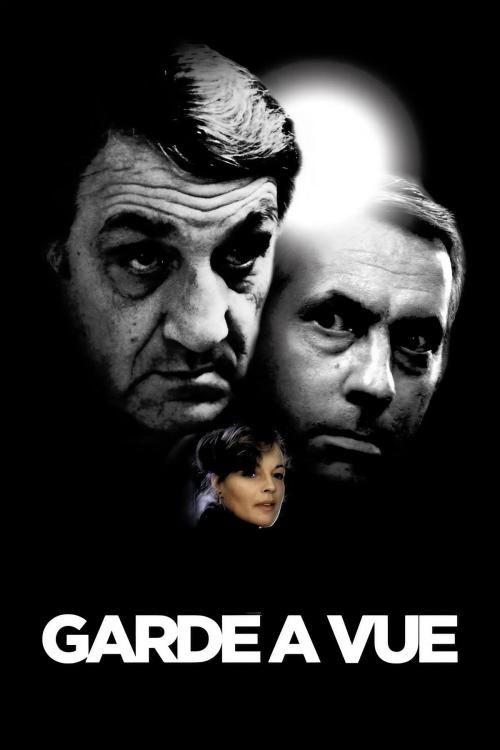
Garde A Vue (1981)

garde1

By Richard Winters

My Rating: 6 out of 10

4-Word Review: Interrogation of a lawyer.

Jerome (Michel Serrault), is a rich and powerful lawyer who is brought into a police station late one night during New Year’s Eve in order to be questioned about the rape and murder of two young girls. Antoine (Lino Ventura) is the lead investigator while Marcel (Guy Marchand) sits in the back and assists him during the interrogation. At first the conversation is light and civil, but as Antoine brings more circumstantial evidence to the forefront Jerome becomes nervous yet insists he’s still innocent. Marcel even implements some physical force against him, but Jerome’s stance never changes. In another room Antoine has a conversation with Jerome’s wife, Chantal (Romy Schneider), who confides to him that she secretly suspected Jerome to be in-love with an 8-year-old girl. Once Jerome gets confronted with this his story soon begins to change.

The film is based on the novel ‘Brainwash’ by John Wainwright and shot entirely in a studio soundstage and in chronological order. Why director Claude Miller would want to film a story that had very little if any cinematic elements to it is a mystery and if anything this might’ve fared better as a stage play. I was initially impressed with the police station room as you’d swear it was an authentic building and not just a prop built for the production. The drenching rain seen pouring down outside the windows is impressive as it gives the viewer a claustrophobic feel and I liked how eventually, when the clock hits midnight, you hear car horns honking outside to represent the New Year. However, every interrogation room I’ve seen, and I watch a lot of confession videos on Youtube from real-life cases, the rooms are very small and with no windows and the film would’ve been better served had it reflected a setting like this as it would’ve brought out better the psychological tension of the suspect and his feelings of the ‘walls closing in on him’, which with here you don’t get.

You can’t help but connect this movie with The Offencewhich starred Sean Connery and was directed by Sidney Lumet. That movie came out 8 years before this one, but had the exact same theme of a suspect being brought in over the murders of some school girls. That movie was well directed but did annoy me for the fact that in that one the suspect, played by Ian Bannen, did nothing, but give off this smirk the whole time.  This one has a much better back-and-forth between the investigator and suspect, which helps keep it compelling as more evidence gets introduced. However, in the Lumet film it had constant shots of this big bright light shining into the camera giving the viewer a point-of-view feeling of what someone in that situation would feel and thus helping hype the sense of urgency of wanting to get out of there, or say anything one needed to in order to stop the pressure, which this film doesn’t do very well. Both films though have cutaways showing the dead girl’s bodies from a distance in a secluded area, which are visually creepy, though again Lumet’s film scores a bit higher in that category too.

Spoiler Alert!

Ultimately the ending is a letdown and rather baffling as it features Jerome caving and admitting to a crime that he really didn’t commit due to the perceived police pressure. For one thing it’s hard to imagine that a seasoned lawyer would be that dumb and wouldn’t just ‘lawyer up’ himself and demand counsel of his own when interrogation got to be too much. I’ve seen a lot of true life interrogations where the pressure put on the suspect was far worse and those people refused to buckle, so seeing the character fall to pieces so relatively quickly especially when he was educated to know better makes the whole thing pathetic.

Didn’t quite get why the wife shoots herself at the end either. Supposedly it’s because she feels guilty about tabbing him for the murder when the real killer eventually gets exposed, but she did it out of honesty as she really felt he had a thing for young girls, so why should she feel tortured about saying something she truly believed? It would’ve been more surprising if she had pulled the gun on Jerome himself as he got into the car and shot him as she would feel, even if he hadn’t been arrested for this crime, that he still had some dark perversions and thus should be killed before he goes and carries out his fantasies on some other girl. Of course if she lied about him having a thing for an 8-year-old in order to get back at him over their contentious marriage then her guilt and suicide would’ve been more plausible, but I didn’t get that from watching it, so if that was ultimately her motivation then the filmmakers should’ve done a better job at intimating it.

This is the rare case where I’d say the Hollywood remake, which came out in 2000 as Under Suspicion and starred Gene Hackman and Morgan Freeman was much better done. It had a better visual balance that didn’t keep the whole thing stuck inside a police room and it better tied-up loose story ends that this one leaves open.

My Rating: 6 out of 10

Released: September 23, 1981

Runtime: 1 Hour 27 Minutes

Not Rated

Director: Claude Miller

Studio: AMLF

Available: DVD, Blu-ray
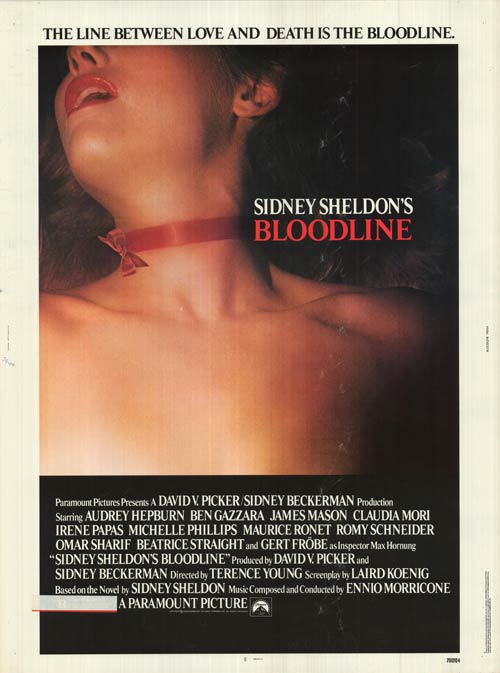
Bloodline (1979)

By Richard Winters

My Rating: 2 out of 10

4-Word Review: Killer stalks rich heiress.

When her father dies under mysterious circumstances Elizabeth (Audrey Hepburn) is given full control of the company he founded, Roffe Pharmaceuticals, a billion dollar empire. Elizabeth soon learns that there’s a power struggle going on amongst the board members and when she refuses to allow the company’s stock to go public she finds that her life is now the target of a mysterious killer who stages ‘accidents’ to occur where ever she goes.

This film marked Hepburn’s last starring vehicle in a theatrical feature and if it weren’t for her presence this thing really wouldn’t be worth seeking out and barely is anyways. The story is based on the best-selling novel by Sidney Sheldon, but comes off more like a hackneyed whodunnit featuring many derivative elements that you’ve seen hundreds of times before in other mystery films that were better done.

Some of the more annoying aspects include the loud, overplayed orchestral score that would be better suited for a sappy romance. There are also segments dealing with Gert Frobe, who plays the lead investigator on Elizabeth’s father’s case, who does most of his detective work sitting in a lab and interacting with a computer whose over-the-top robotic voice turns the whole thing into unintentional camp. I also thought it was dumb that Elizabeth listens to a audio tape recorded by her father just before he died in which he states that he thinks he knows which board member is trying to kill him, but then doesn’t reveal his name, but wouldn’t it have been wise to state that on the tape, so if he ended up getting killed there would be recorded evidence to help the investigators nab the right person? The film also features a recreation of the backstory showing how the father founded the company, which is corny as hell as well as a kinky subplot dealing with snuff movies, something that was added into the script after production had already begun, but wasn’t needed.

The accidents, which should’ve been the film’s highlight become boring throwaways instead. Hepburn’s car crash, which occurs when the killer fiddles with the brakes, is poorly edited and the injuries that she sustains are too superficial, a few bruises and scratches on the side of her face that immediately go away the next day. Her close call in a rigged elevator gets equally botched. We see a split second visual of an elevator speeding down a shaft and only later told that it killed her best friend (Beatrice Straight) who was inside it, but Hepburn decided at the last minute to step out of it to get something that she forgot inside the office, but this is something that the viewers should’ve seen as movies are a visual art and not just explained by Hepburn afterwards.

The variety of exotic locations, which was shot throughout Europe, adds some zest and the eclectic cast is interesting although most are wasted. With that said I still found Romy Schneider, who plays a female race car driver, to own every scene she is in, which proves what a great actress she was as she’s able to make her part flashy despite the weak material. Omar Sharif is also fun as a henpecked husband who finds himself not only dominated by his demanding wife (Irene Papas) but his lady lover as well.

Ultimately though it’s too hokey to take seriously and offers no intrigue. Even Hepburn becomes a problem by playing a character who doesn’t make any sense. She tries to get Ben Gazzara to marry her by admitting it’s for convenience only and that he’d still have his ‘freedoms’ to do ‘other things’ on the side and she’d agree to look the other way. Then when they finally do get married and he meets some of his other lovers at a restaurant she becomes enraged and runs out. This causes him to call her a ‘neurotic bitch’ which given the circumstances I would have to agree with.

Alternate Title: Sidney Sheldon’s Bloodline

My Rating: 2 out of 10

Released: June 29, 1979

Runtime: 1 Hour 57 Minutes

Rated R

Director: Terence Young

Studio: Paramount

Available: VHS, Amazon Video, YouTube

Deathwatch (1980)

deathwatch 2

By Richard Winters

My Rating: 8 out of 10

4-Word Review: Everyone watches her die.

Based on the David Compton novel this story deals with Katherine (Romy Schneider) who is living in a futuristic society where almost all diseases can be cured and death is very rare. When she is diagnosed with having a rare and incurable illness Vincent (Harry Dean Stanton) tries to get her to appear on his hit reality show ‘Deathwatch’ in which they film in documentary style a person’s slow and agonizing death, which is a huge TV hit. When Katherine tries to escape the publicity and hide from their cameras Vincent has a small camera surgically implanted into the brain of Roddy (Harvey Keitel) one of his cameramen, which then allows  Roddy to follow Katherine around and record her actions without her knowing it. The two then slowly form a relationship that culminates with tragic results.

Director Bertrand Tavernier is in top form. The movie is nicely paced and Tavernier shows a perfect grasp of the material. His use of music wonderfully accentuates the mood and tone. Filmed on-location in Scotland he captures the old buildings of the region with a stylish flair that gives the film an added personality and memorable image. Showing characters walking all alone in the seemingly abandoned streets hits home their loneliness and having the scenes done in decaying buildings and neighborhoods illustrates the decaying values and morals of the world these characters live in. The gray stormy skies brings out the pictures moodiness and the isolated shack in the middle of a vast empty field that the two hide out in captures visually the characters lost and hopeless desperation. The film becomes like an orchestral ensemble moved along by a talented conductor at the peak of his skill.

This is also a great example of using a hand-held camera sparingly and only to create a certain mood, or emotion. Too many films these days seem to have what I call ‘the shaking camera syndrome’ and it is annoying and loses the original intended effect. Here Tavernier employs it during a scene where Katherine is trying to elude the production crew and the viewer feels her frantic tension with each move that the camera makes as well as getting a great cultural feel by capturing the various street vendors along the way.

The story itself is fascinating and years ahead of its time. The issues it brings out about television, ratings, and the cutthroat ugly world of business of entertainment have never been more on-target. This film may even transcend the classic Network with its dire message and that is not easy to do. What I really liked though was the fact that the twists keep coming in layers and all of them are unexpected, but equally fascinating. The story is riveting and compelling from beginning to end.

Schneider is brilliant and beautiful as always giving another one of her impeccable performances. Her character is easily identifiable and the viewer immediately gains her sympathy. She shows an array of different emotions and traits making her a fascinating three-dimensional person. Her presence is the main ingredient that propels the film and without her none of it would have worked and her gorgeous natural smile is wonderful and manages to come on display briefly despite the ugly difficulties of her character.

Keitel is in fine form as well playing a character who finds that when one works for those who are more than willing to exploit others they themselves will eventually be exploited by them as well. Von Sydow appears near the very end and lends stature to the proceedings.

I hate to bring this up because I love the film’s visual design, but I did find it a bit odd that the story is about the hi-tech future and yet all we are shown are old buildings and other gadgets that look very much like they are from the 1980’s. The computer that Katherine works on is laughably archaic and I felt from that end they could have tried harder to create a little more of a futuristic impression. Also, the name of the network ‘NTV’ sounds a little too much like the cable network that used to show music videos.

The recent Blu-ray release from the Shout Factory is excellent and restores the film to its original runtime of 130 minutes. I highly recommend this to those who enjoy Sci-fi fare that is thought provoking and original.

My Rating: 8 out of 10

Released: January 23, 1980

Runtime: 2Hours 10Minutes

Rated PG

Director: Bertrand Tavernier

Studio: Gaumont International

Available: VHS (1Hour 57Minute Version), DVD, Blu-ray