Tag Archives: Review

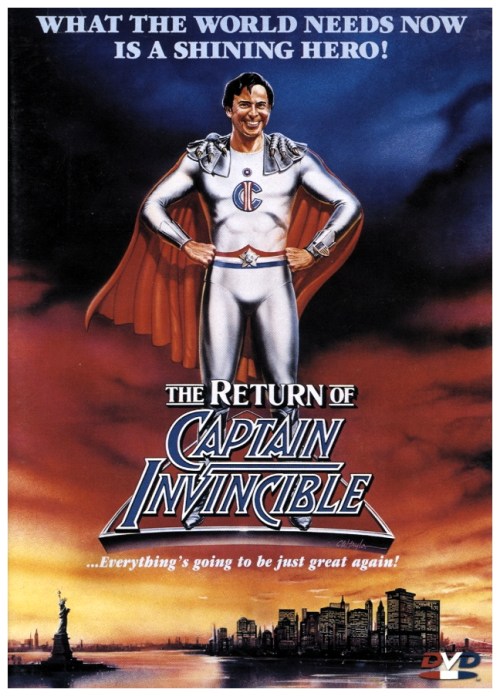
The Return of Captain Invincible (1983)

By Richard Winters

My Rating: 4 out of 10

4-Word Review: Super hero drops-out.

Captain Invincible (Alan Arkin) successfully fights off the Nazis during WWII and becomes a hero to millions, but then by the 1950’s, during the McCarthy era, he is smeared as being a ‘communist’, due to wearing a red cape.  The congressional investigators also accuse him of flying in airspace without a proper license and wearing underwear in public. All of this causes him to drop-out of the superhero business by moving to Australia and turning into a homeless alcoholic. Then his old rival, Mr. Midnight (Christopher Lee) steals a secret weapon called the hypnoray, which puts the whole world at risk. This causes the authorities to plead to Captain Invincible to return and help them stop the madman, but through the years his skills have diminished and he’s not sure he can get back into form to battle crime like he once did.

At the outset this is an inspired concoction made long before the super-hero satire was ever in vogue and there are a few funny bits here and there, but the whole thing gets too bizarre for its own good. The viewer becomes inundated with so much wacky imagery and goofy characters that instead of laughing you’re left scratching your head wondering what’s it all about.

The biggest mistake was adding in musical numbers, which turns the thing into an ill-advised version of The Rocky Horror Picture Show. The original script was not intended to be a musical, but director Philippe Mora had always dreamed of doing one, so he requested that the songs be added in. The first time this occurs it’s kind of fun particularly the line dance done by the well-dressed advisors to the President, which all helps to add to the irreverence, but then continuing to add in more songs bogs everything down  and makes the already sluggish pace even worse. Arkin and co-star Kate Fitzpatrick do not have good singing voices, so hearing them belt-out a half-hearted tune hurts the ears and with no interesting dance numbers to come along with it, these moments become boring visually as well.

Even though the story involves an aging superhero I still felt Arkin was too old for the part and would’ve liked somebody who could have offered more energy. Typical Arkin is great with offbeat material such as this, but everything is so over-the-top that he gets lost in the access and ultimately becomes just a prop. Christopher Lee suffers the same fate although some fans love his rendition of ‘Name Your Poison’ which he sings to Arkin as he tries to entice him to take an alcoholic drink from his personally made wet bar.

The film offers no special effects which becomes most apparent during the segment where Captain Invincible supposedly upends a speeding car, but the camera cuts away, so we never see him do the actual act, and just hits home how cheap the whole production really is. If you’re going to make fun of the Superhero genre you have to at least show some respect for it, which this thing never does. Instead of going off on wild tangents there should’ve been a big showdown between Invincible and Midnight, but it peters out in this area by being too busy trying to be weird when it should’ve worked harder to get a more coherent and interesting story.

My Rating: 4 out of 10

Released: June 11, 1983

Runtime: 1 Hour 36 Minutes

Rated PG

Director: Philippe Mora

Studio: Seven Keys

Available: DVD
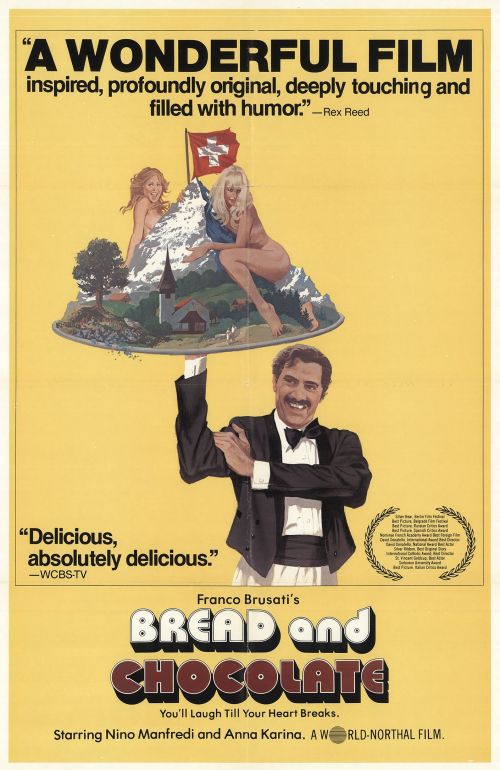
Bread and Chocolate (1974)

By Richard Winters

My Rating: 9 out of 10

4-Word Review: He has no home.

Nino (Nino Manfredi) has moved to Switzerland to work as a guest worker in that country since he’s unable to find employment that pays a living wage in his homeland of Italy. In order to provide for his family he works various odd jobs and then sends the money back home to his wife and kids who he has not seen in years. There are many other foreigners from other countries competing for the same jobs as Nino including a Turkish worker (Gianfranco Barra) who vies for the head waiter position at a fancy restaurant that Nino also wants, but even though the two don’t get along they’re still forced to room together in a cramped attic apartment. Nino’s only source of companionship comes in the form of a friendship that he has with Elena (Anna Karina) a Greek who lives across the street from him in an equally small loft. He moves in with her and her son when he gets kicked out of his other place, but because she’s also a guest worker striving to make ends meet she has no time for a relationship making Nino feel like an unwanted outsider no matter where he goes.

This critically acclaimed film really allows the viewer to get to know their characters and the desperation that they feel. Many viewers today may be unaware of the guest worker program that many European countries took part in during the 60’s and 70’s, so watching this will be an educational experience as well as a good character study. What I found most fascinating though was the issue of racism. Most people wouldn’t consider Switzerland to be a ‘racist’ country, so it’s interesting to see how this element can creep in anywhere and it doesn’t have to hinge on one’s skin color either as the Swiss end up picking on the Italians simply because they aren’t from there, poor and ‘stealing their jobs’, so are therefore in their minds deserving of being looked down upon, much like foreign workers in this country can sometimes feel.

The film also makes keen observations in regards to the rich versus poor and how having a lot of money can sometimes make one a weaker person less able to handle challenges. This comes to a head with Nino’s friendship with an Italian Industrialist (Johnny Dorelli) who despite living a lavish lifestyle commits suicide after losing a custody battle with his ex-wife even though Nino hasn’t seen his family for years and lives in near squalor, but because he’s toughened to the hard times he’s able to preserve and remain upbeat where the rich man couldn’t.

There’s many memorable moments, so many that it would be hard to list as the story and characters are so multi-layered the laughs and insights come in literally just about every frame. Many will consider Nino’s visit with some farm workers who out of desperation have moved into a chicken coop and start behaving like the chickens they tend, which is funny and unique, as the film’s highlight. However, my favorite part came when Nino decides, in an effort to move up in society, to pretend that he’s Swiss and even dyes his hair blond and begins speaking in a Swiss accent. Then while at a bar he watches a soccer match between Switzerland and Italy on the TV and even though he initially cheers for the Swiss team he can’t help but eventually shout out in excitement when Italy scores a goal, which just proves the old saying: You can take a person out of their homeland, but you can never take the homeland out of the person.

The film’s most redeeming quality though is showing the strong bond that forms between the guest workers. Even if they’re at first strangers and from different countries they immediately offer support and friendship to Nino no matter where he goes simply because they are going through the same hardships as he, which becomes a wonderful testament to the hearty human spirit.

My Rating: 9 out of 10

Released: January 18, 1974

Runtime: 1 Hour 40 Minutes

Director: Franco Brusati

Studio: Cinema International Corporation

Available: DVD, Blu-ray (Region B/2)

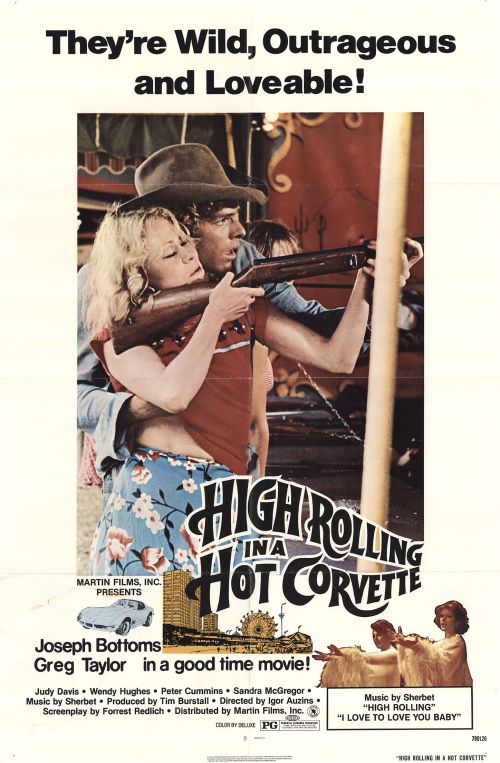
High Rolling in a Hot Corvette (1977)

By Richard Winters

My Rating: 6 out of 10

4-Word Review: Two guys drop out.

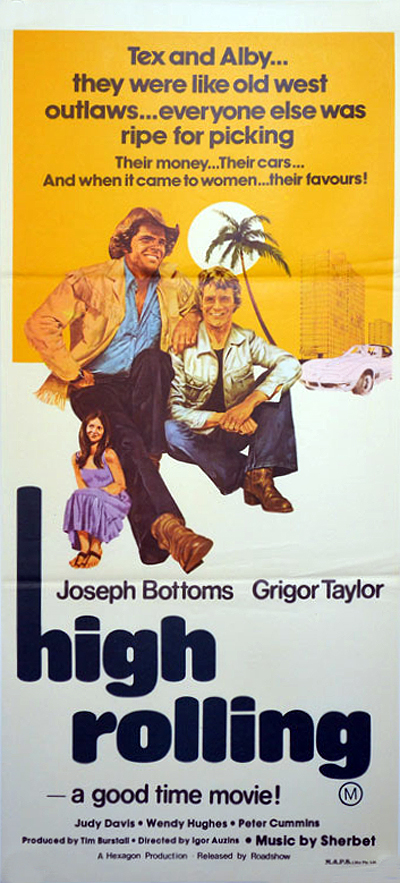
Tex (Joseph Bottoms) and Alby (Grigor Taylor) are two friends working at a carnival who decide, after Tex gets fired when he’s caught having sex with a female customer, to breakaway from the grind by heading out to the Gold Coast and Surfer’s Paradise. They hitch a ride with Arnold (John Clayton) who drives a snazzy green Corvette. After he takes the two to a hotel for the night he comes-on to Alby, who beats Arnold up that puts him into an unconscious state. When Tex finds out what happened they decide to make a run for it by driving away in Arnold’s green corvette, which to their shock is loaded with bags of marijuana. They use Arnold’s money from his wallet to help them get into ritzy nightclubs where they meet up with attractive singers Susie and Barbie (Sandra McGregor, Wendy Hughes), but once the money is spent they’re forced to rob a tour bus full of passengers, but just as they’re ready to escape with the loot Arnold returns with his muscular friends and an ugly confrontation ensues.

This is another Australian flick where it could’ve easily been filmed here and you’d never know the difference. Whether it’s intentional or not the American influence is quite strong including having them eat at such restaurants as Kentucky Friend Chicken and McDonald’s. The Outback is the one area that can help Australia stand out, but the two never go there and stick to the lushly green coastal region, which again looks no different than many of the landscapes in the U.S.

They even hire an American actor for the lead, which I felt was a mistake. Apparently they thought it would be easier to sell to distributors abroad if not all the actors spoke with an Aussie accent, but Bottoms, who is the younger brother of the more famous Timothy Bottoms, isn’t a good enough actor to make anything that he does onscreen either interesting or memorable. His reckless wild boy behavior comes-off as affected and forced and the way he aggressively comes-on to women would be considered misogynist and sexual harassment by today’s standards. Plus, there’s never any explanation for why this Texan would be working the carnival scene in Australia to begin with.

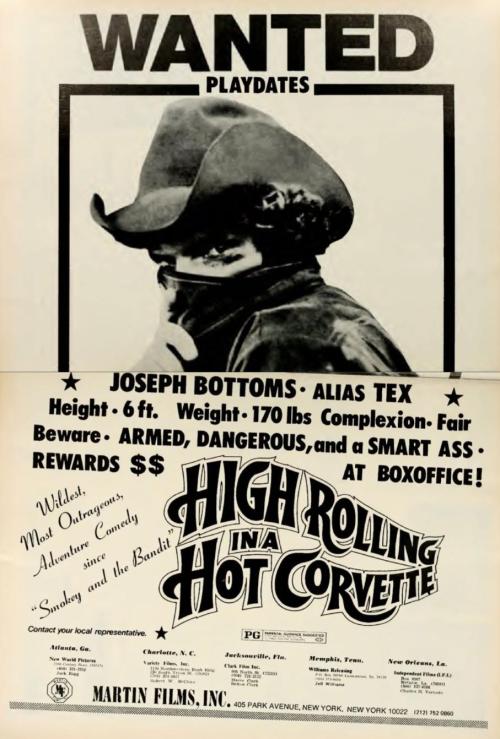
The tone of the film when compared to its trailer, which can be seen on YouTube, is far more grim and dramatic. The trailer gives you the impression it’s a comical, freewheeling adventure that will bring you back to your youthful days of rebellion, when really it’s more about them desperately living on the edge, getting beat-up and seeking shelter in an abandoned church when it rains. If anything it makes the creature comforts of suburbia, even with some of the compromises that come with it, seem not so bad by comparison.

These guys aren’t too smart either and it becomes harder and harder to keep siding with them with each jam they stupidly get themselves into. Driving off with the Corvette was just asking for trouble since they didn’t bother to change the license plate, so any cop could scan the number and realize that the vehicle was stolen. When they rob the bus, which is the best moment in the movie, they don’t wear any masks, so they’ll be easily identifiable. It also makes you wonder why if these bums needed money so bad they couldn’t just find a job like the rest of us instead of robbing innocent people, which is not a nice thing to do and makes the viewer not want to like these guys who are, at least in theory, supposed to be the protagonists.

The filmed is helped by the appearances of two young Australian actresses at the start of their careers. Hughes is beautiful as the showgirl that they meet but her part is ultimately too small. I was afraid Judy Davis, who plays a hitchhiker that they pick-up, would have the same fate, but she returns later on to give the cops a wild car chase driving the Corvette that makes it worth it.

The film though lacks any discernable point or message. The characters show no  arc and behave the same way at the end that they did at the beginning. Nothing conclusive is giving to their ultimate fate. Will they be able to live on the road and on-the-edge all of their lives? This hardly seems possible, but the movie makes no effort to answer this question causing it to be vapid and undistinguished from the plethora of other road movies out there.

My Rating: 6 out of 10

Released: August 4, 1977

Runtime: 1 Hour 21 Minutes

Rated PG

Director: Igor Auzins

Studio: Hexagon Productions

Available: DVD-R

Payday (1973)

By Richard Winters

My Rating: 8 out of 10

4-Word Review: A self-destructive singer.

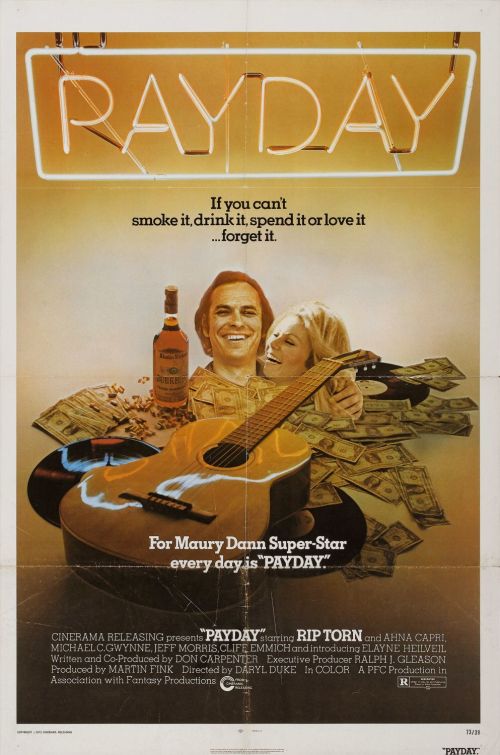
Maury Dann (Rip Torn) is a popular country singer who performs at many clubs throughout the southeast. While he is loved by his many fans he routinely takes advantage of those around him including sleeping with married women while openly seducing the others even when it’s right in front of his current girlfriend Mayleen (Ahna Capri). When Maury is confronted by the father (Walter Bamberg) of one of the young women he’s seduced they get into an ugly fight and Maury accidently ends up killing him, but since he’s so used to exploiting others he asks his loyal limo driver Chicago (Cliff Emmich) to take the blame for him.

The film, which was directed by Daryl Duke, is a masterpiece in penetrating drama to the point that I’m surprised that Duke, who had only directed TV-shows before this, didn’t go on to have a long career in making Hollywood movies instead of going right back to doing episodic TV-work after this. The script though, which was written by Don Carpenter, is completely on-target as it paints a very trenchant, no-holds-barred portrait of the seamier side of show business life and most importantly the people who work in it.

The atmosphere of the smoke-filled bars/nightclubs is vividly captured and the dialogue has a nice conversational quality that makes its point, but never in too much of an obvious way. The characterizations though are the most revealing and include Maury’s loyal manager Clarence (Michael C. Gwynne) who secretly despises Maury and is well aware of his many faults, but does whatever he can to cover them up to the adoring public.  Cliff Emmich as the faithful limo driver, who secretly aspires to be a gourmet chief, is terrific too. He doesn’t say much, but when he does it’s always quite interesting and his facial reactions are great.

My favorite characters though were Maury’s two girlfriends particularly the young, wide-eyed Rosamond (Elayne Heilveil in her film debut) who excitedly jumps into bed with Maury as his new star crush groupie only to become more apprehensive about things, which get revealed through her wonderfully strained facial expressions, the ugliness that goes on around her. Since her character has the most obvious arc I thought she should’ve been the story’s centerpiece.

Capri is quite enjoyable as well playing on the opposite end of the spectrum as a jaded woman who’s been in the groupie scene too long, but desperate enough to stay in it. The film’s most memorable moment is when Maury kicks her out of his limo, without any money, in the middle of a cornfield. She’s able to find another ride quickly, but I would’ve liked seeing a scene later on showing where she ultimately ended-up, or having her return to the story near the end where she could’ve had a climactic final confrontation with Maury, which is what her character deserved.

The only thing that I didn’t like was Maury himself. Torn plays the part in a masterful way, although his singing over the opening credits, which he insisted on doing himself, isn’t so spectacular, but his acting is. The only problem is that his character is just too much of a jerk. Supposedly it’s loosely based on Hank Williams and I’m sure there’s a lot of truth to it, but it would’ve been nice had there been at least one fleeting moment when he did something redeeming as his constant jerkiness becomes almost an overload for the viewer making it border on being too obnoxious to watch, but it’s so well crafted in every other aspect it’s still a worthwhile view.

My Rating: 8 out of 10

Released: February 22, 1973

Runtime: 1 Hour 43 Minutes

Rated R

Director: Daryl Duke

Studio: Cinerama Releasing

Available: DVD

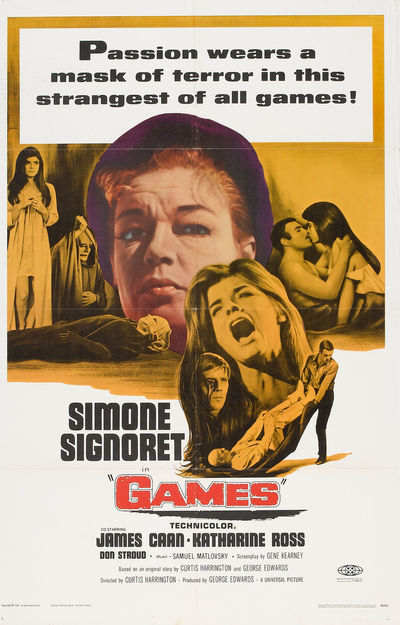
Games (1967)

By Richard Winters

My Rating: 5 out of 10

4-Word Review: Playing tricks on others.

Paul (James Caan) and his wife Jennifer (Katharine Ross) are an affluent upper East Side couple who are into illusion/magic trick shows and entertain their friends at posh parties that they hold inside their spacious townhome. One day Lisa (Simone Signoret) arrives at their door selling cosmetics only to fall ill when she gets inside the home. A doctor (Ian Wolfe) comes over and finds her condition to be only temporary and says she’ll recover in a day if given plenty of rest, so they decide to let her stay the night, which then becomes an extended visit as Lisa and Jennifer begin to bond. The two then start playing tricks on Paul by pretending that Jennifer is having an affair with their delivery boy named Norman (Don Stroud). Eventually Paul realizes he’s been duped, but wants to get revenge by pretending to catch Norman coming onto Jennifer the next day. This time Paul accidently shoots and kills him forcing the couple to get rid of the body without Lisa becoming aware, which they’re able to do, until Jennifer begins seeing what she believes to be Norman’s ghostly presence.

The film has potential, but consistently misses-the-mark and ultimately becomes a misfire. The games the two play are amusing, but nothing special though it’s enough to hold interest particularly at the beginning during the party scenes with all of their pretentious friends. The townhouse the two live in is ritzy and I enjoyed the design, but if you’re going to have a story take place in Manhattan then you better film it there and not on a sound stage in Los Angeles as the ambience of the neighborhood is missing and having almost all of the action take place in one setting eventually becomes claustrophobic.

The real problem though is with the characters. Signoret is fantastic and her presence helps immensely, but the way she enters into the story is ridiculous. What kind of couple would let a strange woman stay overnight in their home? If she’s sick then let her spend it at a hospital. Turning her one night visit into an extended stay is equally farfetched and where exactly did she find this wardrobe to wear when she initially just came over to peddle perfumes?

Ross’s character is a big mess too and it’s no wonder that she has referred to this film as being ‘terrible’ and it’s not her fault either. She’s quite beautiful as always and if you need an actress to give off the perfect scared expression she’s tops, but I didn’t understand why her character allowed herself to be so taken in. This was a couple used to playing tricks not only on their friends, but on each other, so why didn’t she have a more jaded reaction and presume that her husband really didn’t kill Norman and it was all some elaborate game?

Spoiler Alert!

The twist ending is a complete letdown as it hinges on Paul meeting Lisa a year earlier by chance and then springing this idea on her of scaring Jennifer to death to the point that she inadvertently kills someone, so that he can get at her fortune and split it with Lisa, but how would he know that he could trust Lisa to keep this secret and not go to the authorities, or tell Jennifer? It might’ve worked better had the third person been a lifelong friend/family member to Paul, and not just someone he met at random, and therefore not likely to betray him.

A double-ending would’ve been more satisfying as Lisa poisons Paul and walks away with the money, but Paul should’ve been cunning enough to try and poison Lisa first, or through mutual mistrust they poison each other and no one gets the money. An even better idea would’ve had Jennifer only pretending to fall victim to the ruse, so when Lisa walks outside with the suitcase full of money, after having killed Paul, Jennifer and the police squad could’ve been there waiting for her.

My Rating: 5 out of 10

Released: September 17, 1967

Runtime: 1 Hour 40 Minutes

Not Rated

Director: Curtis Harrington

Studio: Universal

Available: DVD-R (Universal Vault Series), Blu-ray

Fast Talking (1984)

By Richard Winters

My Rating: 5 out of 10

4-Word Review: Teen gets into trouble.

Steve (Rod Zuanic) is a teen who has a rocky relationship with his alcoholic father (Peter Hehir) and ditzy mother (Julie McGregor). To survive on his own he’s forced to deal marijuana and  steal newspapers, which he then resells to motorists in their cars while they wait at a red light. His shenanigan’s get him into constant trouble especially at school where he’s perpetually dodging capture with his amazing ability to escape out of just about any jam.

Writer/director Ken Cameron was inspired to do this film after working as a high school teacher as well as for his love of Francois Truffaut’s 400 Blows, which he saw while growing up. The realism is on-target and has a certain cinema vertite feel. I went to high school when this film was made and can attest that the behaviors of the students here resembled many that I knew then and it’s amazing that even though this was shot on a continent halfway around the world the adolescent experience in Australia isn’t all that much different than that in the U.S. In fact if it weren’t for the Aussie accents one might think that it had been filmed here.

The story though, which was based on short films that Cameron made before he did feature length productions, isn’t connected enough to be impactful. The script is more like a collection of vignettes than a plot and while there’s some interesting moments it’s too spotty to be fully effective. I enjoyed Steve’s budding friendship with a mechanic (Steve Bisley) who tries to teach him the trade, but the film cuts away from this only to briefly go back to it much later when it should’ve been more of the focus. This same thing occurs when Steve tries to save a greyhound, that he apparently had a deep emotional bond to, from being killed by his father, but this storyline gets introduced almost 60 minutes in and should’ve at least been alluded to earlier.

Zuanic was discovered after Cameron spent three months teaching drama classes in High Schools around Sydney and while he looks like a genuine teen and not a college-aged kid pretending to be one as in other teen flicks his physique is too scrawny. (The painted image of him seen in the film poster above makes him seem much bigger and mature than he really is.) He resembles more of a child at age 12 and nowhere near someone entering manhood. Maybe that was the point, but watching him smoke, swear, steal, and get involved at times in amorous activities gets unsettling to watch because of it. When he confronts those that are bigger than him, which happens a lot since he’s so painfully small, I kept wincing thinking he’s going to get his ass kick despite his cocksure attitude and with no real ability to defend himself. Having the part played by a 17 year-old with a stocky build would’ve been preferable.

Not much insight is given towards Steve’s relationship with his mother, who’s seen only briefly, even though this is the catalyst for his desperate behavior, so I felt it needed to be played-out far more. His constant ability at escaping capture by whatever authority figure is after him is amusing at first, but eventually becomes redundant and unrealistic as at some point he’s going to be forced to face the consequences of his actions, which needed to be shown, but never is. The wide-open ending, apparently done because Cameron thought this would be made into a sequel, but due to the poor box office returns never was, offers no definitive conclusion to our character’s ultimate destiny, which makes the film even more transparent than it already is.

My Rating: 5 out of 10

Released: August 23, 1984

Runtime: 1 Hour 35 Minutes

Not Rated

Director: Ken Cameron

Studio: Filmways

Available: DVD (Region 4), Amazon Video

Roar (1981)

By Richard Winters

My Rating: 5 out of 10

4-Word Review: Lions takeover a house.

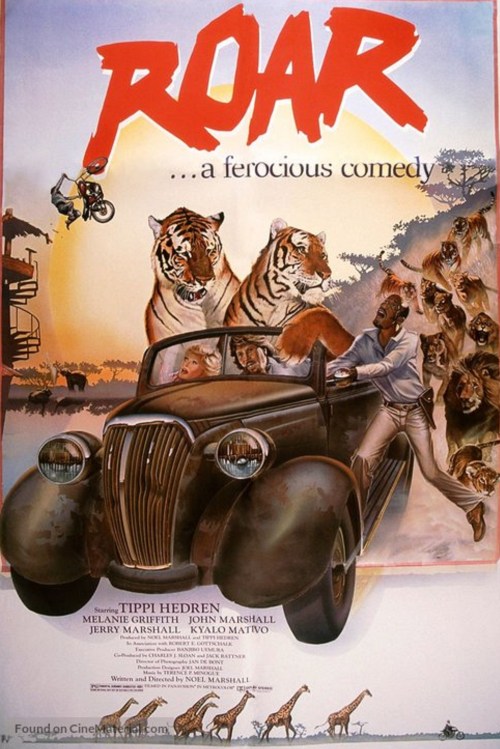
Hank (Noel Marshall) is a naturalist residing in east Africa where he studies the behaviors of lions and keeps several of them in his home. His wife Madeline (Tippi Hedren), daughter Melanie (Melanie Griffith) and two sons (John Marshall, Jerry Marshall) travel from Chicago to visit him. However, when they arrive there’s a mix-up causing Hank to miss picking them up at the airport. The four then travel to the home without him. When they get to the place it becomes overrun with the lions and the family is unable to handle them causing much havoc and destruction as they try to keep from getting attacked and bitten.

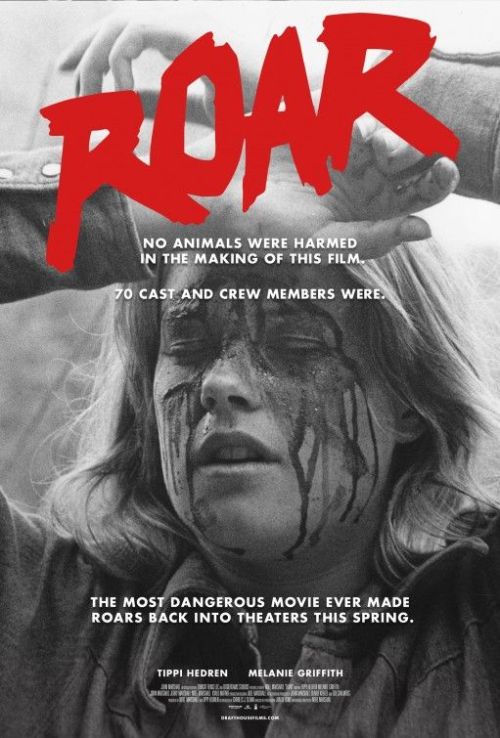
The idea for the film was inspired by Marshall and Hedren, who were married at the time, as they traveled through Mozambique in 1969. While going on a nature tour their guide pointed to a abandoned home that had become inhabited by lions and they thought this would make for a funny movie. It took them over 7 years to find the funds to be able to actually film it and then another 3 years before filming was complete. Over 150 lions were used at a cost of $4,000 a week to feed forcing the couple to sell their 3 homes just to be able to have enough money to cover the food and other expenses. Initially it was never released in the US and only abroad until in 2015 it got reissued to Alamo Drafthouse theaters were it got dubbed as being ‘the most dangerous movie ever made’ due to the many injuries inflicted on the cast and crew by the animals during the production.

To some degree the loose story works. I liked the scene where local official come to Hank’s home in their boats and become inexplicable attacked by the lions without warning even seeing actor Marshall’s hand bitten by one of the beasts, which all comes off as quite realistic and unstaged, something you rarely see in most Hollywood films. Unfortunately having to spend 90-minutes watching the family trying to get away from the lions becomes quite redundant. There’s constantly something going on and there’s a lot of chaos and running around, so visually it’s never boring, but the story goes nowhere. Ultimately it’s like gazing at a hamster inside their cage running inside a spinning wheel, which might be fun for while, but eventually pointless.

Savage Harvest, which I reviewed earlier in the week and came out around the same time, had a much more consistent tone. At least we knew that was intended to be a suspenseful thriller and for the most part it delivered, but here it gets increasingly confusing. While this budget is better and I enjoyed the opening sequence showing the beautiful topography of Kenya I still came away liking the other movie a bit better. The lion attacks are more graphic and in-you-face here, but without any sufficient tension it’s not captivating to sit through. It’s supposed to be a comedy and was marketed as such, but it gets too intense for that. Had the cast been made up of evil poachers that get harassed by the animals the prolonged scenario might’ve worked, but watching a bland family as the intended ‘victims’ isn’t enough to hold sustained interest.

I admire Hedren’s willingness, and the whole cast, for putting themselves in harm’s way and there are a few cute moments like when a lion plays with a skateboard, but it relies too heavily on the action, and the animals who are given onscreen credit along with the rest of the cast, but an actual plot was needed. With that said it’s still a one-of-a-kind movie that needs to be seen to be believed. I’m not sure if this one is included in the book ‘1001 Movies You Must See Before You Die’, as I have not always in agreement with some of the other ones that got listed in it, but this one definitely should be.

My Rating: 5 out of 10

Released: October 30, 1981

Runtime: 1 Hour 38 Minutes

Rated PG

Director: Noel Marshall

Studio: American Filmworks

Available: DVD

Savage Harvest (1980)

By Richard Winters

My Rating: 6 out of 10

4-Word Review: Hungry lions attack family.

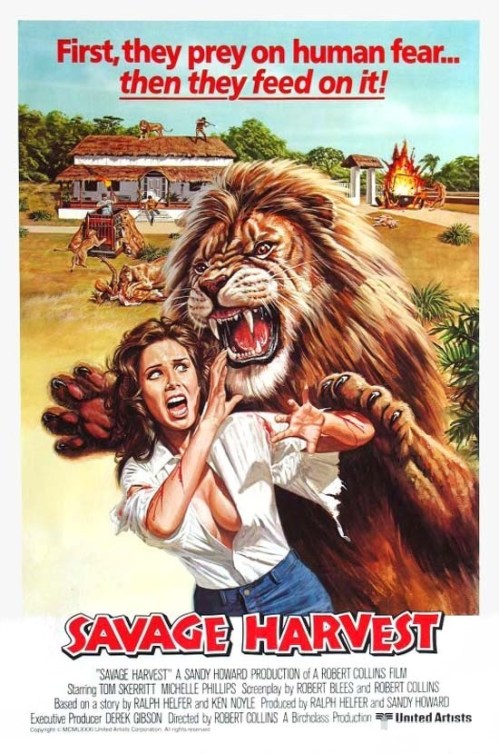
Similar to Roar, which will be reviewed later this week and was released the same year, the plot centers on a family headed by Maggie (Michelle Phillips) who live in Kenya. Due the drought and famine in the area the lions have begun to attack the people. When a pride surrounds their home it’s up to them and Casey (Tom Skerrit), a friend of the family, to fight off the beasts and find a way out of the house and to safety.

Many fans of the film, particularly reviewers on IMDb, will tell you that it’s the footage of the lion attacks that they found riveting and was so scary and realistic looking that it would keep them up at night as kids. Initially though I found some of these attacks not to be all that impressive. In the first one we don’t even see the lion at all just a close-up of one of the frightened villager’s eyes. In the second one, which occurs when actor Arthur Malet gets trapped inside his broken down van, has potential if it had gotten played-out more, but ends up feeling a bit like a cop-out when we again don’t see the lions actually attack him, but instead just a big dent on the roof of his van apparently caused by the lion when he jumps on it and then there’s a quick cutaway only to come back to the scene later after the victim is already dead.

There are other segments that don’t make much sense for instance having a lion somehow crawl through the chimney of the home and into the fireplace, but no explanation for how he was able to get on the roof of the house, nor how a chimney could be wide enough to fit his large body. Later there’s a lion who pops into the living room like it was magic and nothing shown for how he got in.

The film is for the most part a low budget cheapie focused solely on the lion storyline and nothing else. While I did enjoy the moment when the family sings Beatles songs as the lions hungrily try to break into the home I felt the characterizations were too thin. A sub plot might’ve given it a little more depth, but none ever comes and when the lions aren’t on the screen it’s quite sterile.

However, it does get effectively tense if you’re patient and wade through some of the footage of victims looking, even with the quick editing, like mannequins filled with raw meat. The climactic sequence though had me on edge especially as they manage to create a caged contraption out of various household items and then make an attempt to escape while inside it. It’s a truly hold-your-breath moment that more than makes up for any of  the film’s other blemishes.

My Rating: 6 out of 10

May 1, 1981

Runtime: 1 Hour 27 Minutes

Rated PG

Director: Robert L. Collins

Studio: 20th Century Fox

Available: VHS

Nickel Queen (1971)

By Richard Winters

My Rating: 4 out of 10

4-Word Review: Bar owner gets rich.

Meg Blake (Googie Withers) is a widow who owns a pub in a small desert town that has only 10 people living in it. She finds it hard to make ends meet until she hears about a nickel discovery in the outback and decides to be the first one to stake her claim to the land. Little does she know that corrupt executive Ed Benson (Alfred Sandor) fabricated the rumor of a nickel discovery simply so he could sell shares to gullible investors and Meg’s stake of land is actually worth nothing, but because Ed wants other people to also buy shares he pretends that Meg has already gotten rich through her investment and gives her $100,000 up front and parades her around the media while calling her the Nickel Queen. Meg laps up the publicity and spends her newfound fortune lavishly only to ultimately learn, once all her money is gone, that it was a hoax, which causes her and the other angry investors to go after Ed for revenge.

The story was inspired by the real-life event known as the Poseidon Bubble, which occurred in Australia in 1969, where shares in mining soared upon the discovery of a nickel deposit in September of that year only to quickly crash by early 1970 once it was found that the nickel was of a lower quality than initially thought causing many investors to loose a lot of money. Had the film stuck more to the true life event it might’ve had potential, but the way it gets played-out here is rather tepid.

It starts off alright and Withers, acting in front of the camera for the first time in 13 years, creates an engaging character who doesn’t back down to anyone and never hesitates to speak-her-mind. Unfortunately her tenacious personality does not get played-up enough. Once she becomes a media darling her wisecracks no longer have any zing and she falls into Ed’s trap too easily.  During the second half her presence is rather minor as she becomes this naïve person who must depend on her old friend Harry (Ed Devereaux) to get her out of her jam and exposing the corrupt Ed instead of she being the one to do that on her own.

The supporting cast is equally wasted. Initially the hippie guru character of Claude (played by John Laws who was and still is a famous Australian radio personality) seemed interesting as his values and outlook on things, particularly his refusal to work, contrasted greatly with Meg’s making it seem like the two would be sharing some wildly over-the-top confrontations. Instead Claude takes an extreme pivot midway through by showing up as a clean-shaven man willing to sell-out for money and even ends up becoming Meg’s lover, but what’s the point of him starting out one way if he’s just going to end up being the polar opposite? The transition is not revealing or introspective and shows how the filmmakers, who were all over 50, had no understanding of the counter-culture movement at all.

Doreen Warburton, who plays Ed’s gluttonous wife, is equally problematic.  The running joke of seeing her constantly stuffing her face with food gets pretty old, pretty fast to the point that it starts to get kind of disgusting to look at. Not having her utter a single word of dialogue is weird too making it seem like she’s not even human, but simply an unfunny and highly stereotyped caricature.

I liked how the first half was shot in an actual ghost town known as Broad Arrow and having the action take place in some of the town’s abandoned buildings gave the film an added visual flair, but this gets completely lost during the second-half when everything moves to the big city of Perth. The music is yet another issue as it sounds like something from the 40’s or 50’s and completely out-of-touch with the times. A lot of the cast is made up of hippies, so the soundtrack should’ve reflected more of their tastes.

Ultimately the film suffers from being too much of a family project. Writer/director John McCallum was star Googie’s husband and there’s even a part for their daughter Joanna McCallum, who plays Meg’s hippie daughter. While this may have been a fun project to work on from their perspective it offers little in the way that is satisfying to the viewer. The plot is poorly constructed and the wrap-up too tidy making it seem like material better suited for a TV-sitcom than the big screen.

My Rating: 4 out of 10

Released: April 1, 1971

Runtime: 1 Hour 27 Minutes

Director: John McCallum

Studio: British Empire Films Australia

Available: None

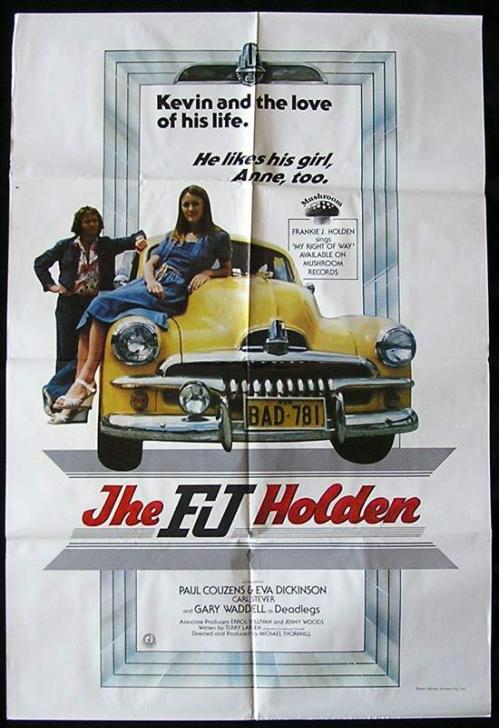
The FJ Holden (1977)

By Richard Winters

My Rating: 3 out of 10

4-Word Review: A youth’s aimless life.

Kevin (Paul Couzens) is a teen over 18 still living at home with his parents (Roy Corbett, Beryl Marshall). Most of his time is spent being idle while driving around in his refurbished FJ Holden and getting drunk with his best friend Bob (Carl Stever). One day while hanging out at a mall Kevin spots Anne (Eva Dickinson) and gives her a ride in his car and eventually the two start going out. Everything goes well for awhile until Kevin makes love to Anne with the bedroom door still open, so that Bob can watch. When Anne realizes what’s going on she kicks Kevin out of the house and breaks off their relationship, but Kevin refuses to let it go and tries to rekindle things with her later at a party, which causes tensions with the other partygoers and the home owner.

I’ve stated many times that I wished Hollywood movies wouldn’t feel so compelled to rush through a story as they do and allow scenes more time to be strung-out and not edit things so quickly. Allowing things to unfold at a more leisurely pace gives the viewer a chance to soak in the setting and characters better without having to be told what to think or feel, but this film goes to the other extreme. The pace meanders so much you become bored and lose focus. There’s just not enough going on to keep you interested or intrigued.

That’s not to say it’s a bad movie as I liked the technical approach, which puts the actors in public settings, but with regular people in the back drop as opposed to film extras. You get more of a realistic atmosphere this way particularly the scenes at the mall, which before the advent of social media, skype, and texting was a social hotspot for most teens to meet other people and hang-out. The story though, which was based on loosely constructed comic poems, is not structured enough to remain engaging. The dialogue is too generic and the situations they go through, whether it’s making love in the backseat of a car, or drag racing, have all been done in many other teen flicks, so watching it here just makes it seem all the more redundant and pointless.

There manages to be a a few interesting bits here and there, but overall it’s a sluggish experience. Only at the very end when Kevin confronts Anne at the party is there are any real potential for dramatic sparks, but it doesn’t get played-out enough. I was hoping for a full-out brawl to make-up for all the boredom that had come before it, but director Michael Thornhill, who has found critical acclaim with some of his later films, just wasn’t confident enough apparently to push this thing full-throttle, which ultimately makes it bland and forgettable.

The car itself doesn’t play as much into the plot as you’d expect and in a lot of ways I didn’t find it all that impressive. It’s a model of car that was built in Australia between the years of 1953 to 1956 and through the decades over 20 car clubs have been formed in Australia committed to preserving the vehicle, and every other year thousands of car enthusiasts gather to celebrate the old-style car, but to me it came off looking old and clunky like something your grandfather would drive and did not have the sleek sports car design that most young men like to be seen in. The car eventually, during the film’s second half, gets painted bright yellow, which makes it look like a taxi cab, but during the first part it’s not painted at all and looks rusty like it had been pulled from the junkyard and what most people would be embarrassed to be seen with and not something to invite a girl for a ride in to impress her even though that’s what happens here.

My Rating: 3 out of 10

Released: April 29, 1977

Runtime: 1 Hour 41 Minutes

Rated M (Originally rated R)

Director: Michael Thornhill

Studio: FJ Films

Available: DVD