Tag Archives: Movies

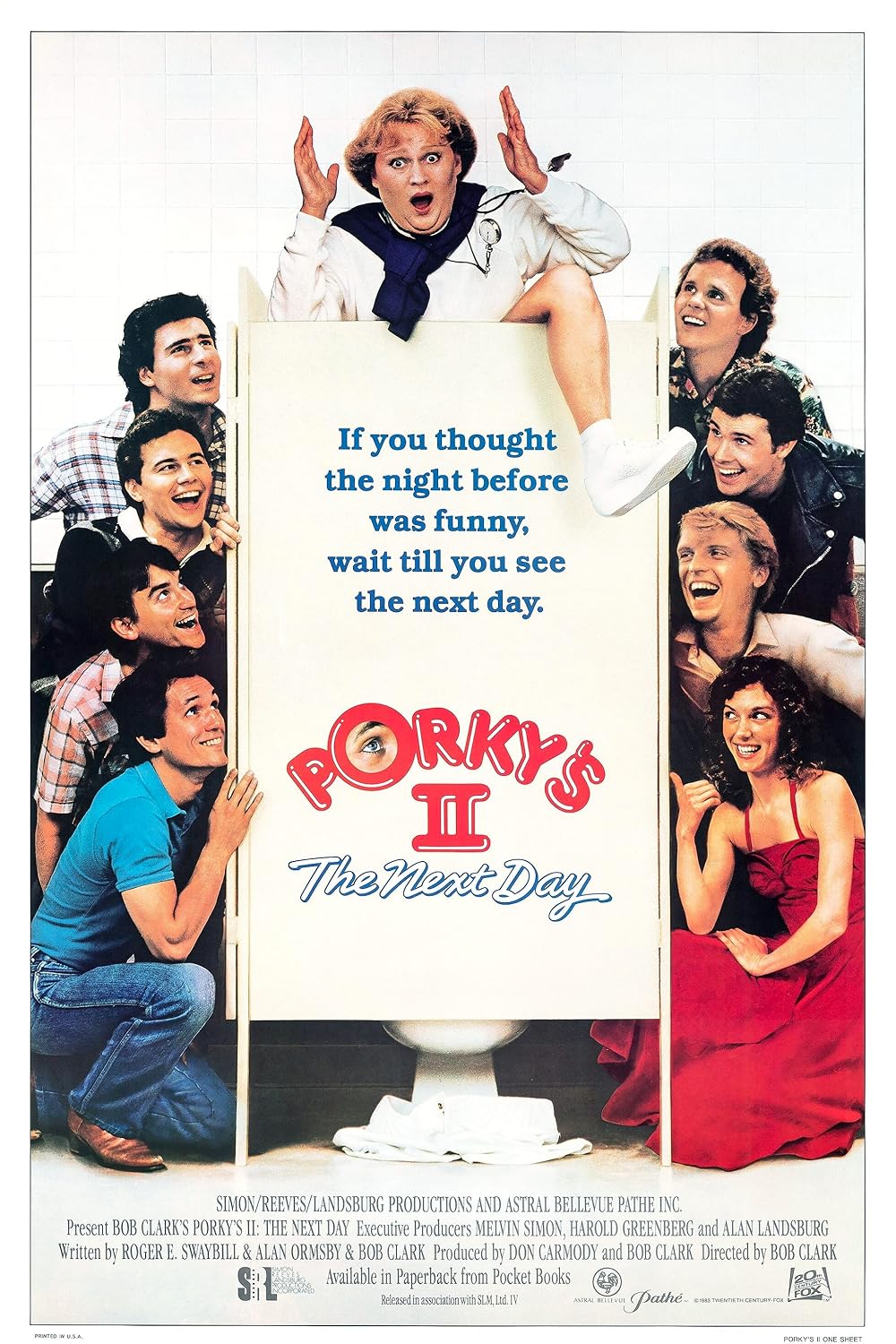
Porky’s II: The Next Day (1983)

By Richard Winters

My Rating: 0 out of 10

4-Word Review: Banning a Shakespeare play.

Now that Pee Wee (Dan Monahan) has lost his virginity to Wendy (Kaki Hunter) they decide that their next project will be putting on a production of ‘Romeo & Juliet’ at their high school, which will be directed by Mrs. Morris (Ilse Earl) Pee Wee’s mother. Problems though ensue when John Henry (Joseph Runningfox), a Seminole Indian, gets cast in the lead where he will then kiss Wendy, a white woman, on stage, which gets the local Klux Klan upset and they proceed to ambush things, so it won’t be able to proceed. There’s also outcry from a local Reverend named Bubba Flavel (Bill Wiley) as he and his religious constituents feel that the play is ‘obscene’ and therefore must be shut down in the name of ‘decency’. The teen cast then visits the office of County Commissioner Bob Gebhardt (Edward Winter) hoping he can use his influence to help keep the play going and while he initially promises them that he will, he eventually renegades. This angers the kids, and they devise an elaborate revenge on not only him, but the Klan and Reverend Flavel.

It’s quite clear that writer/director Bob Clark, who was working on Christmas Story while helming this one, had no idea that the first installment was going to be as big of a success as it was and there had clearly been no plans for a sequel. When the studio came begging for one, he felt obliged and spent 6 months, with the help of two other screenwriters, to come up with something. The result though is a movie in desperate search for a story with a script that’s a mishmash of over-the-top nonsense. What made the first one so good was that as crude as it was it still showed teens as they were with dialogue and situations that rang true, but here all of that gets thrown out with everything played up in an extreme way simply for the sake of a cheap laugh.

The most annoying aspect are the one-dimensional characters particularly the Reverend who is a cartoonish caricature in a silly send-up of a southern preacher. The same goes with the City Commissioner that is well played by Winter, which helps keep it remotely entertaining, but portraying a politician as being sleazy and two-timing is quite cliched and redundant. The return of Beulah Ballbricker, played by Nancy Parsons, is problematic as well. In the first film she was very strict with the rules, but here she’s turned into a religious fanatic, which seems like two different people. The scene where she sits on a toilet and begins singing loudly is dumb. Sure, people may talk on the phone while taking a dump, or read a magazine, or even browse the internet, but bellowing out a loud rendition of ‘That Old Black Magic’ while in a public stall is not one of them making her beyond ‘goofy’ and more into someone who should be institutionalized.

The pranks come off as unnecessarily cruel especially the scene in a graveyard where Pee Wee is made to believe that he accidentally killed a prostitute while having sex with her, which could be quite traumatic for someone and yet his ‘friends’ act like it’s ‘all in fun’. What’s worse is that Pee Wee never brings it up afterwards apparently having no qualms whether a sex worker dies at his hands or not just as long as he’s not blamed, which unintentionally makes him cold and uncaring.

The climactic bit where Wendy dresses up as a big bosomed 17-year-old prostitute who makes a major scene at a posh restaurant in an effort to embarrass the commissioner gets overdone too. For one thing it’s seems awfully extreme to put so much effort to get revenge on what’s nothing more than a tacky high school play with cheap props that isn’t going to make any money and cast members who weren’t all that excited about being in it, so why get so upset if it gets canceled? It also begs the question why these kids are so sure they can get away with their hijinks and not suffer any consequences. The ‘prank’ that gets done inside the restaurant causes a lot of damage and since these teens live in the same community as the adults they would most assuredly get recognized by someone and be either arrested for causing a disturbance and handed a very hefty bill for the repairs, or their parents would, which for them would be just a bad.

The only small funny bit, and I kid you not, comes at the very end during the closing credits, when the head waiter at the now ravaged restaurant tries to save face by convincing the patrons that it had all been an ‘April Fool’s joke’, which got me to chuckle. It’s also kind of amusing how Pee Wee gets so aroused by pics in National Geographic, or sexually stimulated by strippers who aren’t even naked, but just scantily clad enough to excite him anyways, which in this porn saturated era probably wouldn’t be deemed all that titillating, so in that aspect it’s interesting, but everything else is a disaster. It doesn’t even have Porky. How can you have a film titled ‘Porky’s’ if that character never actually shows up though he does reappear in the third installment, which will be reviewed next.

My Rating: 0 out of 10

Released: June 24, 1983

Runtime: 1 Hour 38 Minutes

Rated R

Director: Bob Clark

Studio: 20th Century Fox

Available: DVD, Blu-ray
The Sailor Who Fell from Grace with the Sea (1976)

By Richard Winters

My Rating: 4 out of 10

4-Word Review: They dissect a cat.

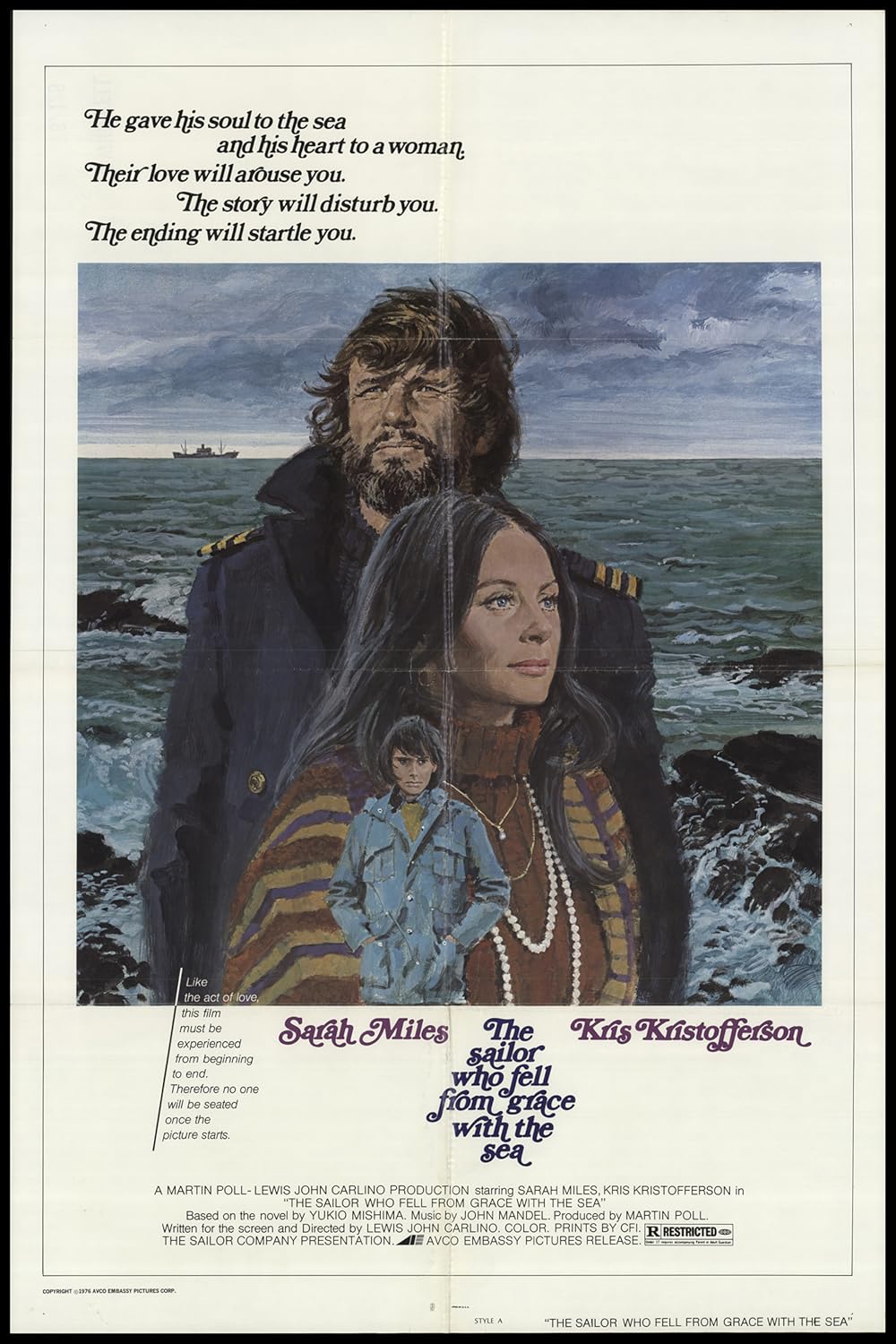
Jonathan (Jonathan Kahn) is a 14-year-old who lives with his mother (Sarah Miles) and nanny Mrs. Palmer (Margo Cunningham) in a beachfront house along the sea after the death of his father three years earlier. Jonathan enjoys his friendship with a group of boys lead by Chief (Earl Rhodes), but his mother does not approve due to Chief’s anti-social sentiment forcing Jonathan to have to sneak out on the sly to see them. One day Jonathan finds a peep hole in his bedroom wall that allows him to see inside his mother’s bedroom, and he begins to peer in on her when she’s undressed, and this creates an unhealthy arousal. When his mother begins a relationship with a sailor named Jim (Kris Kristofferson) he becomes jealous and conveys as much to Chief who devises a sinister plan to ‘solve the problem’.

Lewis John Carlino had a highly respected career as a screenwriter garnering 4 Academy Award nominations for best screenplay, but his three forays as director weren’t as successful and all started out well but ended up just missing the mark. This one was no exception as many critics at the time felt the problem lay in adapting a novel, that was written by Yukio Mishima, which was set in Japan, and trying to convert it to English society. The cultures differences that make up the complex Japanese society that were so integral to the characters in the book gets completely lost in the translation leaving the viewer feeling cold, detached, and genuinely confused when it’s over.

The on-location shooting filmed in Dartmouth, Devon, England, is excellent and the one thing that helps the movie stand-out particularly the isolated hillside house that gives the atmosphere an almost surreal-like feel. There’s also a really creepy performance by Rhodes who nails it as a highly intellectualized kid who displays no moral compass and effectively comes-off as a very believable young sociopath. However, these moments gets coupled with some very disturbing ones dealing with animal cruelty which includes a very drawn-out scene involving the killing and dissecting of a cat as well as putting a firecracker in a seagull’s mouth and while no animal was actually harmed during the production it still left many audiences at the time upset and will very likely do the same with viewers today.

The film’s biggest flaw though is that it doesn’t interpret the character’s actions in any way that helps makes sense of their motivations and for the most part they’re all quite two-dimensional. Jonathan’s arousal at seeing his naked mother needs much better explaining. Most kids aren’t this way, so what is it about his psyche that causes him to enjoy it without any guilt or shame? The movie gives us no clue, nor does it explain how his father died and when you add in the boy’s weird behavior and you start to wonder if the Jonathan maybe had something to do with it, which would’ve opened an interesting subtext if even brought up subtlety, but the script fails to touch on it.

The book makes the reasons for the son’s actions clearer. For instance in the novel the boy losses respect for the sailor when he sees him jump into a water fountain, which he considers to be undignified and the movie really needed to have some similar moment as the kid, like in the book, is initially in awe of the man, but it’s never totally clear what creates the deadly shift. Also, when the son is caught peeping in at his mom the response by his mother in the book is different as she feels the boy should receive a severe punishment, but the sailor, in hopes of becoming ‘friends’ with the kid whom he’s now helping to raise, resists, but the film flubs this scene too by treating it almost like a forgettable throwaway moment that has no impact versus one that would’ve helped reveal the sailor in a more in depth way.

Spoiler Alert!

The ending, which should’ve been a shocker, falls flat as well. In the novel it’s made clear that the boys plan to drug and dissect the sailor just like they did with the cat and they even bring along the tools to do it, in the movie we only witness him drinking the spiked tea. The camera then zooms way out showing the boys at an extreme distance where it’s not obvious what they’re doing. To really make a memorable impression we should’ve seen the boys stab the sailor several times with their knives, which would’ve been far more startling. I felt too there needed to be a reaction from the mother. Does she find out what they did, or does his violent demise remain a mystery? How does her relationship with her son evolve, or devolve afterwards? These questions remain unanswered making the movie seem less like a story and more as a concept that’s never adequately fleshed out.

My Rating: 4 out of 10

Released: April 5, 1976

Runtime: 1 Hour 45 Minutes

Rated R

Director: Lewis John Carlino

Studio: AVCO Embassy Pictures

Available: DVD, Blu-ray, Amazon Video, Plex, Roku Channel, Tubi, YouTube

Educating Rita (1983)

By Richard Winters

My Rating: 5 out of 10

4-Word Review: Trying to better herself.

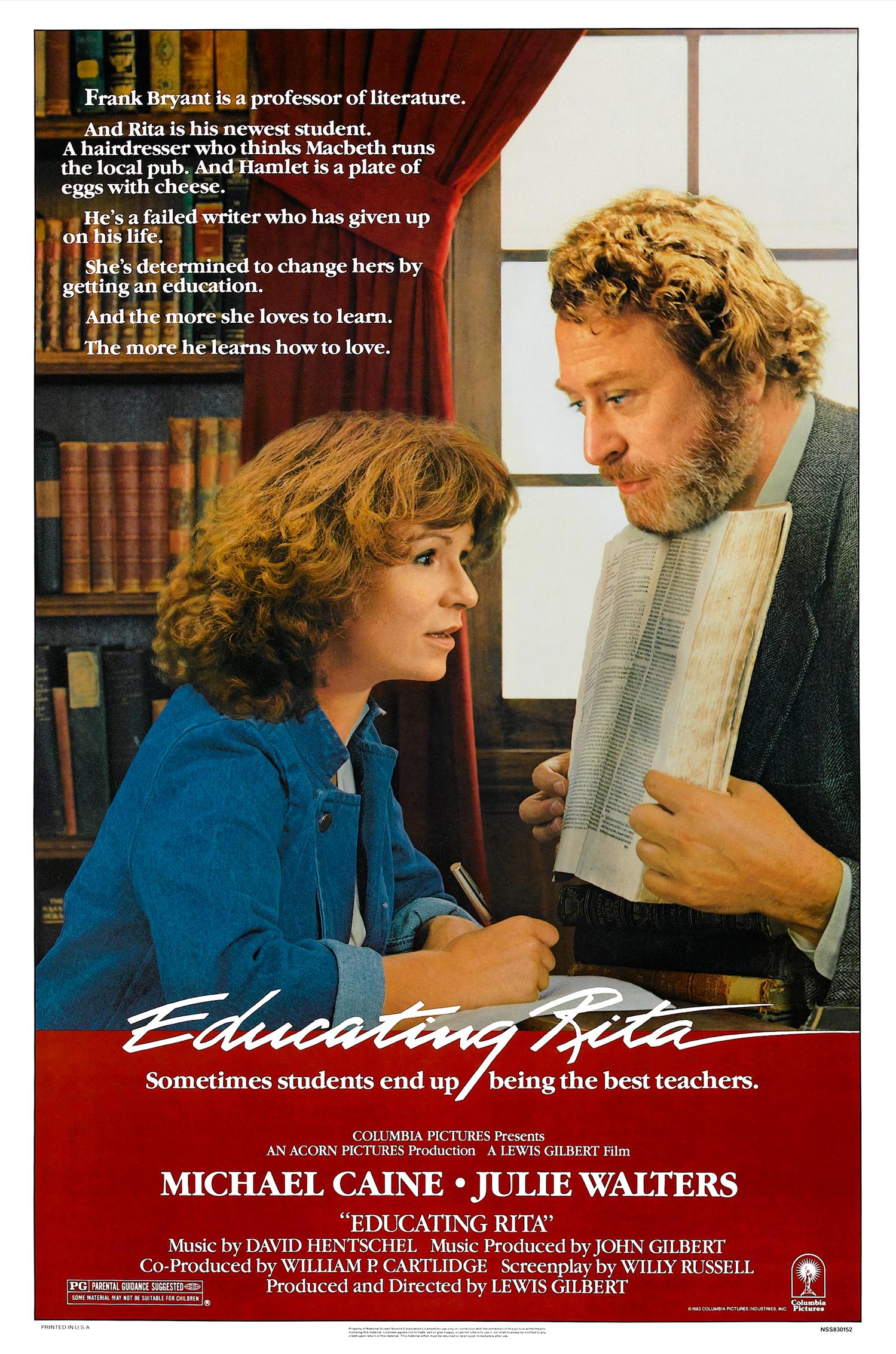
Rita (Julie Walters) is a young working-class woman who finds her job as a hairstylist and marriage to Denny (Malcolm Douglas) to be unrewarding. Denny wants her to have a child, but she fears that will just tie her down more. In an attempt to ‘better herself’ she decides to enroll in Britian’s open university where she takes a course in English literature.  Frank (Michael Caine) is a disillusioned college professor who lost the zeal for his job years earlier and has now taken to the bottle. Rita wants him to be her tutor, but Frank initially resists only to eventually agree. Despite their contrasting personalities the two ultimately form a bond and Frank uses Rita’s passion for learning to reignite his own dormant desires that allows him to breakout of his loveless relationship.  However, Rita too begins to see things differently when her roommate/friend tries to commit suicide and she realizes that things aren’t always greener on the other side of the fence.

The film is based on the play of the same name by Willy Russell that premiered in London in 1980 and also starred Walters in the title role. Unlike the movie the play had only two characters and everything took place inside the tutor’s office.

The story’s theme does have an inspiring quality, which is what galvanized the critics to it, but the main character and her transition is a bit hard to believe. On the surface she’s quite likable and well played by the star, but her ambition seems awfully extreme. It would’ve helped had we seen the moment when she first got the idea to go back to school versus having it just briefly be discussed. Wanting to learn a trade in order to make more money and move out of one’s humble surroundings is both commendable and understandable but becoming well versed on the plays of Henrik Ibsen isn’t really going to do that. To pay the bills she’s still going to be stuck working as a hairdresser, which was supposedly the boring routine she wanted to get out of. Expanding one’s literary knowledge may allow her to have lofty conversations among elites at posh parties, but as a whole she’d still be in her same predicament financially.

The Pygmalion-inspired theme was unnecessary. Without sounding snotty I couldn’t buy into the idea that this working-class woman with a limited education could learn to fully appreciate the great literary works or would even want to. The story acts like all that is needed is a great deal of enthusiasm and you can do accomplish anything, but history is full of people who jump into lofty goals with the best of intentions and still fail. Realistically I think this type of person would’ve eventually gotten overwhelmed and realized she was in over-her-head. To solve this the character should’ve been modified to being someone who was middleclass with a literally background, but who had to drop out because her parents died forcing her to go to work at the factory in order to make ends meet, but still longed to get back into what she really enjoyed and thus hired a tutor to help her, which would’ve been for the discerning viewer easier to swallow.

Rita’s ultimate transition is more off-putting than inspiring. I didn’t like her change in hair color where she goes from blonde to brunette, which makes her seem like a different person instead of someone who’s evolved. There needed to be more challenges and roadblocks. A brief spat with her husband, in which he throws her books into a fire, blows over too quickly and she’s able to grasp the complex material, even able to write in depth term papers with a relative ease that didn’t come off as wholly believable. Having her get a bad grade in a course and using this to reassess her goals would’ve allowed in a broader angle and not have been so fanciful, which the film starts to become.

Caine plays his part wonderfully and he certainly is much more into this role than he was in Blame it on Riowhich he did the same year. However, his character’s motives were difficult to understand. I thought this would’ve been the classic case, which can occur with a lot of academics in higher education, where the students aren’t into learning and are apathetic, which frustrates the professors, and this then turns them to alcohol. Here though that didn’t seem to be the case making him come off more like he was just tuning out on his own accord and thus making him less relatable. I also felt he should’ve been fired much sooner as the young adults attending his classes knew that he was drunk, even verbally said as much, so he likely would’ve been reported, and for him to then on top of this get a second chance when he fell over inebriated during a speech, seemed rather implausible.

I did enjoy the scenes involving Frank’s girlfriend Julia (Jeananne Crowley) and her relationship with a married man named Brian (Michael Williams) and how every time Frank comes into the room, and they are there Brian pretends, as a ‘cover’, that he is speaking to someone on the phone. These scenes, which becomes a running-joke, were amusing, but near the end Frank informs Brian that the phone was disconnected and thus revealing that he was in on their charade. This though doesn’t jive because with the old fashioned rotary phone, such as the ones shown here, there would always be a dial tone when one put the receiver to their ear, except of course if the service had been cut and thus Brian would’ve already known that it had been disconnected when he didn’t hear the tone and no need then for Frank to explain it.

My Rating: 5 out of 10

Released: May 3, 1983

Runtime: 1 Hour 46 Minutes

Rated PG

Director: Lewis Gilbert

Studio: Columbia Pictures

Available: DVD, Blu-ray

Hitch-Hike (1977)

By Richard Winters

My Rating: 5 out of 10

4-Word Review: Couple picks up killer.

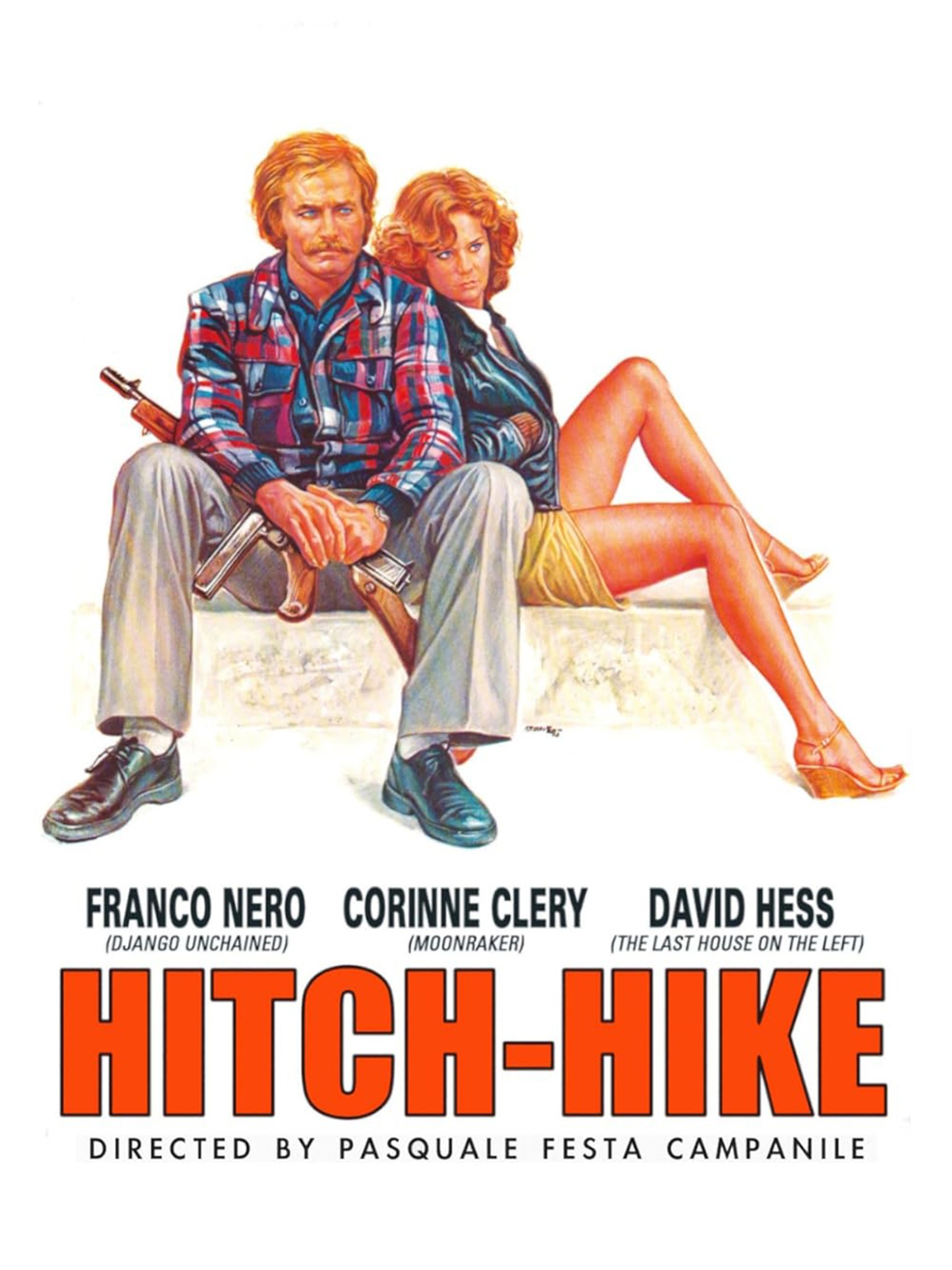
Walter (Franco Nero) and his wife Eve (Corinne Clery) are constantly bickering about Walter’s alcoholism. They go on a trip to Los Angeles and on the way pick-up Adam (David Hess) whose car is stranded on the road. Unbeknownst to them he’s a robber who has doubled-crossed his partners and absconded with a suitcase full of $2 million dollars. It doesn’t take long before Adam has a gun to both of their heads demanding they take him to Mexican border where he plans to escape while also killing them in the process. As the two try desperately to figure a way out they are also being secretly followed by the two young men whom Adam betrayed and who are now intent on extracting a revenge.

One of the biggest problems I had with the movie is that it’s supposed to take place in California but was actually shot in the mountains of Gran Sasso in Italy, which looks nothing like the state. I realize that California has a varied topography but the locales here are screaming southern Europe and the highway signs are done in blue, which anyone living in the U.S. would know is fake as here they’re green, which only accentuates the off-kilter look of the production. Since where they’re driving to makes no real difference to the plot I would’ve just had it be some city in Italy like Rome, which would’ve helped the authenticity.

The other problem I had is that, at least the version I watched, it’s spoken in Italian. Normally I prefer movies that are subtitled versus dubbed, but I could’ve sworn years ago I saw it in English, but what’s available on YouTube, which is the only service currently streaming it, doesn’t offer that, which is a big shame. Not so much because of Nero or Clery, but more Hess as his own voice is not used, which then defeats the whole reason for having him. He’s best known for playing the sadistic killer in The Last House on the Left, and he has an excellent way of being menacing, but because we don’t hear him actually speak in his native tongue all of that gets lost and the creepy energy that was supposed to be there by casting him gets completely wasted.

Spoiler Alert!

The story, which is based on the unpublished novel ‘The Violence and the Fury’ by Peter Kane, doesn’t get off to a good start as it features two people, particularly Nero, who are not likable, and thus the viewer really doesn’t care about their predicament making the tension mediocre at best. There are also elements that are stolen from better known movies like the mysterious truck that keeps chasing them during their drive, with the identity of the driver hidden, that’s taken straight from Duel. Loopholes abound as well as we later learn that Hess is the driver of the truck, but how was he able to avoid being shot by his cohorts earlier with a gun aimed right at him and how was he able to hijack the truck as he had been without any vehicle? Maybe he was able to hitch a ride with a truck driver, just like he did with the couple, and then do away with the driver once inside, but this is stuff that needs to be shown as otherwise it comes-off like the filmmakers are just making up the rules as they go with no concern whether it’s logical.

The twist ending is limp as it features Nero setting the car on fire with his injured wife inside and putting Hess’s dead body next to hers in an attempt to make it look like both he (Nero) and she died in the blaze, but there were such things as dental records back then, so after the coroner examined the charred bodies he/she would determine that it wasn’t really Nero who died and thus the authorities would continue to search for him. Seeing him then become a hitchhiker himself leaves open too many questions and comes off like a cop-out where the filmmakers ran out of ideas and thus decided to just end it there.

End of Spoiler Alert!

The moment where Nero is forced to watch Hess make love to his wife, and witnessing the humiliation and anger in his eyes, is the film’s best moment. Watching Clery, the only person you sympathize with, is entertaining both with her clothes on and off. However, the film lacks any character development, and the plot is quite strained with a lot of moments where the story, much like with the car ride, doesn’t seem to be going anywhere and if anything, just driving itself around in circles.

My Rating: 4 out of 10

Released: March 4, 1977

Runtime: 1 Hour 44 Minutes

Rated R

Director: Pasquale Festa Campanile

Studio: Explorer Film ’58

Available: DVD, Blu-ray, YouTube

Porky’s (1981)

By Richard Winters

My Rating: 6 out of 10

4-Word Review: Revenge on nightclub owner.

Pee Wee (Dan Monahan) is a teen living in the Florida everglades during the 1950’s who suffers from a small penis size, which has prevented him from losing his virginity. He and his high school pals have hatched a plan of pooling their money together and then hiring a prostitute, which they can then all have sex with. Their first attempt doesn’t work out, so they decide to go to a nightclub that sits in a lagoon on stilts and is called Porky’s, which is the nickname of the owner of the establishment, ‘Porky’ Wallace (Chuck Mitchell) that he attained for being overweight. The boys feel they’ll be able to hire one of the strippers at the club to have sex with and Porky agrees to ‘set it up’ and takes their money only to then have the teens fall through a trap door and into the water below. This enrages Mickey (Roger Wilson) who set-up the deal and he becomes consumed with getting revenge on Porky, but when he goes there to ‘settle things’ he gets badly beaten-up, which sends him to the hospital and convinces his friends that even sterner justice is needed in order to get the proper payback.

I remember when this movie came out and there were TV ads capturing people as they left the theaters and getting their first reaction. At the time this was considered ‘outrageous’ and many of the folks in the ad seemed either shocked or embarrassed. Nowadays though it’s unlikely most will consider it extreme, and some might even call it boring particularly in between the moments when it’s raunchy. The idea for it was conceived in 1972 by writer/director Bob Clark who based the story on his own experiences as a teen going to school in rural Florida during the 50’s. The studios though didn’t like the script, and it got shopped around for years before finally getting modest funding out of Canada where it could be used as a tax write-off and thus even though it was filmed in the U.S. by an American director it still gets labeled as one of the highest grossing films in Canadian movie history.

The critics like with the studio heads, didn’t care for it with both Siskel and Ebert naming it one of the worst movies to come out of the 80’s though when compared to the other teen sex comedies from that decade this one doesn’t seem all that bad. The characters have distinct personalities and much of the dialogue while raunchy seemed realistic for that age group and not all that different from what got talked about during my own high school days. The film also manages to tackle some serious topics like antisemitism, which was also a part of that era, so it has an adequate balance and doesn’t just stay hyper-focused on the sex.

On the negative end Nancy Parsons as the female coach version of Nurse Ratched is one-dimensional and Kim Catrall, playing a cheerleader nicknamed ‘Lassie’, plays too much of the bimbo caricature to be even remotely interesting. Neither is the fault of the actresses, who are okay, but more the writer. On the other hand, I loved the bit part of Susan Clark playing a prostitute. She had been in a few Disney movies just before this and later the TV-show ‘Webster’, so seeing her playing against the family image is fun.

I also loved Kaki Hunter who seems just as dirty minded as the guys and how she’s very average looking as I’ve found those types tended to be a little more ‘easy’, as evidenced by her doing it with Pee Wee, in order to get the guys’ attention and make up for not being as attractive versus in other teen flicks where it’s only the super-hot ones that sleep around. In that vein too I enjoyed the fact that during the shower scene when the boys are peeping at the girls there’s an overweight one impacting Pee Wee’s ability to see the thin ones, which is realistic too as in most high schools there’s a mix of body types and not all skinny like most other teen comedies would make you believe.

I did have some problems though with the nicknames mainly with Pee Wee and ‘Meat’ the name for Tony Ganios’ role. Supposedly this is for their penis size, but how would anyone know what their penises looked like? Normally one gets nicknames for physically attributes that everyone can see for instance if they’re a short height they could be called ‘shorty’. Yes, there is a scene where all the boys strip naked together, but their nicknames had already come about long before then. One could argue that maybe it started while they took showers after gym class, but in my high school if some guy was caught looking at another’s genitals, they’d be accused of being ‘gay’, which during that time period would be considered a stigma.

While the plot is lean and there are a few lulls there are enough comical moments to keep it afloat. The segment dealing with Nancy Parsons character going to the principal to ‘report’ seeing a penis in the girl’s shower and advocating for all the boys to undress so she could spot which one had a dick with a mole on it, is a gem especially with the way the camera zooms in on a hanging portrait of a smiling Dwight Eisenhower like even he too is in on the humor. The demolishing of Porky’s bar, which comes near the end, isn’t bad either and helps to make this thing a minor cult classic.

My Rating: 6 out of 10

Released: November 13, 1981

Runtime: 1 Hour 38 Minutes

Rated R

Director: Bob Clark

Studio: 20th Century Fox

Available: DVD, Blu-ray
Mother, Jugs & Speed (1976)

By Richard Winters

My Rating: 8 out of 10

4-Word Review: A corrupt ambulance company.

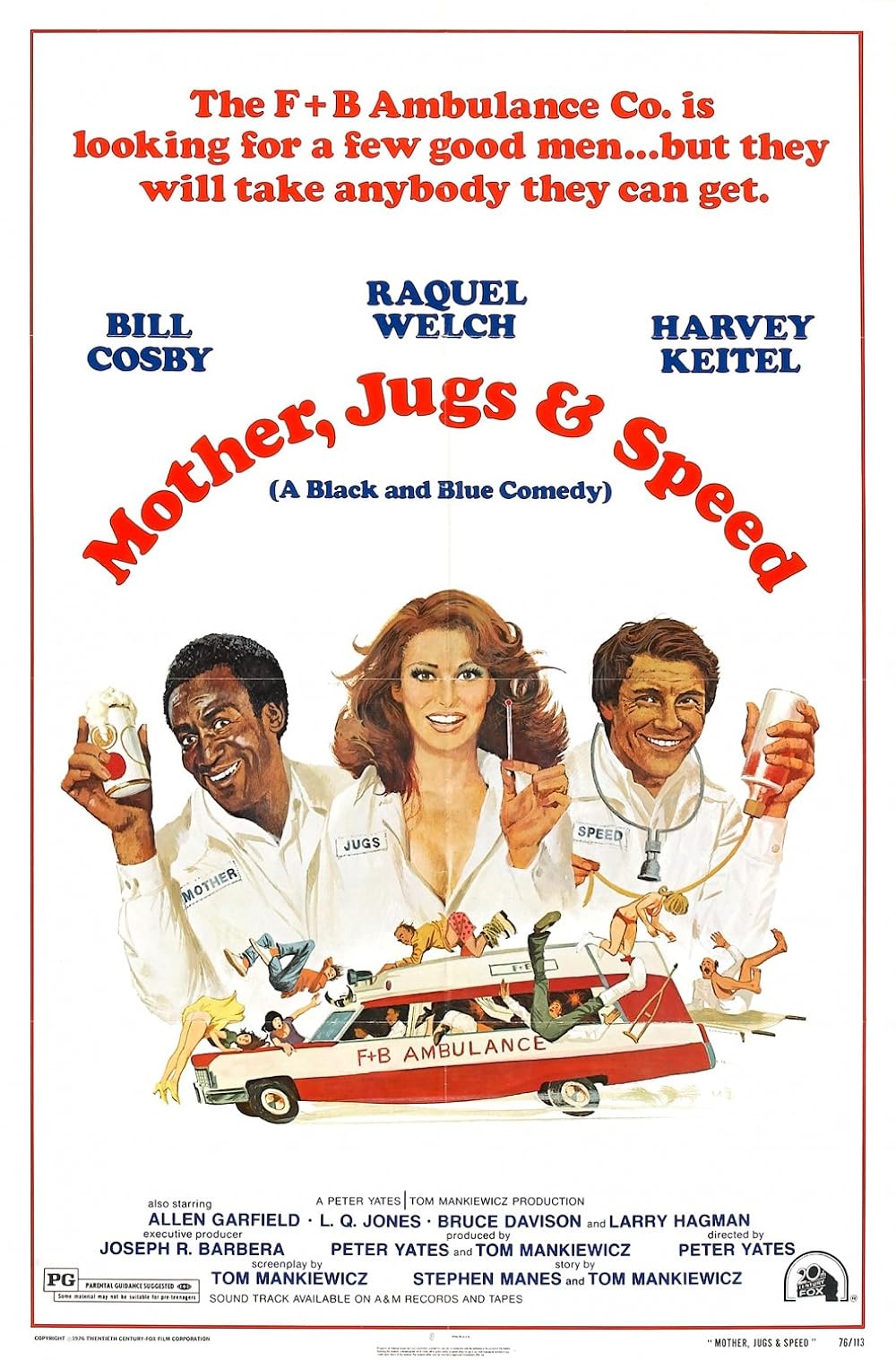
Mother (Bill Cosby) is a part of a team of ambulance drivers working for Harry Fishbine (Allen Garfield) who runs the F & B Ambulance company that is competing with Unity ambulance to get a contract with the city of Los Angeles. Harry is willing to do any underhanded deal that he needs to in order to keep the company competitive, which many times is at the patient’s expense. Tony (Harvey Keitel) is a former cop whose been suspended due to allegations of him dealing cocaine and thus gets hired to partner with Murdoch (Larry Hagman), a man whose compulsion for sex seems to know no bounds. Jennifer (Raquel Welch), nicknamed ‘Jugs’ due to her ample breast size, mans the switchboard, but longs to be a driver and is excited to finally get her certification, only for Harry to refuse to hire her due to sexist reasons.

The disco song ‘Dance’ by Paul Jabara, which gets played over the opening credits, may get some viewers to think it’s a silly 70’s flick, which it definitely isn’t. The concept was inspired by cartoonist Joseph Barbera, who after taking an ambulance ride, became intrigued with the idea of doing a movie about an ambulance company and hired noted screenwriter Tom Mankiewicz to write the first draft. Mankiewicz had plenty of success writing James Bond movies but was at a loss at how to approach this one and only after tagging along on some ambulance rides over a span of three nights was able to come up with the plot. He then bumped into Peter Yates at a party. Yates, best known for having directed Bullit, was interested in a change of pace by doing a comedy, but one that he hoped had ‘some bite’. Mankiewicz then immediately ran out to his car and dug the script out of his trunk and handed it to him and by the next day, after having read it during his flight back, Yates was solidly onboard.

As dark comedies go this one has to be one of the darkest and is compelled to look at every grim aspect of the human experience from drug addiction to poverty and the basic apathy people feel about their jobs and the little things they have to do and tell themselves in order to get through it. What surprised me though was that it was only given a PG-rating. Granted they never say the word ‘fuck’, nor is there any nudity, but it’s still very adult, nonetheless. Because it stars Cosby, who at the time was known for his family-oriented comedy it could’ve given parents the mistaken impression that this would be safe for kids, but it’s definitely not. There’s a lot of caustic humor including Hagman making jokes about having sex with 13-year-old twins and one moment where he attempts to get-it-on with a comatose patient. There’s even a shocking scene where somebody gets shot and killed, so what Jack Valenti and his MPAA board where thinking when they viewed it, I don’t know, but this is certainly not material for young eyes.

Mankiewicz’s acerbic script hits all the right targets, but the acting scores as well. Cosby is terrific as a sort of anti-hero who drinks while he’s driving and harasses nuns but also shows the required proportionate jaded sensibilities to handle the grim challenges. Hagman is outrageously crass but countered nicely by Bruce Davidson and Keitel, who manage to bring some likable qualities into the cast. The funniest person though, despite everything, is Garfield, who’s the perfect caricature of a shyster owner more than willing to do whatever it takes to stay afloat and his motivational rants, particularly the one that starts things out, are hilarious.

The only one that seems miscast is Welch, who despite being easy on the eyes, has never really shown to have much of an acting range. I did like her character’s arch where she’s finally given the chance to go on an ambulance run and learns the hard way that not every life can be saved, as well as a scene where she takes an ambulance on a joyride and gets pulled over by the cops, but sympathetic wise she’s kind of cold. She just doesn’t seem to have the ability to show vulnerability, which is what her character required it’s just a shame the part wasn’t played by Valerie Perrie, who would’ve been perfect, but she declined due to her unwillingness to accept a deferred payment.

Spoiler Alert!

My one caveat is the ending, which has Hagman taking some narcotics that causes him to have a psychotic reaction where he holds the owner’s wife Peaches, played by Valerie Curtin, hostage at the station, but this came off as too jarring. While Hagman’s character certainly had a creepy factor it was still done in a humorous way making him benign and just ‘one of the gang’, so having him go nutso without any type of forewarning didn’t make a lot of sense. Would’ve been better had some addicts looking for drugs robbed the station and held Hagman and Peaches at gunpoint and thus requiring the rest of the employees to work together to find a way to save them.

My Rating: 8 out of 10

Released: May 26, 1976

Runtime: 1 Hour 38 Minutes

Rated PG

Director: Peter Yates

Studio: Twentieth Century Fox

Available: DVD

The Premonition (1976)

By Richard Winters

My Rating: 3 out of 10

4-Word Review: Wanting her child back.

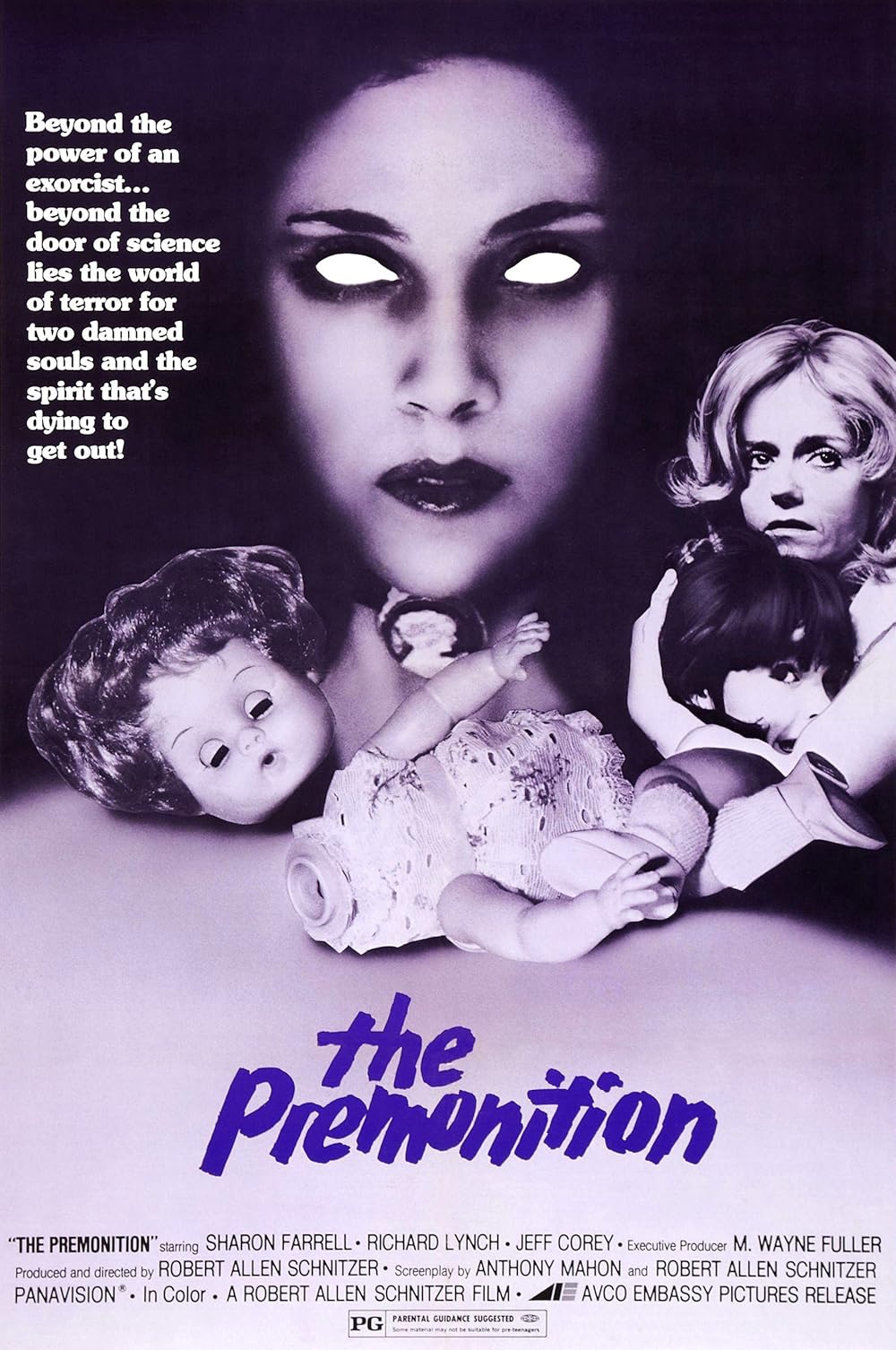
Andrea (Ellen Barber) is a woman who was institutionalized and lost custody of her child Janie (Danielle Brisbois). Janie was then adopted by Sheri (Sharon Farrell) and Miles (Edward Bell) who became her foster parents. Andrea though gets released from the hospital and manages, along on with her boyfriend Jude (Richard Lynch), who works as a circus clown, to track down where Janie is currently living. Andrea wants Janie back and the two conspire to kidnap her, but their initial attempt backfires. Jude becomes irritated at Andrea’s inept abilities to retrieve the child, along with her obsession over a doll that she treats as being a real baby, which sends him into a rage that ultimately kills her. Now, Sheri begins having weird visions of Andrea tormenting her from beyond the grave, but when she complains to her husband about it he refuses to believe her insisting that it’s simply hallucinations from all the stress.

Odd film that seems to be a hybrid between sci-fi and thriller, with just a drop of dramatic character study, that doesn’t fully work despite some moments of potential. The on-location shooting, done in Jackson, Mississippi, allows for some visual flavor, but the story isn’t fleshed out enough to be impactful. There are some shades of an early version of Nightmare on Elm Street, but the film doesn’t go far enough with it. In fact, on a creepy level, it’s very low. The one and only slightly scary moment comes when an eviscerated, ghostly Andrea appears in Janie’s bedroom and tries to scare Sheri, but the scene is too brief and doesn’t go anywhere. The only other ‘spooky’ parts entails when Sheri watches her bathroom mirror fog up as well as the windshield of her car, but that’s literally it. No other scares or shocks to speak of making it confusing trying to figure out what type of audience the producers were going for.

Story-wise it’s muddled. No explanation given for how Andrea and Jude where able to track down where the kid was currently living and Andrea’s ability to get inside the house, where she simply turns the knob of the front door and is able to sneak right in, was too easy. Most people lock their doors at night, and this couple especially should’ve since Andrea had already been spotted by Sheri harassing Janie earlier at the school playground, so having them forget to do this makes them seem dumber than dumb it also hurts the tension. Forcing Andrea to come up with creative ways to get in the home, like maybe trying to slide through the basement, or attic window, would’ve given this segment more intrigue.

There’s also no suitable reason for how Sheri is able to receive the premonitions that she does, or how Andrea is able to give them off. Did Andrea at some point dabble in the occult? Or has Sheri always showed signs of ESP all her life and therefore making her susceptible to Andrea’s ‘messages’? None of this gets even remotely addressed, which ultimately makes the movie poorly thought out. 

Spoiler Alert!

The ending is particularly goofy as it features Sheri performing a musical piece written by Andrea in an attempt to appease Andrea’s angry spirit and get Janie back. However, this all gets done late at night while on the steps of the Mississippi state capitol where a small piano has been placed that Sheri plays while in front of a crowd of curious onlookers. The police then stand-by waiting for any ‘suspicious’ people to arrive, so they can be arrested, but the chances that the authorities would allow such an insane ‘show’ to take place on government property, or believe in evil spirits and visions to begin, with is highly unlikely.

End of Spoiler Alert!

I did though enjoy the acting. Farrell is quite good as the distraught mother and Brisebois, who’s probably best known for playing Stephanie on the ‘Archie Bunker’s Place’ TV-show, is cute and looks to be no more than 3 or 4. Lynch is fantastic playing against type as his character has moments where he seems genuinely concerned and I loved the scene where he dresses in mime make-up and does a silent routine while taking someone’s picture. The best though is Barber who’s unnerving as the unhinged woman, and I wished her role had been bigger.

Unfortunately, there isn’t a payoff. Too many questions get left open and the story doesn’t explore enough angles to make anything that occurs here either memorable or riveting. Some may say this was a precursor of better, more well-known thrillers/horror/sci-fi films to come, and they may have a loose point, but it doesn’t do enough with the material to deserve any recognition. 

My Rating: 3 out of 10

Released: May 5, 1976

Runtime: 1 Hour 34 Minutes

Rated PG

Director: Robert Schnitzer

Studio: AVCO Embassy Pictures

Available: DVD, Blu-ray, Amazon Video, Tubi

Inside Out (1975)

By Richard Winters

My Rating: 5 out of 10

4-Word Review: Tracking down nazi gold.

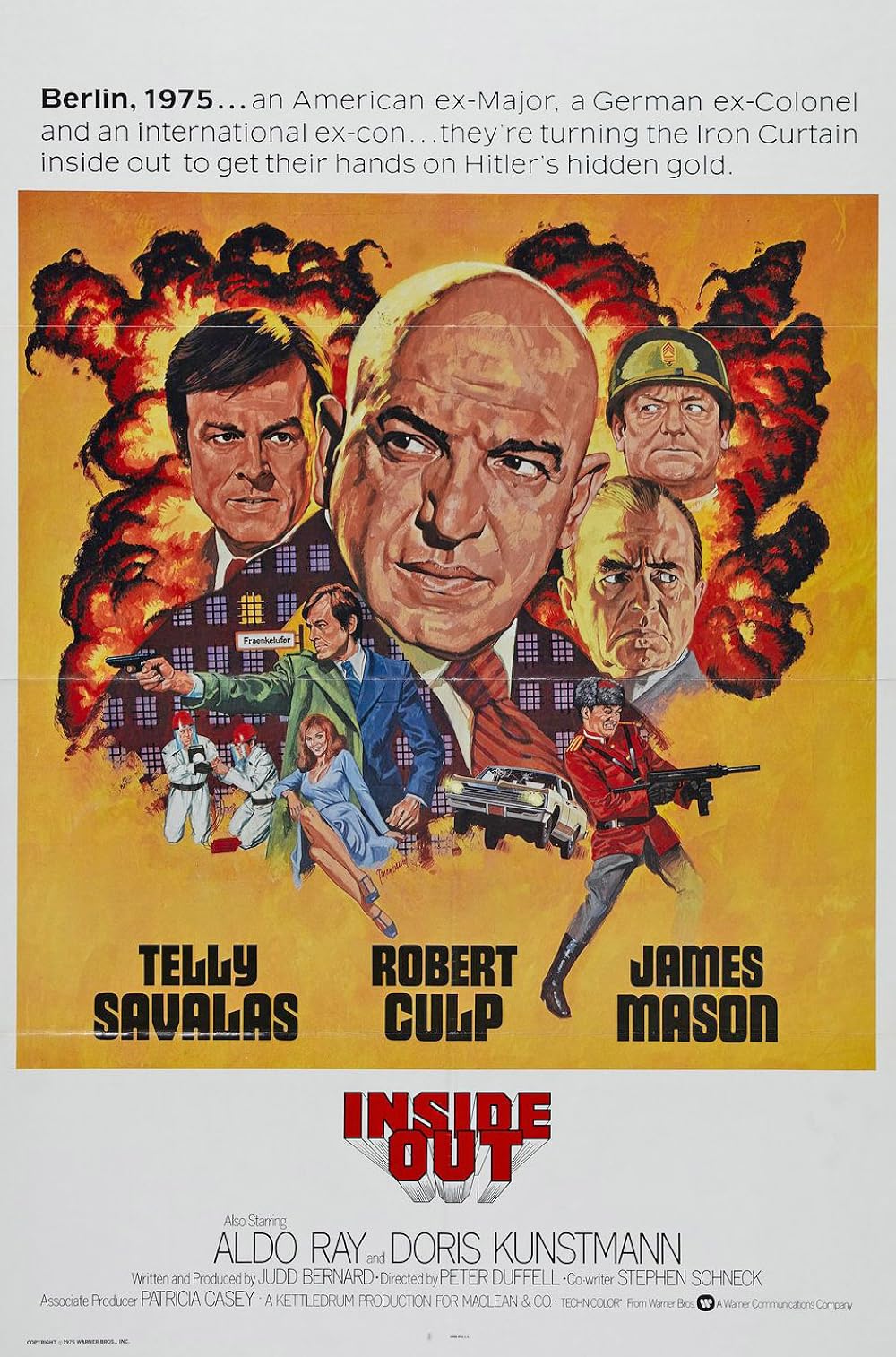
Harry (Telly Savalas) is head deep in bills when he comes across a letter from Ernst (James Mason) an old friend inviting him to meet him the next day at a hotel. Since Harry has nothing to lose he shows up at the agree upon location and learns that Ernst has plans to retrieve some gold that had been misplaced during the war. The problem is that the only one that knows the exact location of where it’s hidden is Holtz (Wolfgang Lukschy) who is locked up in a high security prison. Harry must then hire a team of men that can not only find a way to infiltrate the prison, but also trick Holtz into giving away the secret and then dig up the loot despite it being behind enemy lines.

The film, which was surprisingly written directly for the screen and not based on any book even though I think it would’ve made a great novel that could’ve been actually better than the movie, approaches the material in all the wrong ways. I’ll admit it’s a great concept, but director Peter Duffell unwisely decided to enter comedy into the proceedings, which wasn’t necessary. He also implements a goofy sounding music track that would’ve been better suited for a TV-sitcom. The facility that houses Holtz was shot at Plotzensee Prison in Berlin, which looks like an old rundown building that is barely able to stand on its own and like it’s ready to crumble at any minute. To really make it exciting and daring the place should’ve been modern and state-of-the-art and thus making it more of a challenge to break into.

Spoiler Alert!

Everything comes off too easily and thus hurts any potential tension. The kidnapping of Holtz is especially problematic. The group is able to infiltrate the prison by dressing up in guard costumes, but those costumes wouldn’t be an exact replica of the real guard’s uniform and thus should be easily spotted by a prison employee, and yet that doesn’t happen.

They blackmail Holtz’s doctor Maar (Adrian Hoven) to agree to take Hotlz’s place in the prison cell and pretend to be him while disguising Holtz as the doctor in order to sneak him out, but it’s unlikely anyone would agree to stay in a prison for even a day and trust that this group, whom he really didn’t know, would come back and get him out and not just leave him there. Maar, is also much shorter than Holtz, so the real guards would notice the difference in height and realize he was an imposter, but for whatever reason they don’t.

The drug that they inject Holtz with, which is never named, is unusual in that it puts him to sleep, but still allows him to walk. Most of the time drugs that could knock a person out would make their limbs go limp and force the group to have to drag him away as he slept versus here where they are somehow able to get him to sleepwalk.

The sequence where one of them disguises themselves as Hitler, played by Gunter Meisner, in an effort to trick Holtz to divulge the location of the gold since he had sworn only to give it out to the Fuhrer himself is highly improbable as well since the man really doesn’t look all that much like Hitler and you’d think Holtz, even in the drugged state that he is in, would notice the difference and not share the secret, or give out incorrect information.

I’ll give the script some credit as it does come up with a few unexpected wrinkles, but all these do is stymie the group’s efforts slightly and don’t really put a monkey wrench into the whole thing. For instance, they learn that an apartment building has been constructed on the site where the gold is buried, which most likely would’ve ruined their chances of getting at it, but here they’re able to sneak into the building’s basement via an unlocked door (don’t facilities lock their doors in East Germany?) and then create a ruse to get the tenants out of the building so they can plant a bomb that will cause an explosion to crack the cement floor. There’s even a little boy who sneaks in to witness their efforts and risks getting injured but like with everything else it gets quickly resolved when Telly spots him at the last second and whisks him away to safety and then eventually back to his mother’s arms. However, what’s to say he won’t tell his mommy what he saw? Apparently here he doesn’t, but in reality, he probably would’ve and thus another potential loophole that the film glosses over.

I enjoy Telly more when he’s playing bad guys, but he’s still fun as the protagonist and something that helps keep the movie watchable. Overall though the direction should’ve been tighter and the complex mission gets pulled off too seamlessly and thus seeing them walk away with the fortune isn’t all that satisfying as the complication would’ve been too immense for it to have ever succeeded in real life.

My Rating: 5 out of 10

Released: November 27, 1975

Runtime: 1 Hour 37 Minutes

Rated PG

Director: Peter Duffell

Studio: Warner Brothers

Available: DVD-R (Warner Archive)

I Spit on Your Grave (1978)

By Richard Winters

My Rating: 7 out of 10

4-Word Review: Assaulted woman gets revenge.

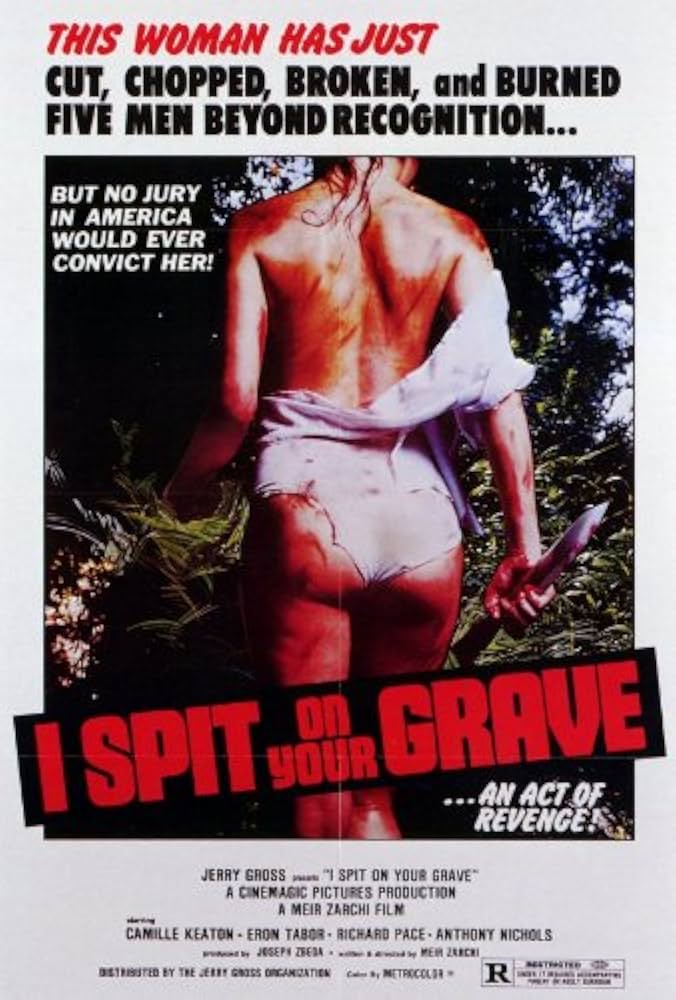
Jennifer Hills (Camille Keaton) is a writer who has decided to get away from the bustle of New York City by renting an isolated cabin by a river that’s just outside of Kent, Connecticut. It’s here that she hopes to finish her novel but finds it hard to do when she inadvertently attracts the attention of Johnny (Eron Tabor) a gas station attendant and two unemployed men named Stanley (Anthony Nichols) and Andy (Gunter Kleeman) who routinely upset her quiet environment with their motorboat. When delivery boy Mathew (Richard Pace), who is mentally disabled and social awkward, comes back to the men describing how when he delivered groceries to her, he ‘saw her breasts’, it gives them the idea to attack her and then ‘offer her up’ to Matthew, so he can finally have sex with a woman. The men chase Jennifer down while she’s relaxing in her rowboat and take her to the backwoods where each of them takes turns raping her over an extended period. Once they finally leave, they give Mathew a knife and tell him to kill her while they wait outside. Mathew though is too afraid to stab her, so he lies and tell them he did when he really didn’t. Eventually, after several weeks, Jennifer recovers from her injuries, both physical and emotional, and decides to seek out the unsuspecting men by killing them off in gruesome ways one-by-one.

This film was and still is highly controversial, some might say it’s the most controversial film ever made and universally condemned by both Roger Ebert and Gene Siskel on their show where they described it as ‘the worst movie ever made’. Ebert even went as far as to write in his review that it made him physically sick to watch it. His review though had a Streisand effect as it garnered it more attention and got people to come to the theater to ‘see what all the fuss was about’ eventually making it quite profitable and a cult classic that’s turned the franchise into marketable one that has given it several sequels and even a 2010 remake.

The inspiration for the story came in October of 1974 when writer/director Meir Zarchi was traveling with his friend and daughter in New York City neighborhood of Jamaican Hills where they came upon a naked, beaten-up woman who told them she had just been raped. When he escorted her to the police, he was appalled at the indifferent treatment she was given and he came home and almost immediately began writing the script.

Almost 2 years later, in August of 1976, he had acquired enough funding so shooting could begin. The argument though was whether this really was a ‘trenchant’ drama meant to expose the brutal nature of rape, versus sanitizing it as other movies at the time tended to do or was simply a cheap way to exploit a difficult subject for money. In a lot of ways, it seems to be the later as gang rapes like the one portrayed here don’t happen too often and it’s usually just one attacker. The fact that the men seem to go away and then suddenly reappear again unexpectedly out of nowhere makes it feel like it’s being played up for tension’s sake and attempting to get the most out of the horror then simply trying to intelligently examine the cruel event.

There’s also no scene showing Jennifer going to the police and being treated poorly, which was supposedly what enraged Zarchi so much during the real event. Without that element it’s harder to justify the plot and there really needed to be a segment showing that.

On the flip side I was impressed with the film’s overall grittiness. It’s like Zarchi had watched Last House on the Left but decided to take out the ill-advised ‘comic relief’ scenes and weird music and just left in the unrelenting tension and to that level it succeeds. Having no soundtrack at all, outside of some organ music that gets played when Jennifer visits a church, helps give it more of a realistic effect almost like we’re watching a documentary where the camera is simply turned-on and whatever terrible things happen is allowed to simply play-out unabated. This along with Keaton’s dynamic performance, where she essentially plays two women, one a victim and the other the perpetrator, is what helps the movie stand out and gives it it’s legs.

Spoiler Alert!

The complaints I had comes more with the third act where Jennifer carries out her revenge. The segment where she entices Matthew to have sex with her again in the woods by the river, so she can put a noose around his neck and hang him, didn’t feel genuine. I would think anyone who had been raped that they wouldn’t want anyone to touch them, or get intimate after such a traumatic event, so allowing herself to get naked and letting a man, one of her former attackers no less, get on top of her, just didn’t seem plausible from a psychological perspective. On the physical end it didn’t seem possible that a young thin woman would be able to pull the rope tight enough to hang someone who clearly weighed more than she.

The second killing where she takes Johnny back to her place and they get naked in her tub had the same problematic issues. She had a gun in her hand when she got out of her car, so why not just shoot him then and get it over with? Why take the chance of bringing him back to her house where he could overpower her? Also, how dumb does this guy have to be that he would completely let down his guard and not think that this woman, who’s assault he happily took part in, could be completely trusted and not try to lure him into a trap?

Her final attack on the two other men is flawed as well as it has her swimming out to the boat that one of them is on, but she comes onboard carrying no weapon. She only gets her hands on the ax when the other guy accidentally drops it into her boat as she tries to side swipe him, but that’s still a very stupid and dangerous way to go about things. If she’s fully intending to kill the guy she should come prepared with something already in hand when she confronts him.

Alternate Title: Day of the Woman

My Rating: 7 out of 10

Released: November 22, 1978

Runtime: 1 Hour 42 Minutes

Rated R

Director: Meir Zarchi

Studio: Cinemagic Pictures

Available: DVD, Blu-ray, PlutoTV, Roku, Tubi, YouTube


Exorcist II: The Heretic (1977)

By Richard Winters

My Rating: 0 out of 10

4-Word Review: A really awful sequel.

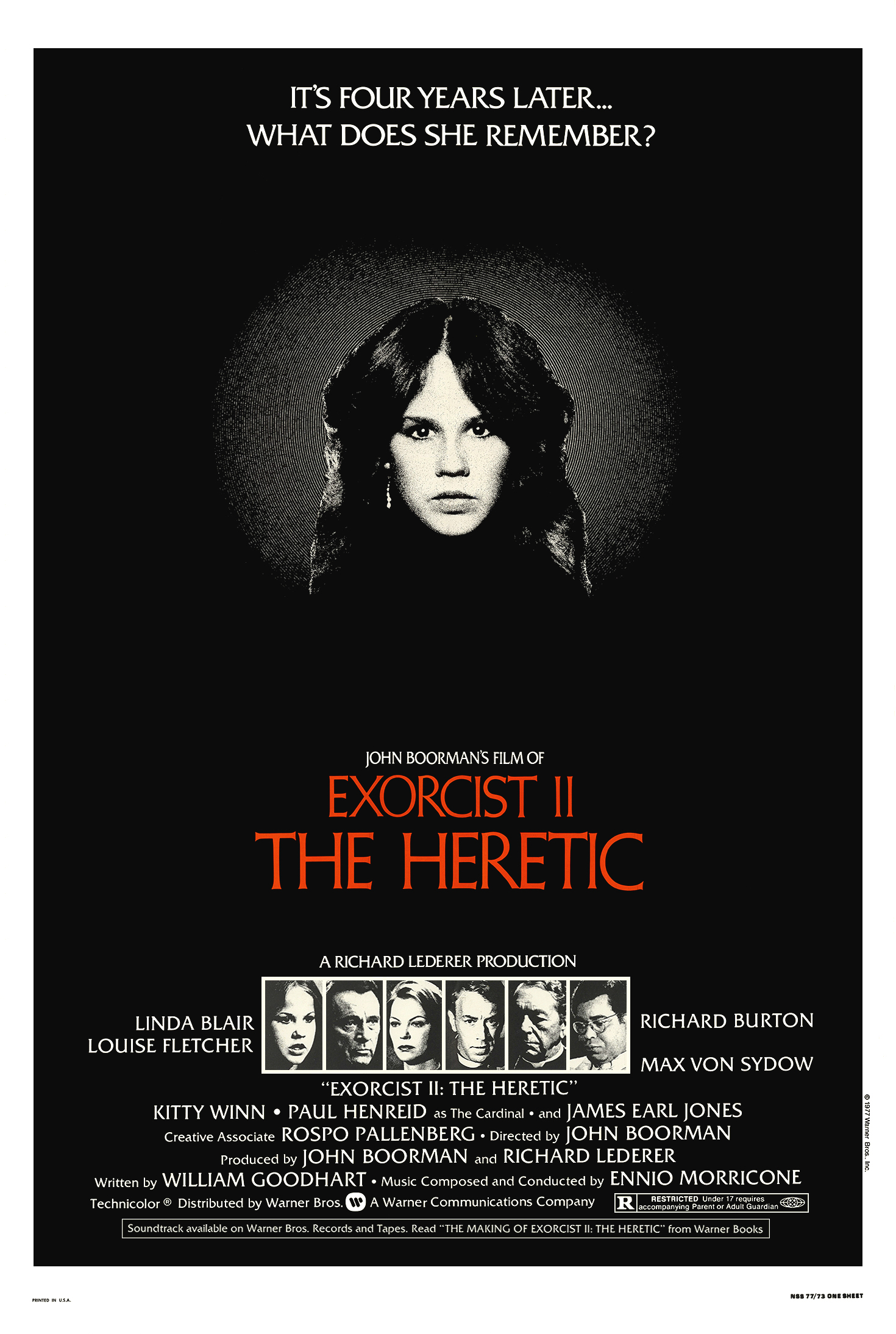
It’s been four years since Regan (Linda Blair) had her bout of possession and is now living a seemingly normal life in New York City with her guardian Sharon (Kitty Winn). Regan does still see a psychiatrist, Dr. Tuskin (Louise Fletcher), who despite Regan’s denials that she can’t remember anything, is convinced that she does have some dormant memories that need to come to the surface. Philip (Richard Burton) is a priest who has been assigned to investigate the death of Father Merrin (Max Von Sydow), who was the priest who died while performing the exorcism on Regan. He meets with Dr. Tuskin and Regan and gets hooked up to a machine called the syncronizer, which allows Philip’s and Regan’s brainwaves to be connected, so he can explore the inner depths of her mind. It is here that he learns about the evil spirit Pazuzu, that was the one that inhabited Regan’s body years earlier, and how Father Merrin had rid a young boy named Kokumo of this same spirit while in Africa. When Philip learns that the now adult Kokumo (James Earl Jones) has developed a special power to defeat Pazuzu he travels to the continent to meet him.

Doing a sequel to the hit movie wasn’t a bad idea per say as there were still some open-ended questions like why did Pazuzu choose Regan’s body to inhabit instead of some other girls and what mental issues would Regan have to deal with after going through such a traumatic event? None of those were ever answered in the first film, but intriguing enough to me that I felt a second film was warranted and could’ve been quite compelling. Unfortunately, what we get wouldn’t even qualify as second-rate. Most of the problem lies with director John Boorman, who admitted in later interviews that his biggest crime was that he didn’t give the viewer what they wanted, which is the truth. I don’t mean to bash the guy as he’s helmed some classics in his own right, but when he professes that he was offered the job to direct the first installment but turned it down because he thought it was ‘repulsive’ then that should’ve disqualified him from getting any consideration to doing the second one.

Everything gets botched right from the beginning including a misguided reenactment of the final segment in the first film that honestly comes-off like a cheap parody. For one thing Father Merrin is seen standing at the end of Regan’s bed, when we know clearly from the first film that he was kneeling on the right side of the bed when he died. Also, due to Blair’s insistence that she didn’t want to go through the grueling routine of having to put on the demon make-up, so a stand-in took her place, but the results are clownish. The silly-‘synchonizer’ further hampers things as it appears more like a child’s toy and the cliched idea of simply attaching a few wires to each participant’s foreheads and that would be enough to get their mind’s ‘in-sync’ looks like something straight out of a tacky B-sci fi flick from the 50’s.

Not able to get Ellen Burstyn to sign-on really hurts though I can’t blame her for being reluctant but trying to use Kitty Winn as her replacement bombs. For one thing the Sharon character didn’t have that much of a prominent role in the first one, I barely even remembered her, and she was Burstyn’s secretary who didn’t interact that much with Blair, so for them to now be so ‘connected’ seemed like a stretch and having Winn sporting short hair, in an attempt I presume to make her ‘seem’ like Burstyn, was tacky. Von Sydow suffers a similar fate. He gets portrayed as being a younger version of his character here but only appears in flashbacks and doesn’t have much to say or do making it seem like it wasn’t even worth the effort.

Fletcher is good in that she played a cold, bitchy nurse in her previous film, One Flew Over the Cuckoo’s Nest, but here shows her great acting ability at playing the total opposite and doing it convincingly. However, her character doesn’t help propel the action and is only there to react to things, which ultimately makes her presence one dimensional. Burton, whose talents I have always greatly admired even when he took less than stellar roles, but his appearance here has to be rock bottom. He admitted that he only did this for the paycheck, due to an expensive divorce he was going through with Liz, but the material doesn’t match his ability and it’s a career low even for him as he was known to make some bad project choices during the 70’s, but this was by far the worst.

To top things off there’s James Earl Jones wearing a giant bug outfit that nearly had me laughing out of my seat. The numerous shots of locusts and the sandy African landscape make it seem more like a nature movie, but whatever it is it’s not scary. It’s so convoluted it’s not even good enough to fall into the ‘so-bad-it’s-good’ category. It is cool though at least see a young Dana Plato playing an autistic child in a small but pivotal part.

My Rating: 0 out of 10

Released: June 17, 1977

Runtime: 1 Hour 57 Minutes

Rated R

Director: John Boorman

Studio: Warner Brothers

Available: DVD, Blu-ray, Amazon Video, Tubi, YouTube