Tag Archives: Mickey Rourke

The Pope of Greenwich Village (1984)

pope

By Richard Winters

My Rating: 7 out of 10

4-Word Review: Cousins turn to crime.

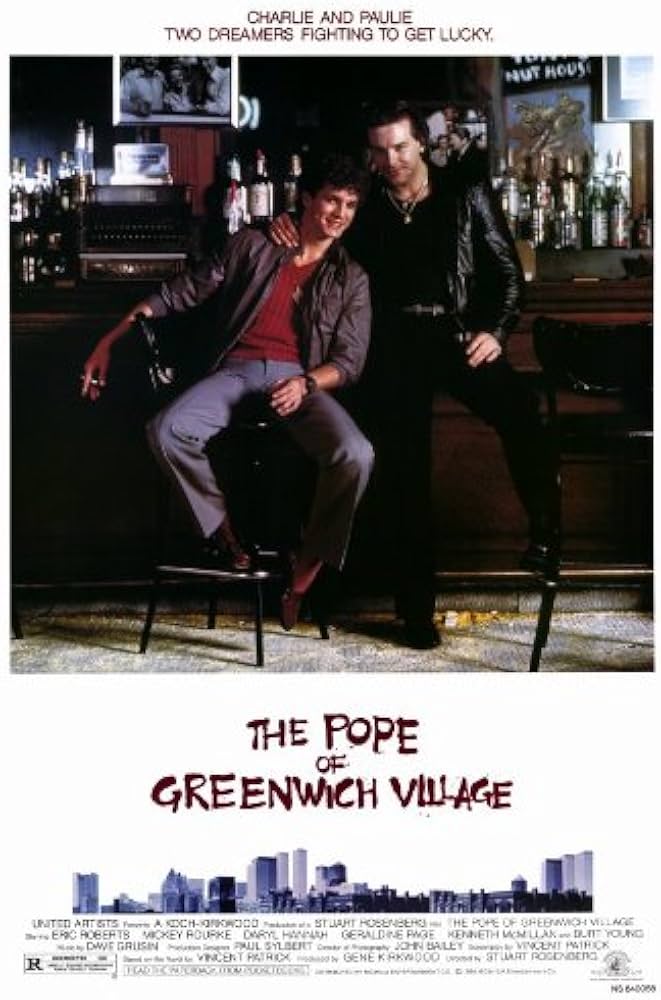
Charlie (Mickey Rourke) and Paulie (Eric Roberts) are cousins working at a restaurant who get themselves fired when Paulie is caught skimming checks. Since Charlie’s girlfriend Diane (Daryl Hannah) has a baby on the way he must act fast to bring in some money. Paulie convinces him of a ‘great’ opportunity, which is to hire a former safecracker, now working as a clock repairman, Barney (Kenneth McMillan) to break-open a safe inside the building of a large company that reportedly has a large amount of money inside it. Charlie is cautious as he doesn’t completely trust Paulie whom he finds immature and unseasoned, but he’s so desperate that he reluctantly agrees. Things go smoothly at first, as they’re able to break into the building easily, but the unexpected arrival of undercover cop Walter (Jack Kehoe) soon sends their plans awry. When Walter dies during the melee they’re now on the hook for his death as well as in the bad graces of mob boss Eddie (Burt Young) who’s safe it was that they tried to rob. 

The film is based off of the 1979 novel of the same name by Vincent Patrick who also penned the screenplay. It does an excellent job of creating a vivid feel of Greenwich Village where it was shot on-location and the interactions of the characters seem overall authentic. The only real issue is the way it hinges of extreme Italian American stereotypes where it seems like anyone from that background must be involved in crime and if any other group was portrayed that way it would be deemed problematic if not downright controversial. The cliches are so strong that had it been heightened just a small degree it could’ve been deemed as parody, or even satire and in fact IMDb does list it as being a ‘comedy’ though I really don’t think that’s the case. I believe it’s meant to be a drama, but either way, for the sake of balance, it would’ve helped had there been some Italians even just one who didn’t fall into the tired caricatures. 

The acting is the crowning achievement. Roberts is superb and I really found it hard to believe he didn’t become a star from this. While he’s always been a great character actor I think he should’ve been given more and I do realize he’s still busy in the business and has been consistently, but I don’t think the quality of the parts has always been there and most filmgoers are probably more familiar with his sister Julia, which is a shame. I was completely blow away by him here and genuinely surprised why the Oscar didn’t fall into his lap.

Rourke is excellent too, but more because he wisely underplays his role and allows Roberts to carry all the emotional energy. Had they both been competing for it it would’ve failed, but their different approaches help create a nice contrast and sometimes it’s the best actors who don’t force it and for the most part that’s what Rourke does here. Of course, he too has his moments like when they go to the racetrack, and he bumps into a guy and instead saying ‘excuse me’ like a normal person he instead says, ‘out of my way asshole’. Him beating up on his refrigerator when Diane leaves him has a memorable quality to it though I would’ve thought the fridge would’ve been more damaged and he should’ve at the very least injured his hand, which strangely doesn’t occur despite him punching at it repeatedly.  

On the female end most accolades goes to Geraldine Page who got nominated for the supporting Oscar despite having only 8-minutes of screentime. She gives a powerful performance for her limited presence, but the idea that she could stymie police efforts to search her deceased son’s room by giving veiled threats that she’ll make them look bad in the media I didn’t totally buy. If cops want something bad enough, they’ll get it with the possible exception of money exchanging hands, which in this case didn’t happen. Hannah as the girlfriend has almost the same screentime, maybe a little more, and hits the bullseye as an idealistic young woman who believes she can somehow get her boyfriend to change only to learn the ultimate harsh lesson that it doesn’t work that way. 

Spoiler Alert!

The ending I felt was a letdown. I was actually intrigued with Charlie finding the tape from the deceased cop that implicated Eddie and seeing how he could use that to stay out of trouble for being a part of the robbery. Having Paulie then swoop in by putting lye into Eddie’s drink and poisoning him seemed too easy. Eddie had just gotten done having his men cut-off Paulie’s thumb, so he should expect Paulie would be looking for revenge and not naive enough to have him make his drinks, or if he does at least have one of his henchmen taste it first. You have to wonder how Eddie was able to climb up the crime ladder if he was that stupid and thus the climax really isn’t that clever, or surprising as the camera focuses up-close on the coffee cup making it too evident that something is going to happen. A letdown for a movie that had been relatively smart up until then.  

My Rating: 7 out of 10

Released: June 22, 1984

Runtime: 2 Hours

Rated R

Director: Stuart Rosenberg

Studio: MGM/UA

Available: DVD, Blu-ray, Amazon Video, YouTube, Tubi, PlutoTV
Barfly (1987)

barfly

By Richard Winters

My Rating: 6 out of 10

4-Word Review: Drunks at a bar.

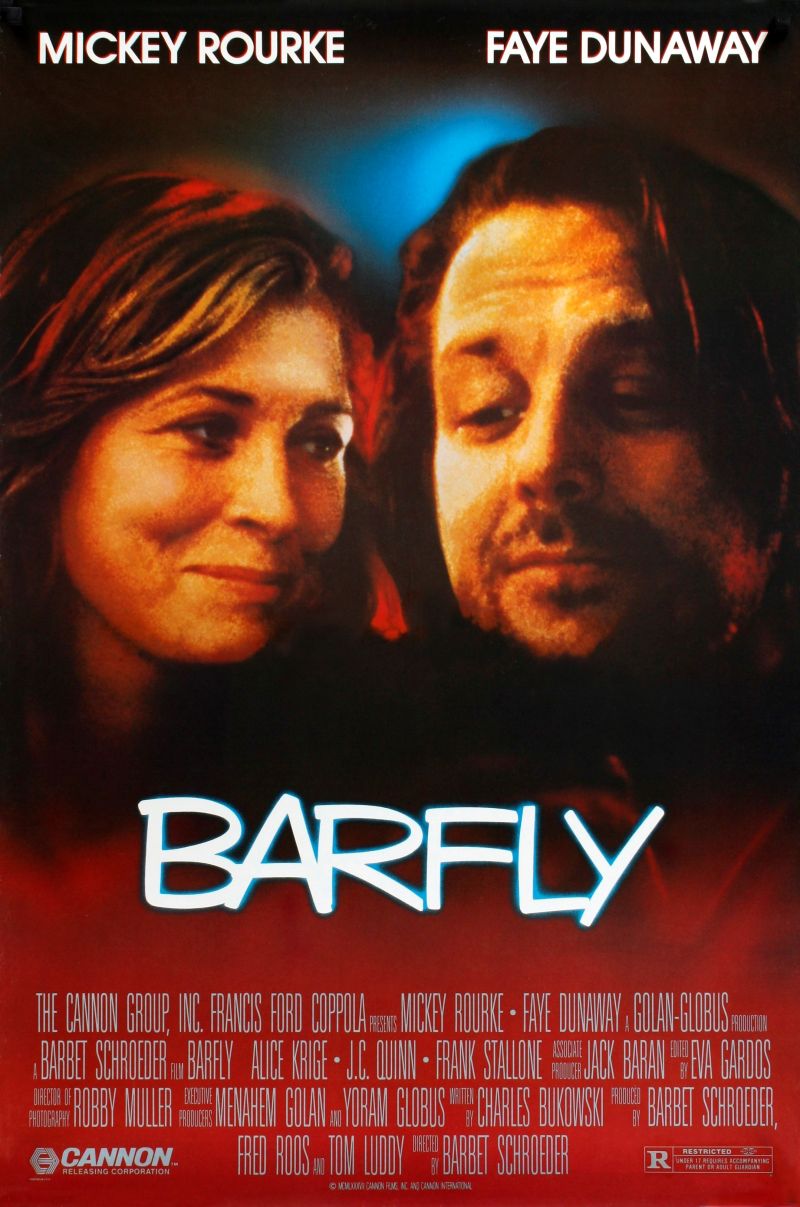
Henry Chinaski (Mickey Rourke) is a bum who has very little money, lives in a small rundown apartment that’s more like a sleeping room, and spends most of his time getting drunk at a bar across the street called The Golden Horn. It’s here where he gets into arguments with Eddie (Frank Stallone) the bartender. During one of their confrontations the two go out back and have a fistfight behind the building, which Henry unceremoniously loses. Feeling embarrassed and dejected he goes on a crusade to ‘win his title’ back by finding food in order to regain his energy, but when he rips a sandwich out of another customer’s hand, since he doesn’t have money he must steal from others, he gets thrown out of the bar by Jim (J.C. Quinn) the bar owner. He then stumbles his way to another waterhole named Kenmore where he meets Wanda (Faye Dunaway) a fellow alcoholic. The two create a makeshift bond and end-up going back to her place, an apartment paid for by a married man who covers for her life necessities, as a kept woman, as long as she’s willing to put-out when he wants it. Just when Henry thinks he might be falling in-love she betrays him by have a tryst with Eddie. Feeling dejected Henry turns back to the bottle only to have Tully (Alice Krige) show-up at the doorstep. She’s a publisher offering him a check of $500 in compensation for some of the poems and short stories that he had submitted, which she found to be both gifted and profound. Henry though isn’t sure he can accept the money as he’s more comfortable being poor and not used to being liked, or a part of the upper class, which for decades he had found snotty. Then Wanda comes back into his life and when she finds out about Tully she makes a personal vendetta to ‘put her out’ as she feels rightly or wrongly that Henry is ‘hers’ and no other woman can have him.

The film is based loosely on the life of Charles Bukowski, who used the character of Henry Chinaski in five of his novels and was considered his alter-ego. It was produced by the notorious Cannon Group a production company that had a portfolio of a hodge-podge of movies some of them of a decent quality and others that were anything but. Although they had made a commitment to finance this one it almost didn’t get made as the studio was going through a period of financial distress and felt this one required too much money to fund, so they threatened to pull-out until director Barbet Shcroeder appeared at their office with a Black and Decker power saw warning that he would cut-off one his fingers to show the world that ‘Cannon was cutting-off a piece of him by pulling out of the project’, which was enough to get the execs to change their mind.

As a film it works mainly because it used authentic Los Angeles locations, many of which Bukowski frequented in real-life, as the setting. The dismal interiors really help create a vivid look making the viewer feel they’re as trapped in the skid row surroundings as the protagonist and with no discernable way to get out. The apartment sequences are especially engaging not only for the scene, that comes near the end, where Henry finally busts in on his noisy neighbors where he has a memorable confrontation, but also at the beginning when he accidentally goes into an apartment that isn’t his, but since it looks just as bleak as his sans for some decorative window curtains, he at first doesn’t even know it.

As a character study it’s revealing though it does hinge on how much tolerance the viewer will have towards someone whose decidedly self-destructive at every turn. Rourke plays the part in an over-the-top way particularly the weird style he walks almost like he’s trying to put a touch of camp to it and I don’t blame Bukowski, who stated in a later interview that Rourke was ‘too exaggerated and a bit of a show-off’ in the part, which Bukowski ultimately felt that he ‘didn’t get right’ though he later warmed-up to it and possibly other viewers may as well.

Dunaway seemed more problematic playing a woman on the skids was definitely not a part of her repertoire and she seems miscast. She almost makes-up for it by appearing topless during the bathroom scene and then getting into a climactic catfight with Krige at the end, but I didn’t understand why the woman would be wearing what appeared to me as female business attire as that was something her character was not and therefore she should’ve had something more ragged to wear even if it was just a simple jeans and T-shirt.

Spoiler Alert!

The film has many quirky moments including the two paramedics that come to visit Henry on a couple of occasions, which almost steals the movie and make this seems more like a surreal, dark comedy than a drama. The leisurely pace I liked and seems more suited for a European audience that isn’t so plot driven, but I would’ve liked seeing Henry working more at his craft. He’s only shown writing a couple of times, which is so brief that I really didn’t think he was that committed to it and almost like a novice writing words on notebook paper making it a complete surprise when a publisher eventually does show-up. You’d think if he hadn’t even bothered to type out what he had written most publishers would’ve thrown it away making the moments with the agent seem almost dream-like and more a fantasy than the intended reality.

I was a bit turned-off by the ending. I remember reading an article back in the 80’s that this movie was an example of a ‘downbeat ending’ that Hollywood studios were shying away from. During the 70’s sad endings had become the standard, but by the 80’s they tended to not register as well with the public and thus making upbeat conclusions became the norm. However, the article had specifically pointed out this movie as having an ending, which ‘wasn’t a happy one’, but I didn’t get that impression. I thought maybe it would have Henry getting knocked out by Eddie during their fight ‘rematch’, but the camera tracks out of the bar, so we never see the results of the confrontation and it’s all left open, so it’s neither sad nor happy. My only conclusion is that the article’s author felt this was a ‘sad’ ending because Henry went back to his old ways of drinking versus becoming a successful writer, but for some people success is a scary thing and falling into their familiar habits, as bleak and destructive as they may seem to others, offers a weird form of security, so I felt it ended on a high note because Henry was doing what was right for him and with the type of people he felt comfortable with. Being rich and famous would never have worked with his personality and therefore he was better off without it.

My Rating: 6 out of 10

Released: October 16, 1987

Runtime: 1 Hour 37 Minutes

Rated R

Director: Barbet Schroeder

Studio: The Cannon Group

Available: DVD, Blu-ray, Amazon Video

Fade to Black (1980)

By Richard Winters

My Rating: 2 out of 10

4-Word Review: A cinephile becomes homicidal.

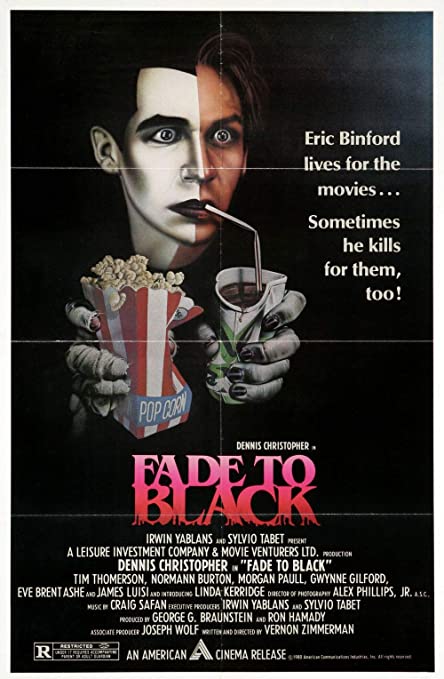
Eric Binford (Dennis Christopher) is thoroughly engrossed in movies to the extent that he watches them all day in his bedroom and does little else. Aunt Stella (Eve Brent), whom he lives with, nags him constantly about what a loser he is as does Richie (Mickey Rourke) who he works with at his job inside a film distribution center. One day he meets Marilyn (Linda Kerridge) who looks exactly like his favorite actress Marilyn Monroe. The two agree to go out on a date to see a movie, but when Eric shows up at the theater and Marilyn is nowhere to be found he becomes unhinged. All of his pent-up rage gets released and soon he goes on a killing spree by slaughtering all of the people who have made fun of him in the past.

Writer/director Vernon Zimmerman has insisted in interviews that this wasn’t meant to be a horror film, but then what exactly was it supposed to be? I admit initially it has some intriguing elements, but like with Zimmerman’s other directorial efforts it misses the mark. Ultimately despite the offbeat touches it  devolves into a mechanical slasher flick by the second act, but in this case a really bad one, as the killings are handled in a very unimaginative way with the victims dying way too easily to the point that the segments become boring and very predictable.

Some felt that this was an odd follow-up project for Christopher to take after his critical success starring in the acclaimed Breaking Away, but I’ll give him credit for not playing it safe and taking a role outside of mainstream Hollywood. He actually plays the part pretty well, but that’s actually the problem as his skinny, geeky build makes him seem too Norman Bates-like and falls into the lonely stereotypical psycho mold too easily and thus witnessing his eventual melt down is neither surprising nor revealing. His attempted impressions of  famous characters/stars are quite poor too and makes these moments very annoying.

Having a cinephile only into classic old movies didn’t seem realistic. You’d think someone like him had seen films others hadn’t even heard of, so referencing obscure flicks and lesser known actors should’ve been added into the mix. I was also confused where he was able to get the money to pay for all the elaborate costumes, make-up, and props that he uses during the killings as at the beginning he was so broke he had to beg people for money just to fill-up his bike with gas, or go out on a date. Some may argue that when his Aunt died she willed him the money, but this is never mentioned or shown.

I did like Rourke and I felt he would’ve been more interesting in the lead role as he plays a movie fanatic as well, but also didn’t fall into the tired nerdy cliché like Christopher. Kerridge though as the love interest proves to be a dud. She certainly is easy-on-the-eyes, but seems uncomfortable playing the Marilyn caricature and her presence ultimately is rather transparent.

The production values are slick and the climactic sequence that takes place both in and on top of the famous Grauman’s Chinese Theater has some pizazz, but everything else falls flat. It’s just not offbeat enough, scary enough, nor darkly humorous enough to ever catch its stride, or sustain any consistent interest.

My Rating: 2 out of 10

Released: October 17, 1980

Runtime: 1 Hour 42 Minutes

Rated R

Director: Vernon Zimmerman

Studio: American Cinema Releasing

Available: DVD, Blu-ray, Amazon Video, YouTube

9 1/2 Weeks (1986)

By Richard Winters

My Rating: 3 out of 10

4-Word Review: A sexually charged relationship.

Elizabeth (Kim Basinger), a curator at a New York art gallery and recently divorced, meets John (Mickey Rorke) one day while shopping at a seafood place. Elizabeth is turned-on by John’s mysterious aura and they commence into having a torrid sexual affair that turns kinky, but eventually she becomes burnt-out by it and finds that besides the sex there is very little that they have in common.

The film is based on the novel of the same name written by Ingeborg Day under the pseudonym of Elizabeth MacNeil, which in turn was based on actual events that occurred to her when she was kept a virtual prisoner in her lover’s home for a period of two and a half months. The movie tones down the prisoner aspect and concentrates more on the erotic one, but the result is a confusing story that meanders without saying much of anything. The film was shelved for over two years because it kept getting bad responses from test audiences and constantly sent back to the studio for re-editing. When it was finally released it bombed badly at the box office.

The sexual aspect is tame and in these jaded times may even be considered laughable. The kink relies mainly on the use of blind folds and food items with the sex done from a feminine viewpoint that might arouse women, but unlikely to do the same for a man. The sexual games, as tepid as they are, get portrayed as being empowering to Elizabeth and something that allows her to release her ‘inner freak’, but I kept wondering what was John supposed to be getting out of all of this while she cavorts around naked or sucks provocatively on various food items. Maybe he was a voyeur that simply enjoyed watching and if so then it should’ve been made clearer because he comes off as nothing more than a transparent bystander otherwise.

We learn nothing about Elizabeth as the film progresses and her constantly giggly, screechy behavior makes her seem more like an immature schoolgirl and not a sophisticated, educated Manhattanite in her mid-30’s. She’s also too passive and easily manipulated without any reason given for why this is. Basinger’s performance is dull with a stunt double used during most of the sex scenes. Margaret Whitton who plays her best friend would’ve been far better in Basinger’s role because at least she shows some spunk and seemed genuinely human while Basinger is more like a zombie.

For a film with such strong erotic overtones there is surprisingly very little of it to see. The sex scenes show up in bits and pieces and then last for only a few minutes. In-between there’s long meandering segments that has nothing to do with the central theme and isn’t particularly interesting. The most memorable moment involves a conversation between Rourke and a bedding saleswoman (Justine Johnston) and even here things get botched because in one shot Rourke inadvertently knocks a vase off of a back shelf when he hops onto a bed in a showroom and then in the very next shot that same vase has magically gotten placed back.

I enjoyed the way director Adrian Lyne frames his shots as well as his color compositions and the provocative concept has a tantalizing quality, but Lyne seems confused about exactly what kind of message he wants to make with it and I think he was hoping that it would somehow manifest itself as the film progressed, but it never does. Bitter Moon, a film that came out 6 years later and had roughly the same idea, is far more impactful and worth your time in seeking out.

My Rating: 3 out of 10

Released: February 21, 1986

Runtime: 1Hour 57Minutes (Director’s Cut)

Rated R

Director: Adrian Lyne

Studio: MGM

Available: DVD, Amazon Video, YouTube