Tag Archives: Michael Ritchie

Smile (1975)

By Richard Winters

My Rating: 9 out of 10

4-Word Review: Producing a beauty pageant.

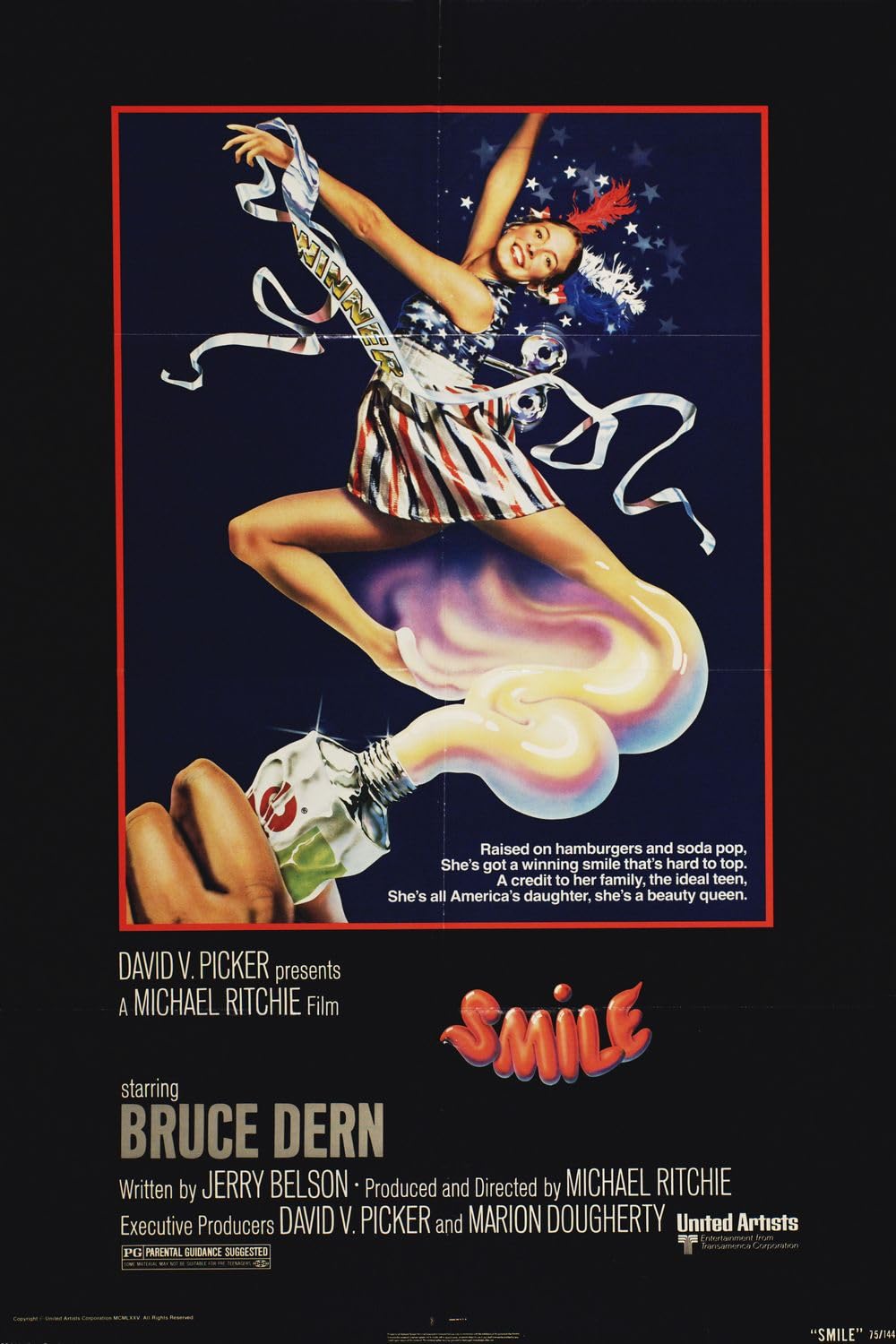
Santa Rosa, California is the site of this year’s Young American Miss Pageant. Each person that’s involved in the pageant approaches it differently. Bob (Bruce Dern), a middle-aged man who works as a car salesman, sees his position as a judge on the panel as a diversion from his otherwise mundane suburban life. Brenda, the pageant’s executive director, considers it a way to display her perfectionist qualities of control and leadership. Her husband Andy (Nicholas Pryor) views the proceedings in a much more cynical fashion and another added element to their already troubled marriage. Tommy (Micheal Kidd), the dance choreographer, approaches it as just another paycheck while Doria (Annette O’Toole), one of the contestants, considers it an opportunity to bolster her name and face even though Robin (Joan Prather), who’s competing against Doria, enjoys the whole thing just for the experience and isn’t concerned with who wins it, at least not initially.

The film marks the third entry in director Michael Ritchie’s American Dream trilogy and one of many he did dealing with competition and how this can change people in both good and bad ways with The Bad News Bears being the most famous of those. The gifted Jerry Belson wrote the script that was based on Ritchie’s own experiences as a pageant judge and many of the situations shown here were ones he went through. Unfortunately, despite the script being absolutely top notch to the extent of being one of the best satires ever written and equal to the more well-known Network that came out a couple years later the movie has not been seen by many, and the title has in recent years been eclipsed by the horror movie franchise. The is because the film’s studio, United Artists, had no confidence in the material and didn’t believe it would generate any profit and thus released it to only 4 theaters nationwide and thus few people ever saw it though in the following decades it has generated a small cult following and even a stage musical.

The finely etched, well-defined characters are what really sets it apart and each of them could be the centerpiece of their own movie if they wanted. Dern, who usually plays psycho roles, is excellent as a father who’s still clinging to his optimism even as everything around him deteriorates. Pryor equally good as his friend and counterpart who finds the suburban dream to be full of letdowns and lies and tries adamantly to break through Dern’s upbeat shield in order to get him to see the truth too. Feldon, best known as Agent 99 in ‘Get Smart’ TV-show, is terrific as well as a complete control freak and her defining moments coming during a scene in her living room, with all the furniture draped in protective plastic, and where she tries to literally goad her husband Andy into killing himself.

Even the minor characters display a unique angle and perspective on things including the janitor (Titos Vandis), who seemingly has a bottle of alcohol hidden everywhere, and makes keen observations on the others as well the music director (William Traylor) whose sarcasm and sexism knows no bounds. Geoffrey Lewis is memorable too as a marketing director who tries to promote the wholesome image of the contest only to in one really funny moment blurt his true cynical feelings about it. Prather and O’Toole though are the ones who drive it as it’s through them we see the inside mindset of those being judged and it’s interesting how at the start it’s O’Toole who’s the more jaded of the two while Prather is the wide-eyed one, but by the end after her experiences here Prather has more than been able to catch up with her.

Spoiler Alert!

The direction is done in a way that makes it seem like a docudrama where everything is captured through an unfiltered lens showing it as it happens with none of the scenes being set-up in a way that makes it feel staged, which is to its benefit. However, this gets ruined, in one of the movie’s few weak points, when Dern’s son Little Bob (Eric Shea) gets caught taking polaroids of the women in their undress. Instead of hearing the dialogue of the people when they catch him, as well as Dern’s when he finds out, which could’ve been quite revealing, music gets played over it, which is jarring as it reminds the viewer they’re watching a movie, even though it had spent the rest of the time trying to convince us we were seeing reality as it unfolded.

The ending is a bit of letdown too. Ritchie and Belson wanted the winner to be a complete surprise both to the cast and crew, which explains why the camera swerves around in a jerky style as even cinematographer Conrad Hall didn’t know who it was and thus had to try to find her when her name is announced. However, having it be a girl (Shawn Christianson) who has no lines of a dialogue, and only seen briefly in a few group shots, was a mistake. The attempt was to show how pointless these contests are and how not much thought or care goes into who’s picked, as evidenced by one of the judges seen flipping a coin before he makes his decision, but it still should’ve been someone we had seen and heard earlier. Maria O’Brien, who plays an obnoxious contestant who annoys the others so much they even sabotage her talent act, would’ve been a better choice and the film would’ve still made the same point and allowed a little more of a lasting emotional effect. With the way it gets done here the viewer leaves feeling miffed and confused.

My Rating: 9 out of 10

Released: March 20, 1975

Runtime: 1 Hour 57 Minutes

Rated PG

Director: Michael Ritchie

Studio: United Artists

Available: DVD, Blu-ray
The Bad News Bears Go to Japan (1978)

By Richard Winters

My Rating: 3 out of 10

4-Word Review: Shyster manages baseball team.

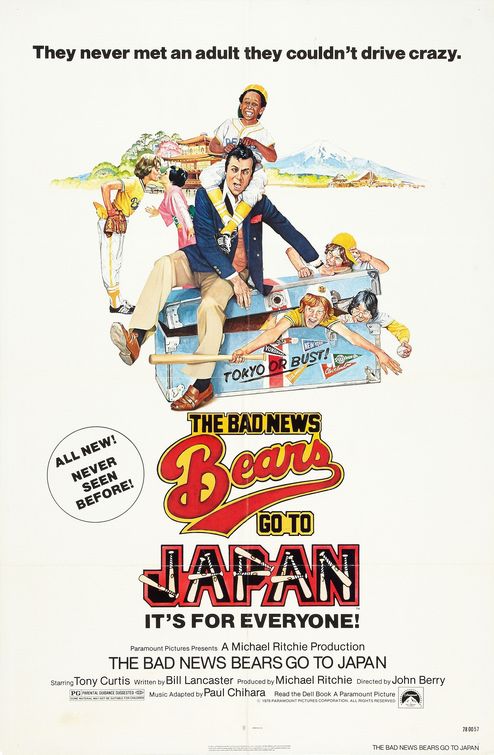
Drowning in debt small-time promoter Marvin Lazar (Tony Curtis) decides to take over the Bear’s baseball time by escorting them to Japan and managing them in a game against the Japanese champions run by coach Shimizu (Tomisaburo Wakayama). Problems arise though when Lazar runs out of money and is forced to partake in shady ploys to keep the team afloat.

The script was written by Bill Lancaster, who had penned the first one, and produced by Michael Ritchie who had been the director on the original, but the immense charm from the first installment is completely lost here. The wide-open poorly structured story lacks originality and filled with strained humor that will barely crack a smile.

The kids lack pizazz and play-off of tired caricatures that are no longer cute or funny. The biggest drawback is that the feisty Tanner who had been so prominent in the first two films is missing. It also looks weird and unrealistic that there is such a vast age difference amongst the kids in the line-up. Aren’t Little Leagues usually designed to be age specific? For instance there is usually a Pee-Wee division and then a 10 to 12 age division and so forth, so then why do we have kids here who look to be in the second grade matched with others who seem ready to enter the Junior High? Such a wide range in skill levels would make it virtually impossible to field a functional team from the get-go.

The playing ability of the team seems to have strangely regressed as well. In the first film they came close to winning the championship and in the second installment they did, but here they play like complete bumbling novices with no baseball experience at all.

Curtis is amusing, which helps save the film from being a complete disaster, but it hurts it as well because the script becomes geared completely around his character while the kids are overshadowed and forgotten. The story goes on long misguided tangents that have nothing to do with baseball at all including a segment dealing with Curtis challenging a Sumi wrestler to a match and the Japanese players getting involved in a singing contest, which begs the question if this is a movie about the Bears team then why is more screen time given to the Japanese one?

The side-story dealing with Jackie Earle Haley’s romantic foray is dumb too. He spots a young Japanese lady (Hatsune Ishihara) walking out of a nondescript store on a busy Tokyo street and for some reason becomes completely mesmerized by her and begins chasing her all around city and aggressively coming onto her like he’s a stalker, which would’ve scared any normal woman, but here this crazy behavior gets her to ‘fall-in-love’ with him despite the fact that she speaks no English.

The production values are surprisingly slick and the on-location shooting done in Japan is nice, but the script and humor is empty-headed and forgettable. It’s also interesting to note that George Wyner who appeared in the first film as the manager of the White Sox team appears here in a completely different part as a network executive.

My Rating: 3 out of 10

Released: June 30, 1978

Runtime: 1Hour 32Minutes

Rated PG

Director: John Berry

Studio: Paramount

Available: DVD, Amazon Video, YouTube

The Bad News Bears (1976)

By Richard Winters

My Rating: 8 out of 10

4-Word Review: From losers to winners.

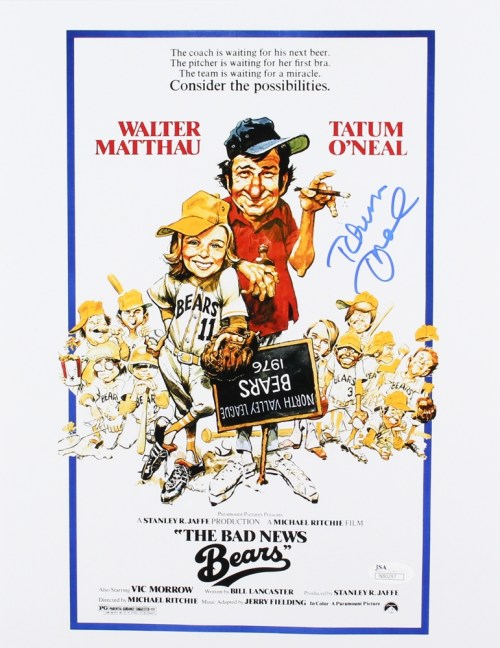
Ex-minor league baseball player and now full-time pool cleaner Morris Buttermaker (Walter Matthau) gets hired to coach a bunch of unskilled, untalented kids in a competitive baseball Little League. At first Buttermaker is only interested in collecting a paycheck and has no drive in teaching the kids the fundamentals or even in winning, but things change after the season opener when his team gets drubbed by the far superior Yankees. Buttermaker takes offence at their arrogant manager (Vic Morrow) and feels compelled to ‘show-him-up’. To do this he brings in the talented Amanda (Tatum O’Neal) to be the team’s new pitcher as well as Kelly Leak (Jackie Earle Haley) who is an excellent fielder and hitter, but as his competitive juices flow, so does his surly side making the game no longer fun to play for the kids.

Don’t be fooled because this is anything but a simple kid’s flick. Sure the kids can watch it and enjoy it, but the multi-layered story brings out many issues that the adults will be more than able to relate to. Director Michael Ritchie deftly picks-up on the many nuances of Little League culture and if one played in it or was involved in any capacity then this movie will tap into those memories and bring back a flood of nostalgia.

My only complaint is a missing side-story dealing with the parents attending the games. It is mentioned in passing how the adults are able to be friendly with each other as the season begins, but by the end they are usually no longer on speaking terms, but it would’ve been much more revealing had this been shown instead of just discussed.

The script was written by Bill Lancaster who was the son of legendary actor Burt Lancaster. He based the story of his own experiences of playing Little League ball and the Buttermaker character is supposedly a composite of his famous dad.

This also marks the fifth film that Ritchie directed dealing with the theme of competition. His first was Downhill Racer, which dealt with the sport of skiing, The Candidate dealing with a senatorial race, Prime Cut, which was about rival crime syndicates, and Smile about the ugly side of beauty pageants and while all those flicks were good this one is his best.

Spoiler Alert!

The film’s climactic game, which has the Bears taking on the mighty Yankees for the championship features many of baseball’s intricate tactics that will appeal to the seasoned fan, but still be straight forward enough for the novice to grasp. It also has the film’s most famous scene where the Yankees’ manager smacks his own son (Brandon Cruz), who was the team’s pitcher, when he doesn’t obey his father’s instructions. Then on the very next play, and in order to get back at his dad, the kid fields a grounder, but refuses to throw it to first base, which allows the opposing team to score an easy run.

It is intended that the viewer should side with kid, but I didn’t. For one thing the dad’s advice was good, since this hitter had already gotten some runs off of him earlier it made sense to pitch low and outside. Just because he kid wants to ‘strike him out’ doesn’t mean that he will or that it’s a good idea. Strategy is a part of the game and that’s what a manger is there for. What happens if this kid grows up and plays in the big leagues and then decides he doesn’t want to do what the manager tells him. How’s that going to go over?

The kid also seemed like an incredibly self-centered little brat. Supposedly he lives with his dad 24/7, so couldn’t he have picked some other time to get back at his old man instead of jeopardizing the game for the rest of his teammates who are counting on him to help win?

This also brings up the issue of who’s really the ‘mean manager’.  It’s supposed to be Morrow, but Matthau in a lot of ways gets just as bad if not worse especially with the way he ends up treating Amanda making me almost surprised that she showed up the next day to play. To me it would’ve been more satisfying having one of the Bears players do to Matthau what the son did to his father and in my opinion Matthau would’ve deserved it more.

This then brings up the third issue which is the fact that Matthau has this extraordinary epiphany in the middle of the big game where he realizes in his zest to win he might’ve pushed things too far and decides to pull back. I realize this is the film’s central theme, which is that becoming overly competitive is not good and can turn otherwise nice people into assholes if they aren’t careful, but the shift comes off like a Jekyll and Hyde. Most of these types of games last for only an hour, so having a guy at the start of the hour come off as this relentless warrior willing to do whatever it takes to win only to end the game being this high minded idealist lecturing the other parents on how it’s important that all the children get a chance to play even if it means blowing the game seems too severe for such a short period of time.

I wasn’t completely happy about the Bears losing the big final game either. Normally I’d consider this a good thing because it works against the formula. It’s also beneficial for kids to realize that not everyone ends up with the big trophy or that ‘the good guys always win’, but more important to hold your head high and be proud of your accomplishments, yet I still remained a bit frustrated. You become so emotionally invested in them winning that it’s deflating when it doesn’t happen, but it’s still one of the best sports movies ever made either way!

End of Spoiler Alert!

My Rating: 8 out of 10

Released: April 7, 1976

Runtime: 1Hour 42Minutes

Rated PG

Director: Michael Ritchie

Studio: Paramount

Available: DVD, Amazon Video, YouTube