Tag Archives: Mel Brooks

The Muppet Movie (1979)

By Richard Winters

My Rating: 7 out of 10

4-Word Review: How they became famous.

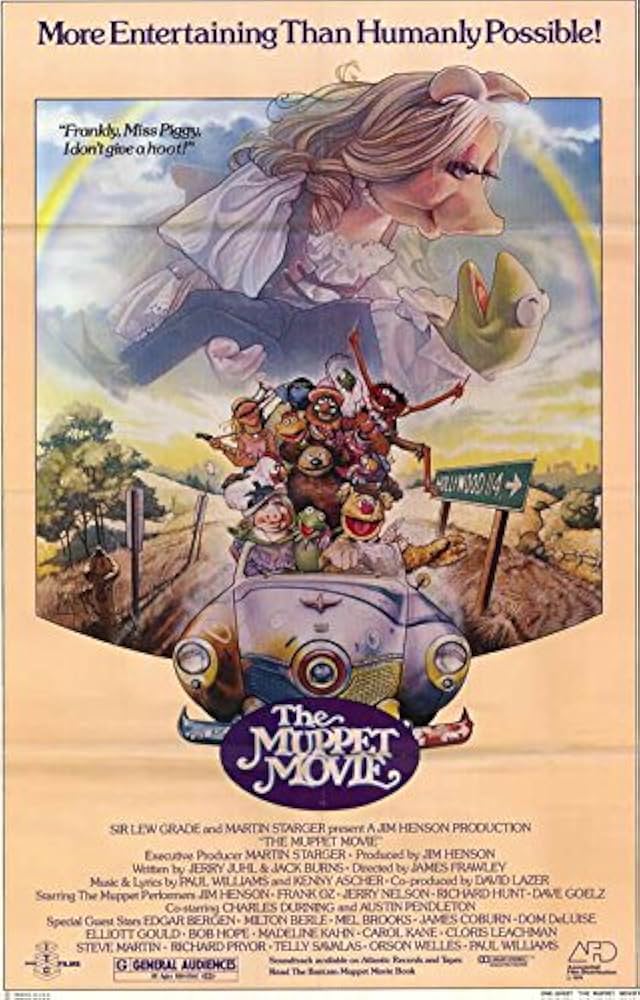
Kermit (Jim Henson) is a lonely frog living in a Florida swamp who dreams of one day making it to Hollywood and becoming famous. He then meets talent agent Bernie (Dom Deluise) who hears Kermit singing a song with a banjo and becomes convinced that the frog has what it takes to become a star. He hands him his card and tells him to give him a visit when it makes it to California. Kermit then sets-off on a cross-country trip and along the way meets several other characters all looking for their big-break including Fozzie Bear, a struggling comedian, and Miss Piggy (Frank Oz) who wants to become a fashion model. They tag along on the trip with Kermit while pilling into Fozzie’s Studebaker as he drives them to the west coast, but then they meet up with Doc Hopper (Charles Durning), an owner of restaurants who specializes in frog legs, who wants Kermit to be his new spokesmen in some commercials that he’s producing, but Kermit declines. However, Doc refuses to take no for answer and chases after the gang and using increasingly more sinister methods in order to get the frog to change his mind. 

Due to the success of ‘The Muppet Show’ creator Jim Henson was given financing to produce his own movie featuring the same puppet characters audiences had grown to love from the program. Since this would be a large-scale production great effort had to be put into making the muppets appear real and able to blend into an actual outdoor setting versus having everything done on a sound stage like it was in the TV-show. Henson refused to compromise on anything and insisted that money would not be a limitation, and this included the segment where Animal, one of the muppet characters, grows to giant proportions. Initially the idea was to keep the puppet the same size and place him on a miniaturized set, which would’ve cut down on costs, but Henson felt this didn’t look convincing enough, so instead they constructed Animal’s head to gigantic proportions that measured over sixty feet, which called for way more money and was very time consuming, but ultimately worth the effort. 

The story itself is pedestrian and relies, similar to the TV-show, with rapid fire quips and comebacks much like in old vaudeville. On the surface the humor is corny, and some could find the whole thing silly, but enjoyment comes with the puppet characters that are made to be like caricatures of humans, and their amusing responses and reactions. It’s also filled with a lot of great songs all written by the talented Paul Williams, who appears briefly. Normally in movie musicals the songs end up sounding the same and it starts to feel like we’re just listening to the same loop done over and over, but here each music bit has a distinct beat and a good toe-tapping quality, which not only adds to the fun, but actually helps move the story along versus holding it up. 

The only drawback is the massive amount of guest star appearances. There are many familiar faces, but most of them are only in it for a half-minute, or so and few of them have anything that’s actually funny to say, or even moderately clever. Performers like Bob Hope, Richard Pryor, Madeline Kahn, and Edgar Bergen, in his last screen appearance before dying just a couple weeks later, are essentially wasted in bits that add nothing and could easily have been excised and not missed. However, there’s a few cameos that do work including Steve Martin as an annoyed waiter, Cloris Leachman as a receptionist allergic to animal hair and Orson Welles who comes on near the end and has the film’s best line. Mel Brooks also quite memorable in an over-the-top send-up of a German mad scientist. 

Durning though is the one exception as he is more like a main cast member and in it quite a bit. Of course, he’s an outstanding character actor and a personal favorite and he shines here as well particularly with his attempt at a Cajun accent, but it seemed a bit ridiculous for a guy to go to such extreme measures just to get Kermit to be in his commercials. A better storyline would’ve had Kermit witness Durning turning one of his family members, perhaps one of his distant frog cousins, into a frog legs meal and thus threaten to turn Durning into the authorities and this would cause him to chase after him in order to try and keep him from squealing.  It also would’ve been nice had he shown a change-of-heart at the end and come around to being a friend to the muppets versus remaining an adversary. It comes close at one point when Durning realizes he doesn’t have any real friends like Kermit does, but I would’ve liked to have seen him come to grips with his aggressive personality and make amends to do better moving forward. 

My Rating: 7 out of 10

Released: June 22, 1979

Runtime: 1 Hour 35 Minutes

Rated G

Director: James Frawley

Studio: Associated Film Distribution

Available: DVD, Blu-ray, Amazon Video, YouTube
The Twelve Chairs (1970)

twelve

By Richard Winters

My Rating: 7 out of 10

4-Word Review: Which chair has fortune?

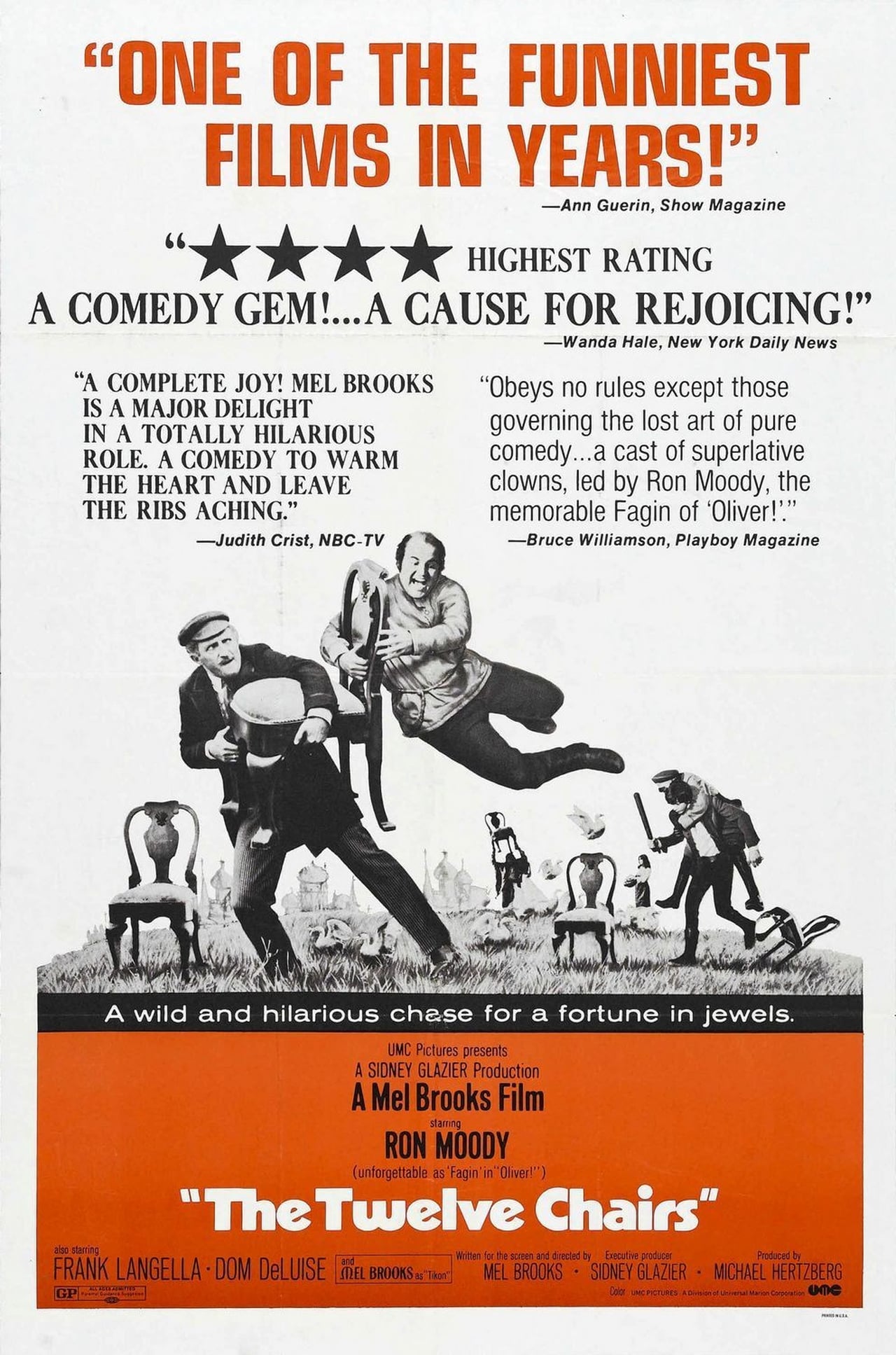
Vorobyaninov (Ron Moody), an poor man living in 1920’s Russia, is summoned to the deathbed of his mother-in-law. She confides in him that there’s a stash of priceless jewels sewn into the seat cushions of one of the twelve chairs from the family’s dinning room set. Unfortunately the newly formed Russian state has appropriated all private property and it’s up to Vorobyaninov to track them down. He teams up with Ostop (Frank Langella) a local con-man to help him, but they have competition. Father Fyodor (Dom DeLuise), a priest, also becomes aware of the jewels when he goes to the mother-in-law’s home to give her the last rites. All three go on a mad dash to retrieve the jewels, but the more chairs they manage to find the more frustrated they become.

The film is based on the 1928 Russian novel of the same name by Ilf and Petrov a famous duo who were quite popular during the early soviet period and wrote not only many satirical novels, including this one and its sequel ‘A Little Golden Calf’, but also several short stories, articles, theatrical plays, and even screenplays. The Twelve Chairs novel though was their most popular and has been made into a movie 18 different times. It had already been done 6 times before Mel Brooks did his with the first version being in 1933 and the most recent rendition of it done in 2013 in Italy.

This version is the most popular and a bit of stretch from Brooks’ other films, which relied on a lot of gags and slapstick. This one has its fair share of those though the first act is quite talky and not too much going on. Brooks himself appears as a character, but he can’t really enliven it. It’s not until the men finally come upon the chairs and start tearing them up one-by-one that it really starts to get funny. The chair thing could’ve gotten redundant as the men rip open the seat cushions in pretty much the same quick way, but Brooks manages to approach each of these scenes in a creative way, so instead of becoming monotonous it remains fresh and comical. My favorite of these is when Ron Moody and Frank Langella chase Dom, who has one of the chairs, through an open field that’s done in stop-action.

The film’s detraction though is the casting of the two main characters. Langella is a terrific actor, but not in comedy. He did appear in the dark comedy Diary of a Mad Housewife, where he was very good, but that took advantage of his glib demeanor and pouty expression and his character there was meant to be unlikable. Here though he has nothing amusing to say and remains a complete jerk the whole way. There is one point where he and Moody are in a row boat and Moody states that he’s cold and Langella gives him a jacket to wear, which I guess was Brooks’ attempt to make him likable, but it’s not enough and the movie is really hurt by spending so much time focused on a guy who’s one-dimensionally cold and responds to antics around him in the same sneering way. He was recommended to Brooks by his wife Anne Bancroft who had performed with Langella in a Broadway play that had a short run, but I felt this is one time when he shouldn’t have listened to her.

Ron Moody, a talented actor as well, has the same issue. The character is meant to be dim-witted, but it doesn’t come-off in a natural way. His banter with Langella is flat and annoying with the bickering doing nothing but slowing up the pacing. Without question DeLuise is the funniest. He’s just as conniving and greedy as the other two, but for whatever reason it doesn’t seem as ingratiating. His character’s ineptness had me laughing and he should’ve been the star while Langella and Moody could’ve been shown only sporadically as the occasional nemesis.

Spoiler Alert!

The ending is much different than the one in the book. In the novel version Vorobyaninov kills Ostap by slitting his throat with a razor in order to keep the loot for himself only to find that it’s not there, so he then goes insane. In the movie Vorobyaninov and Ostap team up to become beggars on the street by pretending Vorobyaninov has an epileptic condition and requesting people throw money at him to help him. Wikipedia, in a line that has since been deleted, stated that this was a ‘happier’ ending though trying to make a living being a street beggar all day can’t be all that fun.

What amused me though is that in both versions the jewels are never recovered by the two men. In the movie the jewels were found first by someone else who used it to build a clubhouse for pompous old men making it seem like greed was inevitable. In the book though the money gets used to build a recreational center that can be used by the entire community and thus giving it more of a pro-communist bent.

My Rating: 7 out of 10

Released: October 28, 1970

Runtime: 1 Hour 33 Minutes

Rated G

Director: Mel Brooks

Studio: UMC Pictures

Available: DVD

Silent Movie (1976)

silent

By Richard Winters

My Rating: 3 out of 10

4-Word Review: Marcel Marceau says no.

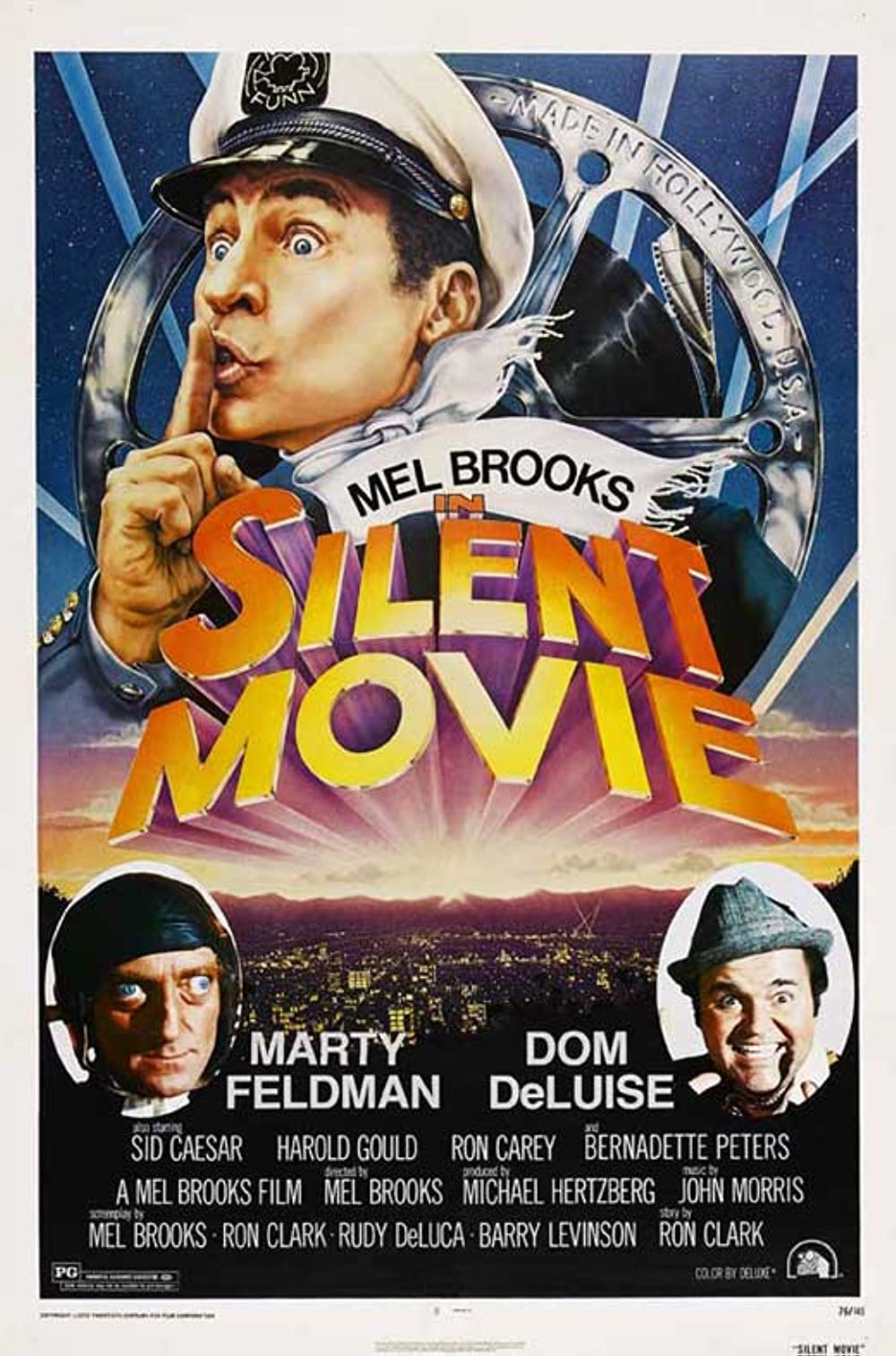
Mel Funn (Mel Brooks) was a one-time top Hollywood movie director, whose career spiraled downward due to alcoholism. He though, along with his two sidekicks, Marty (Marty Feldmen) and Dom (Dom DeLuise), aspires for a comeback. His idea is to make a silent movie, but the studio head (Sid Caesar) initially rejects it and only warms up to it when Mel convinces him that he can bring in some top name stars. Mel and his two buddies then set out to find the talent and although it isn’t easy they’re able to get Burt Reynolds, James Caan, Paul Newman, Anne Bancroft, and Liza Minnelli. The movie is eventually made, but then on opening night the one and only print of it gets stolen by a greedy conglomerate named Engulf and Devour, who want the studio that produced the movie to go under in order for them to take it over.

In 1975 after the success of Blazing Saddles and Young Frankenstein, writer-director Brooks was on top of the film world and I suppose any zany idea he came up with the studios would be willing to roll with considering his already built-in cult following, so it’s no surprise it got made. It even, to my surprise, did quite well at the box office pulling in $36 million from a $4 million budget though this was mainly due to the fact that Brooks had his legion of fans upfront who would be willing, if not running to see his next movie even if it was about farm pigs mating. What really flabbergasted me was how, at least at the time, most critics reviewed it favorably with Roger Ebert even giving it 4-stars. I for one though found very little that was funny and felt more like Anne Bancroft, who was Brooks’ wife, who responded negatively to Alan Alda when he congratulated the couple on it after watching it during an opening night screening. After describing how hard he laughed Bancroft then turned to her husband and said: “You see Mel, I told you some idiot would find this funny.”

A lot of the problem is with the script, or lack thereof where too much emphasis is placed on disconnected gags and not enough on  story. Many silent films from the era had intricate plot lines, so to say because the movie didn’t have dialogue, only title cards, so it had to remain simple is just not a good excuse. There needed to be more at stake and a threatening bad guy, some would say that Harold Gould, who plays the head of the conglomerate is the heavy, and he probably is, but he’s too bumbling, not seen enough, and there’s never any confrontation/showdown between him and Mel.

Having three guys essentially playing the protagonist didn’t make much sense either. I didn’t understand what bonded them, or since Mel was down-on-his-luck, where they would find the time, or money to traipse around in a snazzy little sports car all day and not have to work. There’s little distinction between the three and they could’ve been combined into one person, preferably Marty, whose odd face is perfect for this kind of material.

The humor is on the extreme kiddie level, which may disappoint some Brooks fans who at the time was known for his bawdy and even envelope pushing material. The gags aren’t all that imaginative. I think the only one I got a kick out during the entire 87-minute runtime was the heart machine at the hospital, which inadvertently gets turned into Pong, the very first video game. The Geriatric Lounge where no on one under 75 is admitted and everyone gets carded was alright too, but literally everything else falls flat and for the most part horrendously lame. The jokes have very little to do with the plot, which is anemic enough, and thus takes away from the main storyline as they just get haphazardly thrown in at regular intervals and in certain cases take quite a long time to play-out, which robs the movie of any momentum and makes it seem like it’s bogging down and going nowhere.

The cameos by the famous stars are wasted. I did like Bancroft, who does a rare comic turn from her usual drama forte, and is quite good particularly with the freaky eye trick that she does, which was taught to her by Carl Reiner. Paul Newman, who goes on a wild wheelchair race, isn’t bad either, but Reynolds segment doesn’t have enough going-on and Caan’s moments, in which the four try to eat melon balls inside his trailer that has a broken spring, is just plain silly and highly strained. In Minnelli’s bit she does nothing but just sit there as the other three try to sit down at her table while wearing body armor, which again takes agonizingly long to play-out and less sophisticated than a comic bit on ‘Sesame Street’.

I will give Brooks all the credit in the world with his ability and daring to come-up with what many people would consider an unworkable idea and have the guts to pull-it-off, or at least attempt to. However, like with History of the World, Part 1it becomes an overreach that can’t equal its grand concept. Having characters that weren’t broad caricatures and a script that didn’t rely so heavily on mindless shtick would’ve helped.

My Rating: 3 out of 10

Released: June 17, 1976

Runtime: 1 Hour 27 Minutes

Rated PG

Director: Mel Brooks

Studio: 20th Century Fox

Available: DVD

High Anxiety (1977)

By Richard Winters

My Rating: 7 out of 10

4-Word Review: He’s afraid of heights.

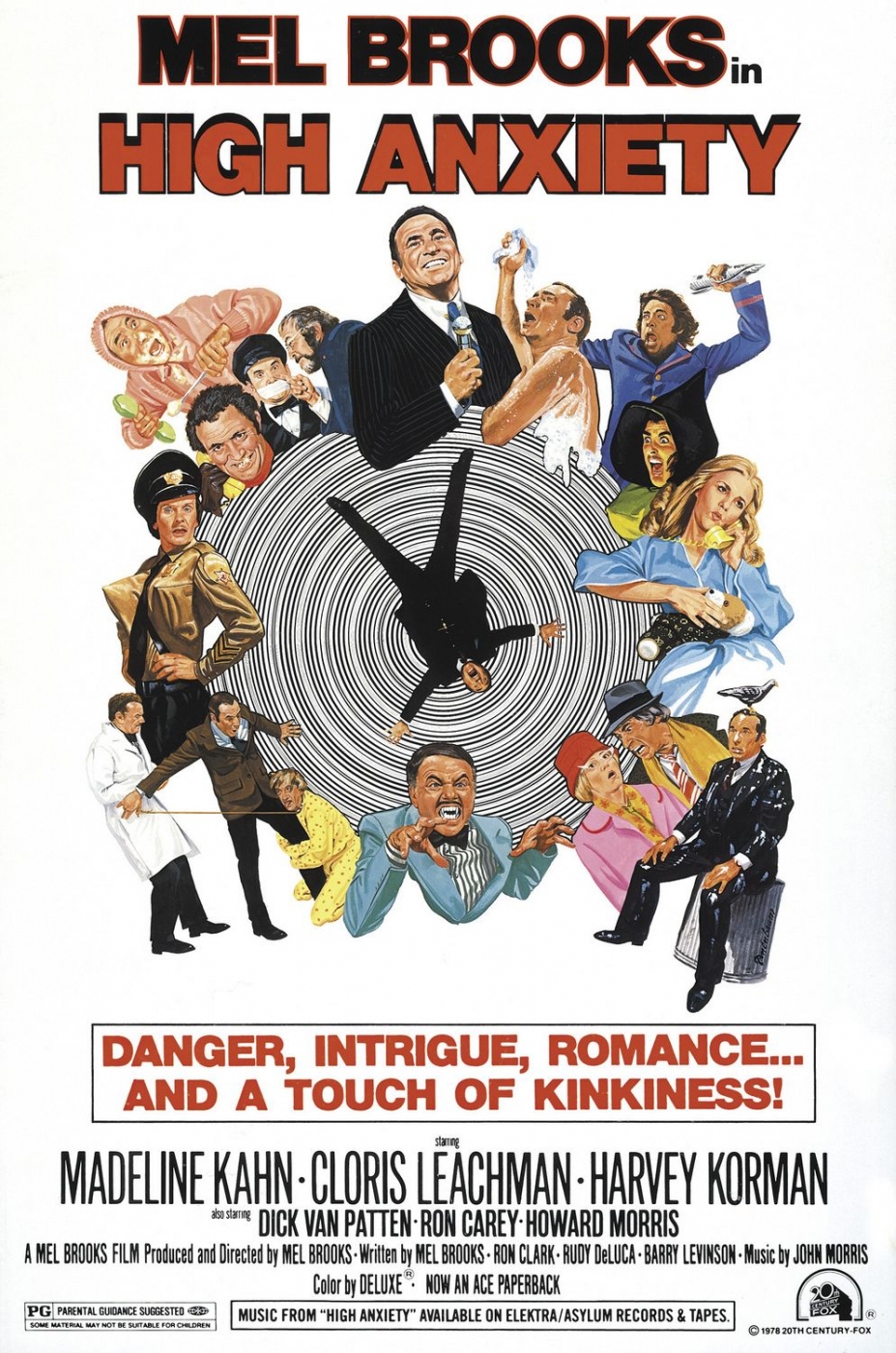
Dr. Richard Thorndyke (Mel Brooks) is hired as the new resident psychiatrist at the Psycho-Neurotic Institute for the Very, Very, Nervous where he is to replace another Dr. who died under suspicious circumstances. While there he becomes aware of many odd things occurring making him believe that the people running the hospital, Dr. Charles Montague (Harvey Korman) and Nurse Diesel (Cloris Leachman), have a scheme going on where they take in rich patients and pretend their conditions are worse than they really are, so that they can keep the patients hospitalized for indefinite periods and thus bilk the patient’s rich families for large sums of money. Richard, together with Victoria (Madeline Kahn) who is the daughter of another patient that is being held there against his will, become determined to expose the scheme, but his adversaries use nefarious tactics to try and stop him by taking advantage of his extreme fear of heights.

Per an interview that Mel Brooks gave with NPR in 2013 he revealed that he wrote a letter to Hitchcock in 1976 telling him that he wanted to do a parody of his movies and was interested in getting his feedback. Hitch wrote back saying that they should get together in his office to go over ideas. In fact it was Hitch’s suggestion to have the scene involving the birds pooping on Brooks. When the film was completed he got his own private screening and afterwards he sent Brooks a case of expensive French wine with the note: “A small token of my pleasure, have no anxiety about this.”

Two of my favorite moments include a Psycho parody where a bellhop (played by a young and soon-to-be famous director in his own right, Barry Levinson) who stabs Brooks with a newspaper while he’s in the shower. The afore mentioned Birds parody is good too with the bird droppings made up of mayonnaise and chopped spinach, but because a helicopter was used during the segment it scared a lot of the pigeons causing real bird do-do to get mixed in with the fake stuff.

I enjoyed the bits involving a parody of the ‘gliding camera’ a technique used in many films where a camera shot begins on the outside of a building, but then somehow ‘glides through’ a wall and goes inside a place without any barrier. Here the camera shatters the glass as it tries to ‘glide through’ the window of the hospital, but Brooks almost ruins the moment by having the characters react by looking up to where the noise occurred, but then going back to their conversation, which makes no sense. If a camera operator has just crashed through a window, most people would get up from their seats and inspect the damage, which would’ve overplayed the joke, so they should’ve just had the characters not respond to the crashing noise at all. This same issue occurs at the end where the camera operators are heard talking just before they crash through a wall, but the scene would’ve played better without the banter.

The plot, as thin and goofy as it is, has some interesting moments. I especially enjoyed the segments done inside the lobby of the Hyatt Regency in San Francisco and the way it takes advantage of the glass elevators there. The scene involving actor Ron Carey blowing up a picture that he took there in order to solve a crime is cool because it goes back to the old way of developing film, which will be a good education for today’s younger viewers who are more used to digital.

The performances are first-rate with Brooks in an uncharacteristic straight part though he still gets in a few zany moments including a segment where he’s a baby who falls from his high-chair. Leachman though steals it in a brilliant send-up of Nurse Ratched from One Flew Over the Cuckoo’s Nest. In fact it’s her contorted face with no make-up and a faint mustache that leaves a lasting impression. She has stated that she disliked doing the role, but it’s so hilarious that I wished her part had been given a wider storyline.

My Rating: 7 out of 10

Released: December 25, 1977

Runtime: 1 Hour 34 Minutes

Rated PG

Director: Mel Brooks

Studio: 20th Century Fox

Available: DVD, Blu-ray, Amazon Video, YouTube
History of the World, Part I (1981)

By Richard Winters

My Rating: 3 out of 10

4-Word Review: Making historical events funny.

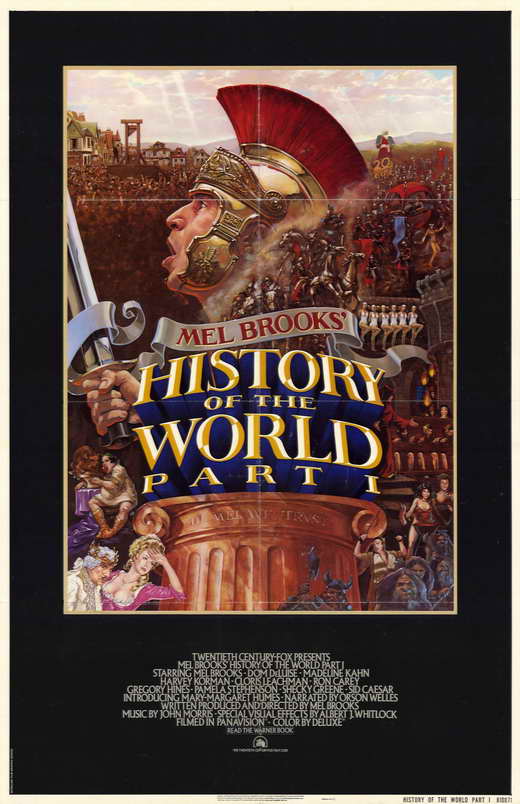
In 1979 Mel Brooks was riding high after directing 4 hit movies and as he was walking across a studio parking lot a man who had worked on his crew from his previous films asked him what his next project would be. Brooks, feeling the pressure to come up with something big and splashy, told him it was going to be about the history of the world. This film ended up being the result of that conversation although it’s hard to call it a movie at all since it’s really just a collection of vignettes dealing with 4 specific periods: The Stone Age, The Roman Empire, The Spanish Inquisition, and The French Revolution.

At first glance it’s almost shocking that something this overreaching could’ve been produced to begin with. Had anyone but Brooks approached the studio heads with this concept it would’ve been slapped down immediately and the person told not to come back until they had an idea that was more focused, but because of Brooks’ prior success these same executives decided to swallow their better judgement. Not only did they unwisely give it the green light, but they threw more money at it than any of his previous film budgets combined; a whooping 11 million, which all pretty much goes to waste.

It’s not like there aren’t a few funny moments here and there: the musical number during the Spanish Inquisition, the Last Supper parody, and the Jews in space all elicit a few chuckles, but the rest of it’s lame and corny like skits from some mediocre variety show. An overarching character that would’v been in all of the scenes was needed like a time traveler from the modern day who goes back and interacts with all the people from the time periods, which could’ve been a riot.

A lot of familiar faces pop in-and-out, but many of them are onscreen for only a few seconds. A better idea would’ve been to whittle down the cast list to only a handful of performers and then having them play the different roles in each time period instead of just introducing more stars into the mix, which only helps to give the already bloated production a very cluttered feel.

Not only does Brooks cast himself into too many of the film’s major roles, which makes the thing seem like a vanity project, but he also relies too heavily on his aging Hollywood friends in supporting parts instead of introducing a young vibrant talent into the mix that could’ve helped attract new, younger fans. It also doesn’t help that Richard Pryor was set to play a big role in this, but then just two days before shooting he suffered a serious accident that burned his face and forced him to bow out leaving Gregory Hines to replace him who is not nearly as funny or dynamic.

I couldn’t help but connect this thing with Bill Cosby’s mega-flop Leonard Part 6.  Apparently many people on the production crew of that film felt the material was subpar, but too afraid to approach Cosby, who was such a big star at the time, to tell him. I can only presume there were also people on the crew of this film who felt the same way, but didn’t want to jeopardize their careers by speaking up, which is too bad. While this movie did ultimately make money it was mainly during its first week and enthusiasm due to bad word-of-mouth quickly dwindled afterwards. Brooks reputation never fully recovered, which is why no one even a big star should be above constructive criticism, which  might’ve helped modify this clunker into becoming something better.

My Rating: 3 out of 10

Released: June 12, 1981

Runtime: 1 Hour 32 Minutes

Rated R

Director: Mel Brooks

Studio: 20th Century Fox

Available: DVD, Blu-ray

Blazing Saddles (1974)

By Richard Winters

My Rating: 7 out of 10

4-Word Review: Black man becomes sheriff.

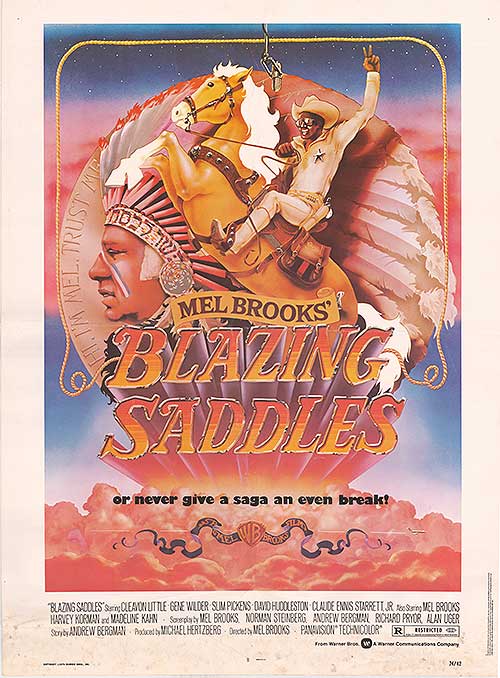
Classic western parody centers on a new railroad being built during the 1870’s and how an attorney general named Hedley Lamarr (Harvey Korman) connives to have it run through a town called Rock Ridge, but in so doing devises a plan to have the residents run out, so the railroad can be put in. He hires a bunch of outlaws to ride into the town and terrorize the people hoping they’ll be scared off and move, but instead they put in a request to the state’s governor (Mel Brooks) for a sheriff. The inept governor gets tricked into hiring a black man named Bart (Cleavon Little) to act as the sheriff, which sends the racist residents of Rock Ridge into an outrage.

The film was known at the time for its outlandish humor, which thanks to political correctness is now considered even more outrageous and would most likely have no chance of being made today. The film’s biggest sticking point deals with its excessive use of the N-word, which writer/director Brooks was pressured to take out by the studio executives (along with many other things), but he resisted insisting that co-writer Richard Pryor and star Little had their blessing to keep it in and that most of the letters he received that were critical of the word being used were from white people. Personally I felt that it was realistic for its setting, which was supposed to be 1874, so in that regard it worked.

The stuff that got on my nerves was the constant anachronistic jokes dealing with people that weren’t even alive when the film’s setting took place. This type of humor gives the film too much of a campy feel and should’ve been scrapped. I was also disappointed when Gene Wilder talks to Little about his past and how he was accosted by a gun-toting 6-year-old, but the film doesn’t cut away to a reenactment of this, which would’ve been hilarious to see, even though it does do this when Little talks about his own past.

The funniest bits that I did find myself laughing-out-loud to where the ones involving Brooks as the cross-eyed governor, but I was frustrated that the streaming video that I watched did not have the scene where Brooks goes to the town of Rock Ridge and mistakes the wooden dummies that are there as being real-people. I remember this scene vividly when I watched it on network TV back in the 80’s and thought it was hilarious, but apparently this segment is only available on the Blu-ray version.

The acting by the supporting cast is great with Korman getting the best film role of his career. Liam Dunn is memorable as the town’s pastor and I got a kick out of Jessamine Milner as a racist old lady who later tries to make amends with Bart, but only under certain conditions. Madeline Kahn is quite good too in a send-up of Marlene Dietrich and rumor has it that she intentionally gave a bad performance in Mame, which was filming at the same time, just so the director would fire her, so she could then get the part here, but still be paid for that one as her contract stipulated guaranteed pay as long as she was terminated and didn’t quit.

The only bad performance comes from Little, who is just too serene and laid back almost like he’s treating the whole thing as a joke and doesn’t get into his part at all. I would’ve expected to see some anger from his character over the way he had been treated by white folks, but none is conveyed and instead he comes off like some guy picked off the street who mouths his lines and that’s about it. The part was intended for Richard Pryor who would’ve given the role the extra edge that it needed.

Spoiler Alert!

As controversial as the film is it’s the bizarre ending that has always had me the most baffled as it breaks the fourth wall and has the characters without warning go from the western time period into the modern-day. When I first saw this years ago I thought it was the weirdest thing I had ever seen and didn’t like it as I felt it ruined the story as I was enjoying seeing the town’s residents take matters into their own hands by literally beating up the bad guys as well as realizing that their racist ways were wrong. Having them suddenly thrown onto a Hollywood backlot made it too gimmicky and took away any possibility for some minor depth/message that the story might otherwise have had.

In retrospect I can only conclude that Brooks did this to show that these characters were never meant to be a part of the true west. In fact the whole reason that attracted him to the project, which was based off of an idea by Andrew Bergman, was because of its so-called ‘hip-talk’, which had 1974 expressions done in an 1874 setting.

If this was the case then the film should’ve started out with the characters in the modern day and then transported them via a time machine into the old west. The movie is so goofy anyways that I can’t see how this funky added element could’ve hurt it and then at the end when they return to the present it would’ve seemed more fluid and less like a cop-out where the writer’s ran out of ideas, so they decided to just go weird.

My Rating: 7 out of 10

Released: February 7, 1974

Runtime: 1Hour 33Minutes

Rated R

Director: Mel Brooks

Studio: Warner Brothers

Available: DVD, Blu-ray, Amazon Video, YouTube