Tag Archives: Martin Ritt

End of the Game (1975)

endofgame

By Richard Winters

My Rating: 7 out of 10

4-Word Review: Unable to prove crime.

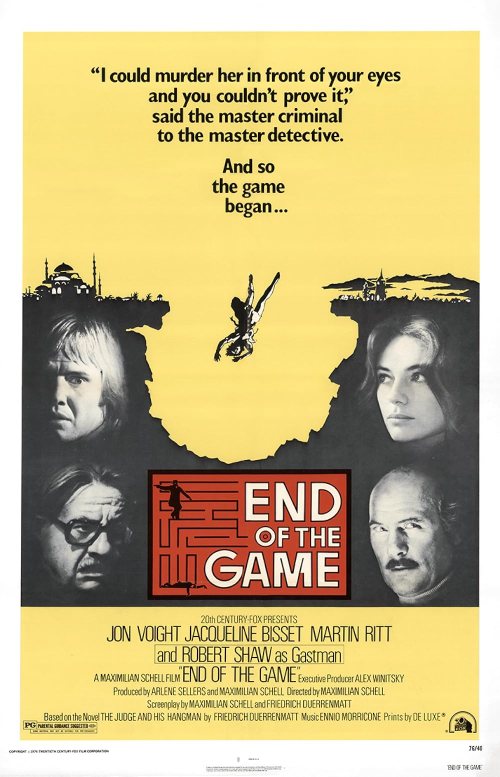
Richard Gastman (Robert Shaw) makes a bet with his young friend Hans (Martin Ritt) that he can commit a crime in front of him, but Hans will be unable to prove who did it. Later Hans’ girlfriend (Rita Calderoni) plunges to her death from off of a bridge. Hans is convinced Gastman did it, but just like he predicted he cannot prove it. 30 years pass and Hans is now a police commissioner with only a few months to live due to suffering from stomach cancer. His Lieutenant Schmied (Donald Sutherland) is found shot to death inside his police vehicle. He’d been assigned by Hans to keep tabs on Gastman as Hans was still intent on making him pay for what he did to his girlfriend, but he again can’t prove that Gastman killed Schmied though he’s certain that he did. Walter (Jon Voight) gets assigned to the case, but Hans can’t be completely honest with him about the case, so instead he sets Walter up to witness firsthand the brutality of Gastman for himself.

The story is based on the 1950 novel ‘The Judge and the Hangman’ by Frederich Durrenmatt who also wrote the screenplay and has a very amusing cameo as a man who plays chess against himself and always loses. The novel was first adapted into a broadcast for German television in 1957 and then again in 1961 for British TV, and then it got adapted for a third time for Italian television and then a fourth as a TV-movie for French broadcast before finally making it’s way to the big screen with this version, which so far has been the last adaptation to date.

The film was directed by Academy Award winning actor Maximillian Schell who was unable to get along with either of his leading actors with Shaw accusing him of being a ‘clockwatcher’ and ‘pocket Hitler’ while Voight described him as being humorless and overly demanding. The film is well directed for the most part, but an unusual reliance on humor almost kills it. The story itself is certainly not meant to be funny, but Schell implements comedic moments particularly in the first half when they’re not needed and almost a distraction. This is particularly evident during Schmied’s funeral and earlier when Schmied’s body is found and another cop drives the corpse to the hospital with Donald Sutherland, in an unbilled bit, playing the dead man and his body twisting around in weird ways as the car goes down the curvy road, which is humorous, but unnecessary and doesn’t help propel the plot. Initially too the corpse is spotted by some pedestrians who stare at it through the car window and seem amused by it, which isn’t exactly a normal reaction people have when witnessing someone who has just died. Possibly this was meant to show the public’s distrust, or disdain for the police, but if that were the case it should’ve been explained and elaborated.

The casting is unusual as it features Ritt in the lead who’s better known as a director, but here ultimately shines and becomes the film’s only likable character though the way he behaves throughout still makes him seem sketchy like everyone else. Shaw, who complained that he never got paid the $50,000 that he was owed for doing this, is commanding as usual, but Voight who wears a shaggy bleached blonde look comes-off as creepy right away. Technically the viewer is expected to side with his character, at least upfront and consider him a ‘good guy’, but right away Voigt telegraphs it in a way that makes him seem ‘off’ and hence kind of ruins the stories eventual twists.

For those who like complex whodunits this might fit the bill. The plot certainly does constantly unravel in surprising ways and no one should be bored, but the characters are cold and unlikable. There’s no one to root for and therefore the viewer is not as keyed into the outcome as they would’ve had they been more emotionally invested. The editing is also quite choppy and there seems to be certain key elements that get left out, which most likely due to the fact that the original runtime was 106 minutes, but the DVD version, the only one publicly available at this time, runs a mere 92 minutes.

My Rating: 7 out of 10

Released: September 21, 1975

Runtime: 1 Hour 46 Minutes (Director’s Cut) 1 Hour 33 Minutes (DVD Version)

Rated R

Director: Maximillian Schell

Studio: 20th Century Fox

Available: DVD-R
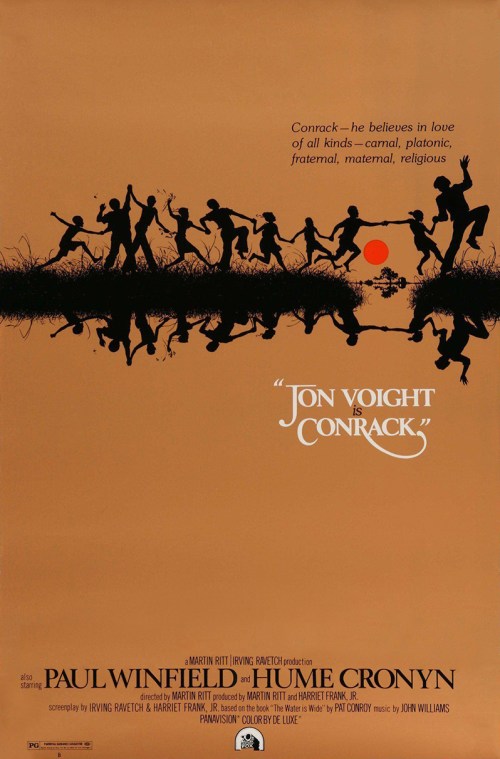
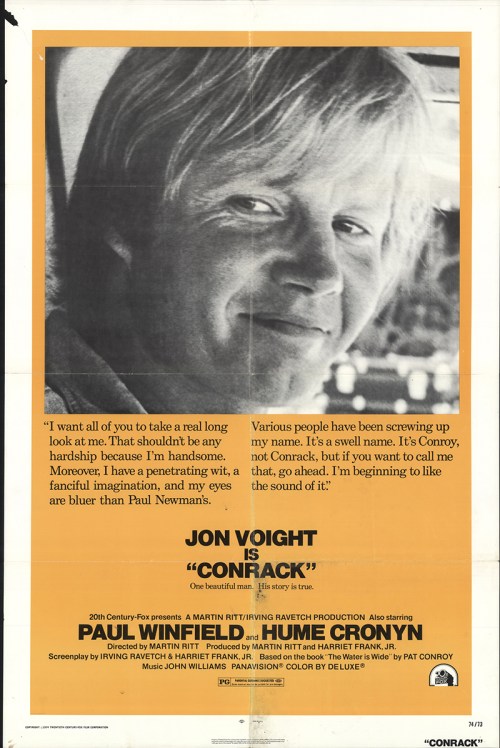
Conrack (1974)

conrack2

By Richard Winters

My Rating: 7 out of 10

4-Word Review: He teaches underprivileged kids.

In the spring of 1969 Pat Conroy gets a job teaching children in grades 5 through 8 in a one room schoolhouse off the coast of South Carolina on an island known as Yamacraw. He soon finds that the students, all of whom are poor and African American, don’t know even the basics of arithmetic, or geography and can’t read. He becomes compelled to change that by instituting unorthodox teaching methods, which he hopes will ‘jostle’ them from their intellectual slumber and get them into learning and enjoying it. Mrs. Scott (Madge Sinclair) is the principal who’s not keen to these methods and routinely lectures him. Mr. Skeffington (Hume Cronyn) is the superintendent who also frowns on some of the things Pat is doing and proceeds to have him fired. Pat tries to win his job back and the students and townspeople help him in his fight, but will it be enough?

The film is based on the novel ‘The Water is Wide’, which was written by Pat Conroy, who later went on to even greater success with The Great Santiniwhich was based on his father, and also made into a movie. This story was supposedly based on some of Pat’s true-life experiences while teaching on Daufuskie Island. Some of what’s shown is revealing and even captivating, but I couldn’t help but feel certain other aspects were exaggerated. I realize that these kids didn’t have the best education system and certainly might not be as well read as certain other kids their age, but to not know what 2 + 2 was, or that they lived in the U.S.A. came off as too extreme to me. There’s also no real explanation for why the teacher before him failed to teach even these most basic things to them. Was she/he just lazy, or grossly incompetent?

The film also comes-off a bit too much like a vanity project where Conroy is portrayed as being this ‘amazing’ teacher who’s able to get extraordinary results from kids that no one else could simply by his sheer presence alone. All the students bond with him quickly and there’s no trouble-maker, or discipline issues. One could argue that Mary (Tina Andrews) was difficult because she refused to show-up to class, but truancy and in-class disruptions, as well as those students who test authority, are two entirely different things and the fact that Pat is able to avoid that is something few other teachers can say they’ve been able to do as well.

Voight is certainly energetic and engaging, but the students themselves fail to elicit any distinctive personalities and it’s hard to distinguish any of them from the others. I enjoyed Sinclair a great deal and felt she gave a great performance, but her confrontations with Pat could’ve been played-up more. The side-story dealing with Paul Winfield as an illiterate hermit whom Pat teaches to read is a total waste mainly because his character is underdeveloped and not in it long enough to really care about.

I enjoyed Pat’s visit with Edna (Ruth Attaway), one of the elderly townspeople, but his relationship with the other people in town should’ve been shown intermittently all through the film instead of just saving it until the third act where they all attempt to come to his rescue when he loses his job. They seemed to really like him, which is great, but I wasn’t sure they even knew he existed since there were never any scenes showing him interacting with them up until then.

Spoiler Alert!

The ending had me raising my eyebrow a bit, as Pat, once he’s let go of his job, proceeds to drive around the local town and broadcast his grievances through a speaker attached to the roof of his pick-up, which had me concerned that in typical Hollywood fashion he would be able to win his employment back even though in real-life stunts like that usually don’t work. Fortunately that doesn’t happen making the film, which was already idealized to begin with, not seem quite as fabricated. If you can forgive some of these issues, the production as a whole is well down and the always reliable director Martin Ritt perfectly captures the rural setting and ambiance, which is the best thing about it.

conrack1

My Rating: 7 out of 10

Released: March 15, 1974

Runtime: 1 Hour 46 Minutes

Rated PG

Director: Martin Ritt

Studio: 20th Century Fox

Available: Blu-ray (Out-of-Print), DVD-R

The Molly Maguires (1970)

By Richard Winters

My Rating: 6 out of 10

4-Word Review: Spy infiltrates secret group.

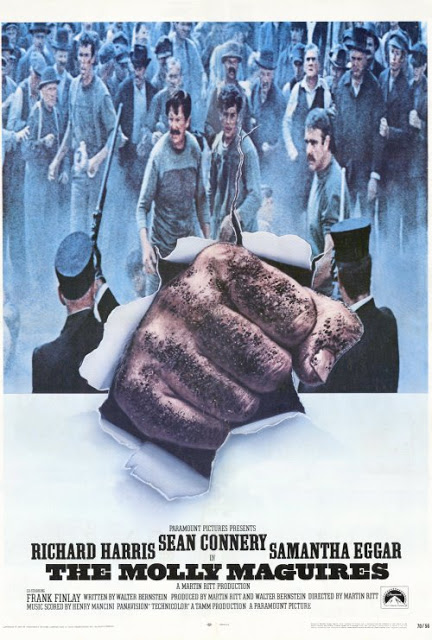
In 1876 a group of Irish immigrants form a secret society known as the Molly Maguires. Their aim is to retaliate against the cruel and unfair working conditions of the mining company that they work at by secretly sabotaging the company’s work site whenever they can. Police Lieutenant Davis (Frank Finley) hires undercover detective James McParland (Richard Harris) to infiltrate the group and find out who the culprits behind the vandalism are. He becomes friends with the group’s leader Jack Kehoe (Sean Connery) which puts into question whether he will turn them in or become a part of the protest.

The story is based on the real-life incident that occurred in 1876 in Reading, Pennsylvania and an actual James McParland who infiltrated a group of Mollies and brought them to justice after their actions ended the lives of several men. The term Molly Maguire comes from the name of an actual woman who lived in Ireland during the 1700’s and helped lead a revolt against rent collectors.

On the technical end the film is well done. The majority of it was shot in Eckley, Pennsylvania whose authentic buildings remained virtually unchanged from when they were built in the 1870’s making it easy for the filmmakers to recreate the period without much effort. The coal plant was built specifically for the film and still stands today, but what impressed me most was that director Martin Ritt allows the natural ambiance of the working conditions to permeate the soundtrack to the point that not a word of dialogue is spoken until 15 minutes in and Connery, who gets shown on and off, never speaks a word until the 40-minute mark.

Despite being made on a large budget of 11 million it managed to only recoup 2 million of its investment at the box office. Personally I feel this was a direct result of exposing the Harris character as an undercover agent right from the start. Usually movies try to keep this element a mystery, which then allows for a surprise reveal at the end, but here that gets ruined.

What’s worse is that the Harris character never changes in any way. He stoically sticks to his mission of turning the men in and betraying the trust that he had earned from them, which I found frustrating. As a viewer you start to bond with Connery and his men and connect to what they’re fighting against. Yes, they do commit crimes of vandalism, but for good reason as they were clearly being exploited by their corporate masters. You’d expect Harris to internally quarrel with this as he becomes friends with them, but he doesn’t and without any insight given to his background it becomes, despite the otherwise high production standards. off-putting and emotionally defeating to have to sit through.

Ritt later directed Norma Rae which dealt with the same subject of worker unions, but that film made unions the center point of the story. Here the union issue seems to be only a side element while Harris’ ongoing con game the main drama, which ultimately creates a nebulous point-of-view.  I walked away wondering what message if anything the film was trying to convey, which could be yet another reason why viewers never warmed up to it despite being otherwise well executed.

My Rating: 6 out of 10

Released: January 27, 1970

Runtime: 2 Hours 5 Minutes

Rated M

Director: Martin Ritt

Studio: Paramount

Available: DVD, Amazon Video, YouTube