Tag Archives: Maggie Smith

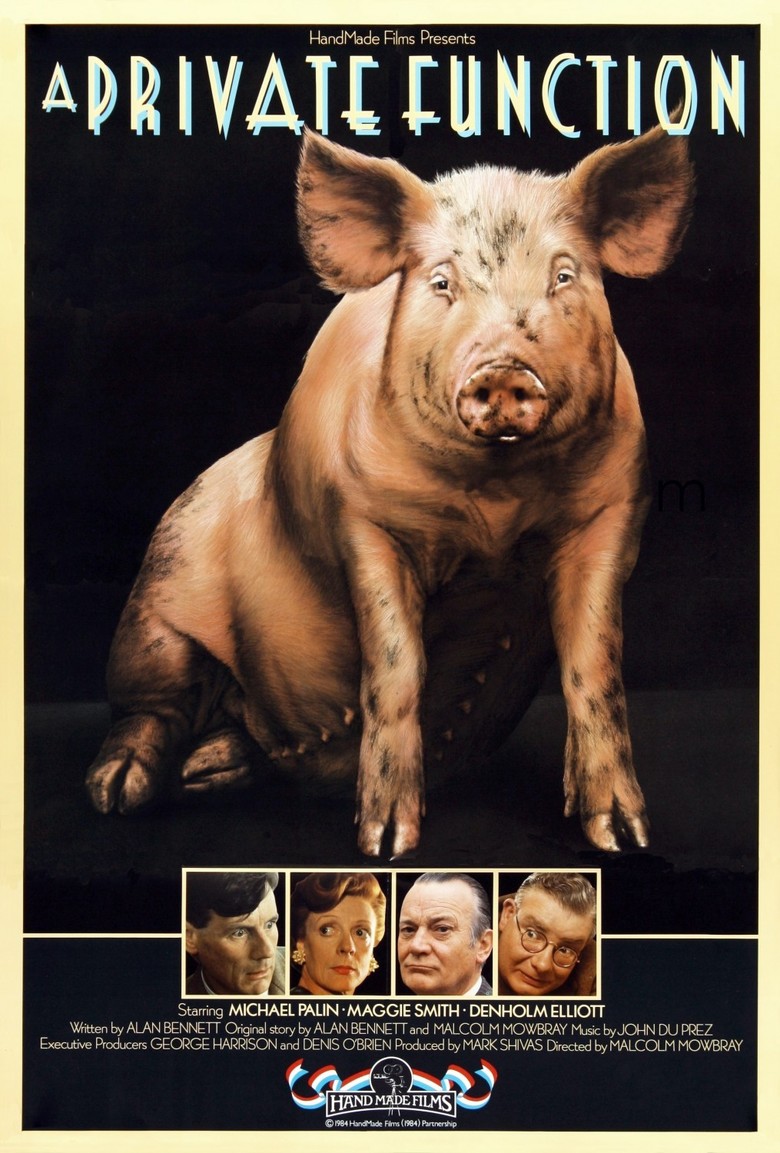
A Private Function (1984)

privatefunction

By Richard Winters

My Rating: 6 out of 10

4-Word Review: Couple hides a pig.

The year is 1947 and even though the war has been over for 2 years there’s still food rationing going on in this small England town. Gilbert (Michael Palin) works as a podiatrist and travels to residential homes where he cuts the toenails of the women who live there. During some of his visits he comes upon families who are hiding meat in their homes, and they must rush to cover-up any evidence of it when the local food inspector (John Normington) comes around to investigate. One such home has been illegally raising a pig in hopes to use it for a private party to celebrate the upcoming Royal Wedding between Princess Elizabeth and Prince Philip. Gilbert tells his wife Joyce (Maggie Smith) about it, and she convinces him to steal the pig, so that they can sell it off to the bacon black market but trying to hide a pig from both their neighbors as well as Joyce’s noisy elderly mother (Liz Smith) let alone being able to kill it proves quite challenging.

The film is a perfect mix of droll English humor and quirky moments. It starts out with a very original idea and manages to add one amusing moment, or sly comment, after the other becoming one of the better foreign comedies of the year where you can pick-up on funny little things that you might’ve missed on the first viewing, each time you watch it. Palin is especially good as a timid man who finds himself in the middle of chaos that he didn’t want and his unique profession along with the giant plastic foot that he orders to help represent his business are all on-target as are his engagingly consternated facial expressions.

Initially I thought Smith, a two-time Academy Award winner, was wasted here as she isn’t seen much during the first act and pushed mainly to the background making it seem almost like a token role that doesn’t have much pizazz, but she comes on strong by the end by having an interesting arch where she is just a passive, doting wife at first, but proves to be quite controlling, conniving and even demanding by the end. Liz Smith is equally engaging as the sometimes-confused aging mother ‘she’s 74’ whose dialogue is limited, but the few lines that she does say are doozies.

Spoiler Alert!

The pig though becomes the main star even though behind-the-scenes it made things quite difficult to film. This led to one 12-year-old boy getting his ‘big break’ into show business. When he heard that they were going to be making a movie in his area he proudly proclaimed that he’d be ‘willing to do anything’ in order to ‘get into the movies’ so the producer handed him a pail and told him to follow the pig around and collect its droppings every time it defecated and for this he got his name proudly billed during the final credits as ‘the bucket boy’.

As pigs go this one struck me as being quite small. Apparently, this was intentional as the filmmakers were advised by animal experts to choose a 6-month-old female pig as it was deemed, they’d be easier to control and less unpredictable, but visually she looked too scrawny and certainly not the type of pig to be used as the centerpiece for a giant feast such as the one that the townspeople were excitedly planning. It’s also a bit of a downer, even depressing, when the animal is eventually killed and served up on a platter. There’s a lot of close calls where the animal evades death and it makes it seem almost like the human captors were ultimately too afraid to do it, but when it does finally occur it hurts the film’s levity and makes it feel like murder when it does die and thus sucks all of the comedy that came before it right out.

The climactic party isn’t eventful either making the story go out with a whimper. It had been relatively lively up to then with all sorts of subtle twists and goofy turns only to end things on a dry note. There needed to be some sort of ultimate confrontation between the couple and the former owners of the pig, so things could’ve ended with more of a bang as it’s not quite able to hold-up feeling almost like it ran out of ideas with an uninspired conclusion.

My Rating: 6 out of 10

Released: November 9, 1984

Runtime: 1 Hour 32 Minutes

Rated R

Director: Malcolm Mowbray

Studio: HandMade Films

Available: DVD
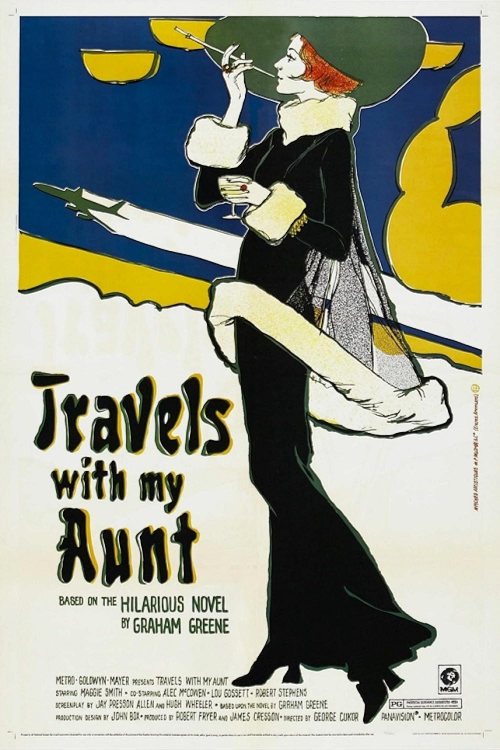
Travels With My aunt (1972)

travels1

By Richard Winters

My Rating: 4 out of 10

4-Word Review: Kooky lady cons nephew.

Henry (Alec McCowen) is a middle-aged bank manager who attends his mother’s cremation where he meets his kooky Aunt Augusta (Maggie Smith). She invites him over to her residence where he finds that she’s living with a black man named Wadsworth (Louis Gossett Jr.) who works as a fortune teller. It is here that she receives a package holding the severed finger of her longtime lover Visconti (Robert Stephens) and told that she must deliver $100,000 in ransom in order to see the rest of him alive. She convinces Henry to go with her to Paris to meet the kidnappers demands and in the process the two go on a wild jaunt across the globe that ends with them in North Africa.

The film is based on the novel of the same name by Graham Greene that was originally intended for Katherine Hepburn in the lead. Director George Cukor, whose career was winding down at this point, had worked with Kate in several projects from decades earlier and felt this role would be the right fit though she disagreed, but then decided that if she could rewrite the script, she’d consider doing it. Jay Presson Allen, who had done the original adaptation, which Hepburn didn’t like, gave full control over to her to rewrite it anyway she’d like, but ultimately the studio felt she was too old for the part especially since she was expected to play a younger version of the character during flashback sequences and they didn’t feel she at her advanced age could come effectively as someone in their early 20’s, so the part went to Smith instead.

Maggie to her credit is quite good and although she was only in her late 30’s really seems quite old during the sequences where the aunt is portrayed in the present. There’s even realistic wrinkles on her face especially around the cheekbones that gives the character the look of someone in their 70’s and 80’s. In the flashbacks she comes-off equally effective as a youthful free-spirit. Unfortunately her daffy character was for me a turn-off as she’s too much of an eccentric caricature that’s more obnoxious than amusing and building a whole film around her doesn’t work.

Henry is equally perplexing as I couldn’t understand why he’d believe this nutty lady when she tells him the mother he had always known wasn’t his biological one. For all he knew she was a goofball that shouldn’t be taken seriously unless she can supply more evidence, which she doesn’t. Most rational people would’ve kept her at an arm’s length instead of galivanting across the continent with her especially whom he had just met. In the book Henry is portrayed as being bored with his life and longing for adventure, but the film doesn’t make this clear, so his motivations and personality become muddled. Also in the book he was in early retirement, which would help explain why he had so much free time to go traveling, but the movie doesn’t bring this up either, so you wonder what he told his employer that would allow him to be off of work for so long and not get fired.

Having the Aunt and Henry bicker about, as their personalities were quite opposite, could’ve been fun, but this doesn’t get played-up. Too much time gets spent on this outlandish James Bond adventure that gets more ridiculous and unbelievable. The flashbacks bog down the pace and weren’t really needed and everything should’ve remained in the present day. The coin flip ending, in which Henry can’t decide what he wants to do moving forward, go back to his old life or continue on with his aunt, is a cop-out and only done because they couldn’t figure out how else to end it, so they do a freeze-frame of the coin in the air and the  let the viewer feel-in-the-blanks, which was far different than the novel. There Henry becomes a changed man who enjoys the excitement of getting involved in illegal activities, but because the film was not centered around him, which it should’ve been, we don’t witness any type of character arch making the whole thing quite trite and saved only by the brief appearance of Cindy Williams who plays a free-spirited hippie that he meets on a train.

My Rating: 4 out of 10

Released: December 17, 1972

Runtime: 1 Hour 49 Mintutes

Rated PG

Director: George Cukor

Studio: MGM

Available: DVD-R (Warner Archive)

The Prime of Miss Jean Brodie (1969)

prime1

By Richard Winters

My Rating: 8 out of 10

4-Word Review: Teacher influences her students.

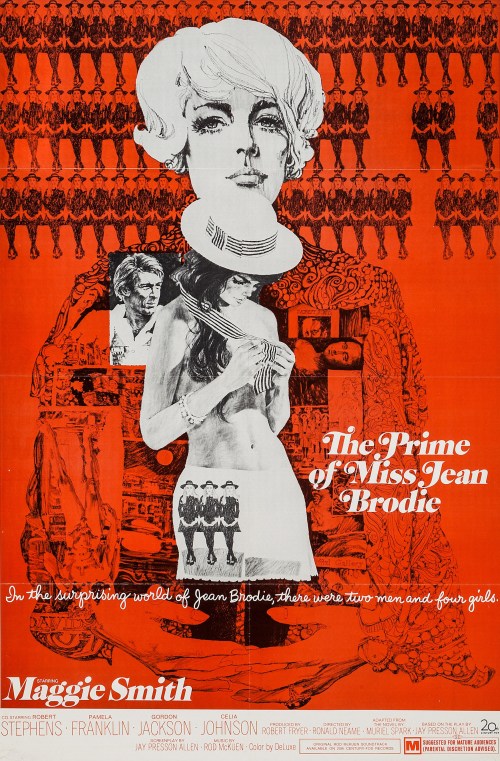
Jean Brodie (Maggie Smith) is a teacher at an all-girls school in Edinburgh, Scotland in 1932.  She routinely strays from the core curriculum and instead instills her own quirky value system, like her admiration for fascist dictators, onto her students. She views them as empty vessels there to be programmed to her liking as she routinely will say: “give me a girl at an impressionable age and she’s mine for life”. The school’s Headmistress, Miss Mackay (Celia Johnson) is aware of Brodie’s unorthodox teaching methods, but unable to do much about it, despite the repeated warnings that she gives to her, due to the fact that Brodie has tenure and been at the school longer than she. Sandy (Pamela Franklin) is one of Brodie’s students, who used to admire her teacher, but now has turned on her and comes up with a way to have her fired, which leads to a dramatic confrontation between the two.

One of the first things that struck me about the story, which is based on the play of the same name by Jay Presson Allen that was based on the novel by Muriel Spark that some feel was inspired by a teacher named Christina Kay who taught at James Gillispies School that Muriel went to as a child, is that it works against the grain of most films. In our individualistic culture the modern day movie centers around the rebel, or those that choose to work outside the system of an autocratic institution and the people that uphold those rules and enforce them are usually the villains. Here though it’s the stuffy authoritarians that ultimately become the makeshift heroes while the non-conformist gets exposed as a ‘loon’ that got too far off-base and needed a serious reeling-in.

It’s also the perfect study of someone who seeks control over others and cannot function in relationships were both sides are on equal footing. We see this not only with the way Jean openly humiliates her students by ridiculing them for even minor infractions like having their shirt sleeves rolled-up, but also in her maladjusted love life. Since she cannot have a healthy relationship with them as that would require selfless behavior from her, which she can’t give, so instead she emotionally manipulates two men (Robert Stephens, Gordon Jackson). She enjoys the attention they give her and gives them just enough incentive to keep on doing it, but never more than that. When the Jacskon character finally does get married to someone else, her sad expression isn’t about losing a person she loved, but more upset that she could no longer have this simp at her convenient disposal.

The recreation of the 1930’s girl school atmosphere was impeccable. Too many times I feel movies dealing with a bygone era don’t recreate it in an accurate way, or it gets viewed through a warped modern lens, but here I came away convinced it was accurate and this in large part could be credited to director Ronald Neame, who was alive when the story took place and therefore better able to feed-off his memory and experience. The scene where the girls all get up out of their seats and stand at attention the second the headmistress walks into the room is one of my favorite moments. To some degree it would be nice if kids today could show that kind of respect to an adult figure, but on the other hand it also reveals the dark side to extreme obedience to authority, which creates an atmosphere that allows someone like Jean to incorporate her will and beliefs onto the students without them ever questioning it.

In the end this is a terrific portrait of how teacher’s where viewed back in the day and the tremendous amount of influence they could hold over their pupils. There were no teen idols, singers, celebrities, or social media influencers back then, so the teacher was the center of most children’s lives sometimes even more so than their parents. While some things have changed the debate about what a teacher chooses to convey in the classroom and how far they should be allowed to stray from the core curriculum rages on today. No matter what side of that issue you may stand it just proves that this story is even more relevant now as it was back then.

My Rating: 8 out of 10

Released: February 24, 1969

Runtime: 1 Hour 56 Minutes

Rated M

Director: Ronald Neame

Studio: 20th Century Fox

Available: DVD/Blu-ray

California Suite (1978)

california suite

By Richard Winters

My Rating: 7 out of 10

4-Word Review: Visitors at a hotel.

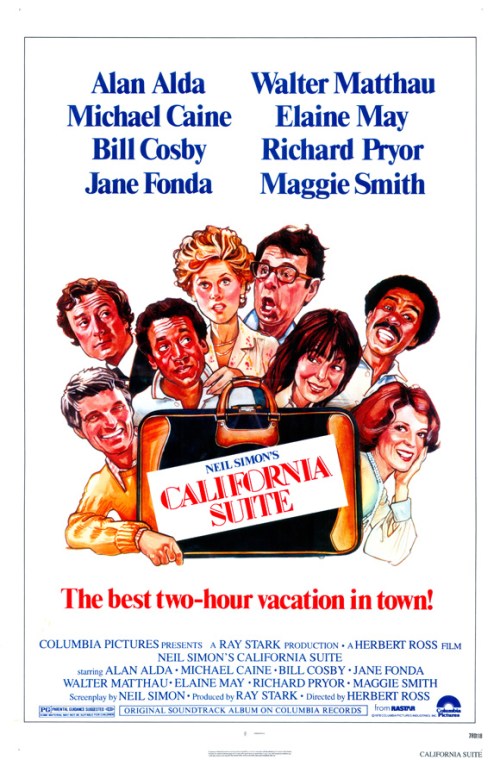
Based on the hit Neil Simon play, who also wrote the screenplay, the film follows five couples all staying at the same posh Beverly Hills hotel. Hannah and Bill (Jane Fonda, Alan Alda) are a divorced couple fighting over the custody of their teenage daughter (Dana Plato). Diana (Maggie Smith) is a famous British actress set to attend the Academy Awards ceremony and being escorted by Sidney (Michael Caine) a man she wants all for herself, but can’t because he is bisexual. Marvin (Walter Matthau) is in town to attend his nephew’s Bar Mitzvah and shocked to find that his brother (Herb Edelman) has sent a prostitute (Denise Galik) to his room to entertain him for the night only for her to promptly pass out drunk the next morning just as his wife (Elaine May) is about to arrive. The final segment deals with two bickering Dr’s (Bill Cosby, Richard Pryor) who can’t get along and seem to get themselves into one over-the-top calamity after another.

Many viewers have commented that they disliked the Fonda character as she came off as too cold and bitchy, but I’ve known many people who are like her who put up a very steely front in order to protect themselves emotionally, so for me her sarcasm worked and the way she delivered her acerbic lines is fun especially as she chews up the already transparent Alda character until it seems like he isn’t even there.

Smith and Caine’s segment seemed a bit trite and generic. The first part of it deals with her nervousness about attending the awards ceremony, which isn’t all that original. The second half examines her frustrations at the fact that Sidney can’t solely commit to her, but I couldn’t completely buy into this because she was playing a rich and famous, globe-trotting actress whom I’m sure could easily find another man if she wanted and didn’t have to cling to someone who didn’t fully want her like she were some lonely, small town housewife with no options.

The third segment dealing with Matthau and the unconscious prostitute is quite funny and had me laughing-out-loud while the scenes involving Cosby and Pryor’s constant arguing is incredibly dumb and even jarring as it features a lot of silly, slapstick humor that does not fit in with the more sophisticated tone of the rest of the film.

I was also not so crazy about the film’s pacing. The first hour deals almost exclusively with the dramatic segments while the second half focuses mainly on the comical ones, which came off as imbalanced. It would’ve worked better had the stories been evenly spread out in a rotating type fashion with a few minutes spent on each one before cutting to the next one. It would also have been cool had it taken a Slacker-like approach where the characters, who never once cross paths in this movie, would have instead passed by each other at certain points and the scene would then shift to the new characters that the other ones just passed.

I was also disappointed that we never get to see much of exterior of the hotel. We do see a bird’s eye view of it during the closing credits, but I thought shots of it should’ve been shown during the beginning. I have nothing against David Hockney’s artwork that does get used, but the hotel is a part of the film’s title and therefore should have taken precedence.

Overall though I felt it was a decent dramedy worth the price of admission. It also features a terrific and distinctive jazz score by Claude Bolling that I wish had been used even more throughout.

My Rating: 7 out of 10

Released: December 15, 1978

Runtime: 1Hour 42Minutes

Rated PG

Director: Herbert Ross

Studio: Columbia Pictures

Available: DVD, Amazon Instant Video, YouTube

The V.I.P.s (1963)

the vips2

By Richard Winters

My Rating: 3 out of 10

4-Word Review: Drama at the airport.

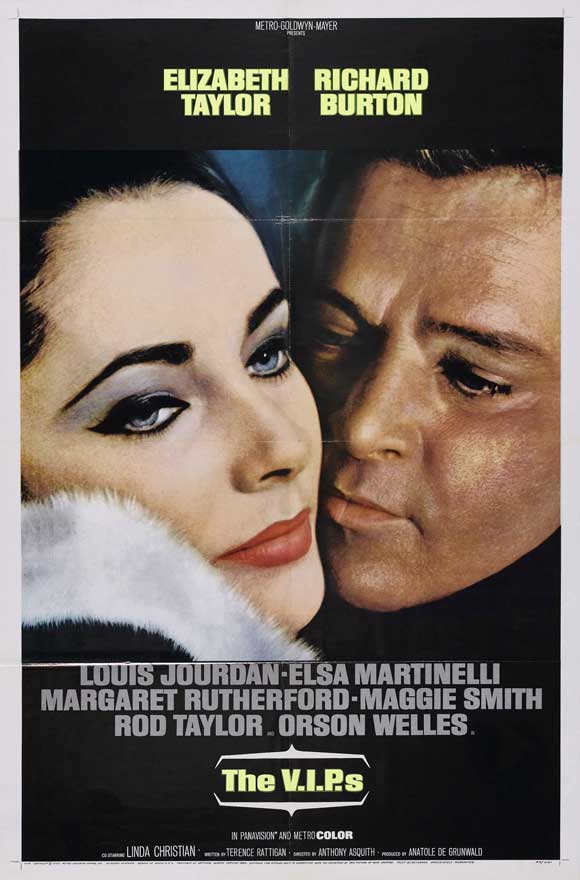
Several diverse characters come together at London’s Heathrow Airport. All have urgent needs that require them to board a certain flight that they hope will take off as soon as possible. Frances (Elizabeth Taylor) is the wife of rich tycoon Paul (Richard Burton) and is secretly having an affair with gambler/playboy Marc (Louis Jourdan). She has left him a ‘dear John’ letter at home and hopes to be well on her way to New York before he reads it. Les (Rod Taylor) is a businessman who also hopes to get to the Big Apple quickly to avoid the hostile takeover of his company. Max (Orson Welles) is a famous movie director traveling with his vapid starlet Gloria (Elsa Martinelli) and hoping to leave England before he is forced to pay an enormous tax penalty. Unfortunately for them a fog rolls in, which delays the flight and sends everyone’s plans into disarray.

The drama has some potential at the beginning, but the 2-hour runtime is much too long for this type of material. Whatever compelling elements the threads may have had when it started become lodged in endless talk and boredom. The scene where Burton smashes Liz’s hand against a mirror is the only time there is any action and Terence Rattigan’s soap opera script is too clichéd. Director Anthony Asquith’s direction shows no visual flair and fails to capture the airport in any type of interesting way. The background sets look like they were built on a soundstage and the fog effects are quite tacky.

Margaret Rutherford won the supporting Oscar for her portrayal of an aging Duchess. She adds some much needed humor particularly in the segment where she has difficulty getting her hat box into the plane’s luggage compartment. However, like with the story thread concerning the Orson Welles character she is seen to briefly and their scenes are spread so far apart that you almost forget all about them.

Spoiler Warning!

There is also another segment where a complete stranger played by actress Maggie Smith approaches the Burton character and asks him for a hundred and fifty three thousand pounds and he gives it to her in the form of a blank check, which had me floored. Men like him don’t become rich by handing out a lot of money to anyone who asks especially people they don’t know. Some may argue that because the character was considering suicide that he didn’t care anymore, but it still seemed too much of a stretch and for me sent this already stale drama into the realm of the absurd and ridiculous.

End of Spoiler Warning

Every story thread gets a nice, convenient happy ending that gives the whole thing a TV-sitcom quality and barely worth the effort to sit through. The production has some glossy aspects and certainly big-name stars, but ends up being a buildup to nothing.

the vips1

My Rating: 3 out of 10

Released: September 19, 1963

Runtime: 1Hour 59Minutes

Not Rated

Director: Anthony Asquith

Studio: MGM

Available: DVD, Amazon Instant Video

Love and Pain and the Whole Damn Thing (1973)

love and pain and the whole damn thing

By Richard Winters

My Rating: 6 out of 10

4-Word Review: Introverts fall in love.

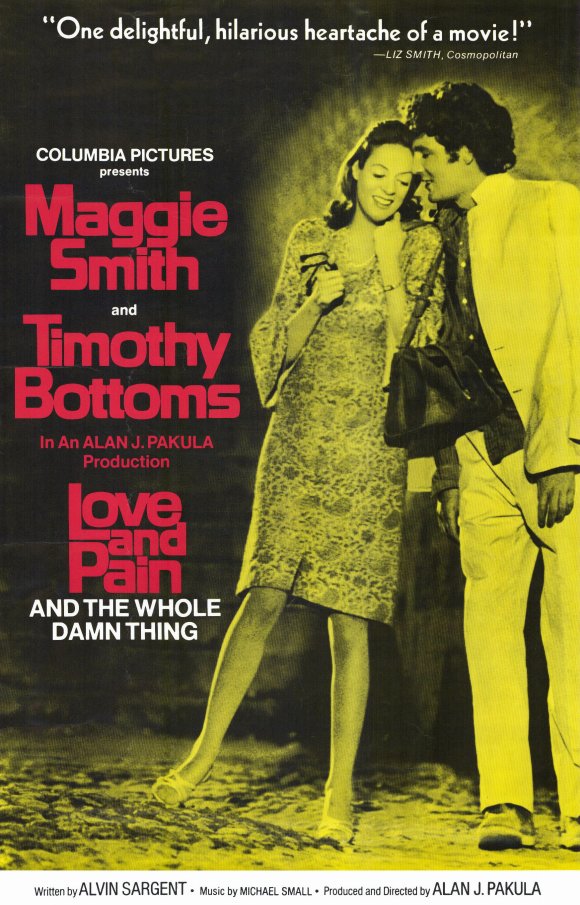
Walter (Timothy Bottoms) is a shy young man in his early 20’s riding through Spain as part of a cycling tour group. Impulsively he ditches this group and joins a bus touring one of which Lila (Maggie Smith) an equally shy woman in her 30’s is a part of. At first the two hardly speak, but eventually they get past their social quirks to form a tight, romantic bond.

The awkwardness and insecurities of the two characters is wonderfully captured and it is nice to see a film examine a romance between people that are not physically beautiful or affluent. The music score is subtle and Alan J. Pakula’s direction approaches the material in a nicely sensitive fashion along with the Spanish scenery that gives the production an exotic feel.

Smith is excellent as usual. Her performance and character is different from anything else that she has done making it a real treat to watch. The scene where she calls home to her family as well as the one where she gets locked inside a remote outhouse is quite amusing.

I would have liked to have seen a little more interaction with the other people on the bus as the supporting cast is almost non-existent and focuses too much on the two main characters making it seem like there are the only ones in the entire country of Spain, which gives the viewer a very isolated type of feeling. This may have been the intention and done as a way to show what it is like being introverted, but I didn’t care for it.

Although the two characters are offbeat the film follows too much of a romantic blueprint that eventually makes it formulaic despite a good start. Its biggest transgression is having one of the characters like in Love Story get afflicted with some mysterious illness that is never explained and put in to create cheap dramatic turmoil.

Overall though the film is okay and has a few touching moments. Those that enjoy romance may like it a bit better as well as fans of Maggie Smith.

My Rating: 6 out of 10

Released: April 19, 1973

Runtime: 1Hour 50Minutes

Rated R

Director: Alan J. Pakula

Studio: Columbia Pictures

Available: DVD