Tag Archives: Kris Kristofferson

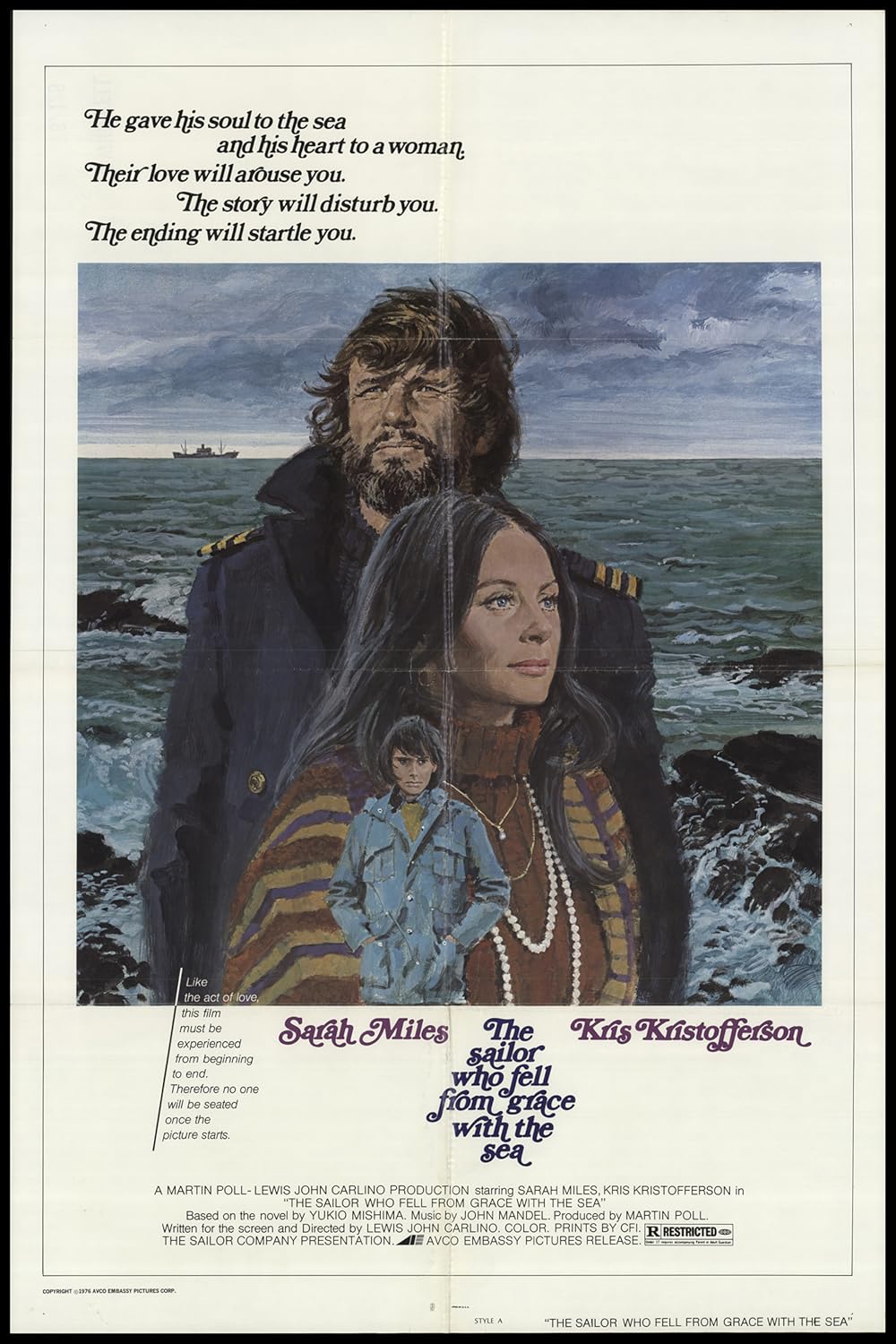
The Sailor Who Fell from Grace with the Sea (1976)

By Richard Winters

My Rating: 4 out of 10

4-Word Review: They dissect a cat.

Jonathan (Jonathan Kahn) is a 14-year-old who lives with his mother (Sarah Miles) and nanny Mrs. Palmer (Margo Cunningham) in a beachfront house along the sea after the death of his father three years earlier. Jonathan enjoys his friendship with a group of boys lead by Chief (Earl Rhodes), but his mother does not approve due to Chief’s anti-social sentiment forcing Jonathan to have to sneak out on the sly to see them. One day Jonathan finds a peep hole in his bedroom wall that allows him to see inside his mother’s bedroom, and he begins to peer in on her when she’s undressed, and this creates an unhealthy arousal. When his mother begins a relationship with a sailor named Jim (Kris Kristofferson) he becomes jealous and conveys as much to Chief who devises a sinister plan to ‘solve the problem’.

Lewis John Carlino had a highly respected career as a screenwriter garnering 4 Academy Award nominations for best screenplay, but his three forays as director weren’t as successful and all started out well but ended up just missing the mark. This one was no exception as many critics at the time felt the problem lay in adapting a novel, that was written by Yukio Mishima, which was set in Japan, and trying to convert it to English society. The cultures differences that make up the complex Japanese society that were so integral to the characters in the book gets completely lost in the translation leaving the viewer feeling cold, detached, and genuinely confused when it’s over.

The on-location shooting filmed in Dartmouth, Devon, England, is excellent and the one thing that helps the movie stand-out particularly the isolated hillside house that gives the atmosphere an almost surreal-like feel. There’s also a really creepy performance by Rhodes who nails it as a highly intellectualized kid who displays no moral compass and effectively comes-off as a very believable young sociopath. However, these moments gets coupled with some very disturbing ones dealing with animal cruelty which includes a very drawn-out scene involving the killing and dissecting of a cat as well as putting a firecracker in a seagull’s mouth and while no animal was actually harmed during the production it still left many audiences at the time upset and will very likely do the same with viewers today.

The film’s biggest flaw though is that it doesn’t interpret the character’s actions in any way that helps makes sense of their motivations and for the most part they’re all quite two-dimensional. Jonathan’s arousal at seeing his naked mother needs much better explaining. Most kids aren’t this way, so what is it about his psyche that causes him to enjoy it without any guilt or shame? The movie gives us no clue, nor does it explain how his father died and when you add in the boy’s weird behavior and you start to wonder if the Jonathan maybe had something to do with it, which would’ve opened an interesting subtext if even brought up subtlety, but the script fails to touch on it.

The book makes the reasons for the son’s actions clearer. For instance in the novel the boy losses respect for the sailor when he sees him jump into a water fountain, which he considers to be undignified and the movie really needed to have some similar moment as the kid, like in the book, is initially in awe of the man, but it’s never totally clear what creates the deadly shift. Also, when the son is caught peeping in at his mom the response by his mother in the book is different as she feels the boy should receive a severe punishment, but the sailor, in hopes of becoming ‘friends’ with the kid whom he’s now helping to raise, resists, but the film flubs this scene too by treating it almost like a forgettable throwaway moment that has no impact versus one that would’ve helped reveal the sailor in a more in depth way.

Spoiler Alert!

The ending, which should’ve been a shocker, falls flat as well. In the novel it’s made clear that the boys plan to drug and dissect the sailor just like they did with the cat and they even bring along the tools to do it, in the movie we only witness him drinking the spiked tea. The camera then zooms way out showing the boys at an extreme distance where it’s not obvious what they’re doing. To really make a memorable impression we should’ve seen the boys stab the sailor several times with their knives, which would’ve been far more startling. I felt too there needed to be a reaction from the mother. Does she find out what they did, or does his violent demise remain a mystery? How does her relationship with her son evolve, or devolve afterwards? These questions remain unanswered making the movie seem less like a story and more as a concept that’s never adequately fleshed out.
My Rating: 4 out of 10

Released: April 5, 1976

Runtime: 1 Hour 45 Minutes

Rated R

Director: Lewis John Carlino

Studio: AVCO Embassy Pictures

Available: DVD, Blu-ray, Amazon Video, Plex, Roku Channel, Tubi, YouTube
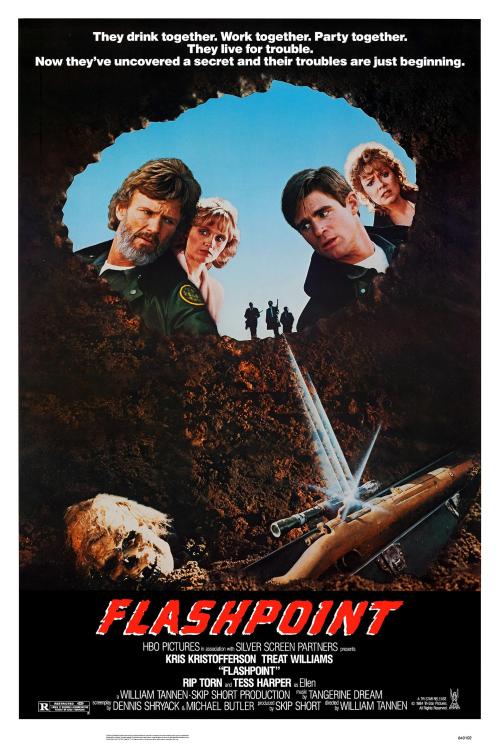
Flashpoint (1984)

flashpoint

By Richard Winters

My Rating: 4 out of 10

4-Word Review: Digging up hidden money.

Bobby (Kris Kristofferson) and Ernie (Treat Williams) are border patrol agents who stumble upon a jeep buried in the sand. Once Bobby digs it up he finds a skeleton in the driver’s seat, a scoped rifle, and $800,000 inside a rusted toolbox. Both of them are unhappy in their jobs and Bobby thinks this would be the perfect time to skip town with the loot, but Ernie thinks it’s stolen money and needs to be investigated. Since the bills are all marked with the dates of 1962 and 1963 they presume this is around the time when the bank robbery, which is where they think the deceased driver got the money from, occurred, but upon an old newspaper research at their local library they can find no such robbery happening in the amount that they recovered. Soon they face more problems when a federal man named Carson (Kurtwood Smith) takes over the agency they work at and exerts extreme control over everything they do. Bobby feels Carson is somehow aware of the money they found and knows more about the driver’s identity than he lets on. While Bobby and Ernie hide the money they find Carson and his team of secret agents hot on their path as he sends them on dangerous missions in an attempt to kill them, so they won’t let on to anyone else about what they’ve found.

This is another example where an intriguing story idea, based on the novel of the same name by George LaFountaine, almost gets ruined by lackluster direction. The mystery is interesting enough to keep you invested but there are definite lulls and cheesy side stories that seem to be challenging the viewer to turn it off before it’s over. This was also another case where the setting is supposedly Texas, which gets mentioned quite a bit, and yet it was all filmed in and around Tucson, Arizona, which is a travesty especially since the deserts of Arizona and Texas have noticeably different characteristics. I also felt that if you’re going to have a story based in the desert you should then have the time period during the summer, instead of the winter like here, where the scorching heat could be used as an added element.

Kristofferson isn’t particularly well cast here in a part that was originally intended for Paul Newman. His laid-back style of acting isn’t riveting enough though I’ll give him props for the scene where he gets shot and must crawl several yards in the dirt with one arm that he can’t move due to it being paralyzed by the bullet, which looks quite arduous to do though he does it effectively and realistically. Williams is by far the superior actor and his distinct personality where he’s the idealist, plays-off well from Kristofferson’s more jaded mindset. You even get a full view of Treat’s bare ass, which comes near the beginning and while nobody necessarily asked for it and wasn’t needed to propel the plot some may enjoy it and as male asses go it’s not too shabby.

Rip Torn, whose hair is dyed gray, does well in support where his strong Texas drawl works nicely in the supposedly Texas setting. While he’s only seen sporadically during the first two acts, to the point where I started to wonder why he even bothered to take the role as it seemed miniscule and pointless, he does come on strong during the finale. Kurtwood Smith though is dull, which isn’t exactly his fault as the part is written too much like caricature, and every successful movie needs an interesting and memorable villain, which this one clearly isn’t.

While the action is fleeting it does have one good stunt, which features Treat trying to prevent a plane, which they think holds drugs, from taking-off by reaching in through the window of the cockpit and forcing the pilot to land it. It had me holding by breath, but it got ridiculous when the plane crashes and explodes, but Treat gets saved when he supposedly jumps off and into a lake, but you don’t see this occur and the other men all presume he went down with the plane only to have Treat jump out of the water intact, but if he had dived into the pool then the water would’ve had a ripple effect from where he went in instead of it being calm and placid like it is.

Spoiler Alert!

The twist at the end in where the money and driver of the jeep are connected to the assassination of John F. Kennedy is cool though it leaves more questions than answers. Of course that might’ve been the intention, but still I feel this is a good enough story idea that it should be revisited with a better director and hopefully one day someone talented will decide to remake it in a way that’s more intriguing than what we get here.

My Rating: 4 out of 10

Released: August 31, 1984

Runtime: 1 Hour 33 Minutes

Rated R

Director: William Tannen

Studio: TriStar Pictures

Available: DVD-R

Vigilante Force (1976)

vigilante1

By Richard Winters

My Rating: 4 out of 10

4-Word Review: Veteran takes over town.

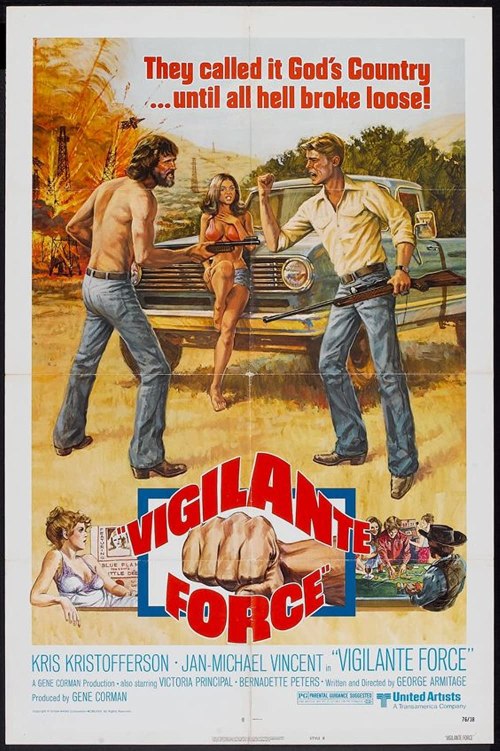
After oil is found near a small California desert town many people, including oil workers, move in looking for work. All the new people coming in causes a great deal of  crime in the community and the local police force is too small to handle the influx. Ben (Jan-Michael Vincent), a longtime resident, decides to hire his brother Aaron (Kris Kristofferson), a veteran of the Vietnam War, to help act as a peacekeeper. Aaron then brings along some mercenaries to assist him, but he and his new associates begin acting more like the bullies forcing everyone to submit to their ways of doing things, or face the consequences. This causes Ben to come to the painful realization that his brother is more of a problem than the solution and forcing him to take matters into his own hands in order to rid the town of him.

This was the third film directed by George Armitage, who did Private Duty Nurses and Hit Man before this one and all three being produced within the Roger Corman family, this one by Roger’s older brother Gene, who approached George about the project having only the title in mind and no actual story. Armitage, who had only 30-days to film, decided to make it an allegory of the Vietnam War where a group of strangers would come into a town, much like the American soldiers did when they came upon a small village in Vietnam, and take it over while focusing on the helpless nature of the residents who could do seemingly little about it.

While the concept had lots of potential the execution is rushed making the story come-off as cluttered and unfocused. It’s one of the few films made where there’s violence and action immediately before there’s barely any onscreen credits, but the motivations of why it’s happening is not clear, so it’s more confusing than exciting.  The plot doesn’t make much sense. Why are these new people all resorting to criminal behavior including robbing a bank? Other towns that boast job opportunities don’t necessarily have a  dramatic spike in crime especially if the new people coming in are actually getting employed, which the film intimates they are, so then why the anger and chaos? It seemed to me that there needed to be some sort of crime boss behind it, but there really isn’t. There’s a certain figurehead shown briefly later on, but he seems to be more of a symptom of the crime that’s already had been occurring versus the main orchestrator.

The setting also has a strong country feel with men folk walking around and behaving like blue collar cowboys making Texas a better location for the town than California. Even if for budget reasons is still had to be done in Cali I would’ve at least made it seem like it was the Lone Star state, which is considered a ‘rebel’, redneck state to begin with and thus making the behavior of the townspeople seem a little more organic.

I loved Kristofferson whose laid-back demeanor comes-off as creepy and menacing, but I would’ve liked his dark side to have been played down more at the beginning. The viewer should’ve been roped-in into believing he was a good guy, or hero, and then had the big reveal in the third act that he really wasn’t versus it being obvious right from the start that there was something not right about him.

Bernadette Peters, who plays his on-again, off-again girlfriend, is a delight, but Vincent is not as good. He’s unable to equal Kristofferson’s screen presence and way too naïve. It’s obvious to everyone his brother is trouble, but he remains oblivious for too long making him seem dumb and then when he finally does catch-on he comments that he was aware of his brother’s ‘problematic side’ ever since they were kids, but if that were the case then why did he hire him in the first place?

If you like basic 70’s action, including car chases, fist fights, and explosions, then this may suffice even with the wobbly story. Anyone though expecting anything more will most assuredly walk away disappointed as the script lacks nuance and surprise.

My Rating: 4 out of 10

Released: September 9, 1976

Runtime: 1 Hour 29 Minutes

Rated PG

Director: George Armitage

Studio: United Artists

Available: DVD-R (MGM Limited Edition Collection), Blu-ray

Cisco Pike (1971)

By Richard Winters

My Rating: 8 out of 10

4-Word Review: Blackmailed into dealing drugs.

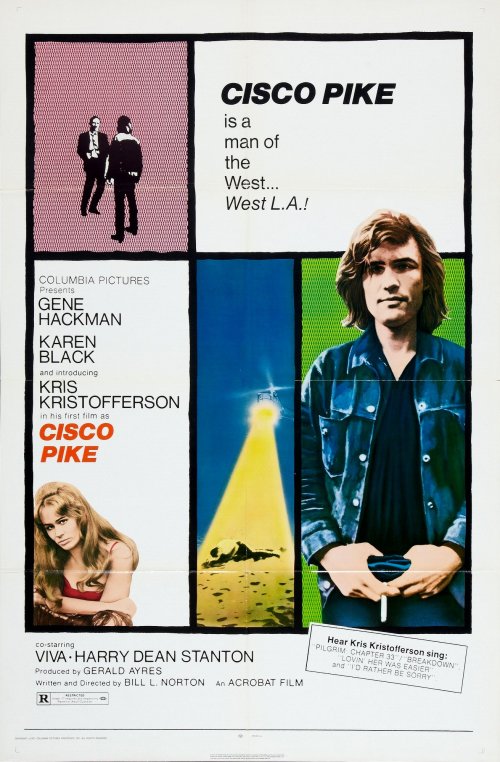
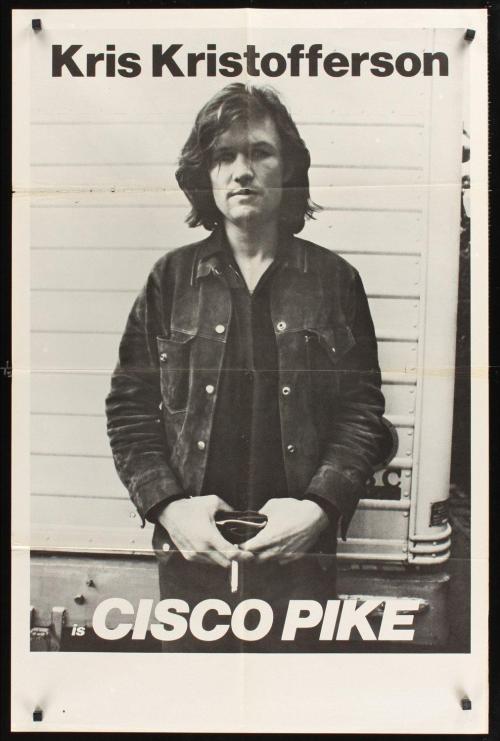
Cisco Pike (Kris Kristofferson) is a down-on-his-luck singer who once was playing to sell-out crowds, but finds his popularity declining and resorting to selling drugs to maintain a living, but under pressure from his girlfriend Sue (Karen Black) has stopped. Leo Holland (Gene Hackman) is a police detective looking to retire and needing enough money to do so. He steals a sizeable quantity of high-grade marijuana from a gang leader and then tells Cisco he must sell it within 59 hours while giving Leo $10,000 of the profits and Cisco can keep anything that he makes beyond that. At first Cisco resists knowing it will interfere with his relationship with Sue, but eventually gives in when Leo threatens to kill him unless he complies.

While this film has achieved a cult status in recent years critics at the time of its release were not kind. Many felt it promoted drug use just as the nation was starting its war on drugs, which caused the film to get a limited release and eventually bombed at the box office. Personally I found it to be a riveting look at the drug dealing culture and a fabulous directorial/screenwriting debut for Bill L. Norton the son of William W. Norton who was also a successful screenwriter.

What I liked most was the cinema vertite style that made it seem almost like a documentary. I enjoyed the camera following Cisco around in a non-stagy way and revealing the variety of people that he sold to with not all of them being hippies either, but also middle-aged suburbanites and even business executives. The film nicely shows how some of the encounters would be non-eventful while others could ended up being a trap and eventual police chase. The unpredictable quality of the transactions replicated the anxiety the dealers would face and how hyper observant they needed to be to the immediate environment around them.

Many films try to recreate things that the filmmakers themselves haven’t gone through, but here I got the feeling that the director and much of the cast had experienced the same situations as the characters which in-turn makes the viewer feel, when it’s over, that they’ve lived it too. The dialogue is excellent as well with a conversational style that doesn’t overexplain things and allows the viewer to read in a bit to what the characters are saying.

Kristofferson, who had been a singer up to that point, makes an outstanding acting debut and all the more impressive when you realize that he had no acting training before he was given the part. Many of his friends advised him not to take the role fearing his lack of experience would hurt the movie and cause him not to be given any more roles, but after reading the script he felt he could relate to the character by simply being honest with his emotions, which he does splendidly and it’s nice too seeing him in a rare appearance without any beard or mustache.

Hackman is excellent as well playing a character that was not in the original treatment, but added in later by Robert Towne when he wrote the revision. It’s unusual seeing him in such a relatively small part with large chunks of time, especially during the second act, where he’s not seen at all, but when he is onscreen he’s effective. It was fortunate that this was filmed just before he won the Academy Award for The French Connection as that turned him into leading man material and it’s unlikely that he would’ve accepted this part had it been produced any later.

Black is interesting, she usually always is, despite, like with Hackman, not having all that much screen time, but she makes the most of what she has particularly her physical reactions to Hackman when he invites himself into her apartment late at night and begins rambling on about his heart condition. Honorable mention too needs to go to Joy Bang, an attractive supporting actress during the early 70’s who later retired from show business to get into nursing. Her toothy smile always looks sexy, at least to me, and I loved when she gives her female companion, played by Viva, an open-mouth kiss while riding in a car and then turns around and gives Kristofferson, who is sitting on her other side, the same treatment.

Harry Dean Stanton, as an aging musician, doesn’t appear until near the end, but has some of the movie’s most profound moments particularly his exchange with Kristofferson were he laments about no longer being sexy enough for the stage while Kristofferson reminds him that it’s not his body that the music business wants, but his soul instead.

My Rating: 8 out of 10

Released: November 2, 1971

Runtime: 1 Hour 35 Minutes

Rated R

Director: Bill L. Norton

Studio: Columbia Pictures

Available: DVD

A Star is Born (1976)

By Richard Winters

My Rating: 4 out of 10

4-Word Review: His career goes downhill.

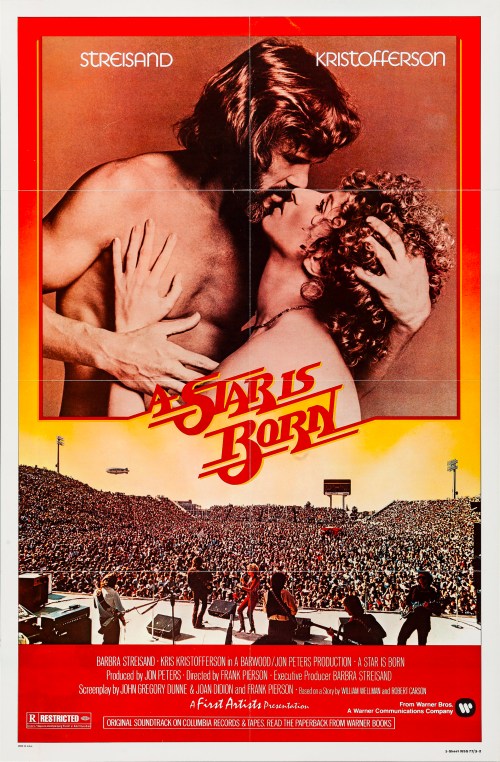
John Norman Howard (Kris Kristofferson) is a famous rock singer who’s found that his career on the road has taken its toll. He’s become jaded by the money and fame and now bored with it while spending his days and nights committing self-destructive acts that alienate the rest of his crew. One night after walking off the stage of his own concert after singing only a few songs he goes to a bar where he sees Esther (Barbra Streisand) singing on stage. He becomes impressed by her talent and uses his resources to make her a star. The two eventually get married, but as her career continues to rise his goes in decline.

This is the third remake of the story that was originally written by William A. Wellman and Robert Carson. The first version came out in 1937 and starred Frederic March and Janet Gaynor while the second one was released in 1954 and starred James Mason and Judy Garland. This version differs from the other two in that the setting was the music scene instead of the movie business, but overall the efforts here to revitalize the tired formula are trite and predictable.

A lot of the blame can go to Streisand who acted as both the star and producer to the project. For one thing she was too old for the part as she was already in her mid-30’s when this was filmed and wearing a tacky afro hairstyle to boot. It would’ve been more effective had a truly young person, like a woman who was 19, which is a typical age for someone to have dreams of breaking into the rock scene, was cast. Possibly having the character start out as one of Kristofferson’s groupies, instead of doing it like it’s done here where he just meets her at random at a bar, which is awkward and forced, and then through their time together he learns of her aspirations and talents and works to help her meet her potential.

It also would’ve helped had the young starlet had the same singing style as Kristofferson, which would’ve made the concert scene where he walks off stage and brings Esther onto it more believable. Kristofferson’s music, or what little we hear of it, has clearly a more hard rock edge while Streisand sings mellow love songs. In the movie we’re supposed to believe that all these fans who paid good money to see Kristofferson sing are suddenly without warning given Streisand instead and are so taken aback by her talent that they all clap and cheer when in reality I think they would’ve been upset and demanding their money back as they came to hear hard rock and not the lite stuff.

I enjoyed Kristofferson’s performance and his impulsive self-destructive acts give the film energy and edge. However, the chemistry between the two is non-existent and he later said that working with Streisand was “an experience which may of cured me of the movies.” His decline gets handled in a rushed, heavy-handed way. Music careers are by their very nature cyclical. Rock stars get replaced with every generation as teens prefer their own singing idols and not those of their parents. For him to become so quickly devastated when his record sales begin to plummet is unrealistic as nobody stays on top forever. He should have enough money to wade out the career lulls and simply held on to when his fans grew up and became nostalgic and then hit the retro tour circuit like many of the pop/rock icons from the past do.

Streisand’s character is flat, one-dimensional, and just plain too-good-to-be-true. She’s well known in real-life for her notorious ego, in fact director Frank Pierson described her as being egocentric, manipulative, and controlling and refused to ever work with her again, so having her then portray someone who is gracious and humble seems very phony and not something that she’s effectively able to convey. The original concept was to have the character be like Janis Joplin and go through a self-destructive decline of her own, but Streisand nixed this idea, which is unfortunate as it would’ve given the film some needed nuance.

The footage of the massive crowds at the concerts is the one element that I found impressive and the segment showing the vast stretch of land that Kristofferson owned in the middle of the Arizona desert was pretty cool too. Everything else though in this otherwise overlong film is boring. Fans of Streisand’s singing may take to it better, but there’s too much of it, making it seem like this was just one big vanity project for her and nothing more.

My Rating: 4 out of 10

Released: December 17, 1976

Runtime: 2 Hours 20 Minutes

Rated R

Director: Frank Pierson

Studio: Warner Brothers

Available: DVD-R (Warner Archive),  Blu-ray, Amazon Video, YouTube

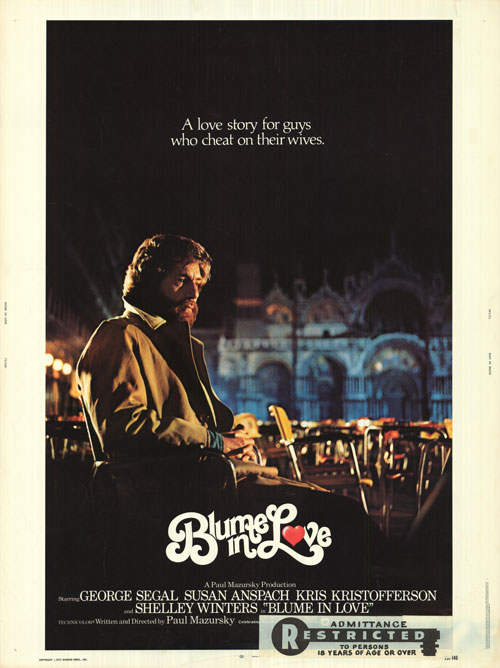
Blume in Love (1973)

By Richard Winters

My Rating: 4 out of 10

4-Word Review: Cheating husband seeks reconciliation.

Stephen Blume (George Segal) is a successful divorce lawyer who suddenly finds himself stuck in a break-up of his own when his wife (Susan Anspach) catches him cheating with his secretary and then leaves him. Now Blume becomes obsessed with winning her back and even starts up a friendship with her new live-in lover (Kris Kristofferson), but as his frustrations boil over he begins to react in violent ways when he can’t get what he wants.

Director Paul Mazursky delivers another insightful look at love and marriage and how the two aren’t always compatible. The narrative works in a fragmented style where clips of the different stages of the relationship are shown at various times and allows the viewer to see the many changes the two go through particularly with our protagonist whose internal flaws are ingloriously displayed for all to see. Normally this could prove a turn-off, but Segal manages to keep the character painfully human enough to be engaging most of the way even though he eventually overstays his welcome.

Mazursky gives the proceedings an artsy, cinema vertite flair especially with the way he captures St. Mark’s Square in Venice and by creating an offbeat romance that is filled with caustic humor. I also enjoyed the supporting cast including Marsha Mason as Blume’s new girlfriend who has a strong bit when she tearfully admits that she will ashamedly remain with Blume even after he acknowledges to her that he thinks only about his wife when the two make love.

Donald F. Muhich is fun as the psychiatrist. He was Mazursky’s real-life analyst and got paid back by being cast in four of his movies. His facial expressions and responses to his patients are so spot-on that it makes you feel like you’re attending an actual patient-doctor session.

Even Kristofferson does well in a part that takes advantage of his laid-back acting style though his character’s friendship with Blume gets overplayed. I felt even the most easy going of people would’ve drawn some boundaries and never have tolerated an ex-husband being around as much as he was. The scene where he finally does punch Blume, which should’ve come a lot sooner, gets totally botched because it has Kristofferson breaking down into a teary-eyed wail right afterwards for no apparent reason.

The film’s biggest flaw though is its manufactured happy ending that makes no sense. Blume was clearly too selfish and immature to have a healthy relationship with anyone and the fact that Anspach decides to accept him back even after he forcibly rapes her is absurd. Both characters were in need of some major psychological counseling and not each other. The fact that the film for the majority of its runtime plays like an anti-love story only to end up throwing in a clichéd wrap-up like all the other formulaic romances makes it a sell-out and a waste of time for the viewer looking for something intelligent and different only to find out that it really isn’t.

My Rating: 4 out of 10

Released: June 17, 1973

Runtime: 1 Hour 55 Minutes

Rated R

Director: Paul Mazursky

Studio: Warner Brothers

Available: DVD, Amazon Video

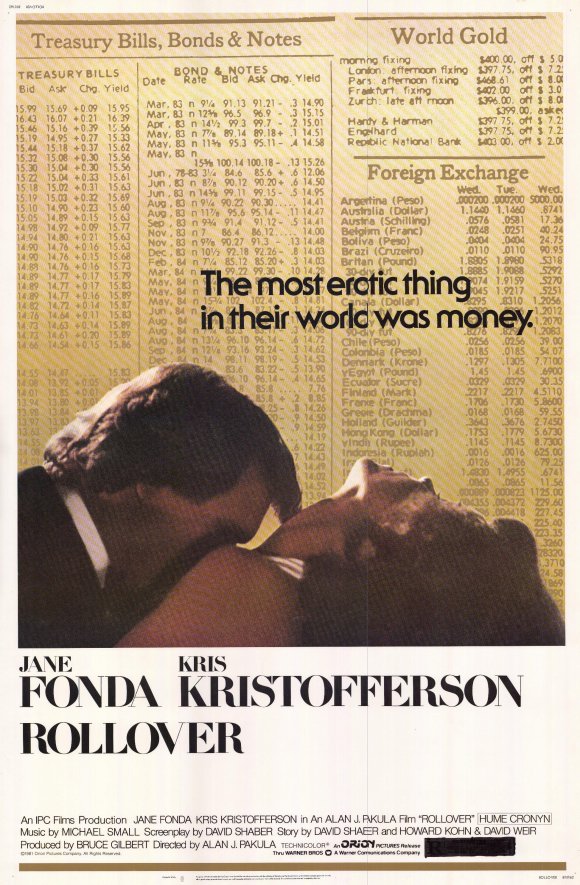
Rollover (1981)

rollover 1

By Richard Winters

My Rating: 3 out of 10

4-Word Review: What’s in account 21214?

Hubbell Smith (Kris Kristofferson) is the newly appointed president of Borough National a bank that is in desperate need of money. He meets Lee Winters (Jane Fonda) the recent widow of the former chairman of Winterchem Enterprises who is looking to obtain a loan in order to purchase a Spanish processing plant. Hubbell broker’s the $500 million deal with some Arab investors and uses the finder’s fee portion to keep his bank solvent, but suspicions are raised when the money goes into a secret account named 21214 that no one knows anything about and can’t access. When Hubbell does some investigating he finds troubling answers that could lead to economic world collapse.

Director Alan J. Pakula approaches this thing like it is another Klute using not only the same star as that one, but similar type of music. Some of the camera work is dazzling and artsy, but I wondered if this was done to help enhance the script, or simply camouflage all of its holes. The story itself is too talky with a heavy reliance of financial business dealings that could become confusing for the average viewer. The two main characters are rather generic and their passionate making-out is tedious instead of sexy. The action is minimal, which includes a scene where Fonda gets trapped in a limo that is driven by a bad guy that had the potential for being exciting, but unfortunately gets underplayed.

Kristofferson with his Texas drawl is an awfully odd casting choice for a hot shot Wall Street businessman. He grows on you as the movie progresses particularly with the way he remains cool and detached even as his business dealings go horribly awry, but I still felt there were a hundred other actors that would have been better suited for the role.

Fonda is excellent and in many ways badly outplays her costar. Her character though doesn’t make a lot of sense as she is supposedly this famous and highly respected actress, much like Fonda herself and yet wants to be chairwoman of this chemical company instead of just selling her share of the stock after the death of husband and go back to acting, which to me would seem a lot more fun.

In an effort to keep the plot moving the film takes a few liberties with the plausibility. One of the major ones is when Hubbell wants to find out about the secret account and does so by breaking into the office of his superior where he finds in his desk drawer a notebook that lists the computer passcode, which seemed too convenient. In reality I would think a programmer would have to be hired in order to hack the system, which would have taken longer to play out, but also if done right heighten the tension as well as the believability.

Spoiler Warning!!

The film’s biggest transgression is the ending itself, which has the Arabs pulling the money out of the secret fund, which causes mass worldwide economic turmoil and chaos. Not only does this seem to create a whole new movie, but it also minimizes the two main characters and everything that we watched them do for the past two hours. A much better ending would have had the characters come up with some way to avert the collapse instead of the gloomy pessimistic way that it does take, which seems overblown and hard to believe.

End of Spoiler Warning!

My Rating: 3 out of 10

Released: December 11, 1981

Runtime: 1Hour 56Minutes

Rated R

Director: Alan J. Pakula

Studio: Warner Brothers

Available: VHS, DVD, YouTube, Amazon Instant Video