Tag Archives: John Lithgow

Blow Out (1981)

blowout2

By Richard Winters

My Rating: 5 out of 10

4-Word Review: He hears a murder.

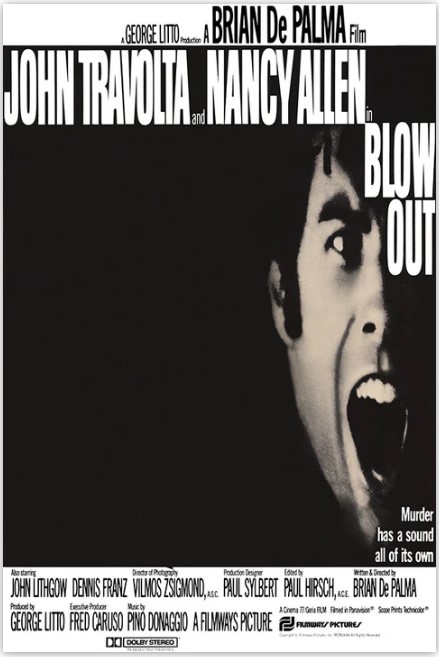
Jack (John Travolta) works as a sound effects technician for a film studio that specializes in low budget horror movies. He gets instructed by his producer Sam (Peter Boyden) to come-up with a more realistic sounding scream, as well as other audio noises, for the most recent exploitation production that they’ve been working-on. Jack then goes out one night to capture the necessary noises, but while doing so witnesses a car drive-off the road and into a nearby river. He immediately jumps into the water and saves a passenger named Sally (Nancy Allen), who had been sitting in the backseat, but he’s unable to get to the driver. Later it’s revealed that the driver was a candidate running for governor and Sally was his escort and pressure is put on Jack by the campaign officials not to reveal this to the press. Jack also comes to the realization, while going back and listening to what he had recorded, that the car going to into the river was no accident as he had initially thought, but instead it had been caused by a gunshot from an undisclosed assassin who intentionally shot at the tire so the vehicle would swerve-off the road, but when Jack goes to the authorities about this they don’t believe him.

The film is noted for having been heavily inspired by the Michaelangelo Antonioni’s classic Blow-up, which came-out 15 years earlier and focused on a photographer who inadvertently witnesses a killing via a picture he takes, while this one is on what the protagonist hears. This could also be considered quite similar to The Conversation, a masterpiece that was released in 1974 and dealt with a sound expert that gets in over-his-head with a criminal underground. Both of those films though were better than this one, which has some flashy camera work, but little else.

I did like Travolta. This was the first film where he becomes essentially an adult and no longer stuck in that quasi-age of a post teen growing into manhood and needing to prove himself. Here we get the bona fide thing and the character’s cynical nature about his job and being stuck in an industry that he doesn’t really respect, or all that excited about, is a refreshing change-of-pace from his more wide-eyed, idealistic roles of the past. The behind-the-scenes look at the movie business, including all the posters from actual horror films that line the walls of the studio hallways, and the wannabe starlets dying to break-in even if it meant just letting-out a simple voice-over scream in order to be a part of the cast, I enjoyed and helps add an authentic ambience to what it would be like working in that type of culture.

The character development, or if you could even call it that, is incredibly weak. Nancy Allen is especially annoying not so much for anything she does, she actually puts-on an effective Brooklyn accent, but more for her cliched character. Portraying a prostitute as a blank-eyed, dim-witted simpleton, who still has a ‘heart-of-gold’, is about as overused as it gets making it a laughable caricature and succeeding at causing one long eye roll every time she appears and opens her mouth. The gangsters and police officials are equally contrived though Dennis Franz plays his role, as the corrupt low-life pimp, with such amusing gusto that I was willing to forgive his scenes, and was even entertained by them, but found the rest of the supporting cast to be wasted and transparent.

There are also a few too many plot holes. For instance, the assassin, played by Jon Lithgow, sneaks into an auto repair shop late at night, to remove the tire from the car that had been retrieved from the river, so no one would find out that it had a bullet hole, but wouldn’t the police have thought about looking for that already? The fact that they don’t seems shockingly shoddy as the first thing to investigate after any accident is the cause and not immediately removing the tire and sending it away to a lab for further analysis seems beyond incompetent. Some may argue that the police were paid-off to look the other way and were a part of the ‘cover-up’, but if that were the case then they would’ve still removed the tire, knowing that it was crucial evidence, and then just conveniently ‘lost it’ versus leaving it on the vehicle in some unguarded repair shop that anyone could walk into.

Having Travolta drive his jeep through a parade and nearly kill hundreds of people in the process and then crash into a storefront window where pedestrians come to his aid and call for an ambulance seemed questionable as well. Maybe it was a more innocent era, but I would’ve thought those same people would’ve beaten the crap out of him when they caught-up versus helping him as they would’ve presumed, he had plowed into the parade intentionally and therefor deserved some rough ‘street justice’ for having put so many lives at risk.

Revealing who the killer was in the second act and the reasons for why he did it ruined the suspense and would’ve been more intriguing had the viewer only figured out his identity right when the protagonists do, which comes near the end of the third act. I also thought his killing of other prostitutes who looked similar to Allen, in order to create this fictional serial killer known as the “Liberty Bell Killer, were rather fake. For one thing if a bad guy is intent on killing somebody and stalking them, they come prepared with their own weapons and not hope to inadvertently pick-up some sharp object along the way like he does here. The scene inside a public restroom where he stands over the toilet stall wall in order to strangle his would-be victim who’s standing on the other side and the woman does not sense someone hoovering over her, she looks around, but doesn’t bother to look-up, is baffling since his body was blocking the overhead light and his shadow would’ve tipped her off that there was someone above.

Spoiler Alert!

The biggest head-scratcher gets saved for the end where Travolta essentially gives-up on pursuing the bad guys, even after Allen is murdered, and goes back to his ordinary life as a sound man though in a more guilt-ridden state. The explanation for this is that when Lithgow throws the film of the assassination into the lake along with the audio tape that means the evidence was ‘gone forever’, but it really wasn’t. He had made a copy of the audio tape already and the film was from motion picture stills he had obtained from a tabloid magazine, so all he had to do was buy another copy of the magazine, resync the pics up with his audio tape copy, and his evidence to take to the authorities would be as good as new.

My Rating: 5 out of 10

Released: July 24, 1981

Runtime: 1 Hour 48 Minutes

Rated R

Director: Brian De Palma

Studio: Filmways Pictures

Available: DVD, Blu-ray (Criterion Collection), Amazon Video, YouTube, Pluto TV, Tubi
Rich Kids (1979)

richkids

By Richard Winters

My Rating: 5 out of 10

4-Word Review: Dealing with divorcing parents.

Franny (Trini Alvarado) is a 12-year-old who’s learning that her two parents (Jon Lithgow, Kathryn Walker) are getting a divorce. She is unhappy about this and thus turns to her friend Jamie (Jeremy Levy) whose parents also went through a divorce a couple of years earlier. He gives her guidance and tips on how to deal with it. She turns to him as a confidant and begins spending time with him at his place even overnights. Her parents are under the impression that Jamie’s father (Terry Kiser) is keeping a watchful eye on them, but in reality he’s over at his new girlfriend’s pad and not paying the least bit of attention to what the kids are doing who then get into all sorts of mischief including alcohol. Once Franny’s parents do catch-on and head over there along with Jamie’s mother and her new husband (Roberta Maxwell, Paul Dooley) they fear it may be too late especially after Franny’s mother finds the book ‘The Joy of Sex’ that her daughter had hidden away and been reading.

On the surface this film, which was produced by Robert Altman, should’ve been a winner and on the technical end it does everything right.  The color schemes and docu-drama approach gives it a vivid day-in-the-life vibe and captures growing up on the Upper West Side neighborhood quite well to the extent that you feel like you’ve visited the area yourself once the film is over. The acting, particularly Alvarado in her film debut, is terrific though kudos must also go to Lithgow and Walker whose portrayal of fraught parents trying to shield their child from life’s ugly realities while also still attempting to be upfront and honest with her is well done. Director Robert M. Young shows a good eye for detail and keeps things visually interesting particularly when they go to Jamie’s dad’s place and interact with the exotic pets he has and make goofy faces with his bedroom full of wall mirrors on every side, which I felt was the movie’s highlight.

Story-wise there are a few profound moments and everything that occurs rings true, but in the process it’s not particularly riveting either. I sat through the whole thing expecting at some point to be grabbed in and it just never occurred. Part of the issue is that it takes too much of a minimalistic approach. So much effort is put in to keeping it realistic that nothing every stands-out. It’s like one of those 70’s after school specials that gets stretched out to 2-hours length, but could’ve easily said what it wanted to in only half that time. It’s all pleasantly done, but ultimately rather meh.

I didn’t like the sex difference of the two kids as it made me cringe all the way through fearing that even at age 12 things might start to get a little kinky like they’d play a game of ‘doctor’, or get drunk, which they kind of do, and dare each other to take their clothes off. It seemed at that age children still like playing with members of their own sex and are quite clicky about it and don’t really begin to reach out to the other side until maybe 14 or 15, so it would’ve been more believable if Jaimie had been a girl instead of a boy.

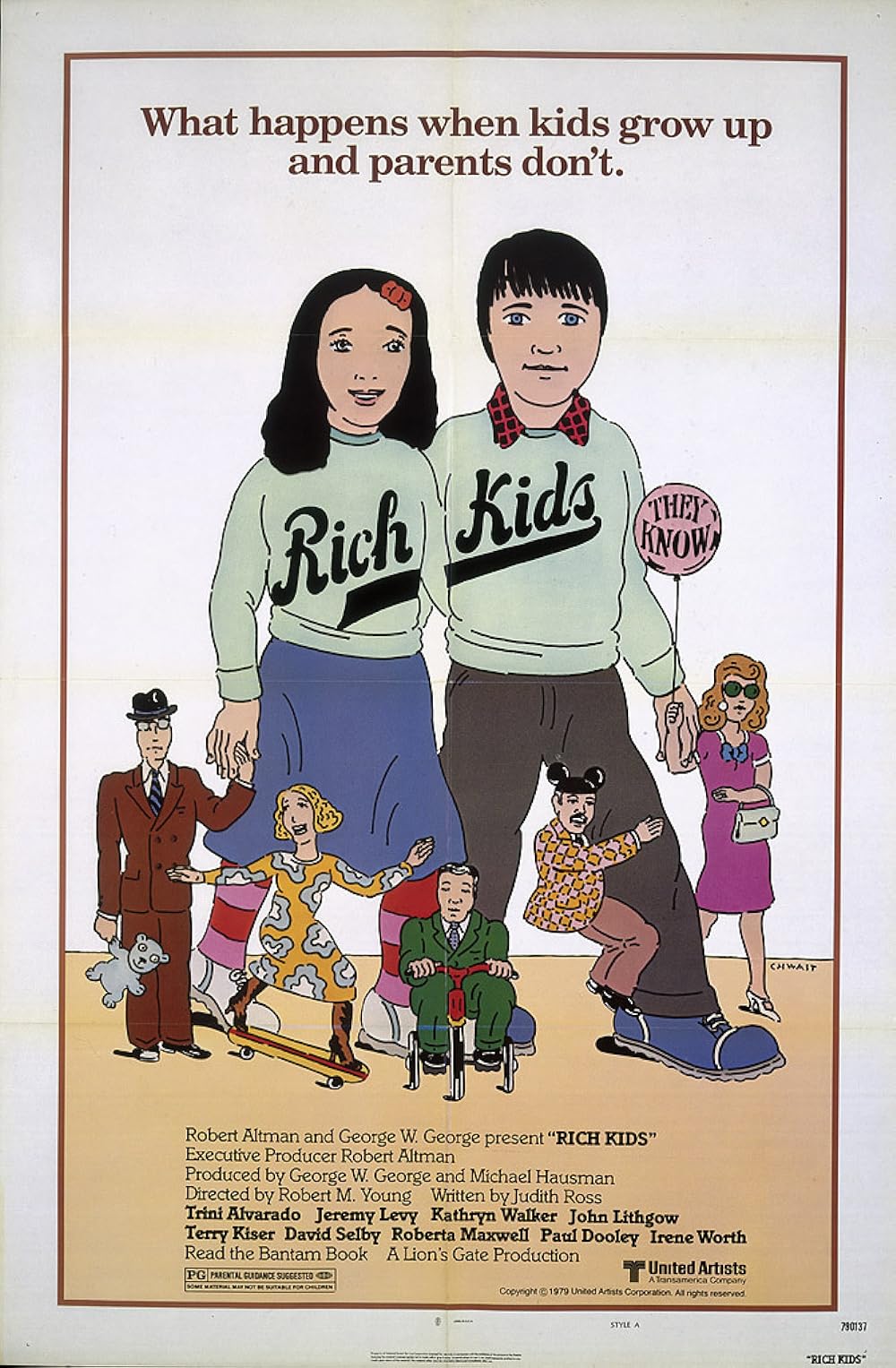
The title is a bit confusing as these really aren’t wealthy families sure they aren’t poor, but there’s nothing about their lifestyles or home life that isn’t of the middle-class variety making it misleading to have the word ‘rich’ in there. The promotional poster is awful too as the drawings don’t look anything like the real stars and depicts the two leads like they’re dorky looking, which they really aren’t. It also gives one the impression this might be an animated feature, which it certainly isn’t. Actual picks of the two stars would’ve been better especially since Alvarado has such expressive blue eyes, photogenic face, and wonderfully natural smile that one shouldn’t pass-up the opportunity to have her sweat face plastered on the promotional materials whenever possible.

My Rating: 5 out of 10

Released: August 17, 1979

Runtime: 1 Hour 41 Minutes

Rated PG

Director: Robert M. Young

Studio: United Artists

Available: DVD

Obsession (1976)

By Richard Winters

My Rating: 3 out of 10

4-Word Review: She resembles his wife.

Michael Courtland (Cliff Robertson) is a wealthy land developer living in New Orleans whose wife Elizabeth (Genevieve Bujold) and daughter (Wanda Blackman) become victims of a kidnapping and die during the police shoot-out. Michael becomes tortured with guilt feeling he should’ve done more to save them. 16 years after the crime was committed he meets a woman (also played by Bujold) who looks strikingly like his former wife. He becomes infatuated with her and the two eventually marry only for him to find that she holds a deep, dark secret.

This film marks yet another attempt by director Brian De Palma to emulate his idol Alfred Hitchcock with a film loaded with fancy camera work, but not much else. For the most part, at least visually, it’s tolerable and not quite as overdone as De Palma’s other Hitchcock imitations. To some degree the camera work and soft focus lens is the most entertaining thing about it although having the camera go back and forth from one talking head to another during a scene where Robertson and co-start John Lithgow have a conversation at a restaurant becomes unnecessarily dizzying.

The casting of Robertson is a problem as he’s unable to convey the demands of the part effectively as his constant staring at Bujold becomes creepy and unnatural and he’s obviously way older than any of his costars. They should’ve at least hired an actor his same age as his business partner as Lithgow was 26 years younger than him and it shows. For the most part Lithgow isn’t too good here either as he wears a wig and speaks in an over-the-top bayou accent, which borders on being annoying and it makes him come off as slimy and creepy right from the start.

Bujold on the other hand gives an excellent performance that rises far above the trite material, but she looks too young as a wife to Robertson during the flashback scenes. Turning around and having her also play a 10-year-old girl during some brief sequences comes off as awkward.

The story, which was based on a script by Paul Schrader, but highly truncated by De Palma is full of loopholes. I thought it was unbelievable that the crooks didn’t spot this green police van with a very odd looking antenna on top of it, which was needed to track the honing device that was put into the briefcase with the supposed ransom money that the crooks retrieved, that was following them around at a much too close distance. I thought it was equally unbelievable that the crooks would not have immediately opened the briefcase the minute they retrieved it and made sure there really was money inside it instead of driving all the way back to their hideout before opening it while naively trusting that there was no chance that they might’ve been duped.

There’s also not enough of a visual transition during the 16 year time period that the story takes place in. Except for a few extra white hairs Robertson’s appearance remains virtually the same while the commercial boat that he rides on to deliver the ransom remains exactly the same as does the deserted dock that he throws the briefcase onto even though after such an extended period of time both things most likely would’ve changed or evolved in some way.

Spoiler Alert!

The twist ending where we learn that Michael’s new wife is really just his grown daughter who he had thought had died during the kidnapping does nothing but produce even more loopholes. Supposedly she died with her mother when the car they were in burst into flames and went into the river and supposedly the police tried to recover the vehicle, but found it to be too difficult, so they gave up, but in reality I don’t think this would’ve occurred. After some setbacks they would’ve kept trying until they were able to retrieve it as they knew the approximate spot where the vehicle went in and a river is not an ocean, so it shouldn’t have been that hard anyways.

In order to avoid the controversy of promoting a film with an incest story line the producers decided to reedit the marriage sequence to make it look like it had been a dream, but this ends up just bringing up even more questions. Like how is Bujold able to get into Robertson’s dreams and continue her scheme by telling him he must prove himself all over again by putting a briefcase of $500,000 of his money back onto the same dock he had done 16 years earlier?

The final shot, which is done in slow motion and features Robertson and Bujold reuniting at an airport, is by far one of the corniest things ever put on celluloid and will surely cause most viewers to either roll their eyes or breakout into laughter.

End of Spoiler Alert!

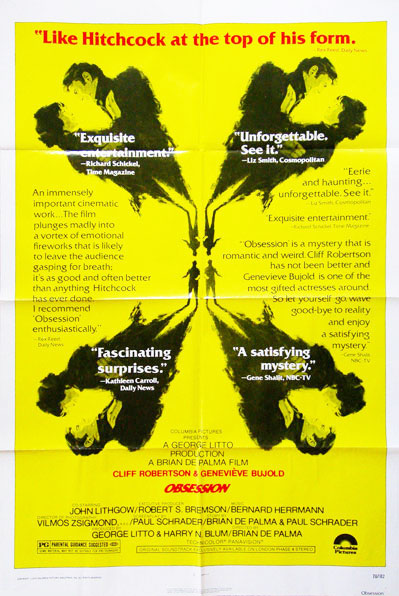
The funniest thing though about this so-so film is probably just Rex Reed’s overly fawning review of it, which gets printed on the promotional poster seen above. In it he calls this movie ‘an immensely important cinematic piece of work’, but how is that as it’s just a tacky Hitchcock rip-off with no message to it at all? He also calls it ‘better than anything Hitchcock has ever done’, which just isn’t true. I know Reed has gotten criticized in recent years for many valid reasons including his fat shaming of Melissa McCarthy, but his career should’ve ended after writing this over-the-top glowing take of a film, which ultimately is nothing more than a third-rate mystery with fancy camera work, as it makes him look like he was a hack paid by the studio to write a puff piece about the movie simply to help promote it.

My Rating: 3 out of 10

Released: August 1, 1976

Runtime: 1 Hour 38 Minutes

Rated PG

Director: Brian De Palma

Studio: Columbia Pictures

Available: DVD, YouTube

Footloose (1984)

By Richard Winters

My Rating: 3 out of 10

4-Word Review: A town bans dancing.

Ren (Kevin Bacon) is a teenager from Chicago who moves with his mother (Francis Lee McCain) to a small town in Utah where he finds that dancing has been banned by the town’s fiery minister (John Lithgow). He becomes determined to try and change that and convinces the other kids including his new found friend Willard (Chris Penn) that dancing really isn’t all that bad. He also falls for the minister’s daughter Ariel (Lori Singer) who is far more liberated than you’d expect someone from a religious upbringing to be.

I remember when this film came out and I intentionally refused to see it as I felt that the plot was too absurd to be believable. I was born and raised in a small Midwestern town of about 7,000 people and the idea that some lone minister could overtake it and start making extreme rules that everyone would follow especially in the modern era of the 80’s is just not realistic. If the town was really small and isolated with a population of like 200 then maybe but the one portrayed in the film comes off as being fairly big and was filmed mostly in American Fork, Utah, which in the 1980 census had a population of 13,606. Having a scene dealing with a literal book burning makes the thing even campier and made me believe this would’ve worked better had the setting been the 1950’s.

There is also no explanation to what the penalty would be if one is caught dancing. Everyone acts like it would mean jail time or something like that when most likely it would just be a small fine and since when have teens ever been that compliant when it comes to rules? There are several scenes where they are seen with joints, so if they’re willing to fudge the law in that respect then why not do it with the dancing too?

The concept is loosely based on an actual incident that occurred in Elmore City, Oklahoma in 1978 where the local teens challenged a city ordinance that banned dancing. However, the incident there made more sense because it was an ordinance that had been on the books for over 90 years. Many cities and towns have old ordinances and laws that are no longer relevant, or followed, but just haven’t been officially removed as opposed to some minister coming into a town and implementing a new law that everyone is forced to comply with. The town was also much smaller (population of only 653 in 1970) than the one portrayed in the movie, so religious sentiment would be more able to oppress the rest of its citizens.

The drama for the most part is limp and does not justify its runtime as there are long segments that have nothing to do with the main story including cringe worthy scenes where we watch Singer dangerously trying to leap between two moving cars and a game of chicken between tractors with Bacon and another teen driving them. There’s also a B-storyline dealing with Bacon trying to teach Penn how to dance, which gets corny.

The most annoying aspect though for me was Singer’s character as she doesn’t seem like a minister’s kid at all. She behaves in too much of a free-spirited way and I would think someone raised in such a repressed environment would reflect some religious traits and yet Singer conveys none. Having her religious at the start and even opposed to dancing and then become tolerant to it after she meets Bacon would’ve created an interesting character arch. Also, if she behaved in a cult-like manner due to her strict upbringing then it would’ve made the minister character more menacing because the viewer would be made to feel that was what he wanted to turn the rest of the town into.

Lithgow is a great actor, but he’s not right for this type of part as he is too young and was only 12 years older than Singer who played his daughter. A much older actor would’ve better illustrated how the older generation was desperately trying to cling onto their old way of life in an ever changing world and how completely detached they were from modern teens. Also, the character here doesn’t seem threatening enough as he is unable to control his own daughter so then how is he expected to control the rest of the town?

The opening bit done over the credits showing the different types of dancing feet is the best thing in the movie although some may take a liking to Bacon’s dancing inside an abandoned warehouse although much of that was done with the help of body doubles.  Otherwise this empty-headed movie, which was remade in 2011, has very little to recommend.

I did want to mention too that recently there was an 80’s podcast that I listened to where they reviewed this movie and one of the critics complained that the town had only white kids and acted like somehow that was not politically correct, but having grown up in a small town during the 70’s and 80’s I can vouch for the fact that there were little if any minorities there and therefore having an all-white cast, whether it is politically correct or not, was realistic.

My Rating: 3 out of 10

Released: February 17, 1984

Runtime: 1Hour 47Minutes

Rated PG

Director: Herbert Ross

Studio: Paramount

Available: DVD, Blu-ray, Amazon Video, YouTube

The Adventures of Buckaroo Banzai Across the 8th Dimension (1984)

adventures of buckaro banzai 1

By Richard Winters

My Rating: 5 out of 10

4-Word Review: This thing is weird.

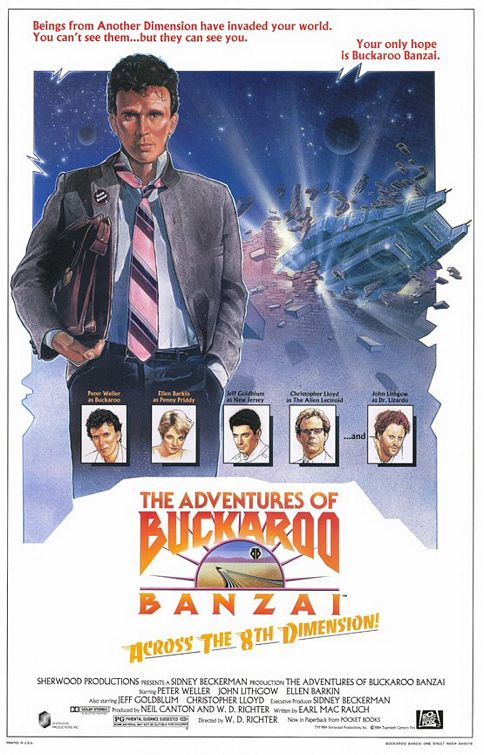
Buckaroo Banzai (Peter Weller) is part-time rock band singer who has invented a mechanism that he calls the oscillation overthruster that allows him to travel through rocks and other solid matter. He is somehow able to do this by tapping into the realms of the 8th dimension, but upon doing so he also attracts the attention of some aliens lead by Lord John Whorfin (Jon Lithgow) who wants to steal the device and use it for their own nefarious needs. Buckaroo, who is able to recognize these aliens who otherwise look human to everyone else after being zapped by some electronic component through a telephone receiver by a group of other aliens, gets a group of fellow geeks together to help fight the evil Whorfin and his men before it is too late.

In a lot of ways this film is a refreshing change-of-pace and it is not surprising that it has attained such a strong cult following. Most films with such an offbeat concept end up selling out and becoming quite formulaic and conventional with only a few odd elements thrown in for good measure, but this movie is completely weird in all facets and truly lives up to its campy over-the-top title. I loved the off-the-wall banter, ridiculously silly, but still quite entertaining special effects and characters that are uniformly warped. The comic book look is great and the story gets increasingly more absurd as it goes along. You have to tune out your logic and conventional movie mode to get into this and enjoy it, but the humor and chuckles are there if you let it.

Unfortunately the pace as well as the beginning become a bit too off. I found things to be completely confusing at the start that I really couldn’t understand what was going on for the whole first half-hour. The film seemed to jump from one outlandish scene and character to the next without any cohesion and the result was quite off-putting. It wasn’t until about 45 minutes in that I was able to finally get into the groove with it, but more of a background to the characters and a set-up would have helped greatly. There are still enough memorably unique moments to make it worth it including my favorite the Banzai Team March, which was filmed at the Sepulveda Dam in the San Fernando Valley and shown over the closing credits.

Weller is in fine form in the lead and seems much more at ease with this role than he was in Robocop where he came off as being miscast. Lithgow is a hoot as an over-the-top villain speaking with a heavy Russian/German accent. I also enjoyed Matt Clark as the Secretary of Defense who acts as if he is above all rules of protocol until finally being put into his place by a little kid with a rifle.

The closing credits listed a follow-up title that was supposedly going to be a sequel that unfortunately was never made due to the film’s production company going out of business, which is a shame as this thing had strong potential of becoming a major franchise. W.D. Richter who has an impressive screenwriting resume does well in his directorial debut and it’s an equal shame that he only helmed one other movie at this point as he shows potential to being uniquely talented in that position.

My Rating: 5 out of 10

Released: August 10, 1984

Runtime: 1Hour 43Minutes

Rated PG

Director: W.D. Richter

Studio: 20th Century Fox

Available: VHS, DVD, Amazon Instant Video

Dealing: or the Berkeley-to-Boston Forty-Brick Lost-Bag Blues (1972)

dealing

By Richard Winters

My Rating: 5 out of 10

4-Word Review: Drugs are a trip.

This review was originally slated to post in February, but due to the death on Christmas Eve of Charles Durning I decided to post it now. Durning was one of the all-time great character actors who always brought an amazing amount of energy to every role he played and could do a wide variety of character types well. Although he has very few lines of dialogue in this movie he still manages to become the most interesting part of the proceedings and helps enliven an otherwise slow moving film.

The plot, based on a novel by Michael Crichton, pertains to Peter (Robert F. Lyons) who is a recent Harvard graduate hired by John (John Lithgow) to transport a suitcase full of marijuana from Boston to Berkeley, California. Peter is new at this and things do not go as planned, but he meets beautiful Susan (Barbara Hershey) along the way and the two fall in love. John next hires Susan to transport another suitcase of narcotics, but when she loses the luggage at the airport and then tries to go back and get it she is arrested by corrupt cop Murphy (Durning) who resells some of the recovered stash back out onto the street. In order to get Susan out of jail Peter plays an elaborate game of cat-and-mouse with the cop, which culminates in a violent showdown.

The story is done in a laid-back style similar to the approach taken by many European films. The emphasis is on mood and subtle nuance yet when the Europeans do it this style seems refreshing, but here it is more off-putting. I really had a hard time getting into it as the first hour is slow with too many scenes going on longer than it should. The set-up is too quick and there is not enough background, or history shown to the main character.

The second hour improves. Durning gives the proceedings some pizazz and Peter’s scheming is fun. The shootout done in the snow has flair and style.

The music by Michael Small is impressive. It is one of the most original scores I have heard and really fits the mood of the script. The best is over the opening credits.

Hershey is as always gorgeous and fans may like that she is shown topless. The part of a free-spirited hippy chick seems to be her forte and she excels. However, having her fall for a guy that is rather dull and ordinary didn’t make sense. Sure they make love right away, but I thought that was more just because it was a part of her lifestyle and she does after all go around in a dress without wearing any underwear. She just seemed to be diving into the free love atmosphere of the era. Obviously having Peter fall for her made sense because she is hot, but why would she go head-over-heels for this schmuck when there are so many other guys that would be more than willing to do it with her. The romantic angle was forced and hurt the credibility of the story.

Lithgow is okay in his film debut, but I had problems with the character. One minute he is cool, conniving, brash, and arrogant and then in the next instant he becomes scared, confused, and meek, which was too much of a quick transition.

The under-rated Lyons is excellent and makes for a terrific lead especially with this type of part. Despite being in his 30’s he looks and acts very much like a college kid from that period. His performance is nicely understated and believable throughout.

The on-location shooting in Boston is vivid and people from the area may like to view this just to see how much it has changed. The DVD transfer from Warner Archive is excellent with a nice clarity and vivid colors. The movie itself is slick, but it also has a detachment to it that doesn’t allow the viewer to get as connected with the characters, or the situations like they should and thus making it an interesting period artifact, but nothing more.

Also, Demond Wilson can be seen briefly as one of the drug dealers. He did this just before his signature role of Lamont in the hit TV-series ‘Sandford and Son’. Ellen Barber is real cute as Peter’s girlfriend and so is Joy Bang who later became a registered nurse. Normally I don’t like women with buck teeth, but with her it actually looks sexy.

My Rating: 5 out of 10

Released: February 25, 1972

Runtime: 1Hour 28Minutes

Rated R

Director: Paul Williams

Studio: Warner Brothers

Available: DVD (Warner Archive)