Tag Archives: Joe Eszterhas

Checking Out (1989)

checking2

By Richard Winters

My Rating: 4 out of 10

4-Word Review: Man becomes a hypochondriac.

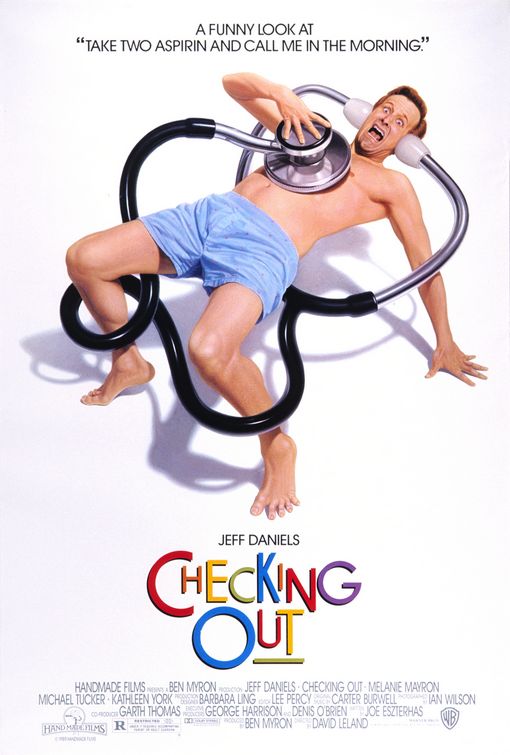
Ray (Jeff Daniels) is a middle-aged father who suddenly experiences deep concerns about his health when his boss (Allan Havey), who’s the same age as he is, drops over dead from a heart attack while at a backyard BBQ. His increasing paranoia about being sick, or potentially dying soon puts a strain on his marriage and his whole life gets essentially put on-hold as he constantly goes in and out of doctor visits over any perceived malady that comes-up.

The film certainly had big-name talent behind it as it was directed by David Leland, who got critical acclaim just a year before in his directorial debut with Wishing You Were Here while the screenplay was written by Joe Eszterhas who wrote such hits as Flashdance and Basic Instinct. However, while the film show flashes of interesting potential, even visually creative moments where Daniels, in a dream segment sees himself getting buried in a grave inside his children’s bedroom while the kids look down on him as the dirt gets shoveled over him, it never fully comes together as a whole. The tone shifts from satirical to sitcom and the concept becomes like a one-joke that gets stretched too far. Leland had promised Eszterhas that he wouldn’t change a thing from his script, but then added in several subplots, which angered Eszterhas to the point that he threatened to have his name removed from the credits, so Leland took out the extra sequences, but I’m almost wishing he had kept them in as it might’ve made the movie more interesting.

The one element that really sinks it is the overreaction by Daniels to his boss dying. For one thing the boss was a total jerk that did nothing but spew out corny jokes, so having him suddenly collapse dead, while saying yet another one of his eye-rolling quips, should’ve been a source of celebration and not dread, which might’ve actually been funny. What’s more is that Daniels immediately starts worrying about his own health, which seemed too rash. If his other friends were also dying suddenly then maybe, but just one guy dropping-over didn’t merit such a panic. Maybe the boss had some underlying heart defect that went undetected and that was the cause of his collapse, but either way it shouldn’t have caused such a drastic change in Daniels’ personality. Only if Daniels had already had some concern about his well-being previously, which he doesn’t, and then this incident brought those deep-seated fears to light would it have made sense. Even if it just meant paying better attention to his diet, but going to such extremes so quickly makes him seem like a completely different person.

The humor is too subtle and there’s long, boring segments in-between where nothing funny even happens only to answer it with a light one-liner. The running gag where Daniels becomes obsessed to find out what the answer is to why Italians can’t have barbeques, which was the joke his boss was saying when he suddenly died, gets overdone. The character arch is handled awkwardly as Daniels gets super hyper about his perceived maladies only to by the second act forget about it and then suddenly go back to being a hypochondriac again when his therapist dies, which makes the story seem like it’s not working in a linear fashion by ping-ponging the character from one goofy personality to the next.

Daniels is excellent and the one thing that keeps the movie watchable. I also enjoyed seeing Melanie Mayron, who up to this time had only played young adult women, getting her first stab at portraying a  middle-aged housewife, she even sports a suburban hair-style, and veteran character actor Allan Rich is quite good too as Daniel’s exasperated doctor. Elderly actor Ian Wolfe, who’s second-to-last movie this was, has a few key moments as an old undertaker who Daniels keeps bumping into at indiscriminate moments.

Spoiler Alert!

However, as interesting as the eclectic cast is they can’t overcome the otherwise mish-mash of the shallow script. Even the twist ending, which features Daniels dreaming that he is dying and going to heaven is forgettable as there have been too may other movies that have featured the afterlife in a more interesting and humorous way.

Watching Daniels then wake-up out of his dream and speed out of the hospital in his wheelchair ready now to take-on life again doesn’t really make it seem like the character grew, or learned anything, but more like a bland family man who went crazy for awhile until he finally snapped out of it. A much better way to have ended it would’ve had Daniels wheeling himself out the hospital door only to then get hit by an ambulance. This would’ve conformed better with the film’s otherwise darkish undertone and been a better payoff. It might’ve even made sitting through the rest of it seem worth it.

My Rating: 4 out of 10

Released: April 21, 1989

Runtime: 1 Hour 36 Minutes

Rated R

Director: David Leland

Studio: Warner Brothers

Available: DVD
Music Box (1989)

By Richard Winters

My Rating: 5 out of 10

4-Word Review: She defends her father.

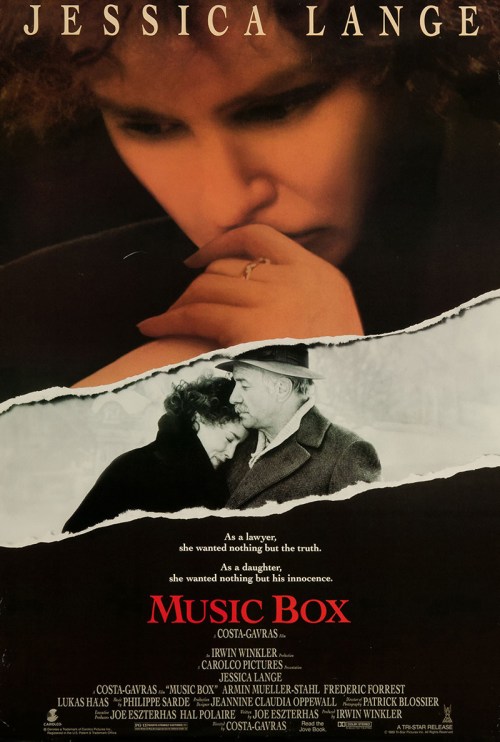
Anne Talbot (Jessica Lange) works as a defense attorney in Chicago and is shocked when her kindly father (Armin Mueller-Stahl), who immigrated to the US from Hungary many years ago, is threatened at having his citizenship revoked due to being accused of committing past war crimes.  Several witnesses have come forward to identify him as being ‘Mishka’ a man who headed a Nazi terror unit known as the Red Arrow that systematically tortured and killed Hungarian Jews during WWII. Anne refuses to believe this and immediately volunteers to defend him in court, but as she researches the case she finds many unsettling elements that makes her question whether her father really is the victim of mistaken identity as he claims, or actually the man responsible for committing heinous acts against humanity.

The film was inspired by the true-life case of John Demjanjuk who immigrated to the US in 1952 and worked as an auto worker for many decades before being identified by 11 Holocaust survivors as being Ivan the Terrible who tortured and killed many Jewish prisoners while working as a guard at a concentration camp. Script writer Joe Eszterhas also adds his own experiences into the story by channeling the emotions he felt when he found out that his father had been involved in disseminating anti-semitic propaganda during WWII.

The plot had all the hallmarks of being a trenchant courtroom drama especially since it was directed by Costa-Gavras who has shown a knack for helming political thrillers with a psychological bent, but it all ultimately falls flat. Much of the problem is that we learn little about Mueller-Stahl’s character as his face never shows any emotion. At first this makes it interesting as he comes off like this kindly old man who seems the complete opposite of what he’s being accused of, but after awhile we need to see what’s going in his mind and beneath the facade. Whether it’s anger, fear, madness, or evil at some point it needs to get conveyed in his face as the trial goes on, but instead all the viewer sees is a constant blank stare that keeps the character frustratingly transparent.

Having a male model pose as the younger version of him in the wartime photos was a mistake too. Googling images of Mueller-Stahl when he was young shows that he looked much different than the model in the movie making the portions where the witnesses positively identify Stahl from the photos seem off-kilter since the guy in them even when given the realities of aging doesn’t look anything like the man sitting in the courtroom. To avoid this they should’ve cropped an actual pic of Mueller-Stahl into the war time photos.

The court case itself ends up becoming quite draggy because instead of focusing on one witness they put in several of them one after the other who essentially retell the same type of story, which gets redundant. There’s also some Hollywood theatrics that get thrown in like when Mueller-Stahl physically confronts one of the witnesses in the courtroom with no one attempting to restrain him before he collapses to the floor in a completely over-the-top fashion. Having everyone in the trial then get flown across the Atlantic to a Hungarian hospital to hear testimony from a dying witness only helps to turn the entire thing into a misguided spectacle.

Lange, who was Hollywood’s darling at the time and constantly offered first dibs at every ‘important’ movie that came out, gives a good performance, but her emotional character arch is predictable. The focus should’ve been on Mueller-Stahl’s character and what made him tick, but no insights are ever given even during the climatic final confrontation, which ultimately cements this as being a big disappoint.

My Rating: 5 out of 10

Released: December 8, 1989

Runtime: 2 Hours 4 Minutes

Rated PG-13

Director: Costa-Gavras

Studio: TriStar Pictures

Available: DVD

Jagged Edge (1985)

jagged edge

By Richard Winters

My Rating: 6 out of 10

4-Word Review: An old Corona typewriter.

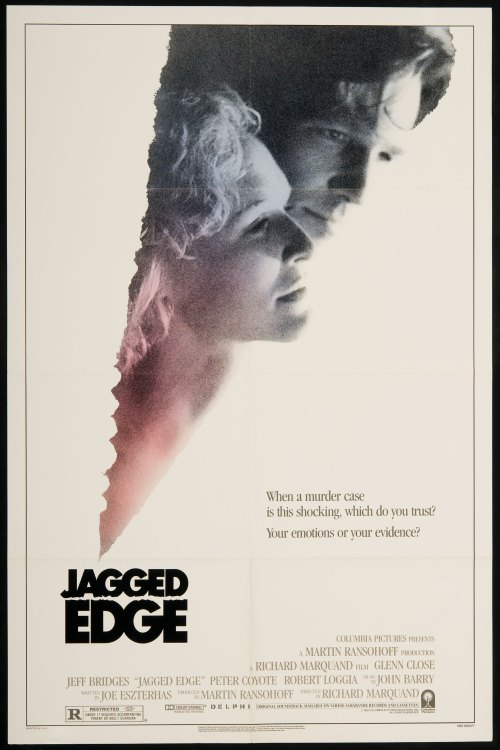
Rich socialite Paige Forrester (Maria Mayenzet) is brutally murdered in her own home the victim of wounds done by the jagged edge of an unusually curved hunting knife. Her husband Jack (Jeff Bridges) claims he was knocked unconscious and didn’t come to until after she was killed and the assailant gone, but when evidence points to his head wound being self-inflicted he gets arrested for the crime. Teddy Barnes (Glenn Close) becomes his reluctant public defender. She is initially not convinced of his innocence, but the more she gets to know him the more she believes it while also allowing herself to become romantically involved with him. As the court case progresses there are many twists and turns including mysterious, anonymous notes typed with the use of an old typewriter and sent to Teddy, which reveal intriguing clues about her client.

The film, written by Joe Eszterhas, has all the trappings of a great court drama. Lots of clues that go either way making the viewer unsure if the defendant is really guilty or not and working very much like real trials do. I felt for the most part the trial procedures were well research and believable including all the meticulous investigating that Barnes does on her own before the trial even begins. The only thing in this area that could’ve been done better was trying to string out the suspense a bit more by prolonging the length of the jury deliberation. In real-life this can go on for several days, even weeks, but this film made it seem like it was only a few short hours.

Close gives an outstanding performance in a part that was originally intended for Jane Fonda. I love the way she can show such a wide range of emotions and the simple, but effective way that her character’s eyes well up with tears as she listens to the testimony of a rape victim is one the ingredients that makes all of her performances impactful and endearing. Veteran actors Robert Loggia, as a gruff, foul-mouthed detective, and John Dehner as a stern, hard-lined judge are also terrific. I also liked the way Teddy’s children are portrayed as being much more savvy to the world and not just there to say cute and precocious things.

Spoiler Alert!!!

The film’s biggest downfall tough is with its twist ending as Teddy ends up finding the typewriter that had written all those mysterious notes inside Jack’s closet and convincing her that he had actually been guilty all along despite getting off as innocent. She then takes the typewriter with her back to her house and then a few hours later Jack breaks into her place and in an effort to ‘silence her’ tries to kill her, which is all quite ridiculous.

For one thing I didn’t understand why Jack would hide the typewriter in a closet that is only a few feet from where he and Teddy slept. The guy lives in a gigantic mansion, so why not place it where it would be hard-to-find and not where she could easily come upon it. Also, he doesn’t need to kill her at all, he simply needs to retrieve the typewriter, which she leaves sitting on the staircase and he walks right past it. Without the typewriter there is no evidence. He takes it back and destroys it and she has nothing on him. Trying to kill her like the character here proceeds to do is the dumbest thing possible because he would be killing her in the exact same manner that he did in his wife, which would immediately make him the prime suspect and quickly arrested. The Jack character had been so smart otherwise that I’m sure he would’ve thought of this, which makes the wrap-up quite weak and unfortunately hurts what is otherwise a slick and entertaining production.

End of Spoiler Alert!!!

My Rating: 6 out of 10

Released: October 4, 1985

Runtime: 1Hour 48Minutes

Rated R

Director: Richard Marquand

Studio: Columbia Pictures

Available: DVD, Amazon Instant Video