
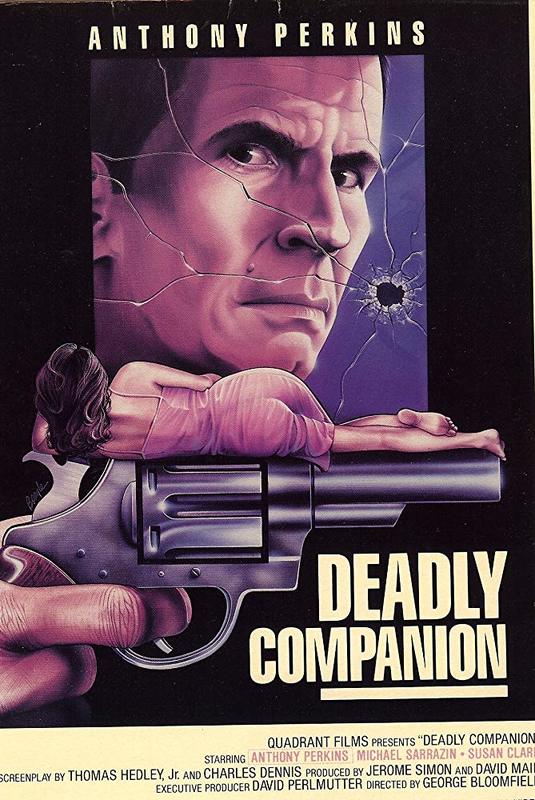
By Richard Winters
My Rating: 4 out of 10
4-Word Review: Who killed his wife?
Michael (Michael Sarrazin) is a photojournalist tormented by fragmented memories of his wife’s murder. Paula (Susan Clark) is his girlfriend who’s trying to help him sort through these flashbacks, so he can find some answers. However, she too has things to hide as she’s busily paying off a man named Lawrence Miles (Anthony Perkins) who threatens to go to the police about what he knows about the killing. There’s also Lester (Howard Duff) a private investigator who sticks his nose too deeply into the case and finds himself at deadly odds with both Lawrence and Paula.
The film is based on the 1948 novel ‘The Three Roads’ written by Ross Macdonald under his real name Kenneth Millar. Macdonald later went on to have a stellar career writing novels about private investigator character Lew Archer and this story has plenty of potential but gets mishandled and ultimately becomes a misfire. A lot of the problem stems from the production employing three different writers who all had different perspectives on where they wanted the story to go and then relying on director George Bloomfield to cram it all together, which he doesn’t succeed at. The result is a fragmented mishmash that takes a long while to become intriguing and even then, remains interesting only sporadically. Lots of extended scenes particularly at the beginning that should’ve been trimmed and a poor pacing that barely manages to create any momentum.
It doesn’t help that the main characters are wholly unlikable and uninteresting. Clark especially comes off as arrogant right from the beginning when we see her drive by what appears to be Amish people in a horse and buggy fighting through the snow and cold while she enjoys things in her warm ritzy car, which makes her seem detached and uncaring. The scene where she’s trying to procure an important real estate deal and then gets hampered by Michael playing loud music in the other room, so she then excuses herself and promises to be right back. I was fully expecting her to yell at Michael for his misbehavior, but instead she strips off her clothes and the two make love, but it seemed like sex should be the last thing on her mind during such an serious business meeting and what would happen if the clients, who were just a door away and waiting for her return, would walk in on them?
Sarrazin doesn’t cut it either. I know he’s been lambasted by critics in his other film appearances for being too transparent and forgettable and yet I’ve usually defended him as I feel he can sometimes be effective even given the right material. Here though he falls precariously flat. Some of it is the fault of the writing which doesn’t lend him to create a character with any nuance, or likability, but in either case he’s a complete bore and the viewer isn’t emotionally invested in his predicament. His flashback moments where he sees himself in some sort of prisoner of war camp doesn’t make a lot of sense, or have much to do with the main plot, and seems like something for a whole different movie.
On the other hand, Perkins is fantastic and the only thing that livens it up to the extent that he should’ve been given much more screen time as the film sinks whenever he’s not on. It’s great too at seeing SCTV alums like John Candy, Eugene Levy, Joe Flaherty, Dave Thomas, and Catherine O’Hara in small parts where with the exception of Candy they’re not comical but instead make a rare turn at being dramatic. Duff is kind of fun and has one great moment, really the only good one in the movie, where he gets trapped in an elevator and must escape being shot by Perkins, who has his arm lodged in the otherwise closed doors, by desperately running back and forth in the closed space that he’s given. Michael Ironside has a memorable bit too as a bar patron who becomes incensed at Sarrazin when he refuses to allow him to buy him a drink.
Spoiler Alert!
The denouement just leaves more questions and fails to tie up the loose ends as intended. For one thing it shows Sarrazin as being the one who strangled his wife, which I had started to suspect a long while earlier, so it’s not a ‘shocking surprise’ like I think the filmmakers thought it would. It also has Perkins leaving the scene, as he was having an affair with the woman, and even briefly speaking to Clark who witnesses him going, so why he’d insist Clark needs to pay him hush money didn’t make much sense. Sure, he could still go to the police and say that it was Sarrazin that did it, but Perkins fingerprints were at the scene of the crime, so I’d think either way he’d get implicated, and Clark could come forward saying she was a witness who saw him leaving. If anything, Clark should’ve been pushing him to go to the cops versus bribing him to stay away.
Also, the way it gets shown, Clark comes into the bedroom after Sarrazin has already strangled his wife, so all she sees is him weeping over his wife’s dead body. For all she knew, from that perspective, is that Perkins really did kill the woman and Sarrazin was simply the first to come upon her dead body and thus for it to be crystal clear Clark should’ve entered while he was still in the middle of the act versus when he was already done.
Beyond that is that question of why would Clark want to stay with someone she knew had such violent tendencies? Wouldn’t she be afraid he could get upset at some point and do that to her? Sarrazin even asks her at the very end if she is afraid and her only response is: ‘aren’t you’? This though only muddles things further cementing it as a botched effort.
Alternate Title: Deadly Companion
My Rating: 4 out of 10
Released: May 12, 1980
Runtime: 1 Hour 36 Minutes
Director: George Bloomfield
Studio: Quadrant Films
Available: Amazon Video
 Scopophilia