Tag Archives: Gordon Willis

Zelig (1983)

zelig1

By Richard Winters

My Rating: 4 out of 10

4-Word Review: Wanting to fit in.

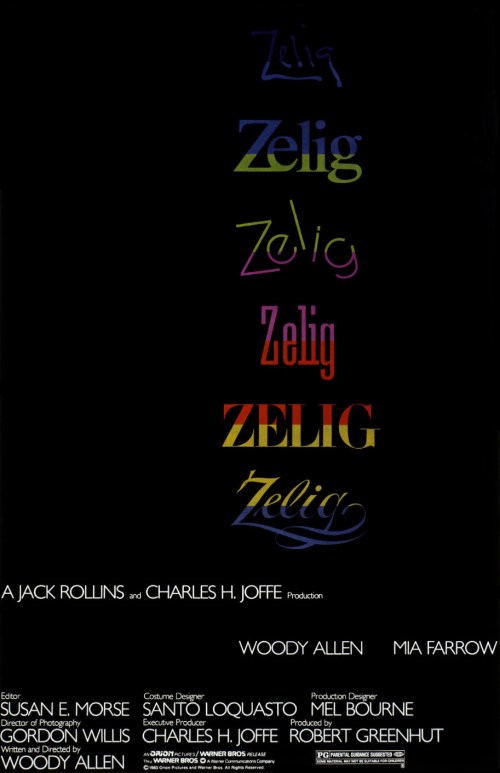
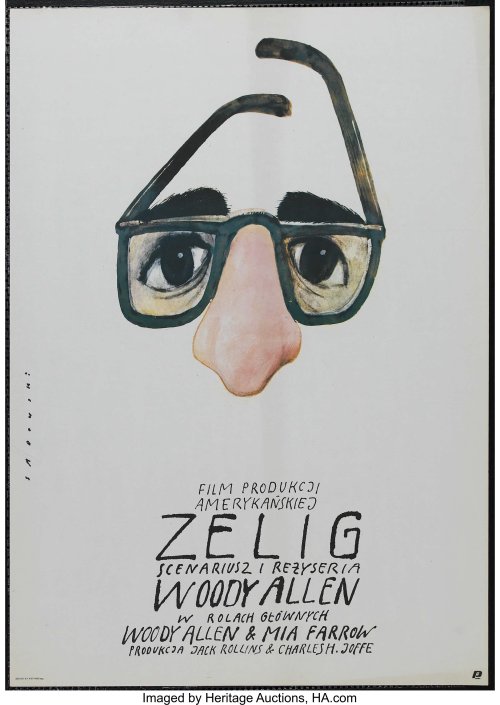
Leonard Zelig (Woody Allen) is a man living in the 1920’s and 30’s who has an uncanny ability to reflect the personalities and features of those he’s surrounded with. Even if he’s in the company of someone of a different race, or ethnicity, he can still acquire their traits, including their skin color, until he looks exactly like them. He becomes known as a the human chameleon and Dr. Eudora Fletcher (Mia Farrow) , a psychiatrist, becomes determined to find the root cause. She takes him on as a patient and under intense hypnosis comes to the realization that his deep need to be liked by others causes him to conform to the most extreme ways imaginable. Through her therapy she gets him to become more confident in expressing his own opinions, but this leads to him arguing with others over the most mundane reasons, which leads to several fights. She again puts him under hypnosis, so that he’ll become more of centrist, but this then leads to even further complications.

Allen was inspired to do this movie when his friend Dick Cavett was hosting a history series on HBO and a segment was done where Cavett’s likeness got spliced into an historical image. While the effects of using old newsreel footage and photos from long ago and inserting in cast members to make it seem like they were there when the picture was taken may not seem like that big of a deal today, but back in the 80’s it was very much talked about. I remember an entire segment of CBS Morning News hosted by Diane Sawyer going in depth about the ‘incredible’ special effects and ‘how did they do it?’ With digital filmmaking and movies like Forrest Gump we’re used to it, but back then it was state-of-the-art and got nominated for several awards. To help make it look as authentic as possible cinematographer Gordon Willis used vintage cameras and lenses from the 20’s and then stomped on the negatives of the film in his shower to help create the crinkles and scratches.

While telling the story through newsreel footage is certainly diverting and many times amusing I was fully expecting after about 20 minutes or so that it would eventually become more like a normal movie with the plot being propelled by actual characters, dialogue, and conventional scene structure, but instead it sticks with the novelty until the bitter end, which for me was a mistake as it makes the viewer too detached from the people in the movie to the point that they become distant caricatures that we really care nothing about. Much comedy is also lost as everything hinges on the voice-over narration of Patrick Horgan and how he describes what’s going on versus having it played out. A great example of this is when Allen gets into an argument with someone over whether ‘it’s a nice day, or not’, but all we see of it is some grainy, black-and-white figures in a distance that appear to be squabbling when witnessing the actual argument in real-time would’ve been so much funnier.

My favorite moment had nothing do with the special effects, but instead was the scene with Farrow and Allen where she tricks him, using reverse psychology, into admitting he really wasn’t a psychiatrist like her, and the movie needed more segments like this one. The vintage footage is nice for awhile and highly creative, but ultimately makes it come-off like a one-note joke, or an experimental film that’s misses the most basic elements of a good story, which is character development. It’s a shame too as Farrow gives a strong performance, which gets overshadowed. Usually she’s best at playing emotionally fragile types, but here is a strong woman and does quite well though I thought it was ridiculous that in color segments where here character is speaking in the modern day as an old woman another actress, Ellen Garrison, plays the part when they could’ve easily had Farrow doing it by dying her hair gray and putting on a few wrinkles. So much effort was put into the black-and-white vintage stuff that they forgot about the simplest of all special effects: stage make-up.

There’s also a host of other famous faces that have cameo bits as they talk about the fictional Zelig in the modern-day like historians discussing a past event, or famous person. Of these includes Susan Sontag, Saul Bellow, Irving Howe, and John Morton Blum, but like with the newsreel element it gets overplayed and derivative. It also brings to question what exactly was the movies’ point. Was it a satire on conformity and if so it could’ve gone much deeper, or poking fun at documentaries, which could’ve been played-up much more too. In either case it’s a misfire that’s engaging for awhile, but eventually, even with its short runtime, wears itself out.

zelig2

My Rating: 4 out of 10

Released: July 15, 1983

Runtime: 1 Hour 19 Minutes

Rated PG

Director: Woody Allen

Studio: Orion Pictures

Available: DVD, Blu-ray

Bad Company (1972)

By Richard Winters

My Rating: 6 out of 10

4-Word Review: Two deserters go west.

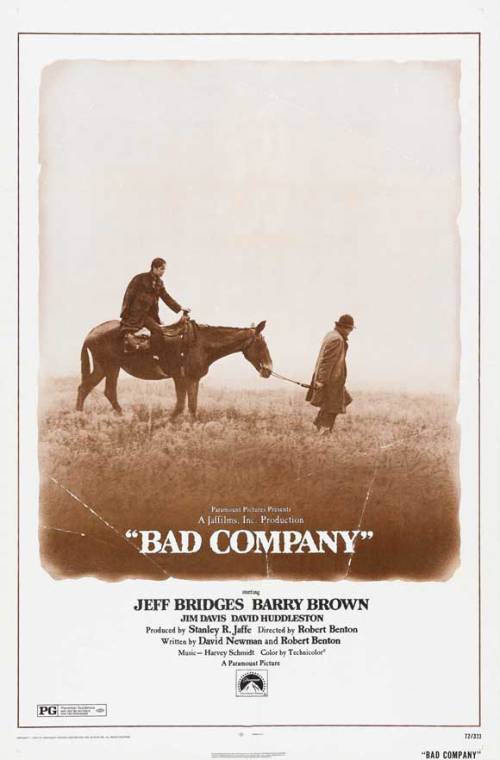
Drew (Barry Brown) is a young man living in the south during the civil war who manages to avoid going into the army by hiding from the soldiers when they come to his family home to retrieve him. After they’ve left his mother (Jean Allison) gives him $100 and tells him to go west. When he gets to St. Joseph, Missouri he meets up with Jake (Jeff Bridges) and the two form an uneasy alliance with Drew even getting invited into Jake’s young gang (Damon Cofer, John Savage, Jerry Houser, Joshua Hill Lewis) of youthful outlaws. The six ride off into the west hoping to find adventure and opportunity, but instead meet hardship and violence.

The film’s stark tone would’ve been more compelling had there not been so many other westerns coming out at the same time with a similar theme. Instead of being this refreshing change-of-pace from the old western serial it just ends up creating new clichés from the then budding revisionist  genre. At certain points it seems almost like a carbon copy of The Culpepper Cattle Company, or even The Great Northfield Minnesota Raid, which star Brown had been in just before doing this one.

The attempt to mix dry humor with harsh reality works fairly well and placing the setting amidst the sprawling wheat fields of Kansas gives it a distinctive look that is perfectly captured through the lens of cinematographer Gordon Willis although the piano score by Harvey Schmidt gets intrusive. This becomes particularly evident towards the end when the two boys get into a gun battle with a gang of outlaws and the action is choreographed to the beat of the music, which only helped to take me completely out of the story. What’s the use of spending so time creating a gritty realism if you’re just going to suddenly sell-out on it in a cheap attempt to be ‘humorous’ and ‘cute’?

The acrimonious friendship between the two leads is what I liked, but the film misses the mark by not focusing on this enough. The supporting cast wasn’t needed and the film should’ve focused solely on the two stars from the beginning making it like ‘the odd couple of the west’, which could’ve been memorable. Instead it meanders and only starts to gel by the third act, but by then it’s almost too late. I also wasn’t too crazy about the wide-open ending either, which offers no satisfying conclusion.

My Rating: 6 out of 10

Released: October 8, 1972

Runtime: 1Hour 33Minutes

Rated PG

Director: Robert Benton

Studio: Paramount

Available: DVD, Amazon Video, YouTube

Comes a Horseman (1978)

By Richard Winters

My Rating: 6 out of 10

4-Word Review: Ranchers battle for land.

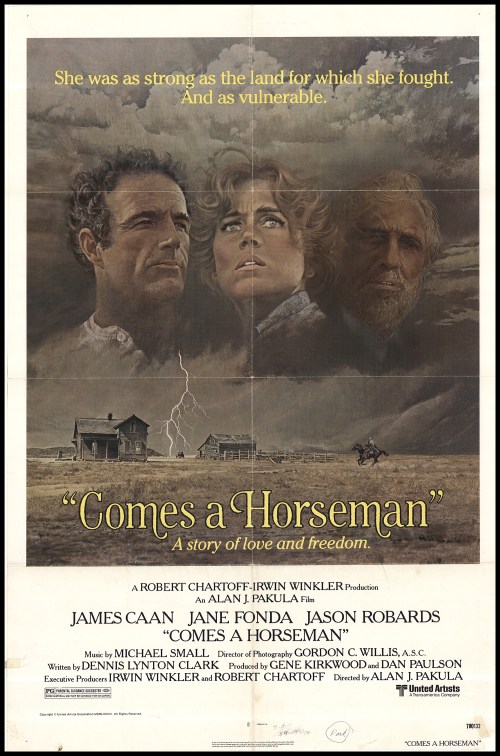
Recently widowed Ella (Jane Fonda) must struggle to run her ranch in the middle of the desolate west by herself. Frank (James Caan) is her neighbor who is being harassed by Jacob Ewing (Jason Robards) to sell his land and Ewing has also made a strong play for Ella’s property as well. Both refuse his offers and then band together to defend themselves and Ella’s ranch from Ewing and his men who are willing to do anything it takes in order to get what they want.

The film’s main charm is its stunning cinematography by Gordon Willis who captures the expansive western landscape in breathtaking fashion and this is indeed one film that must be watched on the big-screen, or in widescreen to be fully appreciated. Director Alan J. Pakula instills a wonderfully slow pace with a minimum of music, which gives the viewer an authentic feel for what life out in the country during the 1940’s must’ve been like.

I also really liked the fact that Ella and Frank didn’t immediately fall-in-love and jump into bed together. Too many times films made during the post sexual revolution depicted characters from bygone eras as being far more liberated than they really were and here they’re authentically reserved and in fact they don’t even show any affection for one another until well into the story and when it does happen it seems genuine instead of just sexual.

Jane gives an outstanding performance. Usually she commands the screen and gives off a sexual allure, but here she literally disappears in her role of a humble farm woman until you don’t see the acting at all. Former stuntman Farnsworth at the age of 58 makes an outstanding film debut in a supporting role that will emotionally grab the viewer.

The story, which was written directly for the screen by Dennis Lynton Clark, lacks depth and has too many elements stolen from other similar films. Stanley Kramer’s Oklahoma Crude, which came out 5 years has almost the exact same plotline, but done in a darkly comic manner. Both deal with a man moving onto a woman’s ranch to help as a farmhand. The woman initially rebuffs the male’s advances, but eventually softens. Both deal with an oil company pressuring her to sell her land and harassing her when she doesn’t and they both have a memorable scene involving a windmill.  The oil subplot, particularly in this film seems rather unimaginative and like it was thrown simply to create more conflict while Ella’s past relationship with Ewing and the dark secret that they share should’ve been more than enough to carry the picture.

The one thing though that really kills the picture is the ending where Ella and Frank find themselves being attacked and in an effort to build up the tension loud music similar to what’s heard in a modern-day thriller gets thrown in. This had been a movie that had been very quiet up until then and it should’ve stayed that way. The actions seen on the screen was more than enough to horrify the viewer and no extra music was needed. Hearing nothing more than the howling wind on the prairie would’ve made it more effective as it would’ve reminded the viewer how remote the location was and how no one else was nearby to help Frank or Ella. For a movie that tried so hard to recreate the feel of a past era only to suddenly go downright commercial at the very end is a real sell-out.

The fact that all the night scenes were filmed during the day using a darkened filter is another letdown. There have been many films that have been shot in actual nighttime darkness so why couldn’t this one? If you want to see a film set during the same time period with equally captivating visual approach, but stays more consistent in theme then I’d suggest Days of Heaven, which was also released in 1978.

My Rating: 6 out of 10

Released: October 25, 1978

Runtime: 1 Hour 59 Minutes

Rated PG

Director: Alan J. Pakula

Studio: United Artists

Available: DVD, Blu-ray, Amazon Video, You Tube

Windows (1980)

windows 3

By Richard Winters

My Rating: 1 out of 10

4-Word Review: She’s obsessed with her.

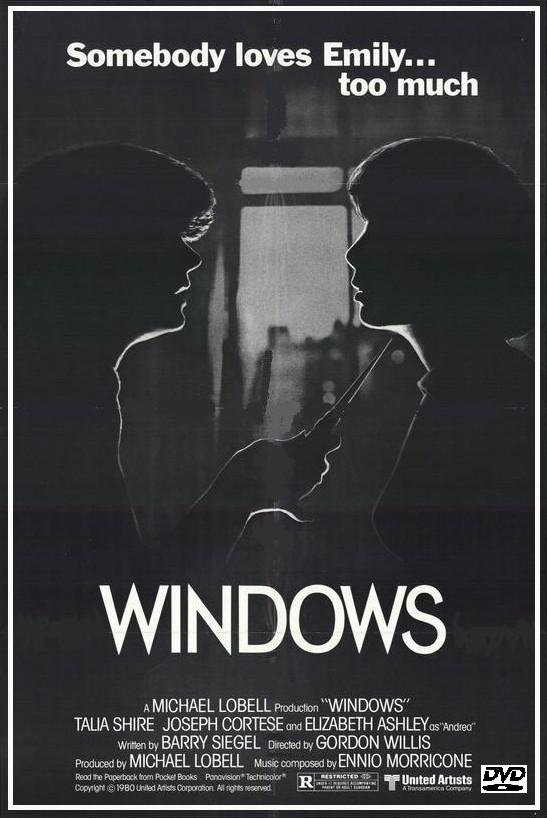
Emily (Talia Shire) is attacked in her apartment by a rapist (Rick Petrucelli) and when the police come to investigate the crime she starts to fall in love with Bob (Joe Cortese) the handsome police captain. Little does Emily know that her friend Andrea (Elizabeth Ashley) was behind the attack. She is a closet lesbian with a secret psychotic obsession for Emily who hired the man to rape her and record it, so Andrea could get-off on listening to the sounds of Emily moaning during the struggle. Now that Emily is going out with Bob it makes Andrea angry and her behavior becomes more dangerous and erratic.

For a thriller this film is extraordinarily low-key to the point that it also comes off like a drama, but fails on both ends. There is no mounting tension and little if any scares. The only one that they do have is when Andrea sticks Emily’s cat into a freezer and later it drops out of it like it was a Popsicle, which is actually unintentionally funny. There is also hardly any music. Ennio Morricone was hired to be the composer, but they don’t use him as much as they should. An amazing amount of the movie deals with the natural street sounds and ambience from life in New York, which is interesting for a while, but does nothing to elevate the tension, or create any excitement. Famed cinematographer Gordon Willis in his directorial debut seems more interested in capturing the New York skyline and creating shadowy interiors than actually making a movie with an original story, or interesting characters.

Shire is so quiet and awkward that she seems to be in a mental stupor. Her screen presence here is transparent and lifeless and it is easy to see why her leading lady status was brief. Cortese is no better as the male lead and the romantic side-story has no energy or chemistry and only helps to bog down an already boring story. Intercutting this with Andrea’s visits to her psychiatrist (Michael Lipton) successfully creates the first thriller to have no suspense whatsoever.

Ashley seems like the perfect choice for a homicidal lesbian, but the part is written in a way that doesn’t allow her to go over-the-top with it, which she should have although you do get to see her wearing quite possibly the biggest pair of sunglasses that I have ever seen. It might have worked better had the viewer not been aware from the start about Andrea’s psychosis and instead only revealed it at the end as a twist.

The climatic sequence between Emily and Andrea would be laughable if it weren’t so mind numbingly stilted and prolonged. The scene goes on for almost twenty minutes and features the two women standing in front of a window with Emily weeping incessantly while Andrea rambles incoherently. How anyone who was involved in the making of this movie would think anyone would flock to see this dull and contrived thing should have their brains checked. Has an air of pretense to it like it is trying to be a ‘sophisticated’ thriller, but it is pointless. If ‘Mystery Science Theater’ were still around this would be a great candidate for it.

My Rating: 1 out of 10

Released: January 18, 1980

Runtime: 1Hour 36Minutes

Rated R

Director: Gordon Willis

Studio: United Artists

Available: DVD, Amazon Instant Video