Tag Archives: Frankie Avalon

Back to the Beach (1987)

By Richard Winters

My Rating: 3 out of 10

4-Word Review: Couple revisits surfing culture.

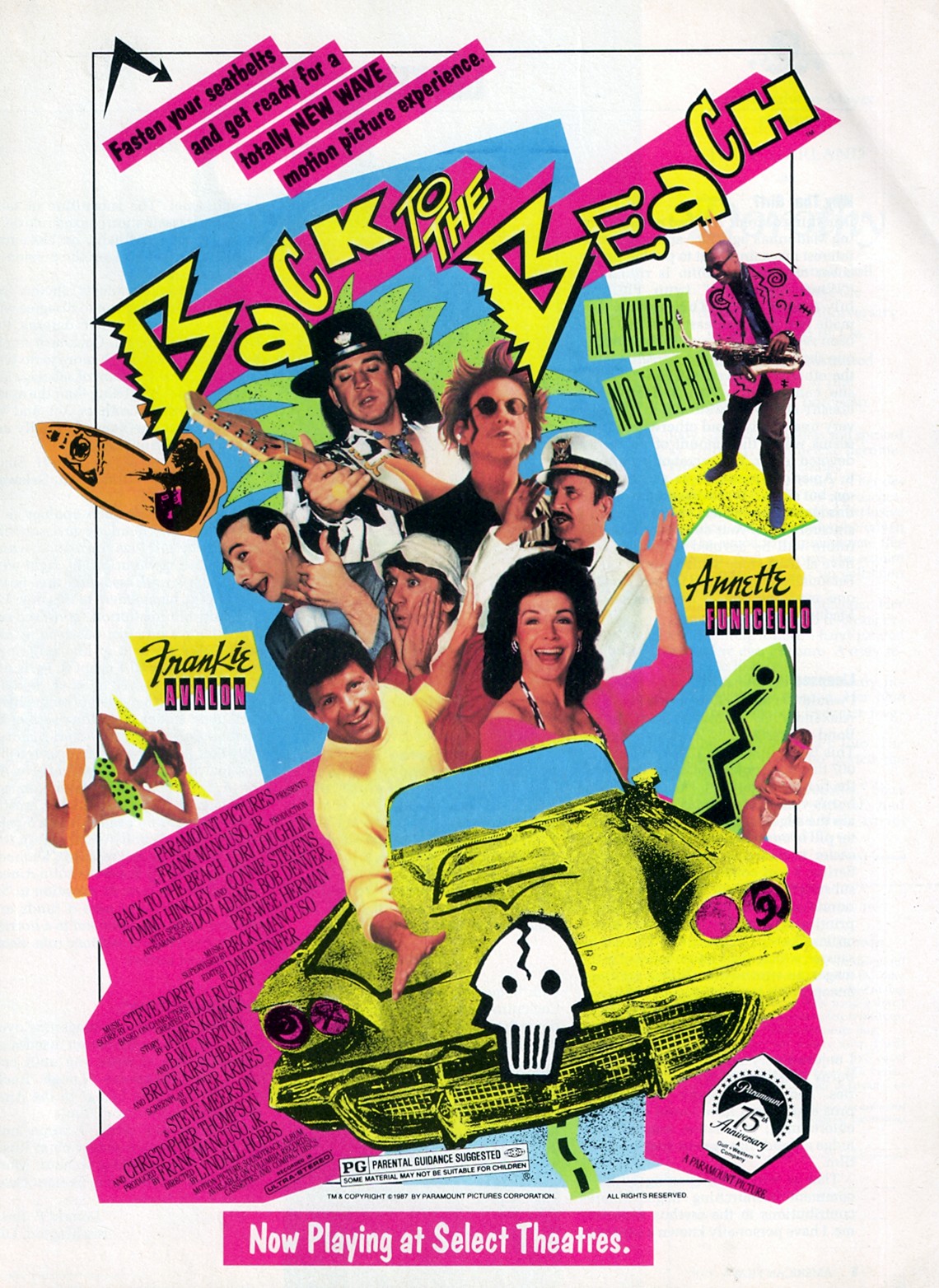
25 years ago, Frankie (Frankie Avalon), was a hot shot surfer known as the ‘Big Kahuna’, but now he’s a middle-aged, frustrated car salesman living in Ohio.  His wife Annette (Annette Funicello) was also a part of the surfing culture and that’s where the two first met, but now she’s a suburban housewife raising a rebellious kid named Bobby (Demien Slade). Frankie longs to revisit his old stomping ground, so the family takes a trip to California to visit their daughter Sandi (Lori Laughlin) not knowing that she’s living on the beach with her boyfriend Michael (Tommy Hinkley). Frankie also runs into Connie (Connie Stevens) his old sweetheart that still has a crush on him. Annette becomes jealous of all the attention Connie gives him causing a rift between the two, so they spend the rest of their vacation doing things on their own. Annette then catches the eye of Troy (John Calvin) who chases after her while Tommy gets in with a group of punk surfers who try to take over the beach prompting Frankie to challenge their leader to a surfing contest.

The film came out at a time when many 60’s shows and movies were getting revisited usually with the same cast members, or at least those that were still alive. Frankie had been shopping around the script for many years before finally finding a taker though the studio had insisted on more campy approach, but producer/writer James Komack resisted insisting that having it a light comedy dealing with the travails of growing into middle age and being a modern-day parent was enough.

It starts out almost like Airplane!, with visual sketch-like comedy, but then meanders into being almost all talk with not a lot happening. More confrontations or dilemmas, even the comic variety, would’ve helped, but instead the second half stagnates. Frankie and Annette ‘breaking up’ is a good example as the minute after having their spat they secretly long to get back together. It would’ve been a more intriguing story had the two genuinely went their separate ways only to decide at the very end that being a part wasn’t worth it and then make an attempt to reconcile, so there would at least be some dramatic tension, which is otherwise totally lacking.

Frankie is amusing and looks almost like he hadn’t aged a day and the potshots at his ‘perfect hair’, which looks suspiciously like a hair piece, are fun. Connie enlivens things as the beach blonde bimbo and Bob Denver is fun playing off his Gilligan persona, this time as a bartender known as ‘little buddy’. Some of the other cameos don’t work as well including Don Adams as The Harbormaster who initially seems like he’s going to ruin the festivities but gets neutered away too easily making his presence seem rather pointless. Having the son Bobby dressing and acting like a punk right from the start is off-putting and not funny. Would’ve been better and allowed for some character arch had he been super clean-cut, maybe in an effort to emulate his dad, only to get ‘corrupted’ when he meets the punks and then changing his look.

Funicello’s presence was disappointing. She hadn’t been in a movie in a while and was better known to younger audiences for being a spokesperson for Skippy peanut butter, which the film does parody, but her acting is rather stiff. This was when she began experiencing MS symptoms, so that may have had something to do with it, but her character is one-dimensional. She never says or does anything outrageous and is too ‘goody-goody’ making her moments flat and forgettable. It’s possible she didn’t have the acting chops to play anything different though it would’ve been nice had she at least tried to go against her image a little.

The film ends on a high note. I enjoyed seeing Frankie back on the surfboard even if he does it in front of a green screen, but I really felt there needed to be more jokes and a faster pace. Trying to turn it into a ‘dramedy’ was not what these cartoon characters needed. A surreal edge was necessary and though it teases this concept at times it wasn’t enough turning it into a misfire that never quite takes off.

My Rating: 3 out of 10

Released: August 7, 1987

Runtime: 1 Hour 32 Minutes

Rated PG

Director: Lyndall Hobbs

Studio: Paramount Pictures

Available: DVD, Blu-ray, Amazon Video, PlutoTV, YouTube
The Take (1974)

take1

By Richard Winters

My Rating: 4 out of 10

4-Word Review: Black cop accepts bribe .

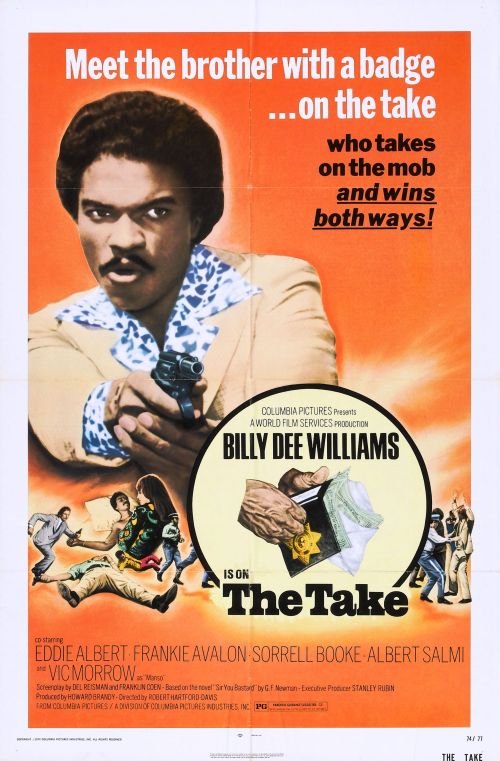
Terence Sneed (Billy Dee Williams) is a San Francisco cop brought to Paloma, New Mexico to help take down local crime boss Victor Manso (Vic Morrow). The only problem is that Manso invites Sneed over to his place and offers him a significant amount of cash to get on his ‘payroll’ and thus allow him to get away with his crimes. Sneed is also informed that another top official in the police department, Captain Frank Dolek (Albert Salmi) is on the take as well. Sneed accepts the cash, but then double-crosses Manso by having Dolek secretly tailed where he finds out who all of Manso’s connections are and uses this info to try and bust Manso’s drug operation, which ends up being a tall order that gets Sneed in hot water not only with Manso, but with his police supervisor Chief Berrigan (Eddie Albert) as well.

The film is based on the 1970 British novel ‘Sir, You Bastard’ by Gordon Frank Newman, which became a bestseller and set-off a series of three books that he wrote around the Sneed character. There were though differences between the book and movie as in the novel Sneed was white and worked in Scotland Yard. The one thing though that remained the same was Sneed being unscrupulous and working outside the system.

The fact that the protagonist accepts bribes and most of the way it’s unclear whether he’s even a good guy at all is what makes the movie interesting and helps differentiate it from the other early 70’s cop action flicks. This is the complete opposite of Serpico where the cop refused all bribes and vigorously fought against it. Here we see the other angle. Instead of the main character being on the outside looking in he’s a part of the corrupt system and in order to survive in it must be willing to play along, which I found more realistic and insightful as someone who’s able to totally rise above the evil environments they’re in is rare and therefore we get more of an everyman’s perspective here. It also works against the ‘Save the Cat’ book, which has become the bible of today’s screenwriters, which insists that the main character must be likable for the movie to work. Here Sneed is anything but and at certain points when he forces an overweight suspect (Robert Miller Driscoll) to take-off his clothes and do jumping jacks in humiliating fashion to the amusement of the other cops he becomes downright nasty, but in-turn it makes the movie less formulaic, which too many movies today have become.

Williams’ skill as an actor helps to keep the character engaging and he gets great support not only by Eddie Albert as his exasperated superior, but also surprisingly by Frankie Avalon who has a small, but memorable bit as a drug dealer who initially comes-off as quite cocky, but melts dramatically once inside the interrogation room. Unfortunately for Vic Morrow, who’s played some classic villains in his career, his presence here doesn’t work. This is mainly from his get-up including dyed blonde hair and at one point a pseudo cowboy outfit, which looked campy. I also didn’t like that it’s shown right away that his character has heart problems, which telegraphs a major vulnerability that instantaneously sets the viewer into expecting that this will predictably lead to his eventual demise.

As for the action I felt it started well particularly the opening courthouse ambush, which is well choreographed with a funky score, but it becomes rather pedestrian after this. Having the main character misjudge things like when he tries the intercept Manso’s transporting of illegal goods, but ends up chasing down the wrong van each time, which were intentionally being used as decoys, was refreshing because in too many other police movies the hero cops always gets things right the first time and his hunches are never proven wrong, which again is just not how things work in reality. Either way it’s not as exciting as it could’ve been with a lot of car chases and action scenarios that ultimately prove to be generic in nature.

My Rating: 4 out of 10

Released: May 5, 1974

Runtime: 1 Hour 32 Minutes

Rated PG

Director: Robert Hartford-Davis

Studio: Columbia Pictures

Available: DVD-R

Blood Song (1982)

blood1

By Richard Winters

My Rating: 3 out of 10

4-Word Review: Psychic connection with psycho.

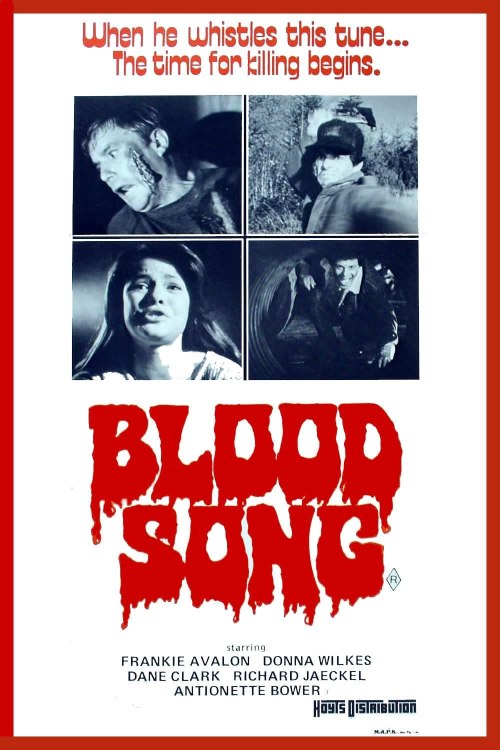
Filmed entirely on-location in Coos Bay, Oregon with a script written by Frank Avainca, a former rock singer, and Lenny Montana, a former wrestler. The story centers on Marion (Donna Wilkes) a teenager whose leg got injured years before when her father (Richard Jaeckel) accidentally ran over it while intoxicated, which forces her to wear a brace. It was during surgery while trying to repair it that doctors gave her a transfusion from a very rare blood type. The only one that had this same type was Paul (Frankie Avalon) who had been institutionalized since he was a child after witnessing his father murder his mother and her lover after the father caught them in bed together before then seeing the father kill himself. Paul manages to escape from the institution and while Marion goes on living her life she begins seeing visions of Paul murdering other people. Nobody believes her when she tells them about it. One day she goes walking in the woods and comes face-to-face with Paul as she witnesses him burying one of his latest victims. She is able to run from him at that point, but begins living in terror that he’s now stalking her, which he is.

The only redeeming thing in this cardboard horror is the performance by Wilkes with this being the second of the three horror films that she did during the 80’s. While she was already 22 at the time it was filmed, which was in October of 1980, she still comes across very much like an actual adolescent. She also gives a likable performance making you care about her character and thus more wrapped-up in the story than you might otherwise. I did though take issue with the crippled leg. If you have a person with a noticeable handicap than that needs to come into play. Here though it really doesn’t. She does run with a bit of limp, but still able to get way. If she has a bum leg then running should’ve been completely impossible otherwise what’s the point of introducing the bad leg in the first place? She then would’ve been forced to find another way to get away from him, which in-turn could’ve made the story more creative and the victim’s quandary more unique.

Avalon was a famous teen singer during the late 50’s and early 60’s before graduating to movies, particularly the Beach Party ones. Then in the late 70’s he had a career resurgence with his appearance in the hit film Grease, but by the 80’s he was back to irrelevance, so I have no idea why they thought this former teen heartthrob would make for a good psycho other than the producer apparently seeing him guest star on an episode of ‘Fantasy Island’ and from that gave him the role. His performance though is one-note and having the killer revert to a child-like voice and mannerisms at times, in an effort I guess to show that he has a ‘split personality’, is corny and cliched.

The dream sequences, in which Wilkes supposedly sees things from Avalon’s perspective, isn’t believable because if that were the case then she wouldn’t see the killer’s face, unless of course he were looking in a mirror, which he never does. It would’ve been far more intriguing if the killer’s identity hadn’t been known until the end and thus heightening the tension because everyone she would meet could be the culprit and she and the viewer wouldn’t know. The explanation for the psychic connection with him (the blood transfusion) should’ve been kept a secret until the end as well and thus adding another layer of mystery instead of spelling it all out right away and then plodding to a predictable finish.

Spoiler Alert!

The climactic chase, which takes place inside a saw mill, offers some diversion, but not enough. Having her sent to a mental hospital after she is found by the police, is stupid. Apparently this was because when they searched the lake where Avalon fell into they didn’t find his body, only the body of another one of his victims, the saw mill nightwatchmen, and thus causing them to believe that Wilkes was the killer, but why didn’t they consider the possibility that the real killer might’ve just swam away? Taking a murder suspect to jail first is realistic and then once they’ve been examined by a court appointed psychiatrist would they possibly be turned over to mental facility versus having them immediately taken there like it gets done here.

The final twist, where Avalon dresses up as a Dr. at the mental hospital in order to get into Wilkes’ room, I figured out the moment they showed someone wearing a white Dr’s jacket, but not revealing his face, making the ‘big surprise ending’ no surprise at all. It’s also a cop-out because we never find out if he killer gets caught. They should’ve just continued the chase inside the hospital and culminating in a final climactic showdown between the killer and victim instead of ending it with all sorts of loose ends.

My Rating: 3 out of 10

Released: October 1, 1982

Runtime: 1 Hour 29 Minutes

Rated R

Director: Alan J. Levi

Studio: Summa Vista Pictures

Available: DVD