
By Richard Winters
My Rating: 7 out of 10
4-Word Review: Which chair has fortune?
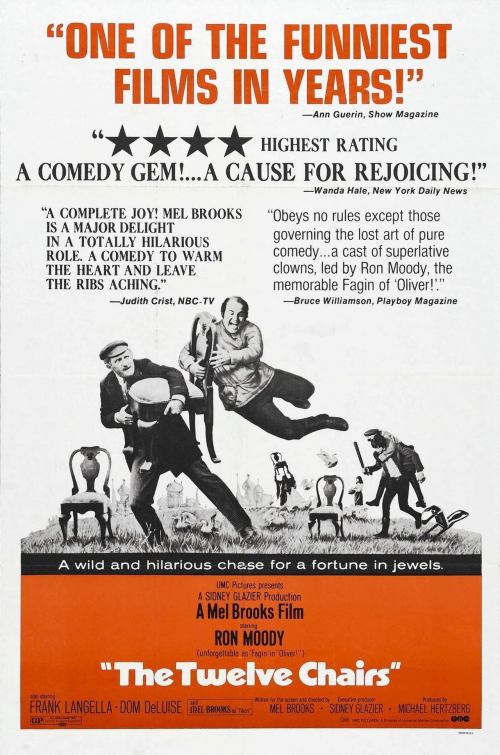
Vorobyaninov (Ron Moody), an poor man living in 1920’s Russia, is summoned to the deathbed of his mother-in-law. She confides in him that there’s a stash of priceless jewels sewn into the seat cushions of one of the twelve chairs from the family’s dinning room set. Unfortunately the newly formed Russian state has appropriated all private property and it’s up to Vorobyaninov to track them down. He teams up with Ostop (Frank Langella) a local con-man to help him, but they have competition. Father Fyodor (Dom DeLuise), a priest, also becomes aware of the jewels when he goes to the mother-in-law’s home to give her the last rites. All three go on a mad dash to retrieve the jewels, but the more chairs they manage to find the more frustrated they become.
The film is based on the 1928 Russian novel of the same name by Ilf and Petrov a famous duo who were quite popular during the early soviet period and wrote not only many satirical novels, including this one and its sequel ‘A Little Golden Calf’, but also several short stories, articles, theatrical plays, and even screenplays. The Twelve Chairs novel though was their most popular and has been made into a movie 18 different times. It had already been done 6 times before Mel Brooks did his with the first version being in 1933 and the most recent rendition of it done in 2013 in Italy.
This version is the most popular and a bit of stretch from Brooks’ other films, which relied on a lot of gags and slapstick. This one has its fair share of those though the first act is quite talky and not too much going on. Brooks himself appears as a character, but he can’t really enliven it. It’s not until the men finally come upon the chairs and start tearing them up one-by-one that it really starts to get funny. The chair thing could’ve gotten redundant as the men rip open the seat cushions in pretty much the same quick way, but Brooks manages to approach each of these scenes in a creative way, so instead of becoming monotonous it remains fresh and comical. My favorite of these is when Ron Moody and Frank Langella chase Dom, who has one of the chairs, through an open field that’s done in stop-action.
The film’s detraction though is the casting of the two main characters. Langella is a terrific actor, but not in comedy. He did appear in the dark comedy Diary of a Mad Housewife, where he was very good, but that took advantage of his glib demeanor and pouty expression and his character there was meant to be unlikable. Here though he has nothing amusing to say and remains a complete jerk the whole way. There is one point where he and Moody are in a row boat and Moody states that he’s cold and Langella gives him a jacket to wear, which I guess was Brooks’ attempt to make him likable, but it’s not enough and the movie is really hurt by spending so much time focused on a guy who’s one-dimensionally cold and responds to antics around him in the same sneering way. He was recommended to Brooks by his wife Anne Bancroft who had performed with Langella in a Broadway play that had a short run, but I felt this is one time when he shouldn’t have listened to her.
Ron Moody, a talented actor as well, has the same issue. The character is meant to be dim-witted, but it doesn’t come-off in a natural way. His banter with Langella is flat and annoying with the bickering doing nothing but slowing up the pacing. Without question DeLuise is the funniest. He’s just as conniving and greedy as the other two, but for whatever reason it doesn’t seem as ingratiating. His character’s ineptness had me laughing and he should’ve been the star while Langella and Moody could’ve been shown only sporadically as the occasional nemesis.
Spoiler Alert!
The ending is much different than the one in the book. In the novel version Vorobyaninov kills Ostap by slitting his throat with a razor in order to keep the loot for himself only to find that it’s not there, so he then goes insane. In the movie Vorobyaninov and Ostap team up to become beggars on the street by pretending Vorobyaninov has an epileptic condition and requesting people throw money at him to help him. Wikipedia, in a line that has since been deleted, stated that this was a ‘happier’ ending though trying to make a living being a street beggar all day can’t be all that fun.
What amused me though is that in both versions the jewels are never recovered by the two men. In the movie the jewels were found first by someone else who used it to build a clubhouse for pompous old men making it seem like greed was inevitable. In the book though the money gets used to build a recreational center that can be used by the entire community and thus giving it more of a pro-communist bent.
My Rating: 7 out of 10
Released: October 28, 1970
Runtime: 1 Hour 33 Minutes
Rated G
Director: Mel Brooks
Studio: UMC Pictures
Available: DVD
 Scopophilia