Tag Archives: Francis Ford Coppola

The Conversation (1974)

By Richard Winters

My Rating: 10 out of 10

4-Word Review: Someone is listening in.

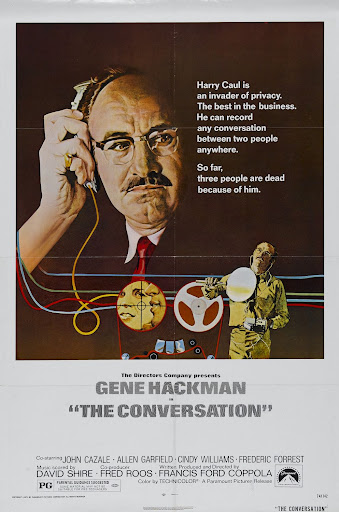
Harry Caul (Gene Hackman) is a surveillance expert who specializes in listening into people’s private conversations and has a reputation of being quite good at it. Many wealthy clients hire him to record things from their enemies that they might not be able to attain otherwise. However, one of these assignments led to the death of three people and Harry, being a highly religious man, has felt guilty about it ever since. He begins to have the same concerns with his new assignment when he overhears a couple (Fredric Forrest, Cindy Williams) who he’s recording mention that ‘he’d kill us if he got the chance’. Harry is unsure if he wants to give the tapes up to his client as he’s frightened the same scenario as before will occur. Martin (Harrison Ford) the man representing the client becomes aggressive in getting the tapes and warns Harry that they’ll get their hands on them one way or the other. Harry, a private man, soon realizes that this client is just as sophisticated in surveillance technology as he and maybe even more so as he becomes aware that his phone and even his apartment is bugged.

Inspired by real-life surveillance expert Martin Kaiser, who was a technical consultant on the production, the film deftly explores how today’s modern technology has easily evaded our private lives and how no one is safe from prying eyes and ears a concern that has become even more pronounced in the decades following its release. Many presumed that it was a testament about the Watergate break-in, which occurred a year before the movie came-out and uses much of the same sound equipment used the by criminals in the real-life event, but in actuality the script, by Francis Ford Coppola, was already complete in 1965, but was unable to get any financial backing until his success with The Godfather. 

The film scores on just about all levels especially with the way it captures San Francisco. I loved the bird’s eye-opening shot of Union Square as well as the terrific use of the fog that gets used to great effect during a memorable dream sequence. The soundtrack by David Shire is quite unique as it’s made to replicate sound waves changing frequency. I liked too that quite a bit of time is spent showing Harry inside his editing studio where he puts together the tape he’s recorded from different sources into a cohesive whole and watching him do it, even if it’s from equipment that would be deemed dated now, is impressive and makes you appreciate the expertise of the character.

Acting wise this may be Hackman’s best, and he stated in later interviews that he considers this to be his finest work, though at the time he felt it was an extreme challenge playing such an introverted person when he himself was highly extroverted, but the payoff is rewarding as he displays characteristics unlike any other role he’s played. What impressed me most was his body posture, which is hunched over, and he walks with a pensive gait, which reveals to the viewer the character’s inner angst without it ever having to be verbally explained. It’s interesting too how he’s mostly shy and stand offish during the majority of it making him seem like a wallflower, but when the subject of his sound expertise comes into discussion, he’s suddenly bragging about his state-of-the-art machinery showing how even the most unassuming of people can still have a big ego and helping to create a protagonist who’s three-dimensional.

There’s also great support from a young Harrison Ford, who appears with a scar on his chin, who despite presenting himself in a composed manner and speaking in a controlled tone of voice is quite menacing. Terri Garr is excellent as a prostitute that Harry frequents and acts as Harry’s only social outlet as well as Allen Garfield playing a huckster whose also Harry’s rival and clearly has a way about him that gets under his skin. Great work too by John Cazale who works as Harry’s assistant and their relationship runs hot-and-cold and there’s even Robert Duvall in a small, but pivotal part.

Spoiler Alert!

While the film is expertly crafted, I did find the scene where Harry’s landlady leaves him a birthday gift inside his apartment to be problematic. We see that Harry has three different locks on his door, which keenly reveals what a private person he is and how paranoid he is to protect it, and yet when he opens up his door there’s an item sitting on the floor left by his landlord. Through a subsequent phone conversation, he has with her we learn that she was able to get in by using her master key, but it’s highly unlikely that she would have three different keys for each lock.

Another issue happens at the end when Harry tears his apartment apart in desperate attempt to find the covert listening device that’s been planted by the client and is able to listen and record everything he says and does. He isn’t able to locate it despite a thorough and exhaustive search and then spends the rest of the time playing his saxophone as it’s the only thing he has left, which is where it finally dawned on me that was probably where they implanted the bug and the movie should’ve had him dismantle that too and then if he was unable to find it there, after destroying everything else, he could be seen lying in the barren, darkened room in a fetal position and completely defeated, which might’ve left an even more lasting and riveting final image.

My Rating: 10 out of 10

Released: April 7, 1974

Runtime: 1 Hour 53 Minutes

Rated PG

Director: Francis Ford Coppola

Studio: Paramount Pictures

Available: DVD, Blu-ray, Amazon Video, YouTube
One From the Heart (1982)

oneheart

By Richard Winters

My Rating: 2 out of 10

4-Word Review: Break-up/make-up

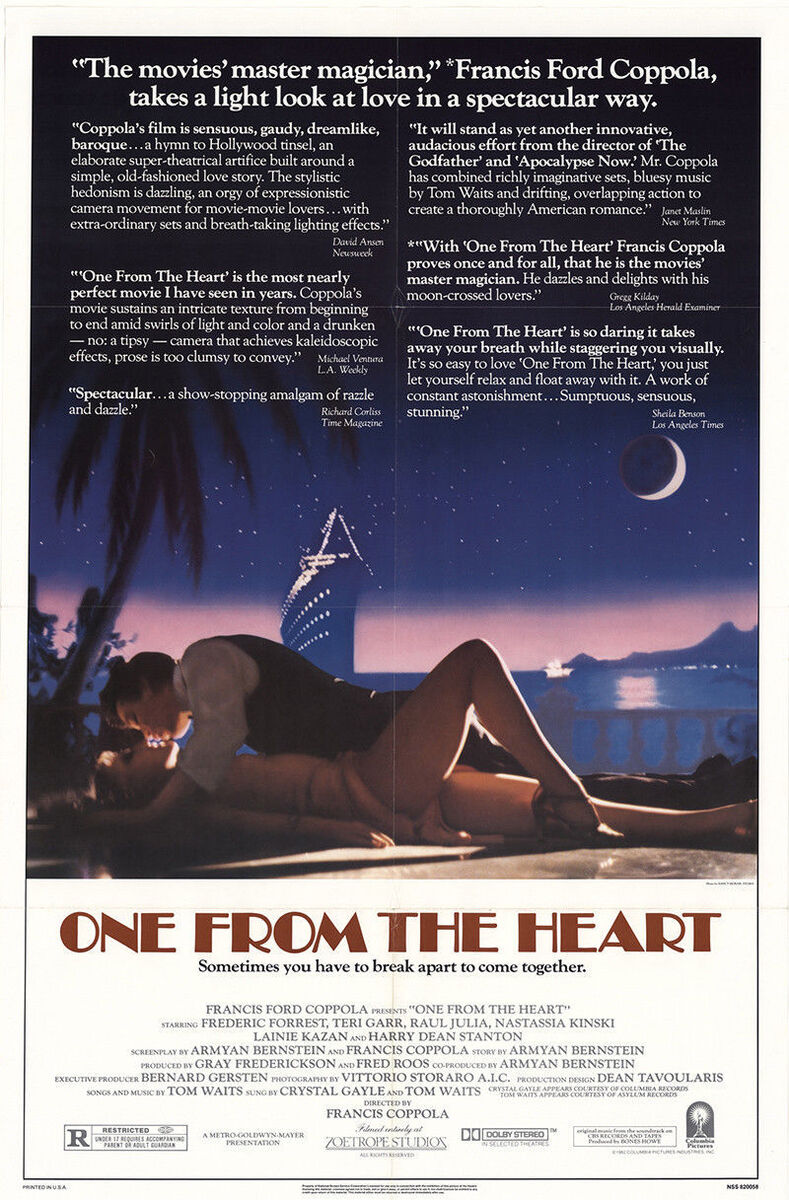
Hank (Frederic Forrest) and Frannie (Teri Garr) have been together for 5-years but while celebrating their anniversary at home the cracks in their relationship begin to show. Frannie is upset that they can never go out and wants more adventure. Hank doesn’t see this as a problem, so the two break up. Frannie meets Ray (Raul Julia) a waiter who has ambitions to become a singer. Hank gets together with Leila (Nastassja Kinski) who is much younger than him and lives the fast lifestyle. Each spends a night with their new partner, but end-up longing for their former mates when it’s over. Ray offers to take Frannie to Bora Bora, but will she really board the plane, or will Hank catch-up with her in time and convince her to move back with him?

The movie has a weird look about it and this is mainly because director Francis Ford Coppola decided he wanted to film the entire thing on the soundstage of his Zoetrope studios. This in retrospect seemed absurd as the setting was Las Vegas with one of the most flamboyant downtowns of any city, so if the real thing is already visually arresting why trump it with a fake one that isn’t half as exciting? The artificial presence kills the movie from the very start and what’s worse is that it was so painstakingly expensive to create the set design, which is massive, that it sent Coppola and his studio into bankruptcy of which it took many years to recover and all of it wouldn’t have been necessary if they had just shot it on-location, which would’ve been a thousand times better.

The lighting is one of the more annoying aspects particularly the red light that shines through the couple’s home window making it look like they live in the red-light district of Denmark, or near a police station. The outdoor scenes look as phony as you’d expect including having the night sky shown to have a ‘ceiling’ and the distant mountain vistas appearing as nothing more than a cheap matted on paintings. Everything comes-off as loopy like a great director whose ego got the best of him, and he made a massive artistic overreach for no other purpose then just to see if he could. The music interludes by Crystal Gayle and Tom Waits don’t work either. If a movie is intended to be a musical, as this one kind of is, then each song needs to sound distinct and at least moderately peppy, but here it comes-off like the same droning song that just never ends and adds little to the already goofy set-up.

The characters are poorly fleshed-out and, with the modest exception of Harry Dean Stanton and Elia Kazan, wholly uninteresting. The break-up is the biggest problem as the ‘squabble’ appears to be over nothing more than the fact that Hank didn’t take Frannie out on their anniversary, but to move-out because of something like that seems awfully trite. Normally for relationships/marriages to go really bad there needs to be a lot of anger simmering underneath the surface and this thing at best is just a tiff especially when at the beginning they seemed content with other. To make it realistic there should’ve been clear underlining animosity right away and not go from ‘happy couple’ to break-up with a snap-of-the-finger.

Not sure either if it’s exactly possible to get back together after the other partner has slept with someone else. Granted there could be some exceptions, but most people would consider it an extreme betrayal and unforgivable and certainly not something that they could just conveniently forget about and return back to the ‘happy couple’ that they were. Yes, in this instance they both cheated, but that makes things even worse. Who’s to say you can ever trust the other again? If one tiny disagreement can get each one to suddenly jump in the arms of a perfect stranger what’s to say that won’t get repeated in the future?

Garr, who appears topless in several scenes and even fully naked from the back in one moment, is okay. The supporting cast is also good especially Allen Garfield as Julia’s perturbed boss. I even found Kinski a bit mesmerizing with her singing and the way she was able to balance herself on a big orange ball that used to be the sign for the Spirit of 76 gas stations, but overall the thing is so thinly plotted, with too much emphasis being put on the garish set design, that it can all be summed up as a hopeless experiment gone wrong. Even Coppola has admitted in subsequent interviews that it’s a ‘total mess’, so if the director is warning you that his own movie doesn’t have much going for it, you’d better listen.

My Rating: 2 out of 10

Released: February 11, 1982

Runtime: 1 Hour 39 Minutes

Rated R

Director: Francis Ford Coppola

Studio: Columbia Pictures

Available: DVD, Blu-ray, Amazon Video, YouTube

The Rain People (1969)

By Richard Winters

My Rating: 8 out of 10

4-Word Review: Needing to find herself.

Natalie (Shirley Knight) wakes up one day and decides to simply get in her car and drive off with no particular destination in mind. She has just found out that she is pregnant and not sure if she can or wants to handle the responsibilities that come with it. She leaves a note to her husband (Robert Modica) telling him she needs time away from him to think things through. During her travels she meets Jimmy (James Caan), otherwise known as ‘Killer’, he was a former football player straddled with a brain injury that has now left him mentally handicapped. She also meets Gordon (Robert Duvall) a traffic cop who pulls her over for a speeding ticket. The two eventually start to date, but the more Natalie tries to find herself the more lost she becomes.

The film was for the most part considered an ‘experimental’ one as the subject matter was years ahead of its time. While many road pictures of the day like Easy Rider took the male perspective this one dared to tap into the feminist viewpoint, which up to that point hadn’t been explored as much if at all. I enjoyed how the film questions the whole wife/mother idea, once considered ‘the ultimate destination’ for any woman, but here brings out the complex issues that come with it and how not every woman may want to be trapped by it, or even find contentment in that situation.

What’s even more interesting is that Natalie never really seems to go anywhere. Yes, she does get in a car and starts driving and passes by many picturesque places of rural America along the way, but trying to escape the clutches that she feels holds her back never goes away. Everyone she meets, including Gordon who’s stuck raising a young daughter (Marya Zimmet) that he wasn’t totally prepared for, seem to be in the same predicament as her making it feel like the further she drives away the closer she gets to where she started.

Francis Ford Coppola makes wonderful use of the rain and there are many shots of it particularly in the first half as we see it creating puddles on the road and even streaming down the car windows in close-up. The cloudy, murky weather acted as a nice motif to Natalie’s inner emotional state and the confusion that she was going through. The film’s promotional poster seen above is excellent too and brings out the moodiness of the movie with one perfect shot although seeing the couple kissing in the backdrop is a bit misleading as that’s one thing you definitely don’t see here despite Natalie’s efforts to try and find it. The two people should’ve, in order to be consistent with the theme of the film it was promoting, been seen standing side-by-side instead of hugging.

I also really loved Coppola’s use of flashbacks here, which gets sprinkled in throughout. I liked the scenes showing the couple in happier times during their wedding as it illustrates how relationships that go bad or don’t work out still had their good moments even if they were brief. The flashbacks dealing with Duvall trying to save his family from a burning house are quite revealing too as what he describes verbally through voice-over is quite different from what we see.

Leonard Maltin, in his review of the film, called the script ‘weak’, which I completely disagree with. Yes, not a lot happens, the random situations that Natalie goes through perfectly reflect what could happen to anyone on a trip, which I liked because the plausibility here is never compromised. She ends her journey feeling as lost as she did when she started, but I felt that was the whole point, so in my opinion the script is strong.

George Lucas, who worked as an aide on this production, filmed a 32-minute documentary of this movie as it was being made called Filmmaker, which is accessible on YouTube although the sound quality is poor. This film has several revealing moments including conflicts that director Coppola had with Knight, but what I found most interesting is that when the crew traveled down to Chattanooga they all cut their hair and shaved their beards,which included Coppola himself, as they felt the locales wouldn’t work with them unless they appeared clean-cut. Seeing Coppola with a rare non-beard look alone makes this short film vignette worth catching.

My Rating: 8 out of 10

Released: August 27, 1968

Runtime: 1 Hour 41 Minutes

Rated R

Director: Francis Ford Coppola

Studio: Warner Brothers

Available: DVD-R (Warner Archive), Amazon Video, YouTube

THX 1138 (1971)

thx-1138

By Richard Winters

My Rating: 9 out of 10

4-Word Review: Sex is not allowed.

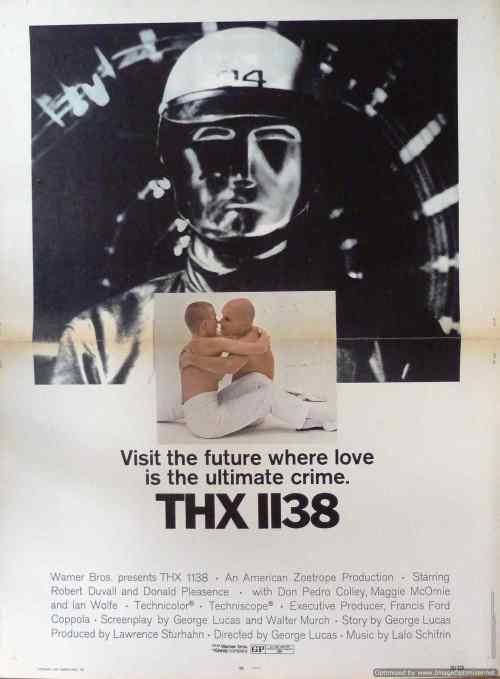
THX 1138 (Robert Duvall) is member of a futuristic, work camp-like society where everyone has shaved heads, forced to take drugs to control their emotions and avoid having sex, which is forbidden. His days are spent on the production line where he helps build police androids and at night he goes home to an apartment where he rooms with LUH 3417 (Maggie McOmie). She is unhappy with her situation and stops taking the required drugs while replacing THX’s with placebos. The two begin a sexual affair and are promptly arrested. THX is thrown into a modernistic prison that has no walls or bars and he eventually decides to attempt a daring escape with the help of SEN 5241 (Donald Pleasence) and a hologram known as SRT 9 (Don Pedro Colley).

This story is an extension to the student film that director George Lucas made while attending the University of California film school. That film was a 15 minute short entitled Electronic Labyrinth: THX 1138 4EB, which dealt with a man trying to escape from a futuristic world while being chased and monitored by government run computers. It won first place in the 1968 National Student Film Festival and was good enough to gain the attention of Francis Ford Coppola who offered to produce a feature film dealing with the same basic premise, but having more of a background to the character and his reason for escaping.

Reportedly Lucas considers this to be his favorite project and despite the fact that it did not do well at the box office I consider it to be his best stuff as well. The visuals are imaginative and striking and make you feel like you are entering a whole new world unlike any that had ever been created before. I especially liked the prison scenes where the characters are surrounded by nothing but an unending white as well as THX’s medical examination done exclusively by robotic arms. Having the characters framed towards the side of the screen instead of the center while action occurs just out of view helps accentuate the off-kilter vibe and was year’s ahead-of-its-time.

Even though there is very little dialogue or music the sound becomes an integral part of the film by relying on comments made by the androids who tell the people in a HAL-like tone to ‘stay calm’ as well as the state sanctioned god known as OHM who routinely advises his followers ‘to be happy’. The best part though comes when two techs have a casual a conversation while viewing through monitors the torture of THX.

The film is visually groundbreaking and one of the greatest directorial debuts of any director living or dead, but it still comes with a few caveats. One is the fact that the plot relies too heavily on the stereotypical Orwellian view of the future where everything is worse than it is today and people no longer have any individual rights. Yet technology has proven to make life increasingly easier for people and with more freedoms and options, so why would everything suddenly revert the other way? Maybe they were survivors of a nuclear holocaust and this society was humankind’s way of ‘starting over’, but that’s never made clear and it would’ve been nice to at least get a glimpse of the person, or people who were behind-the-scenes with the ultimate authority as well as some sort of backstory.

There is also the fact that everyone in this society needs to be working, but jobs today are increasingly being lost to automation every year and that trend will continue. Certain nations like Finland are already experimenting with paying their citizens a basic salary because there are more people than jobs available.  Citizens of future societies are predicted to have more free time than ever before, so why doesn’t the world in this film follow suit? If this society can build android cops why can’t they also build robots to do the all the other jobs too, which would then allow the humans to have more of an idyllic existence than a workaholic one?

I also wasn’t too crazy about the 2004 digital restoration, which added new special effects and footage. I last saw this film in 2001 and could tell right away that this version had been tampered with. I realize that Lucas has been known to do this with his Star Wars films, but to me it’s as bad as colorization. Why mess with something that is already good? The added computer effects does not ‘enhance’ anything, but instead desecrates the original vision and treats it like it were a video game than a movie.

My Rating: 9 out of 10

Released: March 11, 1971

Runtime: 1Hour 28Minutes

Rated R

Director: George Lucas

Studio:  Warner Brothers

Available: DVD, Blu-ray, Amazon Instant Video, YouTube