Tag Archives: Entertainment

The Only Game in Town (1970)

only game in town 1

By Richard Winters

My Rating: 7 out of 10

4-Word Review: A Vegas love story.

Fran (Elizabeth Taylor) is an aging Las Vegas showgirl living alone in a two-bit hotel room while awaiting the return of her lover (Charles Braswell) who has disappeared yet again while he goes off to his wife that he consistently promises he will eventually divorce. In her loneliness she decides to go out to a piano bar and order a pizza. It is there that she meets Joe (Warren Beatty) and the two quickly hit-it-off while also spending the night together. Joe has a gambling problem, but promises that the minute he saves up $5,000 he’ll be out of Vegas for good. He moves into her hotel room where she helps him save up the necessary dough to achieve his dreams even though with his gambling addiction he will fritter it all away the moment he gets his hands on it. Then Fran’s long lost lover returns and ready for marriage. Will she go back with him, or stay with the self-destructive Joe that she has despite her better judgement fallen in love with?

The script by Frank D. Gilroy is based on his stage play and it’s not particularly rich in character development or plot. In fact the play itself fared poorly when it ran on Broadway and had only 16 performances before being shut down. However, despite its lack of originality I still found myself enjoying it and a major reason for this is the casting.

Taylor shines in a role that didn’t seem to be a particularly good fit for her. She spent the latter part of her career playing bitchy old dames that always seemed one step away from the sanitarium or a nervous breakdown. Here her character merits some sympathy and her usual overacting is actually entertaining and helps propel the flimsy plot along. The pairing of her with Beatty is an odd one, but then again the relationship is supposed to be awkward, so it ends up working to the script’s advantage.

Beatty’s performance is equally impressive. Normally he specializes at playing characters that are cool, calm and in control, but here he portrays one that is quietly crumbling and manages to pull it off to complete perfection. The scenes of him at the craps table and compulsively blowing all of his hard-earned money away is genuinely difficult to watch, especially since real cash gets used, and one of the most effective looks at the gambling addiction that I’ve seen.

This also marks the last film to be directed by the legendary George Stevens. He was known for helming some epic Hollywood productions, so it is a bit surprising that he choose to do this one since the storyline and setting were far more constrained from what he was used to working with. In fact the majority of it was shot in Paris, France and not Las Vegas, which many critics at the time felt was a detriment, but to me it made it even more fascinating to watch because of it. For one thing the crew did spend 10 days in Vegas shooting some of the outdoor shots, so you still get some legitimate Sin City scenery regardless. What I enjoyed though was the way Stevens was able to camouflage the rest of the scenes including having the bright daytime light seeping through the hotel room windows, which convincingly looked like the natural sunlight reflecting off of the sandy desert landscape. The recreation of the giant Las Vegas grocery store was impressive as well and strangely one of my favorite moments from the movie.

If you enjoy quirky love stories particularly between characters who are painfully human and less than glamorous you may enjoy this film better than most. It’s also a terrific chance to see two very fine actors playing against type and doing so in splendid fashion.

My Rating: 7 out of 10

Released: January 21, 1970

Runtime: 1Hour 53Minutes

Rated M

Director: George Stevens

Studio: 20th Century Fox

Available: Blu-ray

Heatwave (1982)

heatwave 1

By Richard Winters

My Rating: 8 out of 10

4-Word Review: Fighting to save homes.

Stephen (Richard Moir) is an English architect employed by Robert (Bill Hunter) to construct a massive high-rise building in downtown Sydney that will be financed by Peter (Chris Haywood). However, the construction will require the demolition of several row houses and the eviction of those living in them. Kate (Judy Davis) takes up the cause by protesting the development and along with Mary Ford (Carole Skinner) are able to get a temporary block on the building project by getting the local builder’s union to instill a green ban. Stephen tries to fight this by attending the group’s meetings and airing out his side of the issue, but in the process finds himself more and more sympathetic to the residence especially when he finds out that Peter isn’t a completely honorable businessman and has no plans to use Stephen’s building design at all. When Mary mysteriously disappears he joins forces with Kate to try and find her only to unearth even more troubling and dark revelations along the way.

This film is based on a true-life incident and one of two movies made about it with the other one being The Killing of Angel Street, which will be reviewed here next month. The real-life event centers on Juanita Nielsen (1937-1975) who took up the anti-development cause when it was found that her home was pegged to be demolished in order to make way for three high-rise buildings in the Victoria Street neighborhood of Sydney. Her efforts managed to delay the project for three years, but the developer eventually became impatient and hired men to harass the residents who were trying to stop it and in the process kidnapped Nielsen even though her body has never been found and no one has ever been convicted of her murder.

The film here depicts Nielsen through the fictional character of Mary Ford, but what surprised me was that Ford is not the central person. Instead we only see her briefly at the beginning before she disappears and is generally forgotten while writer/director Phillip Noyce adds other fictional characters and story lines around her, which wasn’t as interesting as the actual case and I’m not sure why they didn’t just stick with the facts.

However, this still a highly intriguing thoroughly riveting plot that keeps you on the edge of your seat from the beginning. Part of what I liked about it is the way it shows things from the different perspective of the various characters while bringing out the myriad of complexities where nothing is black-and-white and no one is completely right or completely wrong. The viewer gets torn about whose side to be on, but fascinated with each new rapid-fire twist that comes about.

There are definite shades of L’Avventura here where a main character disappears and is essentially forgotten until it seems almost like she had never existed in the first place. The script offers no easy answers and instead shows in vivid and almost brutal detail how taxing and frustrating fighting for social change can be and the hopelessness one feels when they realize that all of their efforts may have made little or no difference.

My Rating: 8 out of 10

Released: March 8, 1982

Runtime: 1Hour 32Minutes

Rated R

Director: Phillip Noyce

Studio: Roadshow Film Distributors

Available: VHS, DVD (PAL, Region 0)

Lawman (1971)


lawman

By Richard Winters

My Rating: 5 out of 10

4-Word Review: He does not compromise.

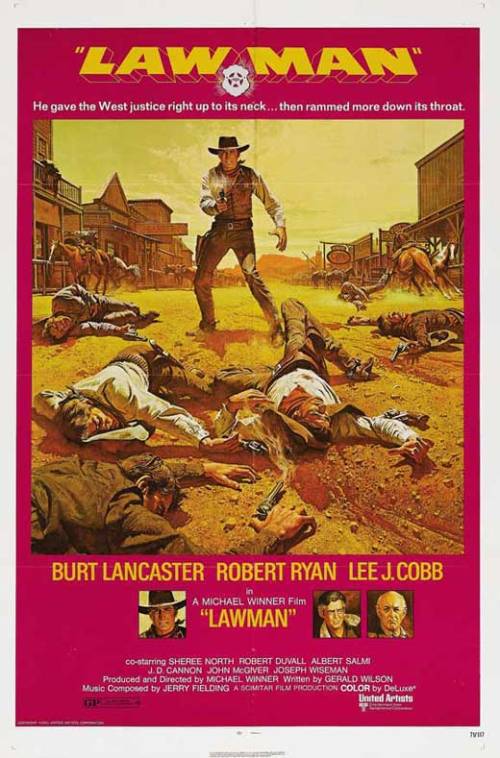
Aging western marshal Jarrod Maddox (Burt Lancaster) rides into the town of Sabbath determined to retrieve five ranchers whose drunken revelry the year before resulted in the death of one of his town’s older citizens. The marshal of Sabbath (Robert Ryan) is reluctant to help Maddox while informing him that the town is ruled by land baron Vincent Bronson (Lee J. Cobb) with a judicial system that is less than stellar. However, Maddox refuses to compromise on any issue no matter what odds or obstacles lay in the way.

During the ‘70s there was a trend to reinvent the western by instilling storylines that did not go along with the age-old, black-and-white formula while questioning the cowboy heroes of yesteryear and putting a grittier slant to the realism. Typically these newer westerns proved to be a refreshing change-of-pace and more in-tune with a hipper generation, which I normally would applaud, but in this rare case I wished that it had fallen back to the old ways.

For one thing Lancaster was still identified with the older film-goer and not in tune with the younger ones. His stiff and detached manner was a better fit to the film’s rigid character and quite frankly I was just plain intrigued to see how this man was somehow going to get all of these other men back to his town to stand trial when everyone else was entrenched to stop him.

Director Michael Winner however decides to switch gears on it and in an apparent attempt to make it more ‘relevant’ to the modern viewer slows the pace down to an almost screeching halt by implementing long-winded conversations and containing the action to only brief interludes while having an initially strong-willed character turn weak and indecisive. To me it was like slashing a tire and watching the air slowly drain out of it. The showdown at the end is anti-climactic and any potential tension is lost by a talky script and a bad guy (Cobb) who is dull and benign. The supporting cast of old pros is the only thing that saves it and I enjoyed the way each of them one-by-one got caught in bed with a prostitute at the town’s local whorehouse throughout the course of the film.

The Maddox character does indeed become an interesting enigma and even going against his supposedly upstanding nature by not only stealing two horses out of a nearby ranch when his is shot dead, but also at one point shooting an unarmed man in the back. Maybe this was the filmmakers attempt to show that western heroes where really human like the rest of us and full of the same contradictions, which could’ve elicited more discussion had the script been tighter.

This also marks the film debut of Richard Jordan a gifted character actor who died much too young, but managed to make some memorable movie appearances along the way. Here he portrays an young gunslinger attempting to stand up to Maddox, but unable to and at one point displays a cut on his face that looks more like a red leech stuck to his cheekbone.

My Rating: 5 out of 10

Released: August 4, 1971

Runtime: 1Hour 39Minutes

Rated R

Director: Michael Winner

Studio: United Artists

Available: DVD, Amazon Instant Video, YouTube

Valley Girl (1983)

valley girl

By Richard Winters

My Rating: 4 out of 10

4-Word Review: Like totally, for sure.

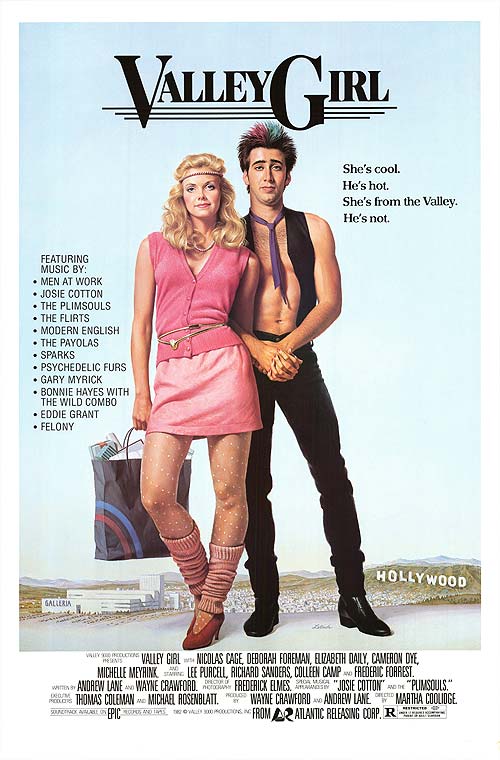
Julie (Deborah Foreman) is a popular teen who is attracted to Randy (Nicholas Cage) who is not a part of her snotty clique. Stacey (Heidi Holicker) and Suzi (Michelle Meyrink) are her friends who want her to go back to dating the two-timing Tommy (Michael Bowen) even though she gets along with Randy far better. Her hippie parents (Frederic Forrest, Colleen Camp) aren’t sure what advice to give her, so she’s forced to choose between her friends and true-love while being threatened with ostracism if she goes out with the ‘wrong guy’.

The film was inspired by the Frank Zappa song, which is far funnier than anything that goes on here. The song had Zappa’s 14-year-old daughter Moon Unit putting on a fake southern California accent and speaking in a valley-speak lingo, which was right on-target. Here though we don’t get any of that. The girls only do the valley-speak thing at the very beginning and then it’s dropped and becomes just a pedestrian story of ordinary teens doing very ordinary teen-like things.

To me a valley girl represented a rich, plastic, entitled teen insulated from real-world issues who charged their Daddy’s credit card like it was a hobby and felt they were ‘too cool’ to work and more concerned with the latest teen fashions than anything else and yet the lead character here doesn’t represent any of this and in fact is the complete opposite.

The cast is also way too old for their roles. Foreman was already 21 and Bowen was 30! In fact none of the lead cast is of the right age range for their characters and making it look much more like college students or even young adults than high school. The party scenes are lame with the kids dancing like zombies moving their bodies in a robotic fashion with no sense or feel to the music or beat. The whole thing lacks hipness and comes off like a mild, sanitized concoction created by middle-aged adults far removed from the teen scene and unable to recreate it in any effective type of way.

Forrest and Camp are mildly amusing as the parents, but aging hippies running some backwoods type health food store probably wouldn’t be able to afford living in the valley let alone getting along with their more elitist neighbors. I was also disappointed that the Lee Purcell character just disappears without any denouncement. She plays Suzie’s very hot-looking mother, and with the possible exception of Foreman is quite easily the best looking member of the cast, who comes-on to one of her daughter’s guy friends (David Ensor) only to later catch the two in bed together, but what should’ve been a funny and lively confrontation and aftermath never gets addressed, which is a letdown.

On a purely romantic level the film could be considered ‘cute’ and the soundtrack has some cool tunes, but the story lacks oomph and fails to take advantage of the true valley girl persona ending up seeming more like just a mild ‘80s update of Gidget instead.

My Rating: 4 out of 10

Released: April 29, 1983

Runtime: 1Hour 39Minutes

Rated R

Director: Martha Coolidge

Studio: Atlantic Releasing Corporation

Available: DVD

Le Mans (1971)

le mans 1

By Richard Winters

My Rating: 6 out of 10

4-Word Review: Car race of endurance.

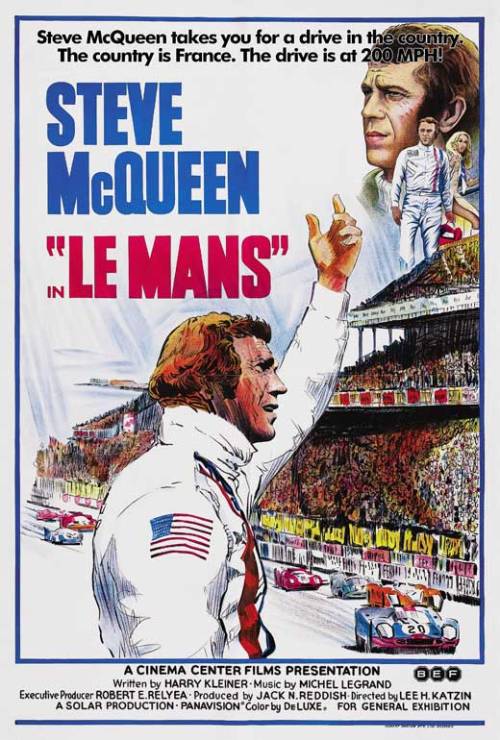
Le Mans is a car race held annually in France in which the test is to show not only how fast the vehicle is, but also its reliability as cars are forced to drive for 24 straight hours with a minimum of pit stops. Michael Delaney (Steve McQueen) is the driver who represents the American team and who is under a great deal of duress because of the fact that he caused an accident that killed another driver just a year before.

The film’s first thirty minutes may be its most captivating and has been described by many fans as being their favorite part of the movie. I loved seeing the empty stands fill up with people as it gives the viewer an authentic race day feeling. Every little facet of the race gets captured almost like it is a documentary with the emphasis more on ambience and the adrenaline it creates instead of a story and in fact no one utters a single line of dialogue until almost 40 minutes in. Watching the cars whizz by with the camera set directly on the pavement just inches away was enough to make me flinch and the wipeouts are particularly graphic and up close.

The film has very little of a backstory to the characters and one gets propelled into the race without much distinction between the various drivers, or even any emotional stake for who wins. Normally I’d say this is a good thing because the dramatic elements in these types of films can get overly drawn out and soap opera-like, but it also makes it a rather detached experience like watching a football game with no concern for either team, or the outcome. The drama that does get played out is boring with dialogue that is only on a conversational level. It also gets confusing as to which driver is in the lead and the constant shots of loud cars speeding by eventually becomes tedious.

Things manage to recover by the end with an exciting finish between three of the race’s drivers that even features a very dramatic tire blow-out. Unfortunately the middle half bogs it down so much that by the time it gets there you feel pretty worn out already. It also wastes the acting talents of McQueen. Granted I was impressed that he did his own driving, but the script doesn’t give him enough to do outside of that.

The film was known for its troubled production in which John Sturges the film’s original director left after being unable to deal with McQueen’s constant meddling and replaced with Lee H. Katzin. Katzin was mainly known for doing TV-Movies and I honestly don’t think had the skill to create the movie’s impressive visual style. I believe it was McQueen’s presence that forged that and I almost feel he should’ve been credited ultimately as the being the director, or at least co-director. The irony is that McQueen ended up not receiving any salary for his work here, or even a percentage of the profits and in fact refused to even attend the film’s premiere.

My Rating: 6 out of 10

Released: June 23, 1971

Runtime: 1Hour 46Minutes

Rated G

Director: Lee H. Katzin

Studio: National General Pictures

Available: DVD, Blu-ray

The Music Lovers (1971)

music lovers 1

By Richard Winters

My Rating: 6 out of 10

4-Word Review: Madness has no bounds.

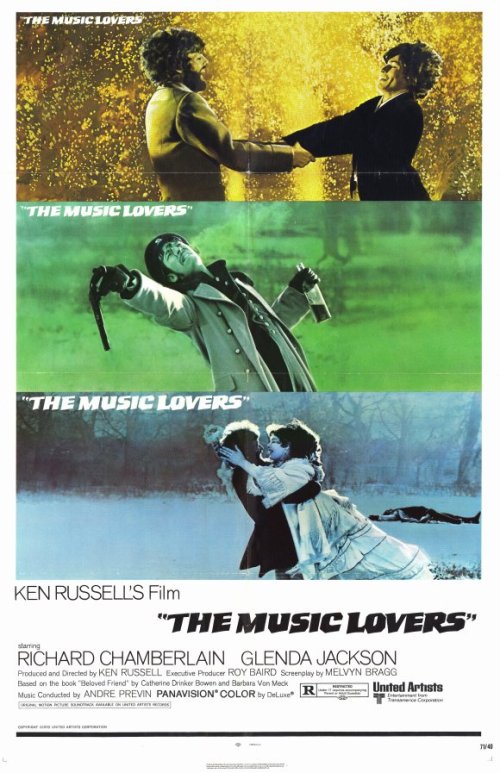
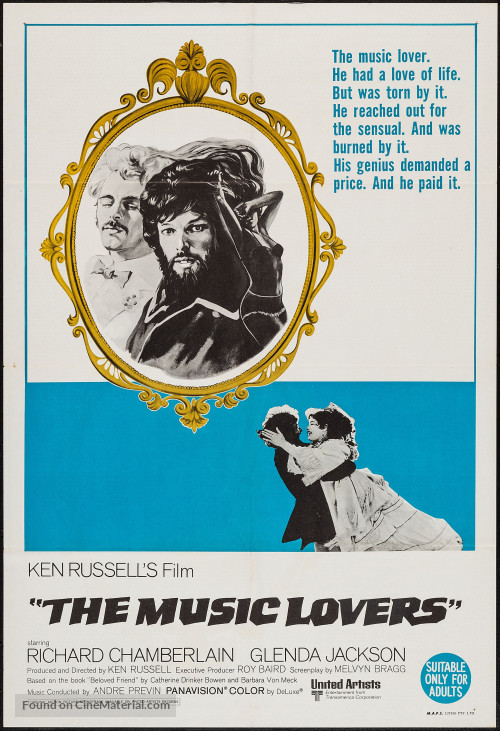
This is a revealing look at Russian composer Pyotr Ilyich Tchaikovsky (Richard Chamberlain) and based on his own personal correspondences as he fought his homosexual tendencies by marrying Nina (Glenda Jackson) a woman he really did not love. Her nymphomania becomes something he cannot satisfy and he eventually abandons her where they then both go on to suffer their own personal forms of madness.

Pianists and composers were like what rock stars are today and I liked how director Ken Russell handles the concert sequence by infusing in the thoughts of the people as they listen to the music and therefore allowing the viewer to visualize the experience of a concert goer.

The scenes with Nina in the asylum are a good example of the grotesque imagery, but they are also well orchestrated and quite memorable. However at times it also gets overdone and unintentionally comical especially the sequence involving Chamberlain’s ill-fated attempt at lovemaking to Jackson on a shadowy, bouncing train car.

Russell shows no feeling for the subject and seems more interested in using it only as an excuse to show off his flashy style. The viewer is never allowed to get emotionally attached to the characters as we are only given a fragment of what these people were like and never the whole picture. The emphasis seems exclusively on their dark and self-destructive sides and watching their descent into madness is not very inspiring or insightful.

The casting of Chamberlain was a poor choice as the guy seems to have a very limited acting range. He is good looking, but lacks the charisma and his facial expressions rarely change while he shifts badly from underplaying the part to overplaying it.

Jackson fares far better and this could be considered a real find for her fans because she plays a type of character that she has never done before, or since. Usually she plays strong willed people, but here her character is weak allows herself to be dominated and exploited shamelessly even by her own mother while also taking part in a very provocative nude scene.

Overall if you like Russell’s style then you will enjoy it more than others. Otherwise it comes off as shallow, moody, and fragmented with some real slow spots during the middle half.

music lovers 2

My Rating: 6 out of 10

Released: January 24, 1971

Runtime: 2Hours 4Minutes

Rated R

Director: Ken Russell

Studio: United Artists

Available: DVD, Amazon Instant Video

Money Movers (1979)

money movers 2

By Richard Winters

My Rating: 8 out of 10

4-Word Review: Employees become the thieves.

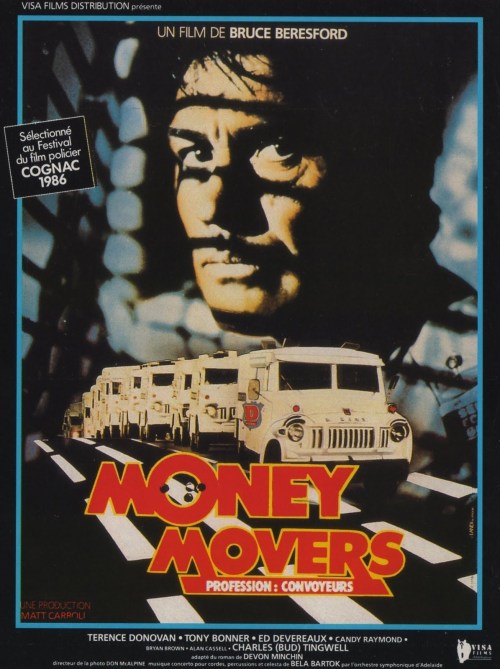
Lionel Darcy (Frank Wilson) runs an Australian armored truck business that transports payroll funds from one location to the other. After there is a robbery to one of his trucks he tries to increase security measures in order to prevent another one from occurring unaware that his own employees, with help of a local crime boss (Charles ‘Bud’ Tingwell) are planning an even bigger attack and everyone, even the police detective hired in to investigate the first crime, are in on it in one or the other.

The film is based on a novel by Devon Minchin, who worked as head of security for The Beatles when they were on tour in Australia and also owned at one time Australia’s largest armored car security company. The story itself is based on two real-life robberies that occurred in Sydney during the summer of 1970.

To me what stands out most about this film is how everyone, with the sole exception of Darcy, is thoroughly corrupt. There is no ‘good-guy’ in this movie, but instead of that being a turn-off it becomes almost like a running-joke where the viewer waits to find out what dark vice each new character will reveal to have. Fortunately they and their vices remain strangely engaging and this is mainly because none of them are portrayed as being inertly ‘evil’, but instead people sucked into an already screwed-up system and simply trying to make a living and doing it in the only way they know how.

Ed Devereaux , who plays a retired cop named Dick Martin, becomes the film’s reluctant protagonist although his presence gets refreshingly underplayed while having him look worn, aged and genuinely overwhelmed yet still remaining dedicated to his cause and ultimately managing to put a monkey wrench into the proceedings. Darcy, the only other non-corrupt character, is equally engaging albeit in an unconventional way as his utter cluelessness as just how criminally overrun his own company is, is a perfect comical testament to how many business owners and CEOs are thoroughly detached from the companies they run and the people they supposedly control.

The violence is graphic and impactful and one of the most memorable elements of the movie particularly during the final shootout that occurs inside the garage of the armor car company. There is none of this staged nonsense where the men have ‘manly’ fistfights that always get coupled with that annoying smacking sound-effect. Instead it gets captured in quick, ugly ways where the men desperately do whatever ugly tactic they can to stop the other one. The action is stark and unglamorous while given a bestial quality like starving animals fighting over a last piece of meat that leaves the viewer feeling like they’ve just witnessed an actual crime as it happened.

The film’s beginning is admittedly confusing and there should’ve been some backstory given before it jumps right away into the crime that features a dizzying array of shootings and double-crossings before the viewer is even able to figure out who is who. Yet after this awkward first part it manages to settle down while becoming a rapid-paced, in-your-face crime thriller that has proven to be highly influential and years-ahead-of-its-time.

money movers 1

My Rating: 8 out of 10

Released: February 1, 1979

Runtime: 1Hour 32Minutes

Rated R

Director: Bruce Beresford

Studio: Roadshow Film Distributors

Available: VHS, Amazon Instant Video 

It Rained All Night the Day I Left (1980)

it rained all night 1

By Richard Winters

My Rating: 2 out of 10

4-Word Review: Stuck in the desert.

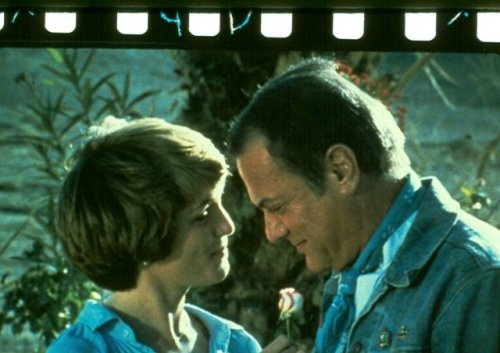
Robert and Leo (Tony Curtis, Louis Gossett Jr.) are two losers working as gun runners who transport their goods in an old beat-up VW that looks to be seriously on its last leg. They meet up with The Colonel (Sally Kellerman) who is the widow of an actual Colonel that fought during WW II. She is now living alone with her nineteen year-old daughter Suzanna (Lisa Langlois) in an isolated ranch in the middle of the African desert. She hires Robert and Leo to help her oversee the water that she pumps to a nearby village. Since she feels that the members of this village had something to do with her late husband’s murder she has cut off their supply to it and only lets them have access to it at certain times of the day, which the two men feel is harsh. They do some investigating on their own and believe that it is neighboring rancher Killian (John Vernon) who is the real culprit to the murder, but trying to convince The Colonel of this, who has a romantic interest in Kilian, is another matter completely.

This obscure, low budget film is pretty much a botched mess from the get-go. Too much emphasis is put on comedy, but filmed by people who have no idea what is funny which forces the actors to carry-on with broadly written banter and insipid slapstick-like scenarios that is intended to be humorous, but falls resoundingly flat instead. The story and setting has some potential, but resorts to contrived, uninspired romance that becomes completely boring.

I’ll give Kellerman credit for lasting over six decades in the business, but her acting never seems to be effective. Her character is supposed to be a domineering, tough-as-nails lady, or at least that is how she is introduced as she even insists that the men refer to her as ‘sir’, but this quickly evaporates until she becomes just another aging, lonely female looking for love and companionship, which isn’t compelling, or original. Langlois as the daughter is equally transparent while delivering her lines as if she were half asleep. Why an attractive young lady such as herself would ever fall for a struggling 55-year-old man like the one Curtis plays here makes little sense and is pretty dumb.

The film is saved to a minor degree by the presence of Curtis. He was a top billed star during the ‘50s and 60s, but by the ‘80s his career had plummeted severely to the point that he was accepting minor, supporting roles in direct-to-video fare that next to no one saw. This film isn’t much better than those, but here at least he retains his engaging persona and helps lift the dead material to a somewhat tolerable level and his pairing with Gossett is odd enough to make it semi-intriguing.

This is a sad, almost embarrassing follow-up project for director Nicolas Gessner who had achieved critical acclaim with the Jodie Foster hit The Little Girl Who Lives Down the Lane. Why he would choose this oddball thing to tackle next is a mystery as I’m sure he must’ve been offered better scripts, but in either case it’s a misfire that never manages to click at all.

My Rating: 2 out of 10

Released: August 6, 1980

Runtime: 1Hour 24Minutes

Not Rated

Director: Nicolas Gessner

Studio: Gaumont

Available: None at this time.

Flashdance (1983)

flashdance 2

By Richard Winters

My Rating: 6 out of 10

4-Word Review: Dancing is her passion.

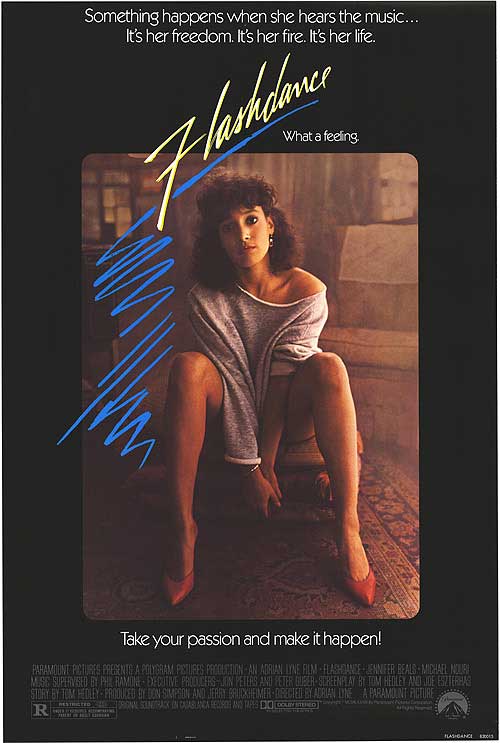
Alex Owens (Jennifer Beals) is a young lady of 19 who works as a welder during the day, but moonlights as an exotic dancer by night. She dreams of one day joining the dance institute and train to work in the professional ballet, but when she goes to their admissions desk they demand that she show some proof of prior training, which she doesn’t have and this is enough to intimidate her from applying at all.  She eventually starts up a relationship with Nick (Michael Nouri) who is the owner of the factory where she works. He uses his money and influence to pull-some-strings at the dance conservatory so that she’ll be able to get an audition, but she resents his help and threatens to not only pull out of their relationship because of it, but her audition as well.

The film is loosely based on the real-life story of Maureen Marder and the plot is relatable to anyone who dreams of one day rising above their humble beginnings, which is what makes the film interesting. Beals does well in the title role and has a very appealing face, but I was surprised how little dancing there actually was. Out of the whole runtime there are only three dance routines that the Beal character does, which was a shame as the routines are well staged, have a lot of energy and creativity and the most unique part about the film while its contrived romantic angle is  a complete bore.

The Alex character has issues as well as she comes off as too much of a mish-mash of different extremes making her more like a caricature than a real person. I realize human beings can be a bag of contradictions, but this character takes it too far. The biggest one is when she goes every week to confession even though she doesn’t behave at all like she is a religious person in any other way. I would think a devoutly Catholic individual wouldn’t feel as relaxed about getting on stage and gyrating her body let alone stripping off her clothes the minute she brings her new boyfriend back to her place, going to bed with him on their first date and even aggressively flirting with him at a restaurant.  In either case the confession scene was unnecessary because all it does is have the character verbally explain what the viewer has already been able to pick-up on visually.

The character is also highly volatile in ways that could easily get her pegged as being a borderline psycho these days. First she throws a rock through her boyfriend’s window when she thinks he is seeing another woman, then she jumps out of a moving car in the middle of a tunnel that could’ve caused a major traffic accident and then tops it all off by rushing onstage to drag her friend Jeanie (Sunny Johnson) off at a strip club and then callously throwing the dollars that Jeanie had earned into a puddle of water all because she consider herself to be a ‘good friend’, which brings up another point; why does this character consider stripping to be so ‘sleazy’ while being an exotic dancer is ‘respectable’? Granted she doesn’t take her clothes off as an exotic dancer, but the outfits she wears are quite revealing and the dance numbers are so sexually tinged that in my opinion there wasn’t that much of a difference.

I was also surprised how the male characters at her factory job seemed to treat her as being ‘just-one-of-the-guys’ as this was a highly attractive single woman making me believe that a lot of the guys would be hitting on her besides just the owner. I would also expect that she would be sexually harassed at the work place by some of them since she spends her evenings playing into their fantasies with her sexy dancing and the fact that the film fails to tackle this subject even briefly makes it poorly thought-out.

Overall though I found it to be an enjoyable watch and I think this was mainly due to Adrian Lyne’s direction and his use of lighting that made each shot seem like a visual design and his ability to photograph the grimy, steel mill setting in a way that made it seem artsy and evocative as well as the film’s rousing dance number at the end that despite its cheesy nature is still inspiring and fun.

My Rating: 6 out of 10

Released: April 15, 1983

Runtime: 1Hour 34Minutes

Rated R

Director: Adrian Lyne

Studio: Paramount

Available: DVD, Blu-ray, Amazon Instant Video, YouTube

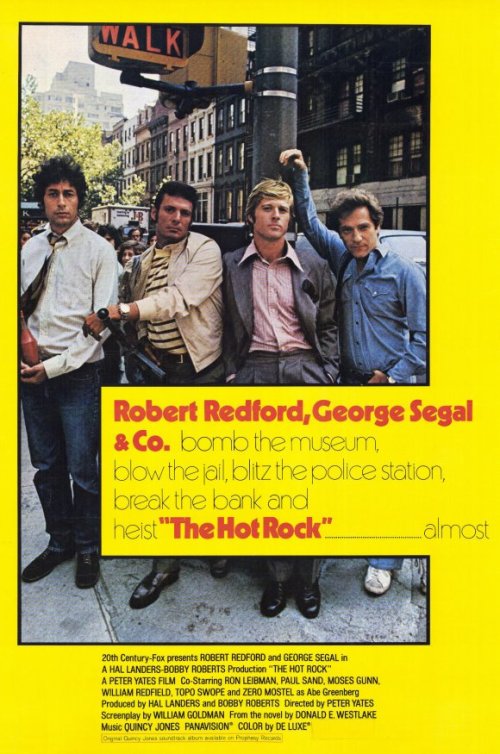
The Hot Rock (1972)

hot rock

By Richard Winters

My Rating: 6 out of 10

4-Word Review: Stealing back stolen gem.

Having just been released from prison Dortmunder (Robert Redford) has no intention of ever going back because if he does it will be life, but even so he still can’t help but get caught up with the enticing offer that his brother-in-law Kelp (George Segal) has planned. The idea is to steal a valuable jewel from a New York museum where Dr. Amusa (Moses Gunn) will pay top dollar for what he believes was stolen from his African ancestors during colonial times. He even offers to help fund the mission and everything goes well until Greenberg (Paul Sand), who is one of the men on Dortmunder’s team, gets caught with the diamond and forced to swallow it. He then hides it inside the police station after he was forced to relieve himself. Now sitting in prison he promises the others he’ll show them where it is, but only if they agree to break him out of jail, which they do only to find further complications involving Greenberg’s dubious, double-crossing father (Zero Mostel).

Based on a Donald E. Westlake novel this film has all the trappings of being a fun, breezy outing and for the most part it is. The actors are game and Redford gives a surprisingly strong performance and maybe one of the best of his career while the supporting cast fall into their roles perfectly especially Mostel who easily steals it from the rest despite having only limited screen time. Director Peter Yates nicely paces the material although the set-up could’ve been more extended as the film spends only a few minutes on the planning phase and then jumps jarringly right into the actual crime making me feel more scenes of the preparation were filmed and then excised for possible shorter runtime purposes.

Spoiler Alert!

The actual crime is where the film falls apart as it starts getting a little too creative for its own good by incorporating too many offbeat touches that it can’t logically get its characters out of without going overboard into the implausible. The first issue comes when Dortmunder and Kelp try to break into prison in order to break Greenberg out of it. To me it just seemed too easy and they routinely open up prison doors that should certainly sendoff loud alarms almost immediately, but strangely don’t. I also couldn’t believe that Dortmunder would ever break into a place he so dearly wanted to stay out of. One misstep and he’d be stuck there for the rest of his life, so why even take the chance?

Later we learn, after they manage to get Greenberg out, that he has hidden the diamond inside the police station, which involves them flying a helicopter onto the roof of the police building, cutting off the power and phones lines and then releasing smoke bombs in order to get the officers out, which they do only to find that someone else has already gotten to the diamond, which was hidden inside the grimy sewage pipes. Later they find that it was Greenberg’s father, but how could some old man have been able to get to it when it took these four men a lot of effort just to get into the building?

The biggest implausibility though and the one that ‘jumped-the-shark’ for me is when, in an attempt to retrieve the diamond which Greenberg’s father has hidden in his safety deposit box in the bank that only he can access, they have a hypnotist hypnotize one of the bank employees, so that all Dortmunder needs to do is say a magic word and the bank employee will open up the father’s box for him.

I’ve tried hypnotism in the past and I can assure you that there is no way that someone can put anyone else into a trance-like state like they do here. It just doesn’t work that way a person’s conscious state doesn’t shut off nor can they be ‘tricked’ to do something against their will or that they are not aware of. If it was so easy to manipulate people in this way then we’d have robberies all over the world committed like this, but we don’t.

It also brings out more questions than answers like how were they able to get this woman to help put this bank employee into a trance? Did they offer her a part of the cut in order to keep her quiet and how would they know that they could trust her to begin with?

End of Spoiler Alert!

I really wanted to like this movie and the production is slick with a nice jazz score by Quincy Jones and a thrilling look at New York’s skyline from a helicopter, but the numerous plot holes became too much to overlook and ultimately made the story impossible to believe at all.

hot rock 3

My Rating: 6 out of 10

Released: January 26, 1972

Runtime: 1Hour 40Minutes

Rated GP

Director: Peter Yates

Studio: 20th Century Fox

Available: DVD