Tag Archives: Drama

The Gypsy Moths (1969)

gypsy

By Richard Winters

My Rating: 4 out of 10

4-Word Review: Skydivers travel to Kansas.

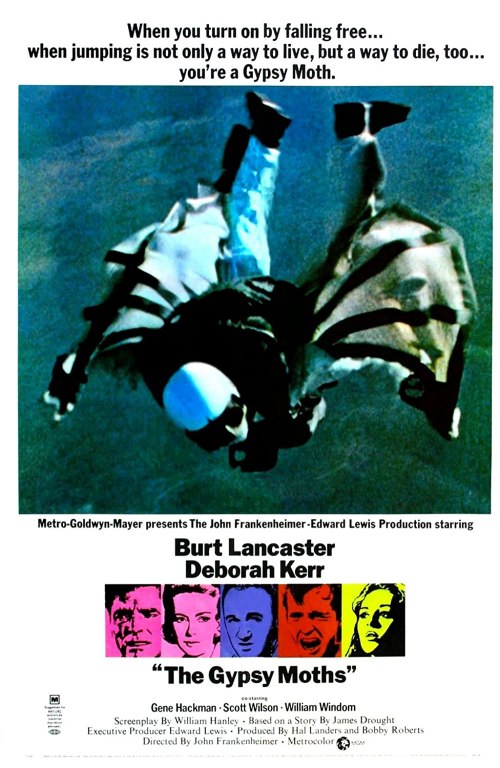
Three skydivers, who make a living going around the country doing airshows for the public, stop off at a small Kansas town on a fourth of July weekend that ends up changing all of their lives. Mike Rettig (Burt Lancaster) is the eldest and the leader of the group. He seems unhappy and suffering from some inner turmoil that he is reluctant to elaborate on.  He ends up having an affair with one of the attractive middle-aged women in town named Elizabeth Brandon (Deborah Kerr).  Joe Browdy (Gene Hackman) is restless and impatient and has a fling with the town stripper (Sheree North).  Malcolm Webson (Scott Wilson) is the introspective member of the trio.  He grew up in the town that they are in and uses the visit as a way to reconcile with his demons from the past.

MGM was hoping for a big hit with this one as it reteamed Lancaster and Kerr 16 years after their famous embrace in From Here to Eternity. The film broke ground as it was the first to feature an established and respected actress who was nearly 50 years of age doing a nude scene. Kerr, who looked great both with her clothes on and off, can be seen fully nude from the front and back during a lovemaking scene with Lancaster.  Yet the film failed to gel with the public.

There were some things that I did like. One is the fact that it was filmed on location in Kansas. The opening shots capturing the countryside of the Midwest really gives a strong visual sense of Americana.  The scenes taking place in the neighborhoods of the small town give the film an added dimension that a studio back-lot just couldn’t do.  The skydiving sequences, which take up the majority of the time, are breathtaking and exciting. The aerial photography makes you feel like you are right there jumping out of the plane and free falling into the air.

The basic plot though is dull and uninteresting.  The characters and situations are contrived and derivative.  It is almost like the story was a second thought to the stunt work and put in merely as filler. I also didn’t like the pretentious quality of the production that made it seem like it was making some sort of profound statement when in reality it was nothing more than second rate soap opera.  The whole thing would have worked better had they skipped the story and made it into a documentary on skydiving instead.

Spoiler Alert!

The most frustrating thing about the movie is the fact that the Mike character dies at the end when he decides, for no apparent reason, not to open his chute and goes, literally, splat on the ground right in front of a throng of spectators. I actually thought this was one of Lancaster’s better later career performances and I was intrigued as to what was causing his character’s inner-strife, but the film offers us no clue, or hint.  I thought there should have been a backstory and even some flashbacks. The ambiguity leaves the viewer cold and unsatisfied and makes the film seem incomplete.

The only possible explanation may come through researching actual Gypsy moths and then correlating the species to the characters. Per Wikipedia, the female gypsy moth is unable to fly. This would then explain why Elizabeth refused to run off with Mike despite her unhappy marriage simply because she could not ‘spread her wings’.  The adult male moth always dies in July, which would then explain Mike’s death. No reason for his demise was needed because his life cycle was ending regardless. July is also the time when the moth lays her eggs, which would explain why Joe and Malcolm, who were much younger than Mike, decided to go off on their own separate ways at the end.

End of Spoiler Alert!

I  ended up finding more misses than hits with this one and can’t help but label it as a misfire.

My Rating: 4 out of 10

Released: August 28, 1969

Runtime: 1Hour 47Minutes

Rated R

Director: John Frankenheimer

Studio: MGM

Available: VHS, DVD

The Fury (1978)

By Richard Winters

My Rating: 5 out of 10

4-Word Review: Blow up the body.

Another Brian De Palma/Hitchcock wannabe, this one involving a sinister secret government agent named Ben Childress (John Cassavetes) who wants to use the amazing psychic abilities of a young college-aged man named Robin Sandza (Andrew Stevens) for his own nefarious purposes. While he is in Israel with the father and son he decides to stage a terrorist attack, which he hopes will kill the boy’s father Peter (Kirk Douglas) and allow him to whisk Robin away to an underground research lab where no one will find him. However, Peter manages to survive the attack and goes on a relentless pursuit to find his son. This occurs while a young woman named Gillian Bellaver (Amy Irving) with equally strong parapsychological traits starts to have visions of Robin and his whereabouts while attending a school that specializes in people with these abilities and eventually she teams up with Peter to help him in his quest.

I liked the opening sequence being shot on-location in Israel, which gives the film an exotic feel. The attack is well-handled and comes as a surprise without any set-up, but I felt there was a fatal flaw with the premise. This is namely the fact that with Robin’s amazing psychic abilities you would think he could figure out that his Dad was still alive and be able to find him while also outsmarting the people who are holding him.

The secret agency thing and what they are using him for is vague and we see only a few scenes with him there. I felt this should have been more detailed and less time spent with Gillian at the psychic school, which is not very compelling and rather draggy.     There are a few good action moments, but unfortunately they come at the beginning and end with a talky middle that lacks any real suspense.

However, Peter’s escape from some gunmen by jumping out of an apartment window and onto the ‘L’ tracks along Wabash Avenue in Chicago is amazingly well shot and nerve-wracking.  A scene where Robin tortures a female Dr. (Fiona Lewis) by using his telepathic powers to spin her around a room until  blood oozes from her body and sprays all over the walls and furniture deserves some merits, but I wished it had been more extended. There is also the exploding body that is the film’s final shot and possibly its best and it is shown several times at different angles. I also enjoyed the darkly humorous scene where Robin uses his powers to send a ride at an indoor amusement park out of control and throwing the riders through the window of a nearby restaurant.

De Palma’s trademark over-direction is in full gear. Sometimes it works, but other times it is a distraction. For instance he uses a lot of panning shots showing one person talking and then panning to the other person and then back again. During a funny scene where Peter breaks into an older couple’s apartment while looking for a disguise this really works, but De Palma continues to go to this well throughout and eventually it becomes annoying. There is also a foot chase that is done in slow-motion, which to me sapped the tension and excitement right out of it. He does have a few bird’s-eye view shots, which while not adding anything to the story, are still kind of cool.

Andrew Stevens, son of actress Stella Stevens, is well cast as the young man who starts out likable, but slowly becomes evil as the film progresses. Stevens has a good knack for this as he can go from nice to menacing very quickly and I first noticed this during a classic episode of Murder She Wrote. His clear blue eyes can give off a creepy stare as well.

John Cassavetes is an excellent bad guy.  He is best remembered as an independent film director with a unique vision, but with his dark features, cryptic glare, and intense delivery he can also be a very good villain. I don’t think the film made the most of it, but it was astute casting.

Although billed as the star Douglas does not have the most screen-time and there are long periods where he isn’t seen at all. This was really a vehicle for Irving, who is convincing and makes the viewer sympathetic to her quandary of having super-powers that she does not fully understand, cannot control and doesn’t really want.

It’s an interesting idea, but doesn’t go far enough with it. There weren’t enough twists to justify sitting through almost two hours. The pacing is poor and had it been trimmed to 90 minutes it would have worked better. The special effects are decent, but there needed to be more of them and they might not hold-up to contemporary standards. John Williams’s orchestral sounding score helps elevate what is really just bubblegum material.

This is a great chance at seeing some young stars in their film debuts including Darryl Hannah, Laura Innes, and James Belushi. There is also an amusing scene featuring Dennis Franz with a full head of hair playing a nervous and befuddled Chicago cop.

My Rating: 5 out of 10

Released: March 10, 1978

Runtime: 1Hour 58Minutes

Rated R

Director: Brian De Palma

Studio: 20th Century Fox

Available: DVD, Amazon Instant Video

A Soldier’s Story (1984)

soldier

By Richard Winters

My Rating: 6 out of 10

4-Word Review: Murder at army base.

This film is based on the off-Broadway play that won the Pulitzer Prize for best drama in 1982 and was written by Charles Fuller. Many of the performers in the play ended up reprising their roles in the film including the stars, Adolph Caesar and Howard E. Rollins, Jr. Director Norman Jewison spent many years trying to get the green light for the project and ended up being rejected by just about every studio. Finally Columbia Pictures gave the go-ahead, but only after Jewison agreed to do it for no salary and all the performers agreed to be paid at the minimum union scale.

The story is actually pretty well written and I’m surprised that so many studio heads refused it by using the excuse that it wasn’t ‘commercial enough.’ The plot involves the murder of a black army sergeant (Caesar) and the subsequent investigation by a black army captain (Rollins) brought in from Washington. The period is around the end of World War II and the setting is an all black army base in the deep South, which leads to many expected racial tensions. What sets this story apart from others of its type is the fact that the racism and underlying tensions is not just white vs. black, but also, and more prominently, black vs. black.

Caesar plays a memorable victim. He is hated by his own men due to his harsh treatment of them. When he is killed everyone is a suspect and as his men recount their dealings with him, it is easy to see why. Yet this is also no one-dimensional character. The story does a very good job of letting us understand why this man has become the way he is. The viewer can’t help but come away feeling sorry for the man and genuinely sad for the way he ended up. The suspects are equally complex, so the film easily becomes quite riveting as it goes along.

Rollins gives an outstanding performance as the head of the investigation. It’s sad that his career, and ultimately his life, was cut short by his drug addiction because he makes a solid impression here. I liked the way he remained stoic throughout despite having to deal with a myriad of different personalities and at times overt racism. Denzel Washington is also very good in a pivotal role.

There were a few things that were thrown in that I felt were not necessary and ended up hurting the film as a whole. One of them is the musical score. It has a very bouncy, ragtime sound to it that would be good if this was a comedy. However, for a drama it seems completely out of place and at times is even jarring. The film has a few musical interludes as well. A couple of them are by Patti LaBelle, who I think is a great singer, but in this film she is out-of-place. It starts to take away too much of the grittiness of the story, which should be the central theme. I also found the use of slow motion to be distracting. It occurs twice. Once during the murder scene and another time during a baseball game between the soldiers.

Overall the film succeeds enough with its story and characters that the viewer is forced to think and feel, which is always a good thing. I can’t say that the resolution was anything shocking, but it does manage to keep you guessing. However, this is one rare case where I might have actually preferred seeing the stage version.

My Rating: 6 out of 10

Released: September 14, 1984

Runtime: 1Hour 41Minutes

Rated PG

Director: Norman Jewison

Studio: Columbia Pictures

Available: DVD, Amazon Instant Video, Netflix Streaming

Dog Day Afternoon (1975)

dog

By Richard Winters

My Rating: 9 out of 10

4-Word Review: Money for sex change.

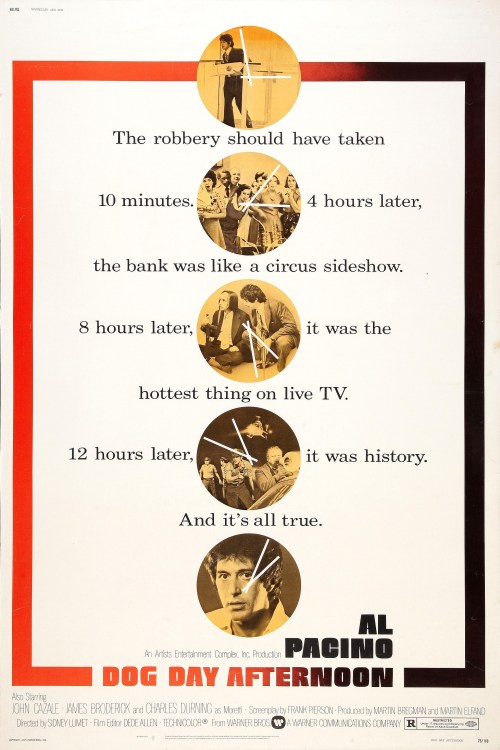
Dog Day Afternoon is a 1975 film based on a true story that took place on August 22, 1972.  It tells the tale of a man by the name of John Wojtowicz, who robbed a Brooklyn bank in order to pay for his gay lover’s sex change operation.  Here the character’s name has been altered slightly to John ‘Sonny’ Wortzik (played by Al Pacino), but otherwise this Oscar-winning script by Frank Pierson pretty much sticks closely to the actual events in this incredible saga about everything that can go wrong will.

Just about everyone who has watched this film will tell you how it manages to grab and pull you in right from the start.  It achieves this without having any special effects, pounding soundtrack, elaborate camera work, or artificial lighting.  Instead of ‘telegraphing all of its punches’ the film draws back and puts more emphasis on the little subtitles like the character’s facial expressions, side conversations, and other nuances that put together make this film very rich and textured.   In essence it successfully ‘shows’ instead of ‘tells’, which is a remarkable achievement since so many Hollywood films seem to want to do the exact opposite.

Director Sidney Lumet allowed for a lot of improvisation by his actors and gave each performer full rein on how to create their character, even the minor supporting ones. The result gives each and every one of the characters a distinct personality. The bank hostages become almost as fascinating as the thieves and it is interesting seeing all the different ways each one responds to the situation and how they interact with the robbers, which at times is both amusing and surprising.

The film also vividly captures 1970’s Brooklyn atmosphere. The sights and sounds of the area as well as the people’s personalities and the anti-establishment sentiment that was still quite prevalent at the time are all right on target.  After you finish watching this movie you feel like you just got back from a trip over there.  I really liked how during the opening credits you are shown all sorts of shots and scenes of Brooklyn, so by the time the story actually begins you are already well entrenched in the setting.

Pacino gives a dynamic performance in the starring role.  Some insist this is the best performance never to be nominated for an Oscar and I might have to agree.  If you are a Pacino fan than you absolutely have to see this, but if you are not a Pacino fan you still should see it because afterwards you might become one.

The supporting cast is stellar.  Sully Boyar, who was a real-life lawyer who did not enter into acting until he was in his 50’s, leaves a strong impression as the stoic bank manager.  As the police captain, the always durable Charles Durning is a blast especially during his frenzied and frantic negotiations with Pacino that almost become the film’s highlight. Another memorable moment is the improvised phone conversation between Sonny and his gay lover played by Chris Sarandon.  John Cazale is also amazing as Pacino’s bank robbing partner.  The partner in the actual incident was only 18 while Cazale was then 39, which created some controversy. However, Cazale is so convincing in the part that it is hard to imagine anyone else doing it as well.

In the end the film’s brilliance comes from its ability to convey the humanity of its characters. You can’t help but feel for the Sonny character despite his many flaws.  This a man who craves acceptance and yet goes through life being betrayed and hurt by everyone he meets. The shocked expression he shows at being betrayed by his own hostages, who he felt he had ‘bonded’ with, is, in my opinion, the most memorable shot of the whole film.

I only have two negative comments about this film and they are both minor.  One is the abrupt ending.  Since the film was made only a few years after the incident there wasn’t much of an epilogue to the characters.  The real John Wojtowicz, who really did look a lot like Pacino, didn’t end up dying until the year 2006.  It would have been a stronger conclusion by showing what happened to the Sonny character through the years and maybe even how he might of changed or grown.  My only other complaint is the fact that actress Carol Kane appears as one of the bank employees, but is shown very little.  A quirky and unique talent such as hers should have been given a bigger role.

Overall this is a great movie that I would recommend to any serious movie fan who can appreciate great film-making in top form.

My Rating: 9 out of 10

Released: September 21, 1975

Runtime: 2Hours 5Minutes

Rated R

Director: Sidney Lumet

Studio: Warner Brothers

Available: VHS, DVD (2-Disc Special Edition), Blu-ray, HDDVD, Amazon Instant Video

John and Mary (1969)

By Richard Winters

My Rating: 4 out of 10

4-Word Review: Sex and then relationship.

Considered provocative at the time this film detailed the new phenomenon of the one-night-stand, a fad in the late 60’s early 70’s that quickly went out of style upon the release of Looking for Mr Goodbar in 1977.  The story here details a rather nondescript man and woman (played by Dustin Hoffman and Mia Farrow) who meet at a singles bar and then go back to his place for sex.  The rest of the film involves them considering whether it can grow into a relationship.

The first ten minutes are pretty good. It nicely analyzes all the expected awkwardness one must have of waking up the next morning and not sure who you’ve been sleeping with. I liked how the John character secretly goes through Mary’s purse to find out more about her while Mary does the same with his telephone messages. Unfortunately after this segment Director Peter Yates unwisely decided to put in voice overs of their thoughts. This adds nothing to the proceedings and ends up being heavy-handed. It also takes away one of the fundamental points of good film-making, which is learning about characters through subtle visual observation.

The film is also no where near as sophisticated or daring as I think the film-makers would like us to believe. I expected, and would have like, the male character to have been a life-long swinger who has had many of these flings and now suddenly finds himself attracted to this woman and wants to go in a different direction. Instead we get a Hoffman character portrayed as being someone who has never done this before and only does so at the coaxing of his much more liberated friend.  This leads him to act all shy and unsure and coming off like an extension to the character he played in The Graduate. The end result is getting a very boring, bland person who responds to things in all the predicted ways instead of giving us a fresh new perspective by delving into the mind of someone living a lifestyle many of us have not experienced.  I also got a strong feeling that the film-makers had done very little research into this topic, thus giving the viewer no new insight whatsoever.  It ends up coming off like one of those trendy ‘statement movies’, but with no idea of what statement it actually wants to make.

There is no chemistry between Hoffman and Farrow at all.  Nothing is shown that would indicate why these two would want to pursue this thing any further. I actually found the scenes involving the side-story of Farrow’s affair with an older college professor (Michael Tolan) to be more interesting and filled with stronger more snappy dialogue.

In the end this ‘provocative drama’ deteriorates into being an uninspired love story. It concludes with the tired, cliche ridden scene of having John madly driving around the city of New York looking for this mysterious woman who he is convinced he is in love with despite the fact that he still does not know what her name is.  It is easy to see how, in Hoffman’s very distinguished career, why this film remains one of his lesser known efforts.

On the technical side this film is actually well done.  I liked how it inter-cut between the present day and the past as well as analyzing the previous relationships of the two characters. This film also offers a nice chance to see a young Tyne Daly as Farrow’s roommate.  Cleavon Little from Blazing Saddles fame appears briefly as a would-be film director.  Olympia Dukakis  has an amusing, non-speaking bit as Hoffman’s activist Mother.  This also marks the film debut of character actress Marian Mercer.

My Rating: 4 out of 10

Released: December 14, 1969

Runtime: 1Hour 32Minutes

Rated PG

Director: Peter Yates

Studio: 20th Century Fox

Available: VHS, DVD

Lipstick (1976)

By Richard Winters

My Rating: 3 out of 10

4-Word Review: Don’t get her angry.

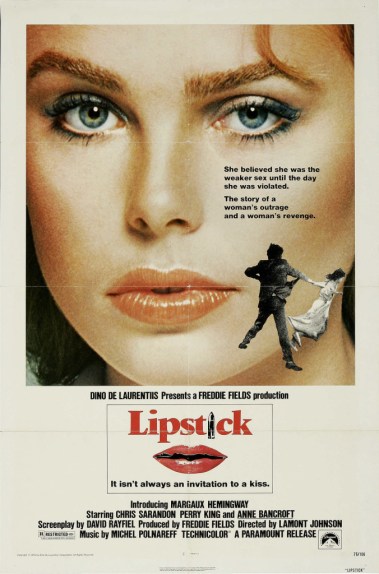
During the mid-70’s, Margaux Hemingway, granddaughter of the legendary author Ernest Hemingway, was one of the most photographed and highest paid models in the business, in fact she was the very first model ever to be awarded a million dollar contract.  After appearing on the June, 1975 cover of Time magazine she caught the eye of famous Hollywood producer Dino De Laurentiis who thought he could turn her into a star. The idea was to prove that she wasn’t just another pretty face by casting her in the difficult and challenging role of a rape victim, which they hoped would affirm her as a ‘serious’ actress. The gamble failed and she appeared in only a few more B-pictures even though her kid sister Mariel, who was cast in the film by Marguax’s suggestion, ended up having her career take off. Alcoholism and depression followed before she eventually committed suicide in 1996 at the age of only 42.

The story is basically just another tired exercise in the now cluttered rape and revenge genre. Chris McCormick (Marguax) is a beautiful lipstick model who is brutally victimized by a weirdo named Gordon Stuart (Chris Sarandon). She is dragged through the long and arduous court proceedings only to have him found not guilty and then start to stalk her younger sister (Mariel), which forces her to take matters into her own hands.

Right from the beginning this film comes off as very clumsy dramatically. Gordon is the high school music teacher of her younger sister Kathy. Chris is introduced to him at one of her photo shoots, but is too busy to listen to his music tapes, so she gives him her home address and tells him to ‘stop by anytime’.  Now, back in the 70’s people may have been a little less cautious than they are these days, but giving one’s home address to a man that she barely knows and isn’t interested in just to listen to one of his weird music tapes seems utterly ridiculous.

The rape happens almost right away before there is any character development. It almost seemed like this was the intended leering ‘highlight’ of the film with the rest just thrown in as second-rate filler. Wikipedia describes this scene as being one of the most ‘infamous in film history’.  That may have been the case at the time, but since then there have been many films that have exceeded what you see here, most notably in the controversial French hit Irreversible. Personally, I didn’t find it to be all that extreme. The one good thing I could say about it is that Sarandon is effectively menacing. I also liked the way his character is initially shown to be very meek and geeky and his inner-rage only comes out after he feels he has been slighted, which I felt made him a little less one-dimensional.

The courtroom scenes fall flat. Normally I find a good court drama to be riveting, but here it is stagy, phony, and uneven. The best thing about this segment is the presence of Anne Bancroft as Chris’s attorney Carla Bondi. She helps give the picture some stature and I wished she could have been in more of it.

If the film comes together at any point it is after the assailant is found innocent and Chris is forced to try to move on with her life and career despite the emotional toil and stigma. This segment has a certain socially relevant drama quality and to an extent it works even though it is brief. It also conveys some rather alarming statistics including the fact that only 10, 000 out of an estimated 50,000 rape cases every year actually ever get reported and only 2 out of 100 rapists ever get convicted. Since the credits list experts in the field that were consulted I can only assume that these numbers were accurate. Things may have hopefully improved since then, but the figures still seemed startling. However, all of this gets undermined by a tacked-on, manufactured, over-the-top, Rambo-like finale that relies too much on extreme coincidence and severely stretches the credibility.

I also found the film’s visual style to be unappealing. The colors are garish and gaudy while captured through a soft focus lens that resembles a model shoot in a glamour magazine and gives one a glossy trash perception.

I can see why Mariel made a strong impression with viewers. Her testimony on the stand is both touching and heart-wrenching and her emotionalism seems genuine and gripping. Marguax does not fare as well. Although her performance improves as the film progresses I still felt she was in way over her head and her nasal sounding voice is a bit irritating.

Although this film was pretty much panned by critics and audiences alike upon its initial release there is a new generation of people who feel it is underrated as evidenced by the many positive comments about it at IMDB. I approached this with an open-mind, but couldn’t help but come away from it feeling it was exploitation from beginning to end and even at that level it seemed derivative and uninspired. The whole thing left me cold and feeling like I wasted 90 minutes.

My Rating 3 out of 10

Released: April 2, 1976

Runtime: 1Hour 29Minutes

Rated R (Rape, Violence, Mature Theme, Language)

Director: Lamont Johnson

Studio: Paramount

Available: DVD, Amazon Instant Video

Where It’s At (1969)

where1

By Richard Winters

My Rating: 2 out of 10

4-Word Review: Father and son argue.

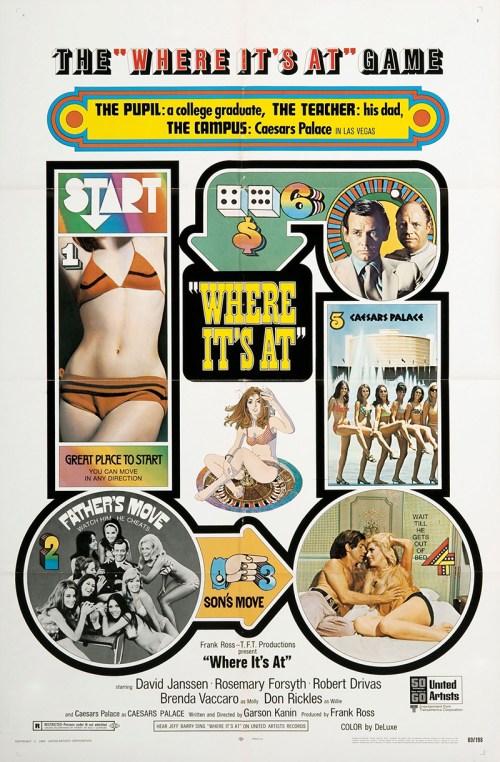
Garson Kanin, best know for penning such comedies as Adam’s Rib (1949), The Girl Can’t Help It (1954), and Born Yesterday (1950), tries his hand at drama here.  David Janssen plays a Las Vegas Casino owner who tries to train his son (Robert Drivas) in the business, so he can take over.  The father is a hard-bitten realist while the son, who has just graduated from college, is a strong idealist.

One of the main problems with this film is that there is nothing distinctive about it.  The arguments between the father and son are  typical stuff. The same topics were argued between ‘Meathead’ and Archie in ‘All in the Family’, but at least there they were funny.  Despite Kanin’s reputation, and despite what some sources list, this film is definitely not a comedy.  There are a few amusing bits by Brenda Vaccaro, who plays Janssen’s secretary and easily steals the film, but that is it.  The rest is  by-the-numbers drama that gets played out in a methodical way.

Despite the Las Vegas setting the sets are dull looking and unimaginative. The opening theme song by Jerry Ball is terrible and the characters unappealing.  I could never get myself involved in the story and kept checking my watch the whole time.

I was interested in seeing this film simply for the presence of Janssen.  I am a big fan of the old ‘The Fugitive’ TV series and was impressed with his work on it.  This film certainly does prove that he can act as his character here is the exact opposite of the Richard Kimble one on the TV show.  There he was always mild-mannered and self-effacing.  Here he is obnoxious and abrasive.  Unfortunately the character stays too one-dimensional in a negative way.  There is never any soft side revealed and thus causing the viewer to be uninterested in seeing what happens to him.

Robert Drivas as the son is another talented and interesting actor whose life and career was sadly cut short by AIDS in 1986.  He had some memorable performances in various TV-shows including ‘The Wild Wild West’ as well as in the movies The Illustrated Man (1969) and Joseph Strickland’s independent classic Road Movie (1974). However, his best ability was in conveying a dark brooding side to his characters, which doesn’t work here.  You never believe for an instant that the character is all that innocent, or honorable because the dark elements start coming out from the beginning.

Don Rickles appears briefly as a card dealer who starts stealing from the house.  When he is caught he breaks down into a long crying spell before he is demoted to a full-time dish washing job until he can pay the money back.  Rickles as a comedian is funny, but as a serious actor he is limited.  Yet it was still fun seeing him play such a wimpy and passive person because it goes completely against his persona.  The film might have been stronger had there been a few more scenes with him.

The film does have a bit of an interesting twist towards the end where the son decides to turn the tables on his father and takes advantage of one of his father’s shady deals by purchasing the casino from under him and then throwing the old man out on the street.  This of course shocks the father and forces him to reevaluate his values as well as what he has taught his son. This might have been more intriguing had the exact same theme not been done so much better in The Godfather movies as well as Harry Chapin’s classic son ‘Cat’s in the Cradle’.

My Rating: 2 out of 10

Released: May 7, 1969

Runtime: 1Hour 46Minutes

Rated R

Director: Garson Kanin

Studio: United Artists

Available: Amazon Instant Video

Thieves (1977)

By Richard Winters

My Rating: 1 out of 10

4-Word Review: A couple drifting apart.

Sally and Martin Cramer (Marlo Thomas, Charles Grodin) are a middle-aged, married couple whose relationship is slowly drifting apart.  They were once connected through their youth and idealism, but now Martin is older and more cynical. He just wants to settle down and live the quiet life as he feels ‘the world is not worth saving’. Sally is still the idealist, she teaches at an inner-city school and even wants to adopt a young African-American boy, which Martin does not want because of the boy’s propensity to steal things. Sally is also pregnant and considering an abortion. The film consists mainly with them arguing about these issues while considering divorce and having affairs.

The film did not go over well with the critics at the time of its release and I was surprised because it was written by renowned playwright Herb Gardner.  I was impressed with Gardner’s talents after seeing the film A Thousand Clowns, which was based on one of his plays. I enjoyed his offbeat characters and situations as well as the sharp one-liners.  I was expecting more of the same here, but found this to be flat and slow going. The idea of having a couple argue almost endlessly for the entire movie can be tough to pull off, but has been successfully done. Most notably in Made for Each Other starring real-life husband and wife Joseph Bologna and Renee Taylor as well as Can She Bake a Cherry Pie?. However, in both of those films the characters were eccentric and interesting and their fights were lively and animated.  Here the characters are dull to the point that there is really no reason to care how their marriage turns out, or even what happens to them. Their arguments become almost soap opera like. Yes, some of the dialogue is eloquent and you can tell it was done by a playwright, but there still needed to be more action and cutaways. The overall mood of the film is very downbeat and paints the city of New York and modern life in general as an urban hellhole.  There could be some truth to this, but it ends up becoming real depressing when the viewer gets beaten over the head with it the whole time.

Although billed as a comedy there is very little of it. The majority is heavy drama and the comedy that they do have comes off as forced, unimaginative, and heavily reliant on stereotypes. For instance Sally makes all her inner-city students put their weapons into a box before they enter her class. I thought it would have been more believable had one of them decided to use them on her, but they never do. Despite the ‘rough and tough’ image the kids seem strangely compliant.  Martin is a principal at a snotty private school, so his problems are at the other end. One scene has him ‘negotiating’ with a spoiled ten year old to come out of his limousine and into class, which is equally contrived.  There is also the strange neighbor who lives in the apartment beneath theirs and is played by actor Hector Elizondo.  He makes random, weird comments throughout that supposedly are used for comic relief, but end becoming quickly irritating.

I thought it would be fun to see Marlo Thomas in a film role as she has done very few of them in her career. She is most well-known for playing the part of Ann Marie the struggling actress in the 60’s TV-series That Girl. Her character was known to be very naïve and proper in that series. Here her character is more jaded and savvy, which makes for an interesting comparison although she is known as a feminist and liberal activist in real-life, so if anything this character more closely identifies with her true personality. She does end up giving an excellent performance overall. Charles Grodin does not fare as well. Usually his sardonic humor and dry approach can elevate even the blandest material, but here the maudlin script ends up pulling him down. Even Grodin fans who have seen this film stated that he seems to be just going through the motions. I also didn’t like the fact that he has a flute and ends up constantly playing the same sad tune. Noted character actors Gary Merrill and Mercedes McCambridge appear as homeless people, but are not given a single line of dialogue, which I found to be frustrating and a waste of their talents.

If there is one positive thing to say about this dreary production that has no visual or cinematic style it is in the presence of Irwin Corey, who plays Sally’s racist and scatological father.  He manages to liven up all the scenes that he is in and I came away impressed as he is mainly a stand-up comedian famous for his bawdy Professor Irwin Corey act. I was even more impressed to find that as of this writing he is still alive and well at the ripe old age of 97 and still doing his comedy act while married to the same woman for over 70 years. A documentary about his life and career called Irwin and Fran is set to be released later this year. Judging just from the trailer it looks more interesting and enjoyable than this film.

My Rating: 1 out of 10

Released: February 11, 1977

Runtime: 1Hour 32Minutes

Rated PG

Director: John Berry

Studio: Paramount

Available: Netflix Streaming